


How to Deal with Chronic Stress: A Practical Guide
The first step in dealing with chronic stress is learning to recognise its subtle, everyday symptoms. It’s about more than just feeling a bit overwhelmed; it's about connecting the dots between those persistent signals—like being constantly tired or irritable—and what’s actually causing them. Once you make that connection, you can start taking action that actually works.
Understanding the Hidden Signs of Chronic Stress
It’s all too easy to write off constant tiredness as just a few bad nights’ sleep, or blame a short temper on a difficult week at work. But when these feelings stick around and become your new normal, they’re often signalling something deeper. Chronic stress isn’t a single, dramatic event. It’s more like a low-level hum of pressure that slowly wears you down, often so quietly you don’t notice until you’re completely running on empty.

Before we get into the ‘how-to’, it’s vital to see how this stress is showing up in your life. This isn't just an exercise; it's about having that 'aha' moment where you see the link between how you feel and the relentless pressures you’re under.
To help with this, I've put together a quick self-check table. It’s designed to help you spot some of the common red flags. Have a look through and see what resonates.
Are You Experiencing Chronic Stress? A Self-Check Guide
Symptom Category | Common Signs to Look For | A Quick Personal Note |
|---|---|---|
Physical Signs | Persistent tension headaches, upset stomach or bloating, unexplained aches (especially in shoulders/jaw), feeling exhausted even after a full night's sleep. | I often hear clients say, "I just thought I was getting old," when really, their body was screaming for a break from stress. Don't ignore these signals. |
Emotional Signs | Feeling irritable or snapping easily, a lingering sense of apathy or hopelessness, finding it hard to enjoy things you used to love, feeling constantly on edge. | This is the one that creeps up on you. You might not realise your baseline mood has shifted until a friend or partner points it out. |
Behavioural Signs | Withdrawing from friends and family, changes in eating habits (eating more or less), difficulty concentrating or making decisions, relying on alcohol or other substances to unwind. | Cancelling plans can feel like self-care, but when it becomes a pattern, it's often a sign that the energy required for socialising is just too much to muster. |
This isn't an exhaustive list, of course, but it’s a solid starting point. Seeing your own experiences reflected here can be the first real step toward making a change.
The Physical Toll of Constant Alertness
Your body often keeps the score long before your mind is ready to admit there's a problem. When your system is perpetually stuck in 'fight or flight' mode, physical symptoms can pop up that you might not immediately connect to stress.
Think of it as leaving a car engine running 24/7. Sooner or later, parts are going to start wearing out. These physical signs are your body’s dashboard warning lights, begging you to pay attention.
Persistent Headaches: I’m not talking about the occasional migraine, but those dull, constant tension headaches that sit in your temples or at the base of your skull.
Digestive Upset: Chronic stress can really mess with your gut, leading to things like bloating, cramps, or just a general 'unsettled' feeling.
Unexplained Aches and Pains: This could be tight shoulders, a sore jaw from clenching your teeth at night, or general muscle stiffness that has no obvious cause.
Constant Fatigue: This is a bone-deep weariness that sleep just doesn’t seem to touch. You wake up feeling just as tired as when you went to bed.
Emotional and Behavioural Shifts to Notice
Beyond the physical side of things, chronic stress has a huge impact on your mood and how you act. You might find your personality changing in ways that feel unsettling or just not you. Often, these are the signs that people around you notice first, even if you haven’t seen them yourself. For many, this slow chipping away at your emotional resilience can lead to complete exhaustion, which is why it's so important to understand the key signs of emotional burnout to stop things from getting worse.
And it’s a massive issue, particularly when it comes to work. In the UK, data from the Health and Safety Executive showed that 776,000 workers suffered from work-related stress, depression, or anxiety. That staggering figure accounted for 46% of all work-related ill health cases, which really highlights how deeply this stuff affects us.
Chronic stress rewires your reactions. Things that once felt manageable can suddenly feel monumental, and your capacity for patience and joy can feel significantly diminished.
Recognising these shifts is the first step toward getting back in the driver's seat:
Irritability and Mood Swings: Find yourself snapping at loved ones over small things? Feel a constant frustration bubbling just under the surface?
Apathy or Hopelessness: A classic sign is losing interest in hobbies you used to love. You might feel a lingering sense of dread or a belief that things won’t get better.
Social Withdrawal: When you’re chronically stressed, being around people can feel like a huge effort. You might start cancelling plans, ignoring messages, and just wanting to be alone.
Changes in Appetite: This can go either way. Some people turn to food for comfort, while others lose their appetite completely when they're under serious pressure.
By honestly looking at which of these signs are showing up for you, you can begin to build a clear picture of your personal stress response. This self-awareness is what makes the strategies that follow so much more powerful, because they can be targeted to what you actually need.
Your First-Aid Kit for Overwhelming Moments
Knowing the signs of chronic stress is one thing, but what happens when it all feels too much, right now? When your heart starts hammering and your thoughts are racing a mile a minute, you need something that works immediately. Think of this as your practical, in-the-moment first-aid kit.
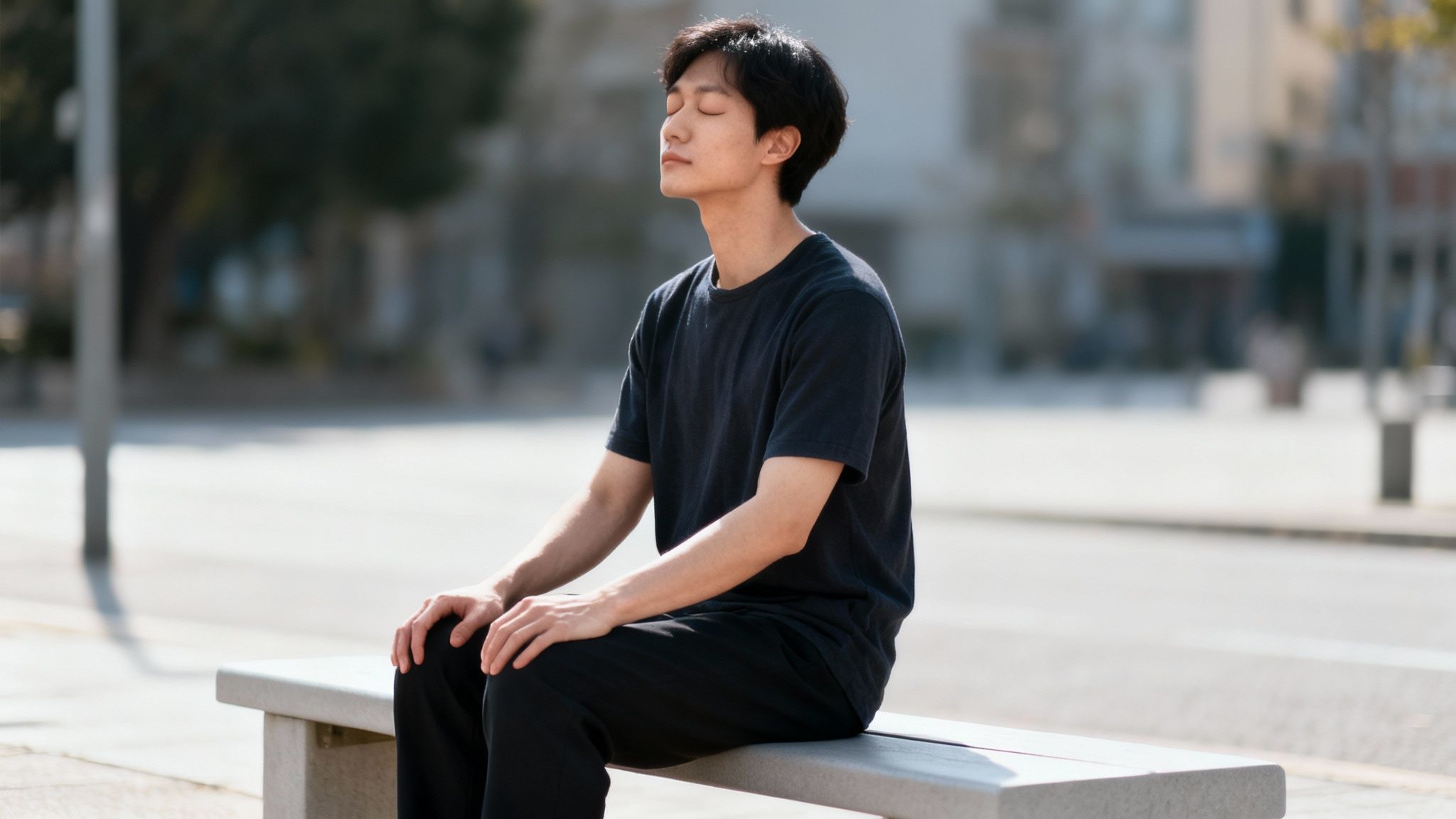
These aren’t complicated theories you need to memorise. They're simple, tangible actions you can take to anchor yourself when you feel like you're drifting out to sea. The whole point is to give you back a sense of control just when you feel you’ve lost it.
Ground Yourself Using Your Senses
When your mind is spiralling, one of the most powerful things you can do is drag your focus back to the physical world. It’s a technique called grounding, and it works by interrupting that runaway stress response, forcing your brain to pay attention to the here and now instead of worrying about what’s next.
A brilliantly simple way to do this is the 5-4-3-2-1 technique. You just walk through your senses, one by one.
5 things you can see: Look around and name five objects. Don't just glance. Really look at the colour of your mug, the texture of the wall, or the shape of a leaf outside.
4 things you can feel: Bring your awareness to physical sensations. It could be the solidness of your feet on the floor, the feel of your chair supporting your back, or the fabric of your sleeve against your skin.
3 things you can hear: Tune in and pick out three distinct sounds. Maybe it’s the hum of your computer, the birds outside, or even just the sound of your own breathing.
2 things you can smell: Try to identify two different scents. It could be the faint smell of coffee in the air or rain on the pavement.
1 thing you can taste: Focus on one taste. This might be the last sip of tea you had, or simply the neutral taste in your own mouth.
This simple exercise yanks you out of your head and plants you firmly back in your body. It’s a discreet and surprisingly effective tool to have up your sleeve.
Take Control with Your Breath
Your breath is one of the most direct lines you have to your body's stress response. When we're stressed, our breathing gets shallow and quick without us even noticing. By consciously slowing it down, you send a powerful signal to your nervous system that the threat has passed and it’s safe to calm down.
The 4-7-8 breathing technique is a fantastic way to do this.
It’s easy:
Breathe in quietly through your nose for a count of four.
Hold that breath for a count of seven.
Exhale fully through your mouth, making a gentle 'whoosh' sound, for a count of eight.
Just repeat this cycle three or four times.
This isn't just a relaxation trick; it's pure physiology. That longer exhale stimulates the vagus nerve, which in turn activates the part of your nervous system responsible for 'rest and digest'. It physically lowers your heart rate.
Techniques like these are especially useful when you're hit with a sudden wave of intense anxiety. They are foundational skills, and you can build on them by reading our guide on effective coping strategies for panic attacks. Getting a handle on these in-the-moment tools gives you a crucial sense of agency when you're navigating chronic stress.
Building a Resilient Lifestyle Day by Day
Dealing with chronic stress isn't about finding some magical quick fix. It's about slowly, deliberately building a solid foundation that supports your mental and physical health for the long haul. Think of it less like a frantic sprint and more like steady training for a marathon. The small, consistent choices you make every single day are what gradually build your resilience.

This long-term approach really centres on three core pillars: sleep, nutrition, and movement. By making small, genuinely achievable adjustments in these areas, you create a powerful buffer against the constant wear and tear of stress.
Prioritising Restorative Sleep
When you're chronically stressed, your nervous system is often stuck on high alert, which can make a decent night's sleep feel like an impossible dream. This creates a nasty cycle: lack of sleep makes you more vulnerable to stress, and stress then ruins your sleep. Breaking this pattern is absolutely essential.
A huge part of building resilience is getting proper rest. It's well worth delving deeper into understanding and enhancing sleep quality to start reclaiming your nights. A good starting point is focusing on 'sleep hygiene'—basically, the habits and environment that set you up for better rest.
Stick to a Routine: Try to go to bed and wake up around the same time each day. Yes, even on weekends. This really helps to regulate your body's internal clock.
Create a Wind-Down Ritual: About an hour before bed, switch off the screens. The blue light can mess with melatonin, the hormone that signals sleep. Read a book, listen to some calming music, or have a warm, caffeine-free drink instead.
Optimise Your Bedroom: Make sure your room is dark, quiet, and cool. Blackout curtains or an eye mask can make a surprising difference.
Remember, the goal isn't a perfect eight hours every single night. That's just more pressure you don't need. It’s about creating the best possible conditions for your body to rest and repair, giving it the resources to manage stress more effectively.
Fuelling Your Body to Fight Stress
What you eat has a direct impact on your mood and your body's ability to cope with pressure. It's so tempting to reach for sugary, processed foods for a quick comfort hit when you're stressed out, but they often lead to energy crashes and can actually make feelings of anxiety worse.
Instead, try to think of nutrition as another tool in your stress-management kit. A balanced diet, rich in certain nutrients, can properly support your nervous system and keep your energy levels stable.
Just a few simple shifts can have a big effect:
Focus on Whole Foods: Prioritise fruits, vegetables, lean proteins, and whole grains. These provide a steady release of energy, helping you avoid the sharp spikes and dips that come from sugary snacks.
Include Magnesium-Rich Foods: Magnesium is brilliant for calming the nervous system. You'll find it in leafy greens like spinach, as well as nuts, seeds, and even a bit of dark chocolate.
Limit Caffeine and Alcohol: While that morning coffee might feel non-negotiable, too much caffeine can amplify feelings of anxiety. In the same way, alcohol can disrupt your sleep patterns, robbing you of the restorative rest you desperately need.
Making these small changes isn't about deprivation. It's about consciously fuelling your body with what it needs to function at its best, especially when it's under strain.
The Power of Gentle Movement
When you're feeling completely drained by stress, the idea of a high-intensity workout is probably the last thing on your mind. The good news is that gentle, consistent movement can be incredibly effective at reducing stress hormones like cortisol and boosting mood-lifting endorphins.
The key is finding something you can actually stick with because you find it accessible and maybe even enjoyable. A simple daily walk is a brilliant place to start. It requires no special equipment and gets you out into the fresh air, which has its own well-documented mental health benefits.
Here in Cheltenham, we're surrounded by beautiful green spaces, which makes a unique approach like walk and talk therapy especially powerful. This combines the benefits of traditional counselling with gentle physical activity and the calming influence of nature. For many men, walking side-by-side can feel less intense and confrontational than sitting opposite a therapist in a room, making it easier to open up. You can discover more about the mental health benefits of nature and how it can become a part of your journey.
Whether it’s a stroll through Pittville Park, a gentle yoga class, or just dancing around your kitchen to a favourite song, the aim is to move your body in a way that feels restorative, not punishing. By weaving these daily habits into your life, you build a resilient foundation, one day at a time.
Mastering Your Mind with Cognitive Strategies
Chronic stress isn’t just about what’s happening to you; it’s profoundly shaped by how you interpret it all. The internal monologue we have running in our heads can either pour fuel on the fire of anxiety or help to dampen the flames. This is where we can borrow some powerful, practical tools inspired by Cognitive Behavioural Therapy (CBT) to start changing our relationship with stress from the inside out.
The goal here isn't to somehow stop having negative thoughts. That's impossible. Instead, it’s about becoming more aware of the automatic thought patterns that keep you feeling stuck. By learning to catch, challenge, and ultimately change these thoughts, you reclaim a huge amount of control over how you feel.
Catching Your Negative Thoughts
The first, and most crucial, step is simply to notice. Many of our most stressful thoughts are so deeply ingrained they fly completely under the radar. They feel less like opinions and more like indisputable facts.
Think of it as a constant background commentary. Your boss gives you some constructive feedback, and your mind immediately jumps to, "That's it, I'm going to get sacked." A friend doesn't text back for a few hours, and you're already convinced, "I must have really upset them." These are what we call negative automatic thoughts (NATs), and they pop up without us even trying.
To start catching them in the act, try these simple exercises:
Pause and Ask: The moment you feel that familiar spike of stress or anxiety, just stop. Ask yourself, "What was just going through my mind?"
Keep a Thought Record: For a few days, just jot down stressful moments and the thoughts that came with them. No judgement, no trying to fix them yet. You're just being an observer.
This isn't about blaming yourself for having these thoughts. It's about shining a light on them so they no longer have unchecked power over you.
Challenging and Reframing Your Thinking
Once you get better at spotting these thoughts, the next move is to question them. Are they really 100% true? So often, we accept our initial, stress-fuelled interpretations without a second glance. It’s time to put them on the stand.
Let’s take a thought like, "I've completely messed up that presentation; my career is over." Now, we challenge it with a bit of curiosity:
Where's the evidence? Did anyone actually say you messed up? Or is that just your interpretation? Was the entire presentation a disaster, or were there some good bits, too?
Is there another way of looking at this? Could it be that it wasn't your best work, but it's a chance to learn? Is it possible no one else even noticed the mistake you're fixating on?
What's a more balanced thought? Instead of the catastrophic "my career is over," a more realistic reframe might be, "I'm disappointed with that one part of the presentation, but I'll prepare differently next time to feel more confident."
This isn't about rose-tinted glasses or pretending everything is fine. It's about shifting from a black-and-white, all-or-nothing perspective to one that is more realistic, balanced, and a lot less stressful.
The knock-on effect of this kind of thinking, especially at work, is enormous. The economic fallout of chronic stress in the UK costs employers a staggering £56 billion a year, with work-related stress impacting 828,000 employees annually. To combat this, cognitive behavioural techniques are a go-to approach. NHS services are seeing a huge rise in referrals and successfully help over 50% of people see their symptoms resolve.
The Essential Skill of Setting Boundaries
One of the most common pathways to chronic stress is having porous or non-existent boundaries. If you're constantly saying 'yes' to every request at work, taking on too much for your family, or never carving out any time for yourself, you're on a direct path to burnout. It's almost inevitable.
Setting boundaries is not selfish. It's a fundamental act of self-care and self-respect. It quietly teaches other people how you expect to be treated and, most importantly, protects your own time, energy, and mental health.
Here are a few practical ways to start flexing that muscle:
Learn to Say 'No' Gracefully: You don't need a five-page excuse. A simple, "Thank you for thinking of me, but I just don't have the capacity for that right now" is both powerful and polite.
Use 'I' Statements: Instead of, "You're always asking me to stay late," try reframing it as, "I feel overwhelmed when I'm asked to stay late, as I really need my evenings to recharge."
Protect Your Time: Block out personal time in your calendar—for a walk, a hobby, or just to sit and do nothing—and treat it like an unbreakable appointment with someone very important: you.
Defending these boundaries is just as important as setting them in the first place. It will likely feel uncomfortable at first, maybe even confrontational. But with practice, it becomes one of the most powerful tools you have for managing stress and reclaiming your life.
Creating Your Personalised Stress Management Plan
Right, we've talked about putting out the immediate fires and building up your long-term defences. But the real game-changer when it comes to chronic stress is crafting a plan that’s yours and yours alone.
There’s simply no one-size-fits-all solution. What feels like a lifeline for one person can feel like just another chore on the to-do list for someone else. This is about you becoming the expert on your own wellbeing, moving from just reacting when things get bad to proactively managing your state of mind.
A personalised plan is a toolkit you build for yourself, piece by piece, choosing strategies that actually fit your life, your personality, and what you’re dealing with right now.
Finding What Genuinely Works for You
The trick here is to stay curious and try a few things on for size. Some people I work with find that the logical, structured process of journaling is brilliant for untangling a mess of thoughts and spotting what’s really triggering them. For others, that sounds like homework. They find their calm by doing something hands-on and creative – painting, getting their hands dirty in the garden, or losing themselves in playing an instrument. That's what gets them into a state of 'flow' and finally switches off the mental noise.
This is especially critical if you’re neurodiverse. A strategy that demands quiet stillness and focus might be completely counterproductive for someone with ADHD who finds their calm through movement. Your plan has to work with how your brain is wired, not against it.
Think about pulling from a few different areas for your toolkit:
Mindful Practices: This doesn’t have to mean sitting cross-legged for an hour. It could be the grounding exercises we covered earlier, or simply taking five minutes to mindfully drink a cup of tea, focusing only on its warmth and flavour.
Cognitive Tools: Scheduling 'worry time' can be surprisingly effective. You set aside a specific 15-minute slot in your day to consciously think about your worries. The idea is to contain them, stopping them from seeping into everything else you do.
Creative Outlets: Find a hobby you do purely for the joy of it, with zero pressure to be 'good' at it. This is a powerful way to let a different part of your brain take over for a while.
Physical Release: This is about more than just a formal gym session. It could be dancing around your kitchen to a favourite song, taking five minutes to stretch every hour, or just getting out for a walk in nature.
The stress faced by young adults in the UK, for example, often needs very specific coping strategies. A recent Burnout Report survey found that a staggering 35% of 18-24-year-olds had to take time off work because of poor mental health caused by stress. Journaling is one method that often helps to process these feelings, track triggers, and reduce that sense of being completely overwhelmed. You can read more in the latest findings from the Burnout Report on mentalhealth-uk.org.
Structuring Your Stress Management Plan
Once you’ve got a few ideas that feel like they might work, you need to be intentional about them. It’s also crucial to understand how to effectively set achievable goals that genuinely support your wellbeing, otherwise the plan itself can become just another source of pressure.
You can use a simple structure like the one below to get started. Don't feel you have to fill every box at once. Just start small with one or two things and see how you go.
Strategy Type | My Chosen Activity | When I Will Do This | How It Helps Me |
|---|---|---|---|
Daily Habit (5-10 mins) | Example: 4-7-8 breathing | "When I first sit at my desk" | "It calms my immediate physical anxiety before starting work." |
Weekly Practice (30+ mins) | Example: A walk in Pittville Park without my phone | "Saturday mornings at 10 am" | "It disconnects me from digital stress and connects me with nature." |
'In Case of Emergency' Tool | Example: 5-4-3-2-1 grounding | "When I feel a panic attack starting" | "It pulls my focus out of my spiralling thoughts and back to the present." |
Remember, your plan isn't set in stone. Think of it as a living document. What you need this month might be completely different from what you need next. The whole point is to have a list of trusted tools you can call on, giving you the power to handle whatever life throws at you with a bit more confidence and calm.
When and How to Seek Professional Support
While the strategies we've discussed are powerful tools for managing chronic stress, it's just as important to recognise when they’re not quite enough.
Reaching out for professional support isn't a sign of failure. Far from it. It's a proactive, courageous step towards taking your health seriously. Acknowledging you need a bit of extra help is a sign of true strength.
Deciding to speak to a professional is a personal choice, but there are some clear indicators that it might be the right time. If stress is consistently getting in the way of your ability to work, maintain relationships, or simply get through the day, that's a significant red flag.
You might also find that despite your best efforts with self-help techniques, the feelings of overwhelm, anxiety, or hopelessness just aren't shifting.
If your usual coping mechanisms are no longer working and you feel stuck in a cycle you can't break on your own, it’s often the ideal time to bring in a professional perspective.
What to Expect From Counselling
The idea of therapy can feel pretty daunting, especially if it's your first time. Honestly, the first session is just a conversation. It’s a chance for you to share a bit about what's been going on, and for me to explain how I might be able to help.
It's also an opportunity for you to see if you feel comfortable with me—the relationship between you and your counsellor is key.
You are always in control of the pace and what you choose to share. Together, we'll explore the roots of your stress, identify unhelpful patterns, and work on practical strategies tailored to your specific situation. This collaborative approach ensures the support you receive is actually relevant and effective for you.
To get a clearer picture of which strategies might work best, this decision tree can help you visualise a starting point for your personal stress plan.
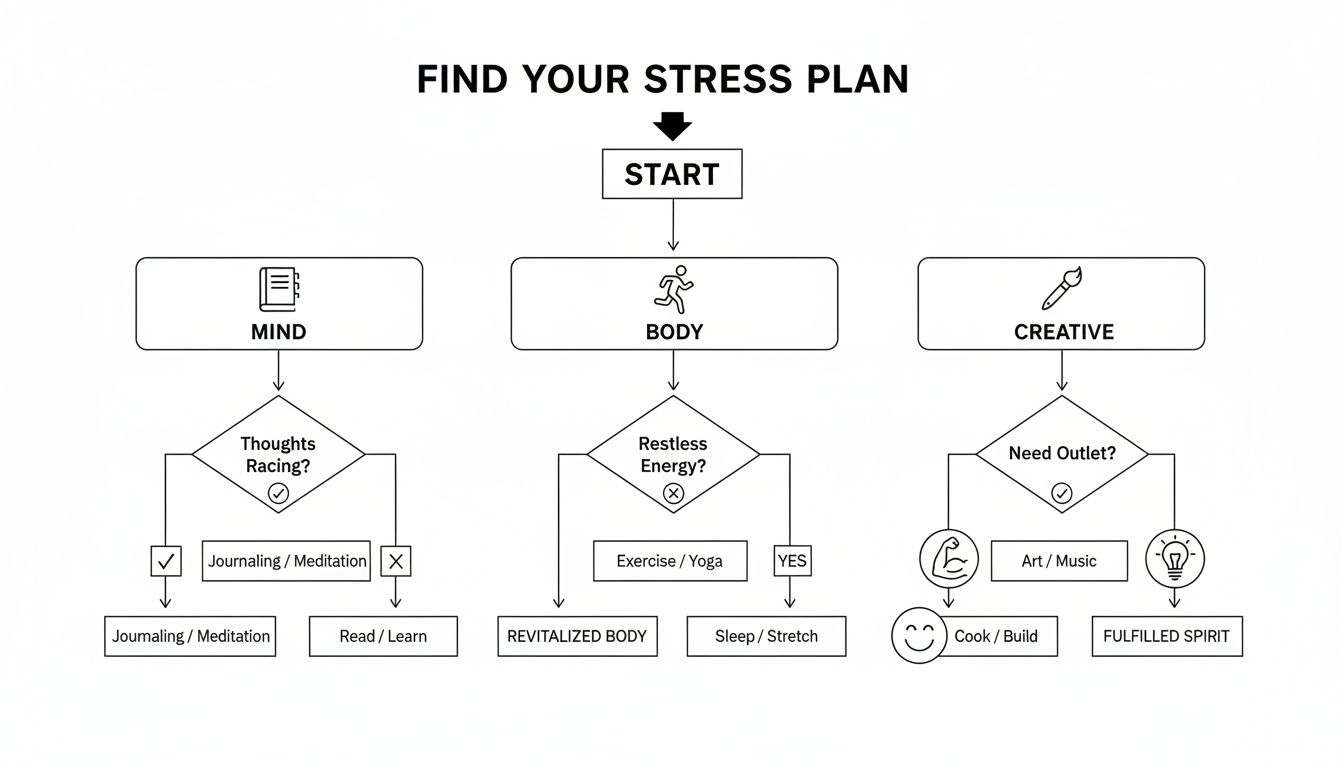
This visual guide shows how different paths—focusing on mind, body, or creativity—can all lead toward better stress management.
Finding the Right Support in Cheltenham
Here in Cheltenham, there are various therapeutic options available. Alongside traditional face-to-face and online counselling, you might consider walk-and-talk therapy. This approach combines a therapy session with gentle movement in a natural setting, which many men find less intense and more conducive to opening up.
If you feel that now is the time to take that next step, I invite you to explore the counselling services I offer.
You can also get in touch directly to ask any questions or to book an initial, no-obligation chat.
Remember, you don't have to navigate this alone.
Got Questions About Chronic Stress?
People often have a lot of the same questions when they first start digging into chronic stress. It's a confusing topic. Here are some of the most common ones I hear in my practice, along with some straight-talking answers.
"How long will it take for these techniques to actually work?"
Some things give you a bit of breathing room straight away. Grounding yourself or doing some proper deep breathing can calm the storm in the moment, sometimes within minutes. Think of these as your emergency toolkit when you feel completely overwhelmed.
But the bigger stuff – sorting out your sleep, changing how you think about things, or getting more exercise – that's more of a long game. You'll probably start feeling small, positive shifts in a few weeks if you're consistent. The really deep, lasting changes? They build up over a few months as those new habits stop feeling like a chore and just become part of how you live.
"Is chronic stress really that bad for my long-term health?"
Yes, it absolutely is. When your system is constantly flooded with stress hormones like cortisol, it takes a serious toll on your body.
It's not just about feeling wired or exhausted. We're talking about a real, increased risk of heart problems, digestive issues, and a battered immune system that can't fight things off properly. It also pours fuel on the fire of anxiety and depression. Tackling chronic stress isn't just a "nice to have" for your mental health; it's essential for protecting your physical health down the line.
"Is it even possible to get rid of stress completely?"
Honestly, no, and that's not the goal anyway. A bit of stress is normal – it's what gets you to meet a deadline or react quickly in a tricky situation. The problem isn't stress itself, but when it gets stuck on 'high' and never switches off.
The real aim is to build up your own resilience. It's about learning how to handle life's curveballs without getting knocked completely off your feet. You're not trying to create a life with no challenges, but one where you have the tools to navigate them without being constantly overwhelmed.
"What’s the difference between being chronically stressed and being burnt out?"
It's a good question, as they're closely related.
Think of chronic stress as running a marathon you never trained for, month after month. You're exhausted, sore, and just about keeping going.
Burnout is when you finally collapse at the side of the road. It's a state of total emotional, physical, and mental exhaustion. It often comes with a deep sense of cynicism and feeling completely detached from your life and work. Burnout is the end result of that long, gruelling marathon of stress.
By Therapy-with-Ben
At Therapy-with-Ben, I offer a confidential, down-to-earth space to get to the bottom of what's driving your stress. We'll work together to build practical strategies that actually fit your life.
If you feel ready to start making a change, you can find out more about how I work over at my website: https://www.therapy-with-ben.co.uk.


Comments