


Conquer Anxiety in the Morning and Start Your Day Calm
Updated: Aug 10
Waking up with a racing heart and a sense of dread isn’t just a bad start to your day; for many people, it's a very real experience known as morning anxiety. It often comes from a natural surge of stress hormones that can make your internal alarm bells ring far too loudly, long before you’ve even had a chance to properly wake up.
Why Does Anxiety Feel So Much Worse in the Morning?
If you regularly wake up feeling overwhelmed, you’re definitely not alone. There are clear, biological reasons why anxiety can feel particularly intense as you first open your eyes. Getting a handle on these mechanisms is the first step toward regaining control and finding a bit of calm. It’s not just "in your head"; it's a genuine physiological response.
The main reason is often something called the Cortisol Awakening Response (CAR). Cortisol is your body's main stress hormone, but it’s also vital for regulating your sleep-wake cycle. To help you get up and face the day, your body releases a big surge of cortisol within the first 30-45 minutes of waking.
The Body's Overzealous Wake-Up Call
Think of this cortisol surge like starting a car on a cold morning. You need a little bit of fuel and a spark to get the engine running smoothly.
For someone prone to anxiety, though, this process is like flooring the accelerator while the car is still in neutral. The engine roars, the system is flooded with stress signals, and you feel shaky and overwhelmed before you’ve even moved an inch. This is why you might experience a racing heart, tense muscles, or spinning thoughts the moment you wake up.
It's not just about hormones, either. A few other things can add to that feeling of morning dread:
Overnight Brain Activity: While you sleep, your brain is busy processing emotions and memories from the day before. If you went to bed feeling stressed, your brain might keep working on these unresolved worries, leaving you in a heightened state of alert when you wake.
Low Blood Sugar: After not eating all night, your blood sugar levels are naturally low. This can cause physical symptoms like shakiness, irritability, and light-headedness, which your brain can easily mistake for signs of anxiety, kicking off a vicious cycle.
It's helpful to look at morning anxiety not as a personal failing, but as a perfect storm of biology. Your body’s natural wake-up systems—hormones, blood sugar, and brain activity—are simply overreacting, creating a powerful but manageable wave of unease.
Understanding what's going on underneath the surface helps to normalise the experience. That knot in your stomach isn't a sign that your day is doomed; it's a signal from your body that its systems are a little out of balance. Once you realise this, you can shift from feeling powerless against the anxiety to proactively taking steps to soothe your nervous system, which we'll explore next.
Pinpointing Your Personal Morning Anxiety Triggers
To get a handle on that feeling of anxiety in the morning, you first need to understand what's actually fuelling it. Think of yourself as a detective, piecing together the clues to figure out your personal triggers. Once you start to see the patterns, you can move from feeling completely overwhelmed to proactively dealing with the root causes.
Starting your day with a knot in your stomach is far from unusual here in the UK. Morning anxiety often mirrors what's happening on a wider scale. A 2023 report from the Mental Health Foundation, for example, found that a staggering 60% of UK adults felt anxiety that got in the way of their daily lives in the previous two weeks. These feelings often hit hardest in the morning, intensified by worries about work, money, or just getting through the day. You can delve into the full report on UK anxiety levels from the Mental Health Foundation.
Spotting your specific patterns is the first real step towards making a lasting change.
To get you started, let's look at some of the most common culprits behind that morning dread. They often fall into a few key areas.
Common Morning Anxiety Triggers
This table breaks down the typical psychological, physiological, and environmental factors that can dial up your anxiety as soon as you wake up.
Trigger Category | Specific Examples |
|---|---|
Psychological | Overthinking the day's to-do list, worrying about an upcoming meeting, replaying a difficult conversation, unresolved stress from yesterday. |
Physiological | Poor or interrupted sleep, dehydration, low blood sugar after fasting overnight, the stimulant effect of morning coffee, the after-effects of alcohol. |
Environmental | Waking up to a stressful work email, a cluttered or chaotic bedroom, ongoing financial pressures, strained family relationships. |
Seeing your own experiences listed here can be validating. It's not just "in your head"; there are real, tangible reasons you feel this way, and that means there are real, tangible things you can do about it.
Psychological Triggers: The Stories We Tell Ourselves
So often, morning anxiety is sparked by our own thoughts before our feet have even hit the floor. Your brain, coming out of a state of rest, can immediately latch onto worries about the day ahead.
This is what we call anticipatory anxiety – that feeling of stress about things that haven't even happened yet. Maybe you've got a tough meeting on the calendar, a difficult conversation you need to have, or just a to-do list that feels a mile long. Your mind starts running through all the worst-case scenarios, and that’s enough to kick your body's stress response into gear. Stress from the day before can also hang around overnight, greeting you with a fresh wave of unease the moment you wake up.
This isn't just about thoughts, though. There are powerful biological forces at play, too.
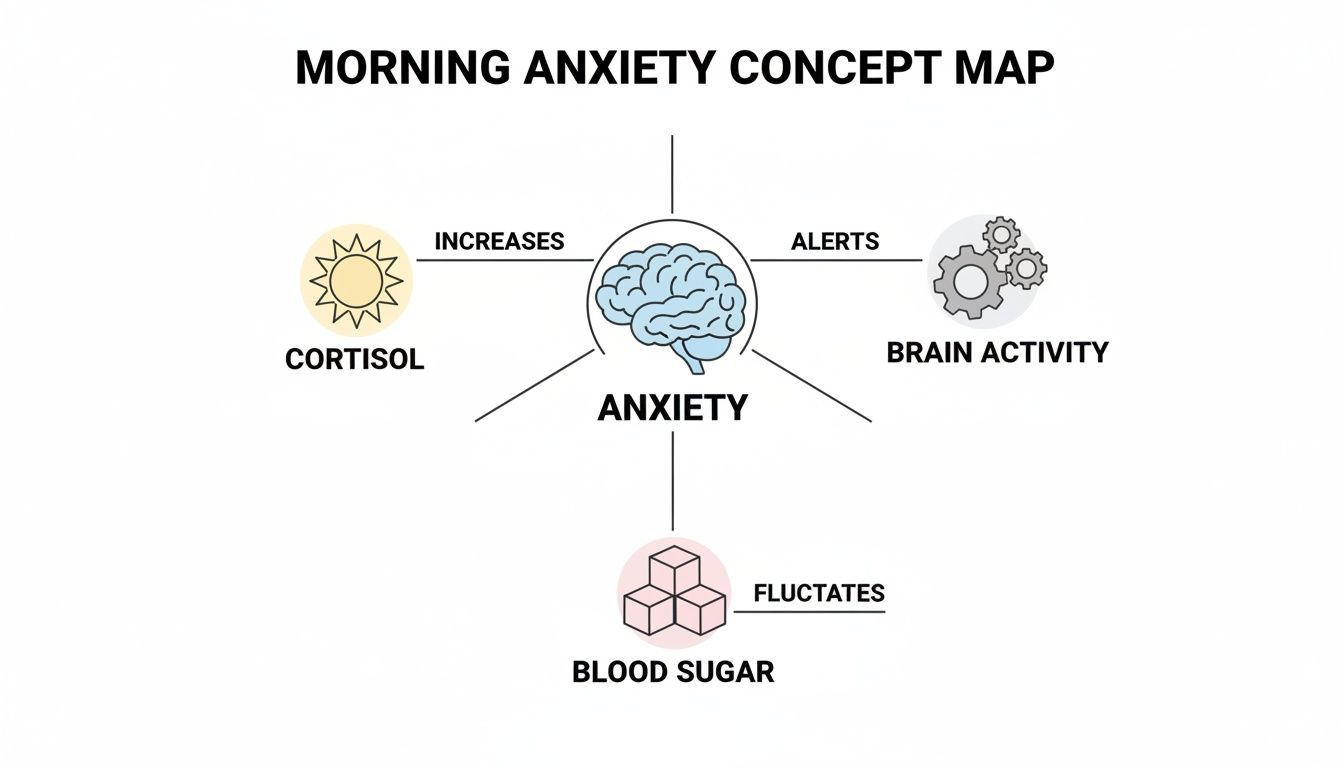
The map above shows how your inner world—hormones, brain activity, blood sugar—is all connected to the anxiety you feel. It helps to see that morning anxiety isn't just one thing, but a mix of interconnected processes that can wind each other up.
Physiological Factors: Your Body's Role in the Drama
Your body's physical state plays a huge part in setting the stage for anxiety. What you put into it and how you rest can either calm your nervous system or send it into overdrive.
Poor Sleep Quality: A night spent tossing and turning means your brain hasn't had the chance to properly process emotions. You wake up more vulnerable to stress and with less capacity to cope, making that anxious feeling almost inevitable.
Caffeine and Alcohol: That first strong coffee might feel essential, but caffeine is a stimulant. It can directly mimic or worsen anxiety symptoms like a racing heart and jitteriness. And while a glass of wine might help you doze off, alcohol messes with your sleep cycle later in the night, often leaving you feeling uneasy and on edge when you wake.
Dehydration and Diet: Waking up dehydrated puts your body under a quiet kind of physical stress. A sugary breakfast can be just as bad, causing a sharp spike and then a crash in your blood sugar, which leads to mood swings and a shakiness you could easily mistake for anxiety.
Realising the power of these physiological links is incredibly empowering. It means small, practical changes—like swapping your morning espresso for a herbal tea or just keeping a glass of water by your bed—can make a genuinely noticeable difference to how you feel.
Environmental Pressures: The World Outside Your Window
Finally, it’s important to look at the world around you. The external pressures in your life can create a backdrop of chronic stress that makes morning anxiety a much more regular visitor. These are the bigger, ongoing things.
We’re talking about a high-pressure job with constant deadlines, money worries that follow you into your sleep, or difficult family dynamics. These kinds of persistent stressors keep your baseline anxiety levels high. This means it takes far less to push you over the edge into feeling overwhelmed, especially in the morning when your natural cortisol levels are already at their peak.
Recognising how your external world impacts your internal state is the key to figuring out what needs to change.
Recognising the Symptoms of Morning Anxiety
Getting a handle on what’s happening in your body and mind is the first real step toward managing morning anxiety. Sometimes the signs are obvious, like a heart hammering against your ribs, but often they’re much more subtle. Learning to spot these symptoms helps to demystify the experience. It takes away some of the fear and gives you the power to use the right strategies when you need them most.
Anxiety isn’t just a feeling in your head; it’s a full-body event. We can usually break it down into three main areas: the physical, the mental, and the emotional.

The Physical Sensations
Quite often, it’s the physical symptoms of morning anxiety that are the most alarming. Your body’s fight-or-flight system kicks into gear, getting you ready to face a threat that simply isn’t there. This internal alarm can feel incredibly real and deeply unsettling.
You might notice some of these common physical signs when you wake up:
A racing or pounding heart: This is a classic sign of adrenaline coursing through your body.
Stomach issues: That horrible knot in your stomach, feeling sick, or even needing the loo urgently.
Tightness in your chest: This can feel like a heavy weight or a squeezing pressure, which can easily lead to worrying about your heart.
Muscle tension and trembling: You might find your shoulders are hunched right up by your ears, or that your hands are a bit shaky.
Shortness of breath: It can feel like you just can’t get a proper, satisfying breath in.
These are all direct results of your nervous system going into overdrive. If you'd like to understand this connection better, you can explore our guide on the physical symptoms of anxiety and how to find relief.
The Cognitive Patterns
Along with the physical feelings, morning anxiety often unleashes a storm of unhelpful thoughts. Your mind gets caught in a loop of worry, making it tough to think straight or feel good about the day ahead.
Imagine waking up to the quiet of a Cheltenham morning, only to have your heart start racing before you've even thought about a cup of tea. That’s morning anxiety hitting hard. This is far more common than you might think in the UK. In fact, in any given week in England, 6 in 100 people are diagnosed with Generalised Anxiety Disorder (GAD), which is often marked by these intense morning spikes. For many, it sets a tense and difficult tone for the rest of the day.
The anxious mind is an expert at "what if" thinking. It creates detailed, negative stories about the future before you’ve even had a chance to challenge them.
Some of these thought patterns include:
Racing thoughts: A relentless stream of worries that jump from one concern to the next without ever finding a resolution.
Catastrophising: Your mind immediately leaps to the absolute worst-case scenario in any situation.
Difficulty concentrating: It can feel impossible to focus on something simple, like choosing what to wear or making a bit of breakfast.
A sense of dread: A vague but powerful feeling that something bad is about to happen.
The Emotional Responses
Finally, morning anxiety has a huge emotional impact that can colour your entire day. These feelings can be intense and often feel completely out of proportion to what's actually happening, leaving you feeling drained and on edge from the moment you wake up.
Common emotional responses include:
Irritability: Small things that wouldn't normally faze you can feel incredibly annoying.
Feeling overwhelmed: The thought of your to-do list or daily tasks can feel completely impossible to manage.
Restlessness or feeling "on edge": An inability to relax or feel calm, even when there's no obvious reason for it.
A desire to avoid the day: A powerful urge to just pull the covers back over your head and hide from it all.
Recognising these symptoms for what they are—signals of anxiety—is a crucial first step. It allows you to step back and say, "This is just anxiety," rather than getting swept away by the fear. From that point of awareness, you can start to use the calming techniques we'll cover next.
Immediate Steps to Calm Anxiety When You Wake Up
That feeling when you wake up and anxiety hits you like a ton of bricks – it can feel like the day is already a write-off. Your mind starts racing, your body tenses up, and the overwhelm is instant. The thing to remember in these first few moments is not to fight it. Instead, you can gently guide your nervous system back towards a state of calm using a few practical tools.
Think of these strategies as your first-aid kit for anxiety in the morning. They’re designed to be done right where you are, often without even getting out of bed, giving you back a little bit of control right when you need it most.
Ground Yourself in the Present Moment
Anxiety has a nasty habit of dragging our minds into a spiral of future worries or past regrets. Grounding techniques are so powerful because they pull you back to the present moment, using your senses to interrupt that cycle of racing thoughts. One of the simplest and most effective is the 5-4-3-2-1 technique.
While you’re still lying in bed, just take a moment and gently bring your attention to the following:
Acknowledge FIVE things you can see: The pattern on your duvet, the way the light is hitting the wall, a book on your bedside table, a shadow on the ceiling, the colour of your curtains. Just notice them.
Acknowledge FOUR things you can feel: Feel the texture of the sheets on your skin, the weight of the blanket, the cool spot on the pillow under your head, the feeling of your own hair.
Acknowledge THREE things you can hear: Listen for the distant sound of traffic, the hum of a radiator, a bird chirping outside, or even the sound of your own quiet breathing.
Acknowledge TWO things you can smell: Maybe you can pick up the faint scent of laundry detergent on your pillowcase, or perhaps the air smells fresh after rain.
Acknowledge ONE thing you can taste: Just notice the neutral taste in your mouth or maybe a hint of toothpaste from the night before.
This simple sensory scan yanks your focus out of that "what-if" spiral and plants it firmly in the here and now. It’s a direct signal to your brain that you are safe.
Regulate Your Breathing to Soothe Your Body
When we feel anxious, our breathing often becomes shallow and quick, which just dials up the physical feelings of panic. By consciously slowing down your breath, you can send a powerful message to your nervous system that it’s time to calm down.
A really simple but brilliant technique for this is box breathing.
Breathe in slowly through your nose for a count of four.
Hold your breath for a count of four.
Breathe out slowly through your mouth for a count of four.
Hold your breath again for a count of four.
Just repeat this cycle four or five times. There’s something deeply reassuring about the rhythmic, predictable pattern that an anxious mind and body can really latch onto. This is just one of many great techniques out there, and if you’re interested, you can discover more practical ways to find peace when you feel overwhelmed.
Release Tension with Gentle Movement
Anxiety doesn’t just live in your head; it sets up camp in your body as physical tension. Some gentle movement, even before you get out of bed, can help release some of that stored stress.
Try these simple stretches:
Full Body Stretch: Lying on your back, reach your arms up over your head and point your toes. Really lengthen your whole body, take a deep breath in, and then relax completely as you breathe out.
Knee Hugs: Gently pull one knee at a time towards your chest, holding it there for a few seconds. This is great for releasing tension in your lower back and hips.
Neck Rolls: Slowly and carefully roll your head from side to side to ease out the tension in your neck and shoulders – a classic spot for stress to build up.
These immediate actions aren’t about making the anxiety vanish completely. They’re about taking the edge off. They are small, manageable steps that remind you that you have some say in the matter, proving you can influence how you feel, even on the toughest of mornings.
By having these tools ready, you can meet that wave of morning anxiety not with fear, but with a plan. It empowers you to start your day from a place of greater stability and calm.
Building an Anxiety-Proof Morning Routine
Those in-the-moment coping techniques are your first-aid kit, fantastic for when anxiety flares up. But if you want to get ahead of it, a solid, intentional morning routine is your best long-term strategy. Think of it as creating a buffer against the day's stress. By starting the day predictably and calmly, you're sending a quiet message to your nervous system: "I'm in control here."
This isn't about piling more pressure onto your morning. It's about consciously carving out a bit of space for your own wellbeing before the world rushes in.

Start with Small, Intentional Actions
The key is to string together a few gentle, positive actions that set a calm tone. The biggest culprit for morning anxiety? Grabbing your phone the second you wake up. That instant flood of news, emails, and social media notifications can send your stress levels soaring. So, let’s try something different.
Here’s a simple, customisable template to get you started:
Hydrate Before You Caffeinate: Before you do anything else, drink a big glass of water. After a full night's sleep, your body is naturally dehydrated. Rehydrating first thing supports brain function and gives you a clean energy boost, without the jitters that coffee can sometimes bring.
Delay Screen Time: This is a big one. Try to give yourself at least 15-30 minutes without your phone after you wake up. Checking it immediately floods your system with cortisol and triggers that feeling of dread about what the day holds.
Incorporate Mindful Minutes: You don’t need to launch into a full meditation session. Just take three to five minutes to focus on your breath. Notice the sounds outside your window. Do a few gentle stretches. It's a simple practice that pulls you out of your head and into the present moment.
Eat a Nourishing Breakfast: Fuelling your body properly makes a huge difference. A breakfast packed with protein and fibre – think Greek yoghurt with berries or scrambled eggs on wholemeal toast – helps to stabilise your blood sugar. When your blood sugar is stable, so is your mood.
For those with families, getting organised the night before can be a game-changer. Using something like an ultimate morning checklist for kids to achieve calmer mornings can prevent a lot of common stressors before they even start.
The Power of Positive Affirmations
Another powerful tool you can weave into your morning is positive affirmations. These are simple, present-tense statements designed to challenge and reframe the negative thought loops that anxiety thrives on.
Instead of waking up with that familiar thought, "I can't cope today," you can intentionally introduce a new script. Repetition really is key here. Saying these phrases to yourself, either out loud or just in your mind, can slowly start to shift your default mindset from one of fear to one of resilience.
Here are a few you could try:
"I am capable of handling the challenges of the day."
"I choose to meet this day with calm and confidence."
"I release worries about things I cannot control."
Think of affirmations as mental signposts. They don't magically solve problems, but they gently redirect your thoughts away from the well-worn paths of anxiety and towards a more empowered and centred perspective.
Introducing Movement and Nature
Getting some physical movement into your week is a cornerstone of managing anxiety. Exercise is brilliant for burning off excess cortisol and releasing endorphins, which are your body’s natural mood-lifters. And it doesn't have to be some intense gym session – a brisk walk can work wonders.
This is where approaches like walk and talk therapy can be particularly helpful. It combines the therapeutic process of talking through what's on your mind with the grounding effects of being outdoors. There’s something about the simple act of moving forward physically that helps you feel less "stuck" mentally. If you're interested in this idea, you can read more about the mental health benefits of nature on our blog.
By crafting a morning routine that nurtures both your mind and body, you're not just fighting anxiety. You're actively cultivating a sense of calm that can carry you through the rest of your day.
Long-Term Strategies and Finding Professional Support
While those in-the-moment calming techniques can be lifesavers, creating real, lasting change with anxiety in the morning is all about building sustainable habits and knowing when it's time to ask for a helping hand. Long-term strategies are less about firefighting the immediate panic and more about strengthening your overall resilience, so that anxiety has less of a foothold in the first place.
This means looking beyond the first few chaotic minutes of your day to your wider lifestyle. It’s amazing what a difference a few simple adjustments can make. Prioritising sleep, for example, gives your brain the chance to properly process emotions overnight. In the same way, a balanced diet helps regulate your blood sugar and mood, while gentle, regular exercise is brilliant for burning off excess stress hormones like cortisol.
The Role of Professional Therapy
These lifestyle changes are powerful tools, but sometimes they aren’t quite enough on their own. This is where professional therapy becomes so valuable, offering a structured, supportive space to dig into the root causes of what’s going on. It’s about more than just talking; it's about learning tailored strategies to manage your thoughts and feelings more effectively.
One of the most effective approaches for anxiety is Cognitive Behavioural Therapy (CBT). In a nutshell, this therapy helps you to spot, challenge, and reframe the negative thought patterns that fuel that morning dread. Instead of waking up and just accepting that familiar spiral of worry, CBT gives you the tools to question those thoughts and build a more balanced, realistic perspective.
The reality is, that feeling of morning anxiety is something that grips so many of us. Figures show that around 1 in 5 people in England experience common mental health issues like anxiety each week. The morning can feel particularly intense for the reasons we've explored, like those natural cortisol rhythms.
When to Seek Help
Knowing when to reach out is a huge, and often difficult, step. It might be time to think about professional support if:
Your morning anxiety is persistent, showing up most days.
It's getting in the way of your ability to work, socialise, or just enjoy life.
The coping strategies you've tried on your own just aren't making enough of a difference.
If you are considering professional help, understanding what to expect from a psychiatric assessment can help ease any worries you might have about the process.
Here at Therapy with Ben, I provide a non-judgemental and supportive space to help you build the tools to manage anxiety for good. I offer face-to-face and online counselling, as well as unique walk-and-talk therapy sessions here in Cheltenham. It's an approach that combines the proven benefits of talking therapy with the calming effects of nature and gentle movement, helping you move forward both mentally and physically.
This post is written by Therapy-with-Ben.
Still Have Questions About Morning Anxiety?
We've explored a lot, but I find clients often have a few lingering questions. It's completely normal. Let's tackle some of the most common ones I hear.
Is Morning Anxiety a Recognised Medical Condition?
This is a great question. In short, no, "morning anxiety" isn't a standalone diagnosis you'll find in clinical manuals like the DSM-5.
Instead, think of it as a specific pattern of symptoms. It’s most often a feature of a wider condition, usually Generalised Anxiety Disorder (GAD). It's not a unique disorder in itself, but more of a recognition that for many people, the mornings are when anxiety symptoms peak. This is often down to those biological factors we talked about earlier, like the Cortisol Awakening Response.
How Long Does Morning Anxiety Typically Last?
Honestly, it varies hugely from person to person. For some, that intense, jittery feeling might start to fade within an hour or so, especially once they're up, have had some water, and eaten something.
For others, though, it can cast a long shadow, setting a tone of unease that sticks around for several hours, or even the whole day. The goal of the strategies we've discussed isn't just to endure it, but to actively shorten its duration and dial down the intensity.
The key takeaway here is that you don't just have to ride it out and wait for it to pass. By using grounding techniques, breathing exercises, and a solid routine, you can actively reclaim your morning from anxiety's grip.
Can What I Eat or Drink Make Morning Anxiety Worse?
Absolutely, and it's something people often overlook. What you put into your body first thing can have a massive impact on your nervous system.
Caffeine: A strong coffee on an empty stomach is probably the biggest culprit I see. Its stimulant effect can perfectly mimic and even pour fuel on anxiety symptoms, like a racing heart or shaky hands.
Sugar: Starting your day with a sugary cereal or pastry can send your blood sugar on a rollercoaster. The inevitable crash that follows can leave you feeling irritable and on edge, feelings your brain can easily interpret as anxiety.
Alcohol: It might feel like it helps you unwind the night before, but alcohol really messes with your sleep quality. This leaves you far more vulnerable to feeling frazzled and anxious when you wake up.
Making a simple switch to a balanced breakfast with some protein and fibre can make a world of difference. It sets you up for a much more stable, calm start to the day.
If you're finding anxiety in the morning is holding you back and you're ready to build some lasting coping strategies, please know that help is available. Through Therapy with Ben, I offer supportive, professional counselling, including unique walk-and-talk sessions here in Cheltenham, to help you find your way to calmer mornings. Learn more and get in touch today.


Comments