


Worry vs Anxiety: Understanding the Differences (worry vs anxiety)
It's incredibly common to mix up worry and anxiety. In everyday conversation, we often use the words as if they mean the same thing, and it’s easy to understand why – both can leave you with a real sense of unease about what’s around the corner.
But getting to the heart of what separates them is the first real step towards managing your mental wellbeing and finding a clearer path forward.
So, What's the Real Difference?
The fundamental difference between worry and anxiety really comes down to one thing: specificity.
Think of it like this: worry is usually tied to a specific, real-world problem. You might worry about a big presentation at work, a bill that's due, or an upcoming exam. The worry is focused, it's about something concrete, and it often pushes you to find a solution. You prepare the slides, you pay the bill, you study for the exam – and once the task is done, the worry tends to ease off.
Anxiety, on the other hand, is a much broader, more pervasive feeling of apprehension. It often lacks a clear trigger. It’s that vague feeling of dread that can hang around long after a stressful event has passed, or sometimes for no obvious reason at all. It's less about the 'what ifs' of a particular situation and more of a general, lingering sense that something isn't right.
This feeling is becoming more and more common across the UK. Recent figures from 2022/23 showed that an average of 37.1% of women and 29.9% of men reported high levels of anxiety, which is a noticeable jump from previous years. If you're interested, you can read more about these UK mental health statistics to get the full picture.
To put it simply, here’s a quick comparison:
Characteristic | Worry | Anxiety |
|---|---|---|
Focus | Specific and concrete (e.g., a bill, an exam) | Vague and diffuse (e.g., a general feeling of dread) |
Experience | Primarily in your thoughts | Felt in both your mind and body |
Impact | Can lead to productive problem-solving | Tends to be unproductive and can feel paralysing |
Control | Feels more manageable and controllable | Often feels uncontrollable and overwhelming |
Getting your head around this distinction is a great starting point. By learning to recognise what you’re experiencing more accurately, you can start finding the right strategies to manage these tough feelings.
A Detailed Comparison of Core Differences
It’s easy to use the words ‘worry’ and ‘anxiety’ interchangeably. On the surface, they feel like close cousins, but when you look at how they operate in our minds and bodies, they’re actually worlds apart.
Getting a handle on these core distinctions is a crucial first step. It helps you accurately name what you’re experiencing, which is fundamental to finding the right way to manage it. Let’s break down the key differences between worry and anxiety.
The Focus: Specific vs. Vague
The clearest line in the sand between the two is what your mind is focused on.
Worry is almost always specific and latches onto a real-world problem. Your thoughts are zeroed in on a particular issue or a potential threat. Think: "I'm worried I won't finish this report by Friday's deadline," or "I'm worried about how I’ll pay for the car repairs." The problem is identifiable, even if it’s a difficult one to solve.
Anxiety, on the other hand, is much more diffuse and often feels untethered from any single trigger. It’s that broad, nagging sense of unease or dread about nothing and everything all at once. Instead of a specific report, you might feel a persistent anxiety about your entire career, thinking, "What if I'm just not good enough?" It can even show up as a sense of impending doom without any obvious cause.
This image really captures that distinction well.
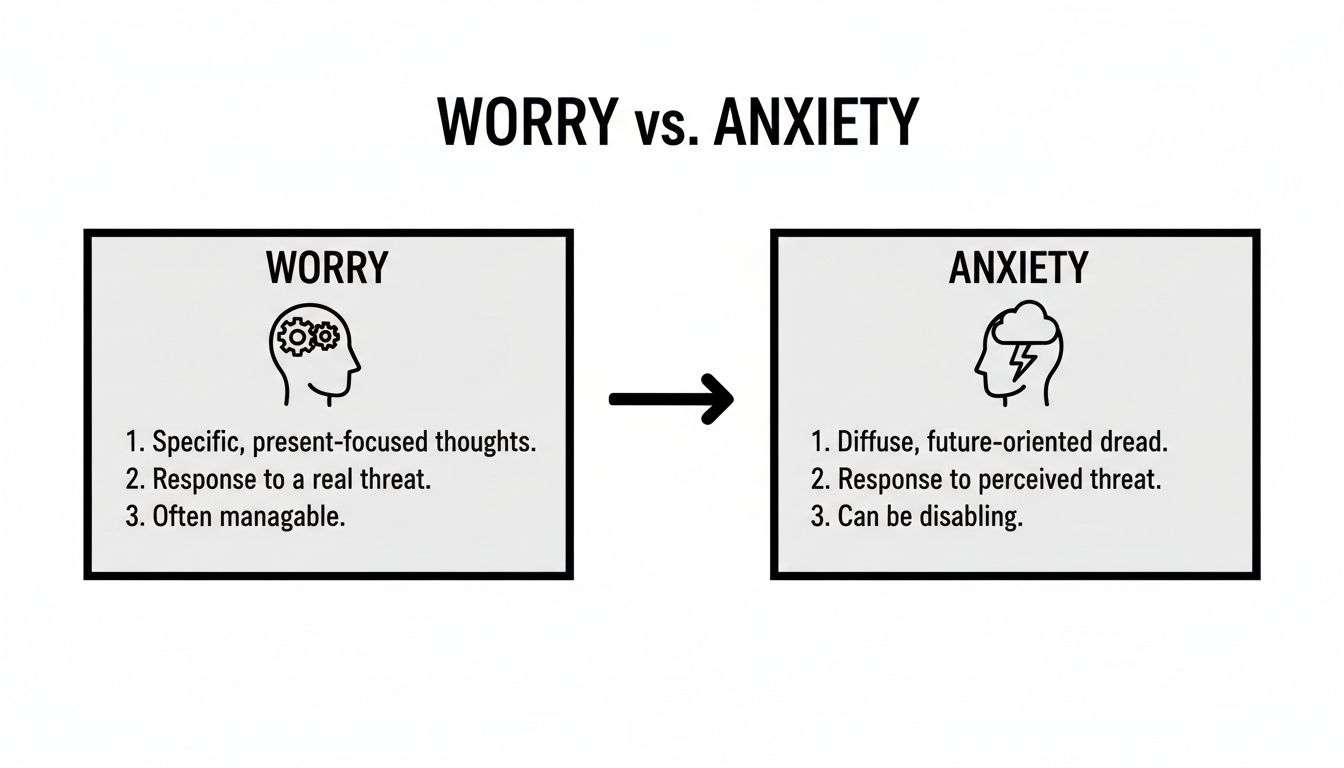
Worry is like gears turning in your mind to solve a problem; anxiety is more like an internal, chaotic storm.
The Feeling: In Your Head vs. In Your Body
Another huge difference is where you feel it.
Worry is primarily a mental activity—a cognitive process. You turn a problem over and over in your mind, playing out scenarios. While you might feel some tension, the main event is happening between your ears.
Anxiety is a full-body experience. It isn’t just in your head; it hijacks your nervous system and triggers the 'fight-or-flight' response. This unleashes a cascade of very real physical symptoms: a racing heart, shortness of breath, trembling, sweating, an upset stomach, or tense muscles. It's this powerful physical component that makes anxiety feel so overwhelming and uncontrollable. It's in your chest, your stomach, and your limbs.
Key Takeaway: If your distress is mainly thought-based and tied to a specific issue, it’s probably worry. If it comes with a host of physical symptoms and a vague sense of dread, you're likely dealing with anxiety.
The Timeline: Temporary vs. Persistent
The duration and impact on your life also tell a different story.
Worry is usually temporary. It’s tied to a situation, and once that situation is resolved—the presentation is over, the bill is paid—the worry tends to fade away. In small doses, worry can even be productive. It’s what motivates you to prepare for that meeting or create a budget.
Anxiety, however, is far more persistent. It can stick around for weeks, months, or even longer, often with little regard for what’s happening externally. And unlike the problem-solving nature of worry, anxiety is often debilitating. It can sabotage your concentration, ruin your sleep, and make it difficult to function at work, at home, or with friends. This is where it often gets confused with stress, too. If you're interested in that, you can learn more about the difference between stress and anxiety in our quick explainer.
To make these distinctions even clearer, here’s a simple head-to-head comparison.
Worry vs Anxiety A Head-to-Head Comparison
This table offers a clear, at-a-glance summary of the fundamental differences between the experience of worry and the condition of anxiety.
Characteristic | Worry | Anxiety |
|---|---|---|
Focus | Specific and identifiable threat (e.g., 'I might fail this exam.') | Vague, diffuse, and often non-specific (e.g., 'I have a feeling something bad will happen.') |
Physical Symptoms | Primarily mental; minimal physical symptoms like mild tension. | Significant physical symptoms: racing heart, shortness of breath, trembling, digestive issues. |
Duration | Temporary and linked to a specific situation; resolves when the situation does. | Persistent and long-lasting; can be present for weeks, months, or longer. |
Impact on Functioning | Can sometimes lead to problem-solving and proactive behaviour. | Often debilitating and interferes with daily tasks, relationships, and work. |
Trigger | Grounded in reality and connected to a specific, external stressor. | Can be internal and may lack a clear, identifiable trigger. |
Using this framework, you can start to analyse your own feelings with a bit more clarity. This kind of self-awareness is the first, most powerful step towards regaining a sense of control. Pinpointing whether you’re caught in a cycle of worry or a state of pervasive anxiety is what allows you to choose the right tools to move forward.
What's Fuelling Your Worry and Anxiety?
Ever wondered why some of us seem to be natural-born worriers, while others are caught in the far more relentless grip of anxiety? There's no simple answer. It’s a messy, complex mix of our biology, the way we think, and the world we’re navigating. Getting to grips with these factors is a massive step towards being kinder to yourself on your own mental health journey.
This isn't about some personal weakness. Think of it this way: just as some people have a knack for catching every cold going around, some of us are simply more susceptible to worry tipping over into anxiety. It's about a combination of what's going on inside and the pressures from the outside.
Genetics and Brain Chemistry: The Internal Blueprint
Let's start with what's going on under the bonnet. Our internal makeup plays a huge part. Some people's genetics simply hand them a more sensitive stress response, meaning their 'fight-or-flight' system is a bit more trigger-happy than the next person's.
On top of that, our unique brain chemistry is a major player. If you've got an imbalance in neurotransmitters like serotonin and dopamine—the brain's mood and fear regulators—it can feel almost impossible to dismiss those intrusive thoughts or calm a nervous system that's stuck in overdrive. This biological foundation can easily set the stage for everyday worry to escalate.
Personality and Thinking Habits
Beyond biology, our personality traits and the well-worn mental paths we follow can shape how we handle life's curveballs. Certain traits can really pour fuel on the fire of both worry and anxiety.
Perfectionism: When you're constantly chasing the impossible standard of being flawless, any potential slip-up can feel catastrophic. It creates the perfect breeding ground for worry.
Pessimism: If you've got a habit of always expecting the worst-case scenario, it doesn't take much for a small, manageable concern to balloon into a terrifying sense of dread.
Low Self-Esteem: When you fundamentally doubt your ability to cope, even minor stresses can feel like huge threats, feeding a relentless cycle of anxious thoughts.
These patterns aren't character flaws; they're often learned responses. The good news is that with the right support, they can be unlearned and replaced with something that serves you better.
Anxiety is not a personal failing. It is a complex condition shaped by a blend of internal and external forces that are often beyond our immediate control.
The World Around Us: Environment and Money Worries
Our external world has a profound impact on our internal one. Being under long-term stress—whether it's from a high-pressure job, a tough family dynamic, or just the constant uncertainty of modern life—can seriously wear down our resilience, leaving us vulnerable.
Socioeconomic factors, particularly here in the UK, play an absolutely crucial role. Financial instability can take legitimate worries about paying the bills or keeping a job and twist them into a state of chronic anxiety. Data from Our Future Health shows a stark link between how much we earn and our mental health. For those earning over £100,000, only 1.3% reported severe anxiety. Compare that to those earning between £18,000 and £30,999, who faced much higher rates of moderate to severe symptoms. Research also shows that people in problem debt are more than twice as likely to experience a mental health problem. You can dig deeper into these 2025 mental health statistics to see the full picture.
This really gets to the heart of the worry vs anxiety debate. Having external stability acts as a buffer, stopping everyday concerns from spiralling out of control. When that buffer is taken away, the line between the two can get very blurry, very fast. Understanding where these feelings come from is the first step towards feeling more in control and finding the right way forward.
When Does Worry Become A Problem?
Worry is a normal part of being human. In many ways, it's actually useful – it’s that little internal nudge that makes sure you prepare for a big interview or tuck some money away for a rainy day. But there is a tipping point. Sometimes, this familiar feeling can shift into something far more persistent and overwhelming, blurring the line between a helpful concern and a real problem. Realising when you’ve crossed that line is the first step toward getting back on solid ground.
A key sign is when your worry starts to feel uncontrollable. It stops being a reaction to a specific issue and becomes more like a constant, looping track in your mind that you just can't switch off. This can happen even after the initial problem has been solved, leaving you with a kind of persistent mental chatter that's both invasive and exhausting.

This seems to be a particular struggle for younger people here in the UK. Data from July to September 2022 showed that among young adults aged 18-29, 25.4% experienced mild anxiety, 12.6% moderate, and 9.9% severe symptoms. It's a stark reminder of how easily situational worry can morph into something chronic and deeply embedded, a clear signal that a line has been crossed.
Identifying the Warning Signs
So, how can you tell if your own worry has turned into a more significant issue? It helps to look for tangible signs in your daily life. This isn't about self-diagnosis, but about building a bit of self-awareness so you know when it might be time to get some support.
One of the most telling signs is when your worry feels completely disproportionate to the situation. For instance, being a bit nervous before a major presentation is one thing; losing sleep for weeks over a minor comment a colleague made is quite another. When your emotional response is miles bigger than the actual trigger, it’s a red flag.
Another critical indicator is the arrival of significant physical symptoms. Worry is mostly in your head, but anxiety is a full-body experience. If your "worry" is coming with a racing heart, persistent muscle tension, digestive issues, or constant fatigue, your body is telling you that your nervous system is stuck on high alert.
A Guiding Question: Ask yourself, "Is this feeling helping me solve a problem, or is it just making me feel stuck and overwhelmed?" If it’s the latter, your worry is likely unproductive and tipping over into anxiety.
The Impact on Your Daily Life
Perhaps the most crucial test in the worry vs anxiety debate is how it’s affecting your ability to function. Worry might distract you for a bit, but it generally doesn't stop you from living your life. Problematic anxiety, on the other hand, puts up walls.
Think about whether you've noticed any of these impacts:
Social Withdrawal: You start avoiding friends, family, or social events you used to love because the thought of them is just too much.
Work or Study Performance: Your concentration is shot, you're missing deadlines, and you struggle to complete tasks that were once perfectly manageable.
Relationship Strain: Your constant state of unease might be making you irritable or distant, creating friction with the people you care about.
Loss of Enjoyment: Hobbies and activities that once brought you joy now feel like a chore or, even worse, another source of stress.
When worry gets to this point, understanding different ways to manage it becomes vital. This article on How to Stop Constant Worrying offers some good starting points. Recognising these signs isn't about sticking a label on yourself; it's about empowering yourself with the knowledge to take that next step towards feeling better.
Practical Strategies for Managing Both

Knowing the difference between worry and anxiety is a great first step, but the real work lies in learning how to handle these feelings day-to-day. Because they show up differently, it makes sense that we need different tools to manage them.
Think of it like building a mental health toolkit. For worry, which is all about our thoughts, we can use cognitive techniques to get a handle on things. For anxiety, which we feel so strongly in our bodies, we need to start with physical, grounding strategies.
Taming Worry with Cognitive Tools
When you’re stuck in a worry loop, your thoughts can feel like a tangled mess. The aim here is to bring some order to that chaos and regain a sense of control.
Here are a couple of really practical techniques you can try:
Schedule 'Worry Time': It might sound counterintuitive, but setting aside a specific, limited window each day (say, 15 minutes after work) just for your worries can be incredibly effective. If a worry pops up outside this time, you simply make a mental note to deal with it later. This stops worry from hijacking your entire day.
Use a Problem-Solving Framework: Worries often latch onto real-world problems. By breaking them down, you shift from aimless rumination to proactive thinking. Ask yourself: What's the actual problem here? What are some possible solutions? What is one tiny step I can take right now? For a closer look at this approach, you might find my guide on how to stop worrying about everything helpful.
These tools are all about engaging with your thoughts on your own terms, rather than letting them run the show.
Calming Anxiety with Body-Based Techniques
Anxiety is physical; it’s the body’s ‘fight-or-flight’ system kicking into gear. So, the quickest way to calm it is often by starting with the body. When you soothe the physical symptoms, the mind tends to follow.
Key Insight: You can't think your way out of a physiological response. To manage the physical symptoms of anxiety, you need to use your body to send calming signals back to your brain.
Here are some powerful body-based strategies to try:
Diaphragmatic Breathing: Often called 'belly breathing', this is one of the fastest ways to slow your heart rate. Place one hand on your chest and the other on your stomach. Breathe in slowly through your nose for a count of four, feeling your belly expand. Hold it briefly, then exhale slowly through your mouth for a count of six. Just a few minutes of this can make a world of difference.
Mindfulness and Grounding: This isn't about clearing your mind of all thoughts—that's impossible. It’s about anchoring yourself in the present. The 5-4-3-2-1 technique is brilliant for this: notice five things you can see, four things you can feel, three things you can hear, two things you can smell, and one thing you can taste. It yanks your attention out of the anxious spiral and back into your immediate environment.
The Foundation of Resilience: Lifestyle Adjustments
Beyond these in-the-moment techniques, certain daily habits build up our resilience over time, making us less prone to both worry and anxiety in the first place.
Regular physical activity is fantastic for burning off stress hormones like adrenaline and cortisol. You don't need to run a marathon; even a brisk walk can reset your system.
Sleep is just as crucial. A tired mind is far more likely to fall into negative thinking patterns. Establishing good sleep hygiene is one of the most powerful things you can do for your mental wellbeing.
By putting these strategies into practice, you can begin to actively manage the unique challenges of both worry and anxiety, finding your way back to a place of calm and control.
How Professional Support Can Help
While self-help strategies are genuinely powerful tools, there are times when the sheer weight of constant worry, or the physical clench of anxiety, just becomes too much to handle on your own. Deciding to reach out for professional support isn’t a sign of weakness; it's a proactive and incredibly brave step towards getting back in the driver's seat of your own life.
Counselling offers a completely confidential, safe space where you can start to unpack the real roots of what you're feeling, without any fear of judgement. A therapist can help you untangle those knotted thoughts and feelings fuelling your distress, offering a fresh perspective that a self-help guide just can't. It's a partnership, designed to empower you.
Finding the Right Therapeutic Approach for You
Knowing the difference between worry vs anxiety is one thing, but learning how to actually navigate it is something else entirely. Therapy isn't a one-size-fits-all fix. Here at Therapy with Ben, the whole focus is on finding an approach that feels right for you and what you're going through, whether you’re local to Cheltenham or connecting from further away.
Different methods have their own unique strengths:
Face-to-Face Sessions: The traditional, in-person therapy session creates a dedicated, private environment where the focus is entirely on you. It's brilliant for those who find value in having a structured, contained space to do the work.
Online Counselling: If you have a packed schedule or simply feel more at ease in your own home, online therapy offers amazing flexibility. You get the same quality of support without the commute.
Walk and Talk Therapy: This is a really unique approach we offer here in Cheltenham, blending the benefits of counselling with gentle movement out in nature. Sometimes, walking side-by-side can make difficult conversations feel more natural and less intense. Plus, the physical activity itself is proven to help calm the nervous system and dial down anxiety symptoms.
A good therapist doesn't hand you the answers. Instead, they give you the tools and the space to find your own. The aim is to build up your own resilience so you can face life's curveballs with confidence, long after our sessions have finished.
Taking the First Step in Cheltenham
The most important step is simply making the decision to get help. From there, we can work together to build a personal toolkit of coping strategies, all tailored to your specific experiences. This might involve cognitive techniques to challenge those spiralling anxious thoughts, or it could mean using body-based methods to soothe your physical response to stress. You can get a feel for some of these by reading about proven methods for anxiety treatment without medication.
Ultimately, professional support means you have a dedicated ally. It’s a real investment in your own wellbeing, giving you the guidance and encouragement to move from a place of feeling completely overwhelmed to one of empowerment and calm.
Your Questions Answered
It's completely natural to have a few more questions bubble up when you start unpicking the differences between worry and anxiety. Let's tackle some of the most common ones I hear from clients, hopefully giving you a bit more clarity.
Can Worry Actually Turn Into an Anxiety Disorder?
Yes, it certainly can. Think of it like a path: everyday worry is a normal, temporary response to a specific problem. But if that path becomes a well-trodden rut of chronic, uncontrollable worry that starts to disrupt your work, relationships, or just your ability to enjoy life, you might be heading towards a clinical condition like Generalised Anxiety Disorder (GAD).
The real shift happens when the worry is no longer just about one thing, but about everything and anything. If it feels constant, overwhelming, and you're noticing physical symptoms like feeling on-edge, tired all the time, or your muscles are constantly tense, that's a strong signal it’s time to chat with a professional.
Is There One ‘Best’ Therapy for Anxiety?
This is a great question, but the honest answer is no – there's no single "best" therapy that works for everyone. The most effective approach is always the one that feels right for you. It needs to resonate with your personality, your history, and your specific struggles.
For some, Cognitive Behavioural Therapy (CBT) is brilliant for breaking down the negative thought loops that feed anxiety. For others, a deeper exploration of where these feelings come from is more helpful. Here at Therapy with Ben, we'll figure out a plan together, whether that’s through online sessions, meeting in my Cheltenham therapy room, or getting out for some Walk and Talk Therapy.
The "best" therapy is the one that clicks with you, led by a professional you genuinely trust. That therapeutic relationship is often where the real magic happens.
How Do I Know if Walk and Talk Therapy Is for Me?
If the thought of sitting opposite someone in a traditional therapy room feels a bit intense or even intimidating, Walk and Talk Therapy could be a perfect fit. I've found that for many people, walking side-by-side in nature makes it so much easier to open up. The pressure of constant eye contact is gone, and the conversation just seems to flow more naturally.
It’s especially helpful if you're someone who thinks better while moving. The gentle rhythm of walking is also a fantastic way to calm an anxious nervous system, easing physical tension and quietening those racing thoughts. The only way to know for sure is to have a quick chat about it and see if it feels like an approach you’d be comfortable with.
By Therapy-with-Ben
Therapy-with-Ben offers a compassionate, confidential space to explore these challenges. If you're in Cheltenham or seeking online support to manage your worry or anxiety, take the first step and learn more about how counselling can help. Visit https://www.therapy-with-ben.co.uk to get started.


Comments