


Proven Methods for anxiety treatment without medication and lasting calm
Updated: Feb 5
Author: Therapy-with-Ben
If you're looking into ways to manage anxiety without medication, you're definitely not on your own. Many of us are searching for effective, long-term strategies that focus on therapy, lifestyle changes, and building our own resilience, rather than relying only on pharmaceuticals. It’s an approach that puts you back in the driver's seat, equipping you with coping skills that will last a lifetime.
Why Are More People Looking for Natural Anxiety Relief?
The hunt for alternatives to anxiety medication isn't just a passing trend; it reflects a real shift in how we think about mental wellbeing. People are increasingly wanting to understand and manage their anxiety from the ground up, not just paper over the cracks. This desire often comes from some very valid concerns and goals.
For many, the potential for side effects from medication is a big factor. Others are keen to avoid dependency and want to build their own internal toolkit for handling difficult feelings when they show up. The aim isn't just to feel better temporarily, but to get better at navigating life's inevitable rough patches. It's a move towards feeling empowered and self-reliant.
The Growing Need for Effective Alternatives
This shift is happening as anxiety levels continue to climb across the UK. The latest data paints a pretty stark picture: in 2023, 23 per cent of working-age adults reported poor anxiety levels, a significant jump from pre-pandemic figures. On top of that, referrals for anxiety among young people under 17 have more than doubled. These numbers show just how widespread the issue has become, highlighting the urgent need for a range of accessible treatment options. You can read the full BMA analysis on mental health pressures to get a sense of the scale of the challenge.
This guide is here to offer a clear, practical roadmap for anyone interested in managing anxiety without medication. We'll explore powerful, proven methods that can help you get back a sense of control and find a more lasting sense of calm.
Managing anxiety without medication is about learning to surf the waves of your emotions, rather than trying to stop the ocean. It’s about building skills, understanding your triggers, and creating a life that supports your mental health from the inside out.
What You Will Discover in This Guide
Throughout this article, we’ll get stuck into real-world strategies that offer genuine relief and long-term benefits. This isn't just about theory; it's all about what you can actually do. Here’s a little taster of what’s to come:
Evidence-Based Therapies: We'll break down approaches like Cognitive Behavioural Therapy (CBT) and Acceptance and Commitment Therapy (ACT), explaining in simple terms how they work and what they feel like in practice.
Innovative Walk and Talk Therapy: Discover how combining counselling with gentle movement in nature can completely change the therapeutic experience, making it feel less intense and often more effective.
Actionable Lifestyle Adjustments: Learn about the small but powerful tweaks you can make to your daily routine—from what you eat to how you sleep—that can significantly lower your baseline anxiety levels.
Finding the Right Support: Get some straightforward advice on choosing a therapist who genuinely gets you, making sure you find the right person to partner with on your mental health journey.
Building Your Therapeutic Toolkit for Anxiety
Venturing into therapy for anxiety can feel like trying to learn a new language. The acronyms and clinical terms might seem a bit intimidating at first, but at their heart, these are practical, hands-on approaches designed to give you more say over your thoughts and feelings. An anxiety treatment without medication is all about building a personal toolkit of strategies that you can carry with you for the rest of your life.
The decision to try therapy is often driven by a deep desire for empowerment—to build genuine coping skills rather than just managing symptoms or potential side effects.
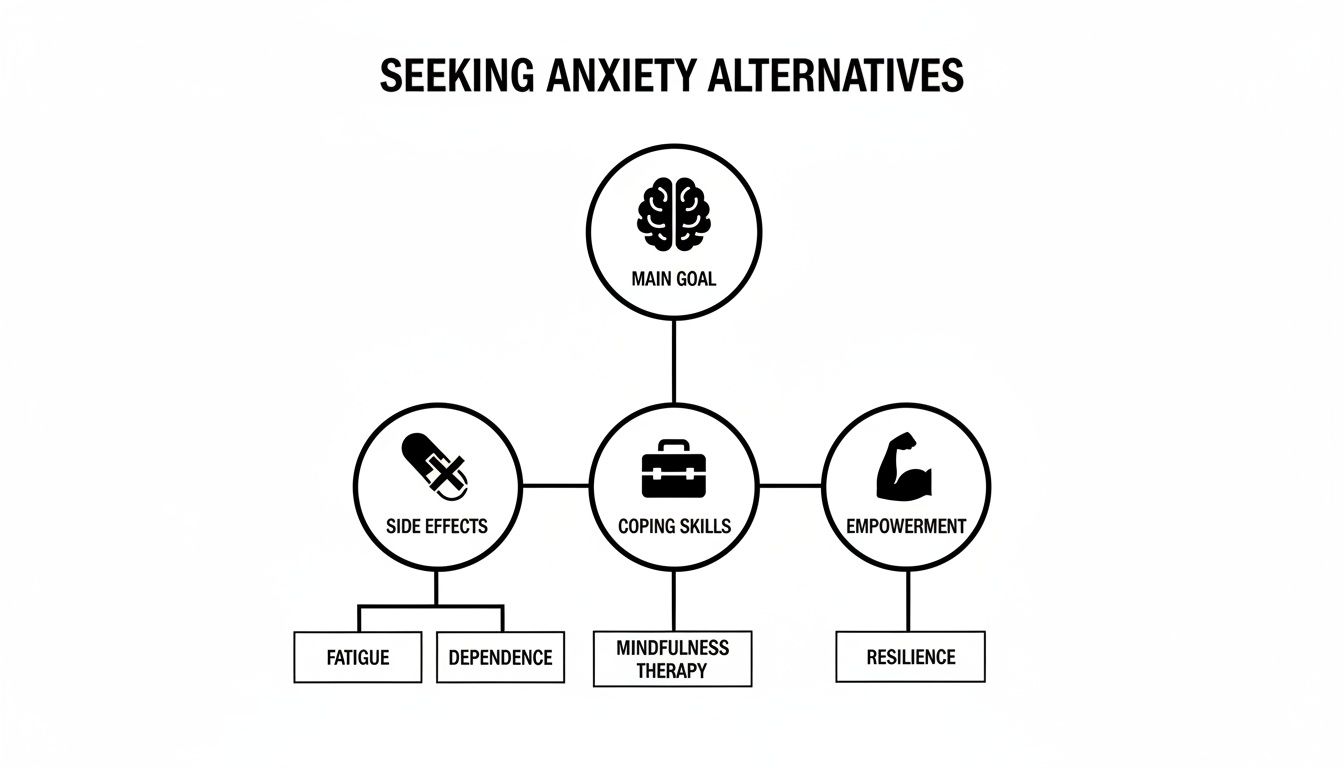
As the flowchart shows, the real goal isn’t just to dial down the anxiety, but to build lasting skills and a sense of personal agency in looking after your own mental health.
Let's unpack three of the most effective talking therapies for anxiety. They each offer something a little different, but all aim to put you back in the driver's seat.
Comparing Therapeutic Approaches to Anxiety
To help you get a clearer picture, this table breaks down the core focus and primary goals of the three main therapies we're about to explore.
Therapy Type | Core Focus | Primary Goal |
|---|---|---|
Cognitive Behavioural Therapy (CBT) | Identifying and challenging unhelpful thought patterns and the behaviours they trigger. | To change your responses to anxious thoughts, breaking the cycle of negativity and avoidance. |
Acceptance & Commitment Therapy (ACT) | Accepting uncomfortable thoughts and feelings, while committing to actions aligned with your values. | To live a rich, meaningful life alongside anxiety, rather than trying to eliminate it completely. |
Person-Centred Counselling | Providing a safe, non-judgemental space for you to explore your feelings and find your own solutions. | To foster self-awareness and self-acceptance, helping you understand the roots of your anxiety. |
While they have different methods, each approach is a well-trodden path towards understanding and managing anxiety more effectively.
Cognitive Behavioural Therapy: Rewiring Your Thoughts
Cognitive Behavioural Therapy, or CBT, is one of the most well-researched and effective therapies out there for anxiety. Think of it less as a stuffy clinical process and more like learning how to change the channel on a radio that's stuck on a gloomy news station.
The whole thing is built on a simple but powerful idea: our thoughts, feelings, and behaviours are all tangled up together.
If you have an anxious thought pop into your head, like, "I'm going to make a complete fool of myself in this meeting," it immediately kicks off feelings of dread and physical sensations like a racing heart. This, in turn, might lead you to avoid speaking up at all. CBT helps you catch those automatic negative thoughts in the act and put them on trial.
You learn to ask some really practical questions:
What's the actual evidence for this thought? Is it 100% true that I'm going to make a fool of myself?
What's a more balanced or realistic way of looking at this? Maybe something like, "I'm nervous, but I'm prepared and I have valuable things to say."
What's the worst that could really happen, and could I handle it? More often than not, the catastrophe we imagine is far worse than what's likely to happen.
By consistently challenging and reframing these thoughts, you’re essentially rewiring your brain's default, anxious responses. It doesn't mean anxious thoughts will vanish forever, but it gives you the power to choose not to buy into them, which drains them of their emotional punch.
Acceptance and Commitment Therapy: Surfing the Waves
While CBT is all about changing your thoughts, Acceptance and Commitment Therapy (ACT) takes a different tack. It teaches you to change your relationship with your thoughts and feelings. Imagine your anxiety is the ocean—trying to stop the waves is exhausting and pretty much impossible. ACT teaches you how to surf them instead.
This therapy comes from the idea that trying to suppress or fight off anxious feelings often just makes them stronger. It’s a bit like trying not to think of a pink elephant; the more you resist, the more it stomps around in your head.
ACT encourages you to acknowledge and make room for uncomfortable feelings without letting them call the shots. It's about accepting that anxiety is part of the human experience, not a sign that you're broken.
A huge part of ACT is figuring out your core values—what truly matters to you deep down. From there, you learn to take 'committed action' towards those values, even when anxiety is along for the ride. This shifts your whole focus from trying to get rid of anxiety to living a life that feels meaningful. If spending time with friends is important, you learn to go to that social event with your anxiety, rather than waiting for it to disappear first. For a deeper dive into this fascinating approach, you can learn more about Acceptance and Commitment Therapy in our detailed article.
Person-Centred Counselling: Creating a Safe Space
Finally, there's person-centred counselling, which provides the solid, supportive foundation needed to explore where your anxiety might be coming from in the first place. It offers a safe, non-judgemental space where you can talk openly with a professional who is there simply to listen with empathy and genuine understanding.
Unlike the more structured therapies, this approach is led by you. The counsellor isn't there to give direct advice or tell you what to do. Instead, they act as a guide, helping you untangle your own thoughts and feelings, supporting you as you find your own answers and gain real clarity on the roots of your anxiety.
It’s a truly collaborative journey towards greater self-awareness and, ultimately, self-acceptance.
How Walk and Talk Therapy Can Help
When you picture therapy, what comes to mind? For most of us, it’s a quiet room with a couple of chairs. And while that classic setup is effective for many, there’s another approach gaining traction – one that blends professional counselling with the simple, restorative power of moving out in nature. It’s called walk and talk therapy, and it’s all about taking the conversation outdoors.
Imagine talking through what’s on your mind, not in a formal office, but while strolling through a peaceful Cheltenham park. This simple change of scenery can make an astonishing difference. It often lowers the intensity that can sometimes build in a face-to-face chat, helping you feel more relaxed and open. For many people, walking side-by-side with a therapist feels less like a formal consultation and more like a collaborative journey.

This is much more than just a nice walk; it's a dynamic and effective form of anxiety treatment without medication. It taps into several natural processes that give your mental wellbeing a real boost.
The Science Behind Moving and Talking
The benefits here aren't just a feeling; they're grounded in the way our brains and bodies react to movement and our environment. The physical act of walking directly influences our nervous system, helping to dial down the 'fight or flight' response that anxiety loves to trigger.
Instead of sitting still while your thoughts race, the gentle rhythm of walking can be incredibly grounding. It helps to release the physical tension we hold in our bodies when we're stressed, which in turn has a powerful calming effect on the mind.
This gentle, forward momentum can be a powerful metaphor for progress. When you feel stuck in cycles of worry, the simple act of moving forward physically can help your mind feel like it’s making progress too.
There are a few key things happening under the surface:
Bilateral Stimulation: The steady, left-right rhythm of walking is a natural form of bilateral stimulation. This process is thought to help the brain process difficult emotions and memories more effectively, a bit like the mechanisms used in EMDR (Eye Movement Desensitisation and Reprocessing) therapy.
Reduced Cortisol Levels: Just being in nature, even for a short while, has been shown to lower levels of cortisol, our main stress hormone. A drop in cortisol means a calmer state of mind, making it easier to do the therapeutic work.
Endorphin Release: Light physical activity gets those endorphins flowing, which are your body's natural mood-lifters. This can give you an immediate lift, making it feel more manageable to tackle challenging conversations.
Breaking Down Barriers to Conversation
Perhaps one of the biggest wins for walk and talk therapy is how it shifts the dynamic of the session. The traditional therapy setup, with its direct and sustained eye contact, can feel a bit intense for some people, making it tough to open up about really sensitive stuff.
Walking alongside your therapist creates a more relaxed and equal atmosphere. The conversation can flow more naturally, with moments of comfortable silence or comments on the world around you. This less formal setting often helps people to lower their guard and speak more freely about what’s really going on for them.
If you’d like to explore this idea further, you might find our guide on walk and talk therapy and getting fresh air for your thoughts helpful. It’s an accessible and surprisingly powerful option for anyone in Cheltenham looking for practical anxiety treatment without medication.
Practical Lifestyle Changes to Manage Anxiety
While therapy gives you the tools and the roadmap, the small choices you make every single day are what really build your resilience against anxiety. Think of these lifestyle changes as tuning your mind and body to a calmer frequency. They work in tandem with therapy to dial down the background hum of anxiety, giving you back control and much-needed mental space.
An effective anxiety treatment without medication isn't just one thing; it's a blend of professional guidance and a personal commitment to habits that support you. It’s all about creating an environment, both inside and out, where anxiety struggles to get a foothold. These aren't quick fixes, but foundational pillars for genuine, long-term mental wellbeing.

Harnessing the Power of Mindfulness and Breathwork
Mindfulness is really just about paying attention to right now, without judging it. When anxiety yanks your thoughts into worrying about the future or replaying the past, mindfulness is the anchor that gently brings you back to the present. You don't need to sit cross-legged on a cushion for hours – just a few minutes a day can make a world of difference.
One of the simplest yet most powerful tools you have is your own breath. When you're anxious, your breathing naturally becomes shallow and quick, kicking your body’s ‘fight or flight’ system into high gear. By consciously slowing your breath down, you send a direct signal to your brain that the danger has passed, helping to soothe your entire nervous system.
Try the 4-7-8 Breathing Technique:1. Breathe in quietly through your nose for a count of 4.2. Hold your breath for a count of 7.3. Breathe out completely through your mouth, making a gentle ‘whoosh’ sound, for a count of 8.4. Repeat this cycle three or four times whenever you feel that familiar wave of anxiety start to build.
It's a simple exercise you can do absolutely anywhere – at your desk, on the bus, or just before a tough conversation – to instantly take the edge off.
The Crucial Connection Between Mind, Gut, and Movement
The link between what we eat and how we feel is clearer than ever. They often call your gut your "second brain" for a good reason; it produces a huge amount of your body's serotonin, a vital chemical for regulating your mood. A balanced diet full of whole foods, lean proteins, and healthy fats supports a healthy gut, which in turn helps keep your mood on a more even keel.
In the same way, regular physical activity is a cornerstone of managing anxiety. Exercise doesn't just release endorphins (your body's natural mood-lifters), it also helps burn off the excess adrenaline and cortisol that anxiety floods your system with. Keeping those stress hormones in check is a big deal; learning how to reduce cortisol levels naturally can be an incredibly powerful part of managing anxiety without medication. Even better, taking your exercise outdoors and exploring the mental health benefits of nature can amplify all these positive effects.
Prioritising Sleep for a Calmer Mind
Sleep and anxiety are tangled up in a frustrating catch-22: anxiety wrecks your sleep, and poor sleep makes you more anxious. Breaking that cycle is vital. Creating a consistent and relaxing routine before bed acts as a signal to your body and mind that it's time to wind down, making it that much easier to drift off and stay asleep.
This is about more than just feeling less tired. Proper, deep sleep is when your brain gets to work processing emotions and filing away memories. Without enough of it, your ability to regulate your feelings takes a real hit, leaving you far more vulnerable to anxious thoughts taking over.
Finding a Therapist Who Is Right for You
Taking that first step into therapy is a big deal, and let’s be honest, choosing the right therapist is probably the most important part of the whole thing. This person will be your guide and ally, so finding a good fit is fundamental if you're looking for anxiety treatment without medication. It’s about so much more than just a list of qualifications; it's about finding a human being you can actually connect with.
The relationship you build with your counsellor is what we in the field call the 'therapeutic alliance', and it’s one of the biggest predictors of a good outcome. It’s that feeling of being properly seen, heard, and understood without any judgement. This connection is what creates the safe space you need to start untangling difficult feelings and making real, lasting progress.
What to Look for in a Counsellor
Before you jump in, it’s always a good idea to do a few basic checks to make sure you're in safe hands. Any professional therapist will be completely open about their credentials and more than happy to answer your questions.
Here are a few key things to think about:
Qualifications and Registration: Look for counsellors registered with a professional body like the BACP (British Association for Counselling and Psychotherapy) or the UKCP (UK Council for Psychotherapy). This is your assurance that they stick to strict ethical standards.
Therapeutic Approach: As we've touched on, different therapies work in different ways. Have a think about whether you’d prefer a structured, practical approach like CBT, or something a bit more exploratory like person-centred counselling.
Specialisation: Does the therapist have a solid background in working with anxiety? Many counsellors focus on particular areas, so finding one who really gets the nuances of anxiety is a massive plus.
Why a Male Counsellor Can Be a Good Fit
For some people, the gender of their therapist is an important thing to consider. Working with a male counsellor can bring a unique and really valuable dynamic to the sessions. Some men and women find they can open up more easily to a male therapist about certain issues, feeling it gives them a different perspective or helps challenge some old, unhelpful ideas.
It can be especially helpful for men who've been taught to bottle up their emotions. Working with another man can make it feel safer to be vulnerable. At the end of the day, the goal is to find an individual you feel comfortable with, regardless of gender, who can give you the support you need.
Finding a therapist isn’t like choosing a doctor; it’s more like finding a trusted guide for a challenging journey. The right 'click' is based on trust, empathy, and a shared understanding of your goals.
Questions to Ask in Your First Session
That initial consultation is a two-way street. It's your opportunity to interview the therapist just as much as it is for them to get to know you. Don't feel shy about asking direct questions to get a feel for their style and whether they're the right person to help you.
You might want to ask things like:
How would you describe your way of working in therapy?
What's your experience in helping people with anxiety?
What does a typical session with you look like?
How will we know if the therapy is actually working?
What are your fees and cancellation policy?
Unfortunately, getting access to treatment is still a major hurdle here in the UK. Globally, it’s estimated that only about 27.6 per cent of people with an anxiety disorder get any kind of treatment at all. These struggles are why non-medication options have become so vital; they can often be accessed more quickly and flexibly than through an overstretched NHS. You can read more about mental health statistics in the UK to get a better sense of the situation.
If you are based in or around Cheltenham and feel you're ready to start this journey, I’d invite you to get in touch with me at Therapy with Ben. We can set up a free initial chat to see if we're a good fit and talk about how we might work together.
Understanding When Medication May Be a Helpful Option
Exploring an anxiety treatment without medication is a powerful and perfectly valid choice. But let's be honest, a responsible overview means we also need to talk about when medication can be a helpful, or even necessary, part of the picture. Deciding to try therapy first isn't an anti-medication stance; it’s simply about finding what truly works for you.
For some people, especially those wrestling with severe anxiety, panic disorders, or trauma-related conditions like PTSD, medication can be a bit like scaffolding around a building under repair. It doesn't fix the deep-down structural issues on its own, but it can provide crucial stability, making it safe and possible to do the real therapeutic work.
When to Consider a Chat with Your GP
If anxiety is seriously getting in the way of your day-to-day life—making it a struggle to work, keep up with relationships, or even just leave the house—it's always a good idea to speak with your GP. They can give you a proper assessment to rule out any underlying physical causes and walk you through all the available options.
Medication might come up in the conversation in situations where:
Your symptoms feel overwhelming: Think frequent panic attacks or anxiety so high that the idea of even starting therapy feels impossible.
Other conditions are in the mix: Anxiety often shows up with friends, like depression. Medication can sometimes help manage the symptoms of both at once.
Therapy alone isn't quite hitting the mark: For some, the most effective approach is a combination of both therapy and medication.
A Combined Approach for Lasting Change
The goal isn't to see medication and therapy as an either/or battle. Very often, they work best as a team. Medication can help dial down the intensity of the physical anxiety symptoms—that racing heart or constant jittery feeling—to a more manageable level. This can create the headspace you need to properly engage with what you're learning in therapy, whether it's CBT or ACT.
Think of it this way: medication can turn down the volume of the anxiety, making it quiet enough for you to actually hear your therapist's guidance and learn the skills to manage the noise yourself for good.
A GP or psychiatrist is the best person to help figure out if this is the right path for you. They’ll look at your specific symptoms, medical history, and personal circumstances to recommend a plan that makes sense. For some, medication is a short-term support to get them through a crisis; for others, it might be a longer-term part of managing their mental health.
Ultimately, the best treatment for anxiety is one that’s tailored to your unique needs. Whether that involves therapy on its own, medication, or a bit of both, the decision should be one you make together with a healthcare professional, always putting your wellbeing and long-term recovery first.
A Few Common Questions About Anxiety Treatment Without Medication
Choosing to tackle anxiety without medication is a big decision, and it’s bound to bring up some questions. That’s perfectly normal. You're taking a significant step, and you deserve clear, honest answers before you jump in.
This is all about finding a path that feels right for you. So, let’s clear the air and look at some of the most common queries I hear about therapy, how well it works, and what it’s actually like.
How Effective Is Therapy for Anxiety Compared to Medication?
This is probably the question I get asked most, and the answer is genuinely encouraging. Heaps of research shows that talking therapies, especially Cognitive Behavioural Therapy (CBT), are incredibly effective for getting a handle on anxiety. For a lot of people, therapy works just as well as medication, but the benefits often stick around for much longer.
The difference is really in the how. Medication works on the chemical side of things, targeting the physical symptoms. Therapy, on the other hand, gives you practical, lifelong skills. It's about learning to understand your own mind – why you think the way you do, how to manage overwhelming feelings, and how to change the behaviours that keep you stuck.
It means that long after you’ve finished your sessions, you have your own toolkit to deal with life's curveballs. This really cuts down the chances of slipping back into old patterns. While for some people a mix of therapy and medication is the best approach, therapy on its own is a powerful and proven way forward.
How Long Does Therapy Take to Work?
There’s no one-size-fits-all answer here. The timeline is different for everyone and depends on your unique situation, the kind of anxiety you’re dealing with, and what you want to achieve. That said, it’s definitely not a never-ending process. Many people start to feel a shift and a bit of relief within just the first few sessions.
With evidence-based approaches like CBT, it's pretty common to see significant progress within 12 to 20 sessions. The whole point is to make real, tangible changes, not to keep you in therapy forever. My goal is to help you become your own therapist.
Remember, therapy isn't something that's done to you; it's a team effort. The progress you see is directly linked to the work you put in, both during our sessions and in your day-to-day life. Being consistent and open to trying new strategies is what really speeds up lasting change.
What Should I Expect from My First Counselling Session?
Think of the first session as a chat to see if we're a good fit. It’s a two-way street, and my main job is to create a safe, non-judgemental space where you feel comfortable. You absolutely won't be pushed to share your deepest secrets right off the bat – you share what you're ready to share.
Here’s a rough idea of what to expect:
A Warm Welcome: The main priority is making you feel comfortable and at ease.
A Bit About You: We'll talk a little about what's brought you here and what you're hoping to get out of our time together.
How It All Works: I’ll explain my approach, how confidentiality works, and what the process might look like going forward.
Your Turn to Ask: This is your time to ask me anything you're not sure about. No question is a silly one.
Honestly, the most important thing is that you leave that first session with a sense of hope and a feeling that someone's properly listened to you.
If you're ready to see how treatments without medication can help you take back control from anxiety, Therapy with Ben offers a practical and supportive space here in Cheltenham. Find out more about getting started. Authenticity and Next Steps
At Therapy with Ben, I believe in authentic, client-led support. If you’d like to know more about my background or the different ways we can work together, have a browse—and when you’re ready, let’s connect.


Comments