


Walk and Talk Therapy: Fresh Air for Your Thoughts
Updated: Feb 23
Author: Therapy-with-Ben
You’ve probably seen therapy portrayed in films a certain way: two people sitting in a quiet, formal office, facing each other. But what if therapy could happen somewhere else entirely? What if it could take place in the open air, with the simple act of walking helping to move the conversation—and your thoughts—forward?
That’s the essence of walk and talk therapy. It’s a form of psychotherapy that swaps the therapy room for the great outdoors, whether that’s a local park, a quiet trail, or a peaceful garden.
What Is Walk and Talk Therapy?
Think of it less as a formal appointment and more as a shared journey. Instead of the often intense, face-to-face dynamic of an office, you and your therapist walk side-by-side. This simple change can completely alter the feel of a session, making it feel more collaborative and less like you’re under a spotlight.
This isn’t just about getting some fresh air, though that’s certainly a bonus. It’s about changing the fundamental dynamic of therapy. For many people, the traditional setup can feel a bit clinical or even confrontational. Walking together fosters a natural sense of partnership. It can break down barriers, making it easier to open up and explore difficult topics.
A Shift in Perspective
Have you ever felt mentally or emotionally 'stuck'? It’s a common feeling, and the physical act of walking can be a surprisingly powerful antidote. The forward momentum of putting one foot in front of the other often helps to unblock stagnant thinking and allows new ideas and perspectives to surface.
It's a metaphor in motion: you are literally moving forward as you work through your challenges.
This less formal setting also takes the pressure off. If you find sustained eye contact difficult or intimidating, especially when discussing personal issues, walking alongside your therapist removes that obstacle. The conversation can flow more freely, sometimes punctuated by a shared observation of the scenery, which can itself become a useful therapeutic tool.
By taking therapy outdoors, we break down the invisible barriers that can exist in a clinical setting. The focus shifts to a shared experience, making the process feel more collaborative and less hierarchical.
This shift is more than just a change of venue; it's a paradigm shift in how we approach therapy.
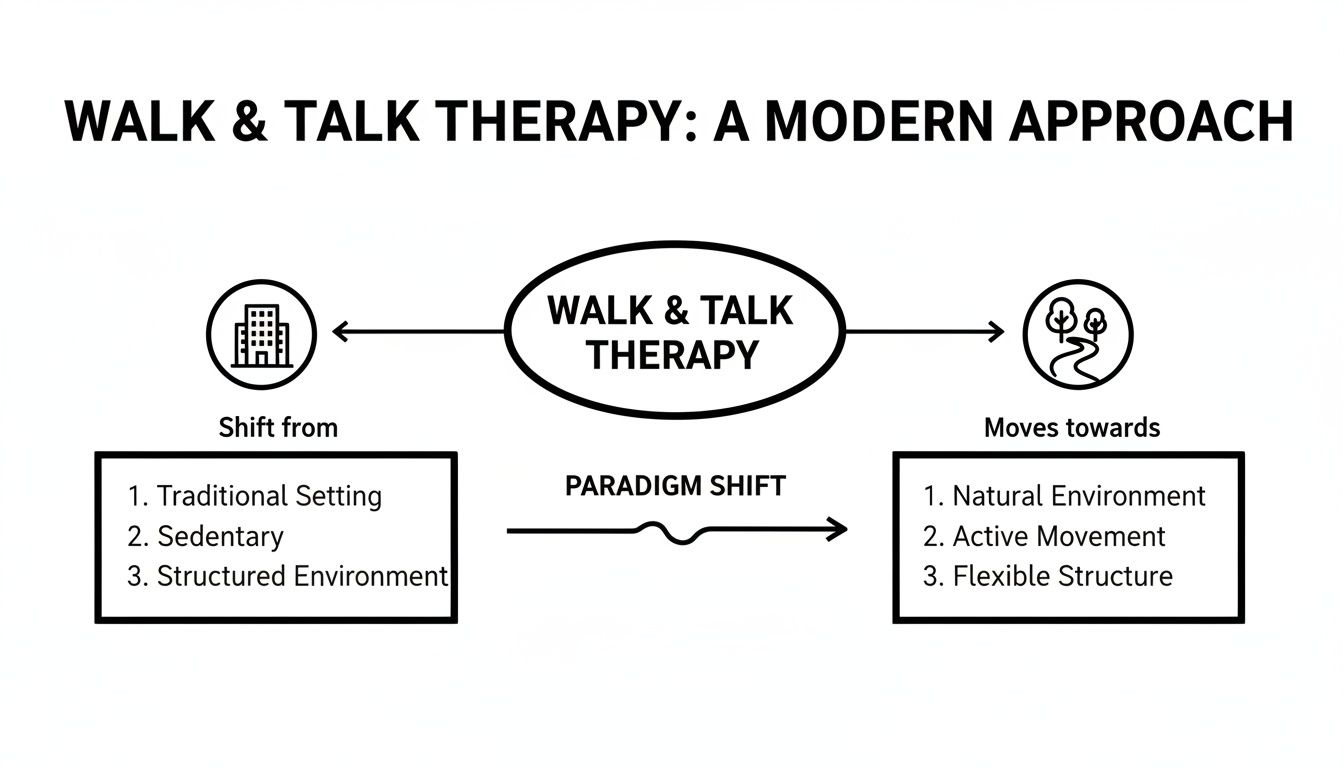
As the diagram shows, it’s about moving away from the confines of four walls and towards the open, expansive potential that nature offers.
To give you a clearer picture, let's compare the two approaches directly.
Walk and Talk Therapy vs Traditional Therapy
Feature | Traditional Office Therapy | Walk and Talk Therapy |
|---|---|---|
Setting | A private, indoor office. | An outdoor, natural environment like a park or trail. |
Physical Activity | Sedentary, sitting face-to-face. | Light physical activity (walking). |
Client-Therapist Dynamic | Often formal, with direct eye contact. | More informal and collaborative, walking side-by-side. |
Conversation Flow | Structured and focused, minimal external distractions. | Can be more fluid, with conversation sparked by the environment. |
Body Language | More constrained and potentially harder to read. | More relaxed and open; physical movement can release tension. |
Sensory Experience | Limited to the sights and sounds of the office. | Multi-sensory, involving nature, fresh air, and movement. |
This table highlights how the environment and physical state are not just backdrops for therapy, but active components that can shape the entire experience.
Who Benefits from This Approach?
While many people find this style of therapy refreshing, it can be a particularly good fit for certain individuals. It’s often incredibly helpful for those who:
Feel anxious, restless, or confined in a traditional office setting.
Find it easier to think and talk while moving their body.
Struggle with direct, prolonged eye contact, finding it too intense.
Want to incorporate gentle physical activity into their mental health care.
Are feeling 'stuck' in their therapeutic progress and need a fresh perspective.
Ultimately, walk and talk therapy is a powerful alternative that blends professional counselling with the restorative effects of nature and movement. It creates a unique space where you can find new paths towards growth and healing, both literally and figuratively.
The Evidence Behind Outdoor Therapy

The idea of taking therapy outside is certainly appealing, but its value goes far beyond just a simple change of scenery. Walk and talk therapy isn't just a pleasant alternative to sitting in an office; it’s a credible and powerful therapeutic method backed by a growing body of scientific evidence. It works because it brings together professional counselling, gentle physical movement, and the quiet, restorative power of the natural world.
This whole approach is rooted in a field known as ecotherapy, which looks at the deep, almost primal connection between our mental health and the environment around us. Study after study has shown that spending time in nature genuinely improves our wellbeing. When you pair that with the proven benefits of therapy, the results can be really profound.
The Science of Movement and Mind
At the heart of walk and talk therapy is the simple link between moving your body and processing your thoughts. The rhythmic, steady act of walking does more than just get your blood pumping; it actually stimulates your brain. That bilateral (left-right) motion can help you work through difficult emotions and memories, creating space for new perspectives to surface.
This can be incredibly helpful when you're trying to dislodge those stubborn, negative thought patterns. When we feel 'stuck' in our heads, our thinking can become rigid and repetitive. The simple forward momentum of walking encourages a more fluid, flexible mindset, making it that much easier to look at old problems in a new light. If you're interested in how physical activity helps with mental wellbeing, you can explore the therapeutic effects of exercise on anxiety.
The simple act of walking side-by-side with a therapist can change the entire dynamic of a session. It fosters a sense of partnership and shared journey, making it easier to navigate difficult emotional terrain together.
For many people, this collaborative feeling is exactly why they find it easier to open up and talk freely during an outdoor session.
Physiological and Psychological Benefits
Walking outdoors does more than just stimulate your mind; it triggers a whole cascade of positive changes in your body. These biological shifts create a solid foundation for effective therapeutic work.
Some of the key benefits include:
Reduced Cortisol Levels: Being in green spaces has been proven to lower levels of cortisol, our main stress hormone. This naturally creates a calmer state, which is much more helpful for a therapeutic conversation.
Endorphin Release: Gentle physical activity releases endorphins—the body's natural mood boosters. This can help lift your spirits and reduce feelings of anxiety or low mood.
Increased Vitamin D: Getting out in the natural sunlight helps your body produce Vitamin D, which plays a vital role in regulating mood and overall mental health.
These physical advantages go hand-in-hand with the psychological impact of being in nature. Simply stepping out of a clinical setting and onto a park trail can feel liberating. You can dive deeper into the specific ways nature supports emotional wellbeing by reading about the mental health benefits of nature in our other article.
Proven Success in the Real World
This isn't just theory, either. The effectiveness of walk and talk therapy has been put to the test in the real world. A groundbreaking pilot programme by The Living Well Consortium, part of the NHS Talking Therapies service in Birmingham and Solihull, saw some impressive results. Monitoring showed that 58% of clients achieved recovery from depression and anxiety after just 8 to 12 sessions.
That figure is significant because it surpassed the NHS benchmark of 50% for all talking therapies, and it led to the service being adopted permanently. You can read more about these encouraging findings on the BACP website. This kind of real-world success story confirms that walk and talk therapy is a legitimate and highly effective mental health service.
Why Taking Therapy Outside Is So Effective
So, what is it about walking alongside a therapist that can be so powerful? Taking therapy sessions out of the traditional four walls isn't just a gimmick or a simple change of scenery. It's about bringing together psychological, physical, and even neurological elements that work in concert to support your mental wellbeing.
The real magic happens in the blend of movement, nature, and a subtle but important shift in the therapeutic relationship itself.
Psychological Comfort and Connection
One of the first things people notice is the change in dynamic. In an office, you're often sitting face-to-face, which can feel a bit intense—even confrontational—especially when you’re digging into difficult topics.
Walking side-by-side naturally dials down that pressure. It creates a sense of partnership, of being on a shared journey. You’re both literally and metaphorically moving in the same direction. For many, this simple change makes it much easier to open up and speak freely, building a stronger, more collaborative connection with their therapist.
This setup is particularly helpful for anyone who finds sustained eye contact a challenge. The focus can shift from each other to the path ahead or the surrounding nature, allowing conversations to flow more naturally without that feeling of being under a microscope.
The Physical Boost to Your Mental State
The link between gentle exercise and a better mood is well-established. Even a simple stroll can trigger the release of endorphins, your body's natural mood-lifters, which helps to ease feelings of depression and anxiety.
At the same time, this physical activity helps lower cortisol, the body’s main stress hormone. Spending time in green spaces has also been shown to have a deeply calming effect on the nervous system, creating a more relaxed state that is perfect for therapeutic work. Understanding the profound impact of physical activity on mental well-being can really shine a light on why this approach works so well.
Beyond the immediate chemical changes, there are other physical wins:
Exposure to Natural Light: Being outdoors helps to regulate your circadian rhythm, which can lead to better sleep. It also boosts your body's production of Vitamin D, a nutrient absolutely vital for mood regulation.
Reduced Tension: When we feel anxious or stressed, our bodies often hold that tension physically. The simple act of walking can help release this stored-up energy, allowing you to feel more relaxed and present in the moment.
In walk and talk therapy, the body isn't just carrying the mind; it becomes an active participant in the healing process. The rhythm of walking can unlock thoughts and feelings that might have remained dormant in a static, indoor setting.
This mind-body integration is a core reason why outdoor sessions often lead to significant breakthroughs. The gentle forward motion helps unstick rigid thought patterns, allowing new insights to bubble to the surface. For a closer look at this, our guide on walking as therapy explores this connection in more detail.
A Touch of Neurological Magic
There’s also something fascinating happening inside your brain when you walk. The rhythmic, left-right motion is a form of bilateral stimulation, which simply means it alternately stimulates the left and right hemispheres of your brain.
This process is actually a core principle behind other respected therapies, like EMDR (Eye Movement Desensitisation and Reprocessing), which is known for being highly effective in processing trauma. As you walk, your brain is gently engaged in this bilateral activity, which can help it process difficult memories, emotions, and experiences more effectively.
It's as if the steady rhythm of your steps provides a grounding, organising influence on your thoughts. This makes it easier to sort through complex feelings without becoming overwhelmed, showing that sometimes, the simplest actions can create the most profound changes.
What to Expect From Your First Walk and Talk Session
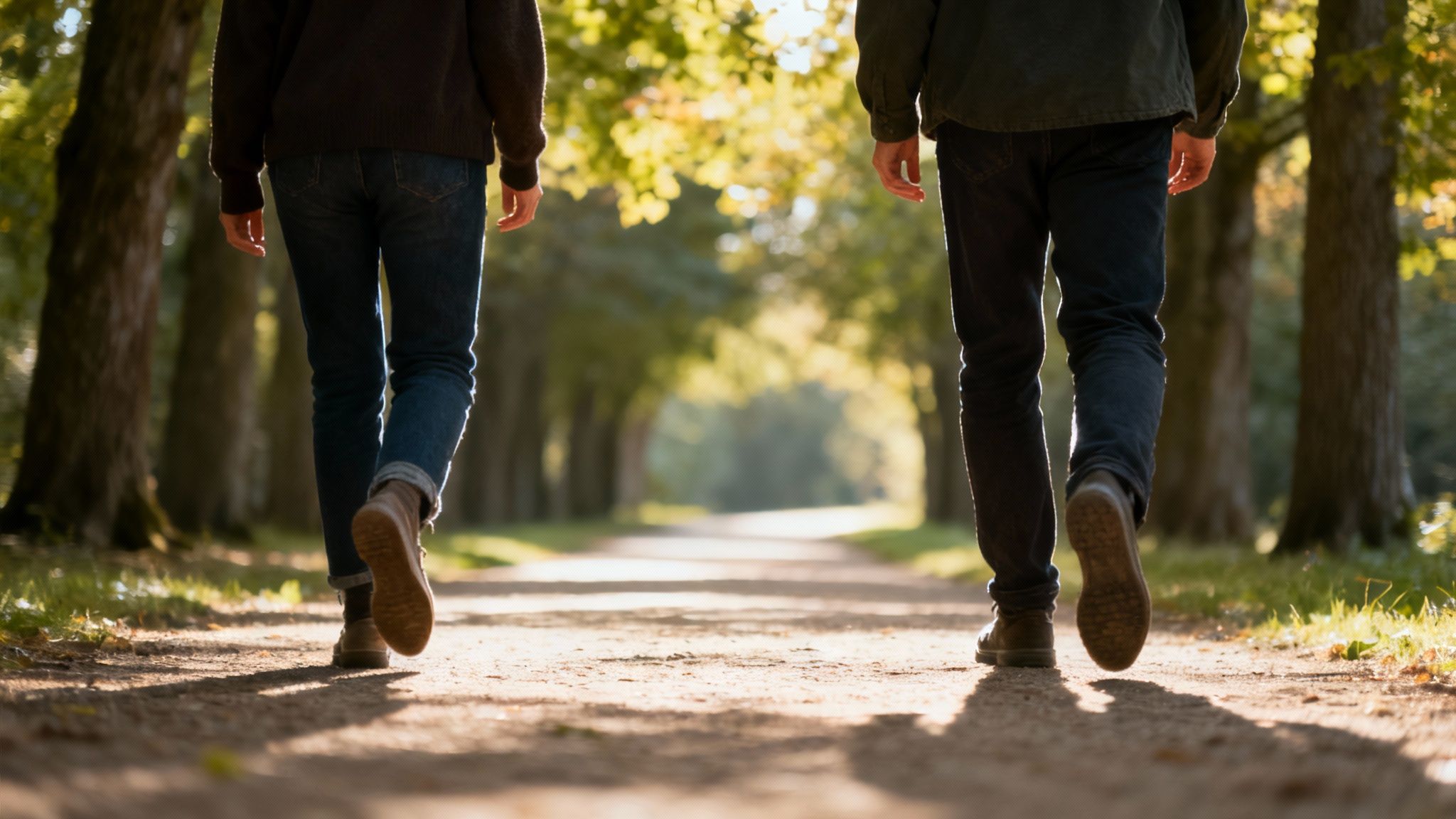
The idea of your first outdoor therapy session might feel a little strange, but knowing what’s involved can help put you at ease. The whole point of a walk and talk therapy session is for it to feel comfortable and collaborative right from the start.
In reality, the session begins before we even take our first step. We’ll have a quick chat beforehand to agree on a meeting spot, a rough route, and how long we’ll walk for. The priority is always creating a space where you feel completely safe and relaxed.
Setting the Scene: The Logistics
Before we meet, we’ll sort out a few practical details. This isn’t just about turning up at a park; it's about having a clear, professional framework for our work, just as we would in a therapy room.
We’ll decide on:
A Meeting Point: We’ll pick a specific, easy-to-find spot to kick things off.
The Route: We’ll agree on a path together, usually a simple loop or a back-and-forth route in a reasonably quiet park or green space.
Contingency Plans: What if it pours with rain? We’ll have a backup plan sorted, whether that’s rescheduling, switching to a video call, or finding a sheltered spot.
Confidentiality is the bedrock of therapy, and that doesn’t change just because we’re outside. We’ll manage this by sticking to less-crowded paths and being aware of who’s around us. If we do approach a busier area, we can simply press pause on the conversation until we have privacy again. Your comfort is what matters most.
Finding a Comfortable Pace
It’s really important to remember that this is a therapy session that happens to involve walking, not a fitness class. The pace is always set by you. It will be gentle, easy, and slow enough to allow for a proper chat without anyone getting out of breath.
The aim isn't to cover a certain distance. The rhythm of walking is just there to support the conversation, not distract from it. We can stop, sit on a bench, or slow right down whenever you feel the need. The physical movement takes a backseat to the emotional work we're doing together.
The emphasis is always on the conversation, not the exercise. The gentle, rhythmic movement is simply a tool to help facilitate a deeper, more natural flow of thoughts and feelings.
This flexible approach keeps the focus squarely on your needs. Many of the core principles are the same as in traditional therapy, so for a bit more context, you might find our guide on what happens in counselling sessions helpful.
How the Conversation Flows
Often, the conversation feels more fluid and natural in a walk and talk session. Moving side-by-side, rather than sitting face-to-face, can make it easier to open up about difficult topics. Plus, the natural surroundings can provide unexpected prompts for reflection.
For example, we might come to a fork in the path, which could act as a simple metaphor for a decision you're facing. Or we might notice a resilient old tree that’s weathered countless storms, sparking a chat about your own strength.
These moments aren’t forced; they just happen organically as we walk. This unique way of interacting with the environment can unlock fresh perspectives that might not have surfaced inside four walls. By the time our session ends, the goal is for you to feel heard, supported, and maybe just a little clearer on the path ahead.
Is Walk and Talk Therapy Right for You?

The idea of therapy in the great outdoors sounds appealing, but it's fair to ask if it's the right fit for your own journey. Walk and talk therapy isn't some magic cure-all, but for certain people and the specific challenges they’re wrestling with, it can be incredibly powerful.
Let's explore who tends to get the most out of this approach. Figuring this out can help you decide if swapping a therapist's office for a park trail could be the breakthrough you need. For some, it’s a refreshing change of pace; for others, it’s the very thing that makes therapy feel possible for the first time.
When Life Feels Overwhelming
Walk and talk therapy really shines when people are navigating a rough patch. There's a special kind of alchemy that happens when you combine gentle movement, professional support, and the quiet calm of nature.
It’s often a brilliant option for those dealing with:
Anxiety: The simple act of walking can help burn off that restless, anxious energy. It grounds you in the here and now, which can make those spiralling thoughts feel a lot more manageable.
Depression: We all know that movement can be a natural mood-lifter. Getting outside helps fight the lethargy and isolation that so often go hand-in-hand with depression.
Grief and Loss: When you're grieving, sitting still with your pain can feel almost impossible. Walking offers a gentle sense of forward motion, a feeling of progress even when you feel emotionally stuck.
Major Life Transitions: Facing a career change, the end of a relationship, or another big life shift? Walking can help untangle complicated thoughts and bring a bit of clarity to the path ahead.
The magic is in the connection between mind and body. The physical act of moving forward often seems to mirror the psychological progress we're all hoping to make.
For Those Who Dislike the Office Setting
Let's be honest, not everyone thrives in a traditional therapy room. For some, those four walls can feel a bit claustrophobic, and the direct, face-to-face intensity can be a bit much.
Walk and talk therapy provides a fantastic alternative for anyone who finds the conventional setup a bit of a barrier. This is especially true for:
Adolescents and Young Adults: Younger people often find the side-by-side, less formal dynamic of a walk far less intimidating than a stuffy office appointment.
Men: Some men find it much easier to open up about difficult feelings while doing something active. It can feel less direct and more like a collaboration.
Anyone Feeling 'Stuck': If you’ve tried therapy before and felt like you hit a brick wall, changing the scenery can be just the thing to get the conversation flowing again.
It’s about more than just a change of scenery; it's about creating a therapeutic space that feels natural, accessible, and less pressured, allowing for deeper and more honest conversations.
This shift helps reconnect the mind and body, allowing you to process feelings physically, not just in your head.
A Therapist's Perspective on Its Power
Therapists who offer this service are big believers in its value. A study of 32 UK-based therapists found they rated walk and talk therapy as hugely beneficial for their clients. It was seen as particularly effective for "unsticking" the process, where physical movement helped cement cognitive and psychological breakthroughs.
While some therapists mentioned that clients could be slow to try it at first, those who did often found they could open up more freely, strengthening that all-important mind-body connection. You can read more about the study’s findings on walk and talk therapy here.
Ultimately, if you’re someone who thinks better on your feet, finds peace in nature, or just feels that a formal office isn't the right place for you to heal, walk and talk therapy could be a perfect fit.
Your Questions About Walk and Talk Therapy Answered
It’s completely normal to have a few questions before trying any new approach to therapy. Getting those questions answered is the first step to feeling comfortable and ready to begin.
So, let's get into some of the most common queries I hear about walk and talk therapy. My aim here is to give you clear, straightforward answers so you know exactly what to expect.
What Happens If the Weather Is Bad?
This is probably the most practical, and most frequently asked, question of them all. Don’t worry, every therapist offering outdoor sessions has a plan for bad weather. After all, we do live in the UK!
This is something your therapist will chat through with you right at the start. The usual options are:
Switching to an online or phone session for that week, so you don’t have to miss out.
Rescheduling the session to another day when the weather is looking a bit kinder.
Meeting in a quiet, sheltered public spot that you’ve both agreed on beforehand, like a peaceful café or a covered walkway, if it feels right.
Some people even find walking in a bit of light rain quite refreshing, as long as you’ve got the right waterproofs on. The main thing to remember is you’ll never be left wondering what to do; a bad-weather plan will be sorted from day one.
How Is Confidentiality Maintained Outdoors?
Confidentiality is the absolute cornerstone of good therapy, and that doesn’t change just because we’ve stepped outside. Therapists are really skilled at managing conversations in public spaces to make sure your privacy is protected.
This comes down to a few careful considerations:
Choosing the right route: Paths are specifically picked because they’re less busy, offering much more privacy than a crowded park or high street.
Situational awareness: Your therapist is always aware of who’s around. If someone gets close, they might naturally pause the conversation, lower their voice, or just shift to a more neutral topic for a moment until they've passed.
Setting boundaries: You and your therapist will agree on clear signals and boundaries so that you always feel the conversation is private and secure.
Maintaining your privacy is paramount. The therapeutic space we create outdoors is managed with the same professional care and ethical standards you'd find in a traditional therapy room. Your sense of safety is never compromised.
It's this careful planning that allows the great outdoors to become a safe, confidential space for our work together.
Do I Need to Be Physically Fit?
Not at all. This is a really important one to clear up: this is therapy that involves walking, not a fitness session. The whole point is the conversation and your emotional wellbeing, not how fast or how far you can walk.
The pace is always set by you, and it’s usually just a gentle, comfortable stroll. There’s zero pressure to cover a certain distance or keep up a particular speed. We can stop for a rest on a bench whenever you like, or just pause to take in the view.
Routes are chosen to be accessible for all fitness levels. Before we even head out for the first time, we'll talk about any physical health concerns or limitations you might have to make sure the location is a perfect fit for you. The walking part is there to help the therapy, never to get in the way of it.
How Do I Find a Walk and Talk Therapist in the UK?
Finding a qualified therapist who offers walk and talk therapy is more straightforward than you might think. A great place to start is with the directories of professional therapy bodies.
Here’s where I’d suggest you look:
Professional Directories: Websites like the BACP (British Association for Counselling and Psychotherapy) or the Counselling Directory have brilliant search functions. You can often filter your search for therapists who specialise in 'outdoor therapy' or 'walk and talk'.
Therapist Websites: Many therapists, myself included, will mention this on their own websites. A quick search for therapists in your local area along with the phrase "walk and talk therapy" should bring up some good options.
Confirm Qualifications: It’s really important to make sure any therapist you choose is fully qualified and has the right insurance to work outdoors. Don't feel awkward about asking them directly about this.
As the person behind this blog, I’m obviously a huge advocate for this way of working. You can find out more about my own professional walk and talk therapy services over on my About Me page.
At Therapy-with-Ben, my goal is to provide a supportive and flexible therapeutic journey that works for you. If walk and talk therapy sounds like it could be the right path, I’d love to hear from you. You can learn more about how we can work together at https://www.therapy-with-ben.co.uk.
Walk-and-Talk Highlight
Interested in something a little different? Discover the benefits of walk-and-talk therapy in Cheltenham’s green spaces, or read more about me and my approach. If you’re ready to start, get in touch to arrange a free introductory call.


Comments