


What Is Acceptance and Commitment Therapy?
Acceptance and Commitment Therapy, or ACT for short, is a really practical, evidence-based way of looking at things that helps you build a life that feels rich and meaningful. Instead of trying to wage war on painful thoughts and feelings, it’s all about learning to change your relationship with them. This frees you up to live a life guided by what actually matters to you.
A New Way to Approach Your Inner World
Ever feel like you’re stuck in a battle with your own mind? Wrestling with anxiety that just won't quit, persistent self-doubt, or memories that keep bubbling up? A lot of therapies focus on challenging or trying to change these thoughts. ACT, however, offers a different path. It works from the idea that the endless struggle against our inner experiences is often what causes the real suffering.
Think of it like this: imagine you're on a long journey, but you're constantly fighting the weather. You can't stop the rain, can you? But you can learn to pop up an umbrella and keep walking towards your destination. ACT gives you that 'umbrella' – a set of skills to handle the internal storms without them bringing your whole life to a standstill.
This approach helps you to:
Stop that exhausting tug-of-war with your own thoughts and emotions.
Free up precious energy to focus on what genuinely makes your life better.
Keep moving forward, even when discomfort is part of the journey.
What Is the Goal of ACT?
The main aim of ACT is to increase your psychological flexibility. This is a bit of a fancy term, but all it really means is the ability to stay present and open to whatever you’re experiencing – the good and the bad – while taking meaningful action towards what you value. Put simply, it’s about being able to feel your feelings and think your thoughts without them calling all the shots.
Rather than trying to win the war against your mind, ACT teaches you to step out of the battlefield altogether. You learn to observe your inner world with a bit of curiosity and kindness, creating a life filled with purpose, not just a life free from pain.
A big part of this is developing mindfulness skills. You can learn more about how mindfulness works in therapy in our guide. By building up this psychological flexibility, you get the freedom to choose your actions based on your deepest values, rather than just reacting to every fleeting thought or fear that pops into your head.
The Six Core Skills of Psychological Flexibility
At its heart, Acceptance and Commitment Therapy is all about building psychological flexibility. This isn't one single skill you learn overnight. Instead, think of it as a set of six interconnected abilities that work together, much like the different muscles you use to keep your balance on uneven ground.
This set of skills is often shown as a hexagon—the 'Hexaflex'—where each point represents one of these core processes.
Developing these skills helps you unhook from those sticky, difficult thoughts, become more engaged with your life right now, and take action that actually matters to you, even when things feel tough. These aren't rigid steps to master in a particular order; they’re more like a fluid set of practices you can draw on whenever you need them.
This flowchart shows how the core goal of ACT is to nurture this flexibility, learning to accept what’s out of your control so you can commit to actions that genuinely improve your life.
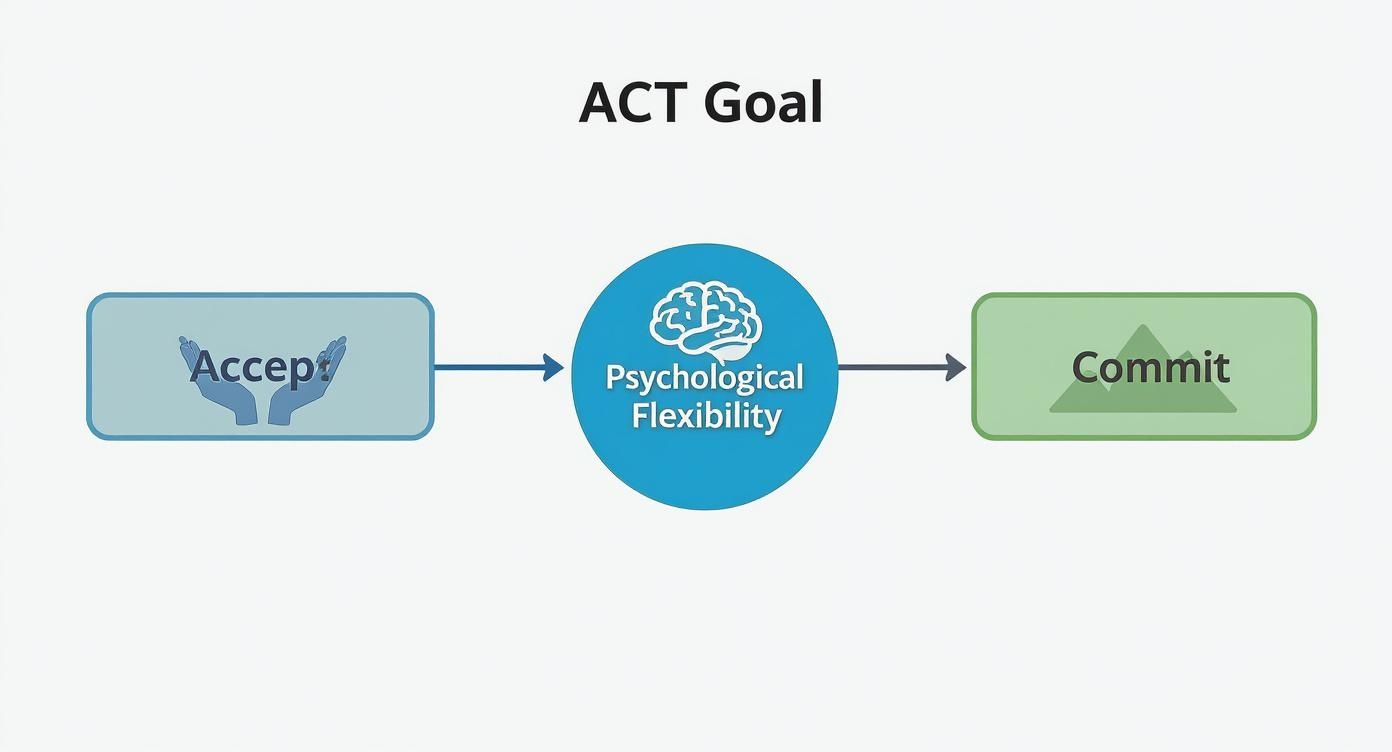
As the image shows, psychological flexibility is the bridge between accepting your internal world (thoughts and feelings) and committing to meaningful action in your external world.
Learning to Watch Your Thoughts
One of the first skills we often explore is Cognitive Defusion. This is really about changing the relationship you have with your own thoughts. Instead of treating your thoughts as absolute truths or commands you have to obey, defusion helps you see them for what they really are: just words, images, and sounds passing through your mind.
Imagine your thoughts are like clouds floating across the sky. You are the sky—vast and always there. You can learn to just watch the clouds (your thoughts) drift by without getting swept up in them or becoming the storm. This creates a bit of breathing room, giving you the freedom to choose how you want to respond.
Another key part of this is Acceptance, a word that often gets misunderstood. It doesn't mean you have to like the pain or just give up. It’s about making room for uncomfortable feelings, sensations, and urges without wrestling with them. It’s an active choice to open up and allow these experiences to be there, simply because they already are.
In ACT, acceptance is not about resignation. It’s about ceasing an unwinnable war with your inner world so you can invest your energy in building a life that truly matters to you.
Connecting with the Now and Your Values
To guide your actions, you need a sense of direction. This is where your Values come in. Values aren't goals to be ticked off a list; they are the core principles that give your life meaning, like kindness, connection, or creativity. Getting clear on your values gives you a compass to guide your choices.
Hand-in-hand with values is Committed Action. This is about taking small, consistent steps in a direction that your values point you towards, even when it feels difficult. It’s about doing what matters, turning your values from abstract ideas into real-world behaviour.
Finally, two mindfulness-based skills help anchor the whole process:
Being Present: This is simply the skill of bringing your full attention to the here and now. Instead of getting lost in past regrets or future worries, you learn to connect with your life as it’s actually happening, moment by moment.
Self-as-Context: This helps you connect with the part of you that simply observes your experiences—the "observing self." It’s that consistent, stable part of you that watches your thoughts, feelings, and sensations come and go, helping you realise you are much more than just your struggles.
A growing mountain of research confirms how powerful these skills are. The global focus on ACT has led to a huge increase in studies over the last 15 years. Analysis shows that alongside ACT itself, the most common topics in research papers include cognitive behavioural therapy, depression, and the core skill of acceptance. You can read the full research about ACT's growth in publications here.
By practising these six core skills, you build the psychological flexibility needed to navigate life’s challenges and create a rich, meaningful existence.
How ACT Can Help With Anxiety and Depression
It’s one thing to get your head around the theory of ACT, but what does it actually do? How does it help in the real world when you're struggling? This is where ACT really comes into its own, offering a compassionate and genuinely practical way to handle challenges like anxiety and depression.
The big shift with ACT is that we stop trying to get rid of these feelings. Instead, we learn to change our relationship with them. This move away from a constant, exhausting internal battle can feel incredibly liberating. It’s about putting your energy into building a life you care about, even when those difficult emotions show up.
Finding Freedom from Anxiety
For so many people, living with anxiety is like being stuck in a never-ending tug-of-war. You’re on one side, pulling with all your might to get rid of the anxious thoughts and physical sensations. And on the other side? Anxiety, pulling back just as hard. It’s draining, and frankly, it doesn't work. The more you fight, the more tangled up you get.
ACT asks a simple question: what if you just dropped the rope?
This isn't about giving up or letting anxiety win. It’s a conscious choice to step out of the struggle. When you accept that anxious feelings are going to pop up from time to time, you reclaim a huge amount of mental and emotional energy.
Dropping the rope in your struggle with anxiety allows you to redirect your energy from fighting your feelings to engaging with your life. You can then learn how to take your anxiety along for the ride, rather than letting it drive.
Suddenly, all that energy can be channelled into things that actually matter to you, helping you move towards your goals even when you feel afraid. If you'd like to read more on this, I've put together a guide on 5 ways therapy can help you manage anxiety.
Navigating the Weight of Depression
Depression can feel incredibly heavy. It often makes you want to withdraw and brings a total loss of motivation, shrinking your world until even the smallest jobs feel like climbing a mountain. ACT offers a compass to help you find your way out of that stuckness, even when you really don't feel like it.
That compass is built from your own values. We work together to get clear on what’s truly important to you – things like connection, creativity, kindness, or learning. This gives you a sense of direction that doesn’t rely on waiting for your mood to improve or for motivation to strike.
Your values become your guideposts. For example:
If you value connection, a small, committed action might be sending one text to a friend, even when you feel like isolating yourself.
If you value health, you might commit to a five-minute walk outside, even when your body feels heavy and sluggish.
We’re not doing these things to ‘fix’ the depression. We’re doing them to live a life that matters alongside the depression. Over time, these small steps build momentum and help you reconnect with a sense of purpose.
ACT is also incredibly helpful for other challenges, from managing chronic pain and high stress levels to helping neurodivergent individuals navigate difficult emotional and sensory experiences. The focus is always the same: building a life that feels authentic and works for you.
By Therapy-with-Ben
Practical ACT Exercises You Can Try Today
Getting your head around the ideas behind Acceptance and Commitment Therapy is one thing, but the real magic happens when you start to actually do it. ACT is what we call an experiential therapy, which is just a fancy way of saying you learn by doing. These simple but surprisingly powerful exercises can give you a real taste of how to build psychological flexibility in your own life.
You don't need any special kit or to block out hours in your diary. All you need is a bit of willingness to get curious about what’s going on inside your own head. These are techniques you can use right in the middle of a difficult moment, whenever you feel stuck, overwhelmed, or like you've lost touch with what really matters to you.

The Leaves on a Stream Exercise
This is a classic exercise for what ACT calls 'cognitive defusion'. It’s all about helping you change the relationship you have with your thoughts. Instead of getting tangled up and wrestling with them, you learn to step back and just watch them float by.
How to do it:
Find a comfortable spot to sit, gently close your eyes, and just take a few easy breaths.
Imagine you're sitting beside a slow-moving stream. Picture leaves of all shapes, sizes, and colours drifting along on the surface.
As each thought pops into your head – a worry, a memory, a self-criticism, anything at all – just gently place it on one of the leaves and watch it float on by. You're not trying to push the leaf or get rid of it.
Simply watch as it appears, drifts past, and eventually disappears down the stream. If you find your mind has wandered off, that’s perfectly normal. Just notice it, and gently bring your focus back to the stream.
The point here isn’t to empty your mind. It's to practise letting your thoughts come and go without letting them drag you down the stream with them.
Finding Your Values Compass
This next exercise is about connecting with what is genuinely important to you, deep down. Think of it like creating an inner compass that can help guide your choices and actions. Values aren't goals you tick off a list; they are the qualities you want to bring to how you live your life, moment by moment.
Think back to a time when you felt truly alive, proud of yourself, or deeply fulfilled. What were you doing? And more importantly, what personal qualities were you showing up with?
Your values are your chosen life directions. They provide the 'why' behind what you do, giving you a source of motivation that isn't dependent on how you happen to feel.
Ask yourself what really matters in these parts of your life:
Relationships: What kind of partner, friend, or parent do you want to be? (e.g., caring, present, supportive, fun)
Work/Personal Growth: What qualities matter to you in your work or learning? (e.g., creativity, diligence, curiosity)
Wellbeing: How do you want to treat yourself and your body? (e.g., with kindness, patience, energy)
Jot down a few key words for each area. This isn't about setting rigid goals, but about clarifying the direction you want to head in.
Dropping Anchor in a Storm
When you're hit by a sudden storm of difficult emotions or thoughts, it’s so easy to get swept away. The 'Dropping Anchor' technique is a quick-fire grounding exercise to help you find a bit of stability in just a few moments.
Just remember the acronym ACE:
Acknowledge: Silently and kindly notice what’s happening inside you. You could say to yourself, "Anxiety is here," or "My mind is racing right now."
Connect: Gently push your feet into the floor. Feel the solid ground beneath you. Stretch your hands, press your fingertips together, or look around the room and name five things you can see. This brings you back into your body and the physical world.
Engage: Notice where you are and what you're doing. Ask yourself, "What's one small thing I can do right now that aligns with my values?" It could be as simple as taking a single deep breath, finishing the email you were writing, or really listening to the person in front of you.
This exercise doesn't make the storm magically disappear. What it does is help you anchor yourself within it, so that you can stay in control of your actions, not your feelings.
By Therapy-with-Ben
What to Expect From an ACT Therapy Session
Stepping into therapy for the first time, or even just trying a new approach, can leave you feeling a bit uncertain. What actually happens in an ACT session? Will I have to spend ages talking about my past? It's completely natural to have questions, and hopefully I can demystify the process a little bit and help you feel more comfortable.
An ACT session is an active, collaborative experience. While understanding your history can be useful, the main focus isn't on endlessly analysing the past. Instead, we concentrate on the here and now, exploring what you can do differently to build a more fulfilling life, starting today.

A Collaborative and Experiential Approach
Think of me not as an expert who has all the answers, but as a guide or a coach. I'm here to walk alongside you, helping you develop the skills of psychological flexibility. The sessions are often experiential, which really just means we'll do more than just talk.
We might use:
Metaphors and stories to illustrate key ideas in a way that sticks.
Mindfulness exercises to help you connect with the present moment.
Values-clarification conversations to get to the heart of what truly matters to you.
The aim is to help you change your relationship with difficult thoughts and feelings. We're creating space for you to take actions that genuinely enrich your life. For a broader overview, you might also find our guide on what happens in counselling sessions helpful.
Structure and Flexibility in ACT
Like any good therapeutic approach, our ACT journey will often involve a structured plan that acts as a roadmap for your progress and goals. If you're curious about what these can look like, there are many helpful structured treatment plan examples online that show how therapy can be organised.
But while ACT provides a clear framework, it's also incredibly adaptable. Research into ACT programmes in the workplace shows that real benefits can be achieved with flexible delivery. On average, these interventions are delivered over just 4.6 sessions, with an average contact time of only 10.4 hours, showing that even brief, focused work can be powerful.
A key takeaway is that ACT sessions are not passive. They are an active, supportive space for you to learn new skills, clarify your direction, and start building a life you value, one committed step at a time.
This flexibility means ACT works effectively in different formats. Whether we meet face-to-face here in Cheltenham, connect through online therapy from the comfort of your own home, or even head outdoors for a Walk-and-Talk session, the core principles stay the same. The goal is always to create a supportive environment for your journey towards greater wellbeing.
Your Questions About ACT Answered
We're nearing the end of our deep dive into Acceptance and Commitment Therapy, and it's completely normal if you still have a few things you're mulling over. To tie everything together, I've gathered some of the most frequent questions I get asked about ACT. My aim is to give you clear, straightforward answers to round out your understanding.
How Is ACT Different From CBT?
This is a brilliant question, particularly since ACT is technically a 'third-wave' Cognitive Behavioural Therapy. They’re from the same family, but their approaches to the mind are worlds apart.
Traditional CBT often works by helping you identify, challenge, and ultimately change thoughts it labels as unhelpful or irrational. It essentially trains you to be a detective, scrutinising your thoughts for evidence and correcting them where they seem 'wrong'.
ACT takes a different path entirely. Instead of trying to change the thought itself, the focus is on changing your relationship with it. You learn to step back, notice thoughts as they come and go, and let them pass without getting pulled into an argument. The goal isn't to get rid of difficult thoughts, but to drain them of their power over your actions, freeing you up to live by your values.
Think of it like this: CBT might teach you how to argue with a bully to make them go away. ACT teaches you how to let the bully shout from the sidelines while you calmly keep walking in the direction that truly matters to you.
Does ‘Acceptance’ Just Mean Giving Up?
Not at all. This is probably the single biggest misconception about ACT, and it’s an important one to clear up. In everyday conversation, 'acceptance' can sound a lot like resignation or defeat, but in the world of ACT, it’s an act of courage and strength.
Acceptance here means making a conscious choice to allow your difficult internal experiences—your thoughts, feelings, and physical sensations—to just be there, without fighting them. It’s not about liking the pain or being happy about it; it’s about dropping the exhausting tug-of-war against it. You stop pouring precious energy into an unwinnable internal battle so you can invest that same energy in building a life you care about.
For instance, you can accept the knot of anxiety in your stomach while still taking the committed action of walking into that important job interview. You’re accepting the feeling, not giving up on your career.
Who Can Benefit From ACT?
Because ACT is built around universal human experiences—like dealing with painful thoughts and wanting to live a meaningful life—its principles can genuinely help almost anyone. It has proven to be highly effective for a whole range of specific challenges, including anxiety disorders, depression, chronic pain, and just managing day-to-day stress.
But its usefulness goes much further. ACT is incredibly helpful for anyone who simply feels 'stuck' or wants to build more resilience and live a life that feels more authentic. It’s also particularly effective for neurodivergent individuals. It offers practical, non-judgemental strategies for navigating emotional and sensory sensitivities while focusing on unique strengths and what truly matters to you.
Is ACT a Long-Term Therapy?
The length of time someone spends in ACT is completely flexible; it’s always tailored to your specific needs and goals. One of its greatest strengths is that it's not a one-size-fits-all model. Some people find they can grasp the core skills and see significant changes in their lives in a relatively short number of sessions.
Others might find a longer-term approach more beneficial, giving them the space to explore their values more deeply and weave these new skills into every corner of their life. The ultimate aim is to equip you with a practical toolkit that you can use on your own, long after our sessions have finished. It's less about creating dependency on therapy and more about fostering your own lifelong psychological flexibility.
By Therapy-with-Ben
If you're in the Cheltenham area and feel that Acceptance and Commitment Therapy could be the right path for you, Therapy with Ben is here to help. I offer a supportive, non-judgemental space to explore these skills, whether that’s face-to-face, online, or through Walk-and-Talk therapy. Reach out today to begin your journey.


Comments