


One Sided Relationship: Spot a one sided relationship and Reclaim Balance
Updated: Oct 3
A one-sided relationship is where you find yourself doing all the heavy lifting. You're the one putting in the time, the emotional energy, and the effort, while the other person... well, they just don't. It's a deep imbalance that can quietly chip away at your confidence and happiness without you even realising what's happening.
What a One-Sided Relationship Actually Feels Like
Let's set aside the clinical definitions for a second. A one-sided relationship is less about a checklist of behaviours and more about a constant, nagging feeling in your gut that something just isn't right. It’s that strange ache of loneliness you feel even when you’re sitting right next to your partner. It’s the sense that you're holding up the entire connection by yourself.
Picture your relationship as a seesaw. In a healthy partnership, both people push off the ground, taking turns lifting each other. There’s a natural rhythm, a give-and-take. In a one-sided relationship, you're the only one pushing. All your energy goes into trying to lift your partner, but you stay stuck on the ground, never getting that feeling of being lifted up yourself. And that is utterly exhausting.
The Slow Erosion of Self
This kind of imbalance rarely appears overnight. It usually creeps in through small, almost unnoticeable moments. Maybe you're always the one to send the first text, to plan your time together, or to apologise after a disagreement just to keep the peace. At first, it's easy to explain it away—you're just the more easy-going one, right?
But over time, these little patterns harden into a draining reality. Your needs get pushed aside, and your emotional well is never refilled. You can start to question yourself, wondering if you're being too needy or asking for too much. This slow corrosion of your self-esteem is one of the most damaging parts of a lopsided relationship. You begin to feel invisible. For many, this leads to profound feelings of isolation; you can learn more about how to overcome loneliness in a relationship in our dedicated guide.
Herein lies the core paradox of a one-sided relationship: you can be completely committed to someone and still feel utterly, painfully alone. The emotional investment only flows one way, leaving you feeling less like a partner and more like an accessory in someone else's life.
It's a profoundly confusing place to be. You might still love your partner, but that constant sense of being undervalued creates a deep resentment that can slowly poison everything. The first, most crucial step is simply to acknowledge that feeling—to validate it and recognise that it’s real. That's where you can start to reclaim your balance.
Key Signs You Are in an Imbalanced Relationship
It often starts with a quiet, nagging feeling, doesn't it? That sense that something is just… off. You can't quite put your finger on it, but you feel like you’re the only one rowing the boat. This gut feeling is usually the first sign, but moving from a vague suspicion to real clarity means looking at the concrete patterns that have taken hold.
Spotting these signs isn’t about keeping a tally of who did what. It’s about recognising a persistent dynamic where your energy—emotional, practical, and mental—just isn't coming back to you. Seeing it for what it is can be tough, but it's the crucial first step toward making a change.
You Are Always the Initiator
Think about it for a second. Who sends the first text? Who suggests getting together on the weekend? Who brings up the important, sometimes difficult, conversations? While it’s normal for one person to be more of a planner, in a one-sided relationship, it becomes a hard and fast rule.
If you were to press pause and stop reaching out, what would happen? If the honest answer is that communication would grind to a halt and plans would just dissolve, that’s a major red flag. It feels less like a partnership and more like a job you never signed up for, and it’s exhausting.
Your Needs Are Consistently Overlooked
In a healthy, balanced relationship, your feelings and needs carry the same weight as your partner's. But in an imbalanced one, they’re often brushed aside, minimised, or flat-out ignored. You might try to explain that you’re feeling burned out and need a bit more support, only to be told you’re “overreacting” or being “too sensitive.”
A one-sided relationship teaches you to silence your own needs. You start to believe that asking for emotional support, help with chores, or even just a listening ear is an unreasonable burden, when in reality, it's the bare minimum of a reciprocal partnership.
Over time, this dynamic forces you to shrink yourself to keep the peace. You simply stop asking for what you need because the response is so disappointing, reinforcing the damaging belief that you don’t matter.
The infographic below really captures this emotional gap: one person feels completely drained and weighed down, while the other seems miles away, unaffected.
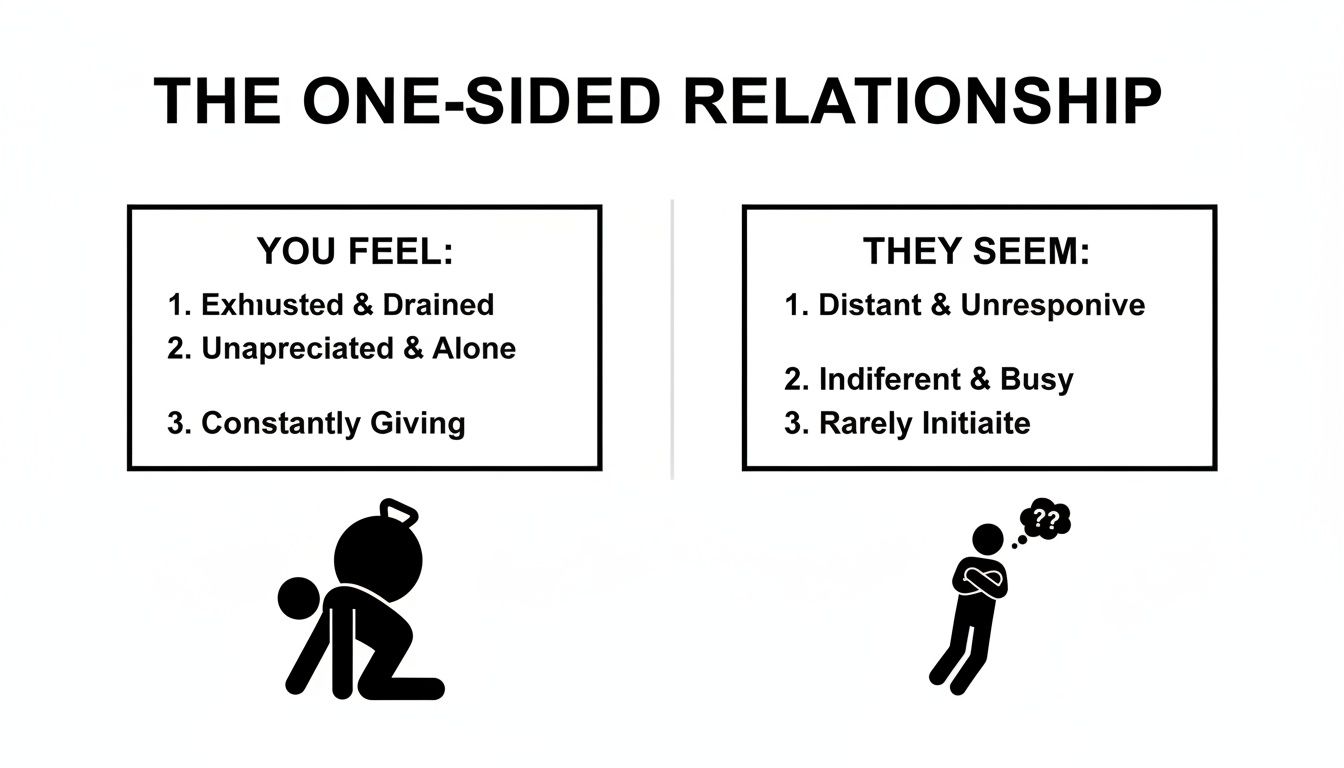
This image really drives home the core disconnect. One partner is anchored by the sheer weight of their effort, while the other remains emotionally distant, contributing almost nothing to keep the relationship afloat.
To make this even clearer, let's compare how a healthy dynamic stacks up against a one-sided one.
Balanced vs One-Sided Relationship Dynamics
Area of Relationship | Balanced Dynamic (Reciprocal) | One-Sided Dynamic (Unbalanced) |
|---|---|---|
Communication | Both partners initiate conversations and make plans. | One person does most of the initiating. |
Emotional Support | Support is a two-way street; both give and receive comfort. | Support flows primarily in one direction. |
Effort & Planning | Shared responsibility for chores, plans, and decisions. | One person carries the majority of the practical and mental load. |
Conflict Resolution | Both work to understand each other's perspectives. | One person's feelings are prioritised; the other appeases. |
This table shows just how different the day-to-day reality can be. In one, you feel like a team; in the other, you feel like you're playing for both sides.
There Is a Major Imbalance in Emotional Support
Life throws curveballs, and our partners are meant to be our primary source of support through it all. A tell-tale sign of a one-sided relationship is when that support only flows in one direction. You’re their go-to person, their cheerleader, and their shoulder to cry on. But when you’re having a rough time? Suddenly, they’re busy, distracted, or just don’t know what to say.
You celebrate their wins, but yours are met with a shrug. They get a promotion, and you’re popping the champagne. You hit a milestone, and it barely gets a mention.
You listen to them vent for hours, but they tune out when you need to talk. You offer thoughtful advice on their work stress, but when you need an ear, their eyes are glued to their phone.
You’re their rock when they’re down, but you’re left to pick yourself up alone. You provide the emotional safety net, but there’s no one there to catch you when you fall.
This emotional imbalance is often the most painful part of an unequal partnership. It’s also important to distinguish these patterns from other relationship issues. Our guide on the 7 signs of unhealthy relationships can offer more clarity here.
You Constantly Walk on Eggshells
Do you find yourself second-guessing what you say, carefully editing your words to avoid setting them off? This is classic "walking on eggshells," and it’s a clear sign of a deeply imbalanced and unhealthy dynamic. Your main job becomes managing their emotional state to prevent an argument, a sulk, or the silent treatment.
Your focus shifts from being your genuine self to simply preventing their discomfort. It puts you in a state of constant, low-grade anxiety, where you can never truly relax. The relationship stops being a safe space and starts feeling like a performance, with you playing a part to keep them happy at the cost of your own wellbeing.
Understanding the Roots of Lopsided Dynamics
One-sided relationships rarely just happen. More often than not, these draining imbalances are rooted in some pretty deep-seated stuff – psychological patterns, behaviours we’ve learned along the way, and needs that just don't quite line up. Getting to the bottom of why these dynamics take hold is the first real step towards breaking the cycle and finding healthier, more give-and-take connections.
It's usually not a case of one person being intentionally malicious, either. Instead, these lopsided patterns often emerge when the underlying issues both partners bring to the table create a perfect storm for imbalance.
The Role of Attachment Styles
One of the biggest factors at play here is our attachment style, which is basically a blueprint for relationships that gets drawn up in our early childhood. When these styles clash, it can create an imbalance almost automatically.
Anxious Attachment: If you lean towards an anxious attachment style, you probably find yourself craving a lot of closeness and reassurance. This can easily lead to over-giving, as you're constantly looking for validation to calm that deep-seated fear of being abandoned.
Avoidant Attachment: On the other flip of the coin, someone with an avoidant style often gets overwhelmed by too much intimacy or emotional demand. They might pull back just as you’re trying to get closer, which creates that classic, frustrating push-pull dynamic where one person is always chasing and the other is always backing away.
This kind of mismatch isn't a personal failing; it's more like a difference in emotional wiring. The anxious partner tries harder and harder to close the gap, while the avoidant partner creates more distance to feel safe. The end result? A classic one-sided relationship.
Learned Behaviours and Family History
The relationships we saw growing up often become the unconscious template for our own. If you were raised in a house where one parent did all the emotional heavy lifting, you might find yourself repeating that pattern without even realising it. You may have learned that love means you have to constantly sacrifice your own needs to keep everyone else happy.
These learned behaviours are incredibly powerful because, to us, they just feel normal. You might not even stop to question the dynamic because it's just a reflection of what you've always known. It’s easy to fall into the belief that this is just what it takes to be a "good" partner, even if it leaves you feeling empty and unappreciated.
Understanding the 'why' behind the imbalance is crucial. It shifts the focus from blaming your partner (or yourself) to recognising the underlying patterns that keep you both stuck. Only then can you begin to address the core issues instead of just the symptoms.
These dynamics aren't just limited to romantic partners, either. You see it in the recent buzz around parasocial relationships—where people invest a huge amount of emotional energy into celebrities who will never give anything back. The fact that Cambridge Dictionary named "parasocial relationship" its 2023 Word of the Year says a lot. It taps into a wider issue here in the UK, where 1 in 4 men believe no one will fall in love with them and a staggering 44% have given up on relationships, often because of these deep-seated fears and patterns. You can learn more about these findings on UK relationships here.
Self-Worth and Fear of Conflict
At its core, repeatedly finding yourself in a one-sided relationship often comes back to self-worth. If, deep down, you don't believe you're worthy of mutual love and respect, you're far more likely to settle for crumbs. Low self-esteem can make you over-give as a way to "earn" affection, as if you have to prove your value through sheer effort.
A deep-seated fear of conflict or abandonment can also make you overly accommodating. You might find yourself biting your tongue, never raising issues or expressing your needs because you're terrified of rocking the boat and being left alone. That fear can lead you to silence your own feelings, continually putting their comfort ahead of your own wellbeing.
By recognising these roots—whether it’s your attachment style, your family history, or your own sense of self-worth—you can finally start the real work of getting your balance back.
The Toll of an Unbalanced Relationship on Your Mental Health
Constantly giving your all in a one-sided relationship and getting little or nothing back is more than just frustrating; it's genuinely damaging to your mental wellbeing. It helps to think of your emotional energy like a bank account. In a healthy relationship, both people make regular deposits, keeping the balance healthy. But in a lopsided dynamic, you're the only one paying in, and it's all going out to support the other person.
Sooner or later, that account is going to be empty. This isn't just a turn of phrase—it describes a very real state called emotional burnout. It can leave you feeling completely drained, cynical, and detached, not just from the other person, but from life itself.
The Rise of Anxiety and Chronic Stress
When you’re in a relationship where you can’t truly rely on your partner for support, your nervous system can easily slip into overdrive. You might find you're always on high alert, waiting for the next letdown or trying to manage their moods. This state of constant vigilance is a perfect recipe for chronic stress and heightened anxiety.
You might catch yourself overthinking every text message, replaying conversations in your head, or just worrying constantly about where things stand. This isn't just in your head; it becomes physical. Chronic stress can bring on headaches, stomach problems, and poor sleep, trapping you in a cycle where both your mind and body are running on empty.
The sheer uncertainty of a one-sided relationship is what really fuels this anxiety. When you never know if your partner will show up for you emotionally, it creates a deeply unstable foundation, leaving you feeling insecure and perpetually on edge.
The Erosion of Confidence and Self-Worth
One of the most damaging effects of an unbalanced relationship is how it slowly but surely chips away at your self-esteem. When your needs are consistently ignored and your efforts aren't recognised, it's easy to start believing a very harmful story: that you aren't worthy of love, respect, or effort.
You might start to question everything:
"Am I asking for too much?" You begin to feel that your basic needs in a relationship are an unreasonable burden.
"Is there something wrong with me?" You could conclude that their lack of investment must be a reflection of your own failings.
"Maybe I don't deserve better." After a while, your confidence can become so worn down that you simply settle for the imbalance, unable to imagine anything else.
Feeling consistently undervalued is a direct hit on your sense of self. It teaches you that your feelings don't matter, which can lead to persistent sadness and even symptoms of depression. Your inner voice, once confident, becomes critical and filled with self-doubt.
This slow erosion of self-worth is exactly why it’s so important to address the imbalance. It’s not just about saving the relationship; it’s about reclaiming your right to feel valued as a person.
A Breeding Ground for Resentment and Neglect
Emotional neglect is what happens when a partner consistently fails to respond to your emotional needs. In a one-sided relationship, this isn't a rare slip-up—it's how things work day-to-day. This kind of environment becomes a breeding ground for deep-seated resentment. Every time you have to face a crisis alone or celebrate a personal win to silence, that resentment builds, slowly poisoning the connection.
Sadly, this disconnection can sometimes lead to more obvious betrayals. An emotional void in a one-sided relationship can leave one partner looking for that connection somewhere else. According to YouGov surveys in the UK, around 1 in 5 British adults—that's 20% of men and 19% of women—admit to having been unfaithful. Unmet needs are often at the heart of this imbalance, turning what was a partnership into something profoundly lopsided. Read more on the UK infidelity statistics and their causes.
The toll isn't just about the arguments you have; it’s also about the silence where support and understanding should be. This emotional vacancy reinforces the feeling that you are on your own, making it vital to address the dynamic for your own long-term health and happiness.
Right, so you’ve had that sinking realisation that you’re in a one-sided relationship. It's a massive, and often painful, moment of clarity. But the next phase is where you start to get your power back. It’s about moving from just knowing something is wrong to actively doing something about it.
This isn't about throwing down ultimatums or demanding everything changes overnight. It’s a more thoughtful process of reclaiming your balance and reminding yourself (and maybe your partner) of your own value.
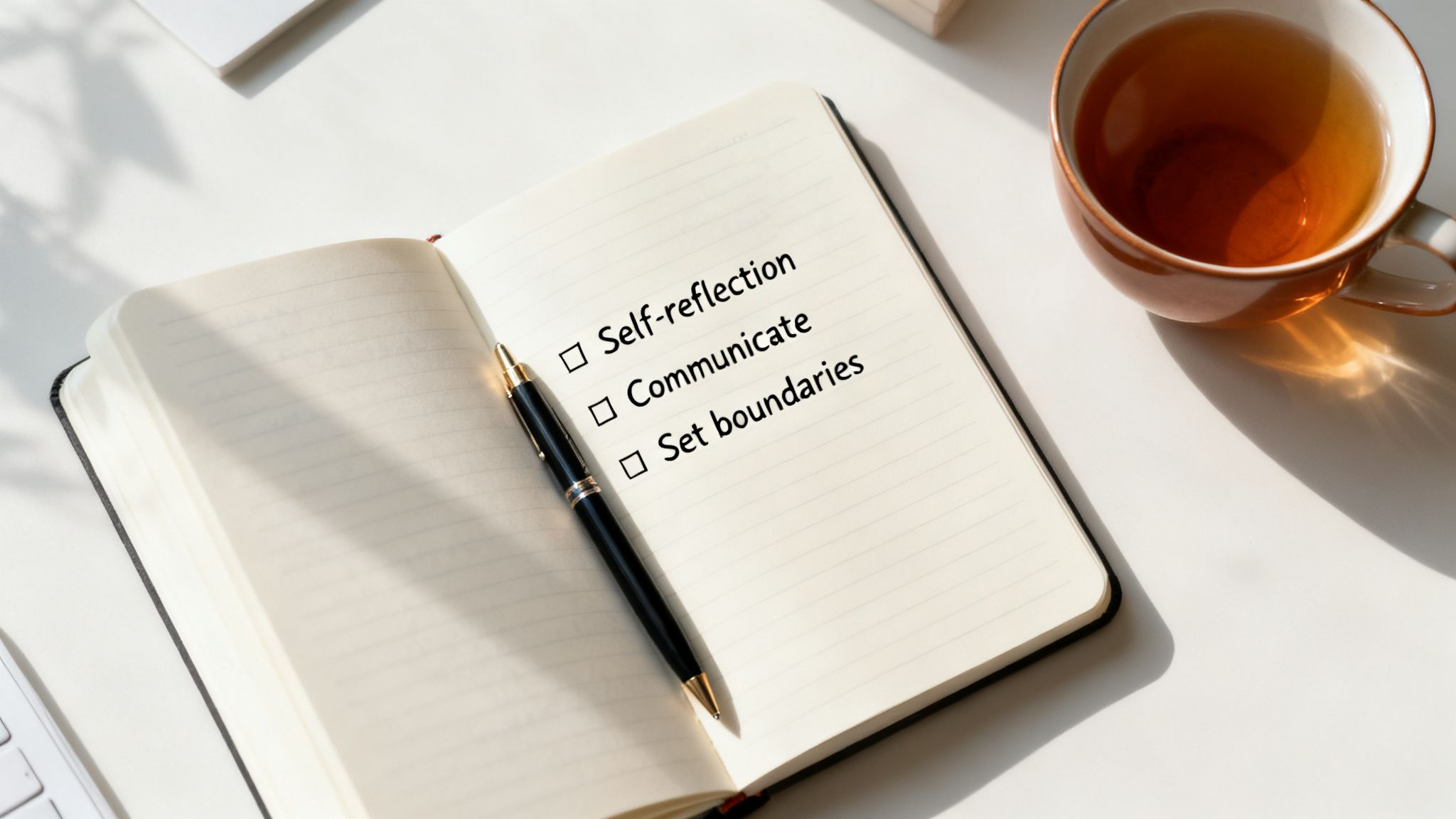
Think of this as a roadmap to help you tackle the imbalance in a way that doesn’t feel overwhelming. Whether these steps help you mend the connection or give you the strength to walk away, the goal is the same: to stop feeling so drained and to put your own wellbeing front and centre again.
Start With an Honest Look Inwards
Before you can have a meaningful chat with your partner, you need to have a really honest one with yourself. When you're constantly the one giving and bending, it’s incredibly easy to lose sight of what you actually need. It’s time to find that again.
Carve out some quiet time, grab a notebook, and ask yourself a few direct questions:
What do I genuinely need from a partner to feel supported and happy? Get specific here. Think about things like emotional check-ins, help with household chores, or just dedicated quality time.
What are my absolute deal-breakers? These are the fundamental needs that, if they aren’t met, make the relationship feel completely unworkable for you.
What have I been putting up with that goes against my own wellbeing? Just acknowledging the compromises you've been making is a huge step.
This isn’t about building a legal case against your partner. It's about getting crystal clear on what a healthy relationship actually looks and feels like to you. That clarity will be your foundation for whatever comes next.
Get Better at Saying How You Feel
Once you’re clear on your needs, the tricky part is sharing them. This can feel really scary, especially if you’re someone who hates conflict. The trick is to frame it in a way that’s not about blame, but about your own experience.
This is where "I statements" are absolute gold. They flip the script from what your partner is doing wrong to how their actions are making you feel, which is far less likely to put them on the defensive.
For instance, instead of saying, "You never make time for me anymore," which just sounds like an accusation, try something like: "I’ve been feeling quite lonely and disconnected when we don't get to spend quality time together." See the difference? You’re explaining the impact on you, not just pointing a finger.
Good communication is a skill, not a weapon. You're trying to open a door so they can understand your point of view, inviting them to find a solution with you. If you're finding this all sounds very familiar and you're feeling stuck in a relationship, just calmly stating the facts is the first step out of the rut.
Set (and Actually Keep) Your Boundaries
Boundaries aren’t about building walls to shut people out. They are simply instructions for how you want to be treated. In a lopsided relationship, those instructions have probably got very fuzzy, or disappeared altogether. It’s time to bring them back to protect your own energy and self-respect.
A boundary can be a simple, clear statement:
"I can't be on the phone every single night, but I'd love to schedule a proper catch-up on Wednesday." (This protects your time.)
"It really hurts my feelings when you brush off what I'm saying. If that happens, I'm going to need to take a break from the conversation." (This protects your emotional safety.)
Setting boundaries feels weird at first, but it's a fundamental act of self-care. For a deeper dive, you can read my quick, practical guide on how to set healthy boundaries. And remember, the real magic is in consistency. A boundary only works if you stick to it.
Sometimes boundaries also mean creating a little emotional distance, particularly when you find yourself repeatedly pulled back into someone else's moods or behaviour. I've written more about how to emotionally detach from someone without simply shutting down your feelings.
Refill Your Own Tank and Rebuild Your Self-Esteem
Being in a one-sided relationship for a long time can do a real number on your self-worth. A massive part of this action plan has to be about rebuilding your sense of self, completely separate from the relationship. You need to start refilling your own emotional tank instead of waiting for your partner to do it.
Make a real effort to get back to the things and people that make you feel good. Call that friend who always makes you laugh, dust off that old guitar, or just block out time in your calendar for a walk by yourself. This isn't just a distraction; it reminds you that your identity and happiness aren't entirely tied to your partner’s actions. It’s about rebuilding your own resilience, which will empower you to make the right decision for your future, whatever that may be.
How Therapy Helps You Reclaim Your Balance
Taking that first step to deal with a one-sided relationship can feel pretty daunting. You might have already tried talking about your needs or setting boundaries, only to find yourself feeling dismissed or completely unheard. This is exactly where getting some professional support can make a real difference, offering a clear way forward when you’re lost in the fog.
Counselling gives you a neutral, confidential space to explore what’s going on in the relationship without any judgement. It's a place to unpack all those feelings, start to understand your own patterns, and get the tools you need to build healthier connections—not just with other people, but most importantly, with yourself.
Finding Clarity in a Confidential Space
One of the biggest benefits of therapy is having an impartial professional help you see the situation for what it really is. A counsellor can help you pinpoint the specific ways the relationship is out of balance and get to the bottom of why, maybe connecting how you feel now to past experiences or your attachment style.
This whole process isn't about pointing fingers or blaming your partner or yourself. Far from it. It's about getting an objective view of what’s happening. That clarity is incredibly empowering, helping you shift from a place of confusion and self-doubt to one of real confidence and understanding.
In some more extreme situations, a one-sided relationship can stray into control and emotional harm. The Crime Survey for England and Wales (for the year ending March 2023) estimated that around 3.8 million people went through some form of domestic abuse last year. While women are affected disproportionately, men's experiences often stay hidden because of stigma, which makes having a male-positive therapy space absolutely vital. You can find out more about the official statistics on domestic abuse in England and Wales.
Building Skills for a Healthier Future
Therapy isn’t just about talking; it’s about learning and practising new skills. A counsellor can arm you with practical tools to handle your relationship more effectively, whether you end up deciding to repair it or to move on.
These skills often include things like:
Effective Communication Strategies: Learning how to say what you need and feel using "I statements," which helps build connection rather than starting a fight.
Boundary Setting Techniques: Gaining the confidence to set and stick to firm, healthy boundaries that protect your own energy and self-respect.
Self-Worth and Resilience Building: Working to rebuild your self-esteem and develop emotional resilience, so you’re less dependent on others for validation.
Therapy provides a safe 'rehearsal space' to practise these new ways of being. You can try out different approaches and build confidence before applying them in your daily life, ensuring you feel prepared and empowered to make lasting changes.
Therapy can also take many forms. Exploring different approaches, like the incredible art therapy benefits for mental health, can open up new paths for healing. Here at Therapy with Ben, we find a style that works for you.
Therapeutic Approaches Tailored to You
I know that everyone’s needs are different, so I offer a few different ways of working, all designed to create a comfortable and effective space for you to heal.
Face-to-Face Counselling: For those in and around Cheltenham, traditional in-person sessions give you a dedicated, private space for deeper therapeutic work.
Online Counselling: This is accessible from anywhere and offers real flexibility and convenience, making sure you can get support no matter your location or schedule.
Walk and Talk Therapy: A unique approach that combines gentle physical activity and being in nature with counselling. Many clients find it creates a more relaxed, reflective atmosphere that feels less intimidating than a formal office.
As a male counsellor with experience in neurodiversity, I’m committed to offering a supportive, understanding, and male-positive perspective. The goal is always the same: to help you find your footing, get your balance back, and move forward with confidence.
Your Questions About One-Sided Relationships
When the penny drops and you realise you might be in a one-sided relationship, a whole flood of difficult questions usually follows. It’s a confusing and challenging time, so let’s get some clear, straightforward answers to the things I hear most often.
Can a One-Sided Relationship Ever Become Balanced?
Yes, it’s possible—but it hinges entirely on both of you being genuinely committed to making a change. It’s not a one-person job. The less-invested partner has to first see and acknowledge the imbalance, and then be truly willing to change their behaviour. This nearly always requires some very open, honest conversations and, quite often, the support of professional couples counselling to guide you both.
The hard truth, though, is that if your partner dismisses your feelings or just isn't willing to put in the effort, the dynamic is very unlikely to change. You simply cannot fix this imbalance on your own.
Am I Being Selfish for Wanting More from My Relationship?
Absolutely not. Wanting your emotional needs to be met isn't selfish; it's fundamental. A desire for mutual respect, support, and effort is the very foundation of any healthy, thriving partnership.
One of the most damaging things about a lopsided dynamic is how it can condition you to feel guilty for asking for what you deserve. Let me be clear: expressing your needs is an act of self-respect, not selfishness.
How Do I Know When It Is Time to Leave?
This is a deeply personal decision, and there’s no single right answer that fits everyone. However, there are some strong indicators that it might be time to put your own wellbeing first and move on.
You might want to seriously consider leaving if:
You’ve communicated your needs time and time again, but nothing ever really changes for long.
The relationship is a constant drain on your mental health, leaving you feeling utterly exhausted.
Your self-esteem has hit rock bottom, and you feel more alone when you're with your partner than you do by yourself.
If your genuine attempts to create a bit of balance are always met with resistance or dismissal, then leaving may be the kindest and healthiest thing you can do for your future self.
If these questions are hitting close to home and you feel stuck, professional support can make all the difference in finding clarity and confidence. At Therapy with Ben, I offer a safe, confidential space to explore what’s happening and help you rebuild your sense of balance. Reach out today to learn how counselling can support you.
Author: Therapy-with-Ben


Comments