


How Much Does Therapy Cost in the UK? 2026 Price Guide
Updated: 3 days ago
Author: Therapy-with-Ben
How much does therapy cost in the UK? Private counselling typically costs around £40–£70 per session, while psychotherapists, CBT specialists and psychologists may charge considerably more. NHS Talking Therapies are free, and lower-cost or concessionary counselling is also available.
At Therapy with Ben, I charge £60 for a 50-minute counselling session, whether we meet online, face-to-face in Cheltenham, or for Walk and Talk Therapy. I also keep some lower-cost spaces available, so if £60 would make counselling difficult to afford, you're welcome to ask about a reduced fee.
Let’s be honest, figuring out the cost of therapy in the UK can feel a bit like trying to nail jelly to a wall. It’s not one fixed price. You can find everything from free support on the NHS right up to sessions with a specialist psychologist that cost over £180. It all depends on the path you take.
How Much Does Therapy Actually Cost in the UK?
Getting your head around the potential costs right from the start makes the whole process of finding help feel so much less daunting. It’s a bit like booking a holiday – the final price tag really hangs on whether you’re after a package deal, a boutique hotel, or a full-on luxury resort. Each one offers a totally different experience and price point.
Therapy is much the same. The cost shifts depending on the professional you see, where they're based, and how you access their support. So, to make things clearer, let’s break down the numbers and look at what you can realistically expect to pay.
UK Therapy Costs at a Glance
The first step in working out the financial side of things is knowing the general ballpark figures for different services. This simple table gives you a quick snapshot of the typical per-session costs for the most common therapy routes here in the UK.
Therapy Type | Average Cost Per Session (UK) |
|---|---|
NHS Talking Therapies | Free (but often with waiting lists) |
Private Counsellor | £40 - £70 |
Private Psychotherapist / CBT Specialist | £60 - £150 |
Private Clinical Psychologist | £100 - £180+ |
Online Therapy (Subscription) | £45 - £70 (usually billed weekly/monthly) |
Charity/Low-Cost Services | Free or donation-based |
Looking for private counselling?
I offer one-to-one counselling for adults for £60 per 50-minute session, with online counselling available across the UK and face-to-face sessions in Cheltenham. Reduced-fee spaces are sometimes available if the standard fee would make counselling difficult to afford.
As you can see, the costs vary quite a bit. It’s useful to have these figures in mind as you start exploring your options.
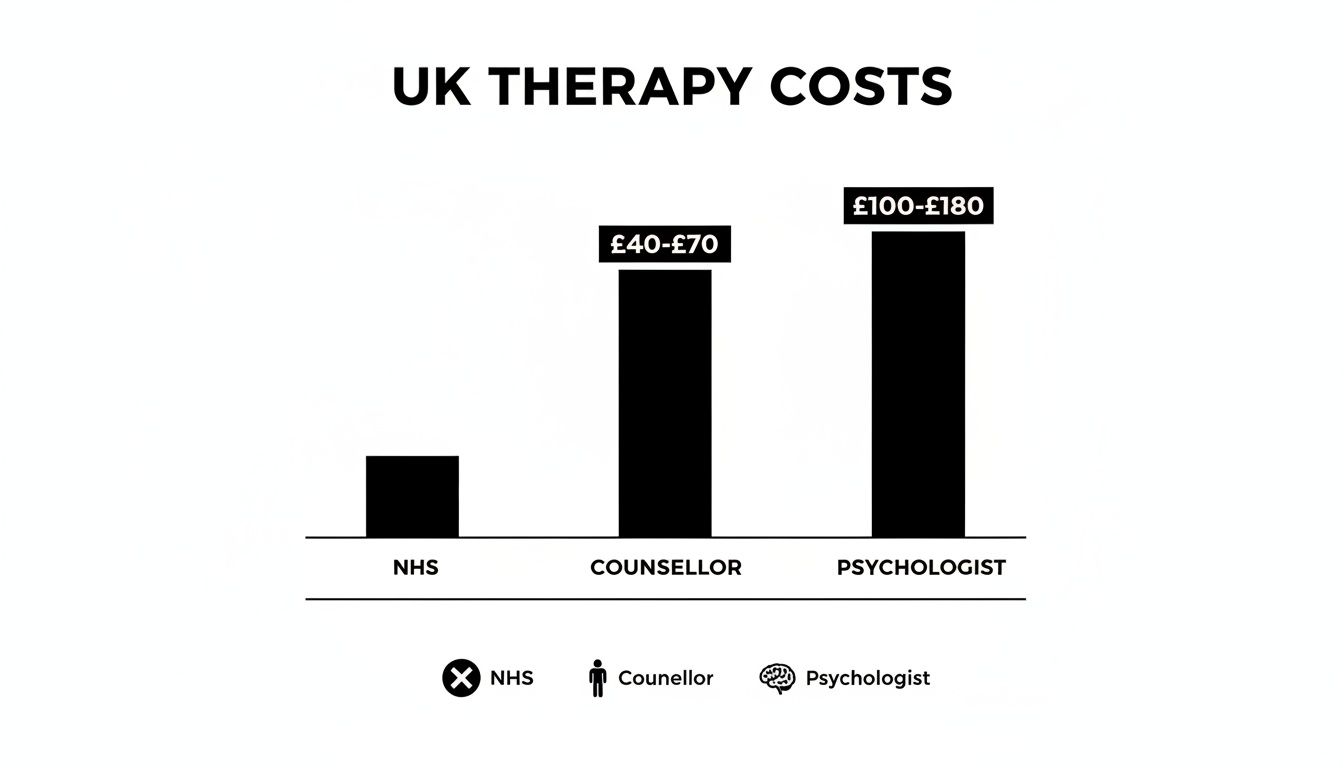
The chart really highlights the gap between free, publicly funded services and going private. That jump in price reflects the differences in waiting times, a therapist's specialisation, and how quickly you can get seen. It brings up the classic trade-off many of us face: waiting for a free service or investing in faster, more specialised care.
What Determines the Price of a Therapy Session
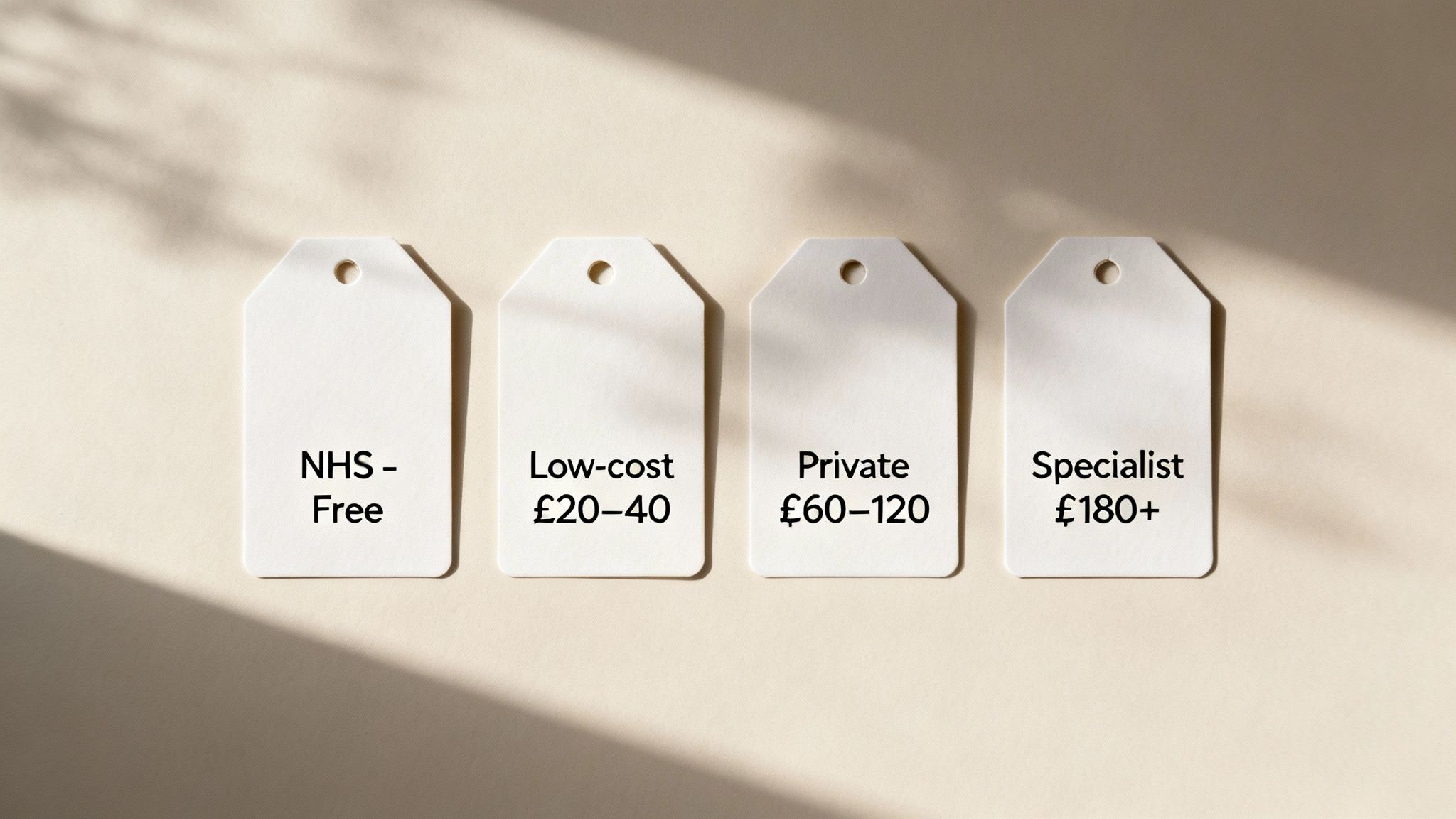
Ever found yourself browsing for a therapist and wondering why the prices can feel all over the map? It's a common question. You might see one therapist charging £50 an hour, while someone just down the road is asking for £150. It can be a bit confusing, but that final number isn't just plucked out of thin air.
The fee is actually a reflection of several important factors.
Think about it like hiring a chef. You wouldn't expect a seasoned, Michelin-starred chef with a rare specialism to charge the same as a talented but newly qualified cook. It's a similar story in therapy – a therapist's qualifications, depth of experience, and specific areas of expertise all play a big part in the cost.
Qualifications and Experience
A therapist's training is one of the biggest pieces of the pricing puzzle. The time they've invested in their education, their level of accreditation, and even their professional title all influence what they charge.
In the UK, you'll find a range of professionals, and their fees line up with their different training paths. Generally speaking, counsellors often charge somewhere between £40 and £70 for a 50-minute session. Psychotherapists and CBT specialists tend to sit in the £60 to £100 bracket, though some can be up to £150.
At the higher end of the scale, Clinical and Counselling Psychologists, who have completed extensive doctoral-level training, typically charge from £100 to £180 or even more.
Experience can also affect fees, although a higher fee doesn't necessarily mean a therapist will be a better fit for you. Some therapists charge more because of their experience, additional training or specialist areas of work, while others deliberately keep their fees at a more accessible level. When choosing someone, it's worth considering their qualifications and experience alongside something just as important: whether you feel comfortable talking to them.
Location, Location, Location
Just like house prices, therapy costs can vary significantly depending on where you are in the country. A therapist working in central London, where the cost of living and renting a therapy room is sky-high, will almost certainly have higher fees than someone based in a smaller town or a more rural area.
Here in Cheltenham, for instance, you'll find prices are generally higher than in less populated parts of the country. This isn't a comment on the quality of the therapy, but simply a reflection of the local economic realities that therapists have to build into their pricing.
"Understanding the 'why' behind the price is key. It helps you shift from seeing therapy as a simple cost to recognising it as an investment in a specific level of expertise, experience, and specialist support."
This is also a major reason why many therapists, myself included, offer online counselling across the UK. It removes the geographical barrier, cutting down on travel time and costs for you. It also means you can choose a counsellor based on who feels like the right fit rather than simply who happens to be nearby. I offer online counselling to adults throughout the UK at the same £60 fee as my face-to-face sessions.
Specialisation and Type of Therapy
The kind of support you're looking for also shapes the price. If a therapist has invested in advanced training for a niche area – like complex trauma, eating disorders, or supporting neurodiverse clients – they're a specialist. That extra expertise means they can charge a higher fee, as you’re paying for a highly focused and developed skillset. If you're curious about different approaches, you might find my guide on the types of counselling in the UK helpful.
The format of the session itself makes a difference, too:
Individual Therapy: This is your standard one-to-one session and what most pricing is based on.
Couples or Family Therapy: These sessions are often longer and more complex. The therapist has to manage multiple dynamics at once, so they are usually more expensive.
Session Length: A standard "therapy hour" is usually 50 minutes. Some therapists offer longer sessions of 60 or 90 minutes, which will be priced accordingly.
Choosing Your Path: NHS vs Private Therapy
When you decide it’s time to talk to someone, one of the first big questions you’ll face is whether to go through the NHS or look for a private therapist. It’s a classic trade-off, really: time versus money. Getting your head around the pros and cons of each path is the first step to finding the support that actually fits your life right now.
The NHS provides an absolutely vital service, offering free access to mental health support for everyone. It's an incredible resource, and for many, it's a lifeline when money is tight. But, as you might expect, this accessibility comes with a few challenges – the main one being the wait.
The NHS Talking Therapies Route
Going down the NHS route usually starts with a self-referral to their Talking Therapies service (which you might remember as IAPT) or a chat with your GP. After an initial assessment, you’ll be put on a waiting list for treatment. The process itself is straightforward, but the wait can be anything from a few weeks to many, many months, all depending on how stretched services are in your local area.
What’s more, the NHS typically offers a set number of sessions of a specific type of therapy. Very often, this is Cognitive Behavioural Therapy (CBT). CBT is brilliant for certain issues, but it isn't the right fit for everyone or every problem. NHS Talking Therapies usually offer structured, evidence-based treatments based on your needs and what's available locally. You may have less choice over the individual therapist you see, the type of therapy offered, or how long you work together than you would when arranging therapy privately.
This structured, one-size-fits-most model is designed to help as many people as possible, as efficiently as possible. The downside is that it can sometimes lack the personal touch and flexibility you might need to really get to the bottom of what's going on for you.
The Private Therapy Option
Turning to the private sector, on the other hand, puts you firmly in control. The most obvious benefit is speed. You can often find a therapist and have your first session booked within a couple of weeks, sometimes even just a few days. When you’re really struggling, that quick access can make all the difference in the world.
Private therapy also gives you choice – and lots of it. You can research different therapists, look into their specialisms, and find someone whose experience and personality just feel like the right fit. You’re free to choose the type of therapy you want to try, whether that’s psychodynamic, person-centred, or even something a bit different like my own Walk and Talk Therapy sessions here in Cheltenham.
This flexibility extends to the practical side of things, too. Private therapists often have more appointment slots available, including evenings and weekends. You can also choose where you have your sessions, from a traditional therapy room to online, from the comfort of your own home. The main thing to weigh up, of course, is the cost.
To help lay it all out, I've put together a simple table comparing the two paths.
NHS Therapy vs Private Therapy: A Practical Comparison
This table gives a straightforward, at-a-glance look at what to expect from each route, helping you weigh up what's most important for you at this moment.
Feature | NHS Therapy | Private Therapy |
|---|---|---|
Cost | Free | £40 - £180+ per session |
Waiting Time | Weeks to many months | Days to a few weeks |
Choice of Therapist | Very limited; usually assigned | Full choice of therapist and specialism |
Session Flexibility | Often rigid; daytime appointments | High; evening/weekend options common |
Therapy Type | Often structured, short-term (e.g., CBT) | Wide range of short & long-term approaches |
Session Location | Assigned clinic or phone/video | Therapist's office, online, or walk-and-talk |
Ultimately, there’s no right or wrong answer here. The NHS provides an essential service that, for many people, is the best and only option. Private therapy offers a different kind of value, one that’s built around speed, choice, and a truly personal experience. The key is to think about what you need most right now: immediate, tailored support that you pay for, or free care that might mean waiting a while.
The Reality of Rising Private Therapy Costs
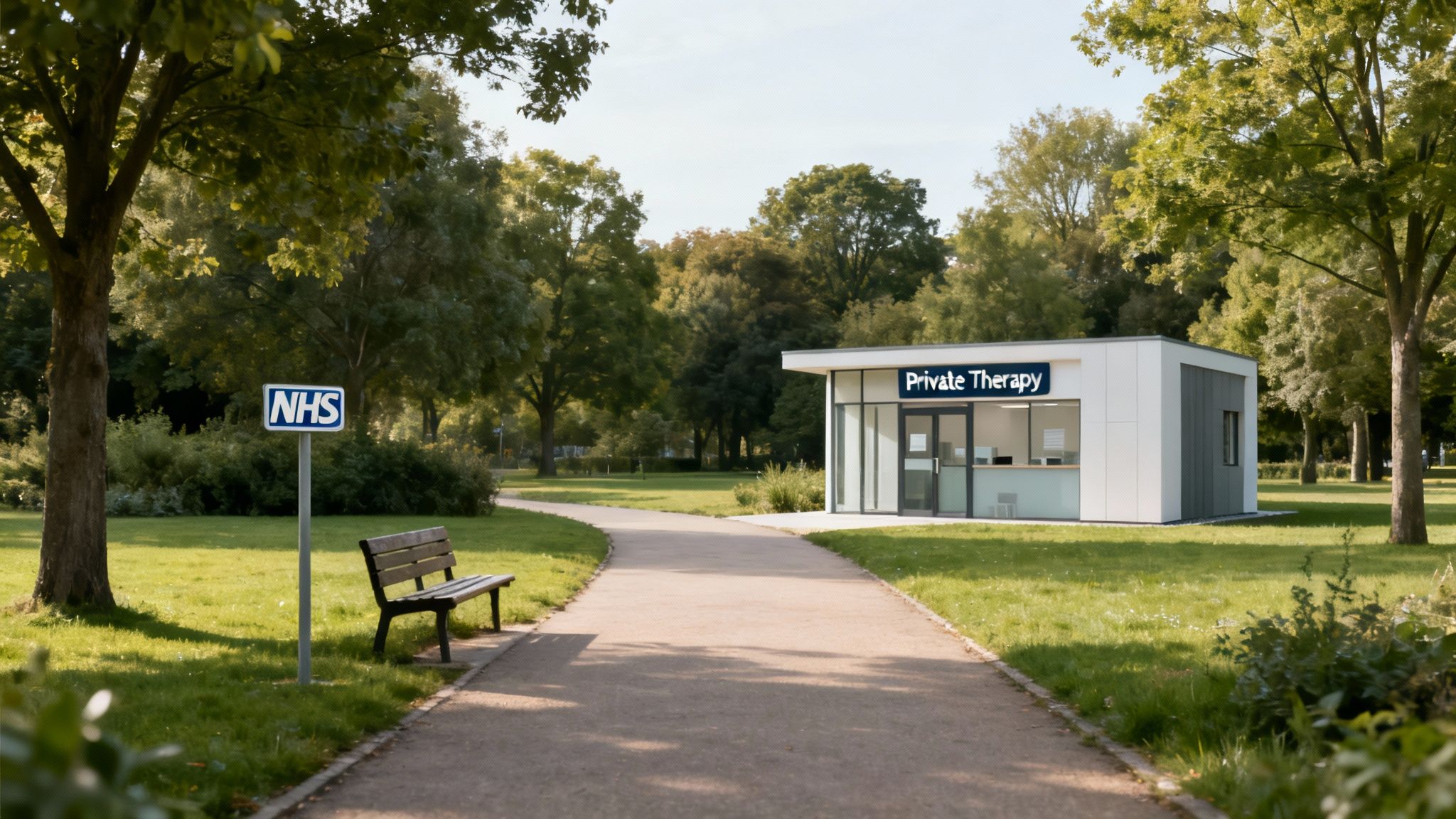
If you've started looking into private therapy and felt a bit of sticker shock, you’re definitely not alone. It’s a clear trend: the cost of therapy in the UK is climbing, making it feel out of reach for many. This isn't just a feeling; it's a reality shaped by some pretty powerful market forces.
The main driver has been a huge surge in demand for mental health support, especially in the years following the pandemic. More people than ever are reaching out for help, which is fantastic. But this has put a real strain on the number of qualified therapists available, which naturally pushes session fees up across the board.
At its heart, it's a simple case of supply and demand playing out in the mental health world.
Economic Pressures on Therapists
On top of this rising demand, therapists themselves are dealing with their own increasing professional costs. Just like any other small business owner, we have to cover a whole range of overheads, and almost all of them have become more expensive.
These professional expenses typically include:
Room Hire: The cost of renting a safe, private therapy space has gone up sharply.
Professional Insurance: Essential liability and indemnity insurance premiums have increased.
Accreditation Fees: Staying registered with bodies like the BACP or UKCP involves annual costs.
Supervision: All ethical therapists must pay for regular clinical supervision to make sure they're practising safely and effectively.
Continuous Professional Development (CPD): We have to constantly invest in new training to keep our skills up-to-date.
When these operational costs rise, therapists have little choice but to adjust their fees to run a sustainable practice.
The National Picture of Therapy Costs
This upward trend is backed up by national data, which shows a significant jump in private therapy fees recently. In fact, the cost of private therapy in the UK has seen a dramatic surge, with average fees rising by over a third since 2022. According to recent research, the average cost for a one-hour session with a private psychologist now sits at £129.90. That’s a massive leap from £96 just three years ago, showing just how quickly things have changed. You can dig into the full research on private therapy costs to get a better sense of these trends.
The research also highlights some stark regional differences. For instance, people in Leicester are now facing the highest average costs at £164 per session, with London not far behind at £160. Compare that to a city like Colchester, where rates are much lower, averaging just £85 per session.
This data isn't meant to put you off, but to give you a clear and honest picture of the current financial landscape for private therapy.
Understanding these economic realities helps explain why costs are what they are. It also reinforces how important it is to find a therapist who is completely open and transparent about their pricing. This knowledge empowers you to make an informed decision, shifting the focus from just the price tag to the true value of the support on offer. It’s this very principle of fairness and clarity that I aim to bring to my own practice.
How I Price My Therapy Sessions
I believe good therapy shouldn't be out of reach. We’ve looked at the broader picture of therapy costs, so now I want to be completely open about my own fees and what you get for them. My aim is to keep my pricing fair, clear and accessible, whether you're seeing me in Cheltenham or working with me online from elsewhere in the UK.
My rates reflect my training, the ongoing professional development I invest in, and the safe, confidential space I work hard to maintain for every single person I see. This fee structure allows me to run a sustainable practice and, most importantly, give you the dedicated focus and quality of care you deserve, whether we meet in my Cheltenham room, online, or out on a Walk and Talk session.
My Counselling Fees: £60 Per Session
To keep things simple, I have a straightforward price for a standard 50-minute therapy session. This price is the same no matter how we choose to work together.
My session fees are:
Face-to-Face Sessions (Cheltenham): £60
Online Counselling Sessions: £60
Walk and Talk Therapy Sessions: £60
This flat rate means you can pick the format that feels right for you, without cost being a deciding factor. If you'd like to see a more detailed breakdown, you can explore my full counselling fee structure.
Making Therapy More Accessible
I’m very aware that the standard cost of therapy in the UK can be a real barrier for some. That’s why I'm committed to making my services as accessible as I can. I always keep a portion of my practice available for clients who might struggle with the full fee.
I keep a limited number of lower-cost spaces available for people who would otherwise find the standard £60 fee difficult to manage. That might include students, people on lower incomes, or simply someone whose circumstances mean the full fee would make regular counselling unrealistic. If that's your situation, you're welcome to ask — we can have an open conversation about what feels manageable.
For me, accessibility is an important part of private practice. I'd rather have an honest conversation about affordability than have someone assume counselling is simply out of reach.
Your Free Initial Consultation
Committing to therapy is a big step, financially and emotionally. It’s absolutely vital that you feel you’ve found the right therapist for you. That’s exactly why I offer every potential new client a free 20-minute initial consultation over the phone or on a video call.
Think of it not as a therapy session, but as a no-pressure chat for us to connect. It’s your chance to ask me anything, get a feel for how I work, and see if you think we'd be a good fit. It’s really important to me that you feel confident in your choice before we even think about booking a first session.
How to Find Affordable Mental Health Support
When you’re looking for therapy, the price tag can feel like another hurdle to overcome. It's a really common and disheartening feeling, but it’s so important to know that good, affordable support is often much more within reach than it seems. If the headline cost of therapy in the UK is making you pause, there are several practical routes you can explore to find help that actually fits your budget.
Thinking outside the box is the key here. So many people just aren't aware of the resources available beyond the usual NHS or private pathways. By taking a proactive approach, you can find options that make looking after your mental health a manageable part of your finances, not another source of stress.
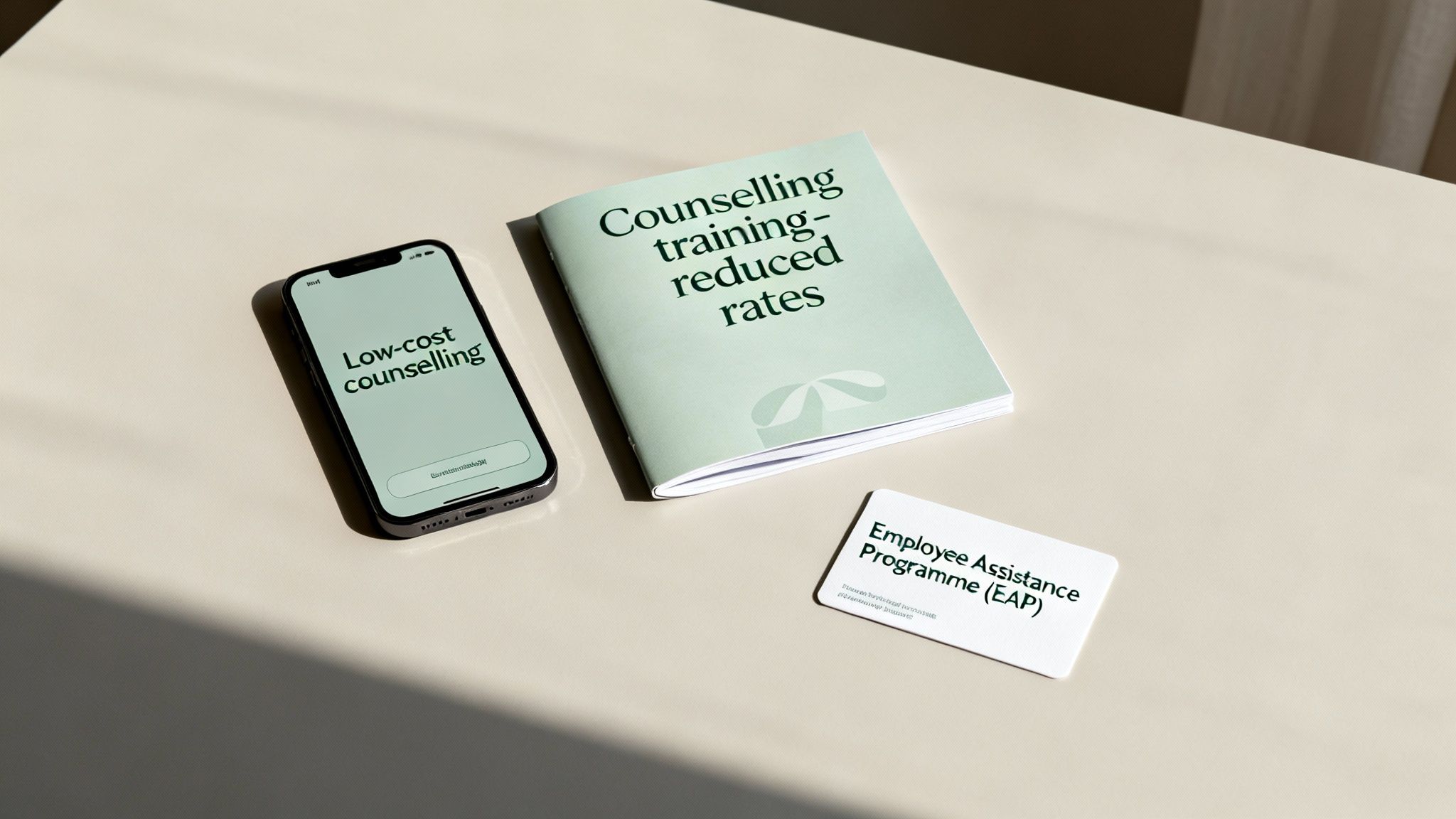
Check Your Workplace Benefits
Before you even start searching online, one of the most overlooked resources is right under your nose: your employer. A lot of companies, both big and small, now offer an Employee Assistance Programme (EAP) as part of their benefits package.
An EAP is a confidential service designed to help employees with personal or work-related issues that might be affecting their wellbeing. These programmes often give you access to a set number of free, short-term counselling sessions. And it's completely confidential—your employer only gets told how many people have used the service, not who they are. Have a look on your company’s intranet or have a word with HR to see if it’s an option for you.
Connect with Mental Health Charities
The UK is home to some truly incredible mental health charities that work tirelessly to provide low-cost or even free counselling to the public. Organisations like Mind, Rethink Mental Illness, and Anxiety UK often have local branches offering support that is either donation-based or heavily subsidised.
These services can be an absolute lifeline, especially if you’re facing a long wait for NHS therapy but can't afford the typical private fees. Some might have their own waiting lists, but they’re often shorter and provide an invaluable bridge to getting the help you need. For a bit more guidance on accessing different services, our article on how to get therapy in the UK is a great practical starting point.
Explore Counselling Training Colleges
Here’s another excellent avenue for affordable therapy: get in touch with local colleges and universities that run accredited counselling or psychotherapy training courses. These places often have clinics where trainee therapists provide counselling to the public at a very low cost.
Don’t be put off by the word "trainee." These are dedicated individuals in the final stages of their rigorous training, and they are always supervised by highly experienced, qualified therapists. You get dedicated support while helping to shape the next generation of mental health professionals.
Ask Therapists About Concessionary Rates
Finally, never be afraid to just ask a private therapist if they offer reduced rates. Many therapists, myself included, keep a certain number of session slots available at a lower price for clients on low incomes, students, or those who are unemployed.
This is often called a sliding scale or concessionary rate. While these slots can be limited, most therapists are genuinely passionate about making support accessible and will be happy to discuss your circumstances. A simple, polite email is all it takes to find out. By exploring these different avenues, you can empower yourself to find the right support without the financial strain.
Is Therapy an Expense or an Investment?
When you're considering weekly or fortnightly therapy, it's reasonable to think carefully about the cost. For some people, £60 a session is a significant commitment, and therapy shouldn't be presented as something everyone can simply find the money for.
What you're paying for, though, isn't just the 50 minutes you spend in a session. Good therapy can give you space to understand patterns in your thoughts, emotions and relationships, develop different ways of coping, and make changes that continue to be useful outside the therapy room.
That doesn't mean therapy has a guaranteed “return on investment”, or that spending more automatically produces better results. What matters is finding support that feels useful, a therapist you feel able to talk openly with, and a cost that you can realistically sustain.
If private therapy isn't affordable right now, the NHS, charities, workplace EAPs and lower-cost counselling services can all be worth exploring.
If you're considering counselling and would like to see whether we might work well together, I offer a free 20-minute initial consultation. I work with adults online across the UK, as well as face-to-face and through Walk and Talk Therapy in Cheltenham. There's no obligation to book afterwards — it's simply a chance to talk, ask questions and see how it feels. Book a 20 min chat for any questions (takes you to my contact page, so you can message, whatsapp, text etc) FAQs and Support
Got questions about counselling, confidentiality, or what to expect? Check out my FAQs or learn more about my integrative approach. When you’re ready, reach out and we can talk through your options.

Comments