


What Are the Goals of Therapy for Better Mental Health
Author: Therapy-with-BenThe main goal of therapy? To create real, positive change in your life. It’s a partnership, a structured process designed to give you the tools you need to handle mental health challenges, improve your relationships, and get to know yourself better. It’s all about working towards a more fulfilling life.
What Is the Real Purpose of Therapy?

Lots of people think therapy is just an aimless chat about your problems. While talking is definitely a big part of it, the real purpose is far more intentional. Think of it less like a casual conversation and more like a guided expedition. You are the expert on your life; the counsellor is a skilled guide, helping you map out where you want to go and how to get there safely.
This journey is built on a foundation of clear, collaborative goals. Setting these objectives is what turns therapy from something passive into an active, empowering process. It gives us direction, focus, and a way to measure the real-world impact of your efforts. It makes sure every session builds towards something tangible, whether that's learning to manage anxiety or finally building some self-esteem.
Turning Intentions Into Outcomes
Therapy goals are as unique as the person sitting in the room. They create a roadmap for your personal growth and are tailored specifically to what you hope to achieve. This targeted approach really works. UK data shows that 73% of adults who have had therapy found it helpful, and a further 75% would recommend it to others. The BACP survey on public perceptions of therapy has some great insights on this.
So, what might these goals look like in practice? They can be anything from very specific issues to broader personal development:
Symptom Reduction: Developing practical strategies to manage the feelings that come with anxiety, depression, or stress.
Behavioural Change: Working to break unhelpful habits or build healthier, more positive routines.
Improved Relationships: Learning to communicate more effectively or set better boundaries with the people in your life.
Increased Self-Awareness: Gaining a deeper understanding of your own thoughts, feelings, and patterns.
Ultimately, good therapy helps you build resilience and gives you skills that last a lifetime. To learn more about the basics, our guide explains what counselling is and how it can help you. It’s about creating lasting change, not just finding a temporary fix.
Setting Therapy Goals for Common Life Challenges
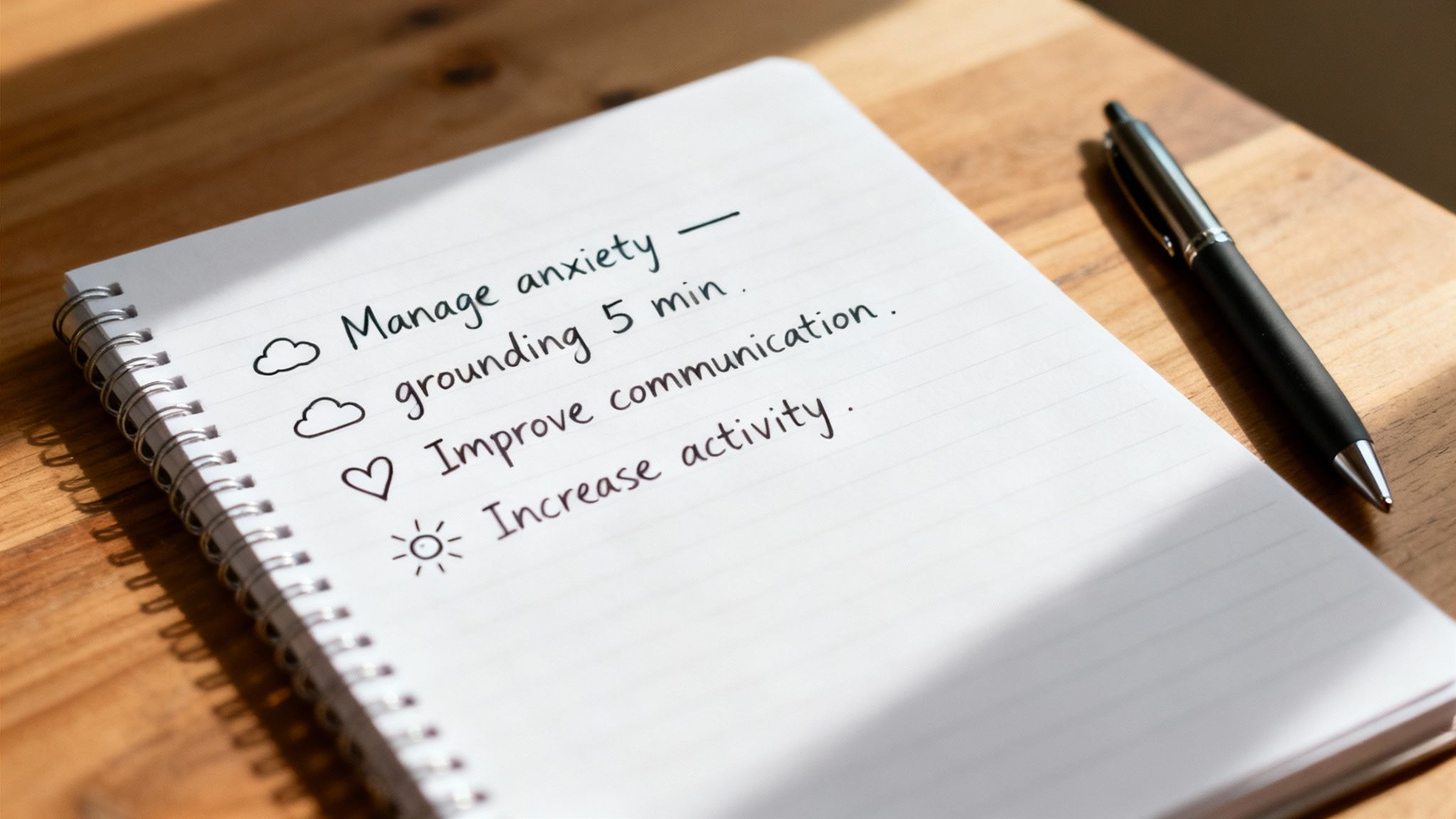
The best therapy goals are never vague ideas; they're personal, practical, and tied directly to the things you're grappling with every day. Good goal-setting takes that big, fuzzy feeling of being overwhelmed and breaks it down into a series of smaller, more manageable steps. It makes the whole thing feel more real and, frankly, more hopeful.
This process is really about translating your struggles into clear objectives. When we define what you want to change, it gives our sessions a proper focus, making sure every chat we have is nudging you closer to where you want to be.
Goals for Managing Anxiety and Depression
Anxiety and depression are two of the biggest reasons people come to therapy. Unsurprisingly, the goals here often focus on getting back a sense of control and finding a bit of joy in life again.
If anxiety is the main issue, our work might centre on building some tangible skills. This could mean learning grounding techniques to deal with the physical side of a panic attack, or learning to spot and challenge the thought patterns that keep you worrying constantly. A goal could be as straightforward as, "I want to be able to go to the supermarket without feeling overwhelmed."
For depression, goals often circle back to re-engaging with the world. We might use something called behavioural activation, which is a fancy way of saying we'll set small, achievable targets to bring positive activities back into your routine. Another big one is learning how to challenge that harsh inner critic that so often comes along with a low mood.
"A core aim of therapy is to break cycles. For anxiety, it's the cycle of worry and avoidance. For depression, it's the cycle of low energy and withdrawal. Setting small, practical goals is the first step in interrupting these patterns and building new, healthier ones."
Goals for Relationships and Neurodiversity
Therapy is also a vital space to work on how we connect with others and simply get by in the world. When it comes to relationship problems, goals are frequently about communication and boundaries. You might want to learn how to say what you need without it turning into a row, or how to set and hold healthier limits with family, partners, or even colleagues.
Therapy can also offer specialised support for neurodiverse individuals. Here, the goals are completely tailored to your unique strengths and challenges. Together, we might work on things like:
Developing personalised strategies for executive function difficulties, like getting organised or managing time.
Building confidence in social situations by looking at different ways to communicate.
Creating systems to reduce sensory overload and help prevent burnout.
On top of personal coping skills, some people also want to find strategies to reduce stress at work, which can have a huge knock-on effect on mental wellbeing and often becomes a key therapy goal. At the end of the day, therapy goals are all about giving you the insight and tools you need to handle your own unique situation with a bit more ease and confidence.
How to Set and Measure Goals That Actually Work
So, how do we get from a vague feeling like ‘I just want to feel better’ to a concrete plan for making that happen? It all comes down to setting goals together. Think of it this way: you’re in the driver’s seat of your own journey, and I’m the experienced navigator sitting beside you, helping you read the map.
This isn’t about me telling you what your destination should be. It’s a team effort to figure out what a successful outcome looks like for you. Understanding how to set life goals that get results is a powerful skill, both in and out of the therapy room, and it makes sure our work is always connected to what truly matters to you.
Making Your Goals SMART
One of the best tools I’ve found for this is the SMART model. It’s a straightforward but incredibly effective framework for turning fuzzy hopes into clear, actionable steps that you’re much more likely to achieve.
SMART stands for:
Specific: What, exactly, do you want to accomplish? Instead of ‘be less anxious’, we might aim to ‘reduce the physical feelings of panic before work meetings’.
Measurable: How will you know you’re getting there? This could be something like, 'I will use a grounding technique for five minutes each morning and rate my anxiety afterwards'.
Achievable: Is this a realistic first step? We’re not aiming for perfection overnight. We start with small, manageable wins to build momentum.
Relevant: Why does this goal matter to you right now? It has to connect with your bigger picture for it to feel worthwhile.
Time-bound: When will you do this? Setting a simple timeframe, like ‘every weekday for the next two weeks’, adds a bit of structure and accountability.
Let’s see how this works in practice. We can take a common, vague goal and sharpen it up:
Vague Goal: I want to stop feeling so anxious all the time.SMART Goal: "To manage my morning anxiety, I will practise a five-minute grounding technique every weekday before work for the next month, and track my anxiety levels on a scale of 1-10."
See the difference? The second one gives you something clear to do.
Tracking Progress and Staying Flexible
Of course, setting the goals is just the start. The real magic happens when we check in during our sessions. We’ll look at what’s working, what’s not, and we’ll definitely celebrate the small victories along the way. Progress is rarely a straight line, and that’s completely normal.
It’s also crucial to remember that your goals aren’t set in stone. As you learn more about yourself through therapy, your priorities might change. That’s a good thing! It means you’re growing. Therapy is a dynamic process, and we can adjust our focus anytime to make sure it always reflects what you need in the here and now. This flexible approach is a big part of figuring out how long therapy takes to work.
Ultimately, this structured-yet-adaptable approach gives our work a clear purpose. It moves therapy from just talking about problems to actively building solutions. It seems to be working, too; in the UK, a powerful 75% of people who have had therapy would encourage others to give it a go, which is a massive vote of confidence.
Finding a Therapy Style That Fits Your Goals

Hitting your therapy goals isn’t just about what you work on; it’s also about how and where you do the work. The setting for our sessions can make a huge difference to your progress, so choosing a format that lines up with your aims is a smart move. It can make everything feel that much more natural and effective.
Think of it like choosing the right exercise for a fitness goal. If you want to build strength, you might lift weights. If you want to improve stamina, you might take up running. Therapy is much the same. The format isn’t a small detail—it’s a tool we can use to help you get where you want to go.
This is exactly why I offer a few different ways of working together. Each one is designed to support different kinds of goals, personalities, and practical needs.
Walk and Talk Therapy for Active Progress
For some people, the thought of sitting still in a room can feel a bit intense or even restrictive. Walk and talk therapy offers a brilliant alternative by taking our sessions outdoors. There's something about moving your body while you talk that can be incredibly helpful for processing difficult thoughts and feelings.
This approach is especially powerful for goals related to:
Reducing Anxiety: The steady, rhythmic nature of walking can have a really calming effect on the nervous system. This often makes it easier to talk about anxious feelings without feeling overwhelmed by them.
Overcoming Feeling 'Stuck': The simple physical act of moving forward can create a mental sense of momentum, helping to break through emotional or creative blocks.
Connecting with Nature: Just being outdoors has proven benefits for our mental wellbeing, offering a calming and restorative backdrop for the work we do.
Online and Face-to-Face Sessions for Flexibility
Of course, the more traditional therapy setting has its own unique strengths. Face-to-face sessions in Cheltenham provide a quiet, private, and consistent space where you can feel secure and focused, completely free from distractions.
Then there's online counselling, which offers fantastic flexibility. It makes therapy accessible even if you have a packed schedule or find it tricky to travel. It allows you to connect from a space where you feel most comfortable – your own home. This format is ideal for keeping up consistency, which is absolutely vital for building momentum towards your goals.
I've put together a quick table to help compare the different options at a glance, making it easier to see which format might be the best fit for your specific goals.
Comparing Therapy Formats to Meet Your Goals
Therapy Format | Best For Achieving Goals Related To... | Key Benefits |
|---|---|---|
Walk and Talk Therapy | Anxiety reduction, overcoming feeling 'stuck', creative blocks, processing trauma in a less intense way. | Physical movement helps regulate emotions, nature provides a calming backdrop, feels less formal and confrontational. |
Online Counselling | Consistency, managing a busy schedule, accessibility issues, social anxiety, comfort of your own space. | Unbeatable flexibility and convenience, removes travel barriers, you can connect from a familiar and safe environment. |
Face-to-Face Therapy | Deep, focused work, building a strong therapeutic bond, privacy, creating a dedicated space for therapy. | Provides a secure, confidential, and distraction-free environment, non-verbal cues are easier to read for both of us. |
Ultimately, the right format is the one that works for you, your lifestyle, and what you want to achieve.
The best therapy format is the one that removes barriers and makes you feel most able to open up. Whether that’s walking in a park, sitting in a calm room, or connecting from your sofa, the right environment empowers you to achieve your goals of therapy.
Different approaches suit different aims. If you're interested in a forward-looking method, for instance, you might want to explore the principles of what Solution-Focused Therapy is in our practical guide. Finding the path that feels right for you is the very first step towards making meaningful, lasting change.
Overcoming Roadblocks on Your Therapy Journey

Let’s be realistic for a moment: the path towards your goals is never a perfectly straight line. Life is messy and complicated, so it's completely normal for bumps to appear on the road. Acknowledging these potential challenges right from the start helps normalise them, making it easier to see them as part of the process rather than a sign of failure.
Therapy is a journey of growth, and like any real journey, it will have its tough moments. Sometimes you might feel like you've taken a step backwards, or that progress has ground to a halt. These feelings are valid and incredibly common, but they absolutely don't mean the work isn't helping.
Navigating Practical and Personal Hurdles
Often, one of the biggest hurdles is the simple act of asking for help in the first place. The stigma around mental health, while improving, still exists. It can be a significant barrier, especially for men who often feel pressured to handle everything on their own. Creating a space where it feels safe to be vulnerable is one of the most fundamental goals of therapy.
Beyond our own personal barriers, there are practical ones. Public services often have long waiting lists, which can be incredibly disheartening when you need support now. While a key goal of private therapy is to improve access to timely support, UK statistics show there's a long way to go. Mind's data on UK mental health reveals that only around 1 in 3 adults with common mental health problems are actually receiving treatment. Private practice can offer a more immediate route to getting the help you need, bypassing those lengthy delays.
When You Feel 'Stuck' in Therapy
It’s almost a guarantee that at some point, you will feel 'stuck'. You might not know what to talk about, or it might feel like you’re just going over the same old ground. This is not a sign that therapy isn't working; if anything, it’s often a sign that you're on the verge of a deeper understanding.
A good therapist understands that feeling stuck is part of the process. My role is to help you sit with that feeling without judgment, explore what might be underneath it, and gently find a new path forward together. Setbacks are not failures; they are opportunities for insight.
Think of these moments like a rest stop on a long hike. It’s a chance to catch your breath, look at the map, and perhaps choose a different trail for the next part of the journey. A skilled counsellor helps you navigate these plateaus, ensuring you keep moving towards your ultimate destination.
So, How Can I Help You Reach Your Goals?
Reading about therapy goals is one thing, but the real magic happens when you start putting those ideas into action. That’s where I come in. My entire approach at Therapy with Ben is built around helping you do just that.
Think of it as a collaborative partnership. You're the expert on your life, and I bring the therapeutic skills. Together, we'll create a supportive, client-centred space to figure out what you want to change and then build a clear, practical path to get you there. This isn’t about me telling you what your goals should be. It's about us working together to turn your desire for change into real, measurable progress.
Finding the Right Path for You
To help you on your journey, I offer a few different ways of working. The idea is to find a format that feels right for you and actually helps you achieve your goals.
Walk and Talk Therapy: This is ideal if you find the idea of a traditional therapy room a bit intense. Just the simple act of moving outdoors in Cheltenham can make it much easier to process difficult thoughts and can really take the edge off feelings of anxiety.
Online Counselling: A great option for flexibility. It removes the hassle of travel and fits around a busy schedule, helping you keep the momentum going without adding extra stress.
Face-to-Face Sessions: Sometimes, you just need a quiet, confidential space to focus without distractions. These sessions offer a secure and supportive environment for that deeper work.
Therapy is most effective when it feels right for you. My commitment is to provide a non-judgemental and empowering environment, helping you build the skills and self-awareness needed for lasting change.
If you feel ready to start defining and working towards your own therapy goals, you can get a better sense of my approach on the About Ben page.
Common Questions About Goals in Therapy
It’s completely normal to have a load of questions swirling around before you even think about starting therapy. Getting your head around the practical side of it all – how goals are set and what we actually do – can make the whole thing feel a lot less mysterious. Hopefully, it’ll give you the confidence to take that first step.
Below are some straightforward answers to the questions I hear all the time. The idea is to demystify the journey and show you that there’s no ‘right’ or ‘wrong’ way to begin.
How Long Does It Take to Achieve My Goals in Therapy?
This is the big one, isn't it? And the honest answer is: it really does vary for everyone. There’s no magic number of sessions. How long it takes depends entirely on your own unique situation, what your goals are, and the pace that feels right for you.
Think of it less like a sprint and more like a marathon. We’ll focus on making steady, sustainable progress and make sure to celebrate the small wins along the way. The most important thing is that the pace feels manageable, ensuring that the changes you make are built to last.
What If I Don’t Know What My Goals Are?
Honestly, that’s a perfect place to start. You’re definitely not alone in that. A lot of people come to therapy with just a general feeling that something isn’t right, or that they feel a bit stuck, without knowing exactly why or what to do about it.
Don’t worry. A huge part of our initial sessions is simply about exploration. We’ll just talk through what’s been going on for you, and through that collaborative chat, clear and meaningful goals will naturally start to take shape. You don't need to have it all figured out before you walk through the door.
The discovery of your goals is part of the therapeutic process itself. It's not a prerequisite for starting. The first goal is simply to show up and be open to the conversation.
Do My Therapy Goals Have to Be Big?
Not at all. In fact, some of the most powerful and effective therapy goals are the small, incremental ones. Trying to tackle huge, life-altering goals right away can sometimes feel overwhelming and even a bit demotivating if you don’t see progress immediately.
Instead, we often focus on smaller, more concrete steps. A goal could be as simple as getting out of bed ten minutes earlier, trying a single new coping strategy when you feel anxious, or managing to say “no” to one small thing. These small victories are what build momentum and create the foundation for real, lasting change.
Can My Goals Change During Therapy?
Absolutely, and I’d be surprised if they didn’t. Therapy is a dynamic process, and so are you. As you gain new insights, develop different skills, and as your life circumstances change, it’s only natural that your priorities will shift.
We’ll check in on your goals regularly. This makes sure that our work always feels relevant and aligned with where you are now, not just where you were when you started. That flexibility is key to making sure therapy keeps serving you effectively over time.
At Therapy with Ben, my aim is to create a supportive space where you can explore your challenges and build a practical roadmap for change. If you're ready to start defining and working towards a more fulfilling life, I'm here to help.


Comments