


How Long Does Therapy Take to Work? A Guide to Your Timeline
Updated: Jan 6
When you're struggling and decide to get help, one of the first questions that pops into your head is usually, "how long does this therapy thing actually take to work?" While there’s no magic number that fits everyone, most people start to feel a positive shift within the first month.
Think of it less like a quick fix and more like learning a new skill – it takes a bit of patience and consistent practice to get the hang of it.
Setting a Realistic Therapy Timeline
Getting your head around the typical journey helps set realistic, and more importantly, hopeful expectations. "Working" doesn't always mean some massive, movie-style breakthrough. Often, it starts with the small stuff: seeing a problem from a slightly different angle, feeling truly heard for the first time, or starting to build a healthier habit.
Your path is your own, but it generally follows a recognisable pattern of growth and discovery. The whole process is a partnership between you and your counsellor. Right at the start, we focus on building a solid, trusting relationship and figuring out what you actually want to achieve. This groundwork is absolutely vital for the deeper, more meaningful work that comes later.
The Stages of Progress
Progress in therapy tends to happen in phases, not one giant leap. At first, you might just feel a sense of relief from having a dedicated, private space to unload everything that's on your mind. Over time, that feeling evolves into a deeper self-awareness and real, tangible changes you can see in your day-to-day life.
Therapy is a process of gradual unfolding. The goal isn't just to feel better right now, but to build the resilience and self-awareness you need to navigate life's challenges long after your sessions have ended.
This visual below gives a good idea of a common therapy timeline, showing how the focus shifts from those initial chats to building skills and then to sustained, long-term growth.
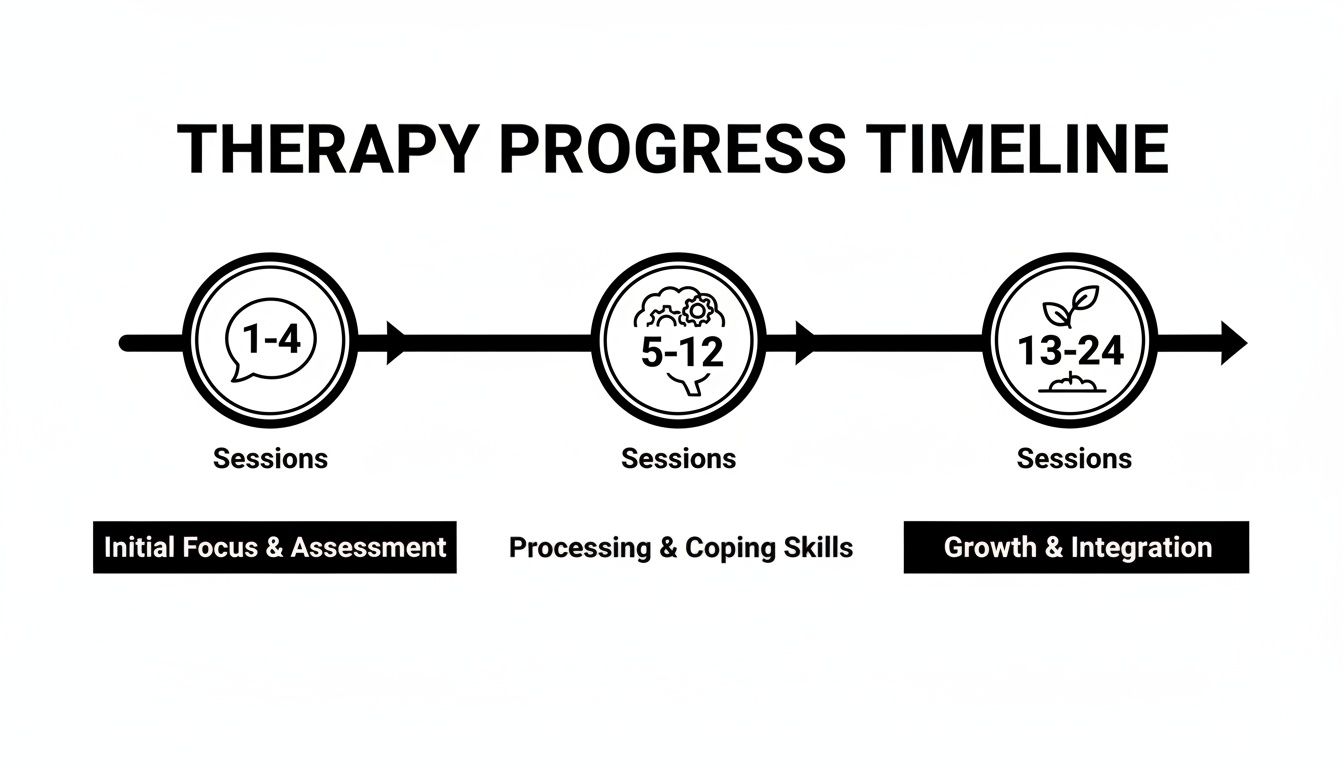
As the infographic shows, the first handful of sessions are all about laying the foundation. The following months are for the active, hands-on work of processing and developing new skills. And the longer-term work? That's where we foster the kind of deep-seated growth that really sticks.
What the UK Evidence Says About Therapy Timelines

While every personal story is unique and powerful, it can be reassuring to zoom out and look at the bigger picture. What does the evidence actually say about how long therapy takes to work? Thankfully, here in the UK, we've got a wealth of data from massive mental health programmes that give us some really clear insights.
This kind of data helps us move beyond guesswork. It provides a solid, data-backed message of hope, normalising the process and showing that structured, measurable support is a reality for hundreds of thousands of people every year, not just an ideal.
Insights From NHS Talking Therapies
One of the best sources we have is the NHS programme, formerly known as IAPT (Improving Access to Psychological Therapies) and now called NHS Talking Therapies. This initiative supports millions of people across England, including right here in the Cheltenham area, and the findings are incredibly useful.
The programme proves that therapy doesn't need to be an endless commitment to be effective. In fact, the data consistently shows that many people see significant, life-changing results within a relatively short and structured timeframe. Often, people start feeling better in just a few months.
For example, the findings from 2020/21 showed that a record 634,649 people finished their course of treatment. The average number of sessions they had was just 7.5. Even with this brief, focused approach, over half of them—51.4% to be exact—achieved recovery from common issues like anxiety and depression. You can discover more about these IAPT findings and what they mean for effective therapy.
What This Data Means for You
This evidence is incredibly encouraging for anyone thinking about starting therapy. It shows that services in the UK are designed to deliver real, tangible results efficiently. The main takeaway here is that meaningful progress is often made within a two- to three-month window.
So, what can we learn from this data?
Short-Term Can Be Effective: A huge number of people find relief without needing years of therapy.
Progress Is Measurable: The NHS uses clear metrics to track recovery, confirming that positive change isn't just a vague hope—it's a real and achievable goal.
Consistency Is Key: That average of around seven sessions really highlights how important it is to attend regularly to build up momentum.
The success of programmes like NHS Talking Therapies proves that effective, structured psychological support can make a profound difference relatively quickly. It’s not about a magic number of sessions, but about a focused, collaborative effort towards recovery.
The Key Factors That Shape Your Personal Therapy Timeline
So, why does therapy seem to work faster for some people than others? It’s not about strength or weakness. The real answer lies in a mix of personal factors that makes your journey completely your own.
Just as every person is unique, so is every therapy timeline. Getting a handle on these variables helps set realistic expectations and takes the pressure off. Your specific circumstances, the nature of what you’re facing, and your personal history all have a massive say in the pace of your progress.
The Issues You Bring to Therapy
The biggest factor is often the complexity and history of the challenges you’re dealing with. Are you coming to therapy to handle a recent, specific event causing a lot of stress, like being made redundant? Or are you looking to work through something more deep-rooted, like childhood trauma or anxiety that’s been with you for years?
Naturally, a more focused, recent problem often finds a resolution more quickly. In contrast, complex trauma or personality patterns that have built up over a lifetime need more time to gently unpack, understand, and reshape. Think of it as the difference between mending a single tear in a piece of fabric and re-weaving an entire section from scratch.
I often compare therapy to physiotherapy for the mind. If you sprain an ankle, the recovery path is relatively straightforward. But if you’re retraining muscles after years of incorrect posture, that process takes longer and requires much more consistent effort.
The Power of Your Therapeutic Alliance
One of the most critical pieces of the puzzle is the therapeutic alliance – that’s the bond of trust, respect, and teamwork you build with your counsellor. A strong connection where you feel safe, heard, and genuinely understood is the perfect environment for healing and change to happen.
This relationship is the very foundation of all the work we’ll do together. When you trust your therapist, you’re far more likely to open up, be vulnerable, and really lean into the process. You can read a bit more on this in my article explaining what the therapeutic relationship is and why it's key to success.
Your Commitment Between Sessions
Finally, what you do outside of our 50-minute sessions matters immensely. Therapy isn't a passive, once-a-week event; it's about taking the insights and new skills we talk about and integrating them into your daily life.
Your willingness to reflect on things, try out suggested exercises, and actively apply what you’re learning has a direct impact on how quickly you'll see progress. It’s also worth remembering that other things, like understanding the importance of good sleep hygiene, can have a huge knock-on effect on your mental state and, in turn, how you progress in therapy.
How Different Therapy Approaches Affect Timelines

The kind of therapy you choose is a massive piece of the puzzle. It’s a big factor in answering that "how long does therapy take?" question because, honestly, not all counselling is the same. Different approaches have entirely different aims and timelines built into them—a bit like deciding whether you need to go for a quick sprint or a long-distance run.
Some methods are built for speed and structure, designed to get to the heart of specific issues within a fairly predictable timeframe. Others are more of a gentle, exploratory path, focusing on deep self-understanding that just naturally takes a bit longer to unfold.
Getting your head around these differences is the key to finding a style that clicks with your personality and what you’re hoping to get out of our sessions.
Structured and Goal-Oriented Therapies
Take something like Cognitive Behavioural Therapy (CBT). This is often a shorter-term approach. It’s very practical and structured, focusing on spotting and changing the unhelpful thought patterns and behaviours that are causing problems right now.
Because it’s so goal-oriented, a course of CBT usually has a clear beginning and end, often somewhere between 12 and 20 sessions. This model works really well for specific issues like phobias, panic attacks, or certain types of anxiety because the work is focused on building practical coping skills for present-day challenges. The NHS often uses this approach because it’s efficient and you can clearly measure the outcomes.
Data from NHS Talking Therapies in 2023/24 showed that these structured courses lead to reliable recovery for almost half the people who complete them. While many people see shifts much earlier, a full course might be around 20-30 sessions, with 47% of people achieving what’s called 'reliable recovery'—a clinical way of saying they’ve made significant and lasting improvements.
Exploratory and Insight-Focused Therapies
On the other hand, some types of therapy are less about reaching a finish line and more about the journey itself. These include:
Person-Centred Therapy: This approach is led entirely by you. My job as the counsellor is to provide a supportive, non-judgemental space for you to explore whatever comes up, at your own pace. The timeline is completely flexible and open-ended; it lasts for as long as you find it helpful.
Psychodynamic Therapy: This modality goes a bit deeper, looking into your past and unconscious mind to understand how earlier experiences might be shaping how you act and feel today. As you can imagine, this kind of deep, insight-focused work is naturally a longer process.
These methods prioritise profound self-discovery over just getting rid of symptoms quickly. If you're curious, you can learn more by reading my guide to different types of counselling in the UK.
Choosing a therapy style is a bit like picking a vehicle. CBT is a reliable car that gets you directly to a specific destination. Person-centred therapy is more like a walking journey, where the path and the discoveries made along the way are just as important as the final viewpoint.
And of course, some approaches can change the dynamic entirely. My walk and talk therapy sessions in Cheltenham use the natural environment to help clients open up. Sometimes, just being outdoors and moving can accelerate progress by making the conversation feel less formal and more fluid.
Recognising the Signs Your Therapy Is Working
It's a common question: "how do I know if therapy is actually working?" We often expect a sudden, dramatic breakthrough, but the reality is usually much quieter. Real progress isn't about feeling happy all the time; it's about noticing small, consistent shifts in how you navigate your daily life.
Think of it less like a lightning bolt moment and more like learning a new skill. You might not feel completely different overnight, but when you look back over a month or two, you’ll likely see you’re handling things in a way you couldn't before. These subtle improvements are the real building blocks of lasting change.
From Feelings to Facts: The Observable Changes
The most reliable signs that your therapy is making a difference are the ones you can actually see and measure in your behaviour. It’s about how you're interacting with the world differently now compared to when you started.
Are you noticing any of these shifts in your life?
Changes in Relationships: You might find you're setting healthier boundaries with family or colleagues without feeling guilty. Perhaps you’re communicating your needs more clearly or not getting drawn into the same old arguments.
Improved Coping Skills: When stress hits, instead of falling back on old, unhelpful habits, you’re starting to use the new strategies we’ve talked about. This could be anything from taking a moment to breathe before reacting, to actively challenging those negative thoughts.
Better Emotional Understanding: You’re getting better at spotting your emotional triggers. You can feel when you’re about to get overwhelmed and have a much clearer idea of why you feel that way, which is a massive step.
Your Internal World Is Shifting, Too
Alongside these outward changes, you’ll probably notice things shifting on the inside. Your thought patterns might start to feel more balanced and a little less self-critical. This internal evolution is a powerful sign that the work we’re doing is taking root.
Therapy is working when the voice of self-compassion starts to get just a little bit louder than the voice of self-criticism. It's about slowly learning to treat yourself with the same kindness you'd offer a friend.
Here’s a simple checklist to help you track your own progress. Think about where you were before your first session and where you are now:
Do I feel a bit more hopeful about the future?
Am I more willing to try new things or face situations I used to avoid?
Is it easier to let go of the small, everyday frustrations?
Do I have a better handle on my own patterns and why I do what I do?
Noticing these signs is incredibly empowering. It validates the effort you’re putting in and helps us have more focused, productive conversations about what’s working well and what we should look at next.
How to Get the Most Out of Your Therapy Sessions
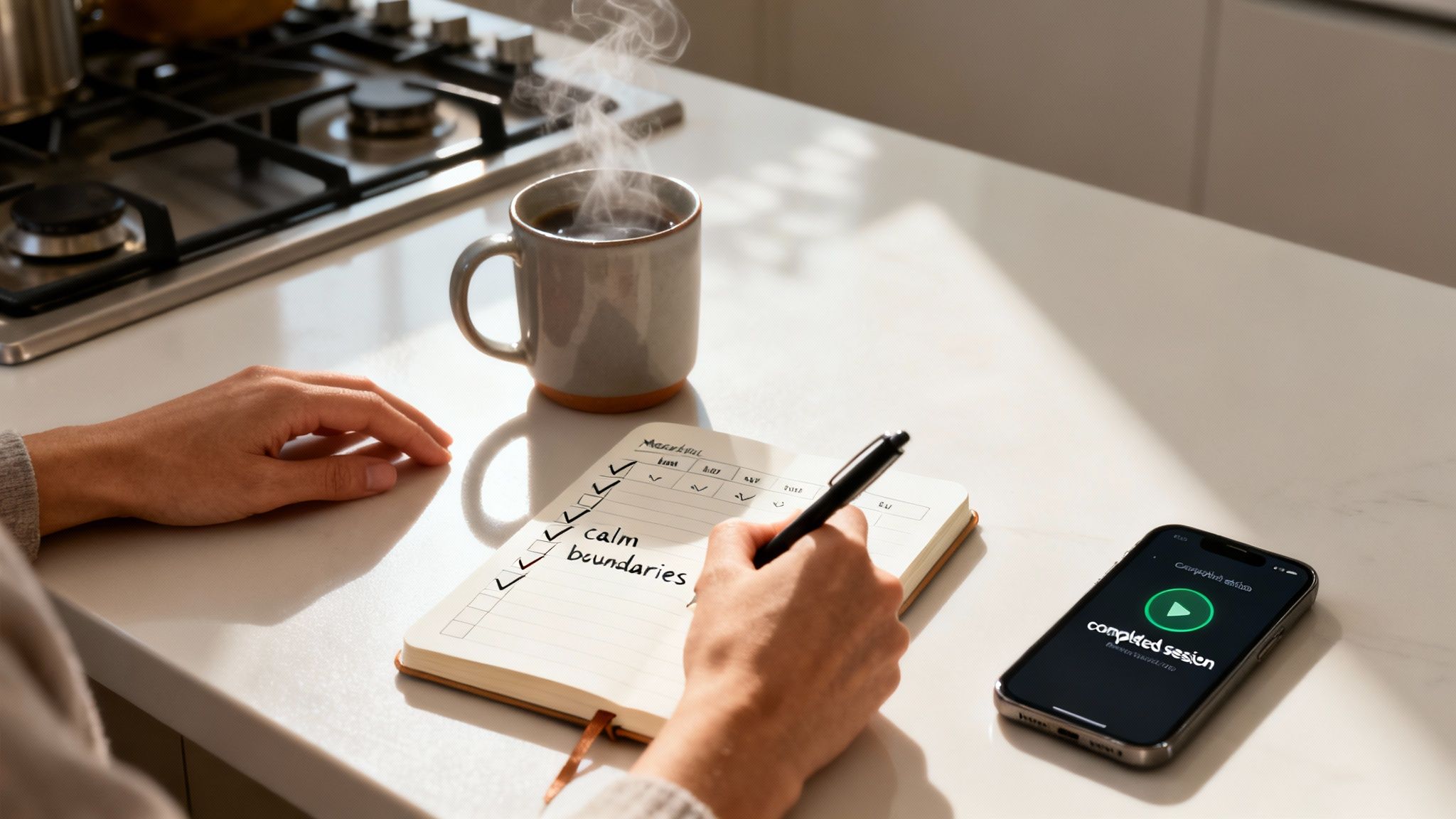
While the question "how long does therapy take to work?" brings up a lot of factors, one of the biggest is, quite simply, you. You can’t force healing to happen overnight, but you absolutely can become an active, engaged partner in your own journey. Doing so often helps you feel the benefits much sooner.
When you take a proactive role, you start to feel more in control. Even small actions can make each session count for more, building momentum and helping you weave what you’re learning into the fabric of your everyday life.
Prepare for Your Sessions
A lot of the real "work" in therapy actually happens between our appointments. Showing up with a rough idea of what you want to talk about can make our time together incredibly focused and productive.
A little bit of preparation really does go a long way. Before we meet, maybe just take ten minutes to think about your week.
What came up for you? Jot down any situations, feelings, or thoughts that stood out—the good, the bad, and the confusing.
What do you want to get out of it? Think about what you'd like to leave the session with. Is there a pattern you’re trying to make sense of? A specific problem you want to untangle?
Be as open as you can be. The more honest you are, the more effective therapy is. Remember, this is a completely safe and confidential space for you to explore whatever is on your mind, without any judgement.
Engage With the Process
Therapy is a collaboration, a real partnership. When we discuss certain exercises or reflections, giving them a go can deepen your understanding and help you apply new insights once you leave the room. This could be anything from journaling to trying a different way of communicating or even just noticing your own reactions to things as they happen.
The most profound changes often happen in the small moments between sessions, when you start applying new awareness to your old routines. This is where therapy moves from being a conversation to a lived experience.
Getting a feel for the structure of a typical appointment can also help you feel more comfortable and ready to dive in. If you're curious, you might find my guide on what happens in counselling sessions useful.
Finally, don't forget the basics. Lifestyle factors play a huge supporting role in all of this. Making sleep a priority, getting some gentle exercise, and eating well can do wonders for your mental resilience and your ability to engage with the therapeutic work. These foundations support your progress, helping you build a stronger sense of well-being from the ground up.
A Few Final Questions You Might Be Asking
We’ve covered a lot of ground, but you might still have a few practical questions knocking around. These are some of the most common ones I hear from clients here in Cheltenham and online, so I wanted to give you some straightforward answers to help you feel more prepared for the journey.
Is it normal to feel worse before I feel better?
Absolutely, and it’s a really important question. It’s very common to feel a bit raw or unsettled when you first start. When you begin to gently unpack difficult emotions and past experiences, it can definitely stir things up.
I often think of it like tidying a room that’s been cluttered for years – you have to pull everything out and make a bit of a mess before you can start organising it properly. That initial discomfort is usually a sign that you’re getting to the heart of the matter, which is a crucial step towards lasting change. The most important thing is to talk to me about these feelings as they come up.
What if I feel like my therapy isn’t working?
This is a big one. If you ever feel stuck, or that things have stalled, the best thing you can do is bring it up in our session. An open, honest conversation about your concerns isn't just helpful; it's a core part of the therapeutic process itself.
When you tell me how you’re feeling, we can explore what might be getting in the way. Maybe we need to adjust our approach, or perhaps it’s time to revisit the goals we set out at the beginning. The relationship we build is a powerful tool for growth, and learning to navigate these kinds of conversations can be incredibly beneficial in its own right.
The real measure of progress isn't a lack of struggle, but a growing confidence in your ability to handle whatever life throws at you.
How will I know when I’m ‘done’ with therapy?
Deciding to end therapy is something we do together. There’s no magic finish line, but you’ll likely know you’re getting there when you feel you’ve met the goals you came in with. More importantly, you'll have built up a toolkit of coping skills to manage challenges on your own.
It’s not about being ‘cured’ or never having a bad day again. It’s about feeling equipped and confident enough to navigate life’s ups and downs without needing that regular support.
At Therapy-with-Ben, your journey is always tailored to you. Whether you prefer the flexibility of online sessions, face-to-face appointments, or getting out into nature with walk and talk therapy in Cheltenham, I’m here to support you at your own pace.
If you feel ready to take that first step, please get in touch. https://www.therapy-with-ben.co.uk


Comments