


The Physical Symptoms of Anxiety and How to Find Relief
Written by Therapy-with-Ben
It’s an unsettlingly common experience. Your heart starts racing, your stomach is doing somersaults, and you feel dizzy for no apparent reason. You start wondering if something is seriously wrong, but there’s no obvious medical cause. This isn't 'all in your head'; it's your body reacting to the very real physical symptoms of anxiety. What you're feeling is your body’s natural alarm system stuck on high.
Your Body Isn’t Broken, It's on High Alert
When these strange physical sensations strike out of the blue, it’s so easy to feel like your body is failing you. One minute you're fine, the next your heart is pounding, your palms are clammy, and a wave of nausea washes over you. It's a confusing and frankly frightening experience, often sending your mind racing towards worst-case scenarios about your health.
But here’s the thing: your body isn't broken. It’s actually doing exactly what it was designed to do, just at the wrong time. Think of it like a smoke alarm that's become far too sensitive. It's meant to blare loudly during a real fire, but yours is going off with the same deafening intensity for a slightly burnt piece of toast. The alarm itself works perfectly; it’s just become over-reactive to its triggers.
You Are Not Alone in This
If this feels familiar, please know you are far from alone. These physical manifestations of anxiety are incredibly common. In fact, in the UK, a staggering 6 in every 100 people deal with Generalised Anxiety Disorder (GAD) in any given week, and it often shows up through intense physical symptoms like a racing heart, sweating, and chronic muscle tension.
These aren't just passing feelings; they can disrupt daily life and make simple tasks feel like climbing a mountain. For millions, this means living with a body that’s constantly on alert. You can get a clearer picture by reading through some of the key mental health statistics from Mind.
This constant state of high alert is exactly why anxiety feels so overwhelmingly physical. Your body is perpetually braced for a threat that isn’t actually there, leading to a huge range of symptoms that can affect every part of you. Recognising these sensations as signals from an overactive alarm system is the very first step toward getting back in the driver's seat.
"The physical feelings of anxiety are not imaginary. They are real physiological responses to a perceived threat, and learning to understand them is the foundation of managing them."
Common Physical Symptoms of Anxiety by Body System
To help make sense of what you might be feeling, it can be useful to see the symptoms grouped by the part of the body they affect. Seeing them laid out like this can normalise the experience and show just how far-reaching the effects of anxiety can be.
This quick-reference table helps you identify the diverse ways anxiety can manifest physically throughout the body.
Body System | Common Symptoms You Might Experience |
|---|---|
Cardiovascular | Pounding or racing heart (palpitations), chest tightness or pain, feeling faint or dizzy, high blood pressure. |
Respiratory | Shortness of breath, feeling like you can't get enough air, rapid breathing (hyperventilation), a sensation of choking. |
Gastrointestinal | Stomach-churning, nausea or 'butterflies', indigestion, constipation or diarrhoea, loss of appetite. |
Neurological | Headaches or migraines, dizziness or vertigo, tingling or numbness in hands and feet, feeling detached or unreal. |
Musculoskeletal | Muscle aches and tension (especially in the neck, shoulders, and back), trembling or shaking, restlessness, fatigue. |
Seeing it all mapped out can be a bit of an eye-opener. It highlights that everything from a dodgy stomach to unexplained aches and pains can be directly linked back to your body’s stress response.
Why Anxiety Feels So Overwhelmingly Physical
When the physical symptoms of anxiety hit, it can feel like your body has been hijacked. One minute you’re fine, the next your heart is hammering against your ribs. This isn’t you "imagining it" or a sign of weakness; it’s a powerful, biological reaction with roots deep in our evolutionary history.
At its heart, this is all down to an ancient survival instinct: the 'fight, flight, or freeze' response. Think of it as your body's built-in alarm system, designed purely to protect you from immediate, physical danger.
Imagine one of our distant ancestors stumbling across a sabre-toothed tiger. There’s no time for a thoughtful debate. Their body would instantly flood with stress hormones, preparing them for intense action—to either fight for their life or run faster than they ever have before.
That same powerful instinct is still wired into us today. The crucial difference is that our modern-day "threats" are rarely so life-or-death. Instead of a predator, the trigger might be a looming work deadline, a difficult conversation, or even just a worrying thought about the future. Your brain, however, can struggle to tell the difference and sounds the same, deafening alarm.
The Science Behind Your Body's Reaction
When your brain perceives a threat—real or imagined—it sends a signal to your adrenal glands to unleash a flood of hormones, mainly adrenaline and cortisol. These are the chemical messengers that drive all those physical symptoms you feel. Their job is to get your body ready for action, and fast.
This hormonal surge triggers a cascade of rapid changes throughout your body:
Your heart beats faster, pumping oxygen-rich blood to your major muscle groups to prepare them for running or fighting.
Your breathing becomes quick and shallow to take in more oxygen, which is what can lead to that feeling of breathlessness or dizziness.
Blood is diverted from functions that aren't essential for immediate survival, like digestion. This is what causes that churning or "butterflies" sensation in your stomach.
Your muscles tense up, ready for action, which can result in trembling, shaking, or those persistent aches and pains.
This simple flow chart gives you a good visual of how a trigger activates the brain, which in turn sets off a physical response in the body.
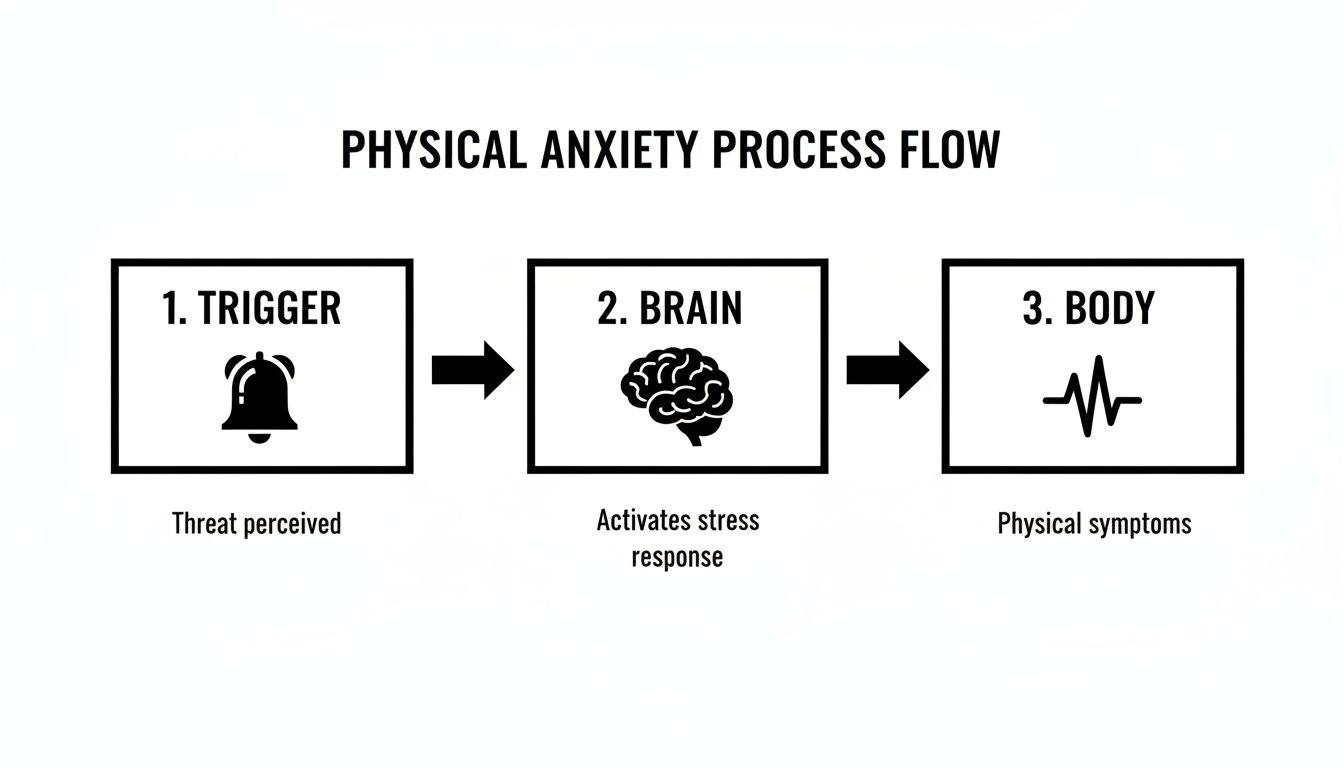
As you can see, the physical sensations aren't random at all. They are the direct, logical result of your body's ancient survival system kicking into gear.
Stress vs Anxiety: A Key Distinction
It’s important to see that while this response is completely natural, the way modern life triggers it can become a problem. The fight-or-flight system was designed for short, sharp bursts, followed by a period of recovery.
Today, however, many of us face prolonged periods of lower-level stress that can keep this system simmering on a low heat, leading to chronic anxiety. Getting to grips with the difference between stress and anxiety is a really helpful step in making sense of your own experience.
Understanding that your body is simply trying to protect you—even when the 'threat' is a thought and not a tiger—is a powerful first step toward managing these physical sensations. It shifts the perspective from "my body is broken" to "my body is trying to keep me safe".
This prolonged activation puts a huge strain on the body. Over time, consistently high levels of cortisol and adrenaline can start to impact various systems. To understand just how serious this can be, you can explore research on Anxiety's impact on heart attack risk. Recognising this link really brings home how important it is to address anxiety—not just for your mental peace, but for your long-term physical health, too.
Common Anxiety Symptoms You Might Be Mistaking for Illness

It’s one of the most maddening parts of dealing with anxiety: the nagging, unexplained physical problems that make you feel genuinely ill. You’ve probably done the rounds at the doctor's, had all the tests, and been told, "everything looks normal." Yet, those worrying sensations just won't go away. It’s an experience that can leave you feeling confused, unheard, and, ironically, even more anxious than when you started.
The first real step forward is connecting the dots between how you feel physically and what’s happening mentally. Many of the most common physical symptoms of anxiety are brilliant mimics, dressing up as heart problems, breathing difficulties, or even neurological issues. Getting to grips with these connections helps demystify what’s happening and allows you to start regaining a sense of control over your own body.
Heart and Chest Sensations
A racing heart or a tight chest is easily one of the most terrifying symptoms. It’s no surprise, either—this is where adrenaline hits first, gearing up your cardiovascular system for a perceived threat.
You might feel things like:
Heart Palpitations: A very real sensation that your heart is pounding, fluttering, skipping beats, or just racing away with itself. This is often just your heart rate picking up speed in response to a shot of adrenaline.
Chest Tightness or Pain: When you’re anxious, the muscles across your chest wall can tense up massively. This can lead to a crushing feeling or even sharp pains that are easily mistaken for something far more serious, like a heart attack.
Of course, you’re going to worry about these feelings. It’s completely understandable. The trouble is, this worry creates a nasty feedback loop. You feel a flutter in your chest, your mind leaps to the worst-case scenario, and that jolt of fear unleashes more adrenaline. Your heart then hammers even faster, which seems to "prove" your original fear was right. Recognising this vicious cycle for what it is can be a game-changer.
Breathing and Respiratory Issues
When anxiety kicks in, your breathing is one of the first things to go haywire. Your body is desperately trying to suck in more oxygen to fuel your muscles for action, but this over-enthusiasm can backfire and create a whole host of uncomfortable feelings.
Common signs include:
Shortness of Breath: That awful feeling that you just can’t get a full, deep breath, almost like you’re suffocating. It’s often caused by taking quick, shallow breaths from your chest instead of your diaphragm.
A Feeling of Choking: The muscles in your throat can tighten up, creating that classic "lump in the throat" sensation that makes you feel like your airway is closing.
These feelings are incredibly distressing, but they are a direct result of your fight-or-flight response throwing your normal breathing rhythm out of whack. It’s not a sign that you are actually running out of air.
The body's response to anxiety isn't random; it's a series of predictable, physiological events. When you learn to identify a racing heart or shallow breath as a symptom of anxiety, you take away its power to create further panic.
Stomach and Digestive Problems
The brain and the gut are so tightly linked that anxiety very often shows up as stomach trouble. When your body flips into survival mode, it diverts blood away from non-essential systems like digestion to focus on your limbs, slowing everything down.
This can trigger a whole menu of issues that look and feel a lot like Irritable Bowel Syndrome (IBS):
Nausea or 'Butterflies': That familiar churning in your stomach is a classic sign of your digestive system reacting to stress hormones.
Stomach Cramps, Diarrhoea, or Constipation: Messing with your gut’s normal rhythm can lead to unpredictable and unpleasant changes in your bowel habits.
Indigestion and Acid Reflux: Anxiety can ramp up the production of stomach acid, leading to heartburn and that horrible post-meal discomfort.
For lots of people, these gut feelings are the main way their body screams "I'm stressed!" Learning to listen to these signals can be your early warning system that anxiety levels are on the rise.
Headaches and Neurological Feelings
To top it all off, anxiety can produce a range of odd sensations that feel neurological, which only adds another layer of worry. These are usually down to a combination of muscle tension and changes in blood flow to the brain.
You might notice:
Tension Headaches: A constant, dull ache that feels like a tight band squeezing your head. This often comes from chronic tension you’re holding in your neck and shoulders without even realising it.
Dizziness or Light-headedness: Those changes in your breathing pattern can mess with the oxygen and carbon dioxide balance in your blood, making you feel faint, dizzy, or unsteady on your feet.
Tingling or Numbness: Often felt in your hands, feet, or face, this "pins and needles" feeling is another common side effect of hyperventilating.
Simply arming yourself with the knowledge that these physical symptoms are real, understood, and linked to a biological process is a huge step. It helps you shift the story from, "What on earth is wrong with me?" to, "Okay, this is my body's alarm system going off—how can I help it feel safe again?"
Right, so you've started to connect the dots and realise that these physical feelings are real, physiological responses to anxiety. That's a huge breakthrough. But, and this is important, we can't just chalk up every single ache, pain, or flutter to anxiety. A sensible, responsible approach to your health means knowing when to pause the anxiety-analysis and get a proper medical opinion from your GP.
The main reason for this is straightforward: we need to rule out other potential medical conditions. Anxiety is a master mimic, and symptoms like chest pain, dizziness, and breathlessness can absolutely be signs of underlying heart, respiratory, or neurological problems. Getting a clean bill of health from your doctor isn't just a tick-box exercise; it's incredibly reassuring. It gives you the peace of mind to focus on managing the anxiety, confident that you’re not overlooking something else.
New, Severe, or Changing Symptoms
A good rule of thumb is this: if a physical symptom is new, has suddenly ramped up in intensity, or just feels different from your usual anxiety pattern, it's time to get it checked. For instance, if you've had tension headaches for years but suddenly get a headache that's unlike anything you've felt before and is intensely painful, that's a signal to see a doctor. Your body is pretty good at telling you when something isn't right, and it's always wise to listen.
Your health is a partnership between your mind and body. While we can explore the psychological roots of what you're feeling, it’s always best practice to first make sure there are no underlying physical causes with a trusted medical professional.
Seeking medical advice isn't about feeding the anxiety or creating drama. It's about being informed and sensible. Once other conditions have been ruled out, you can then throw yourself into therapeutic support, like the anxiety counselling available here in Cheltenham, knowing that you're tackling the real root of the problem.
Red Flag Symptoms That Require Medical Attention
While many of anxiety's physical symptoms overlap with other conditions, there are a few 'red flags' that should always prompt you to seek a medical evaluation, and quickly. These are symptoms where the potential risk of a serious medical issue is high enough that you shouldn't just dismiss them as "just anxiety" without a professional opinion.
If you experience any of the following, it is crucial to speak with your doctor or seek urgent medical care:
Chest pain that feels crushing, spreads to your arm, jaw, or back, or comes with sweating and nausea.
A sudden, severe headache that feels like the "worst headache of your life," particularly if it’s joined by a stiff neck, fever, or changes in your vision.
Difficulty speaking or understanding speech, or a sudden weakness or numbness down one side of your body.
Fainting or losing consciousness, even if it’s just for a moment.
Sudden and severe shortness of breath that doesn't ease up with your usual calming techniques.
These symptoms need immediate attention to rule out serious conditions like a heart attack or stroke. Being cautious and getting checked out is always the right thing to do. It provides a solid, safe foundation from which you can then begin to explore and manage the very real, but less medically urgent, physical side of anxiety.
Practical Ways to Soothe Your Body and Calm Your Mind
Realising that the physical feelings of anxiety are just your body’s alarm system is a massive first step. The next, and most powerful, step is learning how to manually turn that alarm down.
These aren't just generic tips you've heard a hundred times. They're practical, evidence-based techniques you can use the second you feel your body shifting into high alert. The goal here is to build a personal toolkit of strategies that actually work for you.
Some of these are for immediate, in-the-moment relief, while others are about building a lifestyle that makes your nervous system more resilient over time. Think of it as having both emergency first aid and long-term preventative care for your mind and body.
Immediate In-the-Moment Techniques
When a wave of physical anxiety hits—a racing heart, shallow breathing, sudden dizziness—your number one priority is to send a signal to your brain that you are, in fact, safe. These techniques are designed to do just that by directly dialling down your body’s physiological response.
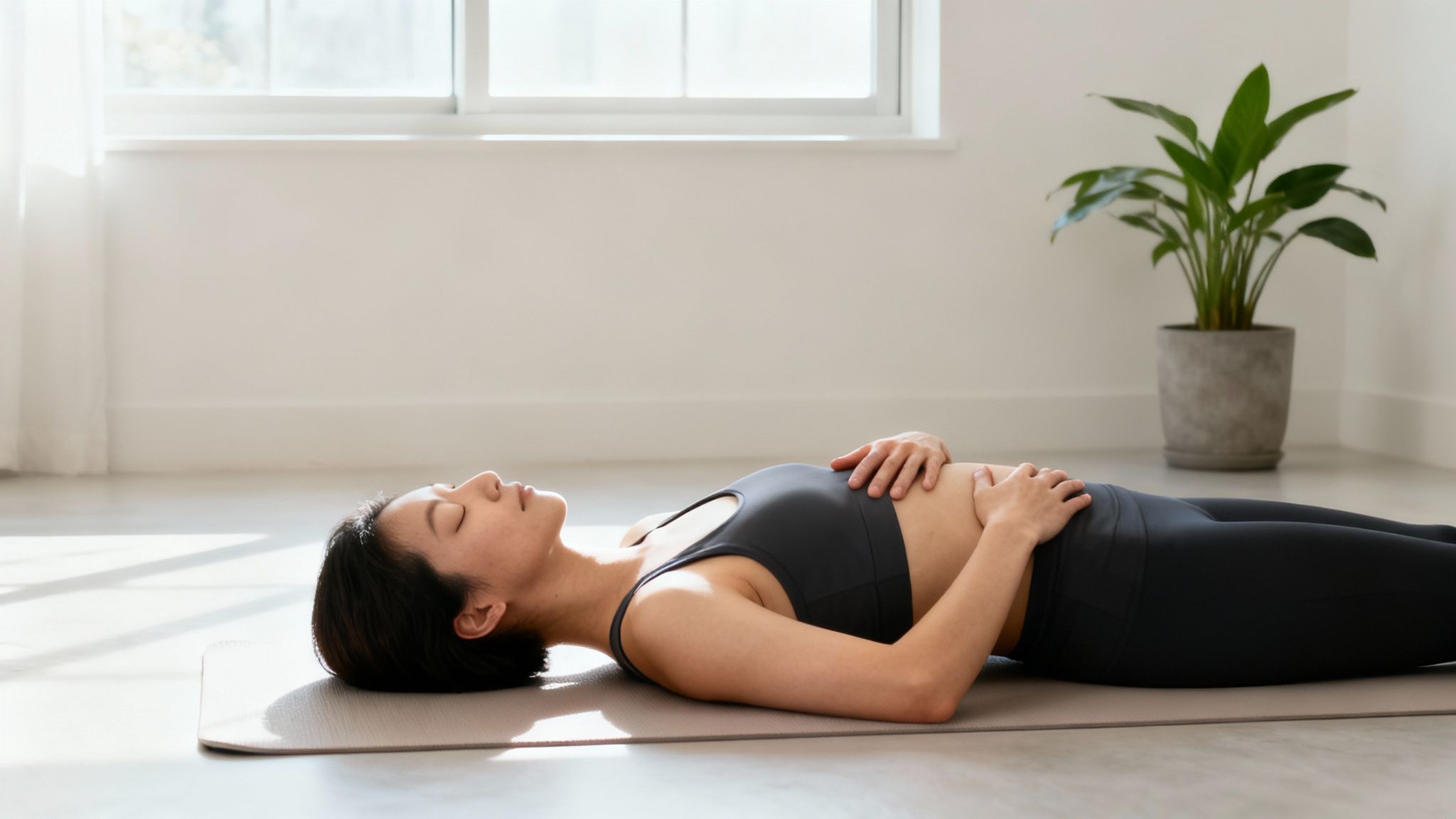
Diaphragmatic (Belly) Breathing: Honestly, this is the most powerful tool you have for calming your nervous system. When you're anxious, your breathing becomes shallow and quick, which just pours fuel on the fight-or-flight fire. Deep belly breathing does the exact opposite. * How to do it: Lie down or sit somewhere comfortable. Pop one hand on your chest and the other on your stomach. Breathe in slowly through your nose for a count of four, focusing on making your stomach rise much more than your chest. Hold it for a moment, then breathe out slowly through your mouth for a count of six, feeling your stomach fall. Keep this going for a few minutes.
The 5-4-3-2-1 Grounding Exercise: Anxiety has a nasty habit of pulling all your focus inward onto the scary physical sensations. This simple exercise yanks your attention back to the outside world, anchoring you firmly in the present moment. * How to do it: Wherever you are, just pause and silently name: * 5 things you can see (the pattern on the floor, a car outside). * 4 things you can feel (the texture of your jeans, the cool air on your skin). * 3 things you can hear (a clock ticking, distant traffic). * 2 things you can smell (your coffee, the soap on your hands). * 1 thing you can taste (even just the inside of your mouth).
Progressive Muscle Relaxation (PMR): This one directly tackles the muscle tension that’s part and parcel of anxiety. By deliberately tensing and then releasing different muscle groups, you teach your body what it feels like to let go of that physical stress. * How to do it: Find a quiet spot. Start with your feet – tense the muscles as tight as you can for five seconds, then release them completely for ten seconds, really noticing the difference. Slowly work your way up your body: calves, thighs, stomach, arms, shoulders, and even your face, tensing and releasing each group.
For many, these grounding exercises are a lifeline during sudden, intense waves of fear. To explore this further, you might find it helpful to read these therapist-backed tips for coping with panic attacks.
Lifestyle Adjustments for Long-Term Resilience
While those in-the-moment techniques are crucial, building a solid foundation of wellbeing can dramatically reduce how often and how intensely you experience physical symptoms in the first place. These are small, consistent changes that can have a massive impact.
"Your daily habits are a conversation with your nervous system. By consciously choosing calming inputs, you teach your body that it can afford to relax."
Think about making some small adjustments in these key areas:
Moderate Your Caffeine Intake: It’s no secret that caffeine is a stimulant. It can directly mimic or worsen physical anxiety symptoms like a racing heart and jitteriness. Try cutting back or swapping to decaf for a while and just see if it makes a difference to how you feel day-to-day.
Prioritise a Calming Sleep Routine: Poor sleep and anxiety are locked in a vicious cycle, each making the other worse. Try creating a simple "wind-down" hour before bed—ditch the screens, read a book, or have a warm bath. A consistent sleep schedule is one of the best gifts you can give your body’s internal clock.
Incorporate Gentle Movement: You don’t need to be running marathons. Gentle, mindful movement like walking, yoga, or stretching is fantastic for releasing stored muscle tension and helping your body process stress hormones like cortisol. Even a 15-minute walk can make a huge difference to a frazzled system.
Beyond just tackling the physical side of things, learning to manage your feelings is key. A comprehensive guide to finding your calm when coping with anxiety can offer some valuable perspectives. Ultimately, these strategies give you the power to actively soothe your body and reassure your mind, helping you feel much more in control.
How Counselling in Cheltenham Can Help You Heal
While the self-help techniques we’ve touched on are fantastic for managing physical symptoms in the moment, getting lasting relief often means going deeper. It’s about getting to the root of what’s causing the anxiety in the first place. This is where counselling comes in, offering a safe, supportive, and completely non-judgemental space to do just that. Think of it as a collaborative journey toward feeling better, not just getting by.
The goal is to gently untangle the web of thoughts, feelings, and life experiences that are keeping your body’s alarm system on such high alert. Together, we can start to understand the triggers behind the physical sensations and build personalised strategies that go way beyond simple coping skills, paving the way for genuine, long-term change.
A Natural Approach to Easing Physical Tension
Here at Therapy with Ben, I offer something a bit different called walk and talk therapy, right here in the beautiful green spaces of Cheltenham. This approach marries the proven benefits of counselling with the incredibly calming effects of gentle movement in nature. There’s something powerful about being outdoors and moving your body – it’s a natural antidote to the very physical tension that anxiety creates.
Instead of sitting face-to-face in an office, we walk side-by-side. Many people tell me this feels less intense and makes it easier to open up. The simple rhythm of walking can help regulate your breathing, lower stress hormones like cortisol, and offer a gentle focus that can make tough conversations feel more manageable. It’s a form of therapy that truly respects the deep connection between your mind and your body.
The last few years have really thrown into sharp focus just how physically draining anxiety can be. During the early days of the pandemic in 2020, for example, nearly 50% (49.6%) of UK adults reported high levels of anxiety. This massive surge in stress amplified physical symptoms like heart palpitations and chronic muscle tension, as the constant uncertainty kept our fight-or-flight response permanently switched on. You can learn more about these anxiety statistics and their impact here.
Therapy isn’t about fixing something that's broken; it's about understanding the signals your body is sending you and learning a new, calmer way to respond.
Support That Fits Your Life
I know that everyone’s life and needs are different. That’s why I offer a few flexible options, making sure you can get support in a way that feels comfortable and right for you. My services include:
Face-to-Face Sessions: Held in a quiet, private, and comfortable setting in Cheltenham.
Online Counselling: Secure video calls that allow you to connect from anywhere you feel safe and have a good internet connection.
Walk and Talk Therapy: Making the most of the beautiful natural spaces around Cheltenham to support your healing process.
Whether you’re specifically looking for a male counsellor or are just curious about how different therapeutic styles can help, my main goal is to create a space where you feel truly heard and empowered. If you feel ready to take the next step, you can find out more about my specialised approach to anxiety counselling in Cheltenham.
Frequently Asked Questions
It’s completely understandable to have questions when you’re trying to get your head around the powerful link between your mind and your body. This section is here to give you some clear, straightforward answers to the things people most often ask about the physical side of anxiety.
Can Chronic Anxiety Lead to Long-Term Physical Health Problems?
Yes, it absolutely can. Think of your body as being stuck in a permanent state of high alert. When anxiety is a constant companion, that's exactly what's happening, and it puts a huge amount of strain on your system.
The continuous flood of stress hormones like cortisol can really take its toll, particularly on your cardiovascular system, sometimes leading to high blood pressure down the line. It can also weaken your immune system, leaving you more open to picking up bugs, and make conditions like Irritable Bowel Syndrome (IBS) or chronic headaches much worse. This is a big part of why getting to the root of the anxiety is so vital for your long-term physical health, not just your mental peace.
How Quickly Can Therapy Help with Physical Symptoms?
There's no single timeline, as everyone's journey is unique. That said, many people start to feel a noticeable difference in how intense and frequent their physical symptoms are within just the first few weeks of therapy.
Learning practical, in-the-moment tools like specific breathing techniques can provide almost immediate relief when you feel your heart starting to race. The deeper work of untangling the thought patterns that fuel the anxiety naturally takes a bit longer, but this is what creates real, lasting change and stops the physical symptoms of anxiety from coming back.
It is completely normal to feel apprehensive about a first therapy session, but please be assured that it is a confidential and non-judgemental space. The goal is for you to feel heard and understood from the very start.
What Is a First Therapy Session Like?
Feeling a bit nervous or even embarrassed about talking through your symptoms is incredibly common. My main focus in a first session is simply to create a safe and comfortable space where you feel you can begin to open up. You only ever need to share what you're ready to.
It's really just a conversation. We'll chat about what you're going through, what you'd like to be different, and importantly, see if working together feels like a good fit for you. There is absolutely no pressure.
If you have a feeling that talking to a professional could help you get a handle on the physical side of anxiety, please don't hesitate to reach out. Therapy with Ben offers a compassionate and practical approach to help you on your journey to feeling better. You can find out more at https://www.therapy-with-ben.co.uk.


Comments