


How to Calm Down Myself: Practical Ways to Find Peace
- Jan 14
- 13 min read
Author: Therapy-with-Ben
When you feel that familiar knot in your stomach and your thoughts start to race, what’s the quickest way to calm yourself down?
My go-to, and the one I always suggest starting with, is to deliberately focus on your breathing. A simple but powerful pattern is to inhale for four seconds and then exhale slowly for eight. This isn't just about 'taking a deep breath'; it's a conscious action that directly interrupts your body's alarm system, slowing your heart rate and pulling your mind away from the spiral. It offers real, immediate relief.
Understanding That Feeling of Overwhelm
That sudden rush—the racing heart, the frantic, looping thoughts—is a profoundly human experience. It’s your body's 'fight-or-flight' response kicking in. The problem is, sometimes that alarm bell rings when there’s no actual fire.
When this happens over and over, it can be a sign of chronic stress, a state where your body and mind remain on high alert. We're all living with more pressure these days, and it takes a toll. You can read more about how this works in my practical guide on how to deal with chronic stress.
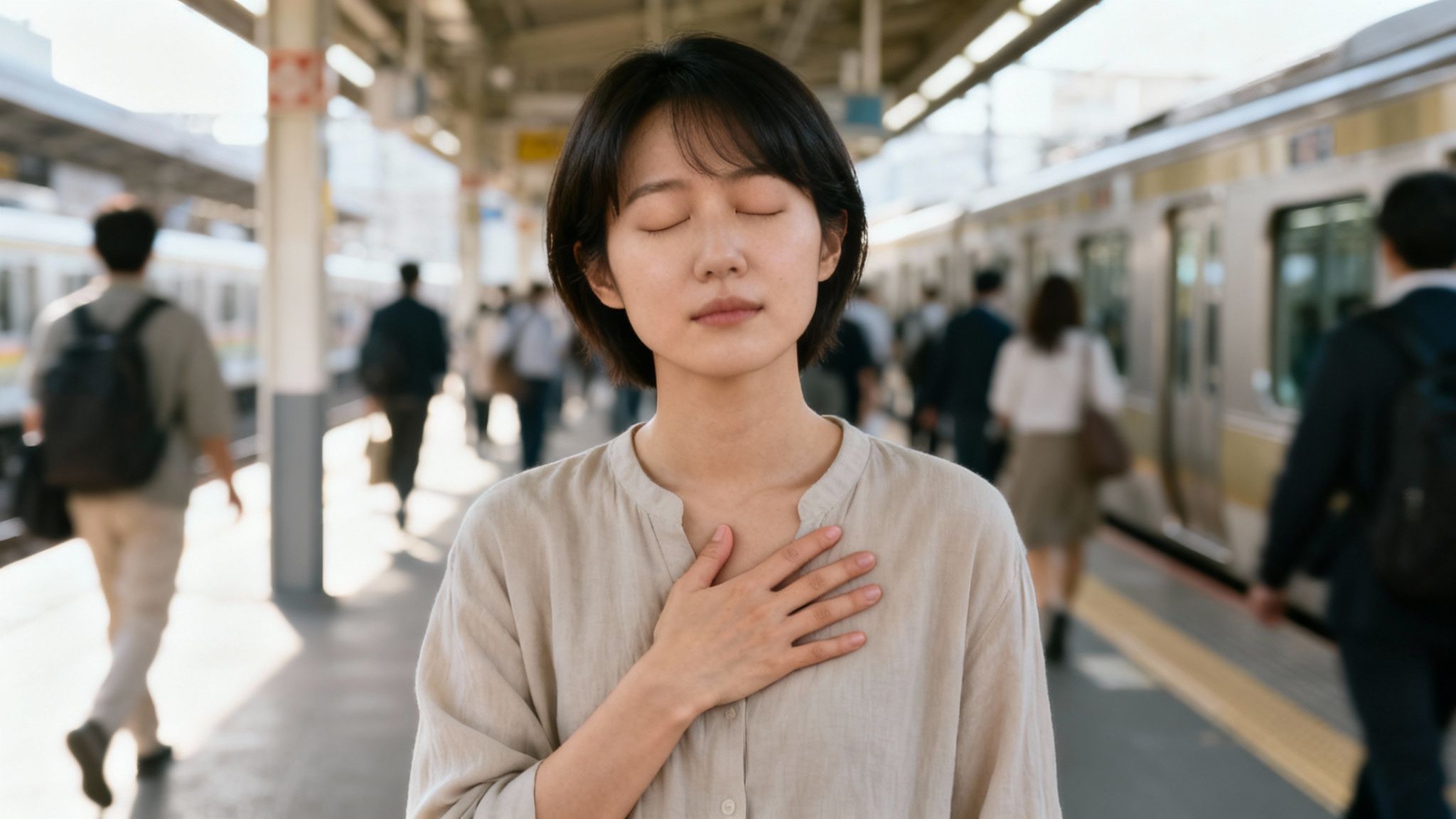
Learning to calm down isn't about trying to avoid stress altogether—that’s impossible. It's about building resilience and having a toolkit you can turn to when things feel unsteady.
Building Your Personal Toolkit
This guide is designed to give you practical, actionable tools you can use discreetly. Whether you’re feeling the pressure in a tense meeting, squashed onto a packed train, or just overwhelmed at home, these techniques are for you.
Think of it as your personal kit for emotional first aid. We'll be exploring strategies like:
Breathing Exercises: Using your breath as a physical anchor to quickly calm your nervous system.
Grounding Techniques: Pulling your focus back to the here-and-now to stop anxious thoughts in their tracks.
Mindful Body Awareness: Learning to notice and release physical tension you might not even realise you’re holding onto.
The goal isn’t to eliminate stress, but to change your relationship with it. When you practise these techniques, you empower yourself to respond to challenging situations with more calm and clarity, rather than just reacting on instinct.
Effectively managing overwhelm often comes down to creating small, calming routines. This could be as simple as transforming your evening rituals to signal to your body and mind that it's time to unwind. For instance, many people find that exploring the use of essential oils for better sleep can be a lovely sensory cue to leave the day's pressures behind.
Let’s start with the most effective methods you can put into practice today.
Using Your Breath for Immediate Relief
When your thoughts start to spiral and your body tenses up, your breath is the most powerful and accessible anchor you have. It’s always there, a tool you can use anytime, anywhere to gently calm your nervous system. By consciously changing your breathing pattern, you’re sending a direct signal to your brain that it’s safe to relax.
This isn't just a nice idea; it's grounded in our physiology. Controlled breathing directly stimulates the vagus nerve, which in turn activates the parasympathetic nervous system – your body's natural "rest and digest" mode. This process has been proven to lower cortisol, our primary stress hormone. Getting a handle on some simple deep breathing techniques for relaxation can make a huge difference when you need it most.
Simple Breathing Techniques to Try Now
The great thing about these exercises is that you don't need a special cushion or a quiet room. You can do them while waiting for the kettle to boil, sitting at your desk before a big meeting, or even on a packed train.
Here are three really effective techniques to get you started:
The 4-7-8 Breath: This is a classic for a reason. Breathe in quietly through your nose for a count of four. Hold that breath for a count of seven. Then, exhale completely through your mouth with a soft whoosh sound for a count of eight. Just repeating this cycle three or four times can have a noticeable effect.
Box Breathing: If you feel scattered, this one is brilliant for regaining focus. Picture a square in your mind. Breathe in for four seconds as you trace the first side up. Hold for four seconds along the top. Breathe out for four seconds down the other side. Hold for four seconds along the bottom to complete the box.
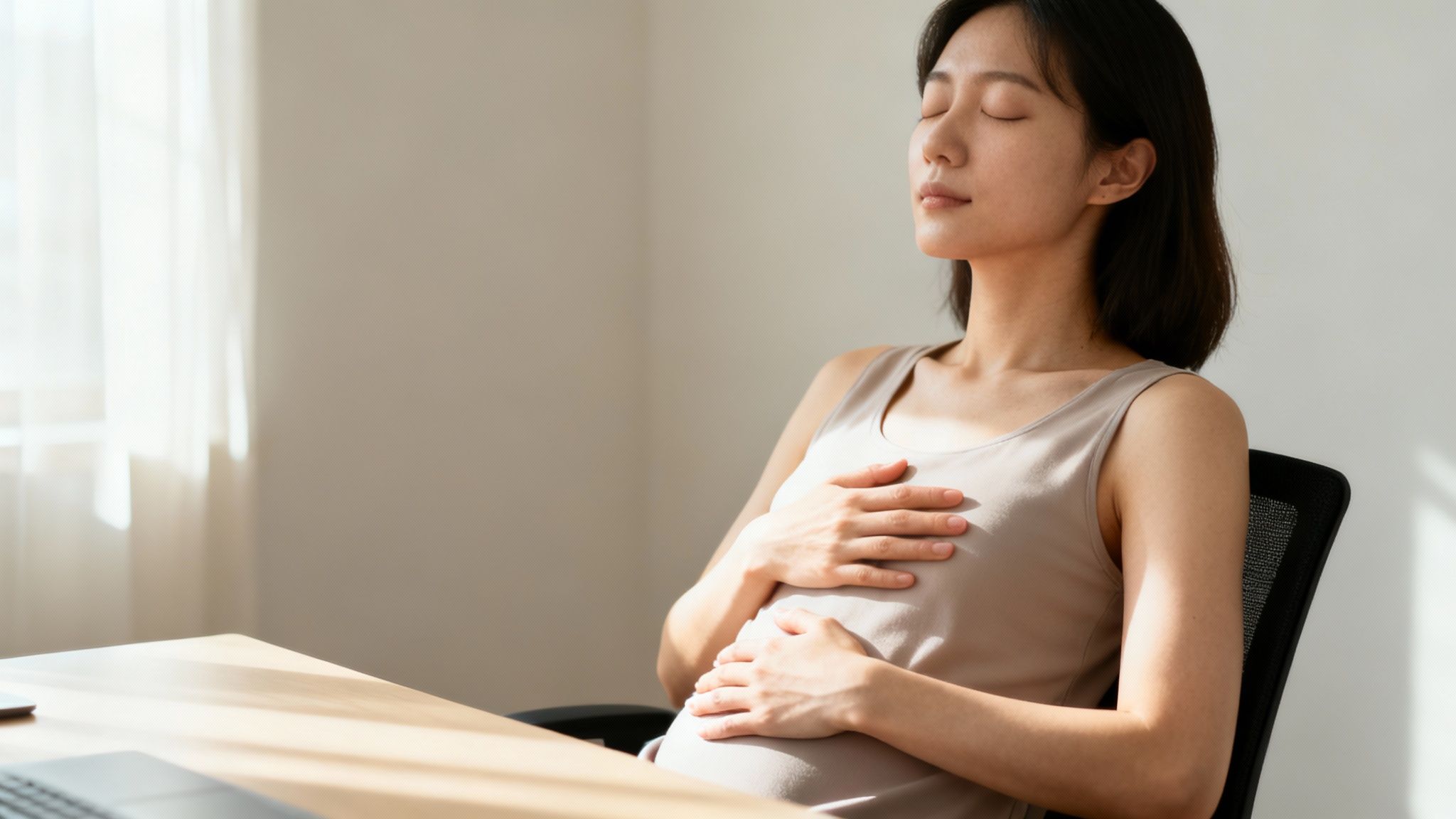
Diaphragmatic (Belly) Breathing: Place one hand on your chest and the other on your belly. As you breathe in slowly through your nose, try to let your stomach rise while keeping your chest fairly still. Then, exhale slowly through your mouth, feeling your stomach gently fall.
These techniques work by physically interrupting the 'fight-or-flight' response, slowing your heart rate and lowering your blood pressure. The counting also gives your busy mind a simple task to focus on, pulling your attention away from whatever is causing the anxiety.
Making It Work for You
What if counting just makes you feel more stressed? I see this sometimes, especially with neurodivergent clients. If focusing on numbers creates more anxiety, simply drop the counting. It’s not a rule.
Instead, just focus on the physical sensation of the breath itself. Notice the feeling of the cool air as it enters your nostrils and the warmer air as you exhale. Pay attention to the gentle rise and fall of your abdomen. The real goal is to anchor yourself in the present moment, and you absolutely don't need numbers to do that.
Breathing exercises are fantastic tools for dealing with sudden spikes of anxiety and form a core part of many strategies for coping with panic attacks. Their effectiveness is well-documented. Studies have shown that techniques like 4-7-8 breathing can reduce a person's heart rate by up to 20% in just a few minutes.
Grounding Yourself in the Present Moment
When anxiety hits, it can feel like you’ve been swept away by a current of 'what ifs'. Your mind starts racing, jumping to future catastrophes that haven't happened, leaving you feeling completely untethered and overwhelmed.
This is where grounding techniques come in. Think of them as your anchor. They are simple but incredibly powerful practices designed to pull your awareness out of that chaotic storm in your head and back to the safety of the here and now.
The whole point is to shift your focus from your internal world of thoughts to the solid, tangible reality of your surroundings. By engaging your senses, you interrupt that spiral of panic and send a clear message to your nervous system: right here, right now, you are okay.
The 5-4-3-2-1 Senses Method
One of the most effective grounding exercises I recommend is the 5-4-3-2-1 method. The beauty of it is that it's easy to remember, requires no special equipment, and you can do it absolutely anywhere. The moment you feel yourself starting to spin out, you can jump into it.
The idea is to consciously notice and name things around you using each of your five senses.
Here’s how it works:
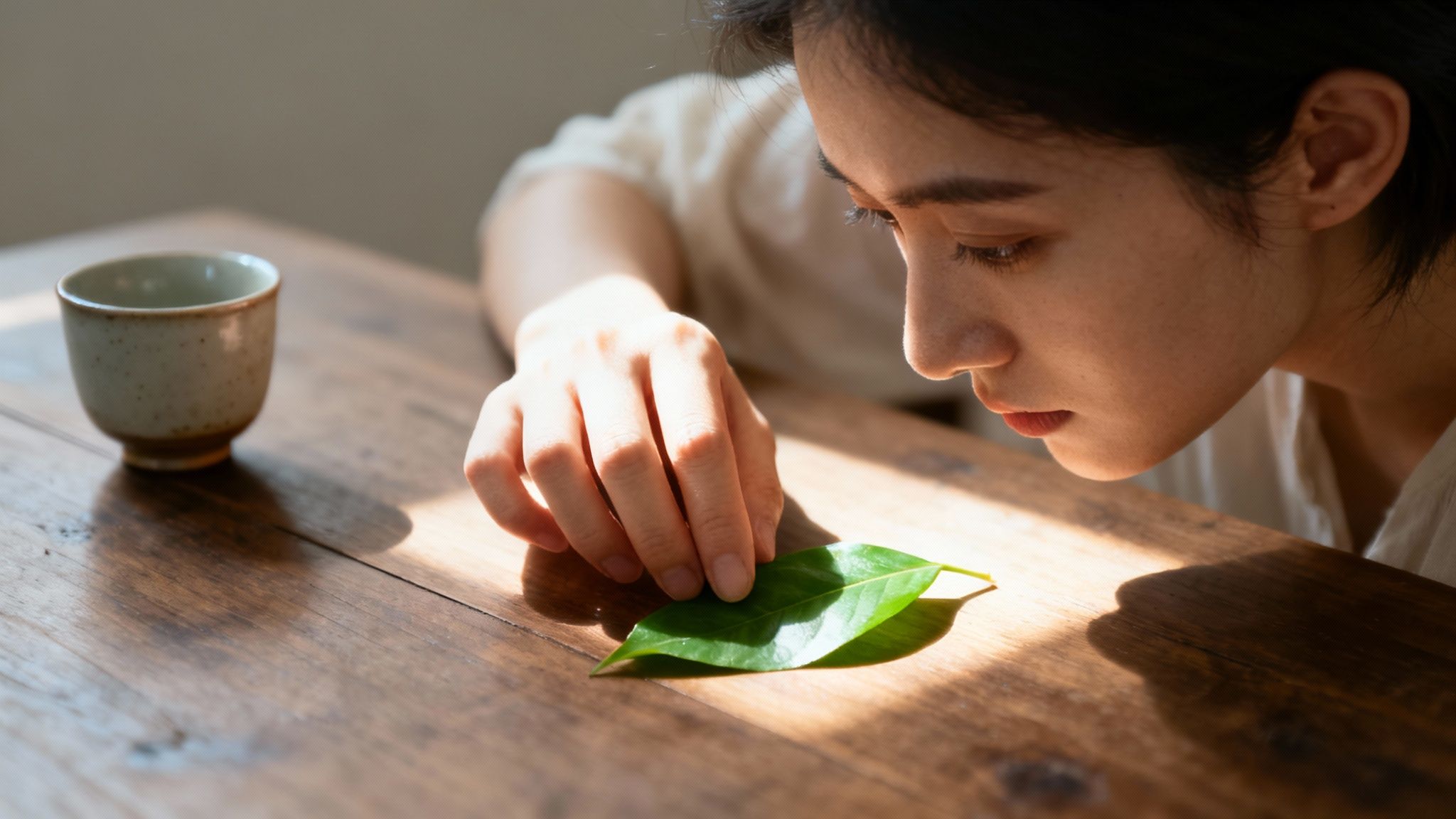
Acknowledge 5 things you can SEE. Look around and, either in your head or quietly out loud, name five separate things. Don't just glance. Really look at them. "I see the blue pattern on my mug." "I can see how the light hits the dust on that shelf." "I see a tiny crack in the pavement." The details are what pull you back.
Acknowledge 4 things you can TOUCH. Now, bring your awareness to the physical sensations on your body. Name four things you can physically feel. It could be the texture of your jumper on your skin, the solid pressure of the chair holding you up, the coolness of a table, or even just the weight of your own feet on the floor.
Acknowledge 3 things you can HEAR. Listen carefully. Try to pick out three distinct sounds in your environment. Maybe it’s the distant hum of traffic, the ticking of a clock, or the simple sound of your own breathing. Tune into the world outside your head.
Acknowledge 2 things you can SMELL. This one can be a bit more subtle, but give it a go. Try to identify two different scents. Perhaps you can smell the faint aroma of coffee, the soap on your hands, or the fresh scent of rain in the air.
Acknowledge 1 thing you can TASTE. Finally, bring your focus to one thing you can taste. This is easy if you have a drink, but you can also just notice the lingering taste of toothpaste from this morning or the natural taste inside your mouth.
The power of this method lies in its structure. It gives your anxious mind a specific job to do, forcing it to disengage from worry and reconnect with the physical world. It’s an anchor in the storm of anxiety.
Grounding in Real-World Scenarios
The real value of a technique like this is how practical it is. You don't need to be in a quiet room with your eyes closed. In fact, it's often most powerful when you use it in the very situations that are making you anxious.
Imagine you're in a busy supermarket and the lights and crowds start to feel like too much. You can just stand to one side and quietly begin: see five red items, feel the cold handle of the trolley, hear the beep of a till. You're pulling yourself back into your body and out of the rising panic.
Or maybe you’re at a stressful family dinner and a difficult conversation is making you tense up. You can ground yourself right there at the table without anyone even knowing. Feel your feet flat on the floor, notice the texture of the napkin in your lap, listen to the clink of cutlery. It's a simple, discreet act that creates a small pocket of safety just for you.
How to Release Physical Tension from Your Body
Stress doesn't just live in your head; it takes up residence in your body. We’ve all been there. Maybe you recognise it as a tight jaw when you're deep in concentration, clenched fists when you're frustrated, or those shoulders that seem to live permanently up by your ears.
This physical tension is a direct, tangible result of your body’s stress response. Learning how to let it go is a vital step in calming your whole system down.
One of the most effective ways to tackle this is a technique called Progressive Muscle Relaxation, or PMR. It’s a deceptively simple exercise that involves deliberately tensing specific muscle groups and then consciously releasing them.
By first creating that tension on purpose, the feeling of relaxation that follows becomes much more profound and noticeable. It’s a bit like night and day.
A Full-Body Guide to Progressive Muscle Relaxation
First things first, find a comfortable position, either sitting or lying down where you won't be disturbed for a few minutes. Take a couple of slow, deep breaths to settle in.
The idea is to move through your body, tensing each muscle group for about five seconds before letting it go completely. Then, you'll rest in that feeling of release for 10-15 seconds before moving on.
Feet and Calves: Start right at the bottom. Curl your toes downwards and tighten your calf muscles. Hold that squeeze for five seconds... then release. Just notice that feeling of warmth and looseness as the tension drains away.
Thighs and Glutes: Now, squeeze your thigh muscles and clench your buttocks. Hold it tight, and then just let it all go. Feel the weight of your legs sinking into the chair or floor.
Stomach and Chest: Tighten your abdominal muscles as if you're bracing for something. Hold... and then release, allowing your stomach to completely soften.
Hands and Arms: Clench both of your fists tightly and flex your biceps. After five seconds, let your hands fall open and your arms go limp. Pay attention to the contrast between the tension and the release.
Shoulders and Neck: This is a big one for many of us. Shrug your shoulders right up towards your ears, feeling the tension build in your neck and upper back. Hold it there... and then let them drop completely.
Face and Jaw: Finally, scrunch up your whole face—frown, squeeze your eyes shut, and clench your jaw. Hold this, and then release everything. Let your jaw hang slightly loose and your face soften.
The core idea behind PMR is that you can't be physically relaxed and mentally anxious at the same time. By systematically releasing this physical tension, you send a powerful signal to your brain that it's safe to calm down.
Discreet Relaxation You Can Do Anywhere
Let's be realistic—you don’t always have the time or space for a full-body scan. The good news is that you can adapt this technique into a 'mini' routine that’s perfect for the office, the bus, or any public space.
Simply focus on the areas where you know you hold the most tension. For many, that’s the hands, shoulders, and face.
Sitting at your desk, you can clench your fists tightly under the table for five seconds and then release. You could follow that with a quiet shoulder shrug, holding and releasing, and then subtly clenching and unclenching your jaw. Honestly, no one will even notice.
This kind of practical, in-the-moment tool is so valuable. In England, where 1 in 4 adults experience mental health issues each year, having something you can actually do is essential. Studies have even shown that a regular PMR practice can reduce severe symptoms of anxiety and depression by 30-50%, offering a real, tangible way to manage the physical side of stress.
You can explore more about UK mental health statistics and calming methods if you'd like to understand the broader picture.
When to Seek Professional Support for Anxiety
The self-help techniques we’ve gone through are brilliant, practical tools for your emotional first-aid kit. They're fantastic for managing those sudden moments of panic, releasing built-up tension, and grounding yourself when the world feels like it’s spinning too fast.
But it’s just as important to recognise when these tools, as helpful as they are, might not be enough on their own.
Reaching out for professional support isn't a sign that you've failed; it's a sign of real strength and self-awareness. It means you’re in tune with your own needs and ready to take a proactive step towards lasting change. Learning how to calm yourself down is a skill, but sometimes we all need a guide to help us get there.
Recognising the Signs
So, how do you know when it’s the right time to speak with a professional? There’s no single, definitive answer, but there are a few common signs that suggest therapy could make a huge difference.
See if any of these feel familiar:
The Anxiety Just Won't Quit: The feelings of anxiety are pretty much constant and don't seem to let up, no matter which calming techniques you try.
It's Impacting Your Day-to-Day: Anxiety is getting in the way of your work, your relationships, or even just your ability to enjoy the things you used to love.
You Feel Stuck: It feels like you've tried everything you can think of, but you're still not feeling any better.
Physical Symptoms are Lingering: You're dealing with ongoing physical signs of stress, like constant headaches, stomach problems, or you just can't seem to get a good night's sleep.
If you found yourself nodding along to any of those points, it might be the right time to think about talking to a counsellor.
Acknowledging that you need support is the first, and often hardest, step. It’s an act of courage that opens the door to deeper healing and understanding.
Finding a Safe Space to Talk
Taking that next step can feel pretty daunting, which is why finding the right kind of therapeutic environment is so important. Here at Therapy with Ben, based in Cheltenham, my whole approach is about creating a warm, non-judgemental, and comfortable space where you feel safe enough to explore what’s really going on for you. There are lots of ways therapy can help you manage anxiety, from building new coping strategies to getting to the root of why you feel the way you do.
But I know a traditional therapy room isn't for everyone. For some people, sitting face-to-face in an office can feel a bit intense or overly formal. That’s exactly why I also offer walk and talk therapy.
What is Walk and Talk Therapy?
This approach simply takes our sessions outdoors, into the beautiful natural spaces we have around Cheltenham. The simple act of moving while we talk can make counselling feel less intense and much more approachable.
The benefits are twofold:
It Eases the Pressure: Walking side-by-side often feels more natural and less confrontational than sitting directly opposite someone.
The Power of Nature: Being outdoors has a proven calming effect on our nervous systems, helping to reduce stress and boost your mood.
It’s a unique way to combine the focused support of professional counselling with the therapeutic power of movement and nature. If you feel that now is the time to get some support, I'm here to help you find your way forward.
Your Questions Answered
It’s completely normal to have a few questions rattling around when you first start trying to figure out what helps you calm down. Building up your own personal toolkit of what works for you takes a bit of time and practice. Here are a few common queries I hear, which might give you a bit more clarity on your own journey.
How Quickly Can These Calming Techniques Actually Work?
A lot of the methods we’ve talked about, especially the deep breathing exercises, can bring a sense of relief in just a few minutes. That’s because they directly interrupt your body’s stress response, slowing your heart rate and sending a signal to your brain that it’s safe to stand down.
The real key, though, is practice. The more you do these things when you’re already feeling okay, the more you build up a kind of 'muscle memory' for relaxation. This makes them far more effective and quicker to kick in when you really need them in the middle of a stressful moment.
What if I Feel Awkward Doing These in Public?
This is such a common and understandable worry. The great news is that many of these strategies are incredibly discreet. Honestly, no one around you is going to see or hear you doing a bit of diaphragmatic breathing or mentally running through the 5-4-3-2-1 grounding technique.
You could even do a mini muscle relaxation at your desk just by clenching and unclenching your fists under the table. Start with whatever feels most comfortable for you – your wellbeing is the priority here.
Can These Techniques Really Help During a Panic Attack?
Yes, they can be a crucial lifeline when you're trying to manage a panic attack. Grounding techniques, in particular, are designed to pull your focus out of that overwhelming internal storm of panic and back into the physical safety of the present moment. They can provide a much-needed anchor when everything feels like it's spinning.
That said, when you're in the grip of a severe panic attack, the main goal is simply to ride the wave and find a safe space. The real power of practising these techniques regularly when you’re not panicking is that it can significantly reduce the frequency and intensity of future attacks, making them less likely to happen in the first place.
"The aim is not just to manage panic when it arrives, but to build a foundation of calm that makes its arrival less frequent and less powerful."
What if I’m Neurodivergent and Find Counting Difficult?
This is a really important point. For many neurodivergent people, trying to focus on numbers or follow rigid sequences can actually add stress instead of relieving it. If that’s your experience, it’s vital to adapt these tools so they actually serve you.
Instead of counting breaths, just focus on the physical sensation. Pay attention to the feeling of your chest rising and falling, or the cool air entering your nostrils.
For grounding, you might find it more helpful to concentrate on a single, soothing texture, like a smooth stone you carry in your pocket or the feel of a soft jumper.
The goal is always to find what works uniquely for your brain to help you feel anchored and calm.
If you find that anxiety is sticking around and these techniques just aren't cutting it on their own, please know that reaching out for professional support is a positive and courageous step. At Therapy with Ben, I offer a safe, non-judgemental space here in Cheltenham to explore these feelings more deeply.
To find out more about how we could work together, including through walk and talk therapy, just visit my website.
Comments