


Living with anxiety disorder: Practical Coping Tips That Work
Updated: Dec 26, 2025
Author: Therapy-with-Ben
Living with an anxiety disorder is a world away from just feeling a bit worried now and then. It’s when that sense of persistent, overwhelming fear becomes a constant companion, seeping into your thoughts, your body, and the way you live your day-to-day life. It often feels like your internal alarm system is permanently jammed on high alert, creating a cycle of dread and physical symptoms that can feel incredibly isolating and impossible to switch off.
What Living with an Anxiety Disorder Really Feels Like

To really get what it’s like, we need to step past the clinical definitions and into someone's everyday reality. Imagine starting each morning not with a sense of calm, but with a wave of unexplained dread washing over you. Your heart might be racing before you’ve even got out of bed, your mind already spinning through worst-case scenarios for the day ahead.
This isn’t just ‘worrying too much’. It’s an unwelcome guest that dictates your choices, drains your energy, and colours your entire perception of the world. It’s the physical tension in your shoulders that never seems to go away, the frustrating loop of catastrophic thoughts you can’t get out of, and the exhausting effort of just trying to appear ‘fine’ to everyone else.
Anxiety can feel like you're constantly bracing for an impact that never comes. It’s a state of perpetual vigilance where your body and mind are exhausted from being on high alert, even when there's no immediate danger. This chronic state of readiness is what separates a disorder from fleeting, everyday worry.
It Is More Common Than You Think
If this experience sounds familiar, it’s vital to know you are not alone. That feeling of being isolated in your struggle is a common part of the condition, yet the reality is quite different.
In the UK, an estimated 5.6% of people have a diagnosed anxiety disorder, a figure that’s notably higher than the global average. Recent surveys also show that high levels of anxiety are particularly prevalent among younger adults and women.
This guide is designed to be your first step towards understanding what’s happening and discovering practical ways to start regaining a sense of control. Getting the full picture of anxiety is crucial, and professional support like therapy is a key ally in this journey. For more guidance on this initial stage, you might find it helpful to learn more about recognising the signs of mental health problems.
Recognising the Many Faces of Anxiety
Anxiety is a bit of a shapeshifter; it really doesn’t look the same for everyone. When you're living with an anxiety disorder, a big part of the journey is learning to spot its unique patterns in your own life.
It can help to think of your internal alarm system as a slightly dodgy smoke detector. A healthy one goes off when there’s a real fire. But an anxious one? It can be triggered by something as harmless as a piece of burnt toast, throwing you into a state of high alert for what feels like no good reason at all.
This constant 'red alert' sends signals all through your body and mind. Getting to know these signals is the very first step toward getting a handle on them. Once you become more aware of how anxiety shows up for you personally, you can start to recognise your own anxiety signature and begin to tell the difference between a genuine threat and a false alarm.
Your Body on High Alert
Often, the clearest signs of anxiety are physical. These aren't just "in your head"; they are very real, physiological responses to the fight-or-flight chemicals, like adrenaline, that your body is flooded with when that internal alarm goes off.
You might feel a constant, humming tension in your shoulders or find yourself clenching your jaw, as if you’re always bracing for impact. For others, it’s a racing heart that seems to pound out of nowhere, a shortness of breath that makes simple things feel like a marathon, or even a tremble in their hands. Unexplained tiredness, headaches, and digestive troubles are also incredibly common signs that your nervous system is working overtime.
When anxiety becomes a disorder, the body starts reacting to perceived threats—like a stressful work email or a crowded shop—with the same intensity it would a real, physical danger. It’s this disproportionate physical reaction that can be so confusing and exhausting.
The Emotional and Cognitive Static
Beyond the purely physical feelings, an anxiety disorder can really colour your emotional state and your thought processes. Emotionally, it might show up as a constant feeling of dread or a sense of impending doom that just hangs over your day. You might find yourself becoming irritable or snappy with people you love, or feeling a restless energy that makes it completely impossible to just sit and relax.
Cognitively, anxiety creates a kind of mental static. This can feel like racing, intrusive thoughts that you just can't switch off, often spiralling into worst-case scenarios—a process known as catastrophising. You could find yourself worrying excessively about things that are pretty unlikely to happen or find it impossible to concentrate because your mind is constantly jumping from one worry to the next.
This little table breaks down some of the common symptoms to help you see how they might be showing up in your own experience.
Common Symptoms of an Anxiety Disorder
Symptom Category | Examples |
|---|---|
Physical Symptoms | Racing heart, shortness of breath, trembling, sweating, headaches, fatigue, muscle aches, insomnia. |
Emotional Symptoms | Feelings of dread or panic, irritability, restlessness, feeling 'on edge', constant worry. |
Cognitive & Behavioural Symptoms | Racing or unwanted thoughts, difficulty concentrating, catastrophising, avoidance of situations. |
Seeing it laid out like this can sometimes make it easier to connect the dots and realise that what you're feeling is part of a recognised pattern.
Identifying Your Personal Triggers
Sometimes, anxiety feels like it just appears out of the blue, with no obvious cause. Other times, though, it’s clearly linked to specific triggers. These can be external things, like high-pressure work deadlines, arguments in a relationship, or big life changes. For many people, social situations are a massive trigger, sparking fears of being judged or embarrassing themselves.
But internal triggers are just as powerful. These can include harsh negative self-talk, replaying past mistakes over and over, or constantly anticipating future events with a sense of fear. It’s also really important to get the difference between anxiety and stress. While they're related, they aren't the same thing; stress is usually a response to a specific, current situation, whereas anxiety can linger long after that stressor has gone. Understanding the difference between stress and anxiety is a really key part of building your self-awareness.
Learning to identify your personal triggers gives you back a sense of power. When you know what sets off your anxiety, you can start to develop strategies to either manage those situations differently or to prepare yourself for the feelings they bring up, which can reduce their ability to overwhelm you.
Building Your Practical Coping Toolkit
Getting to grips with why you feel anxious is a huge first step, but the real work begins when you start to take action. Living with an anxiety disorder can feel like you're constantly caught in a storm with nowhere to turn. This section is all about building that shelter, piece by piece, using practical, proven strategies to find your calm and, in the long run, become more resilient.
We'll start with what to do when that storm hits hard and you need immediate relief. Then, we’ll look at how to change the underlying thought patterns that create the bad weather in the first place. Finally, we'll cover the day-to-day lifestyle habits that strengthen your foundations for good. Think of these as real, actionable tools you can start using today.
In-the-Moment Techniques to Calm the Storm
When you feel that familiar wave of panic rising, you need something that works right now. These techniques are designed to hit the brakes on that physical and mental spiral, pulling you back into the present moment where you are safe.
One of the most powerful and simple methods is the 5-4-3-2-1 grounding exercise. It works by yanking your focus away from the internal chaos of racing thoughts and planting it firmly on your physical surroundings. The best part? You can do it anywhere, anytime.
Acknowledge 5 things you can see: Just look around. Name five random objects you can see, like a pen on your desk, a scuff mark on the floor, or the tree outside the window.
Acknowledge 4 things you can feel: Bring your attention to physical sensations. It could be the texture of your jeans against your skin, the cool surface of a table, or the solid feeling of your feet on the ground.
Acknowledge 3 things you can hear: Listen closely. What are three distinct sounds you can pick out? Maybe it’s the hum of a refrigerator, a distant siren, or your own breathing.
Acknowledge 2 things you can smell: Try to identify two smells in the air. This might be the faint scent of coffee from the kitchen or the fresh smell of rain outside.
Acknowledge 1 thing you can taste: Focus on one thing you can taste. This could be the leftover taste of your lunch, or you can just notice the sensation of your tongue in your mouth.
By forcing your brain to focus on your senses, you anchor yourself in the reality of the here and now, which often proves that the immediate danger your anxiety is screaming about isn't actually present. Simple breathing exercises are also brilliant for this; a slow breath in for four counts and a longer breath out for six can quickly calm a racing heart.
Mindset Shifts from Cognitive Behavioural Therapy
Grounding techniques are your emergency toolkit, but for long-term change, you have to start working with your thoughts. This is where Cognitive Behavioural Therapy (CBT) comes in, offering some incredibly powerful tools based on one simple idea: our thoughts, feelings, and behaviours are all connected.
When you live with an anxiety disorder, it’s easy to get trapped in negative thought loops, what therapists call "cognitive distortions." The first step is just to start noticing them, almost like a detective observing clues. Do you tend to leap to the worst-case scenario (catastrophising)? Or maybe you discount anything positive that happens and only focus on the negative (filtering)?
Once you can spot these unhelpful patterns, you can start to gently challenge them. You don't have to get into an argument with yourself, just ask a few curious questions:
What’s the actual evidence for this thought? What’s the evidence against it?
Is there a kinder, more balanced way to see this situation?
If a friend came to me with this exact thought, what would I tell them?
Reframing isn’t about toxic positivity or pretending everything is fine when it isn’t. It’s about accepting that your first, anxiety-fuelled thought isn't the whole story. It’s about making space for a more realistic perspective to come through, which instantly reduces the power of the anxious thought.
This infographic helps show how anxiety isn't just in your head; it has a knock-on effect on our physical, emotional, and cognitive experiences.
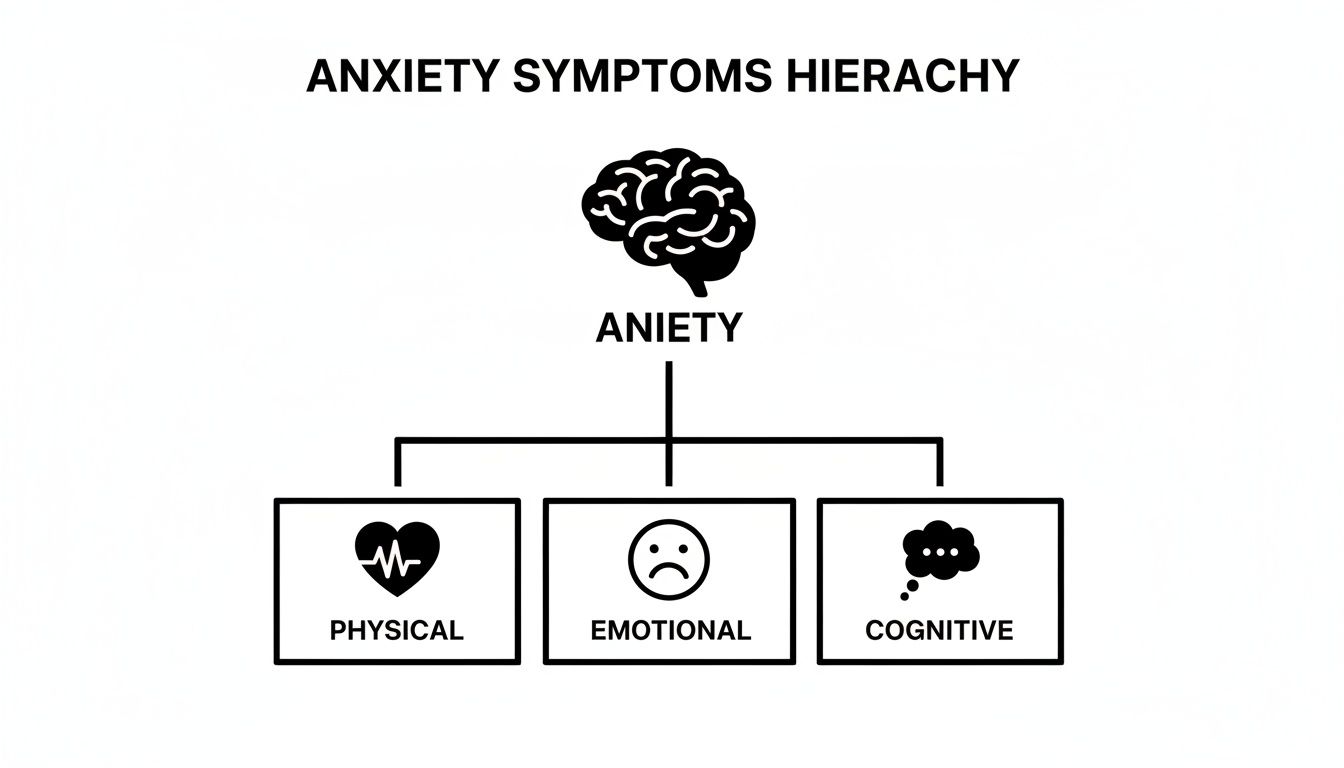
Realising this helps you see that by challenging your thoughts (cognitive symptoms), you can directly soothe how you feel emotionally and physically.
Lifestyle Adjustments for Lasting Change
Finally, building real resilience against anxiety means taking care of your overall wellbeing. Your daily habits are the foundation your mental health is built on, and you’d be surprised what a difference a few small, consistent changes can make.
Regular movement is a massive one. It doesn’t have to mean hitting the gym for two hours; a simple daily walk is incredibly effective at burning off stress hormones. This is actually one of the core ideas behind Walk and Talk Therapy, which cleverly combines the benefits of counselling with the calming effect of being in nature and moving your body.
Getting your sleep hygiene in order is also a game-changer. Anxiety and poor sleep love to feed each other in a vicious cycle. Creating a calming bedtime routine – like ditching screens an hour before bed and making sure your room is dark and cool – tells your body and brain that it’s time to switch off. In the same way, looking at your diet and cutting back on stimulants like caffeine can help stabilise your mood. For many, things like incorporating calming crystals for anxiety into their space can also serve as a tangible reminder to pause and breathe when things feel overwhelming.
How Therapy Provides a Path Through Anxiety

So, you've been trying different coping strategies, but it still feels like something isn't quite clicking. That’s often a sign that a deeper level of support could be what you need. I know the thought of therapy can feel daunting; many people worry about opening up to a stranger or digging into feelings they'd rather leave alone.
But it helps to think of therapy less as a formal interrogation and more as a structured, supportive, and totally confidential conversation. It's a space designed to help you untangle the roots of your anxiety in a way that’s incredibly difficult to do by yourself. It provides a clear, guided path towards really understanding what's going on.
The bedrock of any good therapy is the relationship you build with your counsellor—an alliance built on trust and genuine empathy. This creates a safe space where you can be completely honest, perhaps for the first time, without any fear of judgement. This relationship is the foundation for real, lasting change.
Finding the Right Therapeutic Approach for You
One of the best things about modern counselling is that it’s not a one-size-fits-all deal. There are different approaches and formats out there to suit different personalities, needs, and lifestyles, making support more accessible than ever.
What works wonders for one person might not feel right for another, and that is absolutely fine. The aim is to find a style of therapy that feels comfortable and effective for you. Here are a couple of the main formats you’ll find in Cheltenham:
Face-to-Face Counselling: This is the traditional setup, taking place in a quiet, private therapy room. It creates a dedicated, focused environment, free from the distractions of everyday life, which many people find vital for doing deep, reflective work.
Online Counselling: Offering brilliant flexibility, online sessions mean you can get support from the comfort of your own home. This is perfect if you have a packed schedule, mobility issues, or you simply feel more at ease in your own space.
Therapy isn't just a crisis intervention; it's a proactive and empowering tool for building long-term resilience. It gives you the tools not just to get through tough moments, but to develop the insight and skills needed to live a calmer, more fulfilling life long after your sessions end.
An Innovative Approach: Walk and Talk Therapy
For those of us who feel a bit boxed in or intimidated by the idea of sitting in a formal room, Walk and Talk Therapy is a refreshing and surprisingly powerful alternative. This approach combines all the benefits of traditional counselling with gentle physical movement and the calming influence of being in nature.
Walking side-by-side can feel less intense than sitting directly opposite someone, which often makes it easier to open up and process what’s on your mind. The simple, rhythmic act of walking can help to regulate emotions and release physical tension. On top of that, we know that being in green spaces has a massive positive impact on our mental wellbeing.
This format is particularly helpful for anxiety, as it helps to burn off that restless, adrenaline-fuelled energy. It provides a real-world example of moving forward, both literally and metaphorically. To get a better feel for its impact, you can have a read of our guide on 5 ways therapy can help you manage anxiety.
Ultimately, deciding to start therapy is a powerful act of self-care. It's an investment in yourself and a clear signal that you are ready to take control of your journey with anxiety, rather than letting it control you.
Knowing When and How to Find Professional Support
Building your own toolkit of coping skills is a brilliant, essential part of managing an anxiety disorder. But it’s also important to be honest with yourself and recognise when those strategies just aren't cutting it.
Sometimes, no matter how hard you try, the weight of anxiety feels too much to carry by yourself. Reaching out for professional help isn't a sign you've failed; it's a brave and sensible step towards feeling better.
Knowing when to take that leap can feel a bit murky. It’s usually more about a pattern than a single bad day. If you find anxiety is consistently getting in the way of your work, putting a strain on your relationships, or just stopping you from enjoying life, that’s a clear signal that a bit more support could make all the difference.
Key Signs It’s Time to Reach Out
It can be helpful to look for a few specific signs that self-help alone might not be enough. Spotting these patterns can make the decision to get help feel less like a guess and more like a clear, positive choice.
Ask yourself if any of these feel familiar:
Persistent Disruption: Is anxiety regularly messing with your ability to do your job, connect with people you care about, or just get through the day?
Unhealthy Coping: Have you started leaning on unhealthy habits to get by? This could be anything from drinking more than you’d like to avoiding important situations or anything else you know isn't helping you in the long run.
Feeling Overwhelmed: Do the physical and emotional symptoms feel completely relentless? Maybe your usual coping tricks have stopped working or don't even touch the sides anymore.
Isolation: Have you begun to pull away from friends, family, and things you used to love doing simply because the anxiety of it all feels too much?
If any of those points hit home, it’s a really strong sign that getting some professional guidance could be a game-changer.
Making Contact with a Private Counsellor
The idea of starting therapy can feel pretty big, but the actual process is often much more straightforward and less scary than you might think. For many people in Cheltenham, the first step is just a simple, no-pressure enquiry to a private counsellor.
This first contact is usually just an email or a quick phone call. It’s your chance to give a brief idea of what’s going on and ask any initial questions. The main goal is just to see if you get a good feeling from them and to understand a bit about how they work.
Your first session with a counsellor isn't about finding an instant fix. It's a confidential, non-judgemental space for you to share your story, understand the process, and decide together on the best way forward. It's a conversation, not an interrogation.
After that, you might book an initial session. Here, you’ll likely talk more about what’s brought you to therapy and start to gently map out what you'd like to achieve.
Approaching Your GP for NHS Support
Another great pathway to support is through your GP. Your doctor is there to listen to your symptoms and can refer you to local NHS mental health services, which often include talking therapies like CBT. This is a vital and accessible route for a lot of people.
It’s worth knowing, however, that getting support can be affected by different things. Research shows that mental health struggles in the UK aren't spread evenly, with social and money worries playing a big part. This just highlights why it’s so important for therapists to offer flexible options—like online sessions or Walk and Talk therapy—to make sure everyone can get help when they need it. You can discover more about mental health inequalities in the UK from Centre for Mental Health.
Whether you go down the private or NHS route, the most important thing is simply taking that first step. Making that call or sending that email is a huge move towards getting back in the driver's seat and finding a calmer way to live.
Right, we've covered a lot of ground. We've looked at what anxiety feels like, the patterns it creates, and some real, practical ways to start managing it.
Living with anxiety is tough, there’s no getting away from that. But it absolutely does not have to be a life sentence. The journey to feeling calmer and more in control isn’t about some huge, dramatic leap forward. It’s about the small, steady steps you take every single day.
The most important thing I want you to take away from all this is a sense of hope. You have more power than you think to change how you feel, and that can start right now. It doesn't mean you have to fix everything at once. Far from it. It just means taking one small, manageable action.
Taking That First Small Step
So, what could that one action look like for you? It’s probably something surprisingly simple.
Maybe trying one of those five-minute breathing exercises we talked about.
Gently questioning just one anxious thought, instead of letting it run wild.
Putting your shoes on and going for a quick walk to get some air.
Just having a quiet browse through the websites of a few local counsellors to see who you get a good feeling about.
The goal isn’t to get rid of anxiety overnight – that’s not realistic. It’s about proving to yourself that you can do something positive, even when you feel it rising. Each tiny step, no matter how small it seems, builds a bit of momentum. It reinforces that you are strong and capable.
This is your path to walk, but you really don't have to do it on your own. The understanding, the tools, and the professional support are all out there, waiting for you. You have it in you to reclaim your peace of mind, one intentional step at a time.
If you think you're ready to see how one-to-one support could fit into your journey, please do get in touch for a confidential, no-obligation chat. We can have a proper talk about how counselling could help you find a calmer way forward.
Your Questions Answered
When you're first trying to get your head around anxiety, it's natural to have a lot of questions. Let's walk through some of the most common ones that come up.
How Do I Know If It's an Anxiety Disorder or Just 'Normal' Stress?
This is a brilliant question, and one I get asked a lot. The real difference comes down to a few things: how intense it is, how long it lasts, and how much it gets in the way of your life.
Stress is usually a reaction to something specific happening right now – a looming deadline at work or a difficult conversation you need to have. Once that thing is over, the stress tends to fade. An anxiety disorder, on the other hand, can feel like it's there all the time, a constant, excessive worry that sticks around even when there’s no obvious reason for it.
The key thing to look for is the impact. If the feeling is chronic, feels completely out of your control, and is starting to seriously affect your work, your relationships, or just your ability to enjoy your day-to-day life, it’s leaning more towards being a disorder. Normal stress is a temporary visitor; an anxiety disorder can feel like it’s moved in for good.
What Actually Happens in a First Therapy Session?
Walking into your first session can feel a bit daunting, but I promise it's designed to be as comfortable as possible. Think of it as a get-to-know-you meeting in a completely safe, confidential space.
We’ll chat about what brought you to therapy and the kinds of things you've been experiencing. We can also touch on your background and history, but only at a pace that you're comfortable with. There's no pressure to dive into anything you're not ready for.
The goal isn't a quick fix. It's about starting to build a relationship based on trust. I'll explain how I work, answer any questions you have, and together we can start to think about what you'd like to achieve. It’s a team effort, and there's absolutely no judgement.
Is Walk and Talk Therapy as Good as Sitting in an Office?
Yes, absolutely. For many people, walk-and-talk therapy can be just as effective as traditional counselling, and sometimes even more so. There's something about moving your body, even gently, and being out in nature that can take the edge off difficult emotions. It often makes it easier to talk openly.
Many people find that walking side-by-side feels less intense or confrontational than sitting directly opposite someone. This can be a huge help if you're feeling a bit stuck or find eye-to-eye contact difficult. It’s a powerful way to work that brings together mental and physical wellbeing.
The rhythm of walking and the natural surroundings can be incredibly soothing for the nervous system, creating a uniquely supportive environment for our work. It’s a fantastic option for anyone grappling with an anxiety disorder.
At Therapy-with-Ben, I provide a safe, confidential space to explore your experiences with anxiety. If you're in Cheltenham and feel ready to take the next step towards a calmer life, I invite you to learn more about my counselling services.


Comments