


A Guide to Mirroring in Therapy and How It Works
- Jan 8
- 13 min read
Updated: Mar 15
Author: Therapy-with-Ben
When we talk about mirroring in therapy, we're not talking about a therapist simply copying you. It’s far more subtle and thoughtful than that. Think of it as the counsellor gently reflecting your words, your feelings, or even your body language back to you, as a way of showing, ‘I’m with you, I hear you, and I understand.’ This is one of the most powerful ways to build a strong, trusting relationship – the very foundation of good therapy.
What Is Mirroring in Therapy?
Have you ever looked at a perfectly still lake and seen the sky reflected on its surface? That’s a great way to think about mirroring in therapy. The therapist acts as that clear, calm reflection of your inner world, showing you that they are truly present and engaged with what you’re going through.
The whole point is to create a powerful sense of validation, making you feel completely seen without any hint of judgement. It goes way beyond just repeating your words back to you; it's about capturing and honouring the real essence of what you’re trying to communicate.
Feeling genuinely understood like this is the bedrock of any effective therapy. It builds the trust you need to start exploring those difficult thoughts and feelings in a space that feels genuinely safe. At its heart, mirroring is a profound expression of human connection, demonstrating that your perspective matters. It's a key part of the therapeutic process, closely linked to what we've previously explored about empathy in counselling.
The Core Elements of Mirroring
To get a better grip on how mirroring works in a session, it helps to break it down into a few connected approaches. Each one has a unique role to play in building that strong therapeutic alliance.
We can look at three main types:
Verbal Mirroring: This is where your therapist might reflect a key phrase you've used or summarise your thoughts. It’s a way of checking in and confirming they’ve got it right.
Non-Verbal Mirroring: Here, a therapist might subtly match your posture, hand gestures, or tone of voice. This isn’t about mimicry; it's about creating a natural, subconscious sense of rapport and being on the same wavelength.
Emotional Mirroring: This is a much deeper form where the therapist reflects the underlying feelings you’re expressing. It helps you to name, process, and understand your emotional state more clearly.
When used together, these elements create a supportive space where you feel genuinely heard and acknowledged. This sets the stage for real, meaningful personal growth and healing.
The Three Types of Mirroring in Counselling
While "mirroring" sounds like a single action, a skilled therapist actually has a few different ways of using it to build a connection and really get what you're saying. Think of it like a toolkit, where each tool is designed for a specific job in the conversation. We can break these down into three main types: verbal, non-verbal, and emotional mirroring.
Each one helps to reflect a different part of your experience, and together they create a space where you feel completely seen and heard.
This diagram shows how these three core types of mirroring fit together to form a complete therapeutic approach.
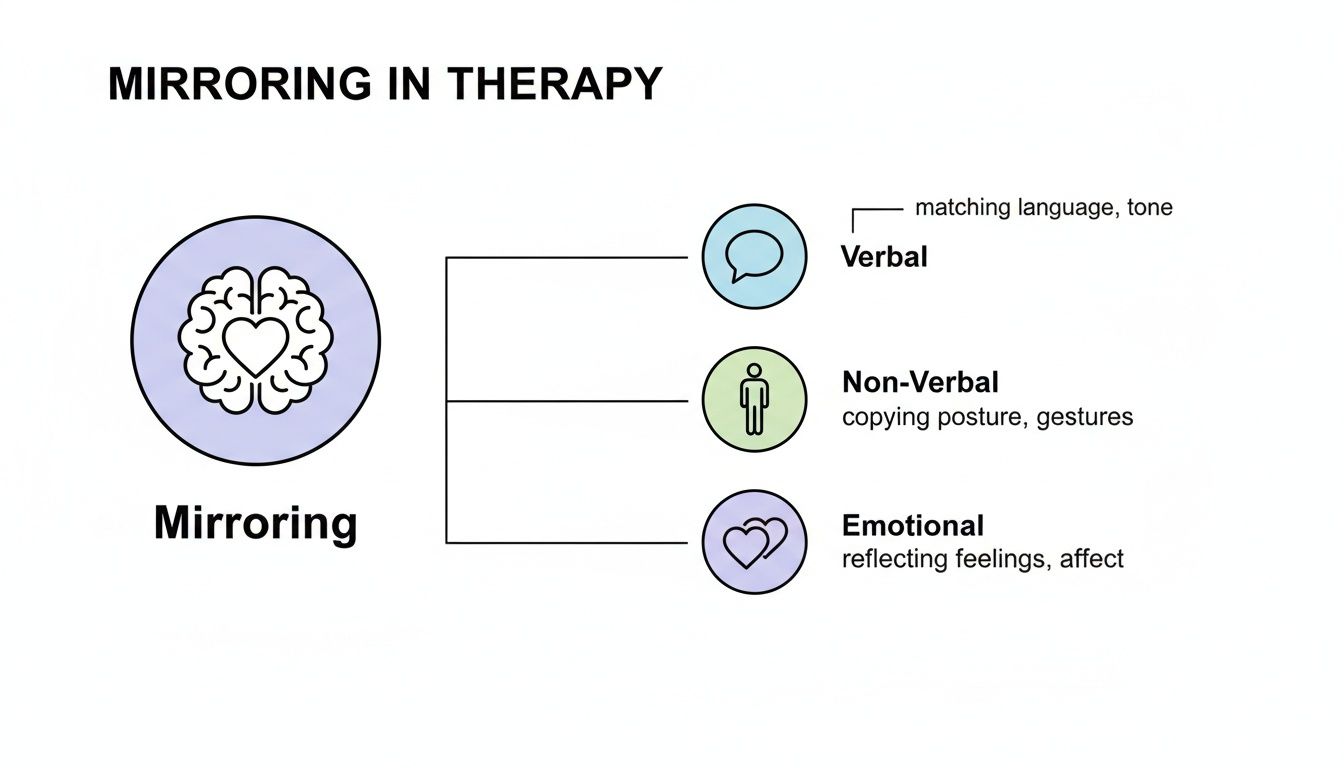
As you can see, mirroring isn't just one thing. It's a rich, multi-layered skill that blends what is said, how it's said through body language, and the underlying feelings being shared.
Let's unpack what each of these looks like in a therapy session. The table below gives a quick overview of the three distinct forms of mirroring, what I would do as your therapist, and how each one helps you.
Three Types of Therapeutic Mirroring
Type of Mirroring | What the Therapist Does | How It Helps the Client |
|---|---|---|
Verbal | Gently repeats key phrases or summarises the client's thoughts. | Confirms active listening and ensures accurate understanding of the client's words. |
Non-Verbal | Subtly aligns with the client's posture, gestures, or tone of voice. | Builds subconscious rapport and creates a feeling of being 'in sync' and safe. |
Emotional | Acknowledges and reflects the underlying feelings the client expresses. | Validates the client's emotional experience, helping them to name and process it. |
Now, let's explore each of these in a bit more detail.
Verbal Mirroring
This is probably the most straightforward type of mirroring in therapy. Verbal mirroring is when a therapist carefully repeats a key phrase you've used or summarises what you've just said to check they've understood you properly. It isn't about simply parroting your words back at you, but about capturing the heart of your message.
For example, if you were to say, “I'm just so exhausted with juggling work and family life; it feels never-ending,” I might respond with something like, “It sounds like that feeling of being overwhelmed is a heavy weight to carry right now.” This simple reflection does two things: it shows I'm listening intently and gives you a chance to either agree or clarify what you mean.
Non-Verbal Mirroring
So much of how we communicate is done without a single word. Non-verbal mirroring is a subtle process where a therapist might naturally align with your posture, the pace of your speech, or your tone of voice. This isn’t about conscious mimicry; it's a very natural way of building rapport and showing attunement on an almost subconscious level.
If you lean forward to share something important, I might subtly do the same. This creates a powerful, unspoken feeling of being ‘in sync’ and helps to foster a comfortable, safe atmosphere in the room. This technique is grounded in the idea that shared physical states can lead to a shared emotional understanding, which works hand-in-hand with other core therapeutic concepts. You can read more about how this helps create a non-judgemental space in our guide on what unconditional positive regard is in therapy.
Emotional Mirroring
Also known as affect attunement, this is perhaps the deepest and most powerful form of mirroring. Emotional mirroring goes beyond just words and actions to reflect the feeling behind what you're expressing. The therapist tunes into your emotional state and reflects it back, helping you to name it and process it.
A therapist using emotional mirroring might say, “I can see the sadness in your eyes as you talk about that,” or perhaps, “There’s a real sense of frustration in your voice.”
This validates your emotional reality, making it feel real and okay to feel. For many people, this can be the first time their feelings have been properly acknowledged without any judgement, which is such a vital step on the path to healing.
The Psychological Science Behind Mirroring
Ever wonder why something as simple as a shared smile or a synchronised nod can make you feel so deeply connected to someone? The power of mirroring in therapy isn't some clever communication trick; it’s wired directly into our brains, tapping into a fundamental human need to be seen, understood, and connected.
The science behind this is genuinely fascinating. It all comes down to a special type of brain cell called a mirror neuron. These clever neurons fire up not only when we do something ourselves but also when we see someone else doing the exact same thing. You can think of them as the brain's built-in empathy wiring—they literally help us step into another person's shoes, understanding their intentions and feeling what they feel on a neurological level.
Mirror Neurons and The Therapeutic Alliance
So, when a therapist subtly mirrors your posture or reflects the tone of your voice, your mirror neurons get to work. This creates a subconscious feeling of being 'in sync', which is the very foundation of the therapeutic alliance—that collaborative, trusting relationship between you and your therapist. A strong alliance is one of the biggest predictors of a good outcome in therapy.
This neurological rapport makes you feel safer and builds trust, which in turn makes it easier to open up and explore those really difficult emotions. It's not about simple imitation; it's about a genuine attunement that sends a powerful message: your therapist is truly present and with you in that moment. This whole process ties back to how we form secure bonds with others, a core idea in attachment theory. You can read more on what attachment theory is and how it shapes you in our related post.
At its heart, this brain-based empathy is what makes mirroring feel so validating. It’s a non-verbal signal that quietly says, “I’m with you, and what you’re experiencing is real.”
An Evidence-Based Approach to Connection
While the concept is powerful, it’s important to see mirroring as one tool in a much larger toolkit. It works best when it’s woven into a holistic therapeutic relationship built on genuine care, skill, and trust—not as a standalone cure. Research consistently shows that techniques that bolster human connection are vital for healing.
For instance, studies in related fields show that the effectiveness of mirroring often depends on it being part of a broader, consistent strategy. The general consensus from research is that while a technique like mirror therapy might not offer greater relief on its own, it becomes much more effective as part of a structured, daily programme within a comprehensive plan. This just reinforces the idea that mirroring in counselling isn't a quick fix, but a meaningful part of a sustained, supportive process.
How Mirroring Supports Healing and Personal Growth
Beyond the clinical definitions, the real power of mirroring in therapy is how it supports your personal journey towards healing. When a therapist really gets you and reflects back your thoughts and feelings accurately, it does more than just show they’re listening. It builds a powerful foundation of trust and safety, creating the secure space you need to explore difficult, often painful, emotions.
This sense of safety is absolutely vital. For so many of us, past experiences might have taught us that our feelings were wrong, over the top, or just too much for others to handle. Mirroring directly challenges those old narratives by consistently validating your emotional reality. It sends a clear, powerful message: what you feel is real, and it is welcome here.

Cultivating Self-Awareness and Compassion
Seeing your own experiences reflected back with genuine empathy can be a profound catalyst for change. It’s like seeing yourself clearly for the first time. This fosters a much deeper level of self-awareness, allowing you to recognise patterns in your thoughts or feelings that were previously hidden, simply by hearing them acknowledged by someone else.
From this awareness, self-compassion can begin to grow. When your inner world is treated with respect and understanding by your therapist, you gradually learn to treat yourself with that same kindness. This can be especially healing if you’ve been living with a harsh inner critic for years.
Client Scenario: Imagine a client, Sarah, who says, "I feel so guilty for taking time off work when I'm burnt out." A mirroring response might be, "It sounds like you're carrying a heavy burden of guilt for simply needing to rest." Hearing this reflected without judgement can help Sarah question her self-criticism and begin to see her need for rest as valid, not a failure.
Empowering Your Therapeutic Journey
Ultimately, the validation that comes from mirroring is incredibly empowering. By confirming your perceptions and honouring your emotional state, it helps you build trust in your own experiences and instincts. This newfound self-trust is a cornerstone of recovery and growth.
Mirroring is a powerful tool that helps clients reflect on their experiences and facilitate personal growth. It’s not about finding quick-fix solutions, but about creating the right conditions for you to find your own. By ensuring you feel truly heard and understood, mirroring in therapy empowers you to connect with yourself more deeply, paving the way for lasting healing.
How Mirroring Is Used in Different Therapy Settings
Mirroring isn't a rigid, textbook technique you just apply blindly. Its real power comes from its flexibility, letting a therapist build a connection in all sorts of environments – whether that’s in a traditional therapy room, over a video call, or even while walking outside in the fresh air.
Each setting has its own unique flavour, but the core principle is always the same: to show you, on a fundamental level, that you are being heard and understood. How we get there, though, can look quite different depending on where we are.

Mirroring in Online Counselling
When we’re working online, we obviously lose some of the full-body non-verbal cues. This just means a therapist has to tune in even more closely to what is there. The focus has to shift to the more subtle signals to keep that connection feeling real and present.
It often comes down to things like:
Vocal Attunement: I’ll pay close attention to the pace and tone of your voice. If you're speaking quickly with energy, I might reflect that back. If you’re speaking slowly and softly, my response will be gentler.
Facial Expressions: Reflecting the emotion on your face is crucial online. A look of concern when you share something difficult or a gentle smile when you have a moment of insight shows I'm right there with you.
Verbal Affirmations: Because a simple nod can get lost on screen, I'll use more direct verbal mirroring and summaries to confirm I've understood you properly.
These little adjustments are vital for making sure the therapeutic relationship feels just as strong as it would if we were sitting in the same room.
Application in Walk and Talk Therapy
Here in Cheltenham, one of the most natural ways to use mirroring is during Walk and Talk Therapy. We take the session outdoors, which blends the calming effects of nature and gentle movement with our conversation. In this setting, mirroring becomes much more fluid and holistic.
Mirroring during a walk and talk session is less about copying fixed postures and more about tuning into your overall energy. It’s about finding a shared rhythm that feels supportive and connected.
For example, I might naturally fall into step with your walking pace. If you slow down to think through something complex, I’ll slow down with you. If you pick up the pace feeling energised, I will too. This creates a powerful, unspoken feeling of being in sync, moving forward together—both literally and metaphorically. If this sounds like something you’d be interested in, we can explore it more on the Walk and Talk Therapy page.
Adapting Mirroring for Neurodiverse Clients
This is incredibly important: mirroring must always be respectful of someone's individual communication style. For some of my neurodiverse clients, for instance, things that are considered 'standard' non-verbal cues, like holding eye contact for a long time, can feel really uncomfortable or even aggressive.
A mindful therapist knows this and adapts. Effective mirroring here isn't about a checklist of actions; it’s about finding a genuine connection that works for you. That might mean mirroring a special interest, matching a verbal communication pattern, or simply respecting a need for less direct engagement.
The goal is always to create a safe space where you feel seen and valued for exactly who you are. It’s about using the technique to build authentic connection, not to create pressure to conform to someone else's idea of 'normal'.
What to Expect in Your Sessions with Ben
When you first think about starting therapy, it’s completely normal to wonder what it’s actually going to be like. My goal is always to create a space that feels safe, genuine, and supportive. Mirroring is a part of that, but it’s something you should feel rather than notice.
You see, my approach isn’t about ticking boxes or using some rigid, robotic technique. Mirroring is woven naturally into our conversations. It’s a subtle way of showing you that I’m fully present – that I’m listening not just to your words but to the feelings behind them. It’s my way of checking in and saying, “I’m right here with you, and I’m really trying to understand your world from your point of view.”
This focus on your experience means mirroring is always used to build our connection, not to analyse or dissect what you’re saying. The whole point is to validate your experience, helping you feel truly heard and seen. If you're curious about my general philosophy, you can read a little more about me.
My Commitment to Ethical Practice
It’s incredibly important to me that every tool I use, mirroring included, is handled with the utmost care and respect. That ethical foundation is what allows us to build trust together.
This means mirroring is always guided by a few core principles:
Authenticity: It will always come from a place of genuine empathy and a real desire to connect with what you’re going through.
Respect: It’s a way of honouring your perspective, never a tool to manipulate or steer the conversation in a particular direction.
Collaboration: Our work is a partnership. Mirroring simply helps us stay on the same page as we explore your journey together.
My commitment is to create a therapeutic relationship built on trust and mutual respect. Mirroring is simply one of the ways I work to ensure you feel secure, understood, and empowered in every one of our sessions.
Ultimately, the goal is to make our sessions a space where you feel you can explore, heal, and grow. Whether we’re meeting face-to-face in Cheltenham, online, or for a walk-and-talk session, my focus is on providing a consistent, supportive presence. To find out more about the different ways we can work together, please take a look at my main services page.
Your Questions About Mirroring, Answered
It's completely normal to have questions when you first hear about a technique like mirroring. Getting your head around what it actually involves can help you feel much more comfortable and confident as you start your counselling journey.
I get asked about this a lot, so I've put together answers to some of the most common questions I hear from clients.
Will I Even Know If My Therapist Is Mirroring Me?
Honestly, when it's done well, you shouldn't. Skilful mirroring feels completely natural, blending seamlessly into the flow of our conversation.
The goal isn't for you to spot a technique in action. The goal is for you to feel a deep sense of being heard, seen, and understood. It’s less of a 'thing' the therapist is 'doing' and more of a sign that they are right there with you, fully present and tuned into your experience. It helps build that feeling of safety and connection.
So, Is It Just Copying What I Say and Do?
Not at all, and this is a really important point. Simple, crude imitation or just parroting your words back would feel awkward, insincere, and maybe even a bit mocking. That’s not therapy.
Proper therapeutic mirroring is far more subtle. It's about capturing and reflecting the essence of what you're communicating – the core feelings, the important ideas, the emotional temperature of the room. It’s a professional tool used with care to build genuine empathy, not a form of mimicry.
Mirroring isn’t about agreement. It’s not about me conceding a point. It’s about containment. To mirror your experience isn't to endorse it; it's to honour it, showing you that I'm making space for your truth and trying to see the world from your perspective.
Can Mirroring Go Wrong?
Absolutely. Like any tool in the therapeutic toolkit, its power lies in how it's used. Its effectiveness comes down to the therapist's skill, experience, and, most importantly, their genuine empathy.
If it's used mechanically or without real care, it can feel robotic and completely miss the mark. A good, well-trained counsellor uses mirroring thoughtfully as just one part of building a warm, respectful therapeutic relationship. Here at Therapy with Ben, any technique I use is always grounded in a genuine respect for you and your unique story.
If you're ready to start a therapeutic journey where you feel truly heard and understood, please get in touch with Therapy with Ben. You can book a session online or reach out to see how we can work together.
A quick note for therapists and small business owners: I use Outrank to help me keep this blog updated and support my website’s SEO. If you run a small business and want a time-saving way to build content and visibility, it may be worth a look: Outrank with code 10OFFBEN for 10% off your first month. If you sign up through my link, I may receive a commission at no extra cost to you.


Comments