


A Practical Guide on How to Deal with Abandonment Issues
- Dec 21, 2025
- 16 min read
Updated: Dec 22, 2025
Dealing with abandonment issues is a two-pronged approach. First, we need to get to grips with where they came from – usually our early experiences with caregivers. Then, we learn to manage the intense feelings that bubble up in the here and now. It’s a journey of understanding your triggers, questioning those anxious thoughts, and building a solid sense of self from the ground up.
Recognising the Echoes of Abandonment

That deep-seated fear of being left behind isn't some kind of character flaw or a sign you're weak. Far from it. It's a profoundly human response, an echo from past experiences that has left its mark on your emotional world. This fear often starts in our very first relationships, setting the scene for how we connect with people as adults.
To figure out how to deal with abandonment issues, we have to look back. Not to point fingers or lay blame, but simply to understand. Things that happened in childhood—like losing a parent, being emotionally neglected, or having caregivers who were just inconsistent—can create a blueprint we unknowingly follow in our adult relationships.
The Roots of Abandonment Fears
The bedrock for our ability to build healthy relationships is laid down when we're infants and children. If a child’s fundamental needs for safety, love, and consistency aren't met, a deep sense of insecurity can take hold. This isn't always about big, dramatic events. Sometimes, it’s the quiet, nagging feeling of not being truly seen or prioritised.
Think of a parent who's emotionally checked out because of their own struggles. They might provide food and a roof, but that crucial emotional connection is missing. This leaves a confusing and painful gap for a child.
This kind of early emotional abandonment is more common than you might think. Research from the NSPCC is quite sobering, highlighting that around 1 in 10 children in the UK have experienced neglect. That's a huge number, translating to about 1.2 million young people. Experiences like this have a massive impact on adult relationships and mental health. You can read the full NSPCC research on child neglect here.
Abandonment isn't just about being physically left alone. It's the emotional chasm that opens up when you feel unseen, unheard, or unimportant to the people who are meant to be your secure base.
How Attachment Styles Shape Your Reactions
These early experiences have a direct line to our attachment style – the way we tend to behave and feel in our close relationships. Getting to know your own style is a massive step in understanding why you react the way you do when that fear of loss kicks in.
There are three main insecure attachment styles that can grow from these early wounds:
Anxious Attachment: You might find yourself constantly needing reassurance, worrying your partner is about to leave, and being hyper-aware of any hint of distance. This can look like neediness or jealousy from the outside.
Avoidant Attachment: You might see yourself as fiercely independent, finding it hard to lean on anyone. When things get too close for comfort in a relationship, you might feel a powerful urge to pull away and create space.
Disorganised Attachment: This is often a real mix of the other two. You might desperately want intimacy but be terrified of it at the same time, which can lead to some confusing and chaotic patterns in relationships.
These aren't meant to be rigid labels that box you in, but they are useful frameworks for making sense of your patterns. They help explain why a delayed text message can send one person into a panic, while another might barely notice. For a deeper dive, you can learn more about what attachment theory is and how it shapes you in our detailed article.
The goal here isn't to beat yourself up. It's about looking at yourself with a bit of compassion and realising that these patterns were your way of surviving some tough situations. Recognising these echoes is the first, and most powerful, step you can take towards healing.
Calming the Storm of Anxious Thoughts

When the fear of being left hits, it doesn't just knock; it kicks the door down. The feeling can be a physical tidal wave—a racing heart, shallow breath, and a mind spiralling with worst-case scenarios.
In these moments, understanding why you feel this way is secondary to surviving the 'now'. The priority is to find an anchor in the storm. Thankfully, there are practical, immediate techniques you can use to regain your footing.
These strategies aren't about ignoring the pain. They're about giving your nervous system a chance to calm down so you can think more clearly. Think of them as first aid for your emotions, designed to bring you back into the present moment when your mind is racing into a catastrophic future. This is a crucial skill.
Grounding Yourself in the Present Moment
When panic takes over, your mind is no longer in the room; it's lost in a maze of fear. Grounding techniques are powerful because they pull your attention away from distressing thoughts and back into your physical body and immediate surroundings. The 5-4-3-2-1 method is a fantastic tool for this.
Wherever you are, just stop and gently notice:
5 things you can see: Look around and name them, silently or out loud. The colour of the wall, a crack on the pavement, the light hitting a leaf.
4 things you can feel: Bring your attention to physical sensations. Feel the texture of your jeans, the cool surface of a table, the weight of your feet on the floor.
3 things you can hear: Listen for sounds you might usually filter out. The hum of a refrigerator, distant traffic, birdsong outside the window.
2 things you can smell: This might be tricky, but try to identify any scents. The faint smell of coffee, soap on your hands, or fresh air from an open window.
1 thing you can taste: Focus on the taste in your mouth. Perhaps it's the lingering flavour of your last drink or just the neutral taste of your own tongue.
This simple sensory exercise short-circuits the panic loop by forcing your brain to focus on the concrete reality of the present. It tells your nervous system that, despite the emotional turmoil, you are physically safe right now. This is a core component of building better emotional self-control, a topic explored further in this post on what emotional regulation is and how to master it.
Challenging Anxious Thoughts with Cognitive Reframing
Once the initial wave of panic has subsided a little, you can start to address the thoughts fuelling it. Cognitive reframing is the practice of identifying an anxious thought, questioning its validity, and replacing it with a more balanced and realistic one. It’s about challenging the internal storyteller who insists on a tragic ending.
As you develop strategies to manage overwhelming emotions, incorporating mindful rituals can significantly aid in soothing your nervous system. For instance, exploring a guide to tea that relaxes your body and mind can introduce small acts of self-care that support the bigger work of reframing your thoughts.
Reframing isn’t about pretending everything is perfect. It’s about acknowledging your fear while refusing to accept it as the only possible truth.
To help with this, I've put together a table you can use to practise identifying a common anxious thought tied to abandonment and replacing it with a more realistic and soothing perspective.
Practical Examples of Cognitive Reframing
Anxious Thought (The Trigger) | Balanced Reframe (The Soothing Truth) |
|---|---|
"They haven't replied to my text for an hour. They must be angry with me and are going to leave." | "There are many reasons for a delayed reply. They could be busy, driving, or in a meeting. Their silence right now doesn't automatically mean something is wrong between us." |
"I said the wrong thing at dinner. Now they'll realise I'm not good enough for them." | "I am human and sometimes I say awkward things. One comment doesn't define my worth or the strength of our entire relationship. Secure relationships can handle small imperfections." |
"They want to spend a night with their friends. They are tired of me and looking for an escape." | "Everyone needs time for their own friendships and interests. It's healthy for us both to have separate lives. Their need for space is about their own well-being, not a rejection of me." |
Learning how to deal with abandonment issues involves creating this internal dialogue where a compassionate, rational voice can gently counter the voice of fear. It takes practice, but with time, that balanced voice becomes stronger and more automatic, giving you lasting control over the storm.
How to Build a Foundation of Self-Trust
Getting lasting relief from the fear of abandonment isn't just about managing panic when it hits; it's about building the deep, internal security you might not have received as a child. It’s a process of creating a solid foundation of self-trust, brick by brick, so you can become your own secure base.
This all starts by fundamentally shifting the relationship you have with yourself. Instead of constantly looking outside for validation, you begin to turn inward. You learn to rely on your own judgement, honour your feelings, and actually treat yourself with a bit of kindness. It’s a journey from needing someone else's reassurance to generating your own internal stability.
Setting Boundaries Is Not Selfish
For many people who fear being left, the idea of setting boundaries can feel terrifying. There’s this nagging worry that saying "no" or expressing a need will just push people away. But actually, the opposite is true: healthy boundaries are essential for healthy relationships.
A boundary isn't a wall you build to keep people out. Think of it more as a line you draw to protect your own emotional well-being. It’s simply about communicating what you’re okay with and what you’re not. For instance, it might be saying, "I can't talk on the phone after 10 pm, as I need that time to unwind," or "I feel hurt when you make jokes about that topic, please stop."
Think of boundaries as the instruction manual for how you need to be treated to feel safe and respected. Without them, people are left to guess, and you are left feeling resentful or anxious.
Starting small is the key here. Try to identify one tiny area in your life where you feel your energy is being drained and practise setting a gentle but firm boundary. Just notice how it feels to honour your own needs for a change. It’ll probably feel uncomfortable at first, but with practice, it becomes a powerful act of self-respect.
Practising Radical Self-Compassion
When that fear of abandonment flares up, the inner critic often gets incredibly loud, doesn't it? Berating you for feeling "needy" or "too sensitive." Self-compassion is the perfect antidote. It simply means offering yourself the same kindness and understanding you would offer a good friend who’s going through a tough time.
Instead of criticising your feelings, just acknowledge them without judgement. You might say to yourself, "This is really hard right now. It's understandable that I'm scared, given what I've been through." This simple shift can dramatically change your internal world. For a bit more guidance on this, our post on what self-compassion is and how it leads to kinder thinking offers some practical steps to get you started.
Choosing Emotionally Consistent People
As you build up your own self-trust, you also get much better at recognising who is trustworthy in your life. Part of learning how to deal with abandonment issues involves consciously choosing to invest your time and energy in people who are emotionally consistent and reliable.
So, what does an emotionally consistent person look like?
Their words match their actions. They actually follow through on their promises.
They can handle conflict without threatening the relationship. Disagreements are seen as problems to be solved together, not as a reason to bail.
They are predictable in a good way. You have a general sense of how they will react and can count on their emotional presence.
This doesn't mean they're perfect, but their behaviour gives you a sense of safety rather than constant uncertainty. This is where getting professional help can be invaluable. To deal with abandonment-like trauma, experts often recommend acknowledging the grief first, and therapy focused on attachment styles can help reframe these experiences. For instance, Cognitive Behavioural Therapy (CBT), which is available via IAPT services across the UK, has shown real effectiveness. Some studies indicate up to a 50% improvement in anxiety symptoms related to loss after just 12 sessions.
By focusing on these three areas—boundaries, self-compassion, and secure relationships—you slowly begin to build a life that feels stable from the inside out.
Finding The Right Therapeutic Support For You
While personal strategies are a fantastic way to manage anxiety in the moment, getting professional guidance can completely reshape your healing journey. Therapy offers a dedicated, safe space to explore the roots of your fears with someone who is trained to help you navigate them. Think of it as having an expert guide for some tricky emotional terrain.
Taking that first step can feel massive, I know. If you're unsure where to even start, there's a gentle guide on how to find a therapist that can help walk you through the process. It’s all about finding that therapeutic relationship where you feel truly seen, understood, and supported.
Common Therapeutic Approaches
Not all therapy is the same, and what works for one person might not be the right fit for another. When it comes to the fear of abandonment, a few approaches have proven to be really effective because they get right to the thoughts, feelings, and past experiences that fuel that fear.
You'll likely come across these:
Cognitive Behavioural Therapy (CBT): This is a very practical, goal-focused therapy. It's brilliant for helping you catch and challenge those automatic negative thought patterns we talked about earlier. A CBT therapist gives you tangible tools to reframe anxious thoughts, helping you change your reactions over time.
Attachment-Based Therapy: This approach goes a bit deeper, exploring how your earliest relationships have shaped your current attachment style. It’s about understanding why you feel things so intensely and learning how to build the secure, healthy connections you're longing for now.
These therapies give you a structured way to untangle the often complex feelings that come with a fear of being left.
Deeper Healing For Past Trauma
Sometimes, the fear of abandonment is tied to specific traumatic events. When that's the case, therapies that work directly with memory and the nervous system can be incredibly helpful.
Eye Movement Desensitisation and Reprocessing (EMDR) is a powerful therapy designed to help people process and heal from trauma. It uses bilateral stimulation (like side-to-side eye movements) to help the brain reprocess distressing memories so they lose their emotional punch.
For many, getting this kind of professional support is key. The NHS's Talking Therapies service, accessed by over 1.5 million people in a single year, delivers EMDR for trauma. Audits have shown it can achieve a 50% symptom reduction in cases of PTSD related to abandonment.
This decision tree gives a simple model for building self-trust, which is a core part of healing.
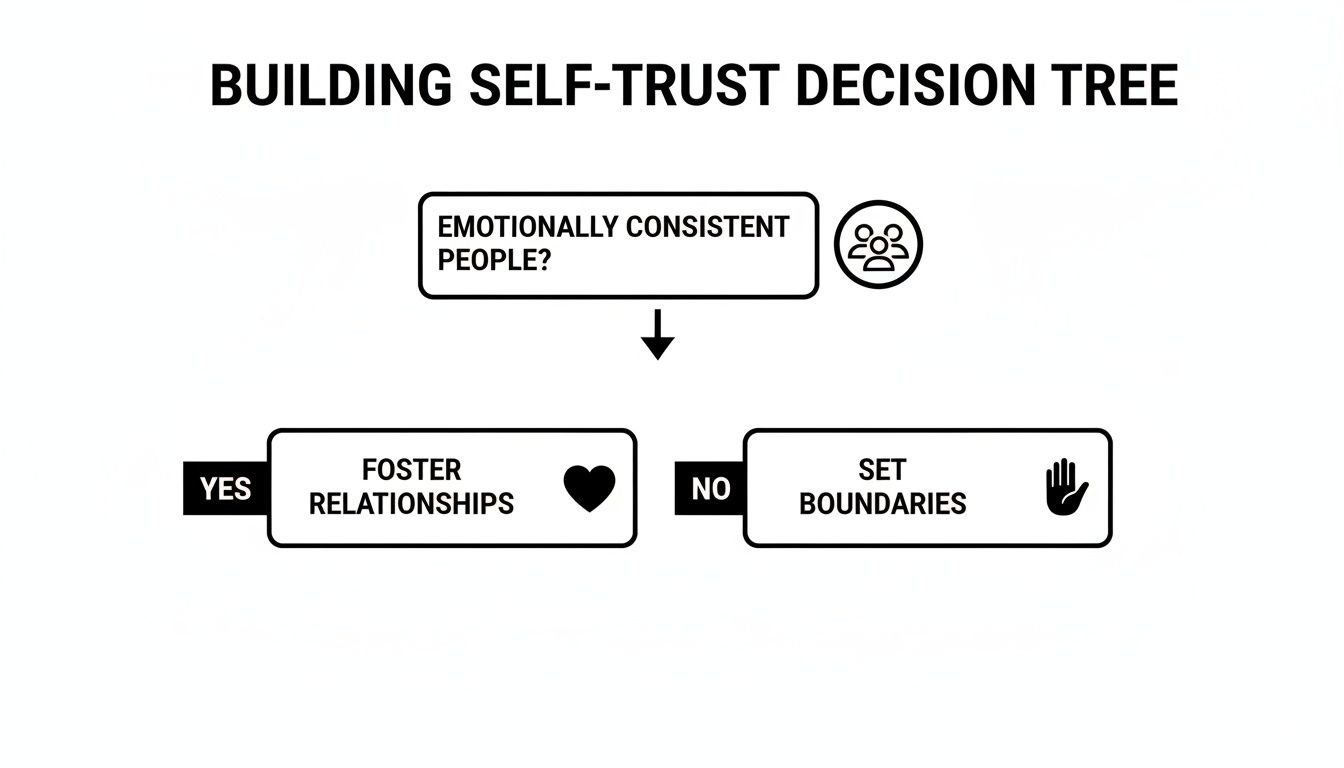
The real insight here is learning to actively choose who you invest in. It's about fostering relationships with people who are emotionally consistent and setting firm, healthy boundaries with those who aren't.
Innovative And Personalised Therapy Options
Therapy doesn't always have to happen sitting in an office. Newer approaches are recognising the powerful link between our minds, bodies, and our environment.
One fantastic example is Walk-and-Talk therapy, which combines counselling with the simple act of walking outdoors. For some people, moving side-by-side with a therapist feels less intense than a face-to-face chat. The gentle physical activity can also help process emotions and make it easier to open up.
The right therapeutic relationship can be what we call a 'corrective emotional experience.' It's a chance to build the trust and security that might have been missing in the past, with a professional who is there to support you unconditionally.
Even the identity of the therapist can play a part. For some, working with a male counsellor can be a profoundly healing experience, especially if past wounds involve male figures. It provides an opportunity to build a secure, trusting relationship in a totally new context, challenging old patterns.
Ultimately, exploring your options is about finding the person and the approach that make you feel safe enough to do the work. That's where real healing begins.
Taking the Next Step and Finding Professional Help
Deciding to reach out for therapy is a massive, courageous step. It's also totally normal to feel a bit lost about where to even start. My goal here is to make that process feel a lot less daunting and give you the confidence to find the support that’s right for you.
One of the first hurdles is simply knowing where to find a properly qualified professional. In the UK, a brilliant place to begin is with the professional bodies that hold therapists to high ethical and training standards. These organisations make sure practitioners are who they say they are.
A key resource here is the British Association for Counselling and Psychotherapy (BACP). They have an online directory that lets you search for accredited therapists in your area who specialise in the very things you’re dealing with, like attachment and trauma.
Finding a Therapist Who Clicks With You
Once you have a list of a few potential therapists, the next move is to book an initial consultation. Think of this as your chance to interview them. You're the one hiring, after all, and you need to feel that you can be safe and truly understood in that room.
Don't ever be shy about asking direct questions about their experience with abandonment issues. A good, experienced therapist will welcome this and be more than happy to talk about their approach. This first chat is all about getting a feel for whether their style will work for you.
Here are a few insightful questions you could bring to that first meeting:
"Could you tell me about your experience working with clients who have a deep-rooted fear of abandonment?" This cuts right to the chase and helps you gauge their specific expertise.
"What kind of therapeutic approaches do you find most helpful for attachment-related issues?" This gives you a clue as to whether they use methods like attachment-based therapy, CBT, or something else.
"How would you describe your style as a therapist?" This helps you get a sense of their personality – are they more structured and directive, or more gentle and exploratory?
Choosing a therapist is an intensely personal decision. You need to trust your gut on this. The connection you build with them – what we call the 'therapeutic alliance' – is genuinely one of the biggest predictors of a successful outcome.
When You Need Support Right Now
Therapy is a journey, and it takes time. But sometimes, you need help right now. If your feelings of distress are becoming overwhelming, or if you're having thoughts of harming yourself, it is crucial that you reach out for immediate support. Realising you need that help is a sign of incredible strength, not weakness.
If you are in crisis, please know that you are not alone and help is available 24/7. Don't hesitate to contact one of these UK-based resources:
Samaritans: You can call them for free, day or night, on 116 123 to talk about anything that's getting to you.
NHS Urgent Mental Health Helplines: You can find your local 24-hour helpline on the NHS website here.
Shout: If talking on the phone feels like too much, you can text the word "SHOUT" to 85258 for confidential support via text message.
Taking this step is an act of profound self-care. It’s about finally acknowledging that you deserve to feel safe and supported, and there are people out there ready to help you find your footing again.
A Few Final Questions
As you start to unpack all of this, it's natural for questions to bubble up. I wanted to finish by tackling some of the most common ones I hear, just to offer that extra bit of clarity as you find your feet.
Can Abandonment Issues Ever Be Fully Cured?
This is a question I get asked a lot, and it’s a big one. The most honest answer I can give is that healing is less about a "cure" and more about learning to manage the wound's impact. The goal isn’t to pretend the fear never existed, but to dial it down so it no longer pulls the strings on your choices, your reactions, or your relationships.
With consistent work, both on your own and maybe with a therapist, you learn to spot the triggers and soothe yourself when they flare up. You get better at choosing and building relationships that feel safe and secure. Most importantly, you start to build a solid foundation of trust in yourself. The old wound might always be there, like a scar—it’s part of your story—but it stops controlling the narrative of your present and future.
Healing from abandonment isn’t about erasing the past. It’s about weaving it into your story in a way that gives you strength. It’s the difference between being defined by a wound and being informed by it.
Is It My Fear of Abandonment or Is My Partner Actually the Problem?
Figuring out the difference between a genuine relationship problem and a triggered abandonment fear is a massive step forward. It means you have to become a bit of a detective in your own emotional world.
Try to step back and look at the situation as objectively as you can, separating the hard facts from the story your anxiety is telling you.
Is there a consistent, observable pattern of behaviour? For instance, does your partner regularly cancel plans at the last minute, brush off your feelings, or act in a way you can’t rely on? If so, that points to a real relationship issue that needs addressing, no matter your personal history.
Was the panic triggered by a small, one-off event? Did a delayed text or a slightly distracted tone of voice send you into a complete spiral? When the reaction feels completely out of proportion to what actually happened, that's a good sign it’s your abandonment wound making a lot of noise.
Learning to see this distinction is incredibly powerful. It stops you from shouldering the blame for legitimate relationship problems and helps you communicate your needs much more clearly when you know your own fears are in the driving seat.
What Can I Do If I Can’t Afford Private Therapy?
This is a real and valid concern. Good therapy can be a significant financial commitment, but a tight budget absolutely doesn't mean your journey is over before it's begun. There are still some excellent, effective options out there.
Here in the UK, you've got a few solid pathways for support that don't come with a private price tag:
NHS Talking Therapies: You can actually self-refer to your local NHS Talking Therapies service (what used to be called IAPT). They offer free, proven support like CBT, and you don’t need to go through your GP to get the ball rolling.
Mental Health Charities: Organisations like Mind and Rethink Mental Illness often run local support groups, which can be free or very low-cost. Just being in a room with people who get it can be incredibly healing.
Invaluable Reading: Books can be an amazing resource. A brilliant place to start is 'Attached' by Amir Levine and Rachel S.F. Heller. It’s a very clear, accessible guide to attachment theory and how it all plays out in our adult relationships.
Mindfulness and Meditation Apps: Apps like Headspace or Calm offer guided practices that are fantastic for managing anxiety and staying grounded in the here and now—a vital skill when that fear of abandonment kicks in.
These resources can give you powerful tools and insights to build momentum, proving that the path to feeling more secure is open to everyone, regardless of their financial situation.
Posted by Therapy-with-Ben
At Therapy with Ben, I offer a supportive and non-judgmental space right here in Cheltenham to explore these challenges. Whether it’s through walk-and-talk therapy out in nature or confidential online sessions, we can work together to build your self-trust and create healthier patterns in your relationships. If you feel ready to take that next step, I invite you to learn more and get in touch.
Learn more about my approach at https://www.therapy-with-ben.co.uk.


Comments