


Christmas and Dealing with Difficult Family Dynamics: A Calmer Break
- Dec 6, 2025
- 16 min read
Dealing with difficult family dynamics at Christmas isn't about just gritting your teeth and getting through it. It’s about preparing yourself emotionally and setting clear boundaries before you even walk through the door. By figuring out your potential triggers, managing what you expect from the day, and having a few responses planned, you can shift from a place of dread to one of empowerment. This way, you stand a much better chance of finding some genuine moments of peace amidst all the festive pressure.
Preparing for the Festive Minefield with Your Family
For so many of us, the festive season feels less like a celebration and more like tiptoeing through a minefield of tricky family relationships. If the mere thought of a Christmas gathering fills you with anxiety, I want you to know you are absolutely not alone. The huge pressure for everything to be ‘perfect’ often just pours fuel on old tensions, creating a stressful environment where arguments can erupt from nowhere.
As a therapist, I want to offer you some practical, real-world strategies to help you move beyond simply surviving the holidays. The goal here is to switch from just enduring it to actively managing your experience, which will empower you to protect your own peace.
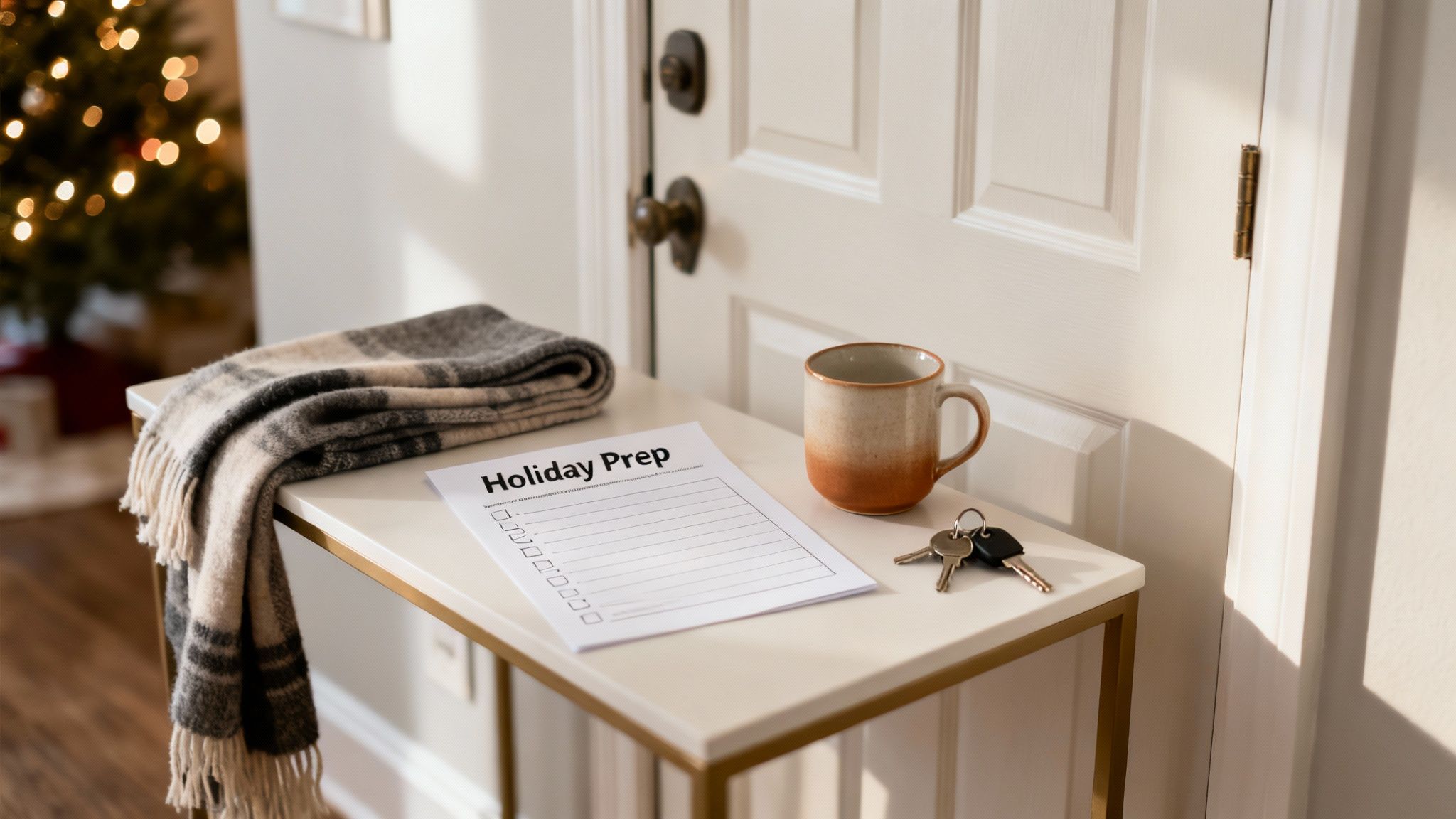
Your Proactive Holiday Preparation Checklist
This first part is all about laying a solid foundation for yourself. Before you’ve even thought about packing a bag or wrapping a single present, taking some time for this mental and practical prep work can genuinely change your whole experience. It's about building up your resilience before you actually need it.
When you’re getting ready for the season, it can be helpful to look into various Christmas occasions to get ideas that might help you manage your own expectations and plan things that feel right for you.
Here’s a quick-reference guide I’ve put together to walk you through the key steps you can take before the festivities even begin. Think of it as your personal game plan.
Your Proactive Holiday Preparation Checklist
Preparation Area | Actionable Step | Goal |
|---|---|---|
Mental Preparation | Identify 1-2 potential triggers (e.g., comments about your job, questions about your love life). | To anticipate difficult moments and reduce the element of surprise, preventing a reactive emotional response. |
Boundary Setting | Decide on one non-negotiable boundary (e.g., "I will not discuss politics"). | To create a clear line that protects your wellbeing and gives you a predetermined point of exit from a conversation. |
Practical Planning | Plan a 'strategic retreat' activity (e.g., a walk, offering to help with washing up, checking on the children). | To have a pre-planned escape route that allows you to decompress and reset if you feel overwhelmed. |
Expectation Management | Let go of the 'perfect' Christmas ideal. Acknowledge that difficult moments are likely and focus on aiming for 'good enough'. | To reduce self-imposed pressure and prevent disappointment from derailing your entire holiday experience. |
Taking even just a few of these steps can make a world of difference. It's not about controlling other people's behaviour, but about taking charge of your own responses and protecting your mental health.
Why Christmas Seems to Magnify Family Tensions
The festive season is often sold to us as a magical time of family harmony and joy, but for so many people, the reality is starkly different. If Christmas in your family feels more like a pressure cooker than a party, you aren't alone, and you’re definitely not imagining it. There's a unique mix of sky-high expectations, money worries, and just being cooped up together that can easily turn goodwill into arguments.
Getting your head around why this happens is the first step to navigating it.
It's not always about dredging up old arguments. The very structure of Christmas can pile on the stress. We're flooded with images of flawless family get-togethers, creating this huge, unspoken pressure to create our own version of that perfection. Trying to live up to this impossible ideal is exhausting and can leave everyone with a short fuse, making us far more likely to snap.
When you feel like you're falling short of this standard, it's easy to feel like a failure or start resenting others. Realising this pressure is mostly external—coming from adverts, tradition, and social media—can be a massive relief. It lets you give yourself a break and approach the day with a bit more self-compassion.
The Financial Squeeze
Here in the UK, money is a huge source of stress, and Christmas just dials that up to ten. The ongoing cost-of-living crisis has squeezed household budgets incredibly tight, making the expectation to splash out on presents, food, and parties a direct source of anxiety and conflict.
When money is tight, disagreements over what’s being spent can blow up fast. One person might think the other is being reckless, while the other feels they're just trying to make the day special for the kids. These arguments are rarely just about the cash; they're usually tangled up in deeper feelings about what’s important, feeling secure, and how we show love.
It helps to reframe these conflicts. It's often not about one person being 'right' and the other 'wrong,' but about two people reacting very differently to the same intense financial pressure.
The Unholy Trinity: Pressure, Perfectionism, and Proximity
Beyond the bank balance, a few other factors collide to really ramp up the tension. The pressure to "perform happiness," all while being in close quarters with people you might have unresolved history with, is a classic recipe for friction.
Think about these common triggers:
More Alcohol: A festive tipple can feel like it takes the edge off, but alcohol also lowers our inhibitions and clouds our judgement. A thoughtless comment that might normally be brushed off can quickly ignite a huge row, especially in an already tense room.
Forced Togetherness: Let's be honest, we don't spend this much intense, unstructured time with our extended family any other time of year. That lack of personal space can make small irritations feel absolutely massive.
Unresolved History: Christmas often acts like a time machine, dragging past hurts and old family dynamics right back to the surface. People can unconsciously slip back into old roles—the rebel, the peacemaker, the responsible one—and the old conflicts come right along with them.
For some families, these pressures can sadly escalate into something far more serious. The Christmas season in the UK sees a disturbing spike in domestic abuse incidents. Tragically, it's estimated that at least 827,000 children in England and Wales have experienced domestic abuse, and the festive period often makes a terrible situation worse. Research shows that financial strain can make abuse up to three times more likely, a stark reminder of how these external pressures can have devastating consequences. You can find out more about the surge in domestic abuse over Christmas to better understand these difficult dynamics.
Build Your Emotional Toolkit Before You Arrive
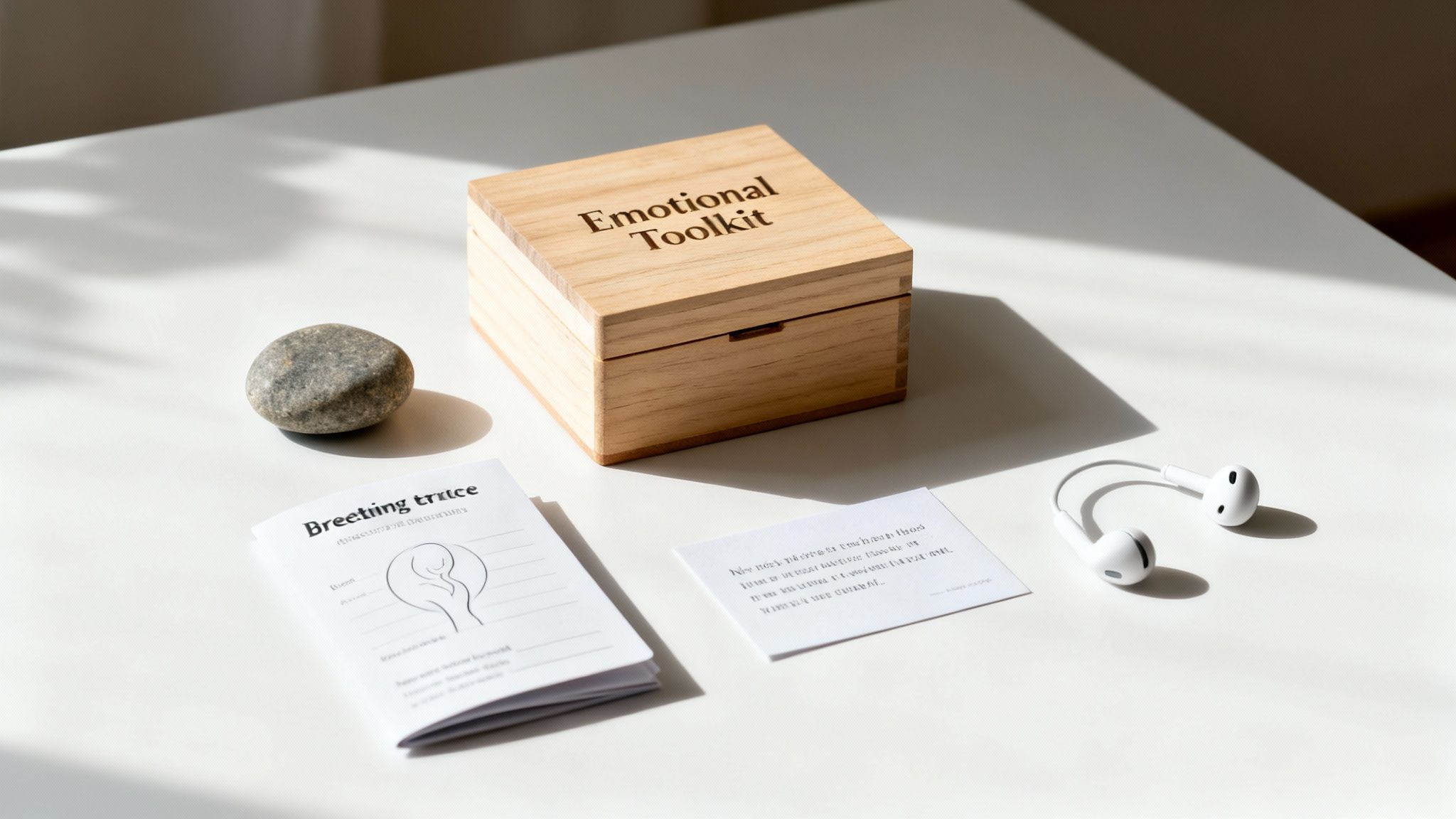
Let’s be honest. The best way to navigate Christmas and dealing with difficult family dynamics isn't about having the perfect zinger ready for when your uncle makes that comment again. It’s about the quiet, deliberate work you do before you even walk through the door.
Going into a potentially stressful family event without any preparation is like walking into a storm without a coat; you’re just leaving yourself exposed. Building an emotional toolkit is a proactive act of self-care. It’s about arming yourself with strategies that create a bit of a psychological buffer, so you can respond thoughtfully instead of just reacting. It puts you back in the driver's seat.
Manage Your Expectations and Accept Reality
The first, and maybe most powerful, tool in your kit is realism. So many of us carry around an idealised picture of Christmas, pieced together from films and what we see on social media. Letting go of this fantasy and accepting the reality of your family—flaws and all—can be incredibly liberating.
This isn’t about resigning yourself to being miserable. It’s about acknowledging that difficult moments aren't just possible; they’re probable. When you accept this, a passive-aggressive comment or an awkward silence doesn't feel like a personal failure or the day being ruined. It’s just an expected bump in the road you're already prepared for.
Identify Your Personal Triggers
Before you go, take some quiet time to think. What specific topics, comments, or even tones of voice tend to get under your skin? These are your personal triggers.
Is it your aunt's intrusive questions about your love life?
Perhaps it's your dad's unsolicited career advice.
Maybe it’s a sibling who always brings up a past mistake.
Jot these down. Simply naming them takes away some of their power. By anticipating them, you’re far less likely to be caught off guard, which is often when we have our most unhelpful, knee-jerk reactions. You can't control what others might say, but you can absolutely control how prepared you are.
Practise Emotional Regulation Exercises Now
Developing the ability to calm your own nervous system is a game-changer. Don't wait until you're feeling overwhelmed at the dinner table; practise these techniques in the days leading up to the event so they become second nature. Part of building a solid emotional toolkit involves cultivating healthy coping mechanisms for stress that you can pull out when things get tense.
Therapist Tip: The goal isn't to switch off your emotions but to manage their intensity. Think of it like turning down the volume on a stereo—the music is still playing, but it's no longer deafening.
Try this simple grounding exercise right now:
5 Things You Can See: Look around and name five things. Notice their colour, shape, and texture.
4 Things You Can Feel: Notice the sensation of your feet on the floor, the fabric of your clothes, or the temperature of the air on your skin.
3 Things You Can Hear: Listen for sounds you might normally tune out—the hum of a fridge, birds outside, your own breathing.
2 Things You Can Smell: Can you detect the scent of coffee, soap, or the pages of a book?
1 Thing You Can Taste: Notice the lingering taste of your last drink or meal.
This exercise pulls you out of a spiral of anxious thoughts and anchors you firmly in the present moment. For a deeper dive, you can learn more about what emotional regulation is and how to master it in our dedicated guide.
The Power of an Ally System
You don't have to face the festive gauntlet alone. Teaming up with someone supportive who will also be there—a partner, a sibling you get on with, a cousin, or a friend—can make a huge difference.
Before the event, agree on a simple pact. This could be a non-verbal signal (like touching your ear) that means, "I need a break," or "Please come and rescue me from this conversation." Just knowing you have someone in your corner who gets it can dramatically reduce feelings of isolation and make those tricky moments far more bearable.
How to Set Boundaries and Navigate Difficult Conversations
Knowing what to say in a tense moment can be the difference between a situation simmering down or blowing up into a full-scale row. The real art of navigating Christmas with difficult family is having a few phrases ready in your back pocket. This isn't about winning an argument; it's about protecting your own peace of mind.
This approach isn't confrontational at all. In fact, it's quite the opposite. The aim is to be polite but firm, creating a sort of conversational shield that helps you manage tricky interactions without making them worse. When you feel prepared, you're far less likely to be blindsided and much more able to stay in control of your own emotional response.
Crafting Your Verbal Toolkit
Think of this as building your own personal library of scripts. Having a few go-to phrases for those all-too-common difficult scenarios means you won't just freeze up or blurt out something you'll regret later. Often, the best responses are the simplest ones, delivered clearly and calmly.
The goal is to state what you need or to change the subject entirely, without making the other person feel like they're being attacked. That feeling of being attacked is exactly what triggers defensiveness and escalates things. It’s a subtle but powerful shift from simply reacting to thoughtfully responding.
A huge part of this is getting to grips with the basics of setting boundaries. If this is a new concept for you, or you just need a quick refresher, our quick practical guide on how to set healthy boundaries provides a solid foundation you can use over the festive period.
Scripts for Common Christmas Scenarios
Right, let's get practical. Here are some of those classic tricky situations and some word-for-word examples of how you might handle them. Remember, the key is to tweak the tone and phrasing so it sounds like you.
Scenario 1: The Intrusive Question
The Comment: "So, when are you two finally going to have a baby?" or "Have you managed to get a 'proper' job yet?"
The Goal: Politely deflect without oversharing or getting defensive.
Your Response: "That's a very personal question! For today, I'd much rather just focus on catching up. How have you been?" Or even simpler: "Thanks for asking, but I’d rather not discuss that today. Did you see the match last night?"
Scenario 2: The Unsolicited Advice
The Comment: "You know what you should do with your house..." or "If I were you, I wouldn't raise my kids like that."
The Goal: Acknowledge their input without actually accepting it, and then shut the topic down.
Your Response: "I appreciate you sharing your perspective. We've got it handled, but thank you." Another option is, "That's an interesting thought. We'll definitely keep it in mind."
Scenario 3: The Passive-Aggressive Remark
The Comment: "Oh, you actually made it on time this year, what a surprise!"
The Goal: Gently call out the subtext without starting a fight, or just refuse to take the bait.
Your Response: A calm and direct, "Yes, it’s lovely to be here. I am glad we made it." This focuses only on the positive part of their comment and completely ignores the sting.
Therapist Insight: The power in these phrases comes from their neutrality. You are not arguing, justifying, or apologising for your boundary. You are simply stating it as a fact and then moving the conversation forward.
Using 'I Feel' Statements to Express Yourself
One of the most effective communication tools in your arsenal is the "I feel" statement. This technique lets you talk about your emotions and needs without pointing the finger of blame at the other person, which immediately lowers their defences.
The structure is quite simple: "I feel [your emotion] when [the specific behaviour] because [the impact on you]. I would appreciate it if [what you need]."
Let’s put it into practice. Instead of an accusation like, "You always undermine me in front of everyone," try framing it like this:
"I feel hurt when jokes are made about my career because it makes me feel like my work isn't respected. I would appreciate it if we could keep the conversation more positive today."
This approach keeps the focus squarely on your own experience and what you need, rather than on what the other person has supposedly done wrong. It's not a magic wand, of course, but it can genuinely transform a potentially explosive conversation into a more constructive one. By mastering a few of these scripts and techniques, you equip yourself to handle whatever the day throws at you with far more calm and confidence.
Real-Time Tactics for De-escalation and Self-Care
Even with the best preparation in the world, the emotional pressure cooker of Christmas can sometimes bubble over. When tensions suddenly spike, having a few simple tricks up your sleeve is essential for managing your own stress and stopping things from spiralling out of control. These aren't about winning arguments; they're about staying grounded and protecting your own peace when things get tough.

The trick is to have a handful of discreet strategies ready to go. You aren't trying to change anyone's mind or prove a point. The only goal is to give yourself the space you need to regulate your own emotions. When you can keep your cool, you're in a much stronger position to handle whatever the day throws at you.
Mastering the Strategic Retreat
One of the most powerful tools you have is the strategic retreat. This isn't about storming off or causing a scene. It's the subtle art of gracefully removing yourself from a stressful moment to give your nervous system a chance to reset.
Having a few plausible reasons planned in advance makes this feel completely natural. You're not running away; you're just taking a necessary pause.
Offer to help: "Does anyone need a hand with the washing up?" This moves you to another room and gives you a simple, repetitive task to focus on.
Use an external factor: "I just need to pop out to the car for a moment, forgot my charger." This buys you a few minutes of fresh air and solitude.
Walk the dog: If there's a family pet, offering a quick five-minute walk is the perfect excuse. It's a kind gesture that doubles as self-care.
Check on the children: "I'm just going to pop upstairs and check on the kids." It’s a completely natural reason to step away from a heated adult conversation.
Even a few minutes away can be enough to break the momentum of a tense interaction. It lets you take a few deep breaths, come back to your senses, and return feeling more centred.
In-the-Moment De-escalation Techniques
Sometimes you can't physically leave a conversation. When that happens, you can still de-escalate it verbally. The aim here is simple: don't add fuel to the fire. You can do this by listening without really engaging in the argument, using responses that are neutral and non-committal.
A key principle of de-escalation is to realise you don’t have to attend every argument you’re invited to. Choosing not to engage is a powerful act of self-preservation.
Try using short, neutral phrases that acknowledge you've heard the other person, but without agreeing or disagreeing. This can stop a provocative topic dead in its tracks because you’re refusing to provide the conflict it needs to thrive.
Examples of Non-Committal Responses:
"That's an interesting perspective."
"I hear what you're saying."
"You've certainly given me something to think about."
Or even just a simple, "Hmm," or "I see."
These phrases act like a conversational full stop. They signal that you've heard them, but you are not taking the bait. It can feel a bit awkward at first, but it's an incredibly effective way to shut down a difficult line of conversation without being rude.
Planning Your Exit Strategy
Just as important as a temporary retreat is your overall exit strategy. One of the biggest sources of Christmas anxiety is feeling trapped. Having a pre-planned departure time is a vital psychological safety net.
Decide with your partner or support person what time you'll be leaving before you even arrive. It helps to have a gentle, pre-agreed reason ready to go.
"We'll need to leave by 8 pm as we've got a really early start tomorrow."
"We'll have to head off around 7 pm to get the dog fed and settled."
Knowing there's a definite end point makes the whole event feel more manageable. It gives you a finite amount of time to navigate, which can empower you to stay present and calm, knowing you aren't stuck there indefinitely. This simple bit of planning can transform your experience from one of dread to one of controlled, temporary engagement.
Post-Holiday Recovery and Finding Further Support
The emotional echo of a challenging Christmas often lingers long after the decorations are packed away. Once the whirlwind of activity dies down, it’s completely normal to be left feeling drained, sad, or even a bit resentful. This period right after is a crucial time for gentle recovery and reflection, giving yourself the space to process what happened and, importantly, to acknowledge your own efforts.

This isn't about pointing fingers or replaying arguments in your head. Think of it more as a compassionate debrief with yourself—a chance to sit with your feelings without judgement. Perhaps you successfully held a boundary you’d set, or maybe you managed to keep your cool during a tense conversation. Recognising these small victories is so important for building your resilience for next time.
How to Emotionally Debrief and Recover
After navigating the minefield that can be Christmas with difficult family dynamics, your emotional batteries are probably running on empty. Prioritising your own recovery isn't selfish; it's absolutely essential.
A simple but surprisingly powerful first step is to get your thoughts out on paper. Journaling can help you make sense of the tangled mess of feelings. If you’re not sure where to start, try these prompts:
What was the toughest moment for me, and what made it so hard?
What am I proud of in how I handled myself?
Was there a boundary I held firm on? Or one I wish I had?
What do I need right now to feel like myself again?
It's also a great time to reconnect with your real support system. Make a point of spending time with friends who lift you up or getting lost in hobbies that genuinely bring you joy. Intentionally scheduling these things can help pull you out of that intense holiday headspace and back into your own life.
Remember, recovery is all about refilling your own cup. Whether that’s a long walk in nature, escaping into a good book, or simply enjoying a quiet evening at home, give yourself permission to do whatever truly recharges you.
When to Seek Professional Support
Sometimes, self-care strategies alone aren't quite enough to unpack the deep-seated issues that family gatherings can stir up. Recognising when you might need a bit of extra support is a true sign of strength.
You might want to consider reaching out to a professional if you notice:
Lingering feelings of anxiety, sadness, or anger that just aren't shifting after a week or two.
The experience is starting to negatively affect your sleep, work, or other relationships.
You feel stuck in a loop of guilt or shame about what happened.
The thought of future family events fills you with a level of dread that feels overwhelming.
That feeling of guilt can be particularly sticky and hard to shift on your own. For a bit more on this, you might find our guide on how to manage guilt and move forward helpful.
If any of this resonates, therapy can offer a safe, non-judgemental space to explore these dynamics. In my own practice, I offer different approaches to suit different people, including online sessions and unique walk-and-talk therapy in Cheltenham, which combines the benefits of counselling with gentle movement in nature. Seeking support is a proactive step towards building healthier relationships and, ultimately, a more peaceful future for yourself.
Your Questions Answered
In my practice, I often hear the same worries come up around managing family gatherings. Let's tackle some of the most common questions I get asked.
What If Setting A Boundary Causes A Huge Argument?
This is a very real, and very common, fear. Let's be honest: when you first draw a line with someone who is used to stepping over it, you might get a bad reaction. The key is to try and remain calm and firm in that moment.
You don’t need a long, complicated speech. Just restate your boundary simply. Using an 'I' statement can help, something like, "I understand you’re upset, but this is what I need right now." Try not to get pulled into a debate or feel you have to justify your feelings. If they keep pushing, it is absolutely okay to calmly walk away. That initial backlash can feel intense, but by holding your boundary consistently, you're slowly teaching others how you expect to be treated.
How Can I Protect My Children From The Family Tension?
Your main job here is to be a safe harbour for your kids. If you have a partner, it’s a great idea to chat beforehand and agree on how you’ll handle any conflict as a team. Unity is your strength.
At the event itself, think about creating a 'safe zone' for the children – maybe a separate room where they can play away from the adult drama. If an argument does kick off, your priority is to get them out of earshot. You could say something simple like, "Right, let's take the little ones outside for a game." Afterwards, it’s important to check in with them in an age-appropriate way. Reassure them that the grown-up disagreement wasn't their fault and that they are safe and loved.
Your mental and emotional wellbeing is paramount. If a family gathering is consistently toxic, abusive, or just plain awful for your mental health, you have every right to say 'no'. Choosing not to go isn't failure; it's a powerful act of self-care.
Is It Really Okay To Decide Not To Go To A Family Gathering?
Absolutely. It’s more than okay.
You can communicate your decision kindly but firmly, without feeling the need to offer up a huge explanation. Something as simple as, "Thank you so much for the invitation, but we won’t be able to make it this year. We hope you all have a lovely day" is perfectly fine. This then frees you up to create your own traditions that feel peaceful and genuinely restorative for you and your immediate family.
If you're finding these dynamics difficult and feel you could use a confidential space to work through them, Therapy-with-Ben is here to help. Whether you'd prefer online sessions or walk-and-talk therapy in the Cheltenham area, we can work together to build strategies for a more peaceful future. Please get in touch to book a session when you're ready.
Comments