


How Do I Choose a Therapist in the UK? A Practical Guide. (Cheltenham, Gloucestershire)
Updated: Mar 15
Figuring out how to choose a therapist can feel like a huge, complicated task, but it really boils down to a few key things. First, you need to get clear on what you need. Then, you can start looking for therapists whose approach and specialisms actually line up with your goals. The final, and arguably most important, piece of the puzzle is finding someone you genuinely click with.
When you break it down like that, what felt overwhelming becomes an empowering first step.
Finding Your Starting Point
Deciding to find a therapist is a big deal—it’s a brave and significant choice. But with so many options out there, it's easy to feel completely lost before you've even started. The good news? It’s a lot more manageable when you have a bit of a roadmap.
This guide is here to cut through all that noise. We'll walk through how to pinpoint what you're looking for, make sense of the different types of therapy, and check that a therapist has the right credentials. Most importantly, we'll focus on finding a good personal fit, because that’s what really makes therapy work.

Why Personal Fit Matters Most
Finding the "right" therapist is an incredibly personal decision. It's not about tracking down the person with the most impressive list of qualifications, but about finding a professional who gets you—your personality, your goals, and your situation. A solid therapeutic relationship is built on trust, feeling safe, and genuinely feeling understood.
Think of it like finding a collaborator for your mental health journey. You need someone whose way of communicating works for you, and who creates a space where you feel okay being vulnerable. That connection, that gut feeling, is often a better predictor of a good outcome than any specific therapy model.
The search for a therapist isn't just a clinical process; it's a human one. Your comfort and sense of connection are not just preferences—they are essential ingredients for meaningful progress.
This table breaks down the core steps for starting your search, giving you a quick-reference framework before we dive into the details.
Quick Guide to Choosing a Therapist
Key Consideration | What It Means for You | Actionable Tip |
|---|---|---|
Your Goals | Getting clear on what you want to achieve. | Jot down 3-5 things you hope to change or work through. Is it anxiety, relationship patterns, or self-discovery? |
Therapy Approach | Different therapists use different methods. | Briefly read up on common types like CBT, psychodynamic, or person-centred to see what resonates with you. |
The 'Fit' | Feeling comfortable and understood by your therapist. | During a consultation, ask yourself: "Do I feel heard? Could I see myself opening up to this person?" |
Logistics | The practical side: cost, location, and schedule. | Decide on your budget per session and whether you prefer online or in-person therapy before you start searching. |
This isn't about finding a 'perfect' therapist on paper, but finding the right person for you right now.
Understanding the Therapy Landscape
The therapy world in the UK is pretty vast. In fact, there are around 283,000 people working in roles like psychotherapy and clinical psychology. That number alone shows just how many different approaches are out there. As you start looking, it helps to know that the title 'therapist' can cover a wide range of training backgrounds and ways of working. You can find a bit more detail on the UK's therapy workforce over on Statista.com.
To help you get organised, try thinking about these initial points:
What are you hoping to get out of this? Are you trying to manage anxiety, process something from your past, improve your relationships, or just get to know yourself a bit better?
What kind of interaction feels right? Would you prefer a therapist who mainly listens and guides, or someone more direct who gives you structured exercises to work on?
What are the practicalities? Think about your budget, location, and whether you'd prefer to see someone in person, online, or even do something like walk and talk therapy.
Answering these questions for yourself first gives you a solid foundation. It's like creating a filter you can use as you start exploring your options, helping you narrow down that huge sea of choices into a manageable shortlist of people who might be a good fit.
Understanding Different Therapy Approaches
Not all therapy is the same. Just like there are specialists in medicine, therapy has its own specialisms and techniques. Getting a handle on the main types can help you find an approach that just feels right for you and what you want to achieve.
Think of it this way: if your car is making a strange noise, you wouldn't take it to a tyre specialist. You’d find a mechanic who can diagnose the engine. It's a similar idea with therapy – understanding the different models helps you match your needs to the right kind of professional support.
Common Therapeutic Models in the UK
Let's break down some of the most common approaches you'll come across in the UK. Each has a different focus and way of working.
Cognitive Behavioural Therapy (CBT): This is a very practical, goal-oriented therapy. It focuses on spotting and changing the unhelpful thought patterns and behaviours that are causing you problems now. It's often used for anxiety and depression and usually involves work to do between sessions.
Psychodynamic Therapy: This approach tends to delve deeper into your past. The core idea is that unresolved experiences and relationships from your earlier life unconsciously affect your current feelings and behaviours. It’s more exploratory and aims for a deep self-understanding.
Person-Centred Therapy: This model is built on the belief that you are the expert on yourself. The therapist provides a supportive, non-judgemental space for you to explore your feelings and find your own answers. The relationship you build with the therapist is central to the whole process.
Of course, there are many other types of therapy out there. For a more detailed look, you can check out this guide to types of counselling in the UK.
Counsellors, Psychotherapists, and Psychologists
You'll also see different professional titles flying about, and while there's plenty of overlap, they can point to different training paths and ways of working.
Counsellors typically help people navigate specific life issues like grief, stress, or relationship problems, often with a focus on more immediate concerns. Psychotherapists often engage in longer-term work, exploring deep-seated emotional and psychological issues. Psychologists, particularly clinical psychologists, have doctoral-level training and can diagnose and treat complex mental health conditions.
The main thing is not to get too bogged down by the labels. What really matters is the individual's experience, their approach, and whether they feel like a good fit for you.
Thankfully, finding qualified professionals is getting easier. Recent NHS workforce data shows a heartening 18% rise in counsellors and a 19% increase in adult psychotherapists. This growth is brilliant news, as it means more options and wider availability for those of us seeking support.
It's also worth remembering that therapy isn't just about talking. It can be helpful to explore the benefits of art therapy for mental health or other creative approaches. Ultimately, the best approach is simply the one that resonates with you and what you hope to get out of it.
How to Research and Vet Potential Therapists
Once you've got a clearer picture of what you’re looking for, it’s time to find the people who can actually provide that support. This isn't just about finding any name; it's about finding the right one. Doing your homework at this stage is crucial. It’s how you make sure a therapist is professional, credible, and a good potential fit before you even pick up the phone.
Think of it as a bit of detective work. It’s pretty straightforward once you know what to look for and, just as importantly, where to look.
Checking Credentials and Professional Bodies
First things first: credentials. In the UK, the titles ‘therapist’ and ‘counsellor’ aren't legally protected. That might sound a bit shocking, but it means anyone, technically, can use them. This is precisely why checking for registration with a professional body isn't just a good idea—it's your primary mark of safety and quality.
You’re looking for therapists registered with established organisations like:
The British Association for Counselling and Psychotherapy (BACP)
The UK Council for Psychotherapy (UKCP)
The British Psychological Society (BPS)
Being a member of one of these bodies means the therapist has met some seriously rigorous standards for their training and ethical practice. They are accountable for their work, which gives you a huge layer of protection. Most therapists who've earned these memberships will display them proudly on their website.
Where to Find a Qualified Therapist
Knowing what to look for is one thing, but where do you actually find these people? A quick Google search will throw up a lot of names, but using dedicated directories is a much more efficient way to find properly vetted professionals.
The professional bodies I mentioned above have their own searchable online registers where you can find accredited members in your local area. Beyond that, well-regarded platforms like Psychology Today and the Counselling Directory are brilliant resources. They let you filter your search by location, specialism, and the specific issues you want to work on.
And of course, if you're going through your GP, you can always explore an NHS referral, which will connect you with approved local services.
This decision tree gives you a simple visual for thinking about whether a short-term, structured approach like CBT or a longer-term, more exploratory therapy like psychodynamic is right for you.
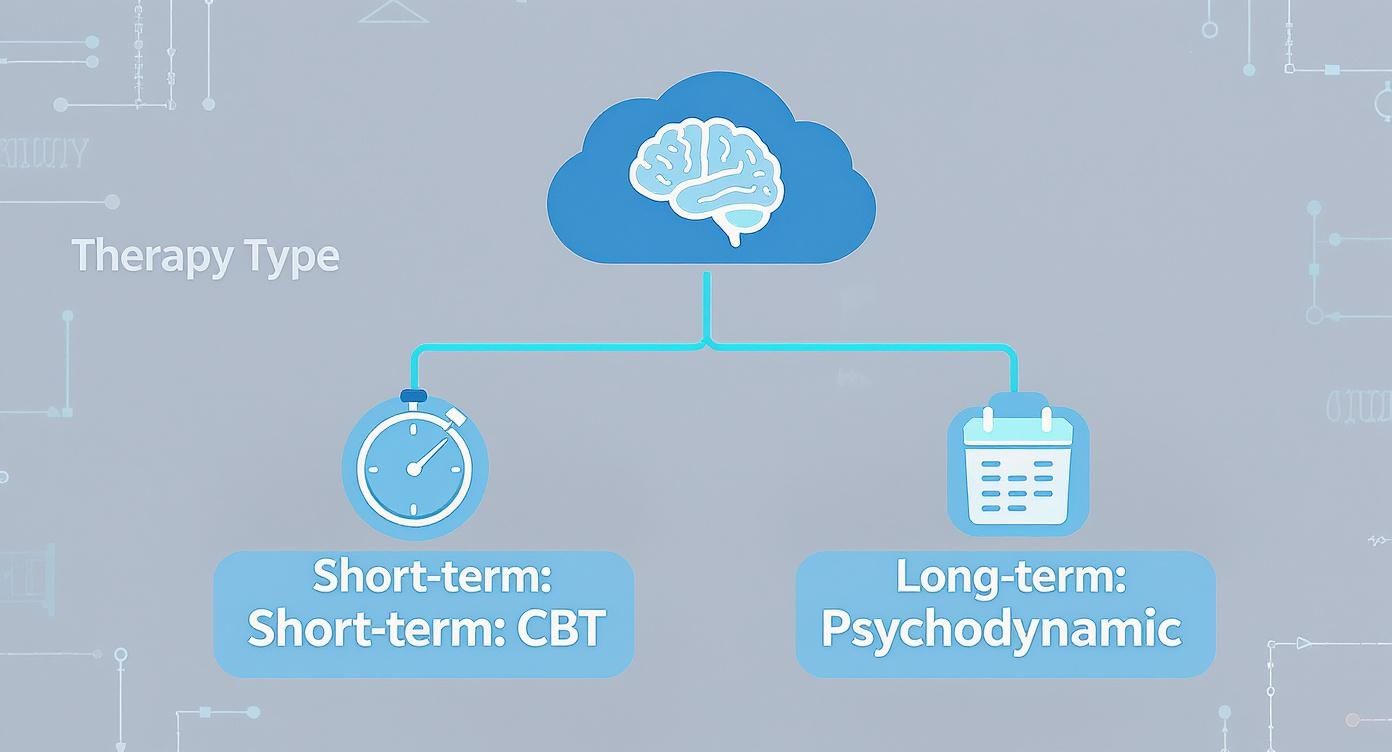
Just having a general preference for short or long-term work can narrow down your search a surprising amount right from the start.
Reading a Therapist’s Website for Clues
A therapist’s website is so much more than a digital business card. It's a window into their professional world and, crucially, their personality.
When you land on a site, pay close attention to the language they use. Does it feel warm, professional, and clear? Or is it bogged down with jargon you don't really understand? A good therapist should be able to communicate complex ideas in a way that feels accessible.
Have a good look at their ‘About Me’ page. Do they share a bit about their approach or what brought them to this work? This isn't about their life story, but it can give you a real feel for their personality. Also, check their listed specialisms. If you’re dealing with anxiety, for example, seeing that listed as a key focus is a great sign they have the right experience and can offer the specific kind of support you need.
Navigating the Practical Details
So, you’ve started looking for a therapist who feels like a good fit. That's a massive step. But for therapy to really work in the long run, it has to fit into your actual life. The practical side of things – cost, session format, and scheduling – is just as important. Getting these details sorted from the get-go can save you a lot of stress down the line and make it easier to stick with it.
Let's be upfront: private therapy is an investment in yourself. In the UK, you can expect fees to range anywhere from £50 to £150 per session. This often depends on the therapist's experience and where they're based. It’s really important to have an honest think about what you can realistically afford week in, week out.
If those figures feel a bit daunting, please don't lose hope. Many therapists, myself included, offer a number of sessions on a sliding scale, where the fee is adjusted based on your income. There are also some fantastic mental health charities and low-cost counselling services out there. For a full rundown of all the options, have a look at our guide on how to get therapy in the UK.
Choosing Your Session Format
The how is just as important as the who. The way you meet your therapist can make a big difference, and what works for one person might not work for another. It’s all about what suits your lifestyle and what you’re most comfortable with.
In-Person Therapy: The traditional approach. You get a dedicated, private space that’s separate from the rest of your life. For many, being in the same room and picking up on non-verbal cues adds a powerful dimension to the connection.
Online Video Therapy: This has become incredibly popular for a reason. It offers huge flexibility, cuts out travel time, and means you can connect with the right therapist no matter where they are in the country.
Phone Sessions: Some people find video calls draining or just prefer not being on screen. Phone calls can offer a bit more anonymity while still giving you that direct, supportive connection.
Remember, your choice isn't set in stone. You could start online for convenience and then move to in-person sessions later, or the other way around. The best format is simply the one that makes it easiest for you to show up.
Location and Accessibility
Finally, let's talk geography. If you're leaning towards in-person therapy, a convenient location is absolutely key. A stressful or lengthy commute can quickly become a reason to skip a session, which defeats the purpose.
Even if you opt for online therapy, location can still play a part. There's a real disparity in mental health provision across the country. NHS data, for example, shows that London has 78 psychological professionals per 100,000 people, while the Midlands has just 47. This can affect waiting times and therapist availability, even in the private sector. It's just a practical thing worth keeping in mind. You can dig into these regional workforce findings on the NHS England website if you're interested.
Thinking through these practical bits and pieces—cost, format, and location—isn't boring admin. It's about setting yourself up for success from day one, making your therapy journey as smooth and sustainable as possible.
Making Your Choice at the Initial Consultation
You've done the homework—checking credentials, sorting the practical stuff. Now you’ve reached what is arguably the most important part of the process: the initial consultation.
This first conversation, whether it's a quick phone call or a full session, is your chance to see if you actually ‘click’ with the person on the other side of the room (or screen). This is where you move beyond the profiles and qualifications to gauge the real-life personal fit. It’s less of an interview and more of a mutual exploration. You're both trying to figure out if you can build the strong, trusting relationship that makes therapy work.

Asking Questions That Go Deeper
Coming prepared with a few thoughtful questions can give you a much clearer sense of a therapist’s style. Going beyond the basics helps you see how they think and whether their way of working aligns with what you actually need.
Instead of just asking about their general experience, try getting more specific to your situation. Here are a few ideas:
"Based on what I've told you so far, how might you approach working with me?" This question shifts the conversation from the general to the personal, offering a small preview of their therapeutic process.
"What would you expect from me in our sessions?" This helps clarify the collaborative nature of therapy. It’s a two-way street, after all.
"How do you track progress, or know when therapy is working?" Their answer can reveal a lot about their therapeutic goals and how they measure success.
Understanding What to Expect in Sessions
It’s also really helpful to get a feel for the rhythm and structure of the sessions themselves. A simple question like, "What should I expect in our first few sessions?" can open up a discussion about their methods and what the initial phase of therapy looks like. If you want to dig deeper into this, our article on what happens in counselling sessions is a great resource.
The goal isn’t to find a therapist with all the 'right' answers, but one whose answers feel right for you. It’s about finding a professional who communicates in a way that resonates and makes you feel hopeful.
Trusting Your Instincts
After the chat, take a moment to check in with yourself. That gut feeling is often the most reliable indicator you have.
Ask yourself:
Did I feel properly heard and respected?
Was the atmosphere calm and non-judgemental?
Could I see myself opening up and being vulnerable with this person?
It is completely normal—and wise—to speak with a few therapists before you commit. This isn't a decision to be rushed. Taking your time to find someone you trust and feel comfortable with is the single best investment you can make in your therapeutic journey. That connection is the foundation on which all progress is built.
Still Have a Few Questions?
Even with all the information in the world, it's completely normal to have some lingering questions floating around as you look for the right therapist. Getting them answered can be the final piece of the puzzle, giving you the confidence to take that next step.
Here are some of the most common things people ask when they're on this journey.
How Do I Know if a UK Therapist Is Properly Qualified?
This is a really important one. The simplest way to check a therapist’s credentials is to see if they're registered with a reputable professional body. In the UK, the main ones to look out for are the British Association for Counselling and Psychotherapy (BACP), the UK Council for Psychotherapy (UKCP), and the British Psychological Society (BPS).
These organisations are a bit like a quality stamp. They have strict codes of ethics and require their members to have completed rigorous training. Any registered therapist will have their affiliations listed on their website, and you can usually double-check their membership on the organisation’s own online register. It’s your best assurance that you’re in safe, professional hands.
What if I Feel My Therapist Is Not the Right Fit?
It happens, and it's nothing to feel bad about. The relationship you build with your therapist is the very foundation of your work together. If it just doesn't feel right after a few sessions, it’s absolutely okay to make a change. A good therapist will understand this completely and won't take it personally.
It’s often best to be upfront about it. You could bring it up in a session or simply send a polite email to let them know you’ve decided to stop. Think of it as a learning experience—what you’ve discovered about what didn’t work can be really useful in helping you find someone who feels like a much better match.
How Long Should I Expect to Be in Therapy?
There's no magic number here, as the length of therapy can vary hugely from person to person. It all comes down to what you’re working on, your personal goals, and the type of therapy you choose.
Some approaches are designed to be quite brief. For instance, certain forms of Cognitive Behavioural Therapy (CBT) might only last for 6-12 sessions. On the other hand, more exploratory approaches like psychodynamic therapy can be a longer-term journey, sometimes lasting for many months or even years.
This is a brilliant question to ask during your initial consultation. Ask a potential therapist what they might typically expect for the kinds of issues you're bringing. Their answer will give you a much clearer idea of the time and commitment involved.
Ultimately, you should be in therapy for as long as it feels helpful and productive for you - this is something I feel strongly about, and do see people who get to a much better place and then finish sessions, often returning at a later date to explore further. After all, therapy can personally be very rewarding.
By Therapy-with-Ben

Link through to main Therapy Landing Page, alternatively if you are ready to book in : Bookings or of course reach out to me for more information. Kind regards, Ben
A quick note for therapists and small business owners: I use Outrank to help me keep this blog updated and support my website’s SEO. If you run a small business and want a time-saving way to build content and visibility, it may be worth a look: Outrank with code 10OFFBEN for 10% off your first month. If you sign up through my link, I may receive a commission at no extra cost to you.
Comments