


How to Manage Stress and Anxiety: A Practical UK Guide
Author: Therapy-with-Ben
If you're trying to figure out how to manage stress and anxiety, the best way forward is usually a mix of immediate coping skills and longer-term changes to your lifestyle. It’s all about building up your resilience by getting to know your triggers, learning to question anxious thoughts, and creating a daily routine that puts your mental wellbeing first.
Getting to Grips with Stress and Anxiety in the UK Today
Feeling swamped seems to be the new normal for so many of us. If you feel like you’re constantly fighting off feelings of pressure, worry, or even dread, please know you are absolutely not on your own. The search for real, practical ways to manage stress and anxiety has shot up, and it’s no wonder given the modern-day pressures we’re all facing.
This isn't just a general feeling; the numbers back it up. The sheer scale of anxiety in the UK has become a serious issue, with things like economic uncertainty and the constant buzz of our digital lives playing a huge part. In fact, over 8 in 10 adults in Great Britain are still worried about the rising cost of living. And in any given week in England, 8 in 100 people are dealing with a mix of anxiety and depression, which just shows how common these struggles have become.
Why Does It Feel So Common Right Now?
It’s really important to look at the world we're living in. The cost-of-living crisis, being digitally connected 24/7, and all sorts of social pressures create a perfect storm for our nervous systems. This environment can make it tough to tell the difference between everyday stress and something more persistent, like anxiety.
Learning the nuances is a great first step, and you can learn more about the difference between stress and anxiety in our quick explainer. Realising that outside factors are affecting how you feel isn't about making excuses—it's a vital part of showing yourself some much-needed compassion.
At Therapy with Ben, my approach is built on understanding these very specific, modern challenges. True resilience isn’t about pretending these pressures don’t exist, but about learning to navigate them with practical, sustainable skills that actually work.
From Acknowledging to Acting
Recognising there's a problem is the first, and often bravest, step you can take. This guide is designed to help you move past that initial acknowledgement and start building real, lasting resilience. We'll dive into actionable advice that fits into the real world, from grounding techniques you can use in a crisis to long-term adjustments to your lifestyle.
While these feelings are undeniably common, the most important thing to remember is that they are also manageable. Throughout this guide, we'll walk through the exact strategies you can start using to get back a sense of control and calm.
Find Calm in Moments of Overwhelm

When your heart starts racing and your thoughts spiral, you need something that works right now. This is about having practical, in-the-moment tools to find your footing when the ground feels like it’s shifting beneath you. These techniques are designed to interrupt the body’s acute stress response—the ‘fight-or-flight’ mode—and switch on its natural relaxation system instead.
Many of us get that surge of panic in the most ordinary situations, like navigating a busy supermarket or staring at a daunting email. In those moments, knowing how to manage stress and anxiety isn't an abstract idea; it's an urgent need. The key is to have discreet, effective strategies ready to go, wherever you are.
Master Your Breathing to Master Your Nerves
Your breath is the most immediate tool you have. When we get anxious, our breathing often becomes shallow and quick, telling our brain there’s danger ahead. By consciously changing your breathing rhythm, you can send a powerful message back to your brain that everything is actually okay.
A technique I often share with clients is box breathing. It’s incredibly simple but profoundly effective.
Breathe in slowly through your nose for a count of four. Really feel the air filling your lungs.
Hold your breath for a count of four. Try not to clamp everything shut; just pause.
Breathe out slowly through your mouth for a count of four. Let the air escape gently.
Hold your breath again for a count of four before repeating.
This steady, rhythmic pattern helps regulate your nervous system, slowing your heart rate and lowering blood pressure. You can practise this anywhere—at your desk before a meeting, in a toilet cubicle, or while waiting in a queue.
Ground Yourself Using Your Senses
Another powerful method is the 5-4-3-2-1 grounding technique. This practice pulls your attention away from the storm inside your head and anchors you firmly in the present moment by engaging all five senses. It’s a brilliant way to stop a thought spiral in its tracks.
If you often find yourself stuck in your head, learning how to stop overthinking everything can be a great complement to these grounding exercises.
Here’s how it works:
5: Acknowledge FIVE things you can see. It could be a pen on your desk, a crack in the pavement, or the colour of a passing car.
4: Notice FOUR things you can feel. This might be the texture of your jumper, the cool surface of a table, or your feet planted firmly on the floor.
3: Listen for THREE things you can hear. Maybe it’s the hum of a refrigerator, distant traffic, or birdsong outside.
2: Identify TWO things you can smell. This could be the coffee on your desk or the scent of rain in the air.
1: Acknowledge ONE thing you can taste. You could take a sip of water or just notice the current taste in your mouth.
These grounding techniques aren't about ignoring your anxiety. They are about shifting your focus. They remind your brain that you are safe in your current environment, which helps dial down the intensity of the emotional response.
When you feel that familiar spike of anxiety, it’s helpful to have a few go-to techniques you can rely on without having to think too hard. I've put a few simple ones into a quick-reference table.
Quick Grounding Techniques for Immediate Calm
Technique | How It Works | When to Use It |
|---|---|---|
The 5-4-3-2-1 Method | Engages all five senses to pull your focus out of anxious thoughts and into the present moment. | When your mind is racing or you feel detached from your surroundings. |
Mindful Breathing | Focuses attention on the physical sensation of your breath, calming the nervous system. | Any time you feel overwhelmed, especially in a public space, as it's very discreet. |
Physical Anchoring | Involves pressing your feet firmly into the floor or holding onto a solid object, like a chair. | During a sudden wave of panic or dizziness to help you feel more stable and connected. |
Temperature Change | Splashing cold water on your face or holding an ice cube can 'shock' your system out of an anxiety loop. | When you're in a high-intensity panic or emotional spiral and need a quick reset. |
Having these tools at your disposal means you're never completely powerless against a wave of anxiety.
Learning to actively focus through mindfulness is another fantastic way to find calm. For those interested in exploring this further, there are some excellent resources on how to practice mindfulness for daily life. By incorporating these small but powerful practices, you start to build a reliable toolkit for navigating even the most overwhelming moments with more confidence.
Reshape Your Relationship with Anxious Thoughts

Anxiety often feels like it's being directed by a relentless internal narrator, one who’s exceptionally good at pointing out every worst-case scenario. Learning to manage stress and anxiety for the long haul means doing more than just calming your body; it involves fundamentally reshaping your relationship with these thoughts. This is where we can borrow some incredibly practical ideas from Cognitive Behavioural Therapy (CBT) to help you get back in the driving seat.
The goal isn't to somehow stop anxious thoughts from ever popping up – let’s be honest, that’s an impossible task. It’s about learning to observe them without automatically buying into them as gospel. Think of it as developing a kind of mental fitness; you’re training yourself to meet your inner world with curiosity, not fear.
Spotting Common Thinking Traps
Our minds love to take shortcuts, but sometimes these shortcuts lead us down some pretty unhelpful and well-trodden paths. In therapy, we often call these 'cognitive distortions' or 'thinking traps'. Simply learning to recognise these patterns is the first step toward taking their power away.
Here are a few common ones you might notice:
Catastrophising: This is the mind’s tendency to leap to the absolute worst possible conclusion from a minor event. A simple typo in a work email spirals into "I'm definitely going to get sacked".
All-or-Nothing Thinking: You see things in black and white. If your performance isn’t perfect, you see yourself as a total failure. There's no room for any middle ground.
Mind Reading: You assume you know what others are thinking about you, and it’s almost always negative. You might leave a party convinced everyone thought you were awkward, despite having no real evidence for it.
Just noticing these thoughts is a skill, and like any skill, it gets stronger with practice. Even just labelling a thought—"Ah, that’s catastrophising again"—can create enough distance to lessen its emotional punch. This is especially useful for anyone looking for ways of dealing with intrusive thoughts in our practical guide.
Challenging and Reframing Your Thoughts
Once you can spot a negative thought pattern as it happens, the next move is to challenge it. Now, this doesn't mean getting into an argument with yourself. It's more like being a friendly detective, gently questioning the evidence for the case your mind is presenting.
Try asking yourself a few simple questions:
What’s the actual evidence for this thought? What’s the evidence against it?
Is there a more balanced or realistic way of looking at this situation?
What would I tell a friend if they were having this exact thought?
For instance, if your thought is, "I messed up that presentation and now everyone thinks I’m incompetent," a challenge might sound like this: "Okay, I did stumble on one slide, but I also answered three complex questions really well. Maybe they just saw a minor slip-up, not a sign of total incompetence." This is called reframing. You’re not pretending the negative didn't happen, but you are balancing it with a more realistic and compassionate viewpoint.
A 'thought record' can be a real game-changer here. It’s not complicated jargon; it's just a simple log where you note down the situation, the automatic thought, the feeling it sparked, and then your reframed, more balanced thought. This process makes the link between your thoughts and feelings incredibly clear.
The Importance of Taking Action
Reshaping your thoughts is a vital part of managing anxiety, but if you don't address the underlying stress, you'll remain vulnerable. The psychological fallout from untreated stress can be severe; research shows 51% of adults who felt stressed also reported feeling depressed, and 61% reported feeling anxious. Ignoring these feelings just isn't an option if you want to protect your long-term wellbeing.
As you get better at working with your thoughts, it can also be helpful to explore specific strategies for navigating social anxiety and building your confidence. This proactive approach—combining cognitive skills with practical, real-world changes—is the foundation for lasting resilience. It’s all about moving from being reactive to your anxiety to proactively managing your inner world with skill and self-compassion.
Building a Lifestyle That Protects Your Mental Health
Real, lasting change doesn’t usually happen overnight with one big, dramatic gesture. It’s actually built from the small, consistent things we do every single day. While those in-the-moment techniques are absolutely vital for getting a handle on a spike of anxiety, building a lifestyle that genuinely supports your wellbeing is the real key to long-term resilience. It's about moving beyond the quick fixes and looking at the foundations that keep you steady.
We'll look at how sleep, what you eat, and how you move your body form a powerful trio in your efforts to manage stress and anxiety. This isn't about piling more overwhelming tasks onto your to-do list; it’s about making small, intentional tweaks that add up to a massive positive effect over time.
Prioritise Sleep Hygiene for an Anxious Mind
Sleep is often the first thing to go when we're stressed, yet it’s one of the most critical parts of staying mentally stable. When you’re anxious, your brain can just refuse to switch off, replaying worries on a loop and leaving you completely drained. Just telling yourself to 'get more sleep' is rarely helpful. What we need to focus on is good sleep hygiene.
This really just means creating a routine that signals to your brain and body that it’s time to wind down. That hour before you intend to sleep is crucial. Try to avoid screens, as the blue light can mess with melatonin production – the hormone that tells your body it's time to rest. Instead, you could try reading a book, listening to some calming music, or doing a few gentle stretches.
A few small changes can honestly make a huge difference:
Try to keep a consistent sleep schedule, even on weekends. This helps to regulate your body's internal clock.
Create a restful environment. Your bedroom should ideally be dark, quiet, and cool.
Avoid caffeine and big meals late in the evening. These can easily disrupt your natural sleep cycle and cause discomfort.
Think of your wind-down routine not as another chore, but as a deliberate act of self-care. It's an investment in your mental clarity for the next day, helping to create a buffer against stress before it even has a chance to take hold.
Fuel Your Brain and Stabilise Your Mood
The connection between our gut and our brain is incredibly powerful, and what we eat directly impacts our mood and anxiety levels. While there’s no single magic food that will cure anxiety, a balanced diet rich in certain nutrients can support your brain and help promote emotional stability. When you're figuring out how to manage stress and anxiety, don't forget to look at your shopping list.
Highly processed foods and sugary snacks can cause sharp spikes and crashes in blood sugar, which can feel a lot like the physical symptoms of anxiety, or even make them worse. The goal is to focus on whole foods that give you a slow, steady release of energy.
Foods that can help include:
Complex carbohydrates like oats, brown rice, and quinoa, which help boost levels of the mood-regulating neurotransmitter, serotonin.
Omega-3 fatty acids found in oily fish like salmon, which have been shown to reduce inflammation and anxiety symptoms.
Magnesium-rich foods such as spinach, nuts, and seeds. Magnesium plays a vital role in calming the nervous system.
And don’t forget hydration. Even being mildly dehydrated can have a negative effect on your mood and ability to concentrate. Aim to drink plenty of water throughout the day to keep your brain working at its best.
Embrace the Power of Gentle Movement
When you feel anxious, the idea of an intense workout can feel completely overwhelming. But movement doesn't have to mean a punishing session at the gym. In fact, some of the most effective physical activities for anxiety are gentle and restorative. Regular exercise helps the body release fewer stress hormones when faced with daily pressures, and it also stimulates the production of endorphins, which have a natural calming effect.
Something as simple as a daily walk can be one of the most powerful tools you have. It gets you out into the fresh air, provides a gentle, rhythmic activity that is inherently calming, and creates a bit of space for your mind to process thoughts without feeling trapped.
This is the whole principle behind my walk and talk therapy sessions here in Cheltenham. By combining gentle physical activity with a therapeutic conversation in a natural setting, we can lower the intensity that sometimes comes with counselling and allow for a more relaxed and open dialogue. It’s a perfect example of how integrating movement into your routine isn’t just about physical fitness; it’s a direct and effective way to manage your mental wellbeing, one step at a time.
Right, we’ve talked through some ways to calm things down in the heat of the moment, as well as some bigger picture lifestyle changes. Now it’s time to pull it all together into something practical you can actually use.
Knowing what to do is one thing, but having a clear, personal plan ready before you need it? That’s where the real power lies. Think of it as building a fire escape plan for your mind. You hope you never have to use it, but just knowing it’s there can bring a huge sense of relief and control.
Figure Out Your Unique Triggers
First things first, you need to become a bit of a detective in your own life. What are the specific situations, thoughts, or even physical feelings that seem to kick off or ramp up your anxiety? These triggers are deeply personal and can range from the really obvious to the surprisingly subtle.
The goal here isn't to avoid these triggers forever—that’s often impossible and not very helpful in the long run. Instead, it’s about learning to recognise them. Once you can spot them coming, you can prepare yourself or use your coping strategies proactively, heading the anxiety off at the pass.
Work, for many of us, is a massive source of pressure. It’s a huge health issue here in the UK, with 79% of British workers saying they experience it regularly. You can find out more about the impact of workplace stress from these statistics.
Your triggers might fall into a few categories:
Situations: Crowded rooms, giving a presentation, facing a financial deadline, or even certain social gatherings.
Emotions: Feeling like you’re not being heard, facing criticism, or just feeling snowed under with responsibility.
Physical Sensations: A poor night's sleep, too much caffeine, or the feeling of being unwell can all be triggers.
Your Own Thoughts: Ruminating on past mistakes or getting caught in a spiral of 'what-ifs' about the future.
Try this: for the next week or two, just jot down a note on your phone whenever you feel a spike of anxiety. After a while, you might start to see some clear patterns emerge.
List Your Go-To Coping Strategies
This is your personalised toolkit. Looking back at the techniques we've covered, which ones actually felt right for you? Pick the ones you can realistically see yourself using when things get tough. The idea is to have a short, simple list so you don’t have to scramble to think of what to do in a moment of panic.
You could even structure it a bit like this:
Immediate Relief (When panic is high): Box Breathing, 5-4-3-2-1 Grounding, splash my face with cold water.
Winding Down (When I'm just tense): A quick 15-minute walk around the block, putting on a specific calming playlist, getting my thoughts out in a journal.
Everyday Habits (To keep things steady): My morning stretch routine, making sure I take a proper lunch break away from my screen.
Having this list written down—whether it's on your phone or in a notebook—takes the pressure off. It removes the mental load of trying to remember what helps when your mind is already overloaded. It's a simple set of instructions from your calm self to your anxious self.
The image below shows the three pillars that hold up any good plan. Sleep, nutrition, and movement all work together to build our resilience.
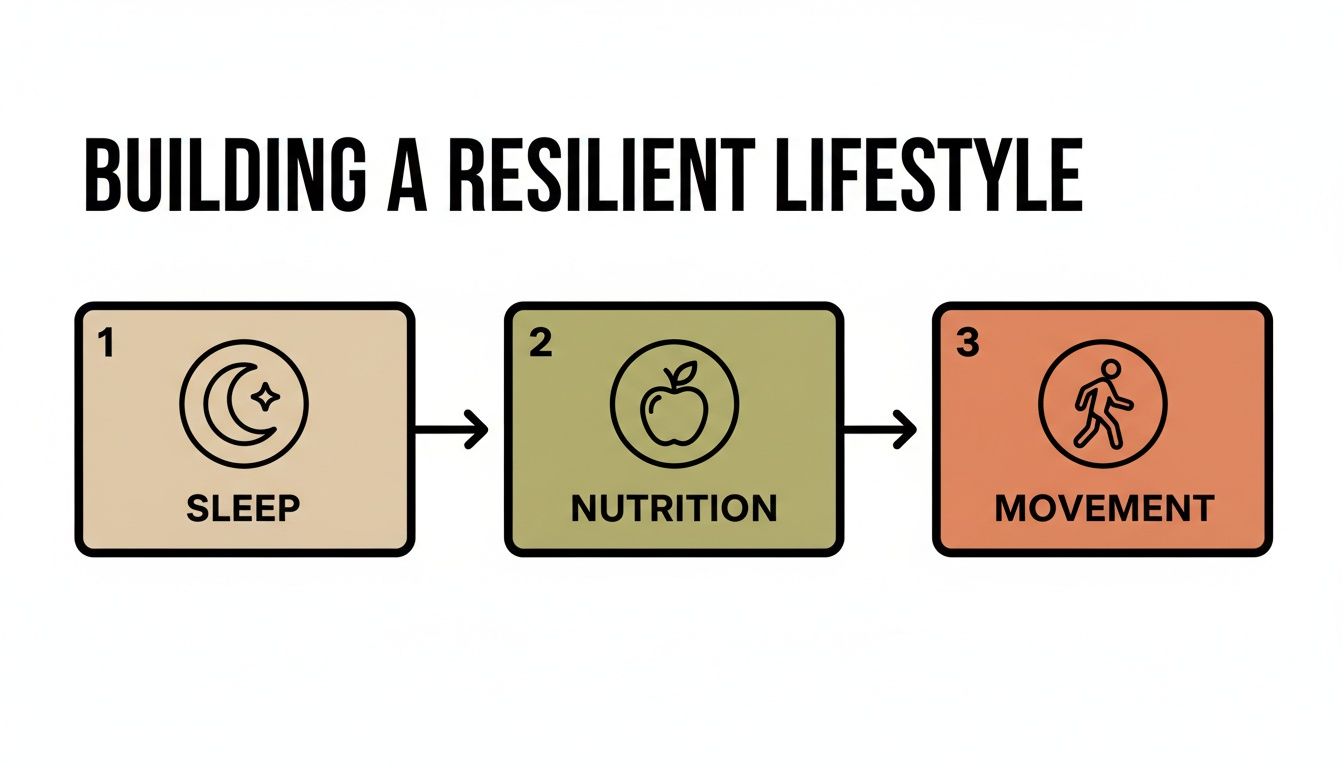
When you improve one area, like getting better sleep, it tends to have a positive knock-on effect on the others, boosting your overall ability to cope.
Build Your Personal Support Map
Anxiety can feel incredibly isolating, making you think you have to handle it all alone. You don't. A support map is simply a list of people you can turn to. It’s well worth thinking about this ahead of time, because in the middle of feeling overwhelmed, it’s often hard to think clearly about who to call.
Your map could have a few different levels of support:
Friends or Family: Who in your life is a really good listener? Who's great at providing a practical distraction, like suggesting a walk?
Professional Support: This could be your GP, a therapist (like me), or a mental health helpline.
Emergency Contacts: For those moments of real crisis, know exactly who to call for immediate help.
Just taking the time to create this plan is a powerful act of self-compassion. It's an acknowledgement that yes, difficult moments will happen, but it’s also a firm statement that you have the resources, skills, and support to get through them.
When and How to Seek Professional Support in Cheltenham
While the self-help strategies we’ve talked about are incredibly powerful tools for handling day-to-day stress, it’s just as important to recognise when you might need a bit more support. Reaching out isn’t a sign of failure; it's a proactive and genuinely courageous step towards looking after yourself. Think of it as adding an expert to your team.
So, when is the right time? You might consider talking to a counsellor if you notice that stress or anxiety are consistently getting in the way of your daily life. Maybe it’s making it hard to concentrate at work, causing friction in your relationships, or simply stealing the joy from things you used to love.
If your usual coping mechanisms feel like they’re just not cutting it anymore, that’s a pretty clear sign it’s time to talk.
Taking the First Step in Therapy
The thought of starting therapy can feel pretty daunting, so let’s pull back the curtain on it. The first session is, at its heart, just a conversation. It's a chance for us to get to know each other and for you to share what’s on your mind in a completely safe, confidential space. It also helps me understand what you’re hoping to achieve.
There’s absolutely no pressure to have it all figured out before you walk in the door. My role is to listen without judgement and to explain how we might work together to help you feel better. It’s all about collaboration and finding a path forward that feels right for you.
A common worry I hear is that you'll be judged, or that your problems aren't 'serious enough'. Please know that if it’s affecting you, it’s serious enough. Therapy is a space where your feelings are validated, not questioned.
Finding the Right Therapeutic Approach for You
Here in Cheltenham, I offer a few different ways we can work together, because therapy certainly isn't a one-size-fits-all solution. What matters most is your comfort and what works for your lifestyle.
Face-to-Face Counselling: These are the more traditional sessions held in a calm, private therapy room. It gives you a dedicated space to focus entirely on your wellbeing without distractions.
Online Counselling: For those with busy schedules or who simply prefer the comfort of their own home, online video sessions offer a flexible and equally effective alternative.
Walk and Talk Therapy: This is a really unique option where we hold our session while walking in one of Cheltenham’s beautiful parks or outdoor spaces. Combining gentle movement with therapy can feel much less formal and is incredibly effective for easing anxiety.
Whatever you’re going through, remember that support is available. Taking that first step to get in touch is often the hardest part, but it’s also the first move towards regaining a sense of control and finding lasting relief.
Got Questions About Managing Anxiety? I've Got Answers
Stepping onto the path of managing stress and anxiety often brings up a lot of questions. That’s completely normal. Here are a few of the most common ones I hear from people in and around Cheltenham, along with some straightforward answers to help you feel a bit clearer as you move forward.
How Long Does It Take for These Techniques to Work?
This is probably the question I get asked most often, and the honest answer is: it really does vary. Quick grounding techniques like the 5-4-3-2-1 method or a few deep, intentional breaths can bring a sense of relief in minutes. They are brilliant for taking the edge off in an intense moment.
The deeper cognitive work and lifestyle changes are more like building up a muscle. You'll likely notice small but encouraging shifts within a few weeks of sticking with it. More significant, lasting change? That often becomes more noticeable over a few months.
The most important thing is that consistency is far more important than perfection. Every time you practise a technique, even for a minute, you're strengthening your mind's ability to navigate anxiety.
What Is Walk and Talk Therapy?
It’s pretty much what it sounds like! Walk and talk therapy is a form of counselling where we hold our session outdoors, walking side-by-side in one of Cheltenham's beautiful parks or natural spaces. For many people, this feels less formal and intense than sitting opposite each other in a room, which can make it easier to open up.
There's something incredibly powerful about the combination of gentle movement, being in nature, and talking things through. The simple act of walking helps release physical tension, and the natural environment has a proven calming effect on our nervous systems. If the traditional therapy setup doesn't feel right for you, walk and talk therapy could be a great fit.
I'm Worried I'll Be Judged If I Go to Therapy
This is such a common and understandable fear. My absolute priority as a counsellor is to create a safe, confidential, and completely non-judgemental space for you. A therapy session is your time.
It’s a space where you can explore your thoughts and feelings openly, without a filter. My role isn't to judge you; it's to listen, offer a fresh perspective, and guide you with helpful tools. We work together, as a team, to help you get to where you want to be.
At Therapy with Ben, my focus is on providing a supportive environment where you can explore what's going on for you and build real, lasting resilience. If you feel ready to take the next step, I invite you to find out a bit more about how we could work together.


Comments