


How to Overcome Fear and Reclaim Your Confidence
Written by: Therapy-with-Ben
When you want to overcome fear, the goal isn't to crush it or pretend it doesn't exist. It's about understanding what it's trying to tell you, learning to calm your body’s immediate panic, and gently questioning the thoughts that give it so much power.
Understanding Where Fear Comes From
Before you can work with fear, it helps to know what it is and why it feels so overwhelming. Fear isn’t a flaw or a weakness; it’s a deeply ingrained survival instinct that our brains developed to keep us safe. The moment your brain spots a potential threat—whether that’s a real danger like a car speeding towards you or a perceived one like an upcoming presentation—it kicks off a whole cascade of physical and mental responses.
This reaction is famously known as the ‘fight, flight, or freeze’ response. It’s an ancient, automatic process run by a part of your brain called the amygdala. Think of it as a smoke alarm, instantly getting your body ready for action. Adrenaline surges, your heart pounds, and your focus becomes laser-sharp. This system is fantastic for dodging predators, but in our modern lives, it can sometimes be a bit overzealous.
Your Brain on Fear
When that fight-or-flight response fires up, your body is genuinely trying to protect you. The catch is, our brains often can't tell the difference between a life-or-death situation and a psychological threat, like the fear of being rejected or speaking in public. In fact, research shows that social rejection can light up the same parts of the brain that register physical pain, which is why it can feel so intensely awful.
The crucial first step is to shift your perspective. Instead of seeing fear as an enemy to be beaten, try seeing it as a misguided friend that's just trying a bit too hard to protect you. This small change in mindset can build a foundation of self-compassion, which is vital for the road ahead.
Fear Manifests in Different Ways
Knowing that fear is a universal human experience can be a relief in itself. It shows up differently for all of us, and it can be helpful to put a name to what you're feeling.
Specific Phobias: This is an intense, overwhelming fear of a particular thing or situation, like a fear of heights (acrophobia) or spiders (arachnophobia).
Social Anxiety: A persistent fear of social situations where you might be judged by others. This can turn everyday interactions into something you dread.
Generalised Anxiety: This is more of a constant, low-level hum of worry about different parts of your life, often without one single, obvious cause.
Recognising these patterns is the first step toward managing them. Once you can identify the specific shape and texture of your fear, you can start using strategies that are tailored to it.
By the way, you asked a great question about internal linking on websites. It’s absolutely key to link to all your relevant pages, not just your blog posts. Linking to your main service pages, like Online Counselling, or even your About Me page, helps visitors find what they need and shows search engines how all your content connects. But let's get back to understanding your fear.
Practical Techniques to Calm Fear Instantly
When fear grips you, rational thinking can feel like it's a million miles away. Your body is in a state of high alert, and vague advice like "just relax" isn't just unhelpful, it can feel completely dismissive. What you need is a first-aid kit of practical, evidence-based techniques to bring your nervous system back from the brink.
These are grounding exercises you can use anywhere, anytime, to dial down that immediate intensity.

Think of these as your go-to tools for managing those sudden waves of panic or anxiety. They work by yanking your focus away from the fearful thoughts spiralling in your head and planting you firmly back in the physical reality of the present moment. This whole process sends a powerful signal to your brain that the immediate threat has passed, giving your fight-or-flight response permission to stand down.
Use Your Senses with the 5-4-3-2-1 Method
One of the most effective ways to break the cycle of escalating fear is to pull your attention back to your immediate surroundings. The 5-4-3-2-1 grounding technique is brilliant because it forces your brain to concentrate on neutral sensory information, which leaves less mental bandwidth for the fear to occupy.
It’s incredibly simple. Just pause and, wherever you are, silently name:
5 things you can see: Really look around you. It could be your computer monitor, a crack in the pavement, a passing car, the colour of the wall, or a bird in a tree.
4 things you can feel: Notice the physical sensations. This might be the texture of your trousers against your skin, the firm ground beneath your feet, the breeze on your face, or the smooth surface of your phone.
3 things you can hear: Listen carefully. Maybe it's the hum of a refrigerator, distant traffic, the sound of your own breathing, or the chatter of people nearby.
2 things you can smell: This one can sometimes be tricky, but try to identify any scents in the air, such as coffee, cut grass, or even just the faint smell of the room you're in.
1 thing you can taste: Focus on the taste in your mouth. You could take a sip of water or simply notice the lingering taste of your last meal or cup of tea.
By deliberately engaging all five senses, you anchor yourself in the present. It’s a powerful mental reset that can stop a spiral of fear dead in its tracks.
Regulate Your Nervous System with Diaphragmatic Breathing
When fear takes hold, our breathing often becomes shallow and rapid, which only signals more danger to our brain. Diaphragmatic breathing, often called "belly breathing," directly counteracts this by activating the parasympathetic nervous system—your body’s built-in relaxation response.
Here’s how to do it:
Find a comfortable position, either sitting or lying down.
Place one hand on your chest and the other on your belly, just below your ribcage.
Breathe in slowly through your nose for a count of four, feeling your belly rise and expand. Try to keep the hand on your chest relatively still.
Hold your breath for just a moment.
Exhale slowly through your mouth for a count of six, feeling your belly fall as you do.
The real key here is making the exhale longer than the inhale. This simple act physically slows your heart rate and sends a direct message to your brain that you are safe. For anyone who experiences intense anxiety, learning effective coping strategies for panic attacks can provide an essential layer of support, helping you feel more prepared and in control.
A common mistake is trying to take huge, forceful breaths. The aim is for your breathing to be gentle, slow, and deep, coming from your diaphragm rather than your chest.
Release Physical Tension with Progressive Muscle Relaxation
Fear makes us tense up—shoulders hunch towards our ears, jaws clench, and muscles tighten as if preparing for a threat. Progressive Muscle Relaxation (PMR) is a technique that involves systematically tensing and then relaxing different muscle groups throughout your body.
This process doesn't just release physical tension; it also deepens your awareness of the difference between tension and relaxation, giving you a greater sense of control.
Start with your toes and work your way up. Tense the muscles in your feet for about five seconds, then release the tension for 20-30 seconds, really noticing the feeling of relief. Gradually move up through your body—calves, thighs, stomach, arms, hands, shoulders, and face—tensing and releasing each group in turn. This practice helps to discharge the pent-up physical energy of fear, leaving you feeling calmer and more grounded.
Right, those immediate grounding techniques are brilliant for calming your body when fear hits. They're your first line of defence. But for real, lasting change, we need to dig a bit deeper and look at the very engine that drives fear: your thoughts.
Fear isn't just a random feeling; it absolutely thrives on the stories we tell ourselves, often without us even realising we're the ones writing the script.
Getting to Grips with Your Anxious Thoughts
This is where the principles of Cognitive Behavioural Therapy (CBT) are so useful. It’s a really practical way of understanding the tangled link between our thoughts, our feelings, and what we end up doing. The core idea is simple but powerful: it’s not the situation itself that causes us distress, but how we interpret it.
Overcoming fear and anxiety has, quite rightly, become a huge focus in mental health support here in the UK. Just to give you a bit of context, in any given week in England, roughly 6 out of every 100 people are diagnosed with Generalised Anxiety Disorder (GAD). CBT is the most widely recommended approach, and for good reason—studies show that up to 50-60% of people who stick with a full course see significant improvements.
Learn to Spot Your Thinking Traps
The first job is just to notice what you’re telling yourself. Anxious thoughts can be automatic and incredibly fast, slipping under the radar of our conscious mind. We call these 'cognitive distortions' – basically, they're unhelpful thinking habits that are usually negative and not entirely based in reality.
Think of yourself as a detective, calmly investigating your own mind. You're not there to judge these thoughts, just to catch them in the act.
Here are a few common culprits you might recognise:
Catastrophising: This is the classic "jumping to the worst-case scenario." You make a small mistake at work and your mind immediately declares, "That's it, I'm going to get fired."
Black-and-White Thinking: This is where everything is either a total success or a complete failure, with no middle ground. If your performance wasn't absolutely perfect, you see it as a total disaster.
Mind Reading: When you assume you know what other people are thinking about you – and it's usually negative. "Everyone in that meeting thought my idea was ridiculous."
Simply being able to name these patterns is a massive step forward. It creates a tiny bit of space between you and the thought, helping you see it for what it is: a mental habit, not a hard fact.
Put Your Thoughts on Trial
Once you've spotted a fearful thought, it's time to put it on the stand. Anxious thoughts feel true, but they rarely hold up under a bit of gentle cross-examination. This isn't about getting into an emotional argument with yourself; it's about looking for the evidence.
Ask yourself: "What's the actual evidence for this thought? And what's the evidence against it?" This simple question forces you to step back and look at the situation more objectively, like a fair-minded judge.
Let's go back to that catastrophising thought, "I'm going to get fired." What's the evidence for it? Maybe your boss seemed a bit annoyed. Okay. Now, what's the evidence against it? Well, you've been a solid employee for years, you've had good feedback before, and you've seen other people make similar mistakes without being fired.
Fear often shows up as procrastination, too, stopping us from taking the steps we need to. Getting to the bottom of why we put things off can be a powerful way to reframe fearful thoughts and get unstuck. Learning how to overcome procrastination can give you some practical tools that work really well alongside this mental work.
Finding a More Balanced View
After you’ve questioned the thought, the final piece of the puzzle is to replace it with something more balanced and realistic. This isn't about slapping on a fake-positive sticker or pretending everything is wonderful. It’s about finding a perspective that’s actually more helpful and grounded in reality.
Here’s a simple table to walk you through how this works in practice.
A Simple Cognitive Restructuring Exercise
Step | Action | Example |
|---|---|---|
1. Catch It | Identify the automatic negative thought (ANT). | "Everyone in that meeting thought my idea was stupid." |
2. Challenge It | Look for evidence for and against the thought. | For: "A couple of people looked bored." Against: "My manager nodded, someone else asked a follow-up question, and no one actually said anything negative." |
3. Change It | Create a balanced, more realistic thought. | "My idea might not have landed with everyone, but some people seemed engaged. I can't know what they were all thinking, and I did my best to contribute." |
Instead of the catastrophic "I'm going to get fired," a reframed thought could be: "I made a mistake, and I feel rubbish about it. I'll own up to it and see how I can fix it. It's a chance to learn, not the end of my career."
This new thought acknowledges the reality of the situation without letting it spiral. It’s also so important to do this with a bit of kindness. Our inner critic is often our harshest judge. Learning to be gentler with yourself is a skill in itself, and you can read more about that in our guide on what is self-compassion and kinder thinking.
By consistently catching, questioning, and reframing these fearful thoughts, you slowly start to rewire your brain. You’re not just coping with fear; you're fundamentally changing your relationship with it from the inside out.
Create a Plan to Gently Face Your Fears
Challenging those fearful thoughts is a huge internal shift, but the real magic happens when you start translating that new perspective into real-world action. Let’s be honest, avoiding the things that scare you feels a lot safer in the moment. The problem is, this behaviour only makes the fear stronger, teaching your brain that the 'threat' is real and avoidance is your only option.
The most powerful way to unlearn fear is through gentle, controlled exposure. This is absolutely not about throwing yourself in at the deep end. It’s about creating a gradual, step-by-step plan that you are in complete control of. In a clinical setting, we call this 'exposure therapy'. You set the pace, and every small step forward proves to your brain that you're far more capable than your fear would have you believe.
Building Your Fear Ladder
The core of this whole approach is what we call a fear ladder, or an exposure hierarchy. It’s just a fancy term for a list of situations related to your fear, which you rank from the least scary to the most terrifying. The whole point is to break down a massive, daunting challenge into a series of small, manageable steps.
You start at the very bottom rung. You only move up to the next one when you feel reasonably comfortable where you are. This simple method ensures you're never totally overwhelmed, and you build your confidence bit by bit with each successful step.
The goal isn't to get rid of anxiety completely during each step. It’s to learn that you can handle the feeling and that the catastrophic thing you're worried about doesn't actually happen. This process is called habituation—your brain literally gets used to the situation and stops sounding the alarm.
Let's say you have a fear of social situations, like going to a party where you don't know many people. A fear ladder for this might look something like this:
Rung 1 (Lowest Anxiety): Just thinking about going to a small get-together with friends.
Rung 2: Looking at photos online from a recent party a friend went to.
Rung 3: Sending a text to a friend to ask about their weekend plans.
Rung 4: Having a five-minute phone call with one close friend.
Rung 5: Going for a quiet coffee with two or three friends you know well.
Rung 6: Attending a small, structured event (like a book club) for 30 minutes.
Rung 7: Going to a larger party with a trusted friend and agreeing to stay for one hour.
Rung 8 (Highest Anxiety): Attending a party on your own and aiming to start one conversation with someone new.
Navigating the Plan Successfully
As you start to climb your ladder, always remember this is your journey. You decide how long to stay on each rung and when you feel ready to move up. Consistency is what matters here, not speed.
It's also really important to bring along those cognitive skills we've already talked about. As you face each step, those fearful thoughts are bound to pop up. The infographic below shows a simple process to catch them, question them, and change them as you go.
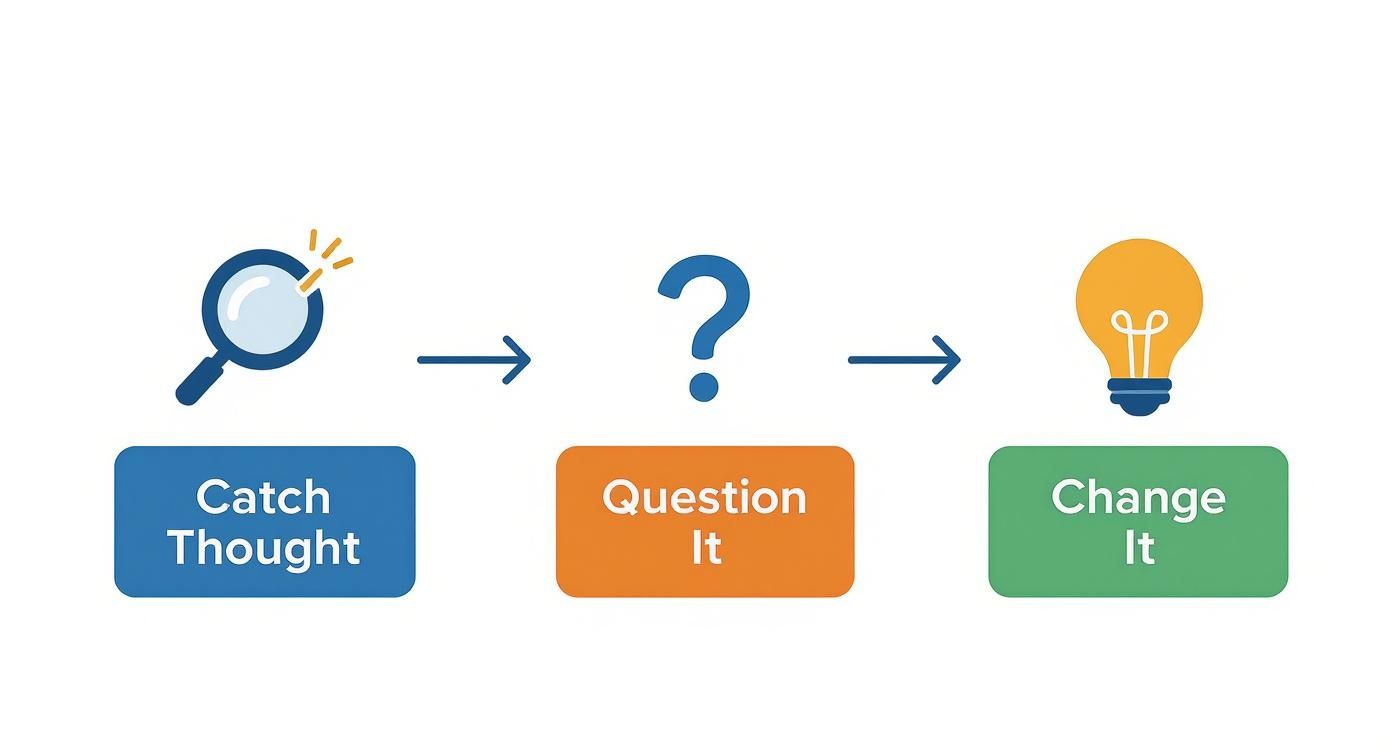
Having a visual process like this reinforces the fact that you can actively step in and reframe anxious thoughts before they take over. It’s an absolutely essential skill when you're doing exposure work.
Here are a few more tips to help you succeed:
Don't Use 'Safety Behaviours': Try to resist the urge to do things that make you feel safer in the moment but actually undermine the whole exercise. This could be constantly checking your phone, only talking to the one person you know, or standing in a corner.
Stay in the Situation: It's really important to remain in the situation long enough for your anxiety to naturally peak and then start to come down. If you run away at the height of your fear, you just reinforce the idea that the situation is dangerous.
Celebrate Every Win: This is vital. You have to acknowledge your courage for completing a step—no matter how small it seems. It's crucial for keeping your motivation up. You are actively proving your own fearful thoughts wrong, and that deserves a proper celebration.
Build a Lifestyle That Resists Fear and Anxiety
Tackling fear isn't just about managing a crisis when it hits; it’s about building a life that naturally pushes back against it. While the immediate calming techniques and mental reframes are crucial tools in your kit, they work best when supported by a solid foundation of healthy, consistent habits. Think of it as creating a baseline of calm, making it that much harder for fear to find a foothold.
It all comes down to the small, consistent choices you make every day. These choices help regulate your nervous system over the long haul. It's not about being perfect, but about creating a supportive environment where your mind and body can genuinely thrive.

Prioritise Restorative Sleep
Sleep and fear are more connected than you might think. When you’re running on empty, your brain's fear centre—the amygdala—goes into overdrive. At the same time, the bit that helps you manage your emotional responses, the prefrontal cortex, gets sluggish. This combo makes you far more vulnerable to anxiety and much less equipped to deal with it.
Making sleep a priority is one of the most powerful things you can do for your mental resilience. Aim for 7-9 hours a night and try to keep a regular schedule, even at the weekend. A simple, calming routine before bed, like reading a book instead of scrolling on your phone, can be a game-changer, signalling to your body that it's time to switch off.
Move Your Body to Soothe Your Mind
Physical activity is a brilliant antidote to the frantic, pent-up energy that fear and anxiety create. You don't have to start training for a marathon to feel the difference; even a brisk 20-minute walk can have a huge impact.
Getting moving helps in a few key ways:
It burns off excess adrenaline and cortisol, those stress hormones that fuel your fight-or-flight response.
It releases endorphins, your body's own natural mood lifters.
It provides a mental break, pulling your focus away from the loop of fearful thoughts and grounding you in your body.
A simple walk in a local spot, like Pittville Park here in Cheltenham, combines gentle movement with the calming effect of being in nature. What’s more, challenging yourself physically can really strengthen your mental game. For some, building mental fortitude through endurance activities is a fantastic way to practise pushing through mental barriers.
The goal here is consistency, not intensity. Find something you actually enjoy, whether it’s dancing around the kitchen, gardening, or cycling, and make it a regular part of your week.
Nurture Your Social Connections
Fear can be incredibly isolating. It often whispers in our ear that we should pull away from the very people who care about us. But connecting with others isn't a 'nice-to-have'; it's a fundamental human need and a powerful buffer against stress.
Just talking about what you're feeling with a trusted friend or family member can lift a huge weight. It validates your experience and reminds you that you aren't going through this alone. Make a real effort to schedule time with people who make you feel safe, supported, and truly seen.
Establish and Maintain Healthy Boundaries
Chronic stress is a huge driver of anxiety. One of the biggest, often overlooked, sources of this stress is having weak or non-existent boundaries. It’s that pattern of saying "yes" to things that you know will drain your energy, leaving you feeling stretched thin and overwhelmed.
Setting clear boundaries is an act of self-respect, plain and simple. It’s about learning to say "no" without feeling guilty, protecting your time and energy, and being clear about your needs. When you do this, you lower that constant, low-level stress that keeps your nervous system on high alert, creating more space for calm and confidence to grow.
When to Consider Professional Support
While all the strategies in this guide are fantastic tools for your own toolkit, it’s crucial to remember you don’t have to do this alone. Learning to work with and overcome fear is a big deal, and reaching out for professional support is a sign of real strength and self-awareness, not failure.
Deciding to speak to a counsellor can feel like a huge step, so how do you know when it might be the right time? A pretty good sign is when fear consistently gets in the way of your life. If it’s starting to really affect your work, put a strain on your relationships, or just stop you from doing things you used to love, it might be time to think about getting some extra support.
Signs It Might Be Time to Talk
Have a think about whether any of these feel familiar:
Avoidance is shrinking your world: You find yourself saying no to social plans, ducking out of career opportunities, or changing your daily routine just to steer clear of things that trigger your fear.
Physical symptoms are persistent: You’re often dealing with the physical side of anxiety—a racing heart, stomach issues, or constant tension—even when there’s no obvious reason for it.
Your own strategies aren’t enough: You've given different techniques a go, but the fear still feels overwhelming, and you feel stuck, unable to make progress on your own.
Choosing therapy is a proactive and empowering decision. It’s about giving yourself a dedicated, confidential space to explore the roots of your fear with someone who is trained to guide you through it.
Finding the Right Support for You
Here at Therapy with Ben, I offer a few different ways we can work together, making sure you feel as comfortable as possible. Everyone’s different, and the right environment can make a massive difference to your experience of counselling.
It's clear that young people in the UK are particularly wrestling with fear and anxiety, but they are also leading the way in finding new ways to cope. In 2023-24, a staggering 25.8% of young adults aged 16–24 reported a common mental health issue. But there's a positive side to this: there's been a huge increase in people asking for help, with 204,526 new referrals for anxiety among those 17 and under. This highlights a real shift towards being proactive about mental wellbeing. You can read more about this generational shift on Centre for Mental Health's website.
The support I offer is designed to be flexible and fit you:
Face-to-Face Counselling: We can meet in a calm, private space here in Cheltenham.
Online Counselling: This gives you flexibility and comfort, letting you have sessions from wherever you feel most secure.
Walk and Talk Therapy: A unique approach where we hold our sessions outdoors. Sometimes, combining gentle movement with therapy can make it easier to open up and process difficult feelings.
Each of these offers a safe, non-judgemental space to work through what's going on for you. If you'd like to explore this a bit more, you might find it useful to read about the 5 ways therapy can help you manage anxiety. Ultimately, finding the right fit is key.
A Few Final Questions About Fear
When you start digging into this work, a few questions almost always pop up. Let's tackle them head-on, because a bit of clarity can make all the difference on the path ahead.
How Long Will This Take?
This is the big one, isn't it? The honest answer is that there’s no finish line or universal timeline. Everyone’s experience is completely their own.
For the nagging, day-to-day worries, you might find that the grounding techniques and thought-challenging strategies we’ve covered bring a sense of relief quite quickly. But for those deeper-rooted fears, or a specific phobia that’s been around for a while, it's a more gradual process. A structured plan, often with the support of a counsellor, can take several weeks or months of consistent, gentle effort.
The real goal isn’t to erase fear completely—that's not how we're wired. It's about getting to a place where fear no longer runs the show. It’s about building the quiet confidence that you can handle the feeling when it shows up.
What if the Fear Comes Back?
It's entirely possible, and frankly, quite normal for old fears to resurface, especially when life throws a stressful situation your way. But I want to be really clear about this: it doesn't mean you've failed or that all your hard work has been for nothing. Not at all.
Think of it like this: the skills you’re learning are for life. You'll now have a toolkit ready to go—you can ground yourself, question your thoughts, and break things down into smaller steps. If an old fear does knock on the door, you’ll be so much better equipped to spot it, use your strategies, and manage it before it can get a proper foothold again. It's more like maintaining mental fitness than a one-and-done cure.
Isn't Fear Just the Same as Anxiety?
We often use the words interchangeably, and they certainly feel very similar in the body, but there's a subtle distinction that can be quite helpful.
Fear is usually a reaction to a clear and present danger. It's that immediate jolt you feel when a car swerves towards you. The threat is right here, right now.
Anxiety tends to be more about the future. It’s that churning, uneasy feeling about something that might happen—like worrying about an upcoming job interview or a difficult conversation.
They both trigger the fight-or-flight response, which is why they feel so alike. The good news? The practical strategies we've discussed in this guide are effective for managing both.
If you feel your fear is holding you back and you're ready for some dedicated, one-to-one support, please don’t hesitate to get in touch. At Therapy with Ben, I offer a safe, non-judgemental space where we can explore these challenges together.
You can visit Therapy with Ben to find out more about how I work and to book an initial consultation.


Comments