


How to recover from break-up: A practical healing guide
Author: Therapy-with-Ben
When a relationship ends, the first few hours and days can feel like a genuine shock to the system. Your world has been knocked off its axis, and it’s completely normal to feel numb, lost, or just completely overwhelmed. The goal right now isn’t to figure everything out; it’s simply to get through this initial wave with as much self-compassion as you can muster. Think of this as emotional first-aid.
Navigating the Initial Shock of a Breakup
The most crucial first step is to give yourself permission to feel whatever comes up, without judging yourself for it. Our culture often pushes this narrative of being strong and moving on immediately, but real strength lies in honouring your pain. Grief, anger, confusion – these are all perfectly valid responses to a significant loss. Trying to bottle them up will only prolong the healing process.
Creating a Safe Haven
Right now, your priority is to find or create a sense of safety. This doesn't have to be some grand gesture. It’s about carving out a small space where you can drop your guard and just be.
Find a quiet corner: This could be your bedroom, a favourite armchair, or even a quiet bench in a park. The idea is to minimise the external chaos.
Comfort your senses: Wrap yourself in a soft blanket, put on some calming music, or light a candle with a scent you find soothing. These little things can help ground you when your mind is racing.
Limit your obligations: If you possibly can, take a day off work. Postpone anything that isn't absolutely essential. You need time to process without any added pressure.
This initial phase is all about triage. Just focus on the absolute basics. Drink a glass of water. Try to eat something simple. Allow yourself to rest, even if proper sleep feels impossible. You're in a state of emotional shock, and both your mind and body need gentle care.
The Power of Selective Support
Your first instinct might be to either hide away from everyone or broadcast what’s happened to the world. A more measured approach is usually more helpful. Reach out to just one or two trusted friends or family members – the people you know will just listen, without jumping in with unsolicited advice or judgment.
Don't be afraid to tell them what you need. A simple, "I don't need any solutions right now, I just need someone to sit with me," or "Could you just let me talk for a bit?" can make all the difference. Being specific helps them support you in a way that actually feels supportive, preventing you from feeling even more overwhelmed. It’s also common to grapple with difficult feelings like regret at this stage; understanding how to manage guilt and move forward is a key part of this journey.
The goal is not to erase the pain, but to create a container strong enough to hold it. Your support system and your safe space are the first building blocks of that container.
Implementing a No Contact Rule
One of the most effective things you can do for yourself in these early days is to establish a 'no contact' rule. This means putting a temporary stop to all communication with your ex – no calls, no texts, and no checking their social media. This isn't about punishing them; it's about protecting yourself.
Staying in contact often creates a painful cycle of hope and disappointment, making it impossible to begin healing. You need clear mental and emotional space to process the end of the relationship without being constantly pulled back into the old dynamic. For those looking for a more structured and mindful way to separate, the idea of conscious uncoupling offers a framework for parting with respect. Even if you're the one who has been left, adopting this mindset of deliberate separation is a gift you give yourself—it creates the quiet you need to start piecing things back together.
Your Emotional Recovery Timeline: Navigating the Aftermath
Once the initial shock of a breakup begins to fade, you step into a new, often confusing, phase. It can feel like being lost at sea. One day, a flicker of hope might surface, only to be swallowed by a wave of sadness the next. This isn't a setback; it's a completely normal part of the process of figuring out how to move forward. The road to healing is almost never a straight line.
Many of us have heard about the 'five stages of grief', but it’s far more helpful to think of them not as a rigid checklist, but as recurring emotional states. You might find yourself bouncing between denial, anger, bargaining, depression, and acceptance—sometimes all in a single afternoon. One of the kindest things you can do for yourself is to let go of any pressure to 'progress' in a certain order.
This simple framework can help guide your immediate actions, focusing on what you can actually control during such an emotional time.
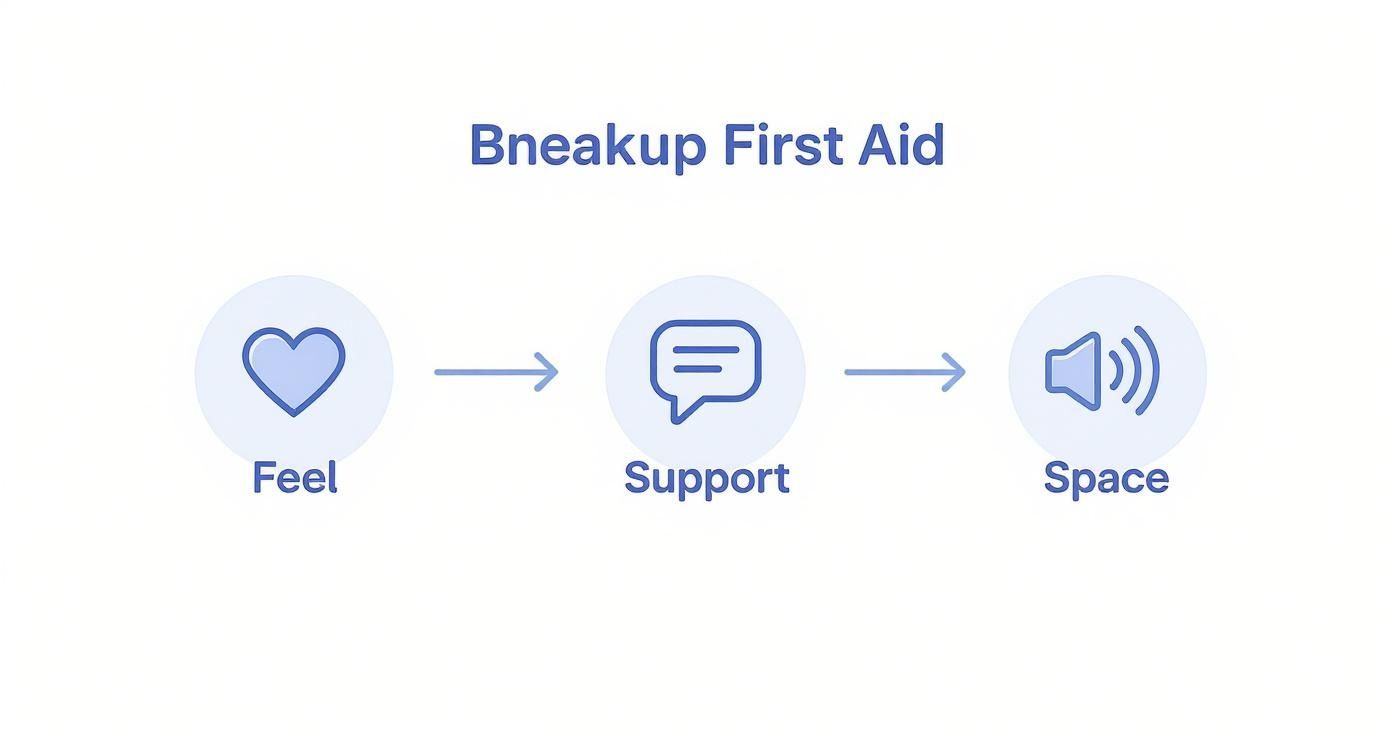
It boils down to three core pillars: giving yourself permission to Feel your emotions, leaning on your Support network, and creating the Space you need to heal. Think of these as your emotional anchors in the storm.
Why Your Timeline Is Your Own
There’s often a silent pressure, both from ourselves and from others, to just 'get over it' and move on. Not only is this unhelpful, it's completely unrealistic. Your personal recovery timeline is shaped by your own unique life experiences, and it’s worth acknowledging them with a bit of compassion.
The Length of the Relationship: A longer partnership usually means your lives, habits, and even your identities have become deeply intertwined. Naturally, it takes more time to gently untangle all of that.
Your Attachment Style: The way you learned to connect with others early in life has a massive impact. If you have what's known as an anxious attachment style, you might find it particularly hard to let go and feel preoccupied with thoughts of your ex.
The Nature of the Ending: Was it a mutual decision, a sudden shock, or a betrayal? The circumstances of the split heavily influence the intensity and duration of the grief you’ll experience.
Understanding these factors can help you stop comparing your journey to anyone else's and start focusing on what you need to heal.
What the Research Actually Says About Healing
When you're in the thick of it, statistics can sometimes offer a strange sort of comfort, a reminder that you're not alone in this, no matter how long it takes. Looking at the data on emotional recovery helps normalise just how varied this experience can be for different people.
| Emotional Recovery Timelines: What the Data Suggests | | :--- | :--- | :--- | | Recovery Milestone | Percentage of People | Average Timeframe | | Starting to feel better | ~75% | 11 weeks | | Feeling "recovered" | ~20% | Within a month | | Process taking longer | ~50% | More than six months | | Letting go (anxious attachment) | Halfway there | 4 years (British study) |
This data powerfully dismantles the myth of a standard grieving period. It shows that a longer, more complex healing journey is not just possible, but quite common. For instance, while about 20% of people feel recovered within a month, another 50% find it takes more than six months. One British study even found that, on average, participants felt only about halfway to fully letting go by the four-year mark, especially those with more anxious attachment styles. You can read more about the research into relationship breakup statistics.
What this all boils down to is a simple, crucial truth: there is no 'correct' amount of time to grieve the loss of a significant relationship.
Grant yourself the grace to heal without a deadline. Your pace is your own.
By acknowledging that grief is fluid and understanding the personal factors shaping your experience, you can start to cultivate the self-compassion you need to get through this. It’s all about honouring your feelings, respecting your unique timeline, and taking gentle, deliberate steps forward—whenever you feel ready.
Building a Practical Self-Care Routine for Healing
When your inner world feels completely chaotic, a simple, grounding routine can be a real lifeline. We've talked about the emotional tidal wave, and this is where we shift to the practical, day-to-day things that can bring back a sense of stability. Self-care isn't about grand, expensive gestures; it's about the small, consistent acts that tell your nervous system it’s safe to calm down.
This is about building a foundation, one small brick at a time, to support your own healing. It creates predictability on days that feel anything but. These small wins are crucial for rebuilding your sense of control and self-worth, especially when both have taken a significant knock.

The Three Pillars of a Healing Routine
Forget complicated plans. Your energy is a finite resource right now, so let's focus on the absolute basics. These three areas tend to provide the biggest return on your emotional investment.
Nourishment: Your appetite might be all over the place, but your body still needs fuel. Don't aim for gourmet meals. Think simple: toast with avocado, a bowl of soup, or a protein smoothie. The goal here is just to give your body the basic nutrients it needs to manage stress.
Rest: Sleep is often the first casualty of heartbreak. Try to create a calming pre-bedtime ritual to signal to your body that it's time to wind down. This could be 15 minutes of reading a book (not your phone), drinking a caffeine-free tea, or listening to a quiet podcast. Consistency is far more important than perfection.
Movement: This isn't about punishing workouts. It's about gentle movement that helps process stress hormones like cortisol and adrenaline. A simple 15-minute walk outside can do wonders for your mood. It breaks the cycle of rumination and reconnects you with the world.
As you start to establish new habits, figuring out how to stay consistent with exercise can really bolster your overall self-care, making movement a reliable part of your recovery toolkit.
Rediscovering Yourself Through Small Activities
A huge part of recovering from a breakup is remembering who you are outside of the relationship. It's so common to feel like you've lost pieces of your identity. 'Rediscovery activities' are just small, intentional steps you can take to reclaim your interests and maybe even explore new ones.
This process is deeply tied to self-kindness. Treating yourself with the same care you'd offer a friend is absolutely essential for rebuilding your self-esteem. You might find it helpful to explore some practical advice on what self-compassion is and how to practise it as you start this journey.
A self-care routine is not another thing to be perfect at. It's a compassionate response to your own suffering, offering structure when everything else feels uncertain.
Think about things you enjoyed before your relationship, or activities you were curious about but never seemed to have the time to try.
Revisit an old hobby: Did you used to paint, play an instrument, or enjoy gardening? Spend just 20 minutes re-engaging with it. No pressure.
Explore your local area: Visit a park, a museum, or a coffee shop you've never been to before. The goal is simply to create new, positive memories in familiar places.
Learn something new: Watch a documentary on a topic that fascinates you or sign up for a one-off online class. Engaging your mind in a new way is a powerful, healthy distraction.
These aren't just things to pass the time; they are deliberate acts of rebuilding your life and your identity. Each small choice you make purely for yourself reinforces the empowering truth that you are whole and complete on your own. It's how you slowly, but surely, begin to heal.
Reconnecting with Yourself and Your Support System
When a relationship ends, it's completely normal to feel like you've lost a piece of yourself. Your daily rhythm, your friends, even the way you see yourself – so much of it was likely wrapped up with your partner. This next part is all about the slow, careful process of rebuilding your own world and strengthening the connections that will see you through.
Figuring out who you are again, on your own terms, is a huge part of learning how to recover from a breakup. It’s also about leaning on friends and family in a way that actually helps, without making you feel like a burden. This is your chance to reclaim your own space, your interests, and your sense of self. One small step at a time.

Leaning on Your Support System Effectively
Your friends and family want to be there for you, but often, they just don't know how. This is where a bit of clear communication can make all the difference, turning their good intentions into the support you actually need. Rather than letting them guess, you can guide them.
I know it’s easy to feel like you’re being a burden, but true friends will see it as a privilege to help. The trick is to be specific about what would make a real difference for you right now.
For the friend who’s a problem-solver: "I really appreciate you trying to find solutions, but honestly, right now I just need you to listen while I talk it all out."
For the friend who keeps checking in: "Your messages mean the world. Could we maybe schedule a quick call on Tuesday? Having something to look forward to really helps."
For when you just need a break from your own head: "I’m having a really rough day. Any chance you're free to just watch a film or go for a walk tonight? I could really use a distraction."
Being direct like this helps them help you. It also avoids that frustrating feeling on both sides when expectations don't match up. It's a kindness to them as much as it is to yourself.
Finding Yourself Again
When you're in a couple, it's so easy for your own hobbies and interests to take a backseat. Now's the time to gently bring them back into focus. This isn't about frantically filling every waking moment with activity, but about consciously choosing things that bring you joy.
Start small. Maybe make a list of things you used to love doing on your own, or things you were always curious about but never got around to trying. You’re not trying to build a new life overnight; you’re just planting a few seeds of your individual self again.
Reconnecting with yourself isn't about finding a 'new you.' It’s about remembering and honouring the person you've always been, independent of a relationship.
Try to do one small thing each week that is just for you. It could be as simple as wandering through a bookshop, trying a new walking trail, or spending an afternoon sketching in a park. Every little action sends a powerful message back to yourself: "I am a whole person on my own."
The Complex Issue of Contact with an Ex
Let's be honest: one of the biggest hurdles to moving on is contact with an ex. It can feel like picking at a scab, keeping the emotional wounds from healing and creating a confusing cycle of hope and hurt that can stall your recovery completely. Setting firm boundaries around communication is one of the most powerful acts of self-care you can do right now.
This gets particularly tricky when you share responsibilities, like children. Interestingly, research sheds some light here. While ongoing contact is a known factor in slowing down emotional detachment, some common beliefs are challenged. For instance, getting into a new relationship doesn't automatically help you get over your ex faster. And while having children with an ex can strengthen the attachment at first, the day-to-day practicalities of co-parenting were actually found to speed up emotional detachment over time. You can discover more insights about these findings if you're curious.
If you absolutely have to stay in touch, keep it purely logistical.
Define the purpose: Only communicate about essentials (e.g., the kids' schedules, shared bills).
Choose the right medium: Stick to something neutral like email or a co-parenting app. This avoids the intimacy and potential for misinterpretation that comes with texts or phone calls.
Be clear and concise: Keep your messages brief, to the point, and free from emotional language or walks down memory lane.
Setting these boundaries isn't about being cold or punishing them. It's about protecting your own emotional energy and giving yourself the clean air you need to properly heal and reconnect with your own life.
Knowing When to Seek Professional Support
Leaning on friends and building a solid self-care routine are massive parts of getting through a breakup. They’re the pillars of healing. But sometimes, those pillars just can't bear the full weight of it all.
It’s crucial to realise that needing extra support isn't a sign of weakness or that you’ve somehow failed. It’s actually a sign of incredible self-awareness and strength. Making that choice to seek professional help is a powerful, proactive step towards getting back on your feet.
But how do you know when you’ve reached that point? Sometimes the pain from a breakup becomes so overwhelming that it starts to properly interfere with your life. This is often when the guidance of a trained professional can provide the structure you need to navigate the storm.
Recognising the Signs You Might Need More Support
It's not always easy to spot when it’s time to reach out. The grief that comes with a breakup can look a lot like depression, making it tough to know what's a 'normal' part of healing and what might be a sign of something more persistent.
Here are a few indicators that professional support could really make a difference:
You feel completely stuck. Weeks, maybe even months, have passed, but that intense pain, anger, or despair hasn't shifted. It feels like you're trapped in a loop with no way forward.
It’s hitting your daily life hard. You're consistently struggling to get out of bed, focus at work, or even manage basic things like eating properly or looking after yourself.
You're leaning on unhealthy coping strategies. This could be anything from drinking a bit too much, using other substances, emotional eating, or just cutting yourself off from everyone.
Your physical health is taking a hit. Are you getting persistent headaches, stomach problems, or a sense of chronic fatigue that you just can't shake?
Your thoughts are becoming overwhelmingly negative. You might be plagued by feelings of worthlessness, hopelessness, or a deep-seated belief that you’ll never be happy again.
If any of that sounds familiar, it could be a signal that the emotional load is just too heavy to carry on your own right now.
How Therapy Can Help You Heal
Therapy offers a confidential, non-judgemental space where you can unpack everything you're feeling without the fear of burdening friends or family. A counsellor brings an outside perspective, helping you see patterns and beliefs that are almost impossible to spot when you're in the thick of it. For a deeper look at what to expect, our guide on what counselling is and how it can help you has some really valuable insights.
One approach that's particularly effective for getting through a breakup is Cognitive Behavioural Therapy (CBT). This type of therapy gets right to the heart of the powerful link between your thoughts, your feelings, and your actions. After a breakup, it’s incredibly common to get stuck in negative thought loops, what we call cognitive distortions.
Seeking therapy is not about admitting defeat. It's about recruiting an expert for your team, someone dedicated to helping you rebuild your life with a stronger foundation.
For example, do any of these thoughts sound familiar?
"I will be alone forever." (Catastrophising)
"It was all my fault." (Personalisation)
"I'll never find someone like them again." (All-or-nothing thinking)
CBT gives you practical, real-world tools to spot these painful thought patterns, challenge whether they're actually true, and start reframing them in a way that's more realistic and kinder to yourself. It doesn’t magically erase the sadness, but it does stop that sadness from spiralling into a much deeper state of despair. By learning to change your thoughts, you can begin to change how you feel and, ultimately, how you move forward with your life.
Common Questions About Breakup Recovery
As you work through a breakup, it’s completely normal for the same worries and questions to pop up, often when you least expect them. You’re not the only one thinking these things. Let’s tackle some of the most common questions that come up when you're trying to get back on your feet after a relationship ends.
How Do I Stop Thinking About My Ex?
This is probably the number one question I hear. The truth is, constantly thinking about an ex is a perfectly normal part of grieving. The real goal isn't to force the thoughts away – that often just makes them shout louder. Instead, we need to change your relationship with them.
When a thought about them pops into your head, just acknowledge it. Don't judge yourself for it. Then, gently guide your focus back to whatever you’re doing right now. It takes practice, but it works.
Cognitive Behavioural Therapy (CBT) has some brilliant techniques for this. It teaches you to catch those painful, automatic thoughts like, "I'll never find anyone else," and actually challenge them. Is that statement 100% true? Of course not. The more you question these thoughts, the less power they have. It also helps to throw yourself into new routines or hobbies that need your full attention. You’re basically creating new pathways in your brain, and bit by bit, your ex will take up less and less space in your head.
Is It a Good Idea to Be Friends with My Ex?
The idea of being friends sounds so mature, doesn't it? But trying to make that leap too soon almost always backfires. It’s often a way to sidestep the painful finality of the split, which just keeps you emotionally hooked and drags out the hurt. You end up in a strange limbo, unable to fully process the end of the romantic relationship.
Honestly, a clean break is usually the kindest thing you can do for yourself. That often means a period of no contact. It’s not about being cruel; it’s about creating the space you absolutely need to grieve properly and start rebuilding your own life, on your own terms.
True healing requires space. Trying to maintain a friendship too early can close that space, preventing you from ever fully moving on.
If you both genuinely want a friendship down the line, that’s something to consider much, much later. We’re talking months, maybe even years, after you’ve both fully healed and moved on.
How Do I Find Myself Again After Losing My Identity?
It’s incredibly common to feel like you’ve lost a piece of yourself, especially after a long-term relationship where your lives were so tangled together. Finding yourself again isn’t some big, mystical quest; it’s an active process that starts with small, deliberate steps.
Grab a pen and make a quick list. What did you enjoy before the relationship? What were you curious about but never got around to trying?
It could be as simple as putting on an old album you love, visiting a museum your ex would have hated, or planning a day trip just for you. The goal is to start making choices based purely on what you want, without filtering them through someone else's preferences. Every tiny decision you make for yourself helps rebuild that sense of who you are and gives you back your independence. It's not about becoming a new person, but about reconnecting with the person you've always been.
How Can Walk and Talk Therapy Help with a Breakup?
Walk-and-talk therapy can be a fantastic tool for getting over a breakup. It blends the benefits of counselling with gentle movement and being outdoors. The physical act of walking can literally help you process stuck emotions like anger and sadness, preventing you from feeling trapped in your grief. We know from countless studies that being in nature lowers stress and boosts your mood.
For a lot of men in particular, walking side-by-side feels less intense than sitting face-to-face in an office. It can make it much easier to open up and talk freely. There’s a powerful metaphor in it, too – you are literally moving forward, one step at a time, which is exactly what the healing process is all about.
At Therapy-with-Ben, I specialise in helping people navigate difficult life transitions, including the profound challenge of recovering from a breakup. If you feel stuck and need support, I offer compassionate, practical guidance through face-to-face, online, and walk-and-talk therapy in Cheltenham. Find out more about how I can help you move forward at https://www.therapy-with-ben.co.uk.


Comments