


How to Recover From Emotional Abuse: A Compassionate Healing Guide
By Therapy-with-Ben
Recovering from emotional abuse isn't a race to a finish line; it’s a journey that starts with one quiet, courageous step: acknowledging what happened. It’s about creating safety for yourself, putting firm boundaries in place to protect your peace, and then, piece by piece, rebuilding who you are with professional support and a whole lot of self-compassion.
Acknowledging the Abuse: Your First Steps to Safety
Often, the hardest part of healing is giving yourself permission to say, "Yes, that really did happen, and it was not okay." Emotional abuse thrives in the shadows, twisting your reality until you're not sure what's real anymore. It’s not just about obvious cruelty; it’s about the devastating impact it has on your inner world.
What you feel is valid. The constant drip of criticism, the gaslighting that makes you question your own mind, the weaponised silent treatment—these aren't small things. They are deliberate tactics that wear away at your sense of self until there's little left.
Realising this isn't about placing blame. It's about seeing the truth. It's the moment you stop believing the narrative that you’re "too sensitive" or "overreacting" and start seeing the damage that was done. This is the first, crucial step that swings open the door to recovery, guiding you from confusion towards clarity and, eventually, healing.
Defining Your Experience
To start healing, it helps to put a name to the subtle, toxic patterns that are so easy to dismiss or downplay. Emotional abuse often looks like:
Constant criticism and belittling: Nothing you do is ever quite good enough. Your successes are minimised, while your flaws are put under a microscope.
Gaslighting: This is a manipulative attempt to make you question your own memory and sanity. You'll hear phrases like, "that never happened," "you're just imagining things," or "you're crazy."
Withholding affection or communication: The silent treatment is a powerful tool used to punish and control you.
Isolation: The abuser might try to cut you off from friends, family, or anyone who could offer a different perspective and support.
Spotting these behaviours for what they are is a game-changer. For a deeper dive, you can learn about the 7 signs of unhealthy relationships to watch for in our detailed post.
Creating Immediate Safety
Once you’ve acknowledged what’s happening, your next priority is safety—both physically and emotionally. This doesn't always mean you have to pack a bag and leave this very second, especially if that's not a safe or viable option for you. It’s about building a protective bubble around yourself, even in small, manageable ways.
Acknowledging that your boundaries were not welcome in an abusive relationship is a vital realisation. It wasn't that you "needed better boundaries"; it's that the environment was designed to violate them. Your response was a normal adaptation to a dysfunctional system.
The journey begins by carving out small pockets of safety. This could be a mental space where you allow yourself to think and feel without judgement, or a physical one, like spending more time with a friend who makes you feel seen and heard. The goal is to start detaching, bit by bit, from the source of the harm.
This simple flow shows the core steps for getting yourself to a safer place: first, you acknowledge the reality of the situation; then, you begin to detach emotionally or physically; and finally, you secure your well-being.
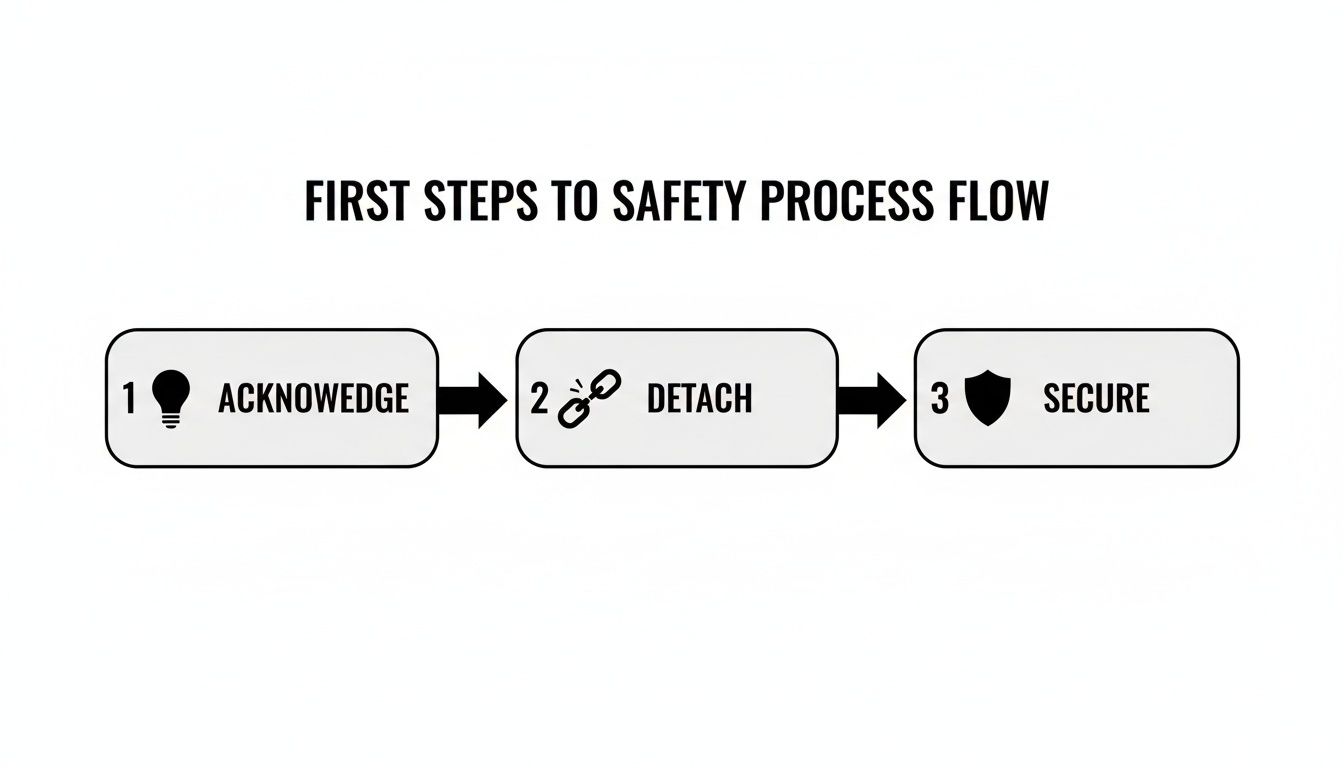
This visual helps to show that healing isn't just one big event. It’s a series of intentional actions, one building on the next, to get your sense of security back on solid ground.
To help you get started, here are some practical first steps you can take.
Immediate Actions for Your Safety and Well-being
Action | Why It Helps | First Step Example |
|---|---|---|
Reach Out to Someone You Trust | Breaks the isolation cycle and provides an external perspective from someone who cares about you. | Send a text to a close friend or family member: "I'm going through a tough time and could really use a chat. Are you free this week?" |
Document Incidents | Creates a factual record, which helps to counteract gaslighting and self-doubt. | Keep a private journal (digital or physical) and note down specific incidents, including dates, what was said, and how it made you feel. |
Establish a Small Boundary | Reclaims a piece of your personal autonomy and demonstrates to yourself that you can have control. | Say, "I'm not available to talk about that right now," and physically move to another room. |
Find a Safe Space | Gives you a physical or mental refuge where you can decompress without fear of criticism or conflict. | Spend an hour at a local park, a library, or a friend's house. Even a locked bathroom for 10 minutes can be a start. |
Contact a Helpline | Provides immediate, confidential, and expert support from people trained to help in these situations. | Call the National Domestic Abuse Helpline on 0808 2000 247. It’s free and available 24/7. |
These actions are not about fixing everything at once. They're about creating enough space to breathe so you can think clearly about your next steps.
The urgency of this can't be overstated. Data from SafeLives reveals that around 80,000 people in the UK are currently at the highest risk of serious harm or murder from domestic abuse, which nearly always has a deep emotional component. With almost 100,000 children also living in these high-risk households, it’s clear why finding a path to safety has to be the first priority.
For immediate, confidential advice and help finding local resources, you can call the 24-hour National Domestic Abuse Helpline for free on 0808 2000 247.
Working Through the Emotional Fallout

Once you’ve managed to create some space from the abuser, the silence that follows can be overwhelming. It’s often in this new-found quiet that the emotions you’ve been holding back finally surface. You might feel a tidal wave of grief, a burning anger at the injustice, or a deep-seated confusion about what was even real.
These feelings aren’t a sign that you’re weak. Far from it. They’re a completely normal and healthy reaction to trauma. For so long, you had to push everything down just to survive. Now, your mind and body are finally beginning to process it all. The first step is to simply allow yourself to feel whatever comes up, without judgement.
Tools for Processing Difficult Emotions
Acknowledging your feelings is one thing, but figuring out what to do with them is where the real work begins. Instead of being swept away by the storm, you can learn to manage these emotions with a few gentle, practical tools.
Two of the most powerful are journaling and mindfulness. They won't make the pain vanish, but they can help you untangle it.
Journaling to Make Sense of the Chaos: When your head is full of conflicting thoughts, getting them down on paper can be a huge relief. It doesn't need to be perfectly written – this is just for you. Use it to ask questions, vent your anger, or create a record of what happened. Seeing your own words on the page can help you separate your truth from the years of gaslighting you endured.
Mindfulness to Stay Grounded: There will be moments when you feel completely overwhelmed. A sudden memory or a wave of anxiety can feel like it's dragging you under. Simple mindfulness exercises, like focusing on your breath for sixty seconds or naming five things you can see in the room, can bring you back to the present moment. It's a way of teaching your nervous system that the threat is no longer here.
This aftermath can also bring on feelings of depression. Some people find that exploring different therapeutic avenues can be helpful; for instance, understanding how hypnosis can provide relief for those struggling with depression might offer another perspective.
Setting and Holding Firm Boundaries
One of the most empowering parts of recovery is reclaiming your right to say “no.” Emotional abuse works by slowly dismantling your boundaries until you forget you’re even allowed to have them. Rebuilding them is an act of profound self-respect.
This is especially important if you still need to have some contact, perhaps because you share children or have other ties. Remember, boundaries aren’t about punishing the other person; they’re about protecting your own peace of mind.
It's easy to fall into the trap of thinking you "should have had better boundaries." In an abusive dynamic, the entire environment is designed to violate them, no matter how clearly you state them. Your response wasn't a failure; it was a normal adaptation to a dysfunctional situation.
Holding firm is the hardest part. Abusers are masters of testing boundaries with guilt-trips, manipulation, or playing the victim. If you can anticipate these tactics, you’ll be much better prepared to stand your ground.
The UK's legal recognition of coercive control as a crime since 2015 is a powerful validation for survivors. In the year ending March 2023, there were 811 defendant proceedings and 566 convictions for this specific form of abuse in England and Wales. This legal backing reinforces that what you went through was real and can help you get protective orders that legally enforce the boundaries you need to feel safe.
Real-World Scripts for Setting Boundaries
Having a few phrases ready to go can make a huge difference when you’re feeling intimidated. Keep them clear, concise, and non-negotiable.
Here are a few examples you can make your own:
For a Former Partner (when communication is essential): * "From now on, we can discuss the children's schedules by email only. I won't be responding to texts about other things." * "This conversation isn't productive. I'm going to hang up now." * "I've made my decision on that, and it's not up for discussion."
For Family or Friends Who Don't Understand: * "I appreciate you're trying to help, but I'm not looking for advice right now. I just need you to listen." * "I’m not comfortable talking about my past relationship. Could we please talk about something else?" * "That comment isn't helpful for my healing. Please don't say things like that again."
You don’t owe anyone a long explanation. A boundary is simply a statement of what you will or will not accept. How they react is their responsibility, not yours. Every time you hold that line, you send a powerful message to yourself: "I matter, and my well-being comes first."
Rebuilding Your Sense of Self and Self-Worth
Emotional abuse works by slowly, painstakingly chipping away at your identity. It's a relentless process of criticism, gaslighting, and blame that erodes your confidence until you start to doubt your own reality. Eventually, you begin to see yourself only through the abuser’s twisted perspective, and the person looking back from the mirror feels like a stranger.
Recovering from this isn't about flipping a switch and instantly becoming the person you were before. It's a much kinder, more intentional process of rediscovering and rebuilding the relationship you have with yourself. It means learning to tune out that harsh, internalised critic and replace it with a voice of compassion.
Think of this stage as your chance to reconnect with who you truly are, separate from the damaging story you were led to believe. It's about taking back your right to have a voice, to hold an opinion, and to trust your own judgement again.
Quieting the Inner Critic
After living through emotional abuse, it's incredibly common to find that the abuser's voice has moved in and taken up residence inside your own head. This "inner critic" can sound startlingly like them, replaying the same cutting phrases and criticisms on a loop. You might find yourself second-guessing every move, wrestling with a constant sense of guilt, or feeling like you’re just never good enough.
The very first step in rebuilding your self-worth is to see this voice for what it is: an echo of the abuse, not your own true voice. It's a pattern you learned, a defence mechanism you developed to try and predict their behaviour to keep yourself safe.
A really effective exercise is to simply start noticing when this voice shows up and what it’s saying. You could try this:
Acknowledge the Thought: When a critical thought like, "I can't do anything right," pops into your head, just notice it. Don't judge it or fight it.
Externalise It: Gently remind yourself, "That isn't me; that's the echo of the abuse." This simple act creates a crucial bit of distance, separating the thought from your core identity.
Offer a Compassionate Counter-Statement: Respond to the criticism with the same kindness you’d offer a dear friend. For instance, "I'm still learning, and it's okay to make mistakes. I am trying my best."
This isn't about getting into a battle with the critic; it's about gently stripping it of its power. Over time, you create more and more space for your own, kinder voice to get stronger.
Reconnecting with Your Values and Passions
Emotional abuse often forces you to make your world smaller. Hobbies, friendships, and interests that once brought you joy might have been ridiculed, controlled, or simply squeezed out of your life. Reclaiming these is a huge part of rebuilding your sense of self.
Take a moment to think back to what you loved before the relationship. What made you feel curious, engaged, or just alive? It could be something small, like listening to a certain kind of music, or something bigger, like a creative project you had to put on the shelf.
Your identity was never actually lost; it was just pushed down. Reconnecting with your passions is like meeting up with old friends who have been patiently waiting for your return. Every small act of self-expression helps rebuild a piece of who you are.
Start with small things that feel manageable. The aim isn't to become an expert painter or musician overnight, but simply to feel a sense of joy and engagement that is entirely on your own terms.
Create a "Joy List": Jot down anything and everything that used to make you happy, no matter how trivial it seems now. It could be visiting a museum, baking a cake, or just going for a walk in the woods.
Try Something New: Sometimes, a fresh start can feel less intimidating. Maybe take a beginner's class in something you've always been curious about, like pottery, learning a language, or even dancing.
Schedule "You" Time: Block out small pockets of time in your diary that are non-negotiable and dedicated just to you. Protect this time as fiercely as you would any other important appointment.
Every time you do something just for you, you're sending a powerful message to yourself: my interests are valid, my joy matters, and I am in control of my own life.
Celebrating Small Wins to Rebuild Trust
One of the most insidious effects of emotional abuse is the way it obliterates your trust in your own judgement. When you've been told relentlessly that you’re wrong, oversensitive, or incompetent, you can't help but start to believe it. Building that trust back up is a gradual process, one built on finding small, consistent pieces of evidence that prove you are capable.
Instead of aiming for huge, overwhelming goals, focus on celebrating the tiny victories. Did you manage to set a boundary and hold it? Celebrate that. Did you make a small decision for yourself without asking for permission or approval? That’s absolutely a win.
This practice starts to rewire your brain to look for proof of your competence, rather than defaulting to finding your flaws. It's a vital part of the healing journey, as knowing how to improve self-esteem with proven strategies to boost confidence provides a solid framework for these actions. By acknowledging these small successes, you begin to restore faith in your own abilities and intuition, creating a foundation of self-worth that no one can take from you again.
Thinking About Therapy and Professional Support in the UK?

By Therapy-with-Ben
Making the decision to look for professional support is, without a doubt, one of the bravest things you can do for yourself. It’s not about admitting defeat; it’s about declaring that you’re ready to invest in your own wellbeing and carve out a new path forward. You’re essentially finding a skilled, compassionate guide to walk alongside you as you work through the after-effects of what you’ve been through.
Therapy gives you a confidential, non-judgemental space where you can finally start to unpack everything. A good therapist is trained to help you spot patterns, process difficult experiences safely, and build a practical toolkit for putting your life back together. It’s different from talking to friends or family.
Thankfully, here in the UK, we have lots of different options available, so you can find an approach that genuinely feels right for you.
Getting to Grips with Different Types of Therapy
The therapy world can feel a bit overwhelming at first glance, but really, each approach just offers a different way of looking at your recovery. The main goal is to find a method that clicks with you and what you want to get out of the process.
Here are a few common types of therapy you'll likely come across:
Cognitive Behavioural Therapy (CBT): This is a structured, goal-focused therapy. It’s fantastic for helping you identify and challenge the negative thought patterns and beliefs that the abuse may have hammered into you. For instance, if there's a constant inner critic telling you "you're worthless," CBT gives you practical tools to question that voice, find real evidence against it, and start replacing it with a kinder, more balanced perspective.
Person-Centred Counselling: This is a much less structured approach where you are firmly in the driver's seat. The therapist's job is to create a warm, empathetic, and supportive space for you to explore your feelings at your own pace. It’s particularly powerful if you've been silenced or made to feel small, as it gives you a space to just be heard and validated, with no pressure.
Trauma-Informed Therapy: This isn't one single technique but more of a philosophy. A trauma-informed therapist understands exactly how emotional abuse affects the brain and nervous system. They’ll make it their priority to create a feeling of safety, control, and empowerment in every single session.
Finding a Format That Suits You
These days, therapy isn't just about sitting in a formal, clinical-looking room. How you get support can be tailored to your lifestyle, comfort level, and what you need right now.
Some of the most popular formats in the UK include:
Face-to-Face Sessions: The classic setup, offering that direct, in-person connection in a dedicated, private space.
Online Therapy: This offers huge flexibility and means you can have sessions from home. It's a game-changer if you have mobility issues, live remotely, or just feel safer and more comfortable in your own environment.
Walk-and-Talk Therapy: A brilliant approach that mixes counselling with the grounding, gentle exercise of being outdoors. For some, walking side-by-side can feel less intense than direct eye contact, making it easier to open up.
Finding the right therapist is a bit like dating—it’s all about the fit. Don't be discouraged if the first person you speak to isn’t the one. Your comfort and sense of safety are paramount, so take your time to find someone you truly connect with.
How to Find the Right Therapist
Knowing where to even begin can feel like a massive task, but there are clear routes to finding qualified professionals in the UK. The most important thing is to look for therapists registered with a reputable professional body, as this ensures they stick to strict ethical codes and have the right training. For a really detailed look at this, our article on how to get therapy in the UK with our practical guide is a great place to start.
When you have an initial consultation, don't be shy about asking questions. Ask about their experience working with survivors of emotional abuse, what their approach is like, and what you can expect. This is your chance to get a feel for them and see if you click.
The need for this kind of support is massive. Data from Women’s Aid (2022-2023) showed that between 41.5% and 50.6% of survivors using their services needed mental health support. Further research reinforces just how vital a safe environment is for recovery, with welcoming emotional support in refuges being key to mental wellbeing. You can explore more on the experiences of women who have survived domestic abuse to see just how important these supportive settings are.
Learning to Manage Triggers and Reconnect with Others
By Therapy-with-Ben
Healing from emotional abuse is almost never a straight line. Just when you feel like you’re finally moving forward, something totally unexpected can pull you right back – a sound, a smell, even just a phrase someone uses.
These are triggers. They're basically emotional or sensory landmines left over from the trauma, and when you step on one, it sets off your body's fight-or-flight response, even when there's no real danger.
Getting to grips with your triggers is a massive part of recovery. It’s not a sign you’re failing or going backwards; it's just an echo of everything you've survived. The aim isn't to get rid of them completely (that's often impossible), but to learn how to handle them so they don't run your life anymore. This is about building that resilience and, just as crucially, starting to gently reopen the door to healthy connections with other people.
Identifying Your Personal Triggers
First things first, you need to figure out what your triggers actually are. This isn't about becoming a detective and digging intensely into your past; it's more about gentle self-observation. Your triggers are completely unique to you and can sometimes be surprisingly specific.
They often fall into a few common buckets:
Sensory Cues: It could be a particular tone of voice, a certain aftershave, or even seeing the same model of car that the abuser used to drive.
Situational Reminders: Things like anniversaries, specific places, or finding yourself in a situation that feels uncomfortably similar to the power imbalance you experienced.
Emotional States: Feelings of being trapped, ignored, criticised, or helpless can be powerful internal triggers that dredge up old memories and feelings.
Try to gently notice when your mood suddenly shifts or you feel a spike of anxiety. Ask yourself, "What was happening just before I felt this?" It’s not about blame; it's just about gathering information. This knowledge is your power.
Grounding Techniques for In-the-Moment Relief
When a trigger hits, it can feel like you’re being physically pulled back in time. Grounding techniques are simple but incredibly powerful tools that yank your awareness back to the safety of the here and now. They work by reconnecting you to your physical body and what's happening around you at this very moment.
Here are a few you can try absolutely anywhere:
The 5-4-3-2-1 Method: Wherever you are, look around and silently name 5 things you can see. Then, notice 4 things you can physically feel (your feet in your shoes, the fabric of your jumper). Listen for 3 things you can hear, identify 2 things you can smell, and finally, focus on 1 thing you can taste.
Temperature Shock: Grab a cold can from the fridge, splash some cool water on your face, or even just hold an ice cube in your hand. That sharp change in temperature can be enough to jolt your nervous system back to the present.
Mindful Breathing: It sounds simple, but it works. Place a hand on your stomach and just focus on that physical sensation of your breath going in and out. It anchors you to your body.
Healing isn’t about never feeling the storm; it's about learning to be the anchor in the midst of it. These techniques are your anchor, holding you steady until the waves pass.
Rebuilding Your Support Network
After what you’ve been through, trusting people can feel impossible. Your experience has taught you that getting close to someone can be dangerous. And yet, real healing almost always happens within the safety of healthy relationships.
The trick is to go slowly, at a pace that feels right for you. Start with people who have already proven they're on your side.
This is about quality, not quantity. Reconnecting might just mean having a quiet cup of tea with one trusted friend or family member. It’s about practising being a little bit vulnerable in small, safe doses and remembering what a supportive chat actually feels like.
When you do feel ready to let new people in, keep an eye out for "green flags"—the signs of a healthy connection:
They listen more than they talk.
They respect your boundaries and accept a "no" without a fuss.
They're genuinely happy for your wins, not jealous.
You leave their company feeling lighter, not drained.
Reconnecting is a slow burn. It's a gradual process of relearning what it feels like to be safe with another person. Be patient and kind to yourself. Every small step you take towards a supportive friendship is a massive victory.
Your Questions on Healing from Emotional Abuse Answered

By Therapy-with-Ben
The journey of healing from emotional abuse is a deeply personal one. As you start to find your footing again, it's only natural for questions to bubble up. Below, I’ve answered some of the most common queries I hear, hoping to offer a bit of clarity and reassurance as you move forward.
How Long Does Recovery Take?
This is probably the question I get asked most often, and the honest answer is there's no set timeline. Healing isn’t a race with a finish line; it’s more of a gradual unfolding.
Some days will feel like you’ve taken a huge leap forward. Others might feel like a frustrating step back. That’s all part of the process. How long your recovery takes really depends on so many things—the duration and severity of the abuse, the support you have around you, and your own unique pace. The goal isn't to erase what happened, but to integrate the experience so it no longer has a hold on your present.
Recovery isn't about getting back to the person you were before the abuse. It's about meeting, and becoming, the person you are now—stronger, wiser, and more compassionate with yourself than ever before.
Is It Normal to Still Miss Them?
Yes, absolutely. It's completely normal and often incredibly confusing. This feeling is a hallmark of what's known as a trauma bond, where moments of affection were mixed with cruelty, creating a powerful, messy psychological tie.
You're not missing the abuse itself. You're more likely grieving the person you thought they were, the good times you might have shared, or the future you had hoped for. Acknowledging these complicated feelings without judging yourself is a crucial part of untangling that bond and truly healing. It certainly doesn't mean you were wrong to leave.
Can I Ever Trust Anyone Again?
After your trust has been so completely shattered, the thought of letting someone new in can feel terrifying. That fear is a protective mechanism, and it's important to listen to it. But it doesn't have to be a life sentence.
Learning to trust other people again actually starts with learning to trust yourself. As you rebuild your self-worth and grow more confident in your own judgement and ability to hold boundaries, you’ll get much better at spotting the "green flags" in others.
Try starting with small, safe steps:
Trust your gut: If a person or situation just feels 'off', give yourself permission to step back. No explanation needed.
Watch actions, not just words: Look for consistency. Does what they say match what they do?
Start with low-stakes relationships: Practise being open with a trusted friend or your therapist before even thinking about a new romantic partner.
Healing is a process of reclaiming your life, your joy, and your sense of self. Every single step, no matter how small it feels, is a victory.
Navigating the path to recover from emotional abuse can feel overwhelming, but you don’t have to do it on your own. At Therapy with Ben, we offer compassionate, professional support tailored to your unique journey, including walk-and-talk therapy in Cheltenham. If you feel ready to take the next step, visit us online to learn more and book a session.


Comments