


How to Stop Worrying About the Future Now
If you want to stop worrying about the future, the secret isn't to ignore it. The real key is to pull your focus away from the vast, uncontrollable 'what ifs' and back to the small, actionable steps you can take right now.
It’s about pinpointing the root of your fears, challenging those nagging thoughts that keep you up at night, and firmly planting your feet in the present moment. When you concentrate on what’s actually within your control today, you start to reclaim a sense of calm and agency.
Confronting Your Future Anxiety Head-On
You know the feeling. That tight knot in your stomach when your mind drifts to what’s coming next. The constant, low-level hum of "what if?" is utterly exhausting, and it robs you of any chance to enjoy the here and now.
The first, and honestly most important, step is to simply acknowledge that worry without judging yourself for it. A bit of planning for the future is healthy, of course. But constant, looping worry? That’s just draining, and it gets you absolutely nowhere.
This guide is built on a simple, therapist-approved principle you can start using immediately: you can stop worrying about the future by focusing on what you can control today. This isn't about sticking your head in the sand and ignoring potential problems. It's about consciously choosing to invest your precious mental energy where it can actually make a difference.
A Practical Roadmap to Regain Control
Instead of getting lost in a dizzying spiral of uncertainty, we’re going to walk through some practical, grounded strategies. The journey involves figuring out where your anxiety is really coming from, learning how to actively reframe your thoughts, and reconnecting with the world right in front of you.
We'll explore how to:
Get to the Root of Your Fears: Pinpoint what’s actually triggering your anxiety. Is it your career, money worries, or concerns about a relationship? Let's name it.
Challenge Unhelpful Thoughts: I’ll introduce you to some cognitive tools that help you question and dismantle the catastrophic stories your mind loves to spin about what might happen.
Ground Yourself in the Present: We’ll look at simple mindfulness and sensory techniques that pull your attention back to the here and now, which has an immediate calming effect on your nervous system.
Take Small, Purposeful Actions: You’ll discover how even minor, proactive steps can replace that awful feeling of helplessness with a genuine sense of control.
This kind of structured approach gives you a clear roadmap to find your calm again. For so many people I work with, worry leads directly to avoidance, a pattern that only makes the anxiety stronger over time. Getting your head around this is vital, and you can learn more about how to break the anxiety and avoidance cycle in a detailed article I wrote on the topic.
Worrying does not take away tomorrow's troubles; it takes away today's peace. Acknowledging this is the first step toward reclaiming your present moment from the grip of future anxiety.
As you start to confront your anxiety, it can also be incredibly empowering to understand its physical side. For instance, you might be interested in the intricate heart-mind link and how anxiety can cause arrhythmia to better grasp just how deeply your mental state affects your body.
By equipping yourself with these practical tools, you're not just learning how to stop worrying. You’re building a more resilient, present-focused way of living, one day at a time.
Your Toolkit for Overcoming Future Worry
To help you get started, here's a quick-reference table summarising the key approaches we'll be diving into. Think of this as your personal toolkit for navigating uncertainty and finding your footing in the present.
Strategy | Core Principle | Primary Benefit |
|---|---|---|
Cognitive Reframing | Thoughts are not facts. | Reduces the power of negative "what-if" scenarios. |
Mindfulness Practice | Anchor in the present moment. | Calms the nervous system and lessens anxiety. |
Action-Oriented Steps | Focus on what you can control. | Builds a sense of agency and reduces helplessness. |
Walk and Talk Therapy | Combine movement with talk. | Processes difficult emotions and gains new perspectives. |
Each of these strategies offers a different way in, but they all share a common goal: to help you move from a state of anxious paralysis to one of empowered, present-moment awareness.
Author: Therapy-with-Ben
Understanding Where Your Future Worries Come From
Before you can learn how to stop worrying about the future, it helps to know why your mind insists on going there. It's not a personal failing; it's usually your brain trying to protect you, but getting its wires crossed and going into overdrive.
At its core, anxiety about the future is born from a deep-seated need to control things that are, by their very nature, uncontrollable. Your brain is hardwired with what’s known as a negativity bias – a sort of primal threat-detection system. This means it’s far more likely to snag on what could go wrong than what might go right. It's an evolutionary hangover that kept our ancestors safe from predators, but in our modern world, it can easily run riot.
This bias takes vague fears about your career, your finances, or your relationships and blows them up, making them feel enormous and incredibly urgent. It’s the engine that powers unhelpful mental habits like catastrophising.
The Habit of Catastrophising
Catastrophising is simply the technical term for jumping to the absolute worst-case scenario. It’s a mental spiral where your brain takes one small, uncertain future event and spins it into a full-blown disaster movie, with you in the starring role.
It usually looks something like this:
The Trigger: You have an important presentation at work next week.
The Catastrophic Thought: "I'm going to mess up my words, everyone will see I'm incompetent, my boss will be furious, and I'll definitely lose my job."
See how quickly that escalated? That isn't a rational prediction. It's a story of complete failure built on a tiny foundation of uncertainty. The problem is, your body doesn't know the difference. It reacts to this imagined catastrophe with a very real stress response – that familiar knot in your stomach, the racing heart, the sleepless nights. Just recognising this pattern is the first real step toward taking back control.
Worrying is like trying to solve an algebra equation by chewing bubble gum. It feels like you're doing something, but you're not actually making any progress. The real work begins when you spot the unhelpful loops your mind is stuck in.
This simple decision tree can help you visualise a more constructive path next time you find yourself spiralling.
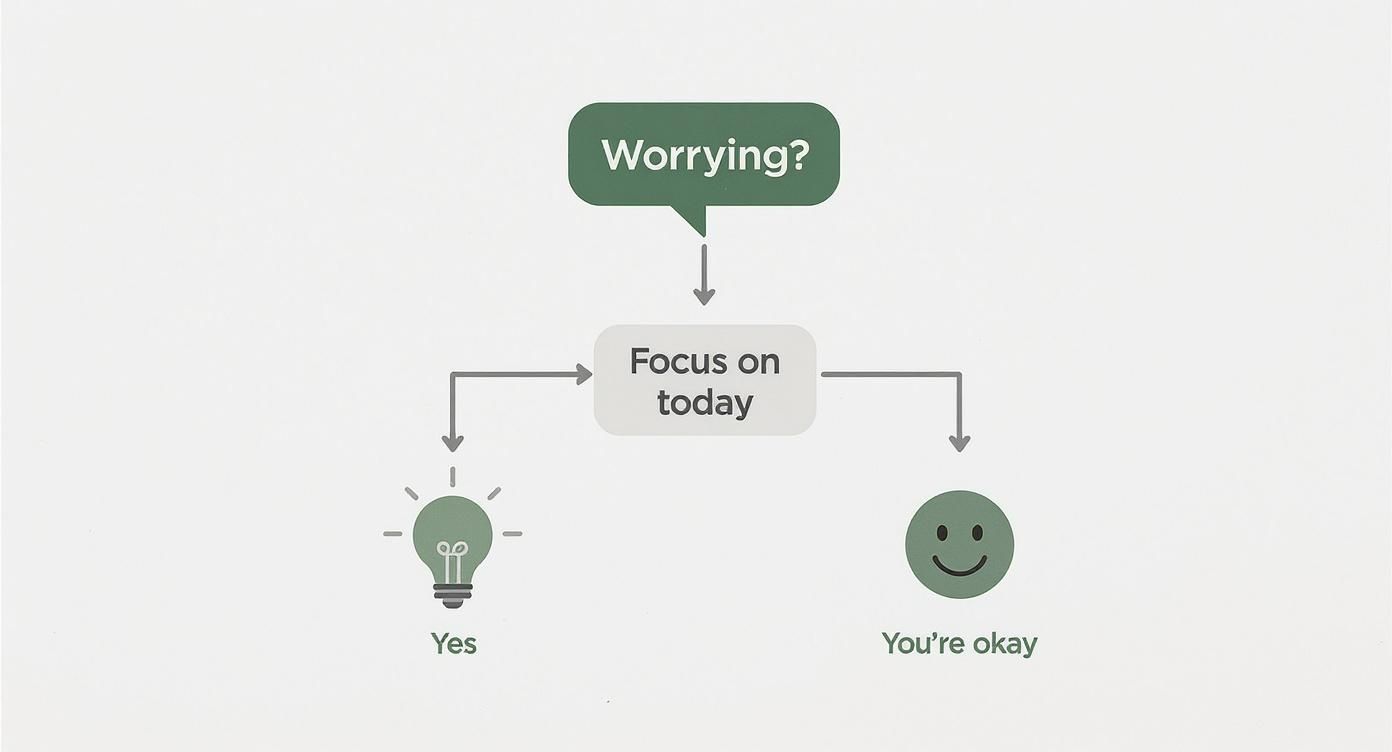
The key takeaway here is that the only truly effective response to worry is to pull your focus back to the present moment, where you have actual influence.
Introducing The Worry Tree
To put this into practice, we can use a simple but incredibly effective tool from cognitive behavioural therapy (CBT) known as 'The Worry Tree'. It’s a structured way to sort through your anxieties and decide what, if anything, needs to be done.
The exercise guides you through a series of questions to figure out if your worry is about a hypothetical situation (a 'what if' you can't control) or a current, solvable problem.
Let’s walk through a real-world example. Imagine your worry is: "What if I can't afford my rent in six months' time?"
Name the worry: "I'm worried about being able to pay my rent."
Can I do something about it now? Yes. While the outcome is in the future, there are concrete actions I can take today.
Brainstorm solutions: I could review my budget, look for ways to cut back, explore options for increasing my income, or dust off my CV.
Take one small action: Pick one thing and do it. For example, spend 30 minutes tonight creating a simple spreadsheet of your monthly outgoings. Action calms anxiety.
Now, let's try a different kind of worry: "What if my children aren't happy when they grow up?"
Name the worry: "I'm worried about my children's future happiness."
Can I do something about it now? No. This is a hypothetical worry about a distant future that you cannot directly control.
Let it go and refocus: The Worry Tree advises you to acknowledge the thought, then gently let it go and bring your attention back to the present moment. You can focus on being a supportive and loving parent today, which is the only thing you actually have power over.
This technique won't magically erase your worries, but it brings immense clarity. It separates the productive from the pointless, allowing you to invest your energy where it matters and, crucially, giving you permission to let go of the rest.
Using Cognitive Tools to Reframe Anxious Thoughts
Knowing where your anxiety comes from is a huge first step, but the real work begins when you start to actively change your thought patterns. This is where we can bring in some incredibly effective, evidence-based tools from cognitive behavioural therapy (CBT) to help you challenge and remould the anxious thoughts that keep you feeling stuck.
Worrying about the future often means we accept our worst fears as stone-cold facts. A thought like, "I'm going to completely mess up that job interview," can feel absolutely true in the moment. Cognitive tools give you the power to step back, examine that thought like a detective, and question whether it’s really as credible as it feels.
This isn’t about forcing a smile or pretending your worries don’t exist. It's about developing a more balanced, realistic perspective on your fears, which in turn reduces their emotional hold on you. It's a skill that, with a bit of practice, can fundamentally change your relationship with anxiety.
Challenge Your Thoughts Directly
The heart of this whole approach is thought challenging. Instead of automatically accepting an anxious prediction, you learn to question it. This simple act creates a bit of breathing room between you and the thought, letting you see it more clearly.
Let’s take that classic worry: "I'll fail the interview and never get a good job."
Rather than letting that thought spiral out of control, just pause. Ask yourself some questions. This is a crucial practice for breaking the kind of thought loops that feel impossible to escape. If you find your mind constantly churning, you might also find some practical advice in our guide on how to stop overthinking everything, which has some great complementary techniques.
Here are a few questions to get you started:
What's the actual evidence for this thought? Have I truly failed every single interview I've ever had? What skills and experiences do I actually have that could lead to a good outcome?
And what's the evidence against it? Can I think of times I've performed well under pressure? Did I prepare for this interview?
Am I catastrophising? Is it really true that failing this one interview means I'll never get a good job? Or is that just a massive exaggeration?
What would I say to a friend with this exact worry? We're often far more compassionate and realistic when advising others than we are with ourselves.
By engaging with your thoughts this way, you start to dismantle their authority. You begin to realise they're just mental events, not prophecies.
Schedule Your Worry Time
I know this one sounds a bit strange, but one of the most effective ways to manage constant worry is to give it a scheduled appointment. The idea is to contain your anxiety so it doesn't spill out and ruin your entire day.
Here’s how to do it:
Designate a "Worry Period": Set aside a specific 15-20 minute slot in your day. Try to make it the same time and place, but don't schedule it right before bed.
Postpone Your Worries: When an anxious thought about the future pops into your head, acknowledge it and then make a conscious decision to "postpone" it until your scheduled time. You can even jot it down.
Engage Fully During Your Slot: When your worry time arrives, sit down and give those anxieties your full, undivided attention. Really think about everything on your list.
Stop When Time's Up: Once your 15-20 minutes are over, you must stop. Get up, do something else, and if a worry comes back, remind yourself that you'll deal with it in tomorrow's session.
This technique essentially trains your brain that there's a time and a place for worry, but it’s not all day, every day. You’ll often find that many of the worries you "saved" for later don't seem nearly as urgent or important when you finally get around to them.
Explore the Best, Worst, and Most Likely Scenarios
Our anxious minds are masters at jumping straight to the worst-case scenario. In fact, they often completely forget to consider any other possibilities. This simple exercise forces a more balanced perspective by making you explore the full spectrum of outcomes.
Let’s say you're worried about a difficult conversation you need to have with your partner.
The Worst Case: "They'll get furious, we'll have a massive fight, and it will destroy our relationship." (This is where the anxious mind loves to hang out).
The Best Case: "They'll completely understand, agree with me on every point, and the issue will be instantly resolved with zero conflict." (This is often just as unlikely as the worst case).
The Most Likely Case: "It will probably be a bit uncomfortable to start. We might not see eye-to-eye on everything, but we'll talk it through. We probably won't solve it all at once, but it’ll be a good start, and we'll both feel better for having talked."
Nine times out of ten, that final scenario is the most realistic one. By deliberately thinking it through, you anchor yourself in reality instead of getting lost in catastrophic or fantasy extremes. It helps you prepare for a plausible outcome rather than panicking about an improbable disaster.
Embracing the Present with Mindfulness and Grounding

Worry has a nasty habit of pulling us into the future, completely yanking our attention away from the only moment we ever truly have: right now. The best way to break this cycle isn't to wrestle your anxious thoughts into submission, but to gently guide your awareness back to the present. This is where mindfulness and grounding come in.
A lot of people think mindfulness means emptying your mind or stopping thoughts altogether, which is a recipe for frustration. It's not about that at all. It's simply the practice of anchoring yourself in the here and now, noticing your thoughts and feelings without getting swept away by them.
These aren't just fluffy relaxation tricks. They're practical skills that have a direct, calming effect on your central nervous system, helping to ease the very real physical symptoms of anxiety. It’s about giving your mind a much-needed and compassionate break from the exhausting job of trying to control an unknowable future. You can dive deeper into what mindfulness in therapy is and how it works in our detailed guide.
The Power of Your Senses: The 5-4-3-2-1 Technique
When your mind is spinning with "what ifs," one of the quickest ways to pull it back to reality is to connect with your senses. The 5-4-3-2-1 grounding technique is brilliantly simple and effective. Best of all, you can do it anywhere, anytime, without anyone even knowing.
Next time you feel that wave of worry building, just pause for a moment and gently notice:
5 things you can see: Look around you and mentally name five objects. Don't just list them; notice their colour, shape, or texture. The pen on your desk, a crack in the pavement, a leaf on a tree.
4 things you can feel: Bring your attention to the physical sensations you're experiencing right now. The feeling of your feet flat on the floor, the texture of your shirt against your skin, the breeze on your face.
3 things you can hear: Listen closely and pick out three distinct sounds. It might be the distant hum of traffic, a bird chirping, or the quiet whir of your computer fan.
2 things you can smell: What scents are in the air? Maybe it's the faint aroma of coffee from the kitchen, the fresh smell after rain, or the soap on your hands.
1 thing you can taste: Focus on one thing you can taste. This might be the lingering flavour of your lunch, or you could simply notice the sensation of your tongue in your mouth.
This exercise works because it yanks your brain out of its abstract worry loop and forces it to engage with the concrete, immediate reality of your surroundings.
Weaving Mindfulness into Your Day
You don't need to find an hour to sit on a meditation cushion to get the benefits of mindfulness. The real power comes from weaving small moments of present-moment awareness into the things you're already doing every day.
Take your morning coffee or tea, for instance. Instead of scrolling through your phone while you drink it on autopilot, turn it into a two-minute mindful practice. Feel the warmth of the mug in your hands. Watch the steam rise. Inhale the aroma before you even take a sip, and then really taste it.
This isn't about adding another task to your to-do list; it’s about changing the quality of your attention during existing activities. By doing this, you create small pockets of calm that interrupt the momentum of your anxiety throughout the day.
This stuff really works. Recent UK-based studies show a staggering 9 in 10 adults experienced high or extreme stress in the past year. But the crucial part? Those who regularly practised mindfulness were 40% more likely to report feeling in control.
There are so many simple, immediate techniques to calm anxiety naturally just by bringing your focus back to the present. The key is to find what works for you and make it a habit. Each time you ground yourself, you're strengthening the mental muscle that allows you to choose where you place your attention.
Build Your Resilience: The Power of Connection and Action

Worry absolutely thrives in isolation. When we keep anxieties locked away, they have this nasty habit of growing larger and more intimidating, making the future seem far more daunting than it truly is.
One of the best ways to shrink those fears back down to size is by building up your own resilience, and that starts with two things: connection and action.
Sharing what’s on your mind can feel incredibly vulnerable, but it’s a vital step. Voicing your fears to a trusted friend, partner, or family member does more than just get it off your chest; it gives you an instant dose of perspective.
Just saying a worry out loud can often rob it of its power. Hearing a supportive voice on the other end is a powerful reminder that you aren't navigating these challenges all by yourself.
How to Kickstart a Difficult Conversation
Opening up doesn't have to be some grand, dramatic event. It can be as simple as finding a quiet moment and using a "soft start-up."
You could try saying something like:
"I've had something on my mind about the future, and I was hoping I could just talk it through with you."
"I've been feeling a bit anxious about [work/finances/etc.] lately. Would you be open to just listening for a few minutes?"
This kind of approach gives the other person a bit of context and, crucially, asks for their permission. It creates a much safer, more supportive space for the conversation to unfold. It’s not about finding someone to solve your problems for you, but simply someone to share the emotional load with.
Building these social support networks is a proven strategy. In the UK, strong social connections are clearly linked to lower anxiety rates. While recent data shows that 37.1% of women and 29.9% of men reported high levels of anxiety, further research has found a powerful protective factor.
In fact, young people with strong family and peer support were found to be 30% less likely to experience severe anxiety symptoms. It’s a compelling case for reaching out. If you’re interested, you can read the full UCL research about the impact of social ties on mental health to understand more.
Replace Helplessness with Agency
Beyond talking, taking small, deliberate actions toward your goals is a fantastic antidote to the paralysis that worry can cause. Anxiety often leaves you feeling helpless, as if the future is just something that happens to you.
Taking action—no matter how small—flips that script. It shifts you from being a passive victim to an active participant in your own life. This proactive approach directly fights back against those feelings of helplessness by focusing your energy on what you can actually influence right now.
Action is the antidote to despair. When we feel stuck in a loop of future-focused worry, even the smallest step forward can break the cycle and restore a sense of agency.
What small, actionable step could you take today?
Worried about your career? Spend 20 minutes updating just one section of your CV or browsing for a professional development course online.
Anxious about your finances? Dedicate half an hour to creating a simple budget spreadsheet or researching a savings plan.
Concerned about your health? Go for a 15-minute walk or finally schedule that doctor's appointment you've been putting off.
The goal isn't to solve the entire problem in one go. Not at all. The real aim is to prove to yourself that you are not powerless. Each small action serves as a piece of evidence that you can influence your own future, which systematically dismantles the foundations of your worry.
Knowing When to Seek Professional Support
All the self-help strategies we’ve talked about are fantastic tools to have in your corner. But it's just as important to recognise when your own toolkit isn't quite cutting it.
Deciding to seek professional support isn't a sign of failure. Far from it. It's a proactive and genuinely courageous step towards feeling better for the long haul. It’s simply acknowledging that some challenges are too heavy to carry alone.
Sometimes, worry about the future isn't just a fleeting feeling—it becomes a constant, overwhelming presence. This is when it might be crossing the line from everyday anxiety into something more significant, like Generalised Anxiety Disorder (GAD). Knowing the signs can help you understand when it’s time to reach out.
Key Indicators It's Time for Help
If you're on the fence about whether your level of worry needs a professional eye, it can help to look for a few key indicators. Often, it's not the worry itself, but the impact it’s having on your life that signals a need for a different kind of help.
Does any of this sound familiar?
Constant Disruption to Daily Life: Your anxiety regularly gets in the way of your work, relationships, or social life. Perhaps you find yourself avoiding situations or putting off important tasks because the worry feels paralysing.
Physical Symptoms: Chronic worry often shows up in the body. This can mean persistent trouble sleeping, constant muscle tension, frequent headaches, or digestive issues that don’t seem to have another medical cause.
A Feeling of Being Uncontrollable: Despite your best efforts with self-help techniques, the worry feels like it has a mind of its own. It feels impossible to "switch off," no matter what you try.
If these points are resonating with you, that's a strong sign that speaking with a professional could make a real difference.
Seeking therapy isn't about admitting defeat; it's about recruiting a skilled ally for your team. A therapist provides a safe, non-judgmental space to explore your worries and equips you with structured, evidence-based strategies to manage them effectively.
One of the most powerful ways to stop worrying about the future is to get that professional support, and recent UK data really brings this home. According to the Office for National Statistics, in 2023, a staggering 23% of working-age adults in the UK reported experiencing 'poor anxiety'.
But there's hope. Studies show that therapeutic interventions like CBT are highly effective; one 2022 study found that 60% of participants reported a significant decrease in anxiety after completing a course of therapy. You can discover more insights into the trends and costs of mental health in the UK to see the full picture.
Understanding Different Therapeutic Approaches
The world of therapy can seem confusing at first, but most approaches for anxiety are practical and goal-oriented. One of the most common and effective is Cognitive Behavioural Therapy (CBT).
CBT works by helping you identify, challenge, and reframe the unhelpful thought patterns that fuel your anxiety. Instead of just talking about your worries, a CBT therapist gives you practical tools—a bit like the ones in this guide, but tailored specifically to you—to actively change your relationship with your thoughts. It’s a very collaborative, skills-based approach.
How to Find a Therapist in the UK
Taking that first step to find support can feel daunting, I know. But there are clear and trusted pathways available right here in the UK.
Here are a few excellent places to start:
NHS Talking Therapies: You can often self-refer to your local NHS talking therapies service (what used to be called IAPT) without even needing to see a GP. They offer free, evidence-based therapies like CBT for common mental health issues.
Professional Bodies: Reputable organisations like the British Association for Counselling and Psychotherapy (BACP) have searchable online directories. These let you find accredited private therapists in your area, giving you peace of mind that they meet high professional and ethical standards.
Your GP: Your doctor is always a good port of call. They can chat through your symptoms with you, rule out any other causes, and refer you to the most appropriate local mental health services.
Remember, finding the right therapist is a personal process. It's perfectly okay to speak to a few different people to find someone you feel comfortable and connected with. Making that call is a powerful action, reclaiming control from the worry and investing in a calmer, more present future.
A Few Common Questions About Future Anxiety
When I'm working with clients, a few questions about worry and anxiety come up time and time again. Let’s tackle some of the most common ones head-on, as the answers might give you some extra clarity.
Is It Normal to Worry About the Future?
Absolutely. A certain amount of planning and thinking ahead is not just normal; it’s a healthy and adaptive part of being human. It's the very instinct that pushes you to save for a pension or revise for an exam.
The real trouble starts when that productive forethought spirals into something excessive, persistent, and starts to chip away at your daily life. If worry is ruining your mood, wrecking your sleep, or preventing you from enjoying the here and now, it has crossed a line. That’s when it stops being helpful and becomes a harmful cycle.
Can Worrying About the Future Cause Physical Symptoms?
Without a doubt. Chronic worry isn't just in your head—your body is keeping score. When you're in a constant state of high alert, your body's stress response (the old "fight or flight" system) gets stuck in the 'on' position.
Over time, this can lead to a whole host of physical issues. I often see people experiencing:
Unrelenting muscle tension, especially around the neck and shoulders.
A feeling of being totally drained or chronically fatigued.
Regular headaches or even migraines.
Trouble getting to sleep or staying asleep.
Digestive problems, from stomach aches to irritable bowel syndrome (IBS).
These symptoms are often your body's way of sending up a flare, signalling that your internal stress levels are getting too high to manage alone.
Think of it like this: your mind and body are in a constant feedback loop. Anxious thoughts send alarm signals south, and your body's physical discomfort sends signals straight back up to the brain, confirming "Yep, there's definitely something to worry about!" It’s a powerful, self-fuelling cycle.
How Long Does It Take for These Techniques to Work?
This is the big question, but there's no single, one-size-fits-all answer. Everyone's journey is unique.
Some tools offer relief almost instantly. Grounding exercises, like the 5-4-3-2-1 method we talked about, are brilliant for providing immediate, short-term relief when you're in the grip of anxiety. Their whole purpose is to yank you out of a worry spiral and plant you back in the present moment.
On the other hand, cognitive tools like challenging your thoughts or scheduling 'worry time' are more like building a new mental muscle. It takes consistent practice. You might need several weeks of dedicated effort before these feel natural and automatic. The secret here is patience and persistence. You’re not just learning a few tricks; you're rewiring your brain and building lasting skills for a much calmer future.
At Therapy-with-Ben, I specialise in guiding people through these exact challenges. If you feel you're going round in circles and need a supportive space to build these skills, including through walk-and-talk therapy in Cheltenham, I'm here to help. You can find out more and get in touch at https://www.therapy-with-ben.co.uk.
Comments