


Living with a Narcissist: A Practical Guide to Reclaiming Your Life
By Therapy-with-Ben
Living with a narcissist can feel like you're navigating an emotional minefield, constantly second-guessing your own reality. It's an utterly exhausting experience, often marked by a cycle of intense highs and crushing lows that leave you feeling isolated and profoundly confused. The biggest challenge is realising their behaviour—from the grandiosity to the staggering lack of empathy—is a deeply ingrained pattern. It is not, and never has been, a reflection of your worth.
Understanding the Reality of Living with a Narcissist

That constant feeling of walking on eggshells, the gut sense that something is fundamentally off even when you can’t quite put your finger on it—this is the day-to-day reality for so many people sharing a life with a narcissist. This goes far beyond dealing with someone who is just a bit arrogant or selfish. We're talking about surviving a consistent and deeply damaging pattern of behaviour designed to control and diminish you.
Your experiences are valid, even when the person causing the hurt insists they’re not. Narcissistic abuse is often subtle, a psychological game that makes it incredibly difficult for anyone on the outside to see. The emotional landscape of your home is likely dominated by their moods, their needs, and their relentless demand for attention.
The Subtle Patterns That Define Your Daily Life
The harm in a narcissistic relationship often comes from a cycle of manipulation that's as confusing as it is painful. Being able to spot these patterns is the first real step toward reclaiming your sense of self.
Love Bombing: This is that intoxicating first stage where they flood you with affection, praise, and attention. You feel completely seen and adored, but this intense idealisation is actually a tactic to secure your loyalty and dependence.
Devaluation: Once you’re committed, the switch flips. The very person who put you on a pedestal starts to subtly (or not so subtly) criticise, belittle, and dismiss you. Your flaws are magnified while your strengths are ignored.
Gaslighting: This is a cornerstone of narcissistic control. They will deny things that definitely happened, twist your words, and accuse you of being "too sensitive" or "crazy." The goal is to make you doubt your own memory and sanity, which in turn makes you more reliant on their version of reality. You can delve deeper into this in our guide to the 7 signs of narcissistic abuse to recognise in 2025.
Living with a narcissist means you are constantly managing their fragile ego while your own emotional needs are consistently pushed aside. Their lack of empathy isn't a personal failing on your part; it’s a core component of their personality structure.
While official statistics for Narcissistic Personality Disorder (NPD) in the UK are hard to come by, data from other regions gives us a useful picture. Some studies suggest NPD may affect around 6.2% of the general population, with men making up nearly 75% of those diagnosed. This gender split often means women are disproportionately on the receiving end of narcissistic abuse in relationships. You can find more about these findings on narcissistic personality disorder from Children of Narcissists.
Healthy Self-Esteem vs Narcissistic Traits
It's really important to distinguish between genuine self-confidence and the harmful behaviours of narcissism. One is rooted in a solid sense of self-worth, while the other is built on a shaky foundation of insecurity and a desperate need for external praise.
This table breaks down some of the key differences:
Characteristic | Healthy Self-Esteem | Narcissistic Trait |
|---|---|---|
Receiving Criticism | Can accept constructive feedback and reflect on it. | Reacts with rage or defensiveness; cannot tolerate being wrong. |
Empathy | Shows genuine concern for the feelings and needs of others. | Is unable or unwilling to recognise or identify with others' feelings. |
Apologies | Can admit fault and offer a sincere apology. | Blames others, rationalises their behaviour, or denies wrongdoing. |
Goals & Ambition | Is driven by personal values and a desire for growth. | Is driven by a need for admiration, status, and power over others. |
Relationships | Seeks mutual respect and connection. | Views people as objects to serve their needs (narcissistic supply). |
Hopefully, seeing it laid out like this helps clarify that you're not dealing with simple arrogance, but a much more complex and damaging set of behaviours.
How to Set Boundaries That Actually Work

If you're living with a narcissist, the very idea of a personal boundary can feel like a fantasy. Any attempt you make to carve out a bit of space for yourself is likely met with anger, manipulation, or a full-blown tantrum. It’s exhausting.
Here’s the thing: setting a boundary isn’t about trying to control their behaviour. You can't. It's about taking control of your response and protecting your own emotional and mental space. The aim is to draw a clear line in the sand that says, "This is where I stop and you start, and this is what I will no longer put up with."
Start Small but Be Absolutely Consistent
Don't try to build a fortress overnight. Introducing a dozen new rules all at once will just lead to more conflict and leave you feeling defeated. The real secret to making boundaries stick is to start with one or two small, manageable limits and then enforce them with total consistency.
A narcissist’s entire game plan is to push, test, and eventually crumble your limits. This makes your consistency non-negotiable.
Pick one thing. Just one. Choose a specific, regular behaviour that really gets under your skin or drains your energy. It could be the constant digs about your cooking, the unsolicited “advice” on your spending, or those late-night calls designed to disrupt your sleep. Once you’ve got it, you can prepare your response.
Remember, a boundary isn't a request. It's a statement of what you will do. The power is all in your follow-through, not in getting them to agree. They don't have to like it, but they do have to face the consequence when they cross it.
For a more detailed look at the basics, our quick and practical guide on how to set healthy boundaries offers some great foundational strategies.
Use Clear "I" Statements
The way you communicate your boundary is every bit as important as the boundary itself. If you start a sentence with "You always..." or "You need to stop...", you’re handing them an invitation to fight. They’ll see it as an attack and immediately go on the defensive.
Instead, frame it around your own feelings using "I" statements. This makes it about your needs and your protection, which is much harder for them to twist or argue against.
Here’s a simple structure:
State how you feel: "I feel..." (e.g., hurt, disrespected, anxious)
Name the specific behaviour: "...when you..." (e.g., raise your voice at me, comment on my appearance)
State your boundary and consequence: "I need you to stop. If this continues, I will..." (e.g., leave the room, end the conversation)
Let's look at a real-world example: Financial Control
Instead of this: "You can't keep grilling me about every single thing I buy!"
Try this: "I feel controlled and untrusted when my spending is constantly questioned. From now on, I'll be managing my own personal budget, and I won't be discussing these small purchases with you."
Master the Art of Disengagement
Narcissists feed on drama. Your emotional reaction—whether it's admiration or anger—is their "supply." When they can't get praise, they'll happily settle for your frustration or tears. One of the most powerful things you can do is learn to emotionally check out.
This is where the "grey rock method" is incredibly useful. The goal is to become as boring and unresponsive as a plain old grey rock. When they start trying to provoke you, you give them nothing but minimal, factual, and completely unemotional replies. No arguing, no defending, no explaining.
They might say: "It's pathetic how you always need to run off and see your friends."
Your 'grey rock' response: "I have plans for Tuesday."
You’re not giving them the emotional fuel they’re looking for. By refusing to engage in the drama, you take away their power and starve them of the reaction they crave. It often makes them lose interest and wander off to find an easier source of supply. This isn't about being weak or passive; it's a strategic move to protect your peace.
Navigating Difficult Conversations with a Narcissist
Trying to have a real, heart-to-heart conversation with a narcissist often feels like you’re speaking a different language. You go in hoping for mutual respect and a bit of understanding, but what you get back is a masterclass in deflection, blame-shifting, and arguments that go in circles until you're left feeling dizzy and exhausted.
The usual rules of communication just don't apply.
Living in this kind of environment means you need a completely different toolkit for these conversations. It becomes less about trying to make them hear you and more about protecting your own energy. The real win isn't changing their mind; it's learning to step out of the chaos they create.
When Emotion Fails, Bring in a Plan
If you find your conversations consistently hit a brick wall, bringing a bit of structure to the table can be a game-changer. There's a powerful technique from Dialectical Behaviour Therapy (DBT) called the DEAR MAN skill, which is brilliant for this. It gives you a clear script to follow, helping you stay on track when they inevitably try to derail you.
Here’s how it breaks down:
Describe: Just state the facts, no emotion. "I noticed the credit card bill was higher than we agreed it would be."
Express: Use an "I" statement to share how their action affects you. "I feel worried when we go over budget."
Assert: Be direct and clear about what you need. "I need us to stick to the budget we set together."
Reinforce: Briefly explain the positive outcome. "If we can do that, we can avoid a lot of financial stress."
The "MAN" part is all about how you deliver it: stay Mindful of your goal (don't get sidetracked), Appear confident (even if you’re shaking inside), and be willing to Negotiate a bit, as long as it doesn't compromise your core need. For a deeper dive, our post on how to handle difficult conversations with confidence has some useful tips.
Document for Your Sanity, Not for Their Approval
When someone is constantly gaslighting you, your own memory can start to feel unreliable. They'll swear things never happened, insist they "never said that," or tell you you're "remembering it wrong." It's a deliberate tactic designed to make you question your own reality.
This is where keeping a private log of interactions comes in. But let me be clear: this is not about gathering evidence to confront them with. Throwing a list of their past wrongdoings in a narcissist's face will almost always backfire, triggering rage and more denial.
This record is for you, and you alone. It’s a tool to ground yourself in reality when you start to feel like you're going mad. It’s your proof that you aren't imagining things—you are having a perfectly normal reaction to a very real and damaging pattern of behaviour.
Just jot down key conversations: the date, what was said, how it made you feel. Keeping it simple and factual gives you an anchor to hold onto when the storm of manipulation kicks up.
Learning some general strategies for handling difficult conversations can also build your confidence across all areas of your life.
Responding to Common Narcissistic Manipulation Tactics
Narcissists have a go-to playbook of manipulative phrases they use to control conversations and shut you down. When you learn to spot these tactics, you can prepare neutral, boundary-setting responses that stop the argument from escalating. The whole point is to not take the emotional bait they're dangling in front of you.
Here’s a quick guide to help you identify what's happening and how you can respond without getting pulled into the drama.
Narcissistic Tactic | Example Phrase | Your Neutral Response |
|---|---|---|
Gaslighting | "That never happened. You're being hysterical." | "I know what I saw and heard." |
Blame-Shifting | "I wouldn't have shouted if you hadn't annoyed me." | "I am not responsible for your reactions." |
Playing the Victim | "I can't believe you'd accuse me of that after all I do for you." | "We are talking about this specific issue right now." |
Word Salad | A confusing, circular argument that makes no sense. | "I'm not going to continue this conversation right now." |
Projection | "You're the one who is always so selfish." | "I'm not willing to discuss your opinion of my character." |
Remember, your response isn’t meant to convince them of anything. It’s a way of drawing a line and communicating that their tactics won't work on you anymore. It's about protecting your peace of mind.
Rebuilding Your Self-Worth and Identity
When you're living with a narcissist, it often feels like your sense of self is being slowly chipped away. Day after day, the constant criticism, the confusing gaslighting, and the relentless emotional manipulation take their toll. Your confidence erodes until you hardly recognise the person staring back at you in the mirror.
It’s completely understandable. Your focus becomes entirely external—you’re constantly trying to predict their moods, manage their fragile ego, and just keep the peace. There’s simply no energy left for you.
This section is about turning that focus back inward where it belongs. It’s a process, often a slow one, of rediscovering who you are outside of the relationship that has consumed so much of you. This isn’t about huge, dramatic changes. It’s about the small, consistent acts of self-care and self-discovery that help you rebuild, piece by piece.
Finding Your Voice Through Journaling
After months or even years of silencing your own thoughts to avoid conflict, your inner voice can become little more than a whisper. Journaling is a brilliant, private way to turn the volume back up. It creates a safe space where you can be completely honest with yourself, free from judgement or contradiction.
This isn't about writing beautiful prose. It's about a raw, unfiltered conversation with yourself.
Start with simple prompts. You don't have to write a masterpiece. Just begin with gentle questions like, "What made me feel good today?" or "What's one thing I really miss doing?"
Keep a "reality log." When a conversation leaves you feeling confused and questioning yourself, write down exactly what happened, as you remember it. This log isn't for them; it's for you to look back on later to confirm your own perception of reality.
Explore what you value. Make lists of things that are truly important to you—things like kindness, creativity, adventure, or loyalty. Then, reflect on whether your current life is allowing you to live by those values.
This simple act of putting pen to paper can be a huge step towards taking back your own story and learning to trust your own mind again.
Reconnecting with Your Lost Self
Narcissistic relationships have a way of shrinking your world until it fits inside theirs. Your hobbies are dismissed as silly, your friendships are subtly undermined, and your passions get pushed to the side. A huge part of reclaiming your identity is deliberately reconnecting with these lost parts of yourself.
Think back to who you were before the relationship took over. What did you love to do? Who did you enjoy spending time with?
The goal here is to shift your energy away from managing the narcissist and start nurturing yourself instead. Every minute you spend on a forgotten hobby or with a supportive friend is a powerful investment in your own well-being.
Start small. Make a list of activities that once brought you joy—listening to a certain type of music, visiting a gallery, going for a walk in the woods. Pick one and schedule it into your week. It might feel selfish or strange at first, but it is an essential act of self-preservation. To support your journey, you might find it helpful to look into resources on how to rebuild resilience and emotional well-being after dealing with such chronic stress.
Using Mindfulness to Stay Grounded
When you're constantly on high alert, your nervous system can feel completely frayed. Mindfulness is the practice of gently bringing your attention to the present moment, without judgement. It's an incredibly effective tool for calming the anxiety that comes from living in a chaotic environment.
It helps you carve out a small pocket of peace, even when things are difficult. You don't need to meditate for an hour a day to get the benefit.
Try a 3-minute breathing exercise. Just for a few minutes, focus only on the sensation of your breath coming in and going out. Your mind will wander—that’s normal. When it does, just gently guide it back to your breath.
Engage your senses. In a stressful moment, pause and name five things you can see, four things you can feel, three things you can hear, two things you can smell, and one thing you can taste. This is a classic grounding technique that pulls you firmly into the present.
These small practices help you to detach from the emotional storm a narcissist often creates. They’re a powerful reminder that their turmoil doesn't have to be yours. This journey of rebuilding is slow, but every single step you take towards yourself is a victory.
Creating Your Personal Safety and Exit Strategy
The very thought of leaving a narcissistic relationship can feel overwhelming. At times, it’s genuinely frightening. But creating a safety and exit plan isn't about forcing your own hand or piling on the pressure to leave tomorrow. It's about giving yourself choices.
Think of it as a quiet, powerful act of self-preservation. It’s a way to replace that gnawing uncertainty with a clear, actionable plan, which in itself can dramatically reduce your fear. Your emotional and physical safety is the absolute priority here. This plan is your practical roadmap, empowering you to take back control, whether you use it next week, next year, or never. It's simply about knowing you have a way out if you ever need one.
Building Your Confidential Support Network
A narcissist’s classic move is to isolate you, making you feel completely dependent on them. Pushing back against this starts with carefully rebuilding your support network. This has to be done with discretion and only with people you trust implicitly.
Reach out to one or two friends or family members who have always had your back, no questions asked. You need to be clear that you need them to listen without judgement and to keep your conversations completely confidential. This isn't the time for chats with mutual friends who might, intentionally or not, relay everything back to the narcissist.
Having a small, trusted circle means you have people ready to help with practicalities—like stashing a bag of essentials or offering a safe place to crash—when and if the time comes.
This is a stark reality for many. While UK-specific data on Narcissistic Personality Disorder is limited, a national survey found that about 4.4% of people in Great Britain met the criteria for a personality disorder. These conditions often overlap, which can amplify controlling and manipulative behaviours. You can find more insight into personality disorder prevalence in Great Britain in this study.
Securing Your Essential Documents and Finances
Control is the narcissist's currency, and that nearly always extends to money and important paperwork. Quietly getting your essential documents together is a critical step in preparing for an independent future.
Start gathering the following items and find a secure place to store them outside your home—perhaps with that trusted friend or family member:
Identification: Your passport, driving licence, and birth certificate (plus those of any children).
Financial Records: Bank statements, payslips, and any details about joint accounts or debts you can find.
Legal Documents: Your marriage certificate, property deeds, car ownership documents, and any existing court orders.
It’s also wise to start putting aside small amounts of cash in a separate bank account that the narcissist knows nothing about. It might not feel like much at first, but it can build into a crucial emergency fund for a train ticket, a deposit on a new place, or just to cover immediate living costs.
The image below shows a simple three-step process for rebuilding your self-worth—a key part of your emotional safety plan.
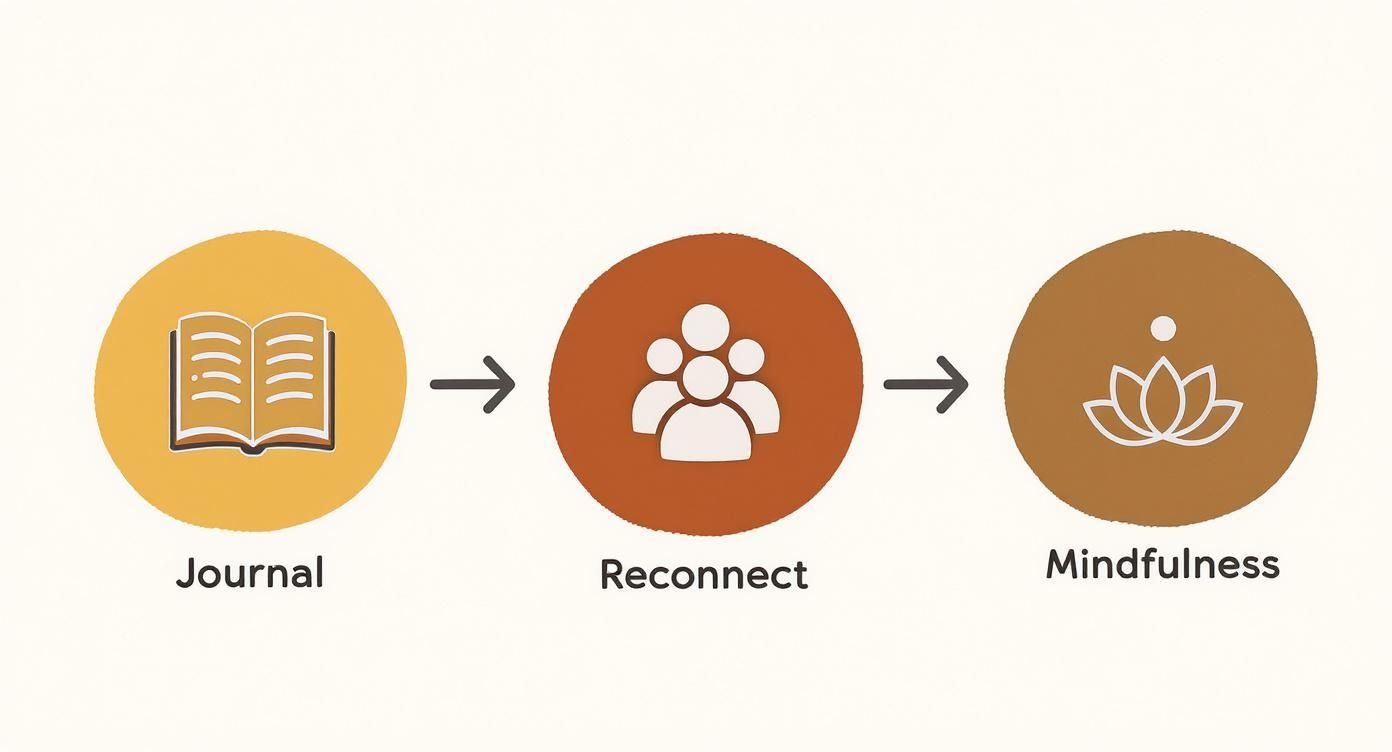
This process shows how journaling, reconnecting with trusted people, and practising mindfulness are fundamental to finding yourself again.
Protecting Your Digital Footprint
These days, digital safety is just as vital as physical safety. There's a real chance a controlling partner could be monitoring your online activity, reading your emails, or even tracking your location through your phone.
You need to take steps to secure your digital world. Change the passwords for your most important accounts, like your email and online banking. Make sure you do this on a safe, private computer—one at a local library or a friend's house is a good option.
It’s also a good idea to turn off location services on your phone and be very careful about what you share on social media. You might want to set your profiles to private and remove anyone you don't completely trust.
Knowing Where to Turn for UK Support
You are not alone in this. There are several fantastic UK-based organisations that offer expert, confidential support for people experiencing domestic abuse.
Refuge: They run a free, 24-hour National Domestic Abuse Helpline (0808 2000 247) and have a wealth of resources online.
Women's Aid: Provides a huge network of local services and support all over the country.
Men's Advice Line: A confidential helpline for male victims of domestic abuse (0808 8010 327).
Getting in touch with these services can give you specialised advice for creating a solid safety plan that’s tailored to your exact situation. This plan is your personal safety net, giving you the strength and the options you need to build a safer, happier future.
Common Questions About Living with a Narcissist
Being in a relationship with a narcissist throws up a whirlwind of confusing and often painful questions. It’s completely normal to feel lost, to question everything—including your own grip on reality. I’ve put this section together to answer some of the most common questions I hear in my practice, hopefully bringing a bit of clarity to the chaos.
Can a Narcissist Ever Change?
This is probably the most hopeful, and yet most heartbreaking, question I get asked. The honest answer? While it’s not completely impossible, genuine, lasting change for someone with deep-seated narcissistic traits is incredibly rare.
For them to truly change, they would need to commit to intensive, specialised therapy. But—and this is the crucial part—they would have to want to do it. The very essence of narcissism is an inability to self-reflect or admit you're at fault. If they don’t believe their behaviour is the problem, what motivation do they have to fix it?
You’ve probably seen what looks like change, especially when you’ve threatened to leave. This is a classic tactic called 'hoovering', designed to suck you back in. They might promise you the moon, but as soon as you’re settled again, those old, damaging patterns almost always creep back in.
It’s far healthier and more realistic to focus your energy on what you can actually control: your own boundaries, your well-being, and your future. Waiting for them to change is usually a recipe for more heartache.
Am I the Problem They Say I Am?
If I had a pound for every time a client asked me this, I’d be a rich man. Being constantly told you’re “too sensitive,” “crazy,” or that you’re “always making things up” is a textbook gaslighting technique. Its only purpose is to make you doubt your own perception of reality, keeping you off-balance and easier to control.
Let me be absolutely clear: your emotional reaction to being mistreated is not the problem. It’s a sign that your internal alarm system is working perfectly. Feeling hurt, confused, or angry are completely valid responses to someone behaving unacceptably.
This constant attack on your sanity is a form of emotional abuse. A huge part of healing is learning to trust your own gut instinct again. Your feelings are not a weakness; they are a strength, telling you that something is deeply wrong.
How Can Therapy Help If My Partner Refuses to Go?
This is a brilliant and important question. Many people think that for relationship therapy to work, both partners have to be in the room. But when you’re living with a narcissist, individual therapy for yourself is often the most effective—and safest—way forward.
You don’t need their permission or participation to get enormous benefits from therapy. In fact, the whole point is to focus entirely on you.
It Validates Your Reality: Therapy is a safe, confidential space where your experiences are heard and believed. This alone is a powerful antidote to gaslighting.
It Gives You Practical Tools: I can teach you real-world strategies for setting boundaries, communication techniques like the 'grey rock' method, and ways to manage the intense anxiety that comes with this kind of relationship.
It Helps You Rebuild Yourself: We work on reconnecting you with your own identity, rebuilding your self-esteem, and rediscovering what you value, completely separate from the relationship.
It Puts Your Safety First: Crucially, a therapist can help you create a personal safety plan and explore your future options in a supportive, non-judgemental environment.
The goal here is to empower you. It's about helping you reclaim control over your own mental health and your life, no matter what your partner chooses to do. You have the power to create a healthier future for yourself, and starting that journey is a courageous first step.
At Therapy-with-Ben, I provide a supportive space for you to process these complex challenges and find your way forward. Whether through face-to-face sessions in Cheltenham, online counselling, or walk-and-talk therapy, we can work together to rebuild your confidence and create a life that feels like your own. Learn more about how I can help you on your journey.


Comments