


Therapy for Low Self-Esteem: Rebuild Confidence with Support
Updated: Mar 15
By Therapy-with-Ben
When you’re looking for effective therapy for low self-esteem, you need something more than just a quick fix or a bit of positive thinking. You need a structured, supportive way to rebuild your sense of self-worth and finally quieten that nagging inner critic. Taking this step is a proactive and genuinely powerful way to build confidence that actually lasts. I am based in Cheltenham, love being a Therapist and am keen to help. About My Therapeutic Approach
While I often discuss a variety of therapy models and techniques in my blog to help readers make informed decisions, my own practice is rooted in an integrative, person-centred and psychodynamic approach. This means our work together will focus on empathy, acceptance, and exploring your unique experiences at your pace, rather than following a set formula like CBT or CFT.
If you’re interested in learning more about how I work, you can read my detailed post on my About Me Page. And if you feel a different modality would suit you better, I’m always happy to discuss options or recommend a specialist.
Why Therapy Is a Powerful Tool for Low Self-Esteem
Low self-esteem isn’t just about having an off day or feeling a bit unsure of yourself now and then. It’s a persistent, internal voice that can quietly sabotage your relationships, hold you back at work, and chip away at your happiness.
It’s a bit like trying to build a house on shaky ground; no matter how strong you make the walls, the foundation itself is unstable.
This is where professional therapy makes such a difference. A lot of people try to fix low self-worth by just telling themselves to ‘think positive’, but this often falls flat because it doesn’t get to the root of why those negative beliefs are there in the first place. My approach to therapy for low self-esteem gives you a structured, compassionate space to do that deeper work, safely.
Moving Beyond Surface-Level Fixes
Imagine your self-esteem is a garden. For years, negative thoughts have been growing like weeds, their roots tangled deep in the soil of your past experiences, difficult relationships, or long-held habits. Just cutting the tops off the weeds (the positive thinking approach) isn’t going to solve the problem for long.
Therapy is the process of carefully digging up those weeds, understanding how they got there, and planting new, healthier seeds of self-compassion and realistic self-appraisal in their place.
A Proactive Step Towards Lasting Change
Starting therapy isn’t a sign of weakness; it’s a courageous and proactive choice to invest in your own well-being. It provides a dedicated time and space to dismantle old, unhelpful beliefs and build a more resilient sense of who you are. In my services for self-esteem, we’ll work together to:
Uncover the Root Causes: We’ll explore where your feelings of inadequacy actually come from – whether it’s things that happened in childhood, past setbacks, or the pressures of life.
Challenge Your Inner Critic: You’ll learn practical ways to notice, question, and reframe the automatic negative thoughts that keep your self-doubt going.
Build a Foundation of Self-Worth: We focus on developing a core sense of value that isn’t tied to external things, like what you achieve or what other people think of you.
This journey is all about building genuine confidence from the inside out.
How Different Therapies Rebuild Your Self-Worth
To really get to grips with low self-esteem, willpower alone often isn’t enough; you need the right tools for the job. Good, effective therapy for low self-esteem isn't about vague chats. It's built on structured, evidence-based approaches that give you practical skills to genuinely change how you see yourself. Here in the UK, two of the most powerful and well-regarded methods are Cognitive Behavioural Therapy (CBT) and Compassion-Focused Therapy (CFT).
Think of CBT as being a detective for your own mind. It helps you catch those automatic negative thoughts that silently chip away at your confidence all day long. These are the thoughts that just pop into your head, uninvited, whispering things like "I'm not good enough" or "I'm bound to mess this up."
With CBT, we learn to put these thoughts on trial. We don't just accept them; we look at the evidence for and against them, challenging them until they start to lose their power. The goal isn't to force some kind of fake positivity, but to swap those harsh, distorted thoughts for more balanced and realistic ones.
Cognitive Behavioural Therapy In Action
CBT is a really hands-on approach that gives you a clear framework to work with. It’s based on a simple but powerful idea: our thoughts, feelings, and behaviours are all linked. If you can change one, you can start to influence the others.
Some of the key techniques we use in CBT to rebuild self-worth include:
Thought Records: A practical exercise where you jot down a negative thought, note the feeling it sparks, and then actively look for evidence that challenges it. It’s a brilliant way to break the cycle of automatic negative thinking.
Behavioural Experiments: We come up with small, real-world tests to challenge your negative beliefs head-on. If you believe you’re un-likeable, an experiment might be as simple as starting a brief chat with a cashier just to see what really happens.
Reframing Perspectives: This is about learning to see a situation from different angles, rather than automatically jumping to the worst-case scenario.
These methods are incredibly effective. Here in the UK, evidence-based approaches for low self-esteem lean heavily on Cognitive Behavioural Therapy (CBT) and Compassion-Focused Therapy (CFT), both of which are backed by solid clinical research. CBT, which is often delivered over 12 to 20 sessions, helps people develop much more realistic ways of evaluating themselves and find better coping strategies.
Cultivating Kindness With Compassion-Focused Therapy
If CBT is the detective, then Compassion-Focused Therapy (CFT) is the supportive coach. CFT was developed specifically for people who are really struggling with high levels of shame and self-criticism—two of the biggest drivers behind low self-esteem.
This infographic gives a sense of how that harsh inner critic can ripple out and affect different areas of your life.
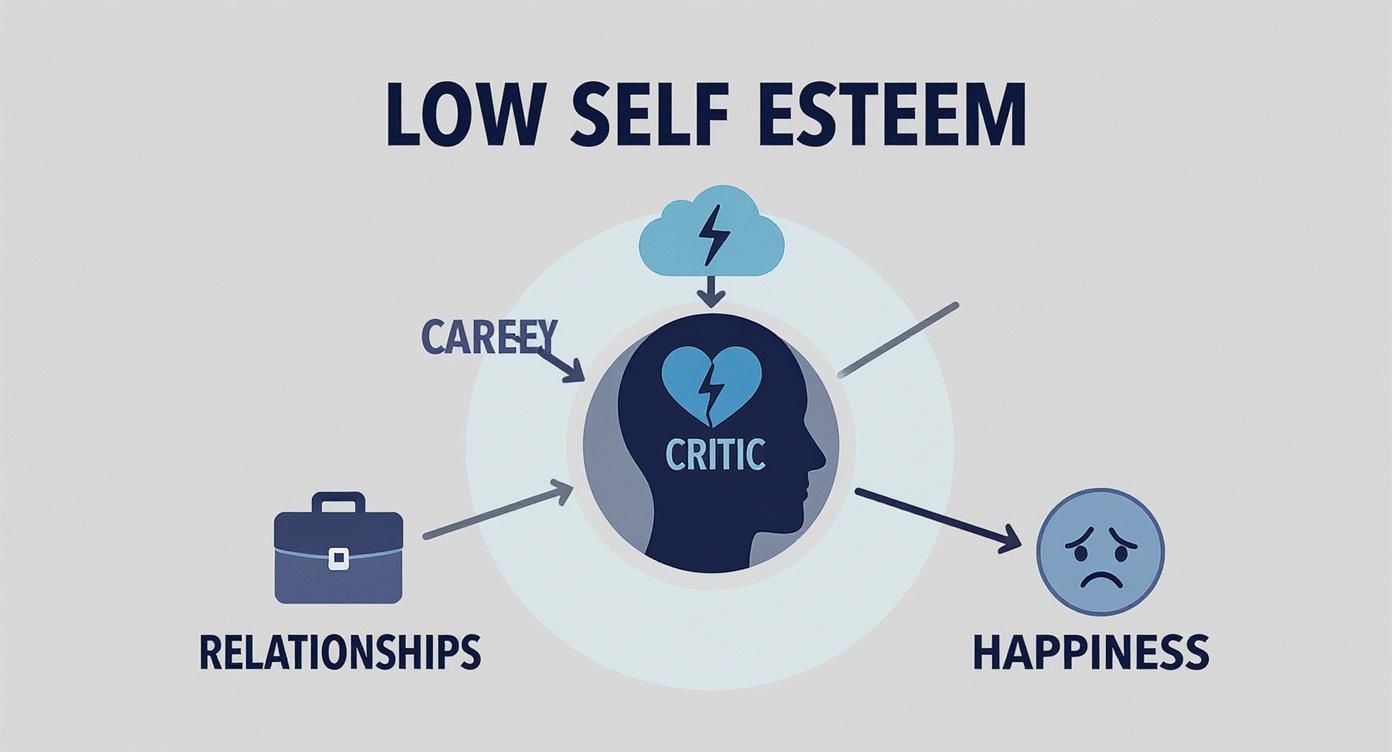
As you can see, that relentless voice of self-criticism doesn't just stay inside your head; it often impacts our relationships, our work, and our general happiness.
CFT goes right for this harsh inner voice by teaching you how to build a kinder, more compassionate relationship with yourself. It helps you understand that being self-critical isn't some personal failing; it's often a protective habit we learned from difficult past experiences. From there, we work on cultivating an inner sense of warmth, safety, and encouragement.
The core idea of CFT is that self-compassion is not self-indulgence; it’s a strength. It provides the emotional resilience needed to face challenges, learn from mistakes, and build a stable sense of self-worth that doesn’t depend on external validation.
Comparing Therapeutic Approaches for Low Self-Esteem
To help clarify how these evidence-based therapies work, here’s a quick summary of how they tackle the core issues of low self-esteem.
Therapeutic Approach | Primary Focus | Key Techniques | Best Suited For |
|---|---|---|---|
Cognitive Behavioural Therapy (CBT) | Identifying and challenging negative thought patterns and behaviours. | Thought records, behavioural experiments, cognitive restructuring. | Individuals needing practical, structured tools to change specific thinking habits. |
Compassion-Focused Therapy (CFT) | Cultivating self-compassion and soothing the inner critic. | Mindful breathing, compassionate imagery, letter-writing. | People who struggle with high levels of shame, self-criticism, and trauma. |
Psychodynamic Therapy | Exploring how past experiences and unconscious patterns influence present feelings. | Exploring past relationships, interpreting patterns, understanding defence mechanisms. | Those wanting to gain deep insight into the root causes of their self-esteem issues. |
Person-Centred Therapy | Providing a supportive, non-judgemental space for self-exploration and growth. | Active listening, empathy, unconditional positive regard. | Individuals seeking a gentle, self-directed approach to build self-acceptance. |
Each of these approaches offers a unique pathway toward building a healthier relationship with yourself. The best fit often depends on your personal history, your specific struggles, and what you hope to achieve in therapy.
These two therapies, CBT and CFT, often work brilliantly together, creating a powerful combination for lasting change. Of course, there are many other effective models out there, and you can explore more in our guide to types of counselling in the UK. It’s also worth remembering that therapy isn't just about talking. Exploring other approaches like deep pressure therapy for anxiety can be a great help, as anxiety and low self-esteem are so often linked. Ultimately, the goal is to equip you with a toolkit that is personalised to you, helping you build a healthier, more supportive relationship with yourself.
Recognising the Signs You Might Need Support
Low self-esteem can be a quiet and persistent companion. It’s often so familiar that its influence becomes almost invisible, and we start to mistake behaviours and thought patterns that hold us back for simple personality quirks. Learning to spot these signs is the first, most powerful step you can take toward making a change.

It’s about understanding that these aren't just "habits"—they are often direct expressions of a fragile sense of self-worth. By seeing these experiences laid out, you can begin to validate your own feelings and realise they are legitimate reasons to seek professional support through therapy for low self-esteem.
This isn’t about ticking boxes or applying labels. It’s about gently connecting the dots between how you act day-to-day and how you truly feel about yourself on a deeper level. This self-awareness is where the potential for growth really begins.
Common Behaviours and Thought Patterns
Do any of these feel a little too familiar? Low self-esteem often shows up in subtle yet consistent ways that can have a huge impact on your life.
Constantly Apologising: Saying "sorry" for things that aren't your fault, like taking up space or asking a question, can be a sign that you feel like a burden.
Difficulty Accepting Compliments: When someone offers praise, is your first instinct to dismiss it, downplay your achievement, or just feel deeply uncomfortable?
Avoiding New Opportunities: You might turn down a promotion, sidestep a new hobby, or say no to social events because of an intense fear of failure or not being good enough.
Relentless People-Pleasing: Your own needs and desires consistently take a backseat to make others happy, often driven by a deep-seated fear of rejection or disapproval.
These behaviours are often just the tip of the iceberg, symptoms of a deeper issue. In the UK, low self-esteem frequently overlaps with broader mental health conditions, affecting about one in four adults every year.
Statistics from Priory Group show that women are disproportionately affected (20.7%) compared to men (13.2%), with young women aged 16 to 24 being the highest-risk group. You can read more about these UK mental health statistics if you'd like to understand the wider context.
The Weight of the Inner Critic
Beyond outward behaviours, the internal experience of low self-esteem can be absolutely exhausting. We all have an inner critic, but for some, it’s a harsh, relentless voice that narrates life with a constant stream of negative commentary.
This critical self-talk isn't just "being hard on yourself"; it's a deeply ingrained pattern that can convince you that you are fundamentally flawed. It magnifies your mistakes and completely ignores your successes, creating a distorted and painful self-image.
Learning to manage this inner voice is a central part of rebuilding your sense of worth. Recognising these patterns isn’t a sign of weakness; it's a crucial first step. If this resonates with you, it might be helpful to learn more about recognising the signs of mental health problems in our related guide.
Acknowledging these challenges is what opens the door to seeking the right support and starting your journey towards a more lasting confidence.
By Therapy-with-Ben
What to Expect in a Session with Therapy with Ben
Stepping into therapy for the first time, especially for something as deeply personal as low self-esteem, can feel pretty daunting. It’s completely natural to wonder what actually goes on behind closed doors, which is why I believe in being totally open about the process right from our very first meeting.
My number one priority is to create a space that feels safe, non-judgemental, and completely confidential. A place where your story is heard and respected. Think of our first session less like an interrogation and more like a conversation to see how we get on. It’s a chance for you to decide if you feel comfortable with me, and for us to figure out if we’re a good fit.

From that point on, everything we do is a partnership. We’ll work together to set goals that are both meaningful and realistic—not just vague hopes like ‘feeling better’, but real, tangible changes you want to see in your life. The whole point is to empower you, helping you take back control of your inner world.
A Collaborative and Interactive Approach
Therapy for low self-esteem isn't a passive experience where you just listen to me give you all the answers. Far from it. Think of it more like an interactive workshop for your mind. You are the expert on your life and your experiences; my role is to bring the professional framework, the right tools, and unwavering support to help you navigate it all.
We'll gently explore where your self-critical beliefs might have come from. The aim isn't to lay blame but simply to understand their roots. Gaining that understanding is the key to loosening their grip on you today.
Your thoughts are not facts. A core part of our work will be learning to observe your negative self-talk without automatically accepting it as the truth. This creates the breathing room you need to challenge and, eventually, change those deeply ingrained patterns.
As we move forward, we’ll start putting new skills and perspectives into practice, right there in the session. This could involve trying out exercises from Cognitive Behavioural Therapy (CBT) to help reframe unhelpful thoughts, or perhaps using techniques from Compassion-Focused Therapy (CFT) to start developing a kinder, more supportive inner voice.
What Our Sessions Typically Involve
While every single session is tailored to you, having a general structure helps keep our work focused and effective. Here’s a rough idea of what you can expect:
A Gentle Check-in: We’ll usually start by having a brief chat about your week, touching on any particular challenges or successes you’ve had with your self-esteem.
Focusing on a Goal: We’ll then connect our conversation back to the goals we’ve set together, making sure our work always has a clear purpose.
Exploring and Practising: This is the main part of the session. It’s where we might dig into a specific belief, practise a new coping strategy, or work through a difficult memory.
Summarising and Looking Forward: We’ll finish up by recapping any key insights from the session and agreeing on something small you could focus on before we next meet.
My overarching goal is to make therapy for low self-esteem feel less like a clinical procedure and more like a supportive, human-to-human partnership. It's a space dedicated entirely to your growth. You can find out more about the specifics of what happens in counselling sessions in our detailed guide.
By Therapy-with-Ben
Why Seeking Therapy Is Becoming More Common in the UK
If you’re thinking about starting therapy, you’re in very good company. The way we talk and think about mental health in the UK has changed massively over the last few years, and for the better. Looking after your mental wellbeing is finally being seen for what it is: a sign of strength and self-awareness, not something to be embarrassed about.
Because of this shift, more and more of us are turning to therapy to work through personal challenges like low self-esteem. The old-fashioned stigma that used to hang around mental health is slowly but surely fading away, which makes it so much easier for people to get the professional support they need and deserve.
A New Generation Is Leading the Way
You can really see this change in younger generations. Young adults are at the forefront of this movement, making it normal to talk openly about mental health and actively look for support. For them, therapy isn't a last resort for when things hit rock bottom; it's a smart, proactive part of modern self-care.
And the numbers back this up. In the UK, therapy for low self-esteem has become much more common. Recent data shows that around 35% of adults have been to counselling or psychotherapy at least once. The figure climbs even higher for younger people, with a quarter (25%) of those aged 16 to 25 having used therapy services. If you’re curious, you can get more of the story from the BACP's public perceptions survey.
This is a really encouraging trend. It shows that the path you’re considering is one that thousands of others are also walking, all of them investing in themselves.
Therapy Is Now a Respected Choice
A big reason for this growing popularity is simply that it works. The same research points out that a huge 73% of people who’ve had therapy said it was a beneficial experience for them.
Seeking therapy is no longer a secret to be kept but a proactive and widely respected choice for building a healthier, more resilient life. It is a practical investment in yourself and your future happiness.
Knowing you're part of this wider shift can be really reassuring. It confirms that deciding to work with a professional to build your confidence is a positive step that’s well-regarded by others. It helps normalise the whole process, so you can feel more confident in your decision to start your own journey. Realising you're not alone in this helps to get rid of any lingering feelings of isolation and empowers you to move forward.
By Therapy-with-Ben
Your Next Steps Towards Building Lasting Confidence
This is where the real work—and the real change—begins. You’ve seen that low self-esteem isn’t a life sentence, but a challenge you can absolutely overcome with the right support. Now it’s about turning that knowledge into action.
Taking this next step is a genuine commitment to yourself and your future happiness. My goal is simply to make this process feel as straightforward and empowering as possible, clearing away any obstacles that might be holding you back.
As you move forward, learning new skills for mastering anxiety can also be a massive help on your journey to feeling more confident.
Remember, reaching out for support isn't a sign of weakness. It's an act of profound self-respect and the first proper step toward building the life you truly deserve.
When you feel ready, here are a few ways to get started with Therapy with Ben.
Book an Initial Consultation so we can see if we're a good fit.
Explore My Services for Self-Esteem to get a better feel for my approach.
Visit the FAQ Page for answers to common questions.
By Therapy-with-Ben
Common Questions About Therapy for Self-Esteem
Thinking about starting therapy can bring up all sorts of questions. It's totally normal. To help put your mind at ease, here are a few answers to some of the things people often wonder about when considering therapy for low self-esteem.
How Long Does Therapy Usually Take?
This is probably the most common question I get, and the honest answer is: it’s different for everyone. There’s no magic number of sessions.
Some focused approaches, like Cognitive Behavioural Therapy (CBT), often run for about 12 to 20 sessions. But that’s just a rough guide. The real timeline depends on what you want to achieve, the issues we’re exploring, and the pace that feels right for you. We’ll chat about this in our first meeting and keep checking in as we go to make sure you’re getting what you need from our time together.
Is Everything I Say in Therapy Confidential?
Absolutely. Confidentiality is the foundation of everything we do. Think of our sessions as a completely private space where you can be open and honest, free from any outside judgement.
The only exceptions, are if I believe you or someone else is at serious risk of harm or if you divulge you are invlovled in money laundering or international drug smuggling as there is a requirement to report these specific things. This is a legal and ethical duty for all qualified therapists in the UK, and it's there to keep everyone safe.
Your privacy is my priority. Therapy is a protected space for you to explore your thoughts and feelings without worrying about what anyone else thinks. It’s your time for deep self-exploration and healing.
What if I Feel Nervous About My First Session?
Feeling a bit nervous before your first session is completely normal—I'd say most people do! Taking that first step is a big deal, and it’s natural to feel a little apprehensive when you don’t know what to expect.
Just remember, our first meeting is really just a conversation. It's a chance for us to get to know each other a bit. There's no pressure to dive into anything you're not ready to talk about. My job is to make you feel welcome and comfortable, so you can decide if I'm the right person to help you on your journey.
Ready to take that first step towards building a stronger sense of self-worth? At Therapy with Ben, I offer a supportive, confidential space where you can explore what’s holding you back and develop a healthier self-esteem. Book your initial consultation today and let's get started.
A quick note for therapists and small business owners: I use Outrank to help me keep this blog updated and support my website’s SEO. If you run a small business and want a time-saving way to build content and visibility, it may be worth a look: Outrank with code 10OFFBEN for 10% off your first month. If you sign up through my link, I may receive a commission at no extra cost to you.
Comments