


What Is Schema Therapy A Complete Guide
- Dec 18, 2025
- 11 min read
By Therapy-with-Ben
Schema therapy weaves together insights from how we think, feel and relate. It’s all about spotting and reshaping those stubborn thought patterns known as early maladaptive schemas. Therapists draw on cognitive, experiential and attachment-based tools to help you rewrite the mental programmes that keep you stuck.
Quick Answer To What Is Schema Therapy

Imagine your mind running on a decade-old operating system, faltering whenever life throws a curveball. Schema therapy offers an emotional upgrade, ironing out those glitches so you can respond more flexibly.
This approach homes in on patterns that repeat across relationships and situations. It’s particularly helpful if you’ve struggled with chronic depression, personality issues or the aftermath of trauma.
Core Components: Schemas, modes and attachment needs
Goals: Greater emotional insight, genuine self-expression and lasting behavioural shifts
Session Structure: Weekly one-to-one sessions with individualised exercises
The journey usually spans eight to twelve months, starting with an assessment and in-depth psychoeducation. As you progress, you’ll learn to recognise triggers and try out healthier ways to cope in your everyday life.
“By updating your emotional software, schema therapy helps you respond rather than react.” — Therapy with Ben
Summary Of Schema Therapy At A Glance
Here’s a quick overview of the main pieces, goals and session flow in schema therapy.
Component | Details |
|---|---|
Core Components | Early maladaptive schemas, modes, experiential work |
Goals | Boost resilience, self-compassion and clear boundaries |
Session Structure | Weekly sessions, homework reviews and progress checks |
This table offers a clear snapshot of schema therapy’s building blocks and how your sessions will unfold.
Now you’re equipped with a concise roadmap to rewrite unhelpful patterns and cultivate healthier responses to life’s challenges.
History Of Schema Therapy
Back in the early 1980s, Dr Jeffrey Young was running a busy CBT practice and noticed a pattern: clients kept returning with the same emotional traps. It felt a bit like patching a dam with tissue paper.
He realised some issues run far deeper than unhelpful thoughts. To tackle chronic patterns, you need to dig into childhood roots.
Schema therapy wove together four key strands:
Cognitive–Behavioural techniques to challenge faulty beliefs
Psychodynamic tools for exploring early relationship wounds
Experiential exercises like imagery rescripting
Attachment-based work to foster a reliable therapeutic bond
In the UK, Young’s team ran clinical trials comparing these extended protocols with standard CBT. The verdict was clear: short-term therapy often skimmed over entrenched schemas, leaving people feeling unheard and stuck.
“Long-standing emotional themes deserve a more nuanced approach”— Early insight from Dr Young
Following these findings, Young published specialised manuals in the late 1980s and early 1990s. His message was simple: some patterns take months—not weeks—to reshape. This model showed how persistent schemas, formed in childhood, can be gently rewritten through a blend of approaches.
Learn more in this detailed overview on PMC.
Why Extended Protocols Were Needed
Young discovered that a typical ten to twenty-session CBT programme wasn’t enough for deep-rooted schemas. It was like trying to untie a complex knot in a few minutes—it just wouldn’t hold.
That insight led to protocols stretching up to eighty sessions. Therapists learnt to:
Offer limited reparenting, providing the nurturing missed in childhood
Guide clients through chair work, giving voice to different parts of themselves
Use imagery rescripting to rewrite painful memories
Today, these methods sit at the heart of every schema therapy session.
Impact On Modern Practice
When you step into a session at Therapy with Ben in Cheltenham, you’re tapping into decades of research. Every tool—from assessment grids to our walk-and-talk format—traces back to those pioneering years.
Appreciating this history shows why schema therapy goes far beyond thought monitoring. It’s an invitation to invest in lasting change, unlocking emotional patterns at their core. And by doing so, you join a lineage of clients and therapists committed to genuine, enduring growth.
Understanding Key Concepts In Schema Therapy
Think of schema therapy as swapping out battered, tinted sunglasses your mind has worn for years. Those scratched lenses colour every moment—especially when they’re shaped by old, unmet needs. Schema therapy shows you how to repair or replace those lenses so you can view life with fresh clarity.
These deep-seated grooves—Early Maladaptive Schemas—are like channels carved into stone by a dripping stream. Over time, they steer your thoughts and actions almost automatically. Recognising these patterns is where the real work begins.
Early Maladaptive Schemas
Early Maladaptive Schemas stem from childhood experiences when basic emotional needs went unmet. They become the invisible filter through which you judge new situations, often before you realise what’s happening.
Common examples include:
Abandonment Schema that fuels anxiety about being left alone
Defectiveness Schema creating a sense that you’re inherently flawed
Approval-Seeking Schema pushing you to please others at your own expense
Spotting these patterns sets the stage for recognising your Schema Modes.
Schema Modes
Schema Modes are like shifts in the emotional weather inside you. One moment you’re bright and confident, the next you might feel thunderous with anger or frozen by shame.
Modes Are Like Emotional Weather, Shifting Your Inner Climate In Moments.
When an Early Maladaptive Schema is triggered, a matching mode can take over, explaining those sudden mood swings.
Below is an infographic visualising the foundational theories that influenced schema therapy.
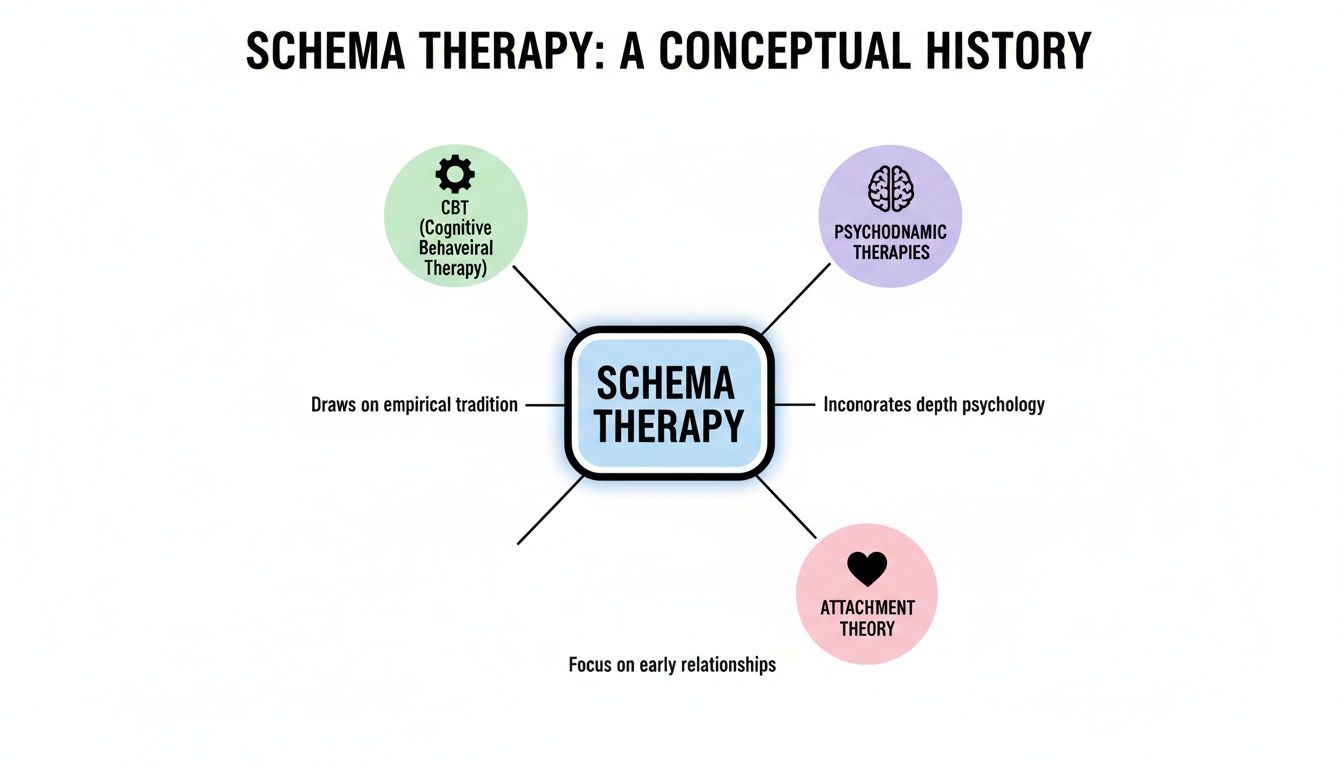
This concept map highlights how CBT, psychodynamic, and attachment theories weave together to form today’s schema therapy model.
You might find our exploration of attachment theory insightful—see what is attachment theory and how it shapes you.
By identifying which schemas and modes drive your reactions, you open up new possibilities for change. Even simple awareness can lead to more flexible responses before you head into deeper work with your therapist.
Practical Steps You Can Take:
Identify a recurring negative belief
Notice which mode appears when you feel triggered
Reflect on how that mood links back to an Early Maladaptive Schema
Share these observations with your therapist to shape personalised exercises
Sharing these insights in sessions helps tailor exercises to your unique patterns. This foundation primes you for lasting change and growth.
How Schema Therapy Works In Practice
Imagine you have a craftsman’s toolkit laid out before you. Each instrument is designed to reshape deep-seated emotional habits. Over time, these tools help you dismantle outdated patterns and build healthier ones.

Limited Reparenting And Imagery Rescripting
Limited Reparenting offers the steady warmth and guidance you may have missed in childhood. Within the therapeutic relationship, you receive genuine empathy, clear boundaries and consistent encouragement.
Imagery Rescripting takes you back to a painful memory so you can rewrite it. Guided visualisations invite you to introduce kindness and security into scenes that once triggered distress.
It creates emotional safety by shifting the narrative around old experiences
It strengthens self-compassion, helping you quiet that harsh inner critic
Participants often experience up to a 30% reduction in anxiety after several sessions
Chair Work And Behaviour Pattern Breaking
Chair Work invites an internal dialogue between different parts of yourself. You might occupy one chair as your inner critic, then switch to another to speak as your Healthy Adult or Vulnerable Child.
Behaviour Pattern Breaking zeroes in on automatic reactions. Together with your therapist, you spot familiar triggers and practise new responses in a supportive environment.
“Trying fresh responses in a safe space is like rehearsing for a play before opening night.”
Testing Fresh Responses In A Safe Lab
The therapy room becomes your laboratory for emotional experiments. Your counsellor provides a friendly but firm setting to test out new coping strategies.
Our walk-and-talk sessions or online meetings blend real life with therapy. Being on the move or in your own space can settle your nervous system, making breakthroughs feel more natural.
Observe your usual reaction to a trigger
Introduce a different thought or action
Reflect on the outcome and adjust accordingly
Case Study Of Imagery Rescripting
Sarah arrived feeling weighed down by harsh self-judgement. Through Imagery Rescripting, she imagined a compassionate adult stepping into a childhood scene.
She pictured her younger self and offered warmth where none existed before
She added sensory details of comfort—soft light, gentle voice, a safe space
After just three sessions, Sarah noticed a 25% drop in self-critical thoughts
Rewriting the past in your mind can shift how you feel today
This small, guided rehearsal plants the seeds for lasting changes in everyday life.
Key Techniques In Schema Therapy
Below is an overview of the main therapeutic techniques used in schema therapy:
Technique | Purpose |
|---|---|
Limited Reparenting | Provide the missed emotional support and meet unmet needs |
Imagery Rescripting | Rewrite and soften the emotional impact of painful memories |
Chair Work | Enable dialogue and integration between conflicting parts |
Behaviour Pattern Breaking | Practise healthier coping strategies in the session |
Each technique tackles a different layer of your emotional wiring, guiding you towards lasting change.
To explore how attachment patterns influence your emotional world, see our detailed post on what is attachment theory and how it shapes you. When you’re ready to take the next step, book a session with Therapy with Ben in Cheltenham and start cultivating more flexible emotional responses.
For hands-on exercises and insights into healing early wounds, check out our guide on how to heal from childhood trauma a practical guide.
This toolkit may look simple, but its impact can be profound.
Benefits And Use Cases Of Schema Therapy
Schema therapy can gently unravel the deep-rooted emotional patterns that trip us up day after day. Instead of quick fixes, it focuses on the beliefs and coping styles forged early in life—and helps you reshape them.
A systematic review of multiple randomised controlled trials showed schema therapy led to significant reductions in personality disorder symptoms compared with treatment as usual, alongside sustained improvements in interpersonal functioning and emotional regulation. Read the full research on sustained symptom reduction here.
These findings underscore why schema therapy matters for anyone wrestling with chronic depression, persistent personality challenges or the lasting scars of trauma. By guiding you through practical steps, it teaches you to rewrite old coping schemas into healthier responses—and to engage with others more smoothly.
Restores emotional regulation by rewriting early maladaptive schemas
Enhances relationships through authentic communication skills
Builds resilience against future stressors via hands-on coping drills
Use Cases In Clinical And Everyday Settings
Group therapy sessions tap into shared experiences, boosting social skills as participants learn from one another.
In forensic programmes, schema therapy is adapted to support people in secure environments—helping reduce reoffending by addressing core beliefs.
Neurodiverse clients often welcome the chance to use tailored exercises that respect sensory preferences and harness special interests.
One-to-one work can even include walk-and-talk sessions, blending movement with reflection to break up the usual four-wall setting.
Online adaptations ensure that busy schedules or mobility challenges no longer stand in the way of progress.
Each approach zeroes in on spotting your triggers, experimenting with fresh reactions and tracking how you’re doing over time.
“Schema therapy helped me break patterns I thought were set in stone.”— a client testimonial at Therapy with Ben
Below is a comparison of typical applications:
Setting | Key Benefit |
|---|---|
Group Formats | Peer support and shared accountability |
Forensic Programmes | Structured support in secure environments |
One to One Sessions | Deep personal exploration and flexible pacing |
Online Or Walk Talks | Increased access and comfort through choice |
Tailoring Sessions To You
Ben prides himself on adapting each exercise to your tempo and style.
For practical, hands-on steps you can start immediately, dive into our guide How to Heal from Childhood Trauma A Practical Guide.
As you bring schema therapy into your everyday life, you’ll learn to spot when modes like Vulnerable Child or Healthy Adult take over—and choose kinder, more intentional responses.
That simple shift turns an unpredictable emotional system into one you can predict and manage.
Whether you’re untangling long-standing patterns or navigating fresh challenges, schema therapy offers a clear map—and a route that aligns with your life and goals.
What To Expect In Schema Therapy Sessions
Starting schema therapy can stir a mix of nerves and hope. In our first meetings, you’ll get a clear picture of how schema therapy unfolds and the milestones we aim to reach.
Sessions come in three flavours, so you can pick what feels best:
Face-to-Face at our Cheltenham centre: a cosy, private room where you can dive deep without distractions.
Video Calls from home: perfect if you need the flexibility to stay in your own space.
Walk-and-Talk outdoors: combine movement with reflection, helping ideas flow more naturally.
Each format moves at your pace. Typically, we work in 50 to 60-minute slots, meeting weekly to build momentum and trust.
I always stress the importance of feeling comfortable from the start. Knowing the setup in advance cuts through the nerves and lets you arrive ready to work.
Session Frequency And Format
Most people begin with weekly sessions. This steady rhythm keeps focus sharp. As you progress, you can switch to fortnightly or monthly check-ins.
Expect a blend of chat, hands-on exercises and homework review. We’ll revisit key moments—maybe from your childhood—and map them onto your early maladaptive schemas. Tools like mood-rating scales or journal prompts help track your breakthroughs between sessions.
“Consistent practice between sessions is key to noticing change.”
Homework is personalised. You might jot down your thoughts after that walk home or try out a fresh coping strategy whenever a trigger pops up.
Tracking Progress And Reviews
To make progress visible, I use simple visual charts. You’ll note down how often different schema modes show up in a week. Then, every 4 to 6 sessions, we pause to review how far you’ve come.
Many clients opt for a 12-month programme, which strikes a balance between deep exploration and realistic goal-setting. In our reviews, you’ll see which symptoms have eased and decide which schemas still need attention.
Rate your emotional intensity on a 1–10 scale
List your key insights in your therapy journal
Identify practical steps to reinforce new patterns
You might be interested in exploring the foundation of your progress through a stronger therapeutic bond. Read The Therapeutic Relationship Explained to discover why that bond shapes therapy success.
By choosing a quiet spot for video calls or bringing along your favourite notebook for in-room sessions, you set yourself up for meaningful work. Every meeting brings you one step closer to lasting change.
Frequently Asked Questions About Schema Therapy
Many clients wonder how schema therapy might fit into their healing journey. These FAQs cover timelines, common conditions, neurodiverse considerations, picking the right therapist and vivid examples to help you decide on your next step.
Which Conditions Respond Best
Schema therapy really shines when old coping patterns stay stubborn despite short-term counselling. Research shows 53% of clients with personality disorders experience lasting improvement after deeper work.
Typical areas of success include:
Borderline personality disorder: easing self-harm urges and smoothing out turbulent relationships
Chronic depression that resurfaces once standard CBT tapers off
Anxious avoidance in relationships rooted in deep-seated abandonment fears
Trauma survivors wrestling with self-criticism and sudden emotional flashbacks
Recurring anxiety driven by persistent “what if” schemas
For example, someone locked into an abandonment schema might feel noticeably calmer after a few rounds of imagery rescripting—almost as if they’re rewriting an old soundtrack with a gentler melody.
Learn more about spotting these patterns in Early Maladaptive Schemas Explained.
Timelines For Change
You’re probably asking, “How soon will I feel a shift?” A focused 12-week block often brings noticeable relief in mood and coping skills.
Most clients follow an 8 to 12-month programme, though early wins tend to show around week 10. Here’s a rough guide:
Level Of Challenge | Change Marker | Timeframe |
|---|---|---|
Mild schema patterns | Improved mood stability | 3 to 6 months |
Moderate complexity | Healthier coping habits | 6 to 12 months |
Deep-rooted schemas | Durable mindset shifts | 12+ months |
Key techniques that fast-track those early victories include:
Imagery Rescripting to ease distress within weeks
Behaviour Pattern Breaking to establish fresh reactions swiftly
Limited Reparenting to build trust from session one
Small adjustments at the start pave the way for deeper transformation.
Tailored homework between sessions keeps momentum alive and ensures you’re practising new skills in the real world.
Benefits For Neurodiverse Adults
If you’re neurodiverse, schema therapy’s clear structure and creative methods can feel like a breath of fresh air. Sessions might combine traditional dialogue with walk-and-talks in the park or online meet-ups—whichever suits your thinking style and sensory needs.
Clients often report:
Enhanced emotional regulation using visual mode charts
Sharper self-awareness through sensory-based exercises
Less overwhelm by mixing movement and reflection
These adaptations respect how your mind processes information. For practical, hands-on exercises, see How To Heal From Childhood Trauma A Practical Guide.
How To Choose A Qualified Therapist
Finding the right schema therapist is crucial. Start by checking:
Accredited schema therapy training and current BACP registration
Detailed client testimonials that reflect real progress
Available formats—face-to-face, online or walk-and-talk—to match your preferences
“A strong therapeutic bond is the spark that ignites change and resilience.”— Therapy with Ben
Discover more about why this connection matters in The Therapeutic Relationship Explained.
With these insights, you can approach schema therapy feeling informed and supported. Your next step is a discovery call to explore your goals—we’ll navigate this path together.
Ready to start your journey? Book a session with Therapy with Ben.


Comments