


How to Get Over Low Self Esteem and Build Real Confidence
Getting a handle on low self-esteem means you have to actively get in there and challenge those negative beliefs about yourself, while at the same time building new, more supportive habits. It’s a process of learning to see your own value by doing practical things, like changing your inner dialogue, being a bit kinder to yourself, and taking small actions every day that build up your confidence.
Why Low Self Esteem Is More Than Just a Bad Day
Let’s get one thing straight: low self-esteem isn't just having an off-day or feeling a bit down. It’s a nagging, persistent feeling that you’re somehow not good enough, flawed, or just lacking. This feeling can seep into every corner of your life, from the jobs you go for to the relationships you form.
It’s that quiet voice in your head that says you’ll fail before you’ve even tried. It’s that heavy feeling in your chest when you find yourself scrolling through social media, comparing your life to everyone else's.
Realising that this is a common human struggle, not some personal failing on your part, is the first big step. You’re definitely not alone in this; so many people are quietly fighting these exact same feelings.
Unpacking the Roots of Low Self Esteem
So, where does this all come from? Low self-esteem rarely just pops up out of the blue. It’s usually a complicated mix, woven together from different threads of our life experiences. For a lot of people, you can trace it right back to childhood.
Early Life Experiences: A childhood full of criticism from parents or teachers, being bullied by other kids, or just that general feeling of not fitting in can leave deep marks. When you hear over and over again that you're not smart enough, capable enough, or likeable enough, you can eventually start to believe it.
Challenging Life Events: Big events in our adult lives can also chip away at our sense of self. Being made redundant, a long-term relationship ending, or constant money worries can all trigger feelings of failure and worthlessness.
Societal and Media Pressures: We’re surrounded by perfectly curated social media feeds and ads that push an impossible standard of success and happiness. It’s no wonder that this constant comparison can leave you feeling like your own life just doesn’t measure up.
The crucial thing to realise is that these outside factors and past experiences shaped your beliefs, but they don’t define your true worth. Understanding the ‘why’ isn't about blaming anyone; it’s about getting the clarity you need to start rewriting your own story.
The UK Context: A Growing Concern
This isn’t just a personal battle; it's a much bigger issue, especially here in the UK. Imagine feeling like you’re not good enough, day in, day out—it’s a struggle that hits a huge number of young people particularly hard. Recent statistics are quite sobering, showing that somewhere between 33% and 50% of UK adolescents are grappling with low self-esteem.
The figure for girls aged 10 to 17 is even more stark: a staggering 61% report low self-esteem, which is often tied to pressures around body image and social media.
Sometimes, these feelings can be linked to physical appearance. For instance, understanding the emotional effects of acne really shows how deeply something on the outside can affect how we feel on the inside. It’s a powerful reminder of how connected our physical and emotional health really are. Acknowledging just how deep this issue runs is the first step toward building a better, more supportive relationship with yourself.
How to Challenge Your Inner Critic
We all have that nagging inner voice, the one that’s quick to point out our flaws and whisper doubts into our ear. It can feel like it's telling the absolute truth, but here’s the thing: it’s not. This inner critic is a major driver of low self-esteem, but you don't have to let it run the show. With a few practical techniques drawn from Cognitive Behavioural Therapy (CBT), you can start to dismantle these unhelpful thought patterns and build a much kinder internal dialogue.
It’s a process. First, you learn to spot the critic's voice as it appears. Then, you start questioning its harsh judgements. Finally, you actively replace those criticisms with more balanced and realistic thoughts. This isn't about slapping on a fake smile or pretending everything's perfect; it’s about learning to see yourself through a clearer, more compassionate lens.
The image below shows a few of the common routes that lead to a powerful inner critic and, ultimately, to low self-esteem.
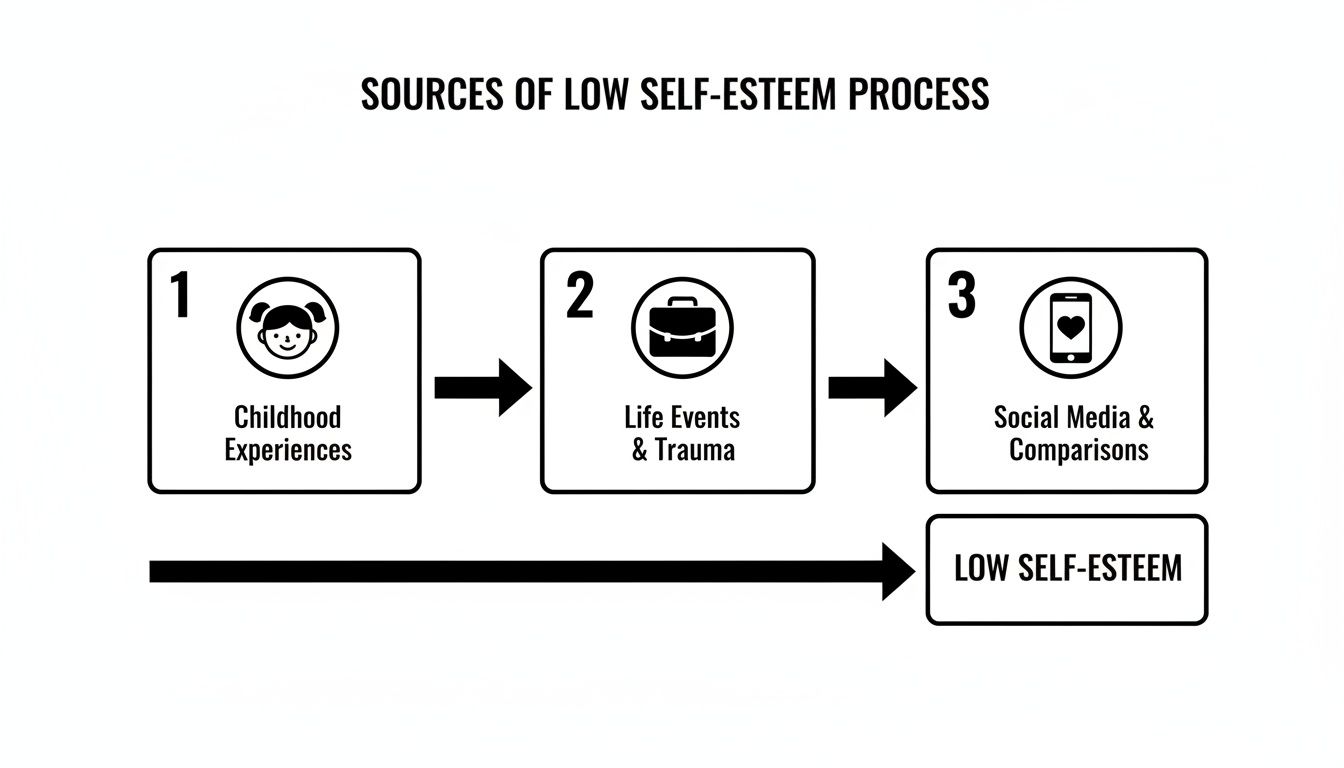
As you can see, things like our childhood experiences, difficult life events, and even the constant pressure from social media can lay the groundwork. Understanding where that voice comes from helps us realise it's often just an echo from the past, not an accurate reflection of who we are today.
Recognise and Separate From the Critical Voice
The very first step in figuring out how to get over low self-esteem is simply to notice when that inner critic pipes up. This voice often feels so automatic and normal that we mistake its commentary for objective fact.
A great trick is to give it a name. Whether you call it "the critic," "the Gremlin," or something faintly ridiculous like "Nigel," creating this character helps you build a bit of mental space. The next time a thought like, "You're going to completely mess this up," pops into your head, you can think, "Ah, that's just Nigel at it again."
This simple act of naming it separates the thought from your core identity. It’s no longer an undeniable truth; it’s just an opinion, and one you certainly don't have to listen to.
Question the Evidence Like a Detective
Once you've got a handle on spotting the critic's voice, your next job is to challenge its claims. The inner critic loves to speak in absolutes and sweeping generalisations, often using words like "always," "never," and "everyone." These are big red flags.
Picture this: you make a small mistake at work, and your inner critic immediately jumps in with, "I always ruin everything." Treat that thought like a statement made in a courtroom. Where's the hard evidence?
Ask for specific proof: "What is the actual evidence that I always ruin things?"
Hunt for counter-evidence: "Can I think of times I've done things really well? What about that project I nailed last month?"
Consider another perspective: "What would a kind and supportive friend say to me right now? Would they agree that I 'always' ruin things?"
This isn't about getting into an argument with yourself. It's about taking a step back, looking at the situation objectively, and realising that your critic's dramatic pronouncements rarely stand up to scrutiny. They're usually just exaggerations fuelled by fear, not fact.
For a more detailed look at this, our guide on how to stop negative self-talk offers a five-step process to help you get a better handle on this pattern.
Reframe and Replace With Balanced Self-Talk
The final piece of the puzzle is to consciously replace the critical thought with one that's more balanced, compassionate, and realistic. This isn’t about forcing some kind of toxic positivity. It's about finding a truthful middle ground that acknowledges what happened without all the harsh judgement.
A balanced thought is not, "I am perfect and I never make mistakes." A balanced thought is, "I made a mistake, which is frustrating, but it doesn't define my worth or my abilities. I can learn from this and move on."
To make this more concrete, let's walk through the process with a simple framework.
A Practical Exercise to Reframe Negative Thoughts
Use this simple framework to catch, challenge, and change the unhelpful thoughts that fuel low self-esteem.
Negative Automatic Thought | Evidence That Contradicts It | A Balanced, Kinder Alternative |
|---|---|---|
"I'm so awkward; everyone at that party thought I was weird." | "I had a nice conversation with two people. Someone laughed at my joke. Most people were busy talking to others, not focused on me." | "I felt a bit awkward at times, which is normal for me in new situations. But I also managed to connect with a few people, and that's a positive step." |
"I'll never get that promotion. I'm not good enough." | "My last performance review was positive. My manager has given me more responsibility recently. Other colleagues have skills I don't, but I have unique strengths too." | "Getting this promotion will be challenging, and it's not guaranteed. However, I have relevant skills and experience, and I'm capable of putting forward a strong application." |
"I always say the wrong thing." | "I can think of many times I've had good conversations with friends and family. This one instance doesn't represent all my interactions." | "I feel I could have phrased that better, and I feel a bit embarrassed. But one clumsy sentence doesn't mean I always say the wrong thing. I can be more mindful next time." |
Making a habit of this three-step process—recognise, question, and replace—is an incredibly powerful technique. Over time, you're essentially retraining your brain to break free from old, destructive habits and build a new, more supportive inner narrative. It's a skill that becomes more natural with practice, creating a solid foundation for healthier self-esteem.
Building Confidence Through Action, Not Just Thoughts
Challenging that inner critic is a massive step, but changing how you think is only half the battle. Real, lasting change in your self-esteem happens when you match those new thoughts with new actions. Your behaviours are incredibly powerful—they’re constantly sending feedback to your brain about who you are and what you’re capable of.
If your actions consistently say, “I’m not worth looking after” or “I can’t do this,” your self-esteem will stay stuck, no matter how hard you try to think positively. This is all about moving from passively thinking to actively doing. We're going to look at tangible ways you can use your behaviour to prove your own worth to yourself.

It means nudging yourself out of your comfort zone, caring for yourself as if you matter, and setting small, achievable goals that build a genuine sense of competence. Every action becomes a piece of evidence that disproves those old, negative beliefs.
Test Your Beliefs With Behavioural Experiments
A core technique I use with clients is the behavioural experiment. It’s a straightforward but potent way to directly challenge the negative beliefs fuelling your low self-esteem. Rather than just arguing with a thought inside your head, you design a small, low-stakes experiment in the real world to see if it holds up.
The aim isn't to prove yourself wrong in some dramatic fashion, but simply to gather more accurate information.
Let's imagine you believe, "I'm boring and nobody cares what I have to say." A behavioural experiment might look like this:
The Goal: To share one relevant opinion in a group chat with friends this week.
The Prediction: "They’ll probably just ignore my comment or shut it down."
The Action: You wait for a topic you know a bit about and post a short thought.
The Outcome: You observe what actually happens. Did someone reply? Did it lead to a conversation? Did nothing terrible happen?
Even if the response is neutral, the experiment is a success. You faced the fear, took a small risk, and you were okay. This single action starts to weaken the power of the original belief by showing you the catastrophe you feared didn't happen.
The Power of Small, Achievable Goals
Low self-esteem often thrives on a feeling of incompetence, that sense that you can’t achieve anything meaningful. The answer isn't to suddenly aim for a massive, life-altering goal. It's to build a foundation of success through small, manageable wins.
This process kicks off a positive feedback loop. Each small achievement gives you a little confidence boost, making it that much easier to tackle the next small goal.
Break It Down: A goal like "get fit" is too big and vague. Break it down into something tiny and doable, like "go for a 10-minute walk every other day this week."
Track Your Progress: Keep a simple log or just tick days off on a calendar. Seeing your progress visually is incredibly motivating and gives you concrete proof that you can follow through.
Acknowledge the Effort: When you complete a small goal, take a moment. Actually say to yourself, "I did that. I stuck to my plan." This actively reinforces that feeling of competence.
Over time, these little wins add up, building a robust sense of self-efficacy—the belief in your own ability to get things done.
Redefine Self-Care as an Act of Worth
For many people I work with, "self-care" can feel like a selfish indulgence they don't deserve. It’s vital to reframe this. Self-care isn't about pampering; it is the practical, daily act of showing yourself that you are worthy of care and attention.
Looking after your basic needs sends a powerful, non-verbal message to your brain: "I matter."
This is more than just a nice idea; it has a real impact on our well-being, especially here in the UK, which has seen a significant 'Self-Esteem Slump'. Research reveals that low self-esteem among adults has more than tripled, rising from just 7% in 2004 to 20% today. After the pandemic, 39% of Brits reported their self-view had taken a hit, often because the very routines that support self-worth, like going to the gym, were taken away. You can discover more about these findings on the national impact of self-care from the CTPA.
Simple, consistent actions are what make the difference:
Prioritise Sleep: Aiming for decent, regular sleep shows you value both your physical and mental health.
Nourish Your Body: Eating reasonably well is a fundamental way of looking after yourself.
Move Your Body: Even a short walk gets the endorphins going and builds a sense of physical capability.
Engage in Hobbies: Making time for things you genuinely enjoy, just for the sake of it, reinforces that your happiness is a valid priority.
Every time you choose to do one of these things, you are casting a vote for your own worth. It’s through these consistent, caring actions—not just positive thoughts—that you build a deep and resilient sense of self-esteem.
Learning to Be Your Own Ally with Self-Compassion
Challenging that inner critic and building confidence are huge, but there's another piece of the puzzle that often gets missed when learning how to get over low self esteem: self-compassion.
This isn’t about wallowing in self-pity or letting yourself off the hook. It’s much more practical. It's about treating yourself with the same kindness and understanding you’d give a good friend who was having a tough time.
For many of us, being our own harshest critic feels normal, even necessary. We tell ourselves it’s what keeps us motivated. But if we’re honest, it usually just leaves us stuck in a cycle of shame and feeling like we’re not good enough. Self-compassion is the antidote to that exhausting pattern.

It means you can acknowledge your struggles without judging yourself for them. It’s about remembering that making mistakes is just part of being human, and it’s about actively comforting yourself when you’re hurting. You shift from being your own worst enemy to becoming your most reliable ally.
The Three Pillars of Self-Compassion
To really get what self-compassion is, it helps to look at its three core ingredients. These ideas, developed by researcher Dr. Kristin Neff, work together to build a much more resilient and supportive mindset.
Self-Kindness vs Self-Judgement: This is simply about being warm and understanding towards yourself when you fail or feel inadequate, instead of tearing yourself down. Rather than attacking yourself for a mistake, you offer yourself acceptance.
Common Humanity vs Isolation: This is the game-changer. It’s about realising that suffering and imperfection are a shared human experience. The moment you mess up, your inner critic loves to tell you, “It’s just you,” which makes you feel totally alone. Common humanity reminds you that everyone struggles. It connects you with others instead of separating you.
Mindfulness vs Over-Identification: This means taking a balanced approach to negative emotions. You don’t suppress them, but you don't let them take over, either. It’s about observing your thoughts and feelings as they are, without getting swept away. You can acknowledge the pain without letting it become your entire reality.
If you’d like to explore this further, our guide explains what self-compassion is and how to practise kinder thinking.
Practical Exercises to Cultivate Self-Compassion
Self-compassion is a skill, and like any skill, it gets stronger with practice. These aren't just nice ideas; they are active, practical things you can do right now to start changing that internal relationship.
Write a Compassionate Letter to Yourself: Think about something that's making you feel bad about yourself—a mistake, a perceived flaw, anything you feel ashamed of. Now, imagine a friend who is incredibly wise, kind, and compassionate. Write a letter to yourself from their perspective, filling it with understanding and acceptance about what you're going through.
Use Supportive Physical Touch: This sounds simple, but it’s powerful. When you feel overwhelmed by stress or that critical voice, a simple physical gesture can be incredibly calming. Try placing a hand over your heart or gently cradling your face. This can activate your body's care system, releasing oxytocin and lowering stress. It sends a direct signal of safety and comfort to your nervous system.
Remember, the goal isn't to eliminate negative feelings. It's to learn how to hold those feelings with warmth and kindness. This transforms your relationship with your own suffering and builds true emotional resilience.
Develop a Supportive Inner Mantra
That inner critic of yours probably has a few well-worn phrases it uses on repeat. You can fight back by consciously creating your own compassionate mantras. These should be short, believable phrases you can turn to in tough moments.
The key is that your mantra has to feel authentic to you. This isn't about forced positivity; it's about offering yourself genuine comfort.
Here are a few ideas to get you started:
"This is a moment of suffering. May I be kind to myself."
"I am doing the best I can with what I have right now."
"It’s okay to be imperfect. Everyone struggles sometimes."
"I can learn from this and move on."
Pick one or two that resonate, write them down, and practise saying them silently to yourself whenever you notice that harsh voice starting up. With time, this kinder voice will become stronger and more natural, helping you build a lasting sense of worth from the inside out.
Knowing When to Ask for Professional Support
While the self-help strategies we've explored are powerful tools for change, sometimes they aren't quite enough on their own. It’s important to know that reaching out for professional support isn't a sign of failure; far from it. It's a proactive and courageous step towards building lasting well-being.
The roots of low self-esteem can be tangled up with other challenges like anxiety, depression, or past trauma. If those feelings of worthlessness just won't shift and are starting to affect your work, relationships, or your ability to simply enjoy life, it might be time to talk to someone.
I know the thought of therapy can feel daunting, but the process is usually more straightforward than you might imagine. Reaching out is an act of self-care and a clear signal that you're ready for a deeper level of change.
Recognising the Signs It’s Time for Support
So, how do you know when it’s the right moment? There’s no single answer, but there are some common signs that suggest guidance from a counsellor could be incredibly beneficial.
Think about reaching out if you notice:
Persistent Negative Feelings: Your low mood or feelings of hopelessness don't seem to lift, no matter what you try.
Impact on Daily Life: Your self-esteem is getting in the way of your job, your relationships with family and friends, or your ability to manage day-to-day tasks.
Overwhelming Emotions: You feel swamped by your emotions and find it difficult to cope with stress or setbacks.
Social Withdrawal: You're increasingly isolating yourself because you feel you aren't worthy of other people's time or company.
For anyone whose low self-esteem is tied to past traumatic experiences, looking into professional effective treatments for PTSD can be a vital step on the healing journey. Recognising these signs and acting on them is a powerful move toward regaining control.
How Counselling Can Help Build Self-Esteem
Counselling offers a safe, confidential space where you can explore where your low self-esteem comes from, without any judgement. A therapist acts as a guide, helping you untangle complex feelings and spot the unhelpful patterns you might be stuck in.
The good news is that attitudes towards therapy are definitely changing for the better here in the UK. Recent data shows that 35% of adults have now tried counselling, with the stigma around it dropping significantly. Even more telling is that a remarkable 75% of those who have tried it would recommend it for mental health hurdles like anxiety or depression. You can read the full research about these public perceptions from the BACP.
This shift shows that more and more people are seeing therapy not as a last resort, but as a valuable tool for personal growth. Working with a professional gives you dedicated support to make meaningful, lasting changes to your self-worth. For a bit more on this, you can also read my guide on how therapy for low self-esteem can help you rebuild your confidence.
Finding the Right Support for You
Here in the UK, you have several options. You can speak to your GP about a referral for NHS talking therapies, or you can look into private counselling to find a therapist who specialises in what you need.
At Therapy with Ben, I offer a space where you can feel heard and understood. My approach is tailored to you, because everyone's journey is different.
I provide a few different ways we can work together, designed to fit your needs and comfort level:
Walk and Talk Therapy: We hold our sessions outdoors, walking side-by-side in the natural surroundings of Cheltenham. This can feel less intense than traditional face-to-face sessions and combines the mental health benefits of nature and gentle exercise with therapy.
Online Counselling: For those who prefer the convenience and comfort of their own space, I offer secure and flexible online sessions. This allows you to access support from anywhere in the UK.
If you feel ready to take that next step, I invite you to explore my services and see how we could work together. Reaching out is the first move toward building the strong, resilient self-esteem you deserve.
Your Questions on Building Self-Esteem Answered
When you start working on your self-esteem, it's natural for a lot of questions to pop up. It’s a path many of us walk, and I’ve gathered some of the most common queries I hear in my practice to give you some clear, straightforward guidance.
How Long Does It Take to Get Over Low Self-Esteem?
There’s no magic number here, as everyone’s journey is deeply personal. For some, putting these techniques into consistent practice can spark noticeable changes within a few weeks. For others, especially if those feelings of low self-worth are rooted in past experiences, it might be a longer process that really benefits from therapy.
The real goal isn't perfection; it's progress. Learning how to get over low self-esteem is all about spotting and celebrating the small wins. Each one is a building block for real, lasting change.
Can Low Self-Esteem Ever Be Permanently Cured?
It’s probably more helpful to think of this as ‘managing’ rather than ‘curing’. The aim is to build a more resilient sense of self, so that when life inevitably knocks your confidence, it doesn't send you spiralling back into old, unhelpful patterns.
Let's be honest, everyone has moments of self-doubt – it's just part of being human. The difference with healthy self-esteem is that you have the tools to navigate these moments without letting them define your worth. You learn to make your inner voice a supportive ally, not a relentless critic.
What Is the Single Most Important First Step I Can Take Today?
A brilliant first step is to simply notice your self-talk without judging it. Just for one day, try to pay close attention to the things you say to yourself inside your head. Don't try to change anything just yet; your only job is to observe.
This simple act of mindful awareness is the foundation for every other technique we've talked about. It creates the mental space you need to realise that your thoughts are just thoughts—they are not unchangeable facts about who you are.
This initial awareness is what truly opens the door to change.
How Can I Stop My Low Self-Esteem Affecting My Relationships?
Low self-esteem can really throw a spanner in the works when it comes to relationships. It often leads to unhelpful patterns, like constantly needing reassurance or, on the flip side, pushing people away to avoid the sting of potential rejection.
A great place to start is by practising self-validation. Before you automatically turn to a partner or friend for approval, try giving it to yourself first. Acknowledge how you're feeling, recognise the effort you're putting in, and give yourself a bit of credit.
At the same time, work on communicating your needs calmly and clearly. Instead of lashing out from a place of insecurity, you could try saying something like, "I’m feeling a bit insecure right now and could really use some support." As you build your internal sense of worth, you'll find it naturally improves how you connect with the people who matter most.
If you feel ready to take that next step and build a stronger, more confident you with professional support, Therapy with Ben is here. Have a look at my services to see how we can work together on your journey.
Find out more at https://www.therapy-with-ben.co.uk.


Comments