


How to Stop Negative Self Talk: A 5-Step Guide to Quieten Your Inner Critic
Author: Therapy-with-Ben
Learning how to stop negative self talk is less about flipping a switch and more about learning a new skill. It starts with simply noticing that harsh inner critic, and then gently, actively, choosing a more balanced way of seeing things. Over time, this fundamentally changes your relationship with your own thoughts.
Why So Many of Us Struggle with Negative Self Talk

If you're battling a relentless inner critic, I can assure you, you are far from alone. That internal voice whispering doubts and criticisms isn't some personal failing; it's a very common response to the pressures of modern life.
The numbers really bear this out. In the UK, low self-esteem—often the fuel for negative self-talk—has surged dramatically. It’s a bit of a shock to see it has tripled from just 7% of adults in 2004 to a concerning 20% today.
This "Self-Esteem Slump" is particularly stark in the wake of Covid. 39% of Brits overall, and an even higher 45% of women, have reported that the pandemic damaged their self-image.
Understanding this context is a crucial first step. It helps to normalise your experience and shifts the focus away from self-blame and towards making proactive, positive changes.
The Real Impact of Your Inner Critic
Negative self-talk does more than just make you feel a bit rubbish in the moment. It has a real, tangible impact on your confidence, your relationships, and your overall wellbeing. This constant drip-feed of criticism slowly erodes your sense of self-worth, making it incredibly difficult to go after your goals or even feel content day-to-day.
For many people I work with, this is a key reason they seek out therapy for low self-esteem to rebuild confidence with support.
A persistent inner critic can feel like you're trying to navigate life with the handbrake permanently on. It limits your potential by convincing you that you aren't good enough, smart enough, or capable enough to succeed—often before you even try.
The good news, and there is good news, is that you absolutely can learn to challenge and reframe these thoughts.
Common Negative Self Talk Patterns and Their Healthier Alternatives
A huge part of the work is simply learning to spot these thought patterns as they happen. We all fall into them. The table below is a quick guide to some of the most common culprits. Use it to spot your own patterns and see how a small shift in language can make a big difference.
Negative Self Talk Pattern | Example Thought | Healthier Alternative (Reframed Thought) |
|---|---|---|
All-or-Nothing Thinking | "I messed up that presentation, so I'm a complete failure." | "That presentation didn't go as well as I'd hoped, but I can learn from it for next time." |
Overgeneralisation | "I got rejected for that job. I'll never get a good job." | "I didn't get this particular job, but there are other opportunities out there. What can I improve on my application?" |
Mental Filter | "I got one piece of negative feedback, so the whole project was a disaster." | "I received some constructive feedback. Let's focus on the parts that went well and what I can improve." |
Personalisation | "My friend seems quiet. I must have done something to upset them." | "My friend might be having a tough day. I can check in and ask if they're okay, rather than assuming it's about me." |
Catastrophising | "If I don't pass this exam, my life is over." | "Passing this exam is important to me. If I don't, I'll be disappointed, but I can make a new plan." |
By familiarising yourself with these, you can start to see them for what they are—distorted perspectives, not objective truths. Recognising the pattern is a powerful tool. It allows you to intercept the thought and consciously choose a healthier, more compassionate response. It’s the beginning of taking your power back.
Step 1: Notice Your Inner Critic Without Judgement
Right, before you can even think about changing that nagging inner voice, you first have to learn to hear it for what it is. The most important first step in figuring out how to stop negative self talk is simply to notice it—without piling on any more judgement. Imagine you're a neutral bystander, just watching these thoughts float past, rather than getting caught up in the current.
It often helps to understand where this inner critic actually came from. More often than not, it started as a clumsy, misguided attempt to protect you. It might have tried to shield you from failure or rejection by insisting you aim lower or be perfect. Realising this allows you to approach it with a bit of curiosity instead of just frustration. It’s not some enemy to be defeated, but a part of you that’s trying to help, just in a really unhelpful way.
This shift in how you see it is everything. Instead of starting a fight with these thoughts, you just listen.
Becoming a Neutral Observer
The aim here is to create just a tiny bit of space between you and your thoughts. Mindfulness is a brilliant tool for this, as it trains you to watch your thoughts come and go, a bit like clouds drifting across the sky. You don't have to believe them or do what they say; you just acknowledge they're there. To get better at taking this detached, observational stance, you might want to look into some essential meditation techniques that are designed to build this kind of awareness.
Journaling is another powerful technique. Think of it as a detective's notebook for your mind. It helps you uncover those recurring negative themes and pinpoint exactly what sets off your inner critic. The act of writing them down gets them out of your head, which makes them much easier to look at objectively.
By writing your thoughts down, you pull them out of the chaotic swirl of your mind and put them on paper. This simple act can instantly dial down their power, letting you see them for what they are—just thoughts, not facts.
Uncovering Your Triggers with Journaling
To get going, use these prompts to explore when and why your inner critic gets loudest. Don’t filter yourself; just get down whatever comes to mind. This is especially helpful if you find yourself getting stuck in loops of rumination. For more on that, you can find extra strategies on how to stop overthinking everything and find calm in our related guide.
Here are a few questions to get you started:
When is my inner critic at its loudest? Is it during work meetings, when you’re out with friends, or late at night when you’re alone?
What specific situations seem to flick the switch? Think back to recent examples. Was it after getting some feedback, scrolling through social media, or making a small mistake?
What words or phrases does it use? Jot down the exact scripts you hear, like "You're not good enough," or "You're bound to fail."
By consistently practising this kind of mindful observation, you start to demystify your inner critic. You learn its patterns, its favourite triggers, and the scripts it relies on. This isn't about fixing anything just yet. It's about gathering the intel you need to start effectively challenging these thoughts later on.
Step 2: Use Practical CBT Techniques to Challenge Negative Thoughts
So, you're getting better at noticing when your inner critic pipes up. Brilliant. The next part of the work is learning how to respond to it using some really effective techniques from Cognitive Behavioural Therapy (CBT). This isn't about getting into a slanging match with that negative voice or trying to shut it up. It’s more like being a detective, calmly looking at the evidence and deciding if the claims hold any water.
The main tool we use is called thought challenging. It’s a skill, and like any skill, the more you practise, the better you get. You learn to catch a negative thought, put it on trial, and then rewrite it into something more balanced and genuinely helpful.
Putting Your Thoughts on Trial
Let's use an example from my own experience with clients. Say you’ve made a small mistake on a report at work. That inner critic immediately jumps in with something like: "I'm so incompetent. Everyone must think I'm useless."
Instead of just letting that thought run riot, you can stop and put it on trial.
Evidence For: "Okay, I did make that error on the report."
Evidence Against: "Hang on. My boss praised my work last week. I’ve completed dozens of these reports without any issues. I see colleagues make mistakes sometimes, and I don't think they're useless. This is just one mistake."
When you actually weigh the evidence, you can see how much of a wild exaggeration that first thought was. A far more realistic and balanced thought might be: "I made a mistake, and I'm a bit annoyed about it, but it doesn't define my overall competence. I know how to fix it and I’ll double-check my work next time."
This process creates a simple, internal habit: notice the thought, jot it down to really see it, and then identify where it's flawed.
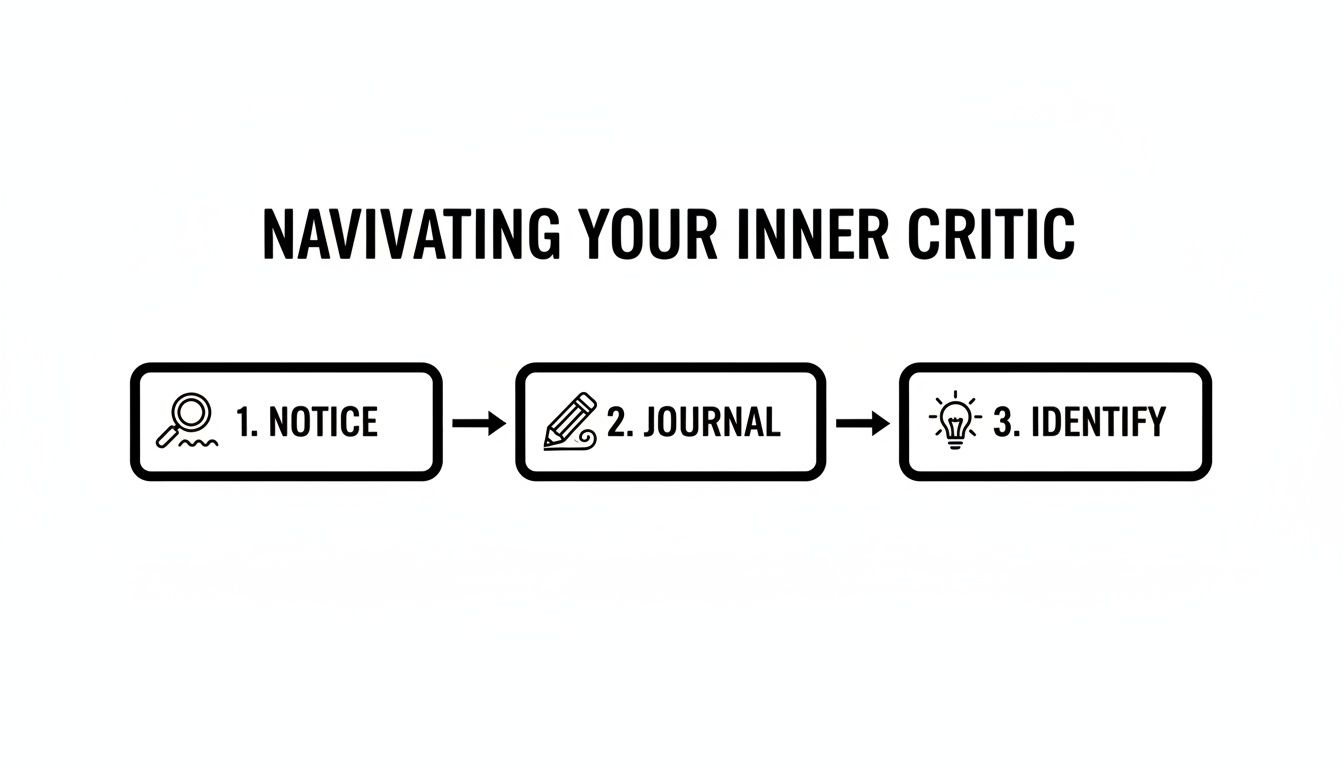
Following this simple flow—Notice, Journal, Identify—takes the thought out of the emotional firing line and turns it into something you can analyse objectively. It immediately strips away a lot of its power.
Testing Your Beliefs with Behavioural Experiments
Sometimes, the most powerful way to dismantle a negative thought is to actually test it out in the real world. In therapy, we call this a behavioural experiment. It’s all about creating a small, safe test to see if your negative prediction actually comes true.
Think about a social situation. Maybe your negative thought is something like, "If I go to that party on my own, I’ll just end up standing in the corner and no one will talk to me."
A behavioural experiment would be to test that very belief. You're not aiming to become the life and soul of the party. The goal is simply to collect some real-world data.
Behavioural Experiment ExampleBelief: No one will talk to me if I go to the party alone.Experiment: I'll go to the party for just 30 minutes. My only goal is to ask one person a simple, open-ended question, like "How do you know the host?"Prediction: They’ll give me a one-word answer and walk off.Outcome: (After the event) I asked someone the question, and we ended up chatting for a good few minutes about our mutual friend. My prediction was totally wrong.
These little experiments give you concrete, undeniable proof that your negative thoughts are often terrible at predicting the future. They're so powerful because the evidence comes from your own direct experience, which is far more convincing than just telling yourself a thought isn't true.
By using thought challenging and behavioural experiments again and again, you actively start to rewire your brain. Each time you successfully reframe a thought or prove a negative belief wrong, you weaken those old, unhelpful neural pathways and strengthen new, more compassionate and realistic ones. This is the practical, hands-on work of learning how to stop negative self talk from running the show.
Step 3: Build Self-Compassion as Your Inner Ally

Challenging your negative thoughts with logic is a powerful step, but the real, lasting change happens when you start replacing that internal criticism with genuine kindness. Learning how to stop negative self-talk isn't about winning a war against yourself; it's about making self-compassion your strongest inner ally.
Self-compassion really is the ultimate antidote to a harsh inner critic. At its heart, it's about treating yourself with the same care and understanding you would offer a good friend who was struggling.
It all rests on three core pillars that work together, helping you shift your internal dialogue from critical to supportive.
The Three Pillars of Self-Compassion
Understanding these components is the first step to actually practising them. They give you a clear framework for how to respond to difficult moments with kindness rather than judgement.
Self-Kindness: This is simply about being gentle and understanding with yourself when you suffer, fail, or feel inadequate, instead of ignoring your pain or beating yourself up.
Common Humanity: This is the crucial realisation that suffering and personal imperfection are just part of the shared human experience. You are not alone in your struggles—everyone goes through similar difficulties.
Mindfulness: This means taking a balanced approach to your negative emotions. It allows you to observe your thoughts and feelings as they are, without trying to suppress them or getting carried away by them.
Together, these pillars create a powerful buffer against the shame and isolation that so often fuel negative self-talk. If you want to dive a bit deeper, have a look at our quick guide to kinder thinking and what self-compassion is.
Self-compassion isn't about letting yourself off the hook; it's about creating the emotional safety needed to acknowledge your mistakes and learn from them without destroying your self-worth in the process.
Practical Ways to Build Self-Compassion
Putting these ideas into practice can feel a bit strange at first, especially if you’re used to being hard on yourself. The key is to start with small, manageable exercises that feel genuine to you.
One simple yet surprisingly powerful technique is to create a personal mantra for difficult moments. It’s just a short, kind phrase you can repeat to yourself when your inner critic pipes up. It could be something like:
"This is a moment of struggle. May I be kind to myself."
"I am doing the best I can right now."
"It's okay to not be okay."
Another really effective exercise is to write a compassionate letter to yourself. Imagine a wise and unconditionally loving friend is writing to you about a specific struggle you're facing. What would they say? How would they offer support and perspective? Read it back to yourself whenever you need a reminder to be kinder.
These practices help create new neural pathways in your brain. Slowly but surely, you're training it to default to kindness instead of criticism. It's about learning to become your own best friend, especially when you need one the most.
Step 4: Seek Professional Support When Needed
While the self-help techniques we've talked about are genuinely powerful, sometimes they just aren't quite enough to make a lasting change on your own. Trying to figure out how to stop negative self talk for good can feel like a lonely battle, but it really doesn't have to be.
Reaching out for professional support isn’t a sign of failure; it's a proactive and pretty courageous investment in your own wellbeing.
Therapy offers a dedicated, confidential space to explore the deeper roots of your inner critic—something that’s often incredibly difficult to do alone. In our sessions, we can dig into where these critical voices first came from and start to understand what their purpose is, which is often a misguided (and unhelpful) attempt at protection.
The reality is that many of us try to manage these feelings in silence. In fact, a staggering 64% of people in the UK admit to putting on a 'brave face' to avoid discussing their mental health.
This behaviour just bottles up negative self-talk. For 24% of those hiding their emotions, it actually leads to their mental health getting worse, which just goes to show how vital open conversation is. You can read more about these findings on mental health conversations.
My Approach at Therapy with Ben
My role is to work alongside you as a guide and a collaborator. It’s not about me telling you what to do.
Together, we build a personalised toolkit of strategies that actually feel right for you, moving beyond generic advice to create something that fits your unique experiences and personality. This is about more than just managing symptoms; it’s about fostering genuine, lasting self-compassion.
Our sessions, whether online from the comfort of your own home or during a unique 'walk-and-talk' therapy session here in Cheltenham, provide a safe environment to practise new ways of thinking. We can challenge those automatic negative thoughts in real-time and explore healthier responses in a supportive setting. You can learn more about my approach on our services page.
Therapy provides a unique space where your inner critic is not the only voice in the room. Having a therapist as an ally means you have someone else in your corner, helping you find the evidence that challenges those old, harsh beliefs.
Recognising When It's Time for Support
Knowing when to seek professional help is a key step in itself.
If you find that your negative self-talk is persistent, overwhelming, or tied to feelings of anxiety and depression that are getting in the way of your daily life, it might be the right time. For those looking into different types of care, understanding the roles of various professionals, such as a psychiatric mental health practitioner, can also be very helpful.
Working with a therapist provides structure, accountability, and expert guidance that’s tailored to your specific needs. It can really accelerate your progress, helping you move from simply surviving your inner critic to truly thriving with a kinder, more supportive internal dialogue.
Step 5: Consolidate Your Learning and Maintain Progress
Once you've started to implement these new skills, the final step is to make them a lasting part of your life. This is about embedding these healthier habits so that responding to your inner critic with balance and compassion becomes your new default.
Your Questions Answered
When you start working on your inner critic, it's only natural for questions to pop up. It's a journey, after all. I've put together some thoughts on the most common questions I hear from clients, hoping to offer a bit of straightforward guidance.
How Long Does It Take to Stop Negative Self-Talk?
This is the big one, and the honest answer is: there's no fixed timeline. It’s a process of unlearning habits that might have been with you for years, and that takes time. Think of it like learning any new skill—the more you practise, the more natural it becomes.
Some people feel a small but noticeable shift within a few weeks. For deeper, more ingrained patterns, it can take several months to really see a significant change. What truly matters is consistency, not perfection.
The goal isn't to silence every negative thought forever; that’s not really how our minds work. Real progress is about catching the thought quicker, challenging it more effectively, and—most importantly—treating yourself with a lot more compassion when it does show up.
Can Negative Self-Talk Ever Be Useful?
It's an interesting one, this. In a strange way, the inner critic often thinks it's helping. It's a misguided attempt at protection, trying to motivate you with fear ("If I don't get this perfect, I'll fail") or shield you from disappointment by keeping your expectations low.
But in the long run, this strategy almost always backfires. It chips away at your confidence, fuels anxiety, and often leads straight to burnout. It's just not a sustainable way to live.
A much healthier way forward is through constructive self-evaluation. This is about being honest with yourself about areas for improvement without attacking your worth as a person. It’s the difference between "I didn't handle that conversation well" and "I'm a complete idiot." One is an observation, the other is an attack.
What if I Can't Seem to Stop the Thoughts on My Own?
First off, if this is you, please know it's incredibly common. There’s absolutely nothing to be ashamed of. These thought patterns can be stubborn, especially if they’re tied to past experiences, trauma, or long-standing anxiety.
If you’ve been trying these techniques for a while and still feel completely stuck, it’s a strong sign that it might be time to get some professional support.
A good therapist can offer a safe, non-judgemental space to dig into where these thoughts are coming from. Together, you can build a more personalised set of tools to manage them. Reaching out isn't a sign of weakness; it's a proactive, powerful step towards taking back control of your wellbeing.
Are There Any Apps or Tools That Can Help?
Absolutely. The right tech can be a brilliant support for the work you're doing. There are plenty of great resources out there that can help reinforce new habits day-to-day.
CBT-Based Apps: Tools like MindShift CBT are designed around thought-challenging exercises, giving you a structured way to practise.
Journaling Apps: Something like Daylio can help you easily track your moods and activities, making it easier to spot your personal triggers.
Mindfulness Apps: Well-known apps like Headspace or Calm have huge libraries of guided meditations to help you observe your thoughts without getting caught up in them.
These tools are fantastic for keeping the momentum going between sessions or just as part of a daily mental health routine.
At Therapy-with-Ben, I can help you build the personalised toolkit you need to quieten your inner critic and foster lasting self-compassion. If you're ready to take the next step, I invite you to learn more about how we can work together.


Comments