


What Is Therapeutic Relationships (what is therapeutic relationships) Heals
Updated: Feb 5
Authored by: Therapy-with-Ben
At its heart, the therapeutic relationship is the unique, professional bond that forms between you and your therapist. It's the very bedrock of our work together – a secure foundation where real, meaningful progress can happen. It’s important to say this isn’t a friendship; it’s a distinct alliance with clear, professional boundaries, focused entirely on your wellbeing and personal growth.
Understanding The Therapeutic Alliance
Let's try an analogy. Imagine you've decided to climb a formidable mountain. You're the climber, bringing your own unique strengths, fears, and a summit you hope to reach.
Your therapist, in this scenario, is like a seasoned mountain guide. They don't pick the destination for you, and they certainly don't carry you to the top. Instead, they bring their expertise, a deep knowledge of the terrain, the right tools, and an understanding of the safest routes to take. They walk alongside you, offering support and guidance, but it's you who does the climbing. That collaborative journey is the therapeutic relationship.
This kind of alliance is more vital than ever, especially when you look at the growing need for mental health support here in the UK. Recent data from NHS England showed that one in five children and young people aged eight to 25 had a probable mental health disorder, which really highlights just how many people can benefit from this kind of professional support. You can read more about these mental health trends over on the NHS England website.
It’s often tricky to distinguish the therapeutic relationship from a friendship, as both involve trust and openness. However, their purpose and boundaries are fundamentally different. This table breaks it down.
Therapeutic Relationship vs Friendship Key Differences
Aspect | Therapeutic Relationship | Friendship |
|---|---|---|
Purpose | Focused solely on your wellbeing, goals, and healing. | Mutual support, shared interests, and enjoyment. |
Structure | Professional, with scheduled sessions and clear boundaries. | Informal, spontaneous, and flexible. |
Focus | One-way focus: the therapist supports the client. | Two-way and reciprocal; both friends give and take. |
Confidentiality | Legally and ethically bound by strict confidentiality. | Based on mutual trust, but not legally protected. |
Duration | Time-limited, ending when goals are met or support is no longer needed. | Can last a lifetime with no set endpoint. |
Ultimately, a friendship is a shared journey, while the therapeutic relationship is a journey guided for your benefit. Both are valuable, but they serve very different roles in our lives.
A Space for Healing
The therapeutic relationship is designed to create a dedicated, safe space. It’s a place where you can explore your innermost thoughts, feelings, and past experiences without any fear of judgement. It's within this trusted container that genuine healing can really begin.
This bond is the groundwork for any effective therapy, but it’s built on a few key pillars:
Collaboration: We’re a team. You and I work together towards the goals you set.
Safety and Trust: Firm professional boundaries and complete confidentiality are non-negotiable. This is what allows you to feel secure enough to be vulnerable.
Client-Focused: The entire process is about you. It’s centred on your needs, your experiences, and your wellbeing.
This connection is especially important in my work, particularly with approaches like walk and talk therapy, where a more relaxed, side-by-side setting can help build rapport and make it easier to open up. When all is said and done, the quality of this relationship is often the single most important factor in whether your therapy journey is a success.
The Core Ingredients Of A Strong Therapeutic Bond
A powerful therapeutic relationship doesn't just happen by chance; it’s built, carefully and intentionally, on a foundation of specific, essential ingredients. In fact, research consistently points to the quality of this bond—more than any specific technique a therapist might use—as the single biggest predictor of a good outcome in therapy.
Think of these core elements as the pillars holding up the entire structure of your healing journey.
This visual really gets to the heart of it: the therapeutic alliance is a joint effort. It's supported by both the therapist (the guide) and you, the client (the climber).
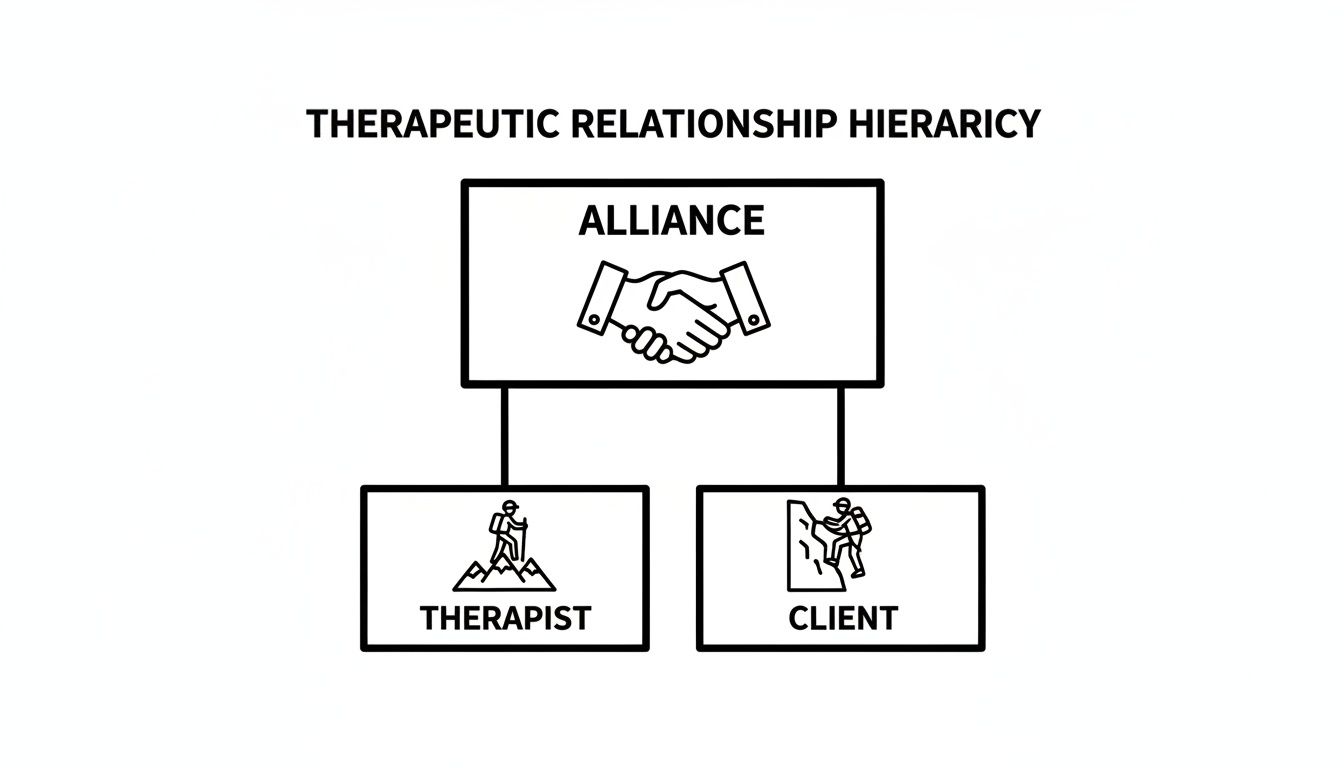
The image hammers home that a strong alliance isn't something a therapist just gives you. It’s co-created, relying on the active participation and engagement of both of you.
The Three Pillars Of Connection
So, what are these crucial components that make it all work? Often called the "core conditions," they were first identified by the brilliant psychologist Carl Rogers and remain absolutely central to effective counselling today.
Empathy: This is so much more than just feeling sorry for someone. True empathy is the therapist's ability to genuinely step into your world and understand your feelings, thoughts, and experiences from your perspective. It’s that feeling of being truly seen and heard without having to over-explain yourself.
Genuineness (or Congruence): This simply means your therapist is real with you. They aren't playing a role or hiding behind a professional mask. This authenticity helps foster a real human-to-human connection, which in turn makes it far easier for you to be open and honest.
Unconditional Positive Regard: This might be the most profound element of all. It means your therapist accepts you completely, without judgement, for who you are right now. This unwavering acceptance creates a space where you can share your deepest fears and perceived flaws, knowing you will be met with respect. We explore this further in our guide to unconditional positive regard in therapy.
These three conditions don't work in isolation; they weave together to build a deep sense of psychological safety. When you feel genuinely understood, connected to an authentic person, and accepted without reservation, you find the confidence to explore really challenging topics and make lasting changes in your life.
The Protective Container
Holding these three pillars together are two non-negotiable elements that act as a protective container for the therapeutic work: confidentiality and professional boundaries.
Confidentiality ensures that what you share in the room, stays in the room. This provides the security you absolutely need to be vulnerable. Meanwhile, professional boundaries make it clear that this is a dedicated, one-way relationship focused entirely on your wellbeing, which protects the integrity and purpose of your therapy.
Together, these elements create the trust necessary for the core conditions to flourish, making the therapeutic relationship a powerful catalyst for healing.
How A Secure Therapeutic Connection Drives Real Change
So, why does the relationship with your therapist matter quite so much? Think of it as the engine for healing and personal growth. A strong, trusting alliance gives you the solid ground you need to face difficult emotions, question old beliefs, and try out new ways of being, all within a space that feels genuinely safe and supportive.
This bond isn't just about feeling comfortable; it’s about what works. It's the fuel for real-world change. When you feel properly seen, heard, and understood by your therapist, it can be a deeply corrective experience. This is especially true if you’ve had relationships in the past where trust was broken or you never felt you could really be yourself.
The process starts to repair and rebuild your capacity for trust, both in other people and, just as importantly, in yourself. This foundation of safety is often the very first, and most crucial, step in getting a handle on things like anxiety and depression.
Turning Trust Into Tangible Progress
Feeling secure with your therapist gives you the confidence to do the hard work. It's the difference between nervously skirting around an issue and finding the courage to look it squarely in the eye.
This relationship acts as a secure base from which you can start to explore the world differently. You can bring your real-life experiences into the therapy room, unpack them with your therapist's support, and then head back out with new insights and strategies. It's this supportive feedback loop where lasting change really starts to take root.
The effectiveness of this isn't just anecdotal. We're seeing it more and more in UK mental health statistics, which show measurable positive outcomes when people stick with therapy. The NHS Talking Therapies service, for example, tracks recovery outcomes as a key measure of success, reflecting just how important these therapeutic connections are. You can discover more about these therapy outcomes on the GOV.UK website.
This connection empowers you to move from a place of simply surviving to actively thriving. It helps you build resilience, not by avoiding life's challenges, but by giving you the tools and self-belief to navigate them with greater confidence.
A Corrective Emotional Experience
For many people, the relationship with their therapist is the first truly healthy, boundaried, and supportive connection they've ever had. It provides a model for what a secure relationship can feel like, which you can then carry over into the other relationships in your life. It teaches you that it's okay to be vulnerable and that you can rely on someone to respond with consistency and care.
This powerful dynamic can reshape how you interact with friends, family, and partners. For those looking to strengthen their own bond, professional guidance through couples counseling can be an incredibly effective way to build that understanding and drive real change together.
Ultimately, the goal is for you to internalise the support you receive in therapy. You learn to treat yourself with the same compassion and understanding your therapist offers, becoming your own advocate long after your sessions have ended.
Navigating The Therapy Journey As A Man

Let’s be honest, society has often pushed the idea that men should be stoic, that showing vulnerability is somehow a weakness. This can make the thought of opening up to a stranger in a therapy room incredibly daunting, and it's a huge barrier for many men who could really do with some support.
Just acknowledging that pressure is the first step. Realising that seeking help is actually an act of strength and self-awareness, not a failing, is a massive part of the journey. It's about taking the reins of your own mental wellbeing.
Finding A Relatable Connection
For some men, speaking with a male counsellor can just click. It’s not about one gender being better at therapy than the other; it’s simply about finding a space built on a shared understanding of certain life experiences. It can feel easier to talk through things like the pressures of fatherhood, career stress, or those unspoken rules of masculinity with someone who has likely navigated similar waters.
With a therapist like me, you get to explore these ideas without any fear of judgement. We can unpack how these expectations have shaped you, creating a therapeutic relationship where you feel properly heard and understood. This is a big deal in the UK, where the stats on men seeking help are pretty stark.
Research shows that men only make up 36% of NHS therapy referrals. Dig a bit deeper, and you find that just 17% of men would think about therapy for a prolonged low mood, compared to 22% of women. You can learn more about UK mental health statistics here.
Creating A More Comfortable Environment
The traditional therapy setup doesn't work for everyone. Sitting face-to-face in a formal office can feel a bit intense, even restrictive, which doesn't exactly help the conversation flow. This is where different approaches can make all the difference in building that crucial therapeutic relationship.
Walk and talk therapy, for example, completely changes the dynamic. By taking the session outdoors into one of Cheltenham’s beautiful parks, the formality just melts away. There's something about walking side-by-side that feels less confrontational, allowing a more natural, relaxed conversation to unfold.
It’s a way of making the whole experience feel more comfortable and engaging, especially for men who might be on the fence about starting therapy in the first place. You get the benefits of physical movement combined with focused support, creating a space where opening up feels not just manageable, but productive.
Adapting The Therapeutic Relationship For Neurodiverse Clients
There's no such thing as a one-size-fits-all approach in therapy, and that’s never truer than when working with neurodiverse clients. People with Autism, ADHD, and other neurodivergent traits often see and experience the world in a completely different way. For a therapeutic relationship to have any real impact, the therapist has to be willing to adapt their entire way of working to meet the client right where they are.
This goes way beyond simply tweaking standard methods. A good therapist will adjust how they communicate, perhaps being more direct and literal, or giving you more time to process your thoughts. They'll also have a deep respect for your sensory needs, making sure the therapy space doesn't feel overwhelming or overstimulating.
For many neurodiverse people, this might be the first time they’ve ever felt truly seen and understood by a professional. It's a chance to be yourself without having to 'mask' or try to fit into neurotypical boxes, which can be an incredibly powerful and freeing experience. We explore this further in our article on neurodiverse counselling.

Flexibility and Creative Approaches
Being flexible is a huge part of adapting the therapeutic relationship. This is where different approaches, like walk and talk therapy, can really come into their own. The traditional, face-to-face setup in an office can come with all sorts of unspoken social pressures that are tough for many to navigate.
By taking away the intense pressure of constant eye contact and offering a calmer, sensory-friendly setting, alternative therapy formats can make a massive difference to anxiety levels. This helps communication feel more open and natural, turning therapy into something genuinely accessible and effective.
Just changing the environment can be a game-changer. It allows for a more natural, side-by-side connection that feels less like a clinical appointment and more like a real, supportive conversation. This can help build trust and rapport much faster, giving you a stronger foundation to do the work that matters.
Some of the essential adjustments include:
Adjusting Communication: Using clear, straightforward language and steering clear of vague or ambiguous phrases.
Sensory Considerations: Being aware of the lighting, noise levels, and anything else in the environment that might be distracting or uncomfortable.
Respecting Pacing: Letting you, the client, set the pace of the conversation and the session itself.
Validating Experience: Acknowledging and respecting the unique strengths and challenges that come with your neurotype.
By making these kinds of thoughtful changes, the therapeutic relationship becomes a genuinely safe space for you to explore, understand yourself, and grow.
Finding The Right Therapist For You In Cheltenham
Getting your head around what a therapeutic relationship is all about is the first big step. But the real game-changer? Finding the right person to actually build one with. For anyone living in and around Cheltenham, this is where the theory ends and the practical search begins.
It can feel like a pretty big task, I know. A good starting point is to have a proper look through a therapist's website or professional profile. This gives you a feel for what they specialise in, how they work, and, just as importantly, a sense of their personality. You’re looking for that initial spark of connection, that feeling of 'fit', even from a distance.
The Importance Of An Initial Chat
This is why most counsellors, myself included, offer a free initial chat. Think of it less as a formality and more as a two-way interview. It’s your chance to see how you feel talking to them. Ask yourself: Do I feel comfortable? Am I being listened to? Do I feel respected? Trust your gut on this one.
That first conversation is also the perfect moment to ask about the things that really matter to you. For some people, that might mean finding a professional with very specific experience. For example, you might need to find a qualified psychiatrist in Cheltenham if you need to explore a particular diagnosis.
A good 'fit' between you and your therapist is one of the strongest predictors of a positive outcome. That first chat is your opportunity to see if that connection is there before you commit to anything.
My Approach At Therapy With Ben
As a male counsellor working in Cheltenham, my priority is to create a space where you feel safe enough to explore whatever is on your mind, completely free of judgement. My entire approach is built on fostering the kind of strong, genuine therapeutic relationship we've been talking about.
I also offer something a bit different: walk and talk therapy in some of Cheltenham's lovely local parks. For many, walking side-by-side can make it feel much more natural and less intense to open up. If you'd like to understand more about the process, you can read my guide on how to find a good therapist in Cheltenham.
Remember, reaching out is a sign of real strength. If anything you've read here resonates with you, feel free to have a look at my About Me page or get in touch directly to arrange a free, no-obligation chat.
Common Questions About The Therapeutic Relationship
Stepping into therapy for the first time, or even with a new therapist, naturally brings up a few questions. Let's tackle some of the most common queries I hear, giving you some clear, straightforward answers to help you feel more at ease.
What If I Don’t Feel A Connection With My Therapist?
It’s completely normal and absolutely okay if you don't feel that 'click' straight away. In fact, finding the right 'fit' is one of the most important parts of making any real, lasting progress. A good therapeutic relationship is built on trust and feeling comfortable, and that doesn't always happen in the first hour.
If you find yourself feeling this way, the best thing to do is often to just bring it up. An experienced counsellor will welcome this kind of honesty; it's genuinely useful information. But if that feeling sticks around after a few sessions and you feel it's getting in the way, it is always your right to look for someone else who might be a better match for your personality and what you need.
How Long Does It Take To Build This Relationship?
There's no magic number here. Building trust is a gradual process that looks different for every single person. Some people might feel a sense of rapport and safety within the first couple of sessions. For others, it takes a bit longer to feel secure enough to be truly vulnerable.
I often think of it like tending a garden; it needs time, consistency, and the right conditions to really flourish. That deep, lasting trust is built bit by bit, through the consistency and empathy your therapist shows, and the understanding you build together. The most important thing is to let it develop at a pace that feels right for you, without any pressure.
Is The Therapeutic Bond The Same In Online Therapy?
Absolutely. A strong, meaningful, and effective therapeutic relationship is entirely possible when you meet online. While the setting is different, the core ingredients – empathy, genuineness, and trust – are exactly the same. Therapists are trained to build that connection and create a safe space, no matter the medium.
For some, online therapy actually offers a level of comfort and flexibility that makes it easier to open up, as you’re in your own familiar environment. The key is simply finding a therapist and a format—whether that's online, in-person, or even walk and talk—that helps you feel the most supported.
At Therapy with Ben, my entire focus is on building a supportive, trusting therapeutic relationship that’s right for you, whether that's in my Cheltenham office, online, or during a walk and talk session. If you feel ready to take the next step, please get in touch for a free initial chat. FAQs and Support
Got questions about counselling, confidentiality, or what to expect? Check out my FAQs or learn more about my integrative approach. When you’re ready, reach out and we can talk through your options.


Comments