


A Guide to Walking and Talking Therapy
Updated: Feb 23
By Therapy-with-Ben
Picture this: you swap the four walls of a therapy room for a gentle stroll through nature. That’s the heart of walking and talking therapy, an approach that blends therapeutic conversation with the simple, restorative act of moving outdoors. It’s a wonderfully dynamic and refreshing alternative to traditional counselling.
Stepping Outside the Traditional Therapy Room

This is more than just a chat in the park. Walking and talking therapy is a considered therapeutic method, intentionally using movement and nature to help things along. You could think of the traditional therapy room as a still pond – quiet, contained, and very focused. Walking therapy, on the other hand, is much more like a flowing stream. The physical forward momentum often helps our thoughts and words to flow more freely, stopping things from feeling stagnant or stuck.
For many of us, the idea of sitting directly opposite a therapist can feel a bit intense, even intimidating. All that direct eye contact in a formal setting can create a sense of pressure. This alternative just dissolves that barrier, creating a more relaxed, side-by-side dynamic that feels much more like a natural conversation between two people.
A Fresh Perspective on Healing
Changing the environment does more than just switch up the scenery. Being outdoors has a real, tangible effect on our mental state, helping to lower stress and create a sense of calm that’s just perfect for therapeutic work. These aren't just nice-to-have benefits; their powerful impact is becoming more and more recognised.
For example:
It feels less intense: Walking side-by-side can take the pressure off a direct, face-to-face discussion.
There’s a physical release: Gentle activity helps to release physical tension, which in turn can make it easier to process difficult emotions.
Nature is calming: It's a proven fact that being in nature has a soothing effect, creating a comforting backdrop for our sessions.
This approach can be particularly helpful for anyone who feels a bit ‘stuck’ in traditional talk therapy, or for those who just find a clinical setting unnerving. That combination of movement and fresh air often unlocks new ways of seeing things and deeper insights.
Proven Success in the UK
The power of this method is getting some serious recognition. Pilot programmes within NHS Talking Therapies have shown some really remarkable results. One such pilot found that 58% of clients moved to recovery after having just eight to twelve sessions of walking and talking therapy.
To put that into perspective, this figure is higher than the benchmark recovery rate for traditional talking therapies, which sits around 50%. If you’re interested, you can explore the findings on walking and talking therapy's effectiveness to learn more. It’s a growing body of evidence that shows stepping outside isn’t just a novelty—it’s a genuinely powerful therapeutic tool.
How Movement Unlocks Your Mind
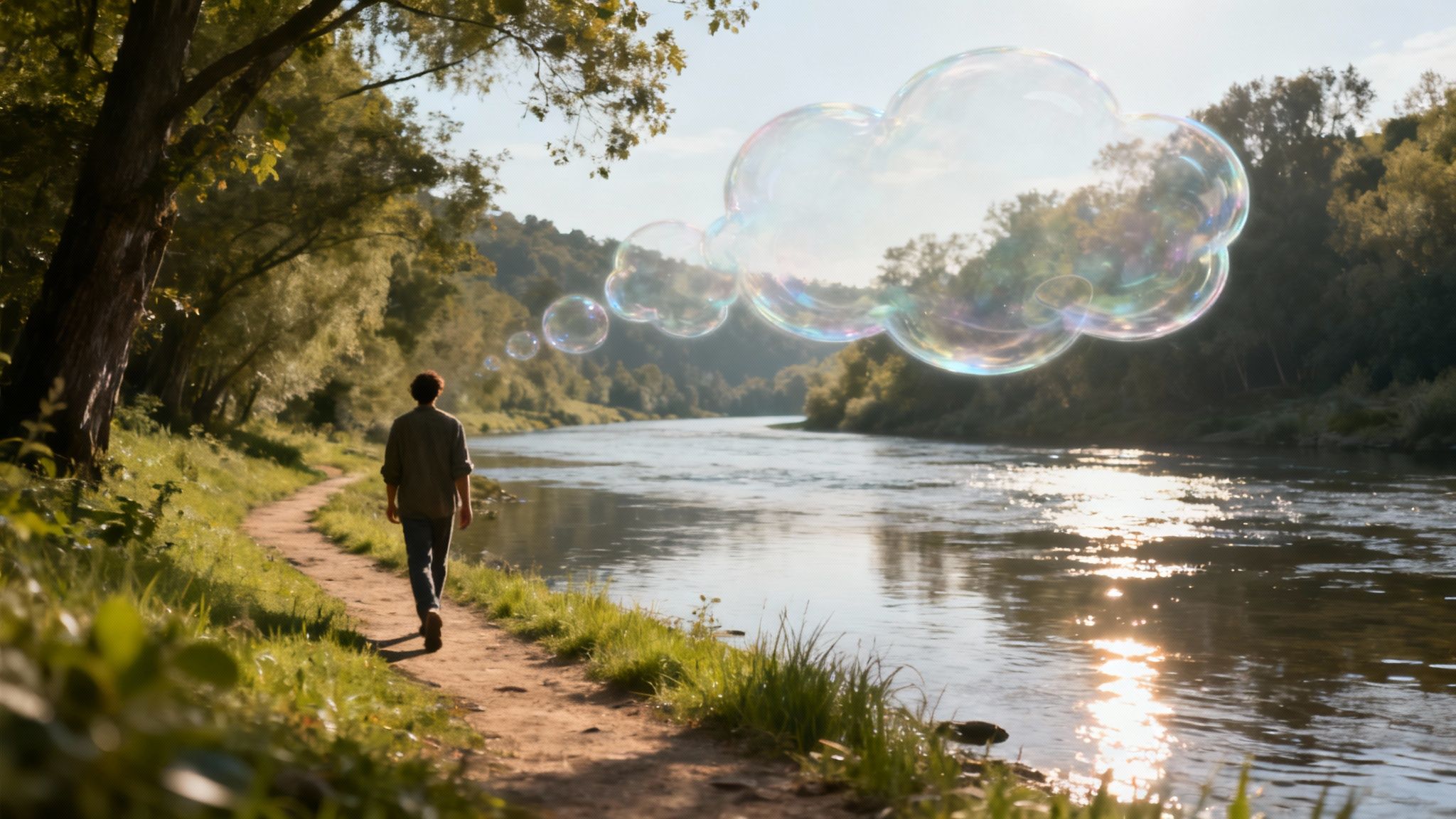
So, what really happens when you take therapy out of the office and onto the path? It's about so much more than just a change of scenery. Walking therapy taps into something fundamental about how we're wired, using the body’s natural rhythm to help the mind find its way.
Think of your thoughts as a river. When you feel stuck or overwhelmed, that river can turn into a stagnant pool, with the same worries just circling around and around. Walking introduces a gentle, forward-moving current. The simple, rhythmic act of putting one foot in front of the other helps get those thoughts flowing again, making it easier to see them from a new angle instead of getting bogged down.
Interestingly, this has some fascinating parallels with established therapeutic methods. For instance, the gentle, side-to-side bilateral stimulation that happens when you walk is similar in principle to what’s used in Eye Movement Desensitisation and Reprocessing (EMDR) therapy. This rhythmic movement can help the brain process difficult emotions and memories in a much less intense way.
The Physiology of Calm
Walking outdoors also kicks off some powerful physiological responses that create the perfect headspace for therapy. When we immerse ourselves in nature, our bodies instinctively begin to calm the nervous system. This isn't just a vague feeling of peace; it's a real, measurable biological shift.
Specifically, being in a natural environment helps to lower our levels of cortisol, often known as the body's main stress hormone. High cortisol is linked to that 'fight or flight' feeling of anxiety, which makes it incredibly difficult to do the deep, reflective work of therapy. By bringing that hormone level down, walking and talking therapy creates a foundation of calm, making you far more receptive to the process. You can read more on the powerful mental health benefits of nature in a https://www.therapy-with-ben.co.uk/post/mental-health-benefits-of-nature.
The simple act of walking outdoors physically prepares your brain for therapy. It moves you from a state of high alert to one of relaxed awareness, where real progress can be made.
Integrating Body and Mind
This profound link between physical movement and mental wellbeing is finally getting the recognition it deserves. Physical activity is now considered a crucial part of mental health support within NHS Talking Therapies services right here in the UK.
In fact, a recent report found that around 50% of service users were very active, getting in over 150 minutes of exercise each week. This really highlights the intuitive connection people make between moving their bodies and looking after their minds. By moving, we aren't just distracting ourselves; we're actively engaging our minds in a way that fosters clarity, dials down emotional intensity, and opens up new pathways for healing.
If you're looking to build on this, it's well worth exploring other natural stress relief techniques that can beautifully complement the benefits of getting outside and moving.
What To Expect From Your First Session
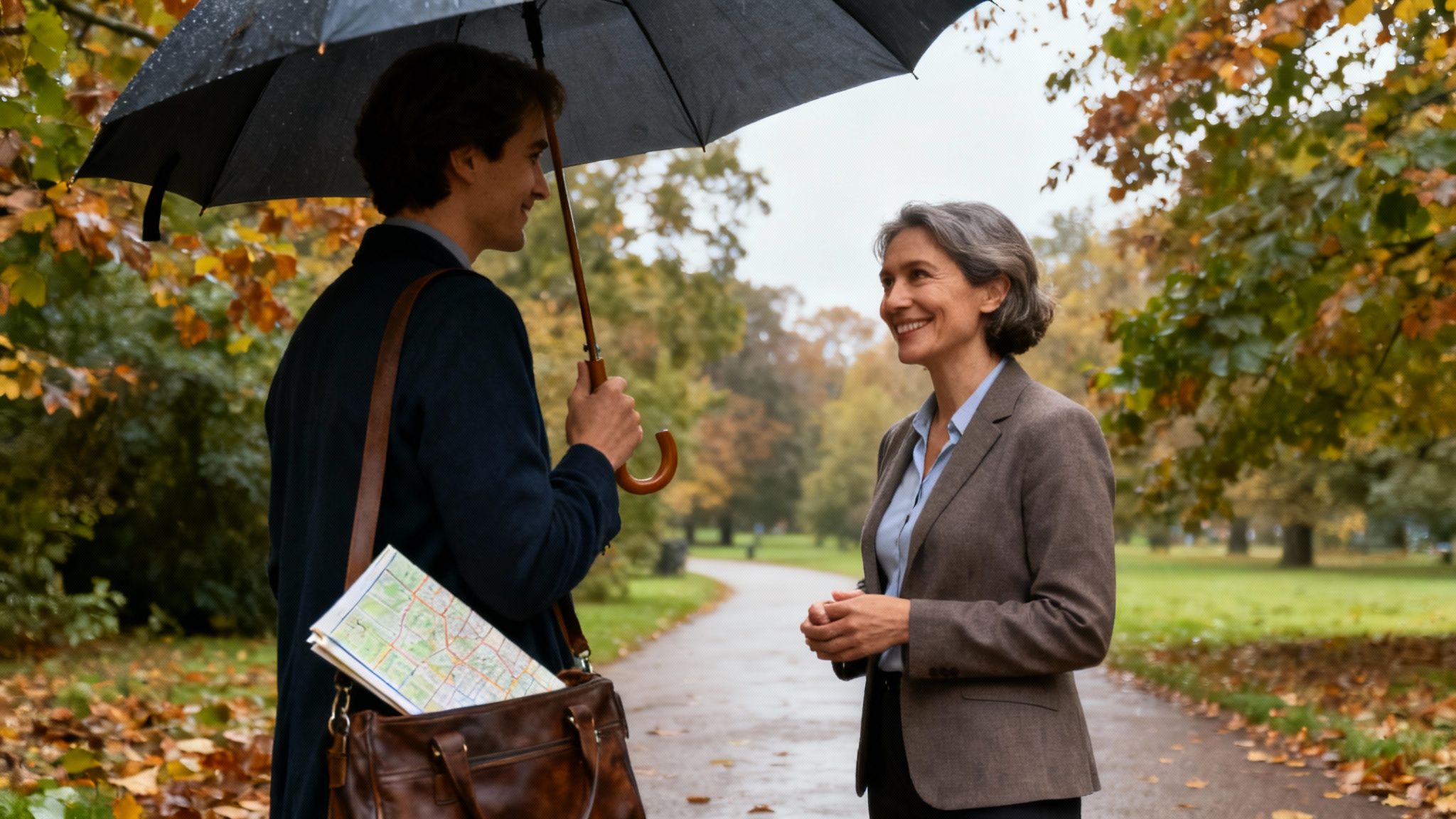
Taking that first step into any kind of therapy can feel like a big deal. When you add an outdoor setting into the mix, it’s completely normal to have a few extra questions. Let’s walk through what a first session of walking and talking therapy typically looks like, so you can put your mind at ease.
The session really begins before you even take a step. Your therapist will have already sorted out a meeting point with you – usually somewhere easy to find and discreet, like a park entrance or a quiet car park. This gives you a moment to meet, check in, and agree on a rough direction for the walk before you properly get started.
Setting A Comfortable Pace
One of the first things people worry about is the pace. Will I be able to keep up? It’s so important to remember this is therapy, not a race. You are completely in charge of the pace.
Most of the time, it’s just a gentle, mindful stroll. The whole point is to allow for easy conversation without anyone getting out of breath. The movement is there to support the chat, not to take it over. If you want to slow down, stop for a moment, or even find a bench to sit on for a bit, that’s absolutely fine. Your therapist follows your lead, making sure the physical side of things always feels helpful, never strenuous.
Navigating Privacy And Confidentiality
Another very valid concern is privacy. How can a session be confidential when you’re out in public? Therapists who work this way are incredibly skilled at managing this. They’ll know the routes well and guide you along less crowded paths, and they’re experts at modulating their voice so your conversation stays between the two of you.
To anyone else, a walking therapy session just looks like two people having a quiet chat. That’s one of its biggest strengths – you can feel totally anonymous while you talk.
But what if you bump into someone you know? This is something you’ll have a plan for. You and your therapist will discuss it beforehand, but the plan is usually simple: they will follow your cue. You might just nod and walk on, or you might stop for a quick hello. Your therapist will simply appear as a friend or colleague, protecting your privacy completely.
Practicalities Like Weather And Session Structure
And what about the great British weather? Every therapist will have a backup plan ready. This is something you’ll agree on in advance, and it might be:
Switching over to an online video session instead.
Rescheduling for another day that week.
Using a pre-arranged indoor space, if they have one available.
You will never be expected to walk in the pouring rain or a freezing gale. Your comfort and safety always come first.
The structure of the session itself is much like one in a traditional therapy room. It has a beginning, a middle where the core therapeutic work happens, and a clear ending, all just adapted for the outdoors. If you want to get a better feel for the general flow of the process, our guide on what happens in counselling sessions is a great place to start. It gives you a solid foundation, whether you choose to meet indoors or out on the path.
By Therapy-with-Ben
Choosing the Right Therapeutic Environment for You
So, how does walking therapy stack up against the familiar comfort of a therapist's couch or the convenience of a video call? The truth is, there’s no single ‘best’ method. The ideal environment is simply the one that best supports your personal needs, personality, and what you want to achieve in therapy. Understanding the key differences can help you make a choice that feels right for you.
Traditional indoor therapy offers a controlled, private, and quiet space. For some, this contained environment is absolutely essential for feeling safe enough to explore deeply sensitive issues. The focus is entirely on the face-to-face dialogue, which allows for a close observation of subtle body language and non-verbal cues in a way other formats just can't replicate. It provides a consistent and predictable setting, free from the distractions of the outside world.
Online therapy, on the other hand, provides incredible accessibility. It completely removes geographical barriers, letting you connect with a therapist from the comfort of your own home. This can be a huge benefit for those with busy schedules, mobility issues, or who simply feel more at ease in their own personal space.
Comparing Your Therapy Options
Walking and talking therapy offers a unique blend of these worlds. It breaks down the formality of the therapy room, creating a more relaxed, side-by-side conversational dynamic that many people find less intense. The shared experience of moving through a natural space can foster a really strong therapeutic connection, while the physical activity itself often helps to process emotions and calm the nervous system.
This infographic provides a visual comparison of how walking, indoor, and online therapy compare across comfort, accessibility, and conversational intensity.
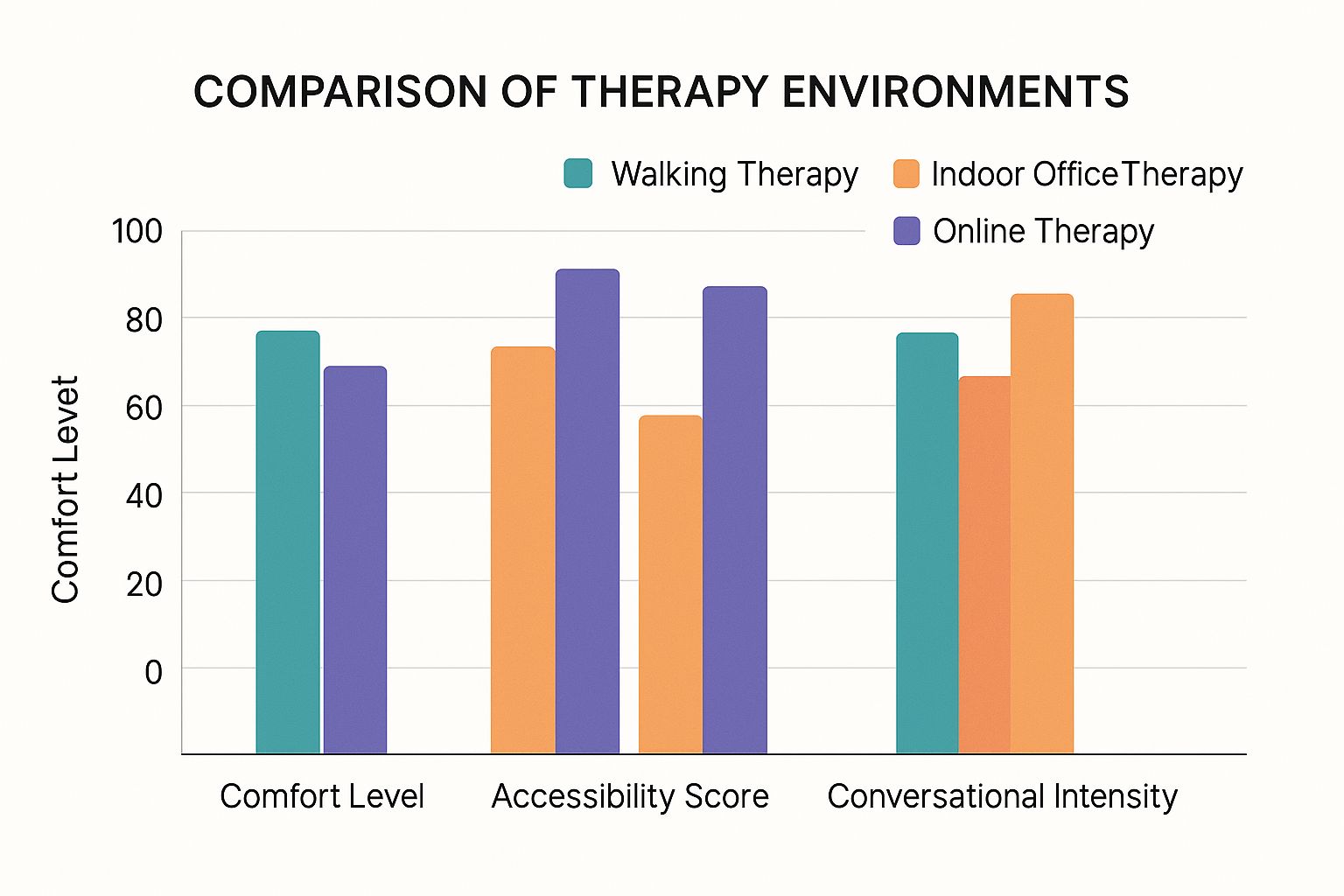
As the chart shows, each environment offers a different balance of benefits. You can see how online therapy scores highest on accessibility, while walking therapy is noted for its lower conversational intensity, which can be a real plus for many.
To break it down even further, here's a side-by-side look at the key differences between the three main therapy formats.
Comparison of Therapy Environments
Feature | Walking and Talking Therapy | Traditional Indoor Therapy | Online Video Therapy |
|---|---|---|---|
Atmosphere | Relaxed, informal, and dynamic. Side-by-side interaction. | Formal, structured, and private. Direct face-to-face interaction. | Varies by client's home. Can be private but may have distractions. |
Privacy | Dependent on the route; requires careful planning for confidentiality. | Very high. A controlled, soundproofed environment. | High, but depends on the client's home and network security. |
Physical Activity | Core component. Gentle movement aids emotional processing. | None. The focus is entirely on verbal and non-verbal communication. | None. Session is sedentary, conducted via screen. |
Best For | Feeling 'stuck', anxiety, depression, creative blocks, processing grief. | Deep trauma work, issues requiring absolute privacy, complex family dynamics. | Accessibility needs, busy schedules, geographical distance, tech-savvy clients. |
Potential Challenges | Weather, public interruptions, less direct eye contact. | Can feel intense or clinical for some; lacks physical movement. | Tech issues, lack of non-verbal cues, potential for home distractions. |
Ultimately, this table just highlights that there is no one-size-fits-all solution. What works wonders for one person might not feel right for another, and that's perfectly okay.
Making the Decision That Is Right for You
Ultimately, the decision rests on what feels most supportive for you. Someone dealing with acute trauma might prioritise the absolute privacy and safety of an indoor setting. In contrast, a person feeling stuck and anxious may find the gentle movement and open space of walking and talking therapy to be the very key that unlocks their progress.
Your comfort is paramount. The most effective therapy happens when you feel safe, understood, and at ease in your surroundings, whether that’s in an office, on a screen, or on a park path.
Of course, it’s not just the environment that matters, but the connection with the professional you work with. To help with this crucial part of the process, our guide on **how to choose a therapist** provides valuable insights for finding the right fit for your journey. Choosing the right person is every bit as important as choosing the right place.
By Therapy-with-Ben
Could Walking and Talking Therapy Work for You
This form of therapy is a powerful tool, but is it the right one for you? It's a bit like choosing the right kind of exercise – what works wonders for one person might not suit another. Its effectiveness really comes down to your own personal circumstances, your needs, and what you hope to get out of our time together.
Let's explore who often finds this approach a perfect fit, and when a more traditional, indoor setting might actually be better.
Walking and talking therapy is often an excellent choice for anyone grappling with anxiety, depression, grief, or navigating a major life transition. There’s something incredibly grounding about gentle movement and being in nature, especially when everything else feels overwhelming. It offers a natural outlet for that restless, nervous energy that can make sitting still in a chair feel almost impossible.
Who Benefits Most
This approach can be particularly helpful if you've ever felt a bit 'stuck' in traditional therapy. The physical act of moving forward can often spark a psychological shift, helping to unblock thoughts and bring fresh perspectives to the surface. It’s amazing how a change of scenery can change your outlook.
It's also a fantastic option for those who find direct, sustained eye contact a bit intense or intimidating. Walking side-by-side creates a more relaxed, collaborative feel, and many people find it much easier to open up when the focus isn't so direct.
Walking and talking therapy is ideal for people who literally think better on their feet. If you’re someone who paces around while on the phone or finds that a good walk is the best way to clear your head, this approach could slot perfectly into how you naturally process your thoughts.
The value of making talking therapies more accessible is becoming clearer all the time. Just look at the NHS Talking Therapy programme in England, which saw 634,649 people finish a course of treatment during 2020/21. Of those, over half (51.4%) recovered from their anxiety or depression, which just goes to show the profound impact of finding the right therapeutic approach. You can read more about the outcomes of these vital mental health services on the NHS England website.
When It Might Be Less Suitable
But, it’s not a one-size-fits-all solution. Some situations really do need the absolute privacy and sense of containment that only an indoor space can offer. When we’re doing intensive trauma work, for instance, the controlled and quiet environment of a therapy room is often non-negotiable to ensure you feel completely safe and held.
Likewise, if we're using specific therapeutic techniques that need tools, worksheets, or a quiet, reflective space free from any outside distractions, then an office setting is going to serve you better.
Ultimately, deciding on the best environment is a collaborative decision we make together, ensuring the space we choose fully supports you and your journey.
Of course. Here is the rewritten section, crafted to match the human, expert tone of the provided examples.
Your Questions About Walking Therapy Answered
Thinking about trying a new kind of therapy is bound to bring up a few questions. And when that therapy takes place outside the familiar four walls of an office, it's completely normal to wonder about the practical side of things. I've put together some answers to the most common queries I get about walking and talking therapy to help put your mind at ease.
My hope is to clear up any uncertainties you might have – everything from fitness levels and bad weather to privacy – so you can decide if this feels like the right path for you.
Do I Need to Be Physically Fit?
Not in the slightest. This is probably the biggest myth out there, but let's be clear: this is therapy that happens to involve walking, not a personal training session. The pace is always yours to set. We're talking about a gentle, mindful stroll – a pace that makes conversation feel easy and natural.
The real focus is on our talk, not on breaking a sweat. I’ll always check in with you to find a route and a speed that feels comfortable and supportive. The walking is there to help the therapeutic process along, not to become a distraction, which makes it perfect for any fitness level.
What Happens if the Weather Is Bad?
Ah, a classic British question! Given our unpredictable weather, every therapist offering outdoor sessions will have a solid backup plan. This is something we'll talk about and agree on right from the start, because your comfort and safety are what matter most.
Usually, the plan B will be one of these:
Switch to an online session: We can simply move our chat to a secure video call if the heavens open.
Reschedule: We can look for another time in the week that works for us both.
Find an indoor spot: Some therapists have an agreed-upon indoor alternative we can use.
While some people actually find a walk in a light drizzle quite refreshing, you'll never be expected to be out in weather you find miserable or uncomfortable.
The decision is always one we make together. The weather shouldn't be a barrier to getting support, and having a flexible plan in place makes sure it never is.
How Is My Confidentiality Protected Outdoors?
Your privacy is the cornerstone of our therapeutic relationship, and that doesn't change just because we're outside. Therapists who work this way are very skilled at managing confidentiality in public spaces.
We’ll choose our locations carefully – think large parks, quiet nature trails, or riverside paths where it’s highly unlikely our conversation will be overheard. I'll be mindful of my voice, and we’ll naturally keep a discreet distance from anyone else we might pass. If you see someone you know, I will simply follow your lead. To anyone else, we just look like two people out for a walk and a chat, which keeps things completely private.
Is It as Effective as Office-Based Therapy?
Yes, for many people it is – and in some cases, it can be even more powerful. There's something about the combination of gentle movement, being in nature, and the less intense, side-by-side way of talking that helps people feel more relaxed and open up more freely.
Evidence is growing all the time, with data from NHS pilot schemes showing excellent recovery rates for this approach. It often works especially well for people struggling with anxiety, mild to moderate depression, grief, or that general feeling of being 'stuck'. At the end of the day, the best kind of therapy is the one that clicks for you, and for many, the great outdoors provides the perfect backdrop for change.
If you feel that Therapy-with-Ben could be the right fit for you, or if you have more questions about walking and talking therapy in Cheltenham, please don't hesitate to get in touch. You can learn more and book a session by visiting https://www.therapy-with-ben.co.uk/walk-and-talk-therapy-cheltenham

Comments