


A Practical Guide to Coping with Change and Finding Stability
Before we can talk about coping with change, we have to get one thing straight: it's perfectly normal for it to feel unsettling. This isn't a sign of weakness; it's a deeply human reaction to having your world turned upside down. The real skill lies in understanding that response and then building a toolkit of practical, actionable strategies to handle the stress that comes with it.
Why Change Feels So Difficult to Navigate
Let’s be honest—navigating change is hard. It doesn't matter if it's an exciting new job, a tough redundancy, moving house, or even a subtle shift in a relationship. Any kind of disruption can knock us off-balance. It’s something everyone goes through, but it can feel incredibly lonely when you're in the thick of it.
The simple truth is, our brains are wired for predictability. We build routines and habits that help us get through our days feeling safe and in control. When change comes along, it smashes those familiar structures and throws us into the unknown.
That uncertainty isn’t just in your head. It triggers a genuine psychological and physiological response. Your mind starts racing with "what ifs," and you might feel the physical effects of stress, like a tight chest or sleepless nights. This is your brain’s ancient alarm system trying to protect you from what it sees as a potential threat, even if the change is actually a good one.
What you're feeling is a completely valid human response to losing the familiar. Acknowledging the feelings of stress, anxiety, or even grief is the first step towards managing them effectively.
The Human Resistance to Disruption
Our resistance to change usually boils down to a few core psychological factors. Getting your head around them can make your own experience feel more normal and show you that you’re not alone in finding this stuff tough.
Loss of Control: Change often means we have to give up the driver's seat. This can leave us feeling powerless and vulnerable, which is a deeply uncomfortable place to be.
Fear of the Unknown: It's natural to fear what we can't predict. The future becomes a blank page, and our minds have a nasty habit of filling it with worst-case scenarios instead of hopeful possibilities.
Disruption to Routine: Our daily routines are comforting. When they're broken, we have to use up so much more mental energy just to get through the day, which can lead to feeling drained and frustrated.
Emotional Grief: Every change, even a positive one, involves losing something—a familiar place, an old role, or even a past version of yourself. This can kickstart a genuine grieving process.
The Wider Context in England
This personal struggle doesn't happen in a vacuum. It's playing out against a backdrop of wider societal shifts. Over the last few years, rates of common mental health conditions have surged in England, especially among young adults navigating life's big transitions.
The Adult Psychiatric Morbidity Survey shows the prevalence of these disorders in adults has climbed from 1 in 6 in 2014 to 1 in 5 in 2023/24. That’s a 20% relative increase in a decade, which really highlights how vital it is for us all to develop effective coping skills. You can find more insights on these UK mental health statistics on PrioryGroup.com.
By understanding why change is so hard, you can start to approach your feelings with a bit more compassion. From there, we can begin building the resilience you need to move forward.
Grounding Techniques for Overwhelming Moments

When the stress of change feels like a tidal wave, it’s all too easy to get swept away. The current of racing thoughts and physical anxiety can feel overpowering. In those moments, what you need is an anchor.
That’s where grounding techniques come in. They are simple, powerful tools designed to pull you out of your head and back into the present, calming your nervous system when it’s gone into overdrive.
These aren't just distraction tactics; they work by engaging your senses to interrupt the brain's panic cycle. When anxiety rises—maybe after some difficult news or feeling swamped in a crowded space—your focus narrows. Grounding deliberately widens it again, reminding your body and mind that you are safe, right here, right now.
Reconnect With Your Senses Using the 5-4-3-2-1 Method
One of the most effective and discreet grounding exercises out there is the 5-4-3-2-1 method. It forces your brain to concentrate on the immediate environment rather than on internal fears. Think of it as a structured way of checking in with each of your senses, which you can do anywhere without anyone even noticing.
Here’s how to put it into practice:
See 5 things: Look around and silently name five objects. Notice the details – the grain of wood on a table, the colour of a passing car, the shape of a cloud.
Feel 4 things: Tune into the physical sensations you're experiencing. This could be the texture of your clothes, the solid ground beneath your feet, or the cool air on your skin.
Hear 3 things: Listen carefully and pick out three distinct sounds. It might be the distant hum of traffic, the ticking of a clock, or the sound of your own breathing.
Smell 2 things: This one can be tricky, but try to isolate two scents. Maybe it's the faint smell of coffee, rain on the pavement, or even the soap on your hands.
Taste 1 thing: Focus on one thing you can taste. This could be the lingering flavour of your last drink, or you can simply notice the sensation of your tongue in your mouth.
This technique is a core part of many mindfulness practices. If you're interested in exploring this further, you can read more about what mindfulness in therapy is and how it works in our detailed guide.
Regulate Your Body With Mindful Breathing
When we panic, our breathing becomes shallow and rapid, which only signals more danger to our brain. Intentionally slowing your breath is one of the quickest ways to regain a sense of control.
Box breathing is a simple yet potent technique used to regulate the nervous system. Imagine drawing a box with your breath. Inhale slowly for a count of four, hold your breath for four, exhale slowly for four, and then hold for another four before repeating. This rhythmic pattern helps to lower your heart rate and sends a clear message to your brain that the immediate threat has passed.
Key Takeaway: You don't need to eliminate the overwhelming feeling entirely. The goal of grounding is to create just enough space to think clearly and decide what to do next.
Physical Grounding and Movement
Sometimes, the best way to get out of your head is to get into your body. Physical grounding involves connecting with your body and the environment to feel more stable and secure. This can be as simple as pressing your feet firmly into the floor and just noticing that sensation of being supported.
Simple physical actions can also make a huge difference. Try stretching your arms overhead, clenching and unclenching your fists, or even just running your hands under cold water for a moment.
When faced with these overwhelming moments, it's also worth exploring the therapeutic effects of exercise for anxiety. Even a short, brisk walk can help discharge that nervous energy and reset your emotional state. These physical acts serve as a powerful reminder that you are in control of your body, even when your thoughts feel chaotic.
A Practical Framework for Building Resilience

While grounding techniques are fantastic for getting you through a tough moment, building real, long-term strength for coping with change needs a bit more structure. It’s about moving beyond just surviving and learning how to actually thrive when things feel uncertain. This is all about actively developing resilience—and no, it’s not some innate trait you either have or don’t. It’s a skill, and you can absolutely cultivate it.
To do this, we can lean on three core pillars that work together to create a solid foundation for your emotional wellbeing. These are Cognitive Reframing, Behavioural Activation, and Emotional Acceptance. Think of them as the practical steps that take you from feeling completely overwhelmed by change to feeling capable of navigating it.
Shifting Your Perspective with Cognitive Reframing
When change hits, our minds have a nasty habit of jumping straight to the worst-case scenario. It’s a protective instinct, sure, but it’s rarely helpful. Cognitive reframing is the practice of catching and challenging these automatic negative thoughts. It isn't about slapping on a fake smile or forcing positivity; it's about finding a more balanced and realistic point of view.
A common thought pattern I see is catastrophising, where we imagine the most disastrous outcome possible. For example, if you’re facing a potential redundancy, your mind might spiral into thoughts of homelessness and utter failure.
To reframe this, you can ask yourself some gentle but direct questions:
What’s a more likely outcome? (e.g., "It will be tough, but I have good skills and I can find another job.")
What actual evidence do I have that my worst fear will come true? (Spoiler: there’s often very little.)
How would I advise a friend in this exact situation? (We're usually much kinder and more rational with others.)
This whole process helps you take a step back from the panic and see the situation more clearly, which immediately reduces its power over you. It's a fundamental skill, and if you fancy digging deeper, our guide on how to build emotional resilience and thrive has more detailed strategies.
Creating Stability Through Behavioural Activation
Change has a way of stripping away our familiar routines, leaving us feeling completely adrift. Behavioural Activation is a therapeutic technique focused on bringing back structure and positive activities, and it’s especially powerful when you’re feeling low or anxious. The main idea is that action can come before motivation.
You don't have to wait until you feel like it. Instead, you build small, manageable routines that give you a sense of control and accomplishment, which in turn lifts your mood. For anyone going through big life transitions, like a career change, finding a structured approach can be a game-changer. You might find a guide on how to change careers successfully useful on that front.
For a neurodivergent person starting a new job, this can be invaluable. The sensory overload and social unpredictability of a new environment can be utterly exhausting.
Example in Practice: A neurodivergent person could create a rigid 'start-of-day' routine: the same breakfast, the same route to work, listening to the same playlist. This creates a predictable bubble of comfort before the unpredictable workday begins, helping to conserve precious mental energy.
Even tiny actions make a difference. Committing to a ten-minute walk every lunchtime or just making your bed every morning creates an anchor in your day when everything else feels chaotic.
The Gentle Power of Emotional Acceptance
This final pillar is perhaps the toughest, but it’s also the most freeing. Emotional Acceptance means allowing yourself to feel the difficult stuff—sadness, anger, fear—without judging it or trying to shove it away. We often think we need to fight these feelings, but that resistance only creates more tension.
Acceptance is not the same as resignation. It doesn’t mean you like the situation or that you're giving up. It simply means acknowledging the reality of how you feel in this moment.
Imagine someone navigating the end of a long-term relationship. They might feel a huge amount of grief and loneliness. Instead of constantly distracting themselves, emotional acceptance would involve setting aside time to just sit with those feelings.
This could look like:
Mindful Observation: Noticing the physical sensations of sadness (a tight chest, a lump in your throat) without getting lost in the story behind it.
Self-Compassionate Talk: Saying to yourself, "This is really hard right now, and it's okay to feel this sad."
Expressive Outlets: Writing in a journal or talking to a trusted friend about the pain, without needing them to fix it for you.
By allowing these emotions to exist, you let them flow through you rather than getting stuck inside. It’s a process that, over time, reduces their intensity and creates space for you to heal and move forward with greater strength.
Your Personal Resilience Action Plan
This simple worksheet is designed to help you actively apply this framework to whatever you're facing right now. Take a few minutes to think through each column. The act of writing it down can be surprisingly powerful.
Area of Change | My Automatic Negative Thought | A More Balanced Perspective (Cognitive Reframing) | One Small New Routine (Behavioural Activation) | How I Will Acknowledge My Feelings (Emotional Acceptance) |
|---|---|---|---|---|
Example: New Job | "I'm going to fail and everyone will think I'm an imposter." | "It's normal to be nervous. I have the skills for this, and I'll learn as I go. Mistakes are okay." | "I'll walk for 15 minutes at lunchtime every day to clear my head." | "When I feel anxious, I will pause, take three deep breaths, and tell myself, 'This is anxiety. It's an uncomfortable feeling, and it will pass.'" |
Putting these ideas into practice is where the real change happens. This isn't a one-and-done exercise; it's a tool you can return to whenever you feel that sense of overwhelm creeping back in.
The Power of Connection and Finding Support
When you're dealing with a big change, it's easy to feel like you're weathering the storm all on your own. But one of the most powerful anchors we have is connection. Humans are social creatures, after all; we’re just not built to face our biggest challenges in isolation. Actively building and leaning on your support system isn’t a sign of weakness—it's a fundamental part of resilience.
You don't have to carry that weight by yourself. In fact, trying to go it alone often makes the whole process feel much heavier and more difficult. Sharing what you're going through can offer perspective, comfort, and even practical help, reminding you that your feelings are valid and that you’re not the only one who has ever felt this way.
The last few years have really shown us just how crucial connection is. The COVID-19 pandemic—a sudden, massive global change—threw millions into isolation, completely upending routines and cutting off social ties. The impact on mental health in the UK was dramatic.
In 2019, NHS mental health services in England recorded around 3.8 million referrals. By 2024, that number had rocketed to a record 5.2 million, which is a staggering 37.9% increase. You can explore the full BMA analysis of mental health pressures and data to really grasp the scale of the challenge.
Leaning on Friends and Family
Your immediate circle of friends and family can be your first port of call, but sometimes, just asking for help feels like the hardest part. A lot of people worry about being a burden, and that fear stops them from reaching out when they need it most. The key is to try and communicate what you need clearly and specifically.
Instead of a vague, "I'm having a tough time," which can leave people unsure how to respond, try being a bit more direct:
"Could we just sit and have a cuppa on Tuesday? I don't need to solve anything, I'd just appreciate a bit of company."
"I'm feeling really overwhelmed with it all. Would you mind just listening for ten minutes while I get some things off my chest?"
"Would you mind just checking in with a text every now and then? Knowing someone's thinking of me makes a real difference."
Communicating like this makes it so much easier for people to support you in a way that’s genuinely helpful. If you find this difficult, our guide on how to communicate better in relationships offers some practical tips for expressing your needs.
Key Insight: People who care about you want to help. By telling them exactly what you need, you’re giving them a gift—the chance to show their support in a meaningful way.
The Strength Found in Community
Beyond your immediate circle, there's immense power in connecting with others who share similar experiences. This is where the broader community comes in. Finding people who truly understand what you're going through can be incredibly validating and really helps reduce those feelings of isolation.
It might be worth exploring options like these:
Formal Support Groups: These groups, often centred around specific life changes like bereavement or redundancy, provide a structured and safe space to share stories and coping strategies.
Online Forums and Communities: Digital spaces can offer anonymous, accessible support at any time of day. You can connect with people from all walks of life who are navigating similar challenges.
A Space for Men to Open Up
It's also important to acknowledge that societal expectations can make it particularly difficult for men to seek and accept support. That pressure to appear strong and self-reliant often creates a huge barrier to opening up, even when things are tough.
This is one of the reasons why working with a male counsellor can be so beneficial. It can offer a relatable, non-judgemental space where those traditional pressures feel less intense. As a male therapist, I understand these unique dynamics and aim to create an environment where you can speak freely, explore your vulnerability, and build the tools for coping with change—without feeling like you’re failing to meet some outdated ideal of masculinity.
Knowing When to Seek Professional Guidance
Self-help strategies are incredibly powerful, there’s no doubt about that. But it’s just as important to recognise when they have their limits.
Sometimes, no matter how many breathing exercises you do or how often you challenge your negative thoughts, that heavy feeling of being overwhelmed just won’t shift. Realising you might need more support isn’t a sign of failure. If anything, it’s a sign of real self-awareness.
Thinking about professional help can feel like a huge leap, but I encourage you to see it as simply adding another tool to your resilience toolkit. It's often the most effective next move when your own efforts aren’t quite getting you back on steady ground.
Clear Signs It Might Be Time to Talk
So, how do you know when it’s time to reach out? It can be a tricky one to figure out, as there isn’t a universal alarm bell that goes off. However, there are some common threads I see that suggest professional support could make a real difference.
If any of the following feel familiar, it might be a good time to consider speaking with a counsellor:
A Persistent Low Mood: You feel sad, flat, or just hopeless most of the time, and it’s a feeling that hangs around for more than a few days at a time.
Anxiety That Disrupts Your Life: Your anxiety has become so intense that it’s getting in the way of daily tasks, affecting your work, or putting a strain on your relationships.
Feeling Stuck or Trapped: You have a sense of being completely unable to move forward, as if you’re trapped in a cycle you just can’t break on your own.
Relying on Unhealthy Coping Mechanisms: You find yourself leaning more on things like alcohol, overeating, or just avoiding situations altogether to get through the day.
Your Support System Isn’t Enough: You’ve talked to friends and family, but you still feel isolated or perhaps that they don’t quite get what you’re going through.
This decision tree gives a good visual of the path to finding support, from those initial chats with friends to reaching out to a professional.
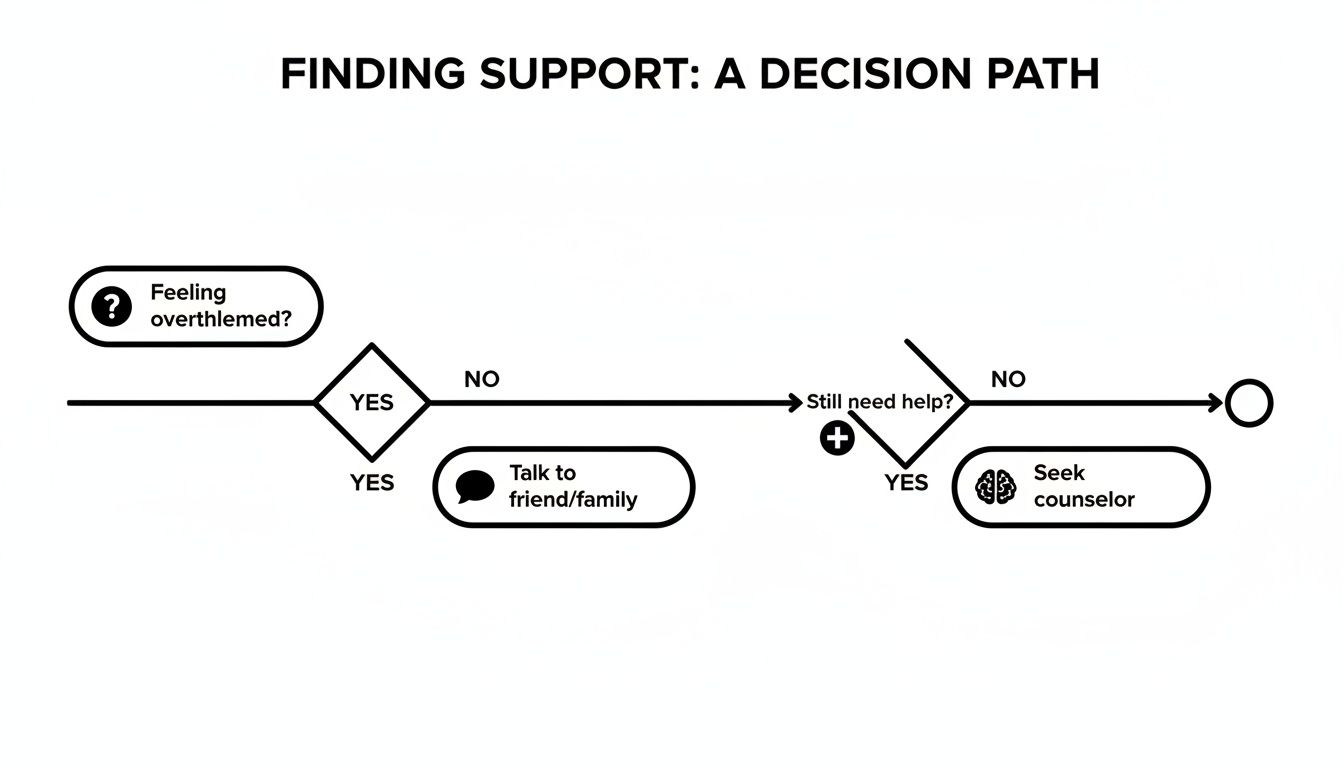
The main takeaway here is that seeking professional help is a completely natural and valid step when the support you have just isn't cutting it anymore.
How Wider Pressures Magnify Stress
It’s also crucial to remember that our personal struggles don't exist in a vacuum. They’re often made so much heavier by what’s going on in the world around us. Right now, the cost-of-living crisis is a massive one. The relentless stress of financial uncertainty can turn an already difficult period of change into a truly crushing weight.
Wider socioeconomic pressures, especially rising deprivation and debt, have had a sharp, measurable impact on mental health here in England. A recent report found that adults in the most deprived areas face a 26.2% prevalence of common mental disorders. Compare that to 16.0% in the least deprived areas—that’s a staggering 63% higher risk. Those in problem debt are more than twice as likely to experience these issues. You can dive into the data yourself by reading the full report on mental health and inequality from CentreforMentalHealth.org.uk.
When you’re worried about paying the bills or feeding your family, your capacity to cope with anything else shrinks dramatically. In these circumstances, professional guidance isn’t an indulgence; it's a vital support service.
Finding a Therapeutic Approach That Works for You
If you've decided that talking to someone is the right step, the next question is naturally, "What kind of therapy is right for me?" The good news is that modern counselling is much more flexible and can be adapted to fit your life and comfort levels. At Therapy with Ben, my whole approach is built around making support accessible and practical.
I offer a few different ways for us to connect, designed to meet you where you are:
Face-to-Face Sessions: For those who prefer a traditional therapeutic setting, I offer sessions in a calm, private space in Cheltenham. This can be perfect for doing focused, in-depth work together.
Online Counselling: This gives you maximum flexibility, letting you have sessions from the comfort of your own home, wherever you are in the UK. It's a great fit for busy schedules or for anyone who just feels more at ease talking remotely.
Walk and Talk Therapy: This is a unique approach that combines counselling with gentle movement out in nature. Sometimes, walking side-by-side can feel less intense than direct, face-to-face conversation, making it easier to open up. Plus, the natural environment has its own calming benefits. It's a fantastic option if you find a traditional office setting a bit intimidating.
My practice also offers neurodiversity-aware support. I recognise that if you're neurodivergent, you often experience and process change in very unique ways. We can work together to find strategies that are genuinely suited to your specific brain wiring.
Taking that step to seek professional guidance is a real act of empowerment. It’s about choosing to invest in your own wellbeing and finding a dedicated space where you can build the skills to not just get through change, but to move through it with real strength.
Ultimately, choosing to work with a counsellor is about finding the right person and the right approach for you. It’s about creating a partnership where you feel safe, heard, and properly equipped with the tools you need to find your footing again.
Your Questions Answered: Navigating Change and Therapy
When you're dealing with a big life shift, it's completely normal to have questions swirling around. Let's tackle some of the most common ones I hear from clients, hopefully giving you a bit more clarity.
How Long Does It Take to Adapt to a Major Change?
This is the big one, isn't it? The honest answer is, there's no set timeline. It’s not a race with a finish line, but a deeply personal process. Think of it less like a project to be completed and more like learning to sail in new waters.
The best thing you can do is give yourself some grace. Some days will feel like you’re making real progress, and others might feel like you’ve been knocked back by a wave. That’s perfectly okay and all part of the journey of coping with change. True adaptation isn’t about forcing things; it’s about learning to ride those waves.
What If My Anxiety Makes It Hard to Start a New Routine?
I hear this a lot, and it makes perfect sense. When your anxiety is cranked up high, even a simple new task can feel monumental. The trick here is to think small. Forget about overhauling your entire life right now and focus on 'micro-habits'.
A micro-habit is a tiny, almost ridiculously easy action you can do every day.
Maybe it’s just making a cup of tea at the same time each morning.
It could be stretching for just 60 seconds right after you get out of bed.
Or it might be as simple as putting your shoes by the door, ready for a walk later.
The point isn't to achieve something huge. It's about building a tiny bit of consistency. Every time you complete that small action, you're quietly showing your brain that you can create stability, which helps to gently dial down that feeling of anxiety.
Is Walk and Talk Therapy Effective for Serious Issues?
Yes, absolutely. Don't let the informal setting fool you. Walk and talk therapy is a powerful therapeutic approach that’s very effective for working through serious and complex issues. For many, walking side-by-side feels less intense than sitting opposite a therapist with constant eye contact.
That subtle shift can make it feel safer to open up about really difficult things. On top of that, the gentle physical movement and being in nature are proven to help calm the nervous system, making it easier to process tough thoughts and emotions.
Seeking therapy is not a sign of weakness; it's a sign of profound strength. Just as you would see a professional for a physical injury, a counsellor provides expert tools and a supportive space to help you build mental resilience and navigate challenges you are not meant to face alone.
Why Should I Consider Therapy if I Feel I Should Handle This Myself?
That thought – "I should be able to handle this on my own" – is probably one of the biggest things that holds people back from getting support they really need and deserve. We're often taught to be self-reliant, but the reality is, we aren't meant to go through life's biggest challenges completely alone.
Deciding to see a therapist is an act of taking charge of your wellbeing. It’s about arming yourself with strategies designed specifically to help people navigate these exact situations. A counsellor offers a neutral, confidential space to explore what’s going on without judgment, giving you insights and tools that friends and family, however well-meaning, just aren't equipped to provide.
If you're struggling to cope with change and think a dedicated space to talk things through might help, Therapy with Ben is here. You don’t have to do this on your own. Reach out today to learn more about my services or to book an initial consultation.


Comments