


How to Cope with Social Anxiety: Practical Tips from a Counsellor in Cheltenham, Glos
Updated: Nov 16, 2025
Posted by: Therapy-with-Ben
Figuring out how to cope with social anxiety usually starts by getting to grips with what’s really going on under the surface. From there, we can start using practical strategies to manage the physical feelings, the anxious thoughts, and the behaviours that keep the cycle going. The real key is learning to challenge those fearful thoughts, gently face the situations you’d rather run from, and have a few in-the-moment techniques to bring you back to centre.
Understanding What Social Anxiety Really Is

So many people mistake social anxiety for just being ‘shy’. And while they can look similar from the outside, they’re worlds apart. Shyness is more of a personality trait—that feeling of being a bit reserved or nervous around new people.
Social anxiety, on the other hand, is a much more powerful and often crippling fear. It’s the fear of being judged, picked apart, or outright rejected by others.
This isn’t just about feeling a few butterflies before a big presentation at your office in Manchester; it’s the all-consuming dread that can start days, or even weeks, before. It's not about preferring a quiet night in; it's about actively dodging a friend's birthday party in Birmingham because the idea of making small talk is completely overwhelming.
The Three Pillars of Social Anxiety
To really get a handle on what you're up against, it helps to break social anxiety down into three parts that all feed into each other. Spotting how it shows up for you in each of these areas is the first proper step towards managing it.
Cognitive Symptoms (Your Thoughts): This is the constant, nagging inner critic. It's that voice in your head predicting the worst-case scenario, telling you that you’ll definitely say the wrong thing, that everyone secretly thinks you're awkward, or that one tiny mistake will lead to total humiliation.
Physical Symptoms (Your Body's Reaction): Your body doesn't know the difference between a social threat and a physical one, so it kicks into survival mode. This can show up as a pounding heart, blushing, sweating, trembling hands, or even feeling nauseous.
Behavioural Symptoms (Your Actions): These are all the things you do—or more often, don't do—to try and cope with the fear. The biggest one by far is avoidance. That means turning down party invitations, staying silent in meetings, or avoiding phone calls. Other "safety behaviours" might include obsessively rehearsing what you're going to say or needing a drink to feel like you can relax.
The Reality of Social Anxiety in the UK
If any of this sounds familiar, I want you to know you are far from alone. Recent statistics from the Centre for Mental Health's Big Mental Health Report show that mental health issues are on the rise, now affecting 20.2% of adults in England. The increase has been especially sharp for young adults aged 16–24.
Factors like financial debt can pour fuel on the fire, making it much harder to manage conditions like social anxiety, which absolutely thrives on feelings of loneliness and low self-worth. On top of that, long waits for mental health support can leave people feeling even more isolated.
Social anxiety is not a personal failing or a sign of weakness. It's a recognised mental health condition with specific, understandable symptoms that are fuelled by powerful, albeit often inaccurate, beliefs about yourself and others.
Understanding this is so important. It helps you shift your thinking from "What's wrong with me?" to "What am I experiencing, and what can I do about it?" There are some great resources out there offering practical tips to cope with social anxiety that can help you dig a bit deeper.
Simply acknowledging what’s happening—the racing heart, the runaway thoughts, the urge to escape—is the kindest and most powerful first step you can take towards getting your life back.
Practical Ways to Manage Anxiety in the Moment

When a wave of social anxiety hits, it can feel like your brain and body have been completely hijacked. Your heart starts pounding, thoughts race a mile a minute, and the urge to just get out of there can be overwhelming. In those moments, you don't need a complex long-term strategy; you need simple, immediate tools to pull you back to the present.
These in-the-moment techniques are designed to do just that – to interrupt the anxiety cycle before it spirals. They work by shifting your focus away from the internal storm of fear and back to the physical world, helping to calm your nervous system so you can think more clearly.
Ground Yourself with Your Senses
Grounding is a brilliant way to anchor yourself when your thoughts are running away with you. It pulls your attention out of your anxious mind and into your immediate environment. One of the most effective and easy-to-remember methods is the 5-4-3-2-1 technique.
It’s wonderfully simple and you can do it anywhere, whether you're about to walk into a crowded room or feel your mind go blank mid-conversation.
5: Look around and mentally name five things you can see. Notice their colour, shape, and texture. It could be a picture on the wall, a crack in the pavement, or the pattern on someone's shirt.
4: Acknowledge four things you can physically feel. This might be the sensation of your feet on the floor, the texture of your chair, or the feeling of your watch against your skin.
3: Listen for three distinct sounds. Really tune in to the hum of a computer, distant traffic, or the sound of someone's footsteps.
2: Identify two things you can smell. Perhaps it's the scent of coffee from a nearby café or the subtle fragrance of your own hand lotion.
1: Name one thing you can taste. This could be the lingering taste of your morning tea, or you could simply notice the natural taste inside your mouth.
This sensory exercise breaks the loop of anxious thoughts by forcing your brain to concentrate on the tangible world. Think of it as a mental reset button.
This technique isn’t about making the anxiety disappear forever; it’s about giving you control in the moment it feels most overwhelming. It proves you can redirect your focus, which is an incredibly empowering skill.
Master Your Breathing to Calm Your Nerves
When we feel anxious, our breathing often becomes shallow and rapid, which is a big sign to our brain that we're in danger. The good news is that we can flip this on its head. By consciously changing our breathing pattern, we can send a message back to our brain that everything is actually okay.
One of the most effective breathing exercises for this is box breathing, sometimes called four-square breathing. It’s incredibly discreet and can be practised without anyone even noticing.
Breathe in slowly through your nose for a count of four.
Hold your breath for a count of four.
Exhale slowly through your mouth for a count of four.
Hold your breath again for another count of four.
Repeat this cycle for a minute or two, focusing entirely on the count and the sensation of your breath. This simple rhythm helps to regulate your heart rate and settle your body's fight-or-flight response. The intense physical symptoms of anxiety often share similarities with panic attacks, and mastering your breath is a core skill for both. For a deeper look into this, we have a detailed guide with effective coping strategies for panic attacks that you might find useful.
The table below offers a quick-reference guide to these and other simple, practical exercises you can use to calm social anxiety symptoms as they happen.
In-the-Moment Anxiety Management Techniques
Technique | How It Works | When to Use |
|---|---|---|
5-4-3-2-1 Grounding | Engages all five senses to pull focus away from anxious thoughts and into the present environment. | When your thoughts are spiralling or you feel detached from reality. |
Box Breathing | Regulates your breathing pattern to slow your heart rate and calm the body's fight-or-flight response. | Before entering an anxious situation or when you feel physical symptoms like a racing heart. |
Progressive Muscle Relaxation | Involves tensing and then relaxing different muscle groups to release physical tension held in the body. | Good for when you feel tense all over, can be done discreetly by focusing on hands or feet. |
Mindful Observation | Choose a single object in your vicinity and observe it in great detail without judgement. | Useful for breaking a loop of worry, especially in waiting rooms or queues. |
Having these tools ready gives you a sense of agency over your anxiety, empowering you to stay present and manage the physical symptoms as they arise.
For those who find specific social situations particularly challenging, such as public speaking, there are many resources that offer practical ways to improve public speaking skills and build confidence. Combining these skills with in-the-moment calming techniques can be incredibly effective, allowing you to engage more freely and authentically.
Posted by: Therapy-with-Ben
How to Challenge Anxious Thought Patterns
While grounding techniques are fantastic for putting the brakes on anxiety in the moment, the real, long-term work involves changing the very thoughts that fuel the fire. Social anxiety is often driven by a relentless inner critic, one that specialises in worst-case scenarios and harsh self-judgement.
Learning to challenge these thoughts is like building a new mental muscle. It takes a bit of practice, but it's genuinely one of the most powerful ways to cope with social anxiety for good. This whole process is a cornerstone of Cognitive Behavioural Therapy (CBT), a really effective approach for anxiety. The goal isn't to force yourself into 'positive thinking', but to become more of a detective, examining your thoughts for actual evidence rather than just accepting them as fact.
Catching Your Negative Automatic Thoughts
The first job is to simply notice the thoughts that pop into your head when you start to feel anxious. In CBT, these are often called Negative Automatic Thoughts (NATs) because they appear in a flash and, in that moment, feel completely true.
Think back to a recent social situation that made you uncomfortable. What was going through your mind? Chances are, it was something along these lines:
"Everyone can see how nervous I am."
"I’m going to say something stupid and embarrass myself."
"They all think I'm boring and awkward."
"I just don't belong here."
These thoughts are the culprits. They’re the ones that trigger the physical feelings of anxiety—the racing heart, the sweaty palms—and that powerful urge to escape. Just learning to recognise them as they happen is a huge first step in taking back control.
Putting Your Thoughts on Trial
Once you've caught a thought, the next step is to question it. Don't just let it run the show. Instead, put it on trial and look for the facts. This is where you really start to challenge the assumptions your anxiety is built on.
You can do this by asking yourself some direct questions to test how valid the thought really is:
What's the actual evidence for this thought? What hard facts support the idea that everyone thinks you're awkward? Did someone actually say that, or is it a feeling?
And what's the evidence against it? Has there ever been a time you had a pleasant conversation? Did someone smile at you or include you in a discussion? Don't dismiss the small things.
What's a more balanced or realistic way of looking at this? Could it be that people are far more focused on themselves than on you? Is it possible they didn't even notice your nervousness?
What's the worst that could happen, and could I cope? Seriously. Even if you did say something awkward, would it be a total catastrophe, or just a momentarily uncomfortable experience that passes?
This process helps you see that your anxious thoughts are often just one possible interpretation of a situation—and usually not the most likely one. Overthinking these scenarios is exhausting, and learning how to break the cycle is key. If you struggle with this, you might find some useful guidance in our post about how to stop overthinking everything.
Anxious thoughts are not facts. They are mental events—hypotheses your brain generates based on fear. Your job is to treat them as such and look for the real evidence.
Creating a Thought Record
A brilliant, practical tool to help with this is a simple thought record. It might sound a bit clinical, but it's really just a way of organising your thoughts on paper so you can see them more clearly. It forces you to slow down and properly analyse what's going on in your head.
Here's a simple structure you can use:
Situation | Automatic Thought(s) | Evidence For/Against | Balanced Thought |
|---|---|---|---|
Example: Invited to a work social event. | "I'll have no one to talk to and I'll just stand there awkwardly. Everyone will think I'm a loser." | For: I feel nervous in big groups. Against: Sarah from my team is usually friendly. I've had good one-on-one chats with her before. Most people will be busy talking to their own friends. | "I feel anxious about going, but I can probably find Sarah to talk to. Even if I feel awkward for a bit, it's unlikely anyone will be judging me as harshly as I judge myself. I can aim to stay for just an hour." |
Filling this out takes the thought out of the echo chamber of your mind and puts it somewhere you can dissect it objectively. Over time, you'll find yourself doing this process more automatically, without even needing to write it down. You'll begin to spot the distortions in your thinking as they happen and can reframe them in real-time. It's a fundamental skill for reducing the power social anxiety has over you.
Posted by: Therapy-with-Ben
Facing Your Fears with Gradual Exposure

When you're dealing with social anxiety, avoiding the situations that set it off feels like the only sensible thing to do. In the short term, it works. You get immediate relief from the racing heart and spiralling thoughts.
The problem is, this avoidance is the very thing that keeps anxiety in the driver's seat. Every time you swerve, you're reinforcing the idea that these situations are genuinely dangerous and that you just can't handle them.
To break this cycle, we need to gently and systematically face those fears. This isn't about throwing yourself in at the deep end – far from it. It's a carefully managed process called gradual exposure. It’s a powerful, evidence-based technique that helps you reclaim your confidence by proving to your brain, through real-world experience, that you can handle a lot more than you think.
The core idea is to start small. You pick situations that only cause a mild bit of anxiety and slowly work your way up to the more challenging ones. Every successful step builds you up and recalibrates that old fear response.
Building Your Personal Exposure Ladder
An exposure ladder (sometimes called a hierarchy) is your personalised roadmap for this process. Think of it as a list of social situations you fear, ranked from the least scary to the most terrifying. Creating this is your first practical step towards taking back control.
To get started, grab a piece of paper and just brainstorm all the social situations that make you anxious. Don't censor yourself. Once you have your list, rate each one on a scale from 0 (no anxiety at all) to 10 (extreme panic).
Here’s what a simple exposure ladder might look like for someone who finds initiating conversations difficult:
Make eye contact and smile at a cashier (Anxiety: 2/10)
Ask a stranger for the time (Anxiety: 3/10)
Give a simple compliment to a colleague on their work (Anxiety: 4/10)
Ask a colleague an open-ended question about their weekend (Anxiety: 6/10)
Start a short conversation with someone at a bus stop (Anxiety: 7/10)
Join an ongoing chat with two colleagues in the kitchen (Anxiety: 8/10)
Go to a work social and aim to talk to three different people (Anxiety: 9/10)
The trick is to make your steps specific and manageable. "Be more social" is far too vague. "Ask a colleague an open-ended question" is a clear, actionable goal you can actually achieve.
Putting Your Ladder into Practice
Once your ladder is ready, you start right at the bottom rung. The goal is to stay in that situation long enough for the initial spike of anxiety to naturally come down. This is the crucial bit – if you leave too soon, you just teach your brain that escape is the only way to feel better.
Repeat each step as many times as you need to until it feels significantly less daunting. Only then do you move up to the next rung. It's absolutely vital to move at your own pace and practise a bit of self-compassion. Some steps will feel easier than others, and that's perfectly normal.
This whole process is especially relevant for young adults in the UK navigating the pressures of the modern workplace. The Burnout Report by Mental Health UK found that a staggering 9 out of 10 people have experienced high or extreme stress in the last year, with the 18-24 age group being particularly vulnerable. This stress, often combined with a reluctance to talk about mental health with managers, can really heighten social withdrawal and anxiety. You can read more about the generational divide in stress and its impact on their site.
Gradual exposure isn't about getting rid of fear. It's about learning to tolerate the discomfort and discovering that the awful outcome you're dreading rarely, if ever, actually happens. It’s about building confidence, not fearlessness.
This journey is all about collecting evidence that contradicts your anxious thoughts. Every single time you complete a step on your ladder, you are giving your brain new data: "I did it, and I was okay." Over time, this new evidence becomes far more compelling than the old, fearful beliefs, and that’s what fundamentally changes your relationship with social situations for the better.
Posted by: Therapy-with-Ben
Finding Professional Support and Therapy Options in the UK
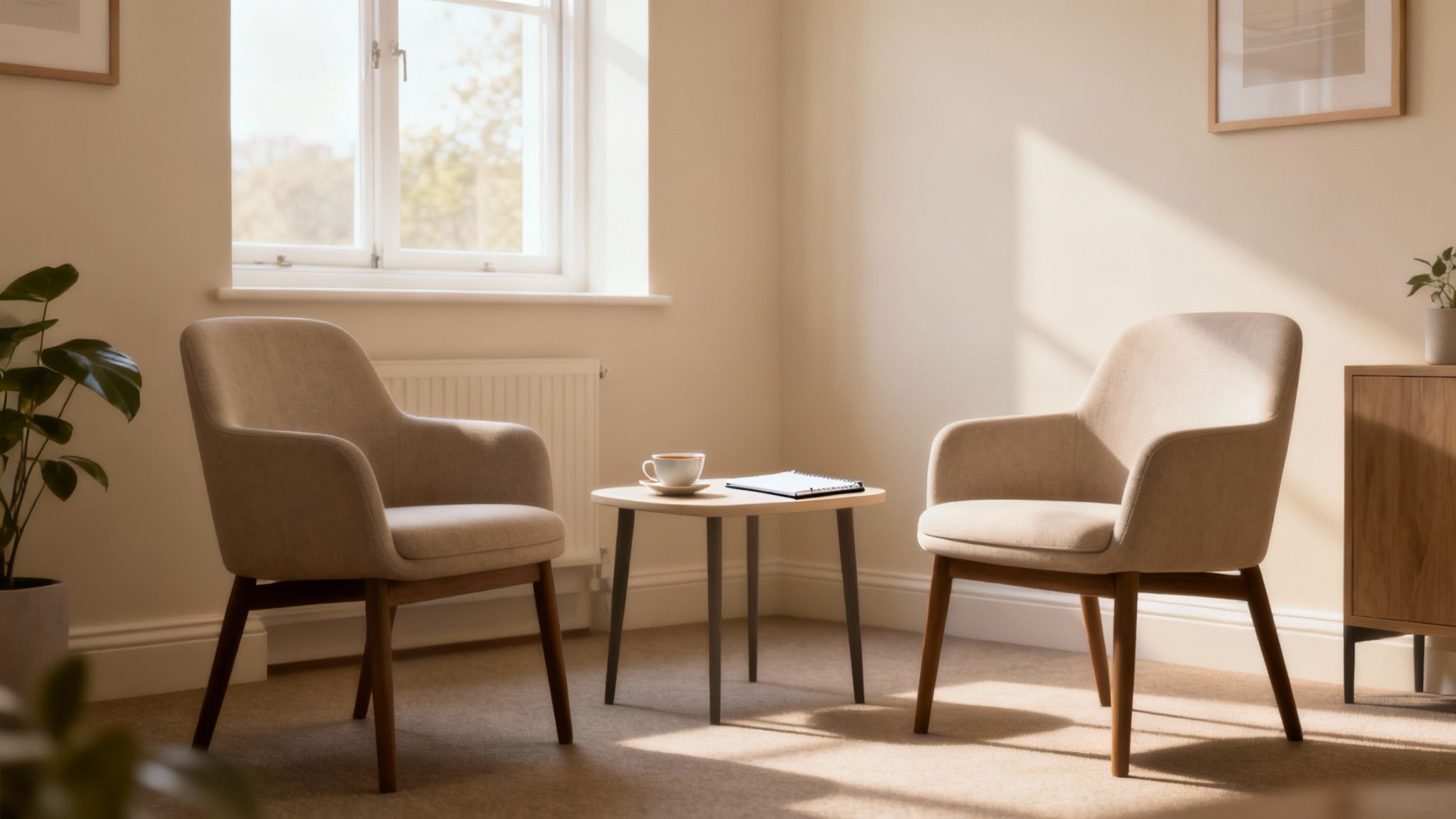
While the self-help strategies we've talked about are genuinely powerful, there are times when getting professional support is the kindest and most effective thing you can do for yourself. Realising you might need a hand is a sign of real strength.
I know that navigating the world of therapy can feel a bit overwhelming, but it doesn't have to be. In the UK, there are some clear routes to finding the right support, whether that’s through the NHS or privately. Let's break it down and make the whole process feel much more manageable.
Effective Therapeutic Approaches for Social Anxiety
When it comes to therapy for social anxiety, a few approaches really stand out because they’ve been shown to work time and time again. The two you’ll hear about most often are Cognitive Behavioural Therapy (CBT) and Acceptance and Commitment Therapy (ACT).
Cognitive Behavioural Therapy (CBT): We’ve already touched on this, but CBT is a really practical, hands-on therapy. It helps you get to grips with the negative thought patterns and behaviours that keep your anxiety going. You’ll learn tangible skills to change your relationship with those anxious thoughts and, step-by-step, start to face the situations you fear.
Acceptance and Commitment Therapy (ACT): ACT comes at it from a slightly different angle. Instead of fighting to get rid of anxious thoughts, it teaches you to let them be there without letting them run the show. It’s big on mindfulness and helps you figure out what’s truly important to you (your values), so you can commit to building a life you love, even when anxiety pops up.
Both of these are evidence-based, meaning they have a solid track record. They offer a safe, structured space to explore your fears and build confidence that actually lasts.
Navigating Your Therapy Options in the UK
So, where do you actually start? Here in the UK, you’ve got two main pathways: going through the NHS or finding a private therapist.
For the NHS route, your GP is the best first port of call. You can book an appointment to chat about how you're feeling, and they can refer you on to your local Improving Access to Psychological Therapies (IAPT) service. These services are set up specifically to make therapies like CBT more accessible to everyone.
Going private is the other option. The main benefits here are often shorter waiting times and a much wider choice of therapists and the types of therapy they offer. A great way to find someone is through reputable online directories:
The BACP (British Association for Counselling and Psychotherapy) Register: This is a fantastic resource for finding qualified therapists who stick to a strict ethical code.
Counselling Directory: Another well-known platform where you can filter therapists by location, what they specialise in, and how they work.
Think of therapy as an investment in yourself. It's about finding a guide who can give you the tools, the perspective, and the support you need to find your way out of social anxiety.
Exploring Different Ways to Do Therapy
Therapy doesn't always have to be two people sitting in a formal room. For a lot of us, different formats can feel less daunting and just work better.
For instance, online counselling has become a hugely popular and effective choice, offering flexibility and the comfort of being in your own space. If you're curious, we have a whole guide on finding effective online counselling for anxiety.
Another approach I'm a real advocate for is walk-and-talk therapy. This is exactly what it sounds like – having your session outdoors, walking side-by-side. The gentle movement and being in nature can really take the pressure off. For many, not having to make constant eye contact makes it so much easier to open up.
It’s clear this is a growing issue, especially for young people. A recent UCL report highlighted that by 2020, a staggering 36% of UK participants aged 16-29 met the criteria for social anxiety disorder. The problem is, access to support hasn’t quite caught up with this need. This just goes to show how vital it is to know what your options are and to feel empowered to seek out the help that feels right for you.
Right, let's get into some of the questions I hear all the time about social anxiety. When you're in the thick of it, things can feel confusing and overwhelming, so getting a few straight answers can make a world of difference.
Is Social Anxiety Just an Extreme Form of Shyness?
This is probably the most common one, and a really important distinction to make. They can look pretty similar from the outside, but at their core, shyness and social anxiety are two very different things.
Think of shyness as more of a personality trait. A shy person might feel a bit awkward or reserved around new people, but they generally warm up. It can be uncomfortable, sure, but it doesn't usually stop them from doing the things they want to do.
Social anxiety disorder, however, is a recognised mental health condition. It’s driven by an intense, overwhelming fear of being judged, embarrassed, or humiliated. This fear is so powerful that it often leads people to avoid social situations entirely, which can seriously affect their work, friendships, and general quality of life.
The real difference comes down to impairment. Shyness might make you think twice before speaking up in a group. Social anxiety can make you call in sick to avoid the office party altogether.
Can Medication Help with Social Anxiety?
Yes, absolutely. For a lot of people, medication can be a really useful tool in their recovery. Most often, GPs will look at antidepressants, particularly a type known as Selective Serotonin Reuptake Inhibitors (SSRIs).
What these medications do is help to take the edge off the intense physical symptoms of anxiety – that racing heart, the constant churning in your stomach, the obsessive worrying. By dialling those down, it creates the headspace you need to actually engage with therapy and start practising new coping skills.
It's not a magic pill, though. Medication works best when it's part of a bigger picture that includes therapy like CBT. If you're thinking about it, the first port of call should always be a good, long chat with your GP to see if it’s the right move for you.
How Can I Manage Social Anxiety at Work?
The workplace can feel like a daily performance when you have social anxiety. Meetings, presentations, even just making a coffee in the kitchen can feel like a huge challenge. The trick is to start small and build from there – don't try to become the life and soul of the office overnight.
Here are a few practical things you can try:
Do your prep: Got a meeting coming up that’s making you nervous? Get ahead of it by preparing one or two points you’d like to make. Just knowing you have something to say can stop that awful feeling of your mind going blank.
Start with one-to-one: Big group chats can be intimidating. Focus on having a brief, low-stakes conversation with a single colleague. Ask about their weekend or a project they're on – that's it.
Focus on the task, not the audience: When you have to present or speak, try to shift your focus onto the information you’re sharing, rather than the people listening. It’s a subtle mental switch, but concentrating on the "what" instead of the "who" can really lower the self-consciousness.
Use your in-the-moment tools: Remember those grounding and breathing exercises we talked about? They're your best friend at work. A few quiet rounds of box breathing before you dial into a call can make all the difference.
At the end of the day, it's not about becoming fearless. It’s about learning you can act even when you feel the fear. Every small step forward is a win, and each one provides a little more proof that you’re more capable than your anxiety wants you to believe.
At Therapy with Ben, I offer a supportive and non-judgemental space to explore these challenges. Whether through online sessions or walk-and-talk therapy in Cheltenham, we can work together to build the confidence you need. Find out more at https://www.therapy-with-ben.co.uk.


Comments