


Difference Between Counselling and Psychotherapy Explained
By Therapy-with-Ben
When you're thinking about getting some support, you’ll often hear the words ‘counselling’ and ‘psychotherapy’ used almost interchangeably (as well as Therapy). But while they share some common ground, the difference between counselling and psychotherapy really comes down to their focus, depth, and how long they last.
Think of counselling as more short-term support, usually zeroing in on a specific life event you’re dealing with right now – maybe a bereavement, redundancy, or a relationship ending. The goal is to help you build coping strategies to navigate the here and now.
Psychotherapy, on the other hand, usually takes a longer, deeper dive. It’s about exploring those recurring emotional patterns or underlying issues that might stem from your past. The aim here is to foster profound self-awareness and create lasting change from the inside out. So whilst I do Counselling, I often think Therapy is a better term to describe the potential for the deeper work.
Counselling and Psychotherapy Key Distinctions

Trying to figure out which approach is right for you can feel a bit confusing at first glance. They look similar, but their foundations and what they set out to achieve are quite distinct.
Counselling is often the more practical and focused of the two. It’s a dedicated space to work through a particular problem that’s affecting your life at this moment. It’s generally action-orientated, giving you the tools to manage present-day challenges more effectively. If you'd like to read more, I've covered this in my guide on what counselling is and how it can help you.
Psychotherapy tends to dig into the 'why' behind your feelings and behaviours. It explores those deep-seated patterns, often making connections between what you’re struggling with now and experiences from your past. It’s a process designed to help restructure your understanding of yourself and nurture significant personal growth over time. In fact, that is arguably why I use an integrative style, to also explore the past and how you have become your distinct self.
To make things a bit clearer, I've put together a simple table that lays out the key differences side-by-side.
Counselling vs Psychotherapy at a Glance
Characteristic | Counselling | Psychotherapy |
|---|---|---|
Primary Focus | Addresses specific, present-day issues (e.g., stress, grief). | Explores deep-rooted patterns and recurring difficulties. |
Typical Duration | Short-term, often 6-12 sessions with a clear structure. | Long-term, potentially lasting months or even years. |
Main Goal | To provide coping strategies and find practical solutions. | To foster deep self-awareness and fundamental change. |
Depth of Work | Works on a conscious level, focusing on thoughts and behaviours. | Explores conscious and unconscious elements of experience. |
Hopefully, this gives you a better feel for which path might be more suited to what you're looking for right now. One focuses on managing the waves, while the other helps you understand the entire ocean.
Comparing the Goals and Focus of Each Approach

Knowing what you’re hoping to get out of therapy is the best first step you can take. Often, the main difference between counselling and psychotherapy becomes clearest when you look at what each is trying to achieve. They set out with quite different intentions, and that shapes the whole process.
Counselling tends to be more practical and focused on the 'here and now'. It’s all about helping you handle specific, current life problems. Think of it as targeted support for getting through a particular rough patch.
The Practical Focus of Counselling
The aim of counselling is really to give you some practical tools and coping strategies. It’s designed to provide relief and help you get your feet back on the ground when you're dealing with immediate issues.
For instance, a counsellor might help you to:
Find ways to manage a sudden spike of anxiety before a big work presentation.
Navigate the stages of grief after losing someone close to you.
Learn better communication skills to sort out a specific conflict with your partner.
In all these scenarios, the focus stays squarely on the present problem. We’re looking for a direct and manageable way forward, addressing the 'what' and 'how' of what’s happening right now.
Counselling often answers the question, "How can I cope with what is happening to me right now?" It provides the tools to build a raft to navigate a present storm.
The Deeper Exploration of Psychotherapy
Psychotherapy, on the other hand, is about diving into the 'why' behind your feelings and behaviours. The lens is much wider and the exploration goes deeper, aiming to uncover the roots of emotional patterns or psychological difficulties that have been around for a while.
This approach is less about managing a single crisis and more about looking at those long-standing patterns. A psychotherapist might help you explore how your childhood experiences are affecting your confidence at work or your sense of self-worth today.
The ultimate goal here is a much deeper self-awareness and, hopefully, a lasting change in how you relate to yourself and the world. It’s about resolving those foundational issues, not just putting a plaster on the symptoms they cause.
Navigating UK Training, Qualifications, and Regulation
Knowing your therapist is properly qualified and regulated brings a crucial sense of peace of mind when you start your journey. In the UK, the difference between counselling and psychotherapy often comes down to the training pathways and professional standards practitioners are expected to meet.
It’s a distinction that can really help you make an informed choice. While the titles ‘counsellor’ and ‘psychotherapist’ aren't legally protected here, membership in a professional body is a strong signal that a practitioner has met specific standards for their training and ethical conduct.
Professional Bodies and Accreditation
The most prominent body you'll likely come across is the British Association for Counselling and Psychotherapy (BACP). When a practitioner is registered or accredited with the BACP, it means they've completed robust training and stick to a strict ethical framework, making them accountable for their practice.
The BACP itself notes that while both fields demand rigorous training, psychotherapists often go through more extensive education, frequently at a postgraduate level. This deeper training equips them to work with more complex or long-standing psychological conditions. Their public perceptions survey sheds more light on the more than 60,000 registered practitioners in the UK.
This focus on advanced study means psychotherapy training can be longer and more intensive, preparing therapists for more in-depth work. If you're curious about the professional landscape, you might find it interesting to learn about the steps involved in how to become a counsellor.
When choosing a therapist, always feel empowered to ask about their qualifications and which professional body they are a member of. This is a standard and important part of ensuring you receive safe, ethical, and effective support.
Ultimately, having this knowledge helps you confidently pick a professional whose credentials line up with what you need. For more guidance on finding the right person, have a look at our practical guide on how to get therapy in the UK.
Understanding Session Structures and Duration
When you're trying to get a handle on the practical difference between counselling and psychotherapy, one of the clearest ways to see it is in how the sessions are structured and how long the process takes. This is a really important piece of the puzzle, as it shapes the whole therapeutic journey and helps you know what to expect.
Counselling is usually a much shorter, more focused affair. Think of it as a fixed block of sessions, often a 6 to 12-week programme, designed to tackle a specific, current problem head-on. This time-limited approach gives a clear beginning and end, so all the energy goes into creating practical coping strategies for whatever you're facing right now. We go into a bit more detail on what these meetings look like in our guide on what happens in counselling sessions.
Open-Ended Exploration in Psychotherapy
Psychotherapy, on the other hand, is quite different. It's often an open-ended process without a fixed end date. It's a longer-term commitment that might last for many months, or even years, depending on how deep you need to go.
This longer timeframe is crucial because it allows a really strong therapeutic relationship to be built between you and the therapist. In many ways, that relationship becomes a central part of the healing work itself, creating a safe and reliable space to untangle those deep-seated patterns.
Psychotherapy’s open-ended nature isn't about aimless conversation; it's a deliberate approach that provides the necessary time and space for profound self-discovery and lasting change to unfold organically.
The way the sessions are set up really reflects the overall goal. While counselling is very solution-focused and tends to move at a pretty steady pace, psychotherapy gives you the room for a more reflective, unhurried kind of exploration. Understanding this distinction can really help you choose the path that fits not just your immediate needs, but your long-term goals for personal growth, too.
How to Choose the Right Support for You
Deciding between counselling and psychotherapy isn't about which one is 'better' – it's about what you need right now. The definitions are useful, but context is everything when you're trying to figure out the right path for yourself.
If you're grappling with a specific, recent life event, counselling can offer targeted, effective support. Think of things like a difficult breakup, a stressful career change, or a recent bereavement. It’s designed to give you practical strategies to navigate the immediate challenge.
However, if you feel stuck in repeating patterns of anxiety, struggle with low self-esteem, or are dealing with the lingering effects of past trauma, the deep, exploratory nature of psychotherapy is likely a better fit. This approach helps to uncover and address the root causes of long-standing difficulties.
To help you visualise this, here’s a simple way to think about it based on whether your needs feel more immediate or long-term.
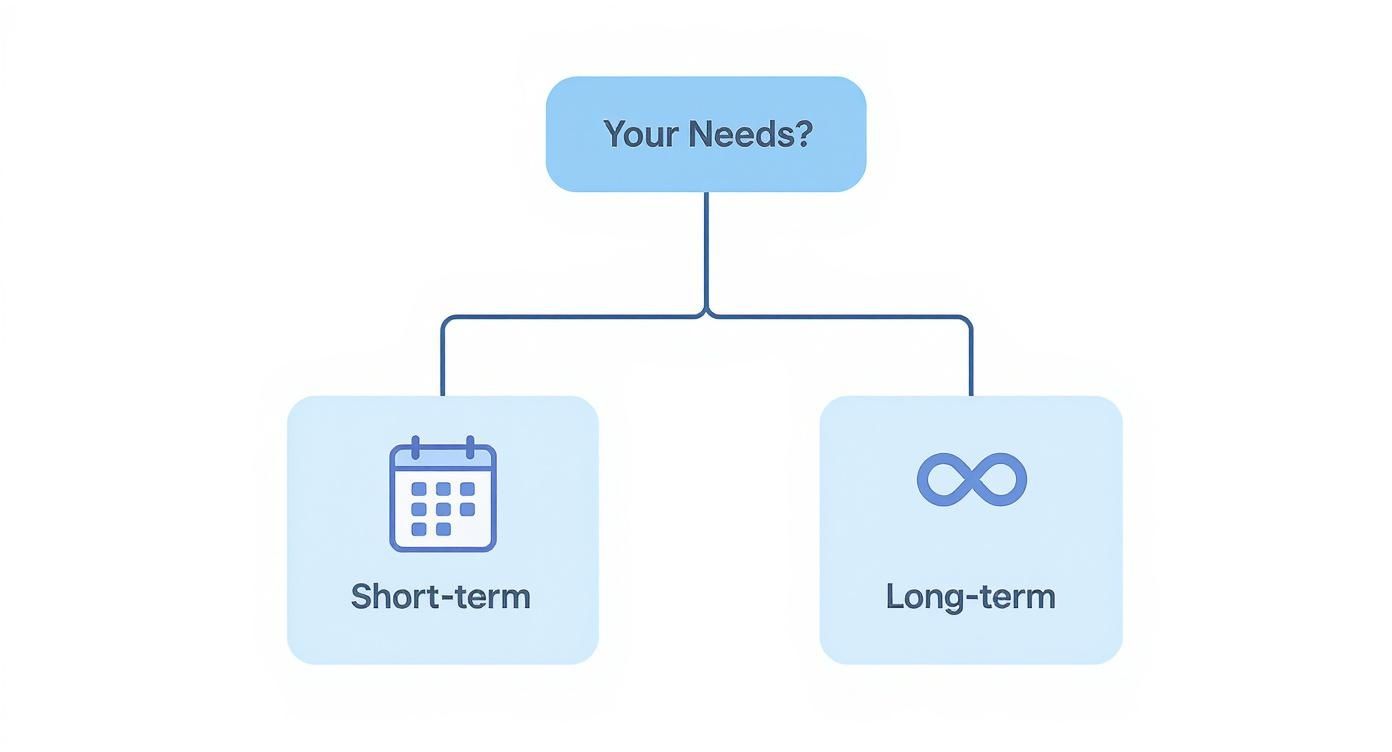
As the infographic shows, your timeframe and what you hope to achieve are the key starting points for choosing the right therapeutic path for you.
Reflective Questions to Guide Your Decision
To get a clearer picture of your own needs, take a moment with these questions. Your answers can point you toward the most suitable form of support.
What’s my main reason for seeking therapy now? Am I dealing with a specific, current problem (like a job loss) or a recurring feeling (like a persistent sense of emptiness)?
What outcome am I hoping for? Do I want practical tools to manage a current crisis, or do I want to understand the deeper reasons behind my behaviours and feelings?
How much time and emotional energy am I ready to invest? Am I looking for focused, short-term support, or am I prepared for a longer journey of self-exploration?
Answering these honestly can bring a lot of clarity. Data from the NHS shows how effective both routes can be, reporting that 80% of clients who receive counselling see significant improvements in their mental health. It also highlights that this kind of early support can prevent more severe conditions from developing, whereas psychotherapy is often associated with longer-term outcomes for more complex issues.
Your readiness for change is a powerful guide. Counselling meets you where you are today to tackle a specific challenge, while psychotherapy invites you to explore the history that shaped you.
It's also interesting to see how professional guidance is being built into modern tools. For example, you can read insights from a therapist who helped deepen self-reflection tools for a digital platform.
Ultimately, choosing the right support is a personal decision about what feels most aligned with your current needs and long-term well-being.
Common Questions About Counselling and Psychotherapy
By this point, the core difference between counselling and psychotherapy should be much clearer. But to make sure you feel completely confident in your decision, let's tackle some of the most common questions people have when weighing up their options. Think of this as the final bit of clarity you need.
Can a Counsellor Become a Psychotherapist?
Yes, absolutely. It's a well-trodden path for many professionals to start as counsellors and later undertake further, more advanced training to qualify as psychotherapists.
This extra education and supervised practice give them the skills to work with a much broader range of complex issues and at a greater psychological depth. It's a natural progression for therapists looking to build on their foundational experience and expand what they can offer.
Is One Approach Better Than the Other?
This is a great question, but the simple answer is no. Neither counselling nor psychotherapy is inherently ‘better’ than the other. The best choice for you depends entirely on your unique circumstances, what you need right now, and what you're hoping to achieve.
The "best" therapy is the one that aligns with your specific goals. Counselling excels in providing targeted support for present-day problems, while psychotherapy is designed for a deeper exploration of long-standing patterns and their origins.
Take a moment to think about what you need. Are you looking for practical tools to handle a current challenge, or are you seeking a deeper understanding of who you are and why you feel the way you do? Your answer points the way.
Can I Switch From One to the Other?
Of course. It's actually quite common for someone to start with counselling to manage an immediate crisis, like a sudden bereavement or intense work-related stress. Down the line, they might realise there are deeper-rooted issues they want to explore, prompting a move into psychotherapy.
This is something you can always discuss with your therapist. A good practitioner will support you in making that transition, or they can refer you to a suitable colleague who is better equipped to meet your evolving needs.
Do They Use the Same Techniques?
You'll definitely find some overlap here. For instance, both counsellors and psychotherapists might use well-known approaches like Person-Centred Therapy or Cognitive Behavioural Therapy (CBT).
However, psychotherapists are generally trained in a wider array of therapeutic models. Their toolkit often includes methods that focus specifically on long-term developmental processes and the unconscious mind, such as psychodynamic or psychoanalytic therapies.
At Therapy with Ben, I'm here to help you navigate these choices and find the support that feels right for you. Whether you're looking for short-term counselling or a deeper therapeutic journey, please get in touch to see how I can help, as other parts of my site explain, I work either in-person or walk and talk therapy, as well as online sessions, if you are further away, or if sometimes, it is just more convenient.
Comments