


Discover i don't know who i am: Find Clarity and Rediscover Yourself
That quiet, persistent thought, 'I don't know who I am anymore,' is a deeply unsettling one, and it can feel incredibly lonely. But if this is you, please know it isn't some kind of personal failure. It’s a surprisingly common and understandable reaction to the pressures of modern life, big changes, and the kind of internal tug-of-war that can slowly wear away at your sense of self.
The Unsettling Feeling of Not Knowing Yourself
Waking up and feeling like a stranger in your own skin is a disorienting experience, to say the least. It’s like being adrift at sea without a map or a compass, unsure of what you value, what you're passionate about, or even where you're trying to go.
You might catch your reflection and genuinely wonder who that person staring back is. Or maybe you find yourself just going through the motions, living a life that feels like it belongs to someone else. For many, this isn't just a fleeting moment of doubt; it's a profound and nagging struggle.
This sense of identity confusion is often tangled up with wider mental health challenges. Here in the UK, it’s a significant issue. A report from the Centre for Mental Health and Mind found that one in five adults (20.2%) in England are living with a common mental health problem. The numbers have been climbing, especially for young people aged 16-24. You can read their full report to get a clearer picture of the trends.
Why This Feeling Is So Common
So, what brings on this feeling of being lost? Usually, it's a combination of things. The weight of what society expects from us, the pressure to follow a specific path, or major life shifts can all leave you questioning everything you thought you knew about yourself.
Major Life Changes: Big events like a career change, the end of a long relationship, or becoming a parent can shake the very foundations of who you believed you were.
Societal Pressure: We’re constantly surrounded by a culture of comparison, both online and off. Trying to live up to someone else’s ideal can create a real disconnect from your authentic self.
Internal Conflict: Sometimes, the person you actually are clashes with the person you think you should be, and that creates a deep, internal rift.
This moment of confusion, however uncomfortable, can also be a powerful starting point for rediscovery. It’s an invitation to pause, reflect, and begin the journey of reconnecting with who you truly are.
Here at Therapy with Ben, my Cheltenham-based counselling service, I get how tough this journey can feel. I’ve found that unique approaches like walk-and-talk therapy can offer a natural, grounded way to start exploring these feelings. There's something about walking in nature alongside a counsellor that can make difficult conversations feel more manageable, providing a sense of immediate reassurance and a clear way forward.
If you’re ready to start this journey, a good first step is understanding the role of self-awareness. My guide on using self-awareness in counselling can offer some helpful initial insights.
So, Why Might You Feel So Lost and Disconnected?
That nagging feeling of not knowing who you are rarely just appears out of thin air. More often, it’s a slow burn – a gradual unravelling caused by big life events, internal shifts, or the constant pressure from the outside world that slowly chips away at your sense of self. Getting to grips with the ‘why’ behind it all is the first real step to finding your way back.
Major life changes are often the biggest culprits. Things like a career change, the end of a long relationship, or even something positive like becoming a parent for the first time can shake the very ground you stand on. The roles that once defined you – ‘the ambitious one’, ‘the partner’, ‘the independent one’ – might suddenly vanish or transform, leaving a void and that tricky question: “Well, who am I now?”
This map gives a good visual sense of how these different pressures can tangle together.
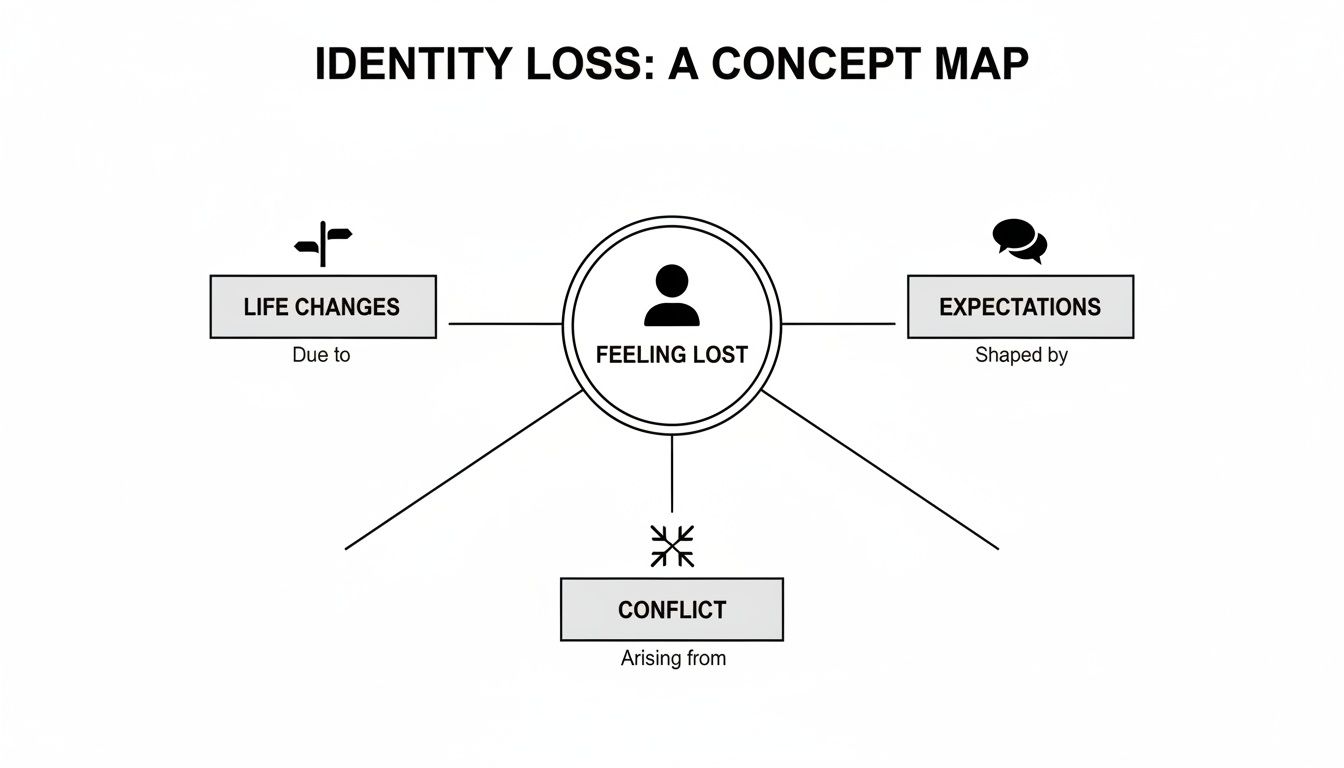
As you can see, feeling lost isn't usually down to one single thing. It’s often a messy mix of life changes, what society expects of you, and a deep internal conflict pulling you in different directions.
All sorts of experiences can knock our sense of identity off-kilter. The table below breaks down some of the most common triggers and the kinds of questions they might stir up inside you.
Common Triggers for an Identity Crisis
Trigger | What It Feels Like | Key Question It Raises |
|---|---|---|
Major Life Transitions | Your old roles (e.g., employee, partner) no longer fit. | Who am I without this title or relationship? |
Trauma | Feeling disconnected from your past and present self. | How can I feel like 'me' again after what happened? |
Mental Health Struggles | A fog of anxiety or depression makes self-reflection feel impossible. | Is this feeling of emptiness who I really am? |
Neurodiversity | Exhaustion from years of 'masking' to fit in. | Who is the real me, underneath the mask I wear for others? |
Societal Pressure | Feeling you don't live up to external expectations. | Am I living for myself, or for what others expect of me? |
Seeing the cause written down like this can sometimes be the first step in acknowledging just how much you’ve been dealing with. It’s not about making excuses, but about understanding where the struggle is coming from.
The Impact of Mental Health and Internal Conflict
That haunting question, 'Who am I really?', seems to echo louder than ever these days, doesn't it? It's often fuelled by the rise in anxiety and depression we’re seeing across the UK, which can completely cloud your ability to understand yourself. According to the Priory Group, 1 in 4 adults in England grapples with a mental health issue each year, and 6 in every 100 people deal with generalised anxiety disorder on a weekly basis. When your mind is in that state, connecting with your authentic self can feel like an impossible task.
This can feel like a constant battle inside your own head. That feeling of being lost is often rooted in this deep internal conflict. Gaining a bit of insight into these personal struggles can be a huge help, and for some, understanding 'man vs. self' conflict can be a useful starting point for putting a name to that feeling.
How Trauma and Neurodiversity Shape Identity
Past trauma can also forge a massive disconnect from who you feel you are. To cope with incredibly painful experiences, we often (unconsciously) build walls or adopt different personas to keep ourselves safe. It's a survival mechanism, but years down the line, it can leave you feeling numb and completely detached from your own life story.
It’s a similar story for many neurodivergent people, like those with autism or ADHD, who often have to navigate a world that wasn't built for them. Spending years 'masking' – trying to fit into neurotypical standards – can lead to a profound sense of identity confusion. When you spend so much energy suppressing your natural instincts, it’s no wonder it becomes hard to recognise and embrace your true self.
Realising that your feeling of being lost has a valid cause is not an excuse—it's an explanation. It offers a compassionate starting point from which you can begin to heal and rediscover the person you are underneath it all.
Key Signs You're Having an Identity Crisis

So, how can you tell if what you’re feeling is a genuine identity crisis? It often runs a lot deeper than just feeling a bit lost for a while. Being able to spot the specific signs is the first step to validating what you're going through and realising you’re not the only one.
These signs often creep in subtly at first, but the feeling can get louder and louder over time, leaving you feeling really unsettled. They are the little emotional and behavioural clues that point to a growing gap between the life you're living and the person you are inside.
A Disconnect from Your Core Values
One of the biggest tell-tale signs is a sense of being cut off from your own principles and beliefs. You might find yourself making decisions or just going along with things that leave you with this nagging feeling of unease, almost like you’ve let down a part of yourself you can't quite put your finger on.
This kind of internal tug-of-war happens when your daily actions don't line up with what you truly value deep down. It’s a bit like trying to navigate with a broken compass; you’re still moving, but you've got no real confidence you're heading in the right direction. That can be completely exhausting and demoralising.
Constantly Comparing Yourself to Others
Ever find yourself scrolling endlessly through social media, measuring your life against the seemingly perfect lives of others? This habit of constant comparison, whether it’s online or offline, is a classic sign of an unstable sense of self.
When you don't really know who you are, it becomes all too easy to use other people's lives as a yardstick for your own success and self-worth. Instead of building your own identity, you end up trying to measure yourself against an impossible, often carefully curated, standard. It’s a game you can’t win, and it only deepens that feeling of being inadequate or lost.
When your sense of self is shaky, it’s natural to look outside for validation. But a true identity is built from within, not by comparing your behind-the-scenes reality to someone else's highlight reel.
Lack of Purpose or Passion
Maybe those hobbies and activities that once brought you joy and a sense of purpose now just feel… flat. You might struggle to muster any real enthusiasm for your career, your relationships, or even how you spend your free time, leaving a persistent feeling of emptiness.
This loss of passion is a strong hint that you’ve become disconnected from the things that once defined and energised you. It’s not just simple boredom; it’s a much deeper signal that what used to feel meaningful no longer resonates with the person you're becoming. This can make big decisions about your future feel almost impossible.
If these signs are hitting a bit too close to home, it’s a clear signal that it might be time to pause and start a journey of self-exploration. Acknowledging that you don't know who you are isn’t a weakness; it's the first courageous step towards finding yourself again.
Gentle Steps to Begin Your Journey of Self-Discovery

When you feel adrift, the idea of finding your way back to shore can feel completely overwhelming. But the good news is you don’t have to have it all figured out right now. The journey of getting to know yourself again starts with small, gentle steps that help you reconnect with who you are underneath all the noise.
These aren't about forcing some big, sudden revelation. Think of them more like quiet, practical exercises—a way to gently rebuild the relationship you have with yourself, one day at a time. The real aim is simply to start listening to your own inner voice again, maybe for the first time in a long while.
Start a Conversation with Yourself Through Journaling
One of the most powerful, yet simple, tools you have is a pen and some paper. Journaling gives you a safe, private space to untangle the thoughts clouding your mind when you feel that sense of "I don't know who I am". The trick is to come at it with curiosity, not judgement.
Instead of staring at a blank page, try using a few specific, compassionate questions to guide you. These prompts are designed to help you notice the small sparks of yourself in your everyday life.
When do I feel most like myself? Think about specific moments, places, or even people. What were you doing? Who were you with?
What activities make me lose track of time? This often points towards things you're genuinely passionate about, even if they seem small or trivial.
If fear and money were no object, what would I do? Let your imagination run free for a bit, without worrying about whether it’s practical.
What am I genuinely curious about right now? It doesn’t have to be some grand passion; it could be anything from learning a new recipe to understanding a bit of history.
Self-discovery isn't about finding a new you, but about returning to the you that has been there all along. It's an act of remembering, not inventing.
Reconnect with Your Core Values
Think of your core values as your internal compass; they’re the fundamental principles that guide your decisions and actions. When you feel lost, it’s often because your life has drifted away from these core beliefs. Taking a bit of time to get clear on what truly matters to you can provide a solid foundation to rebuild from.
This isn’t about what you think you should value, but what you genuinely do. Consider the qualities you admire most in other people, or what causes you feel strongly about. A clear sense of your values—like honesty, creativity, security, or compassion—makes it much easier to recognise when something in your life feels right, and when it doesn’t.
If you're ready to explore this a bit more, you might find this practical guide on how to know yourself better and find your path a helpful next step.
Rediscover Joy in Old Hobbies and New Curiosities
Think back to a time before you felt so lost. What did you love to do? Sometimes, rediscovering an old hobby—whether it's painting, playing an instrument, hiking, or coding—can reconnect you with a part of yourself you thought was gone for good.
At the same time, give yourself permission to be a beginner again. Try something completely new without any pressure to be good at it. The goal isn't to find a new career or a side hustle; it's just about experiencing the joy of learning and getting absorbed in something. These small acts of exploration are powerful reminders that your identity isn't fixed in stone, but is a living, evolving part of you.
When to Seek Professional Support for Identity Confusion
While the self-discovery exercises we've touched on can be incredibly powerful, sometimes that feeling of being lost is just too deep to navigate on your own. Reaching out for professional help isn't a sign of failure; it's a courageous, proactive step towards finding your way back to yourself when you feel completely stuck.
But how do you know when it’s time to make that call? A key indicator is when the feeling just won't go away. If a sense of emptiness, numbness, or confusion has become a constant backdrop to your daily life, it might be time to talk to someone. When those feelings start to poison your work, damage your relationships, or just suck the joy out of everything, that's a clear signal to seek support.
Recognising the Deeper Struggles
Identity confusion isn't always a standalone issue; it can often be tangled up with more severe mental health challenges. It’s crucial to take these connections seriously, as feeling lost can be both a cause and a symptom of conditions like anxiety and depression.
The link is well-established. Recent data shows that 20.2% of adults in England are living with common mental health conditions, with that figure climbing to a worrying 25.8% for young adults aged 16-24. Tragically, suicidal thoughts, which have doubled since 2000, are often rooted in a loss of identity stemming from issues like debt or deprivation.
Seeking therapy isn't about admitting defeat. It's choosing to have a skilled, compassionate guide in your corner as you navigate one of the most challenging parts of the human experience. It's an investment in your own wellbeing.
If your struggle with the question "who am I?" is accompanied by any of the following, please make getting professional help a priority:
Overwhelming Anxiety or Depression: You feel a constant sense of dread, hopelessness, or emotional pain that you just can’t shake.
Thoughts of Self-Harm: If you are having any thoughts of hurting yourself, it is vital to speak to a professional immediately.
Significant Life Disruption: Your identity confusion is making it impossible to function at work, hold onto relationships, or even manage day-to-day tasks.
If any of this resonates with you, exploring the key signs you might need therapy could offer more clarity. At Therapy with Ben, I provide a safe, non-judgemental space where we can explore these deeper challenges together and start paving a path back to yourself.
How Therapy Helps You Find Yourself Again

Therapy carves out a unique, dedicated space to really dig into that big question, "who am I?", without any fear of judgement. It’s not about me giving you a map. It’s more about us learning how to read the one you already have inside you.
Think of it as a partnership. Together, we can safely unpack the experiences, pressures, and beliefs that have brought you to this point of confusion. A counsellor’s role isn't to tell you who you are or what to do. Instead, I act as a guide, helping you to spot the unhelpful patterns, challenge the negative self-talk, and get back in touch with your own gut feelings.
A Space to Be Heard and Understood
So much of feeling lost comes from feeling unheard or misunderstood, sometimes even by ourselves. Therapy offers a confidential place where every part of your story is welcome. It’s somewhere you can finally say thoughts you’ve never voiced before and look at feelings you’ve pushed aside for years.
This is especially true for men, who are often brought up to bottle things up. Speaking with a male counsellor can create a sense of shared understanding, making it feel safer to be vulnerable. That therapeutic relationship can be a powerful model for expressing emotions in a healthy way, which is a huge part of rebuilding your sense of self.
Therapy isn’t about being fixed, because you are not broken. It is about being seen, heard, and guided back to the wisdom you already possess. The answers to "who am I?" are within you; counselling simply helps you clear away the noise so you can hear them.
Finding New Perspectives with Walk and Talk Therapy
Let's be honest, sometimes sitting in a traditional therapy room can feel a bit intense. That's why I offer walk and talk therapy around Cheltenham. The simple act of walking in nature, side-by-side, can completely change the dynamic. It lowers the intensity, making difficult conversations feel more natural and less like you're under a microscope.
Moving your body while you talk can often unlock new ways of thinking and processing emotions. As we walk, you might find your perspective shifts and solutions that once seemed impossible start to feel within reach. This approach helps ground you in the present moment, connecting your mind and body as you find your way back to yourself.
This is all part of a client-led approach, which is a cornerstone of person-centred counselling. It’s all about empowering you to find your own way forward. You can read more about it in my article on what humanistic therapy is and how it fosters self-discovery.
Your Questions About Identity and Therapy Answered
When you're grappling with the thought, "I don't know who I am anymore," it can feel like you're lost in a fog. It’s natural to have a lot of questions about what this means and what on earth you’re supposed to do about it. Let’s clear up a few of the most common ones.
Is It Normal to Feel This Way as an Adult?
Absolutely. We tend to think of an identity crisis as something that only happens in our teenage years, but the truth is, it can hit at any stage of life. It’s often triggered by a major life change – maybe a career path ends, a long-term relationship breaks down, or you step into the new role of being a parent.
Feeling this way isn't a sign you've done something wrong. Far from it. It's a completely human reaction to big shifts, and honestly, it’s a powerful opportunity to reconnect with who you are now and what truly matters to you.
How Does Walk and Talk Therapy Actually Work?
My walk and talk therapy sessions in Cheltenham offer something different from the traditional four walls of an office. There's something about moving side-by-side outdoors that feels less intense, less like you’re under a microscope. It can make it much easier to start talking.
The simple act of walking helps to process difficult emotions, ease anxiety, and can often spark a new way of looking at things. Many people I work with find the natural surroundings calming, which helps them feel more able to explore those tough feelings about who they are.
For me, this approach is all about creating a space where the conversation can just flow. We’re in it together, exploring things as partners, and letting the outdoors support the work we’re doing.
Can Therapy Help a Man Who Finds It Hard to Talk About His Feelings?
Yes, and this is something I hear a lot. I’ve made my practice a comfortable, non-judgemental space for this very reason. As a male counsellor myself, I get the pressures men often face that make opening up feel like an impossible task.
My goal is never to force you to talk. It's to build a trusting partnership where you can figure things out at your own pace. The walk and talk format can be especially helpful here, as the focus is less direct and it can feel more like a natural, shoulder-to-shoulder chat.
What’s the First Step to Getting Help?
Taking that first step is straightforward and completely confidential. All you need to do is pop over to the contact page on my website. You can send me a message or find my number to give me a call for a free, no-obligation chat. It’s a chance for you to ask me anything and get a feel for whether my approach is the right fit for you.
If you feel ready to find some clarity and start understanding yourself again, Therapy with Ben is here to walk alongside you. Visit my website to learn more about my counselling services and to book a confidential consultation.


Comments