


What Is Humanistic Therapy? A Path to Self-Discovery
By Therapy-with-Ben
Humanistic therapy is a deeply positive and encouraging way of looking at mental health. At its heart, it trusts in your own potential to grow. Instead of digging into diagnoses or getting stuck on past events, it focuses on you as a whole person right here, right now. The core belief? You are the real expert on your own life.
Understanding Humanistic Therapy: What It Means for You
Think of a gardener. They don't force a plant to grow by pulling on its leaves. Instead, they create the best possible conditions—the right amount of sunlight, good soil, and water—so the plant can flourish all by itself. That’s a pretty good picture of what humanistic therapy is. My role as a therapist isn't to "fix" you, but to help create a safe, understanding, and completely non-judgemental space where your natural ability to heal and find your path can come to the surface.
This way of working came about in the mid-20th century, offering a more hopeful and human-centred alternative to some of the more clinical approaches out there. It puts your unique, personal experience front and centre. It's all built on the simple but powerful idea that every single one of us has the inner resources we need to live a more fulfilling life.

Core Beliefs of the Humanistic Approach
Humanistic therapy is built on a few key ideas that really shape how a session feels. Getting your head around these principles can help you see why this approach might feel different to others you've come across.
You Are the Expert: This is a big one. This approach has a massive amount of respect for your own experience and intuition. I'm here as a guide and a sounding board, but you're always the one in the driver's seat.
Focus on the ‘Here and Now’: Of course, your past is part of your story, and we don't ignore it. But the real work happens in the present moment—looking at your thoughts, feelings, and experiences as they are today. It’s about building self-awareness right now.
Emphasis on Personal Growth: At its core, this is an optimistic approach. It doesn't see you as a collection of problems or symptoms. It sees you as a person with a natural drive to grow, be creative, and find meaning. This is often called self-actualisation.
"The driving force behind [humanism] is the strongly held belief that medicine should be, above all else, a humanistic endeavour... we are also obliged to reinforce the dignity and humanity of those in our care."
This perspective has become a real cornerstone of modern counselling here in the UK, shaping how therapists build supportive and genuine relationships with the people they work with.
To make it even clearer, this little table breaks down what these foundational beliefs actually mean for you when you're in the therapy room.
Core Principles of Humanistic Therapy at a Glance
Principle | What It Means for You |
|---|---|
Holistic View | Your therapist sees all of you—mind, body, and spirit—not just a diagnosis or a problem that needs solving. |
Authenticity | The relationship is real. It's a genuine and open space where you can feel safe enough to be your true self. |
Empathy | Your therapist works hard to understand your world from your point of view, without judgement, helping you feel properly seen and heard. |
Self-Actualisation | Therapy is all about helping you see and unlock your unique potential to live a life that feels more meaningful and authentic to you. |
These principles aren't just abstract ideas; they are the living, breathing heart of every session, creating a relationship built on trust and respect.
The Three Pillars of Humanistic Thought
While "humanistic therapy" gives us a broad and empowering philosophy, it's more helpful to think of it as a family of approaches rather than one single method. Just like pillars holding up a grand structure, there are three main branches that support humanistic thought. Each has its own distinct focus, but they all share a common foundation: a deep trust in your own inner wisdom.
Getting to know these can help you see the rich variety within this way of working. Each one offers a unique lens for exploring your inner world, yet they all lead back to the same destination—helping you live a more authentic, self-aware, and fulfilling life.

Person-Centred Therapy: The Power of Acceptance
Perhaps the most well-known branch, Person-Centred Therapy, was developed by the psychologist Carl Rogers. His belief was simple but profound: for a person to grow, they need an environment that provides them with genuineness, empathy, and acceptance. This approach is all about creating a deeply supportive and non-judgemental relationship between you and your therapist.
Rogers identified three essential ingredients, or "core conditions," that a therapist must provide to create the right climate for change. These aren't complicated techniques, but fundamental ways of being with another person.
Empathy: Your therapist genuinely strives to understand your experiences and feelings from your point of view, without passing judgement. It’s about feeling truly seen and heard for who you are.
Genuineness (Congruence): The therapist is authentic and real in the relationship. There are no masks or professional facades, which helps to build a solid foundation of trust.
Unconditional Positive Regard: This is the bedrock of the person-centred approach. It means your therapist accepts and values you completely, no matter what you share. To explore this vital concept further, you might find it helpful to read our detailed guide on what is unconditional positive regard in therapy.
When these conditions are present in the room, you are free to explore your feelings without fear of criticism. In my experience, this naturally leads to greater self-acceptance and real, lasting personal growth.
Gestalt Therapy: Seeing the Whole Picture
Gestalt Therapy invites you to look at yourself as a complete, whole person, right here in the present moment. Imagine your life experiences are like thousands of tiny, scattered pieces of a mosaic. Some pieces you hold up to the light, while others might be hidden away, feeling fragmented and disconnected.
The aim of Gestalt therapy is to help you gather these fragments and see how they fit together to create the whole picture of who you are right now. It focuses intensely on your present-moment awareness—your thoughts, feelings, and even physical sensations as they happen.
A core idea in Gestalt is that self-awareness is the key to change. By paying close attention to your immediate experience, you can uncover patterns of thinking and behaving that may be holding you back from feeling complete.
Instead of just talking about something that happened in the past, a Gestalt therapist might use creative exercises, like role-playing, to help you actually experience and process those emotions safely in the room. This makes the work feel very active and grounded in the present, helping you integrate different parts of yourself into a more cohesive whole.
Existential Therapy: Finding Your Meaning
The third pillar, Existential Therapy, is less a set of techniques and more a philosophical exploration. It’s for grappling with the big, universal questions of human existence that, let's face it, we all face at some point.
This approach acknowledges that life inherently comes with challenges and anxieties related to freedom, responsibility, isolation, and our search for meaning. Rather than seeing this anxiety as a symptom to be "cured," existential therapy views it as a normal and even useful part of the human condition—a signal that we are wrestling with what it truly means to be alive.
An existential therapist supports you as you confront these "givens" of life, such as:
Freedom and Responsibility: The inescapable reality that we are free to make our own choices, and with that freedom comes the weight of responsibility for our lives.
Meaning and Purpose: The personal quest of exploring what gives your life meaning, in a world that doesn't provide any ready-made answers.
Mortality: Coming to terms with the fact that life is finite, and exploring how this awareness can motivate us to live more fully and authentically.
By exploring these profound themes, you can find the courage to make choices that align with your deepest values, and ultimately build a life that feels truly your own.
How Humanistic Ideas Shaped Modern UK Therapy
Humanistic therapy didn't just pop up overnight. It emerged as a powerful, hopeful alternative at a time when psychology was dominated by two very different views of what it means to be human. On one side, you had psychoanalysis, digging deep into the unconscious mind and old conflicts. On the other, you had behaviourism, which mostly just looked at our observable actions.
But by the mid-20th century, a lot of thinkers and therapists felt something crucial was being missed. They argued that these approaches, for all their insights, often skipped over a person's direct experience, their ability to choose their own path, and that inner drive we all have to grow.
This feeling gave rise to what's often called the 'third force' in psychology. It was a movement that put the whole person—with all their hopes, fears, and potential—right at the very centre of therapy.
This new way of thinking championed ideas that might seem obvious now but were revolutionary then: free will, self-discovery, and the power of the 'here and now'. It was a massive shift away from a model where the therapist was the expert diagnosing a problem. Instead, it moved towards a genuine partnership built on trust, empathy, and a real human connection.
The Arrival of Person-Centred Values in Britain
The work of American psychologist Carl Rogers had a huge impact here in the UK. His person-centred approach just seemed to click with the British therapeutic landscape. Rogers’ core conditions – empathy, genuineness, and unconditional positive regard – offered a framework that was both deeply compassionate and refreshingly practical.
By the 1950s, humanistic psychology was really gaining ground in Britain, establishing itself as this vital 'third force' alongside the older schools of thought. The person-centred approach, with its focus on therapist empathy and not telling the client what to do, now forms the bedrock of most psychotherapy, social work, and counselling services across the country. To get more of the historical context, you can explore the insights on the rise of humanistic psychology in the UK.
Slowly but surely, this philosophy began to weave itself into the fabric of British therapy. Training colleges started adopting these principles, raising a new generation of therapists who saw their role not as an authority figure, but as someone who helps the client unlock their own healing process.
The core idea was simple, yet radical: if you provide someone with a relationship that is safe, trusting, and completely non-judgemental, they will naturally start to move towards growth and becoming more whole.
A Lasting Influence on UK Mental Health
Today, the legacy of this 'third force' is everywhere you look. Even though we have countless therapeutic models to choose from, the core principles of humanistic thought have left a permanent mark. You can see its DNA in the strong emphasis on the therapeutic relationship within many NHS services and in the ethical codes that guide all modern counselling.
It even changed the way we talk about therapy, making it normal to see it as a journey of self-exploration rather than a 'cure' for an 'illness'.
This human-centred philosophy has become so deeply embedded that its core ideas are now seen as essential for good practice, no matter which therapeutic approach a counsellor uses. For a wider perspective on how all these ideas fit together, have a look at our guide to different types of counselling in the UK.
Understanding this history helps you see that humanistic therapy isn't just another technique. It’s a cornerstone of modern mental health support in the UK—a trusted and profoundly human path towards personal growth.
Comparing Humanistic Therapy with CBT and Psychodynamic Approaches
Trying to choose a therapeutic approach can feel a bit like navigating a maze, especially when all the names sound so technical. To help you find your way, it’s useful to see how humanistic therapy stands apart from other well-known methods like Cognitive Behavioural Therapy (CBT) and the psychodynamic approach. Each one has a different way of looking at things, and one might just click with you more than another.
I find a simple analogy can really bring these differences to life. If CBT is like a practical ‘toolkit’ for managing difficult thoughts and behaviours, and psychodynamic therapy is like ‘archaeology’ digging into the roots of your past, then what is humanistic therapy? It's a bit like ‘gardening’—it’s all about creating the right conditions for you to grow naturally.
This is a really important distinction. While some therapies are focused on fixing a specific problem or analysing your history, the humanistic approach is fundamentally about nurturing your own innate potential to heal and flourish. It’s a partnership, a shared journey towards accepting yourself and living more authentically.
A Look at Core Philosophies
The core beliefs of each approach really shape what it feels like to be in therapy. Humanistic therapy is built on the idea that you are the expert on your own life. It trusts that you have an inherent drive towards self-actualisation – becoming the best version of yourself. The focus is squarely on your experience right now and your potential for the future, not on a diagnosis.
CBT, on the other hand, is more structured. It’s based on the principle that your thoughts, feelings, and behaviours are all linked. The idea is that by changing negative patterns of thinking, you can change how you feel and act. It tends to be very goal-oriented, often homing in on practical skills to cope with specific issues like anxiety or phobias.
Psychodynamic therapy, which has its roots in psychoanalysis, holds that our unconscious mind and past experiences, especially from childhood, are the architects of our current behaviour. The goal here is to bring these unconscious patterns into the light so you can understand and resolve conflicts that go way back.
The Therapist’s Role in Each Approach
The relationship you build with your therapist will feel quite different depending on the approach. In humanistic therapy, the therapist is a genuine, empathetic partner. I see my role as a facilitator, creating a supportive, non-judgemental space where you feel safe enough to explore your feelings and find your own answers.
In CBT, the therapist is more of a teacher or a coach. They’ll help you spot unhelpful thought patterns and give you tools and strategies to challenge them. The relationship is still collaborative, but it’s often structured around specific exercises and goals.
The psychodynamic therapist often takes on the role of an expert interpreter. They listen intently to help you connect the dots between your past and your present, uncovering hidden meanings in what you say and do. The focus is frequently on understanding how those early relationships are still playing out today.
This highlights a key difference: humanistic therapy empowers you by trusting your inner wisdom, while other approaches might focus more on providing external tools or interpretations.
To make these distinctions even clearer, it can be helpful to see them side-by-side.
Comparing Therapeutic Approaches: Humanistic vs. CBT vs. Psychodynamic
This table breaks down the key features of each model, offering a snapshot of their goals, focus, and the role of the therapist.
Feature | Humanistic Therapy | Cognitive Behavioural Therapy (CBT) | Psychodynamic Therapy |
|---|---|---|---|
Primary Goal | To foster personal growth, self-acceptance, and help you live a more authentic life. | To identify and change unhelpful patterns of thinking and behaviour to relieve symptoms. | To uncover and resolve unconscious conflicts rooted in past experiences. |
Session Focus | Your subjective experience in the ‘here and now’; your feelings, values, and sense of meaning. | Current problems and symptoms; developing practical skills and strategies. | Exploring past relationships and experiences and their influence on the present. |
Therapist’s Role | An empathetic, genuine, and supportive partner who facilitates your self-discovery. | A collaborative teacher or coach who provides tools and structured guidance. | An expert interpreter who helps you understand your unconscious mind. |
Looking at how therapy has evolved can also be insightful. This infographic visually charts the journey of therapeutic thought, from psychoanalysis through to the human-centred focus that shapes so much of modern UK practice.
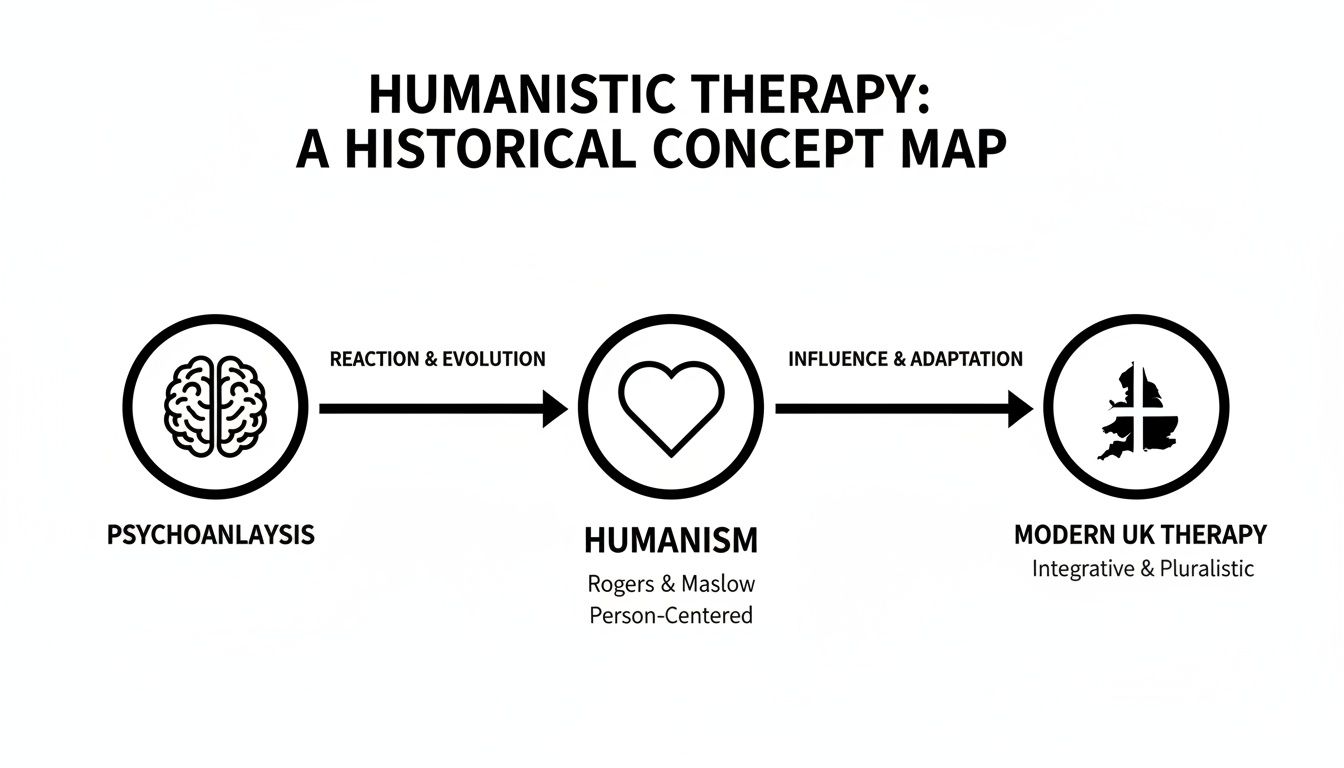
The map shows a clear shift, moving from a clinical focus on the mind (psychoanalysis) to a more holistic emphasis on the person's whole, inner experience (humanism). Ultimately, understanding these different paths can empower you to make an informed choice that feels right for your unique journey. You can explore more about how I bring these ideas into my work on my page explaining my therapeutic approach.
Who Tends to Click with a Humanistic Approach?
Because it’s built on a foundation of genuine connection and personal growth, humanistic therapy can be a source of profound support for a huge range of people. It isn’t about diagnosing a condition; it’s about connecting with the person. This makes it a deeply welcoming space for anyone ready to explore their inner world, whether they're dealing with specific issues or just looking for a more authentic way to live.
The appeal, for many, is its focus on the whole person. Instead of just trying to fix the symptoms, we create a safe environment where you can explore the underlying feelings that might be fuelling challenges like anxiety or depression. The whole process is about building a stronger sense of self-worth and inner resilience from the ground up.
Support for Anxiety and Depression
When you're struggling with anxiety or depression, it can feel like you're at war with your own mind. Many therapies focus on managing the symptoms—the negative thoughts or overwhelming feelings. And that can be helpful, of course. But humanistic therapy takes a slightly different path by trying to understand the person behind the symptoms.
It helps by:
Building Self-Acceptance: We create a space of what we call ‘unconditional positive regard’. It’s a bit of jargon, but it just means helping you accept all parts of yourself. This can seriously lessen the internal conflict that often drives anxiety.
Reconnecting with Your Values: Depression has a nasty habit of making you feel disconnected from what matters. This approach helps you rediscover a sense of purpose and meaning, which is a powerful force for recovery.
Empowering You to Trust Yourself: Instead of me giving you external solutions, humanistic therapy strengthens your ability to listen to and trust your own feelings. That’s a crucial skill for navigating life’s ups and downs.
The core belief here is that by nurturing your self-worth and helping you feel whole again, the symptoms of anxiety and depression naturally start to lose their grip. It’s about cultivating inner strength rather than just fighting the darkness.
A Validating Space for Neurodiversity
The client-led, non-judgemental nature of humanistic therapy makes it an especially supportive environment for neurodiverse individuals. In a world that often demands we all fit into the same box, this approach genuinely honours and validates different ways of thinking, feeling, and seeing the world.
There’s absolutely no pressure to follow a rigid structure. The therapy adapts to you. It respects your unique perspective and trusts that you are the expert on your own experience. For many neurodiverse clients, that validation is incredibly powerful. It fosters a sense of acceptance and confidence that allows you to explore your strengths and navigate challenges on your own terms.
Finding Yourself When You Feel a Bit Lost
Beyond specific mental health challenges, humanistic therapy is ideal for anyone who simply feels a bit lost. It could be a sense of emptiness, a struggle with low self-esteem, or just that nagging feeling that you're not quite living the life you were meant to. It’s for those moments when you find yourself asking, "Is this it?"
This approach is perfect for people who want to:
Explore their identity and what really makes them tick.
Strengthen their relationships with others by first strengthening their relationship with themselves.
Navigate big life transitions, like a career change, bereavement, or relationship breakdown.
Move beyond that harsh inner critic and cultivate some genuine self-compassion.
Ultimately, it’s a journey toward feeling more connected to yourself and living a life that feels authentic and meaningful. If any of this resonates with you, I invite you to book an initial chat to see if we might be a good fit.
What to Expect in Your Humanistic Therapy Session
Walking into a therapy room for the first time can feel a bit strange, I get that. But knowing what to expect can really help take the edge off. In humanistic therapy, the session is our shared space – it's built on a real, human-to-human connection, not some complicated agenda or a sense of clinical distance.

The most important thing to know is that you are in the driver's seat. You set the pace and decide what we talk about. My job isn't to diagnose or tell you what to do, but to be right there with you, listening carefully and helping you find your own clarity. It's all about creating a safe, supportive environment where you can finally be yourself.
A Collaborative and Non-Judgemental Space
Humanistic therapy is built on one core belief: you are the expert on your own life. This isn't a new idea; its principles have been influencing British clinical psychology since the 1950s, with groups like the Association for Humanistic Psychology forming back in 1962. It's a well-established way of working.
This means our sessions are a genuine partnership. Think of it less like a doctor's appointment and more like a focused, protected conversation where your experience is the only thing that matters.
A humanistic session is your time and your space. It's a confidential setting dedicated entirely to you—to your thoughts, your feelings, and your unique perspective—without any fear of judgement.
This non-judgemental stance is everything. It’s what makes it possible to explore difficult feelings, question old habits, and connect with your own inner wisdom. To demystify the process even more, I’ve put together a guide on what happens in counselling sessions, which might help you feel more prepared.
Different Ways We Can Work Together
Life is busy and everyone’s needs are different, so I offer a few ways for us to work together. The goal is to make therapy feel as comfortable and accessible as it can be for you.
You can choose from:
Face-to-Face Sessions in Cheltenham: My therapy room is a calm, private space where we can sit down together and focus completely on you.
Walk-and-Talk Therapy: If sitting in an office feels a bit intense, we can take our sessions outside. Walking in nature around Cheltenham often helps people feel more relaxed and reflective.
Online Sessions: For maximum flexibility, online therapy allows you to have your sessions from wherever you feel most comfortable, fitting them around your life and other commitments.
No matter which option you choose, the core principles of empathy, authenticity, and respect are always there. If you want to know a bit more about me and how I work, feel free to have a look at my About Ben page.
A Few Common Questions About Humanistic Therapy
Even after digging into what humanistic therapy is all about, it’s completely normal to have a few more practical questions bubbling up. This last section is here to give you some straightforward answers to the things people often ask, hopefully making the idea of taking the next step feel a bit clearer.
How Long Will Therapy Take?
This is usually one of the first things people want to know. Unlike some very structured therapies that might come with a set number of sessions, the humanistic approach is guided by you.
There’s no one-size-fits-all timeline. For some people, it’s a relatively short-term process to navigate a specific challenge, like a breakup or a career change. For others, it becomes a longer, more open-ended journey of self-discovery. The simple answer is: therapy lasts for as long as you feel you’re getting something valuable from it. We’ll check in on the pace and direction as we go.
Can It Help With Something Like Severe Anxiety?
Yes, absolutely. Humanistic therapy is a well-respected approach for working with anxiety. While other methods might focus on giving you tools to manage the symptoms, the humanistic way often gets to the root causes fuelling the anxiety – things like a harsh inner critic, a feeling of being a bit lost in life, or a disconnection from who you really are.
By building a genuinely safe and accepting relationship, therapy gives you the space to develop your own inner resilience. It's about building a stronger, more compassionate relationship with yourself, which often leads to anxiety naturally easing as you feel more grounded and sure of who you are.
Will You Just Listen, or Will You Give Me Advice?
This is a great question, and it really gets to the heart of how this works. A humanistic therapist’s core belief is that you are the expert on your own life. Because of that, they won’t tell you what you "should" do or hand out direct advice.
Instead, I see my role as more of a skilled and supportive guide. My job is to:
Listen with my full attention to really grasp what your world feels like from your perspective.
Gently reflect back what I’m hearing, helping you find your own clarity in the fog.
Create a genuine, non-judgemental space where you can safely explore all your options and feelings.
It’s a real partnership. The goal is to empower you to hear your own inner wisdom and find the path forward that feels right for you.
How Do I Know if This Is the Right Therapy for Me?
Honestly, the biggest factor in any therapy being successful is the connection you have with your therapist. You have to feel safe, properly heard, and respected for who you are. The best way to figure out if humanistic therapy – and my way of working – is a good fit is simply to give it a try.
I offer an initial consultation which is the perfect, no-pressure way for you to ask me anything and get a real feel for how I work. It’s your chance to see if we click. Trust your gut instinct; the right therapist is someone you feel you can eventually be open and honest with.
If you feel ready to explore what a more authentic and fulfilling life could look like, please do get in touch. Therapy with Ben offers a welcoming, confidential space right here in Cheltenham. You can learn more or book an initial chat by visiting my website.


Comments