


Does Couple Counselling Work: Does Couple Counselling Work in Relationships
When your relationship feels like it’s on shaky ground, it’s completely normal to ask: does couple counselling actually work?
The short answer is a resounding yes. For the vast majority of couples who commit to the process, it’s a powerful and effective way to rebuild connection, learn to communicate again, and navigate those tough patches together.
Unpacking the Evidence Behind Couple Counselling
Deciding to invest your time, money, and emotional energy into therapy is a big step. You deserve to know what the real-world outcomes look like, and thankfully, it’s not all just vague hopes and crossed fingers. The success of couple counselling is backed by solid research.
At its heart, therapy creates a safe, structured space where you and your partner can properly explore what’s going on between you. It's about getting the right tools to break out of those negative cycles, build genuine empathy, and lay the groundwork for healthier, happier patterns.
What the Data Reveals About Success
Looking at the numbers can be incredibly reassuring for couples who are on the fence. Study after study shows that most pairs see a real, tangible improvement in their relationship.
A significant body of research from the UK and beyond confirms that around 70% of couples report positive outcomes from their time in therapy. They find it far more helpful than trying to go it alone with no support. You can explore a detailed study on these findings for a deeper dive.
The data paints a clear picture: this isn't a coin toss. It’s a well-established approach with a strong track record of helping couples create meaningful, lasting change.
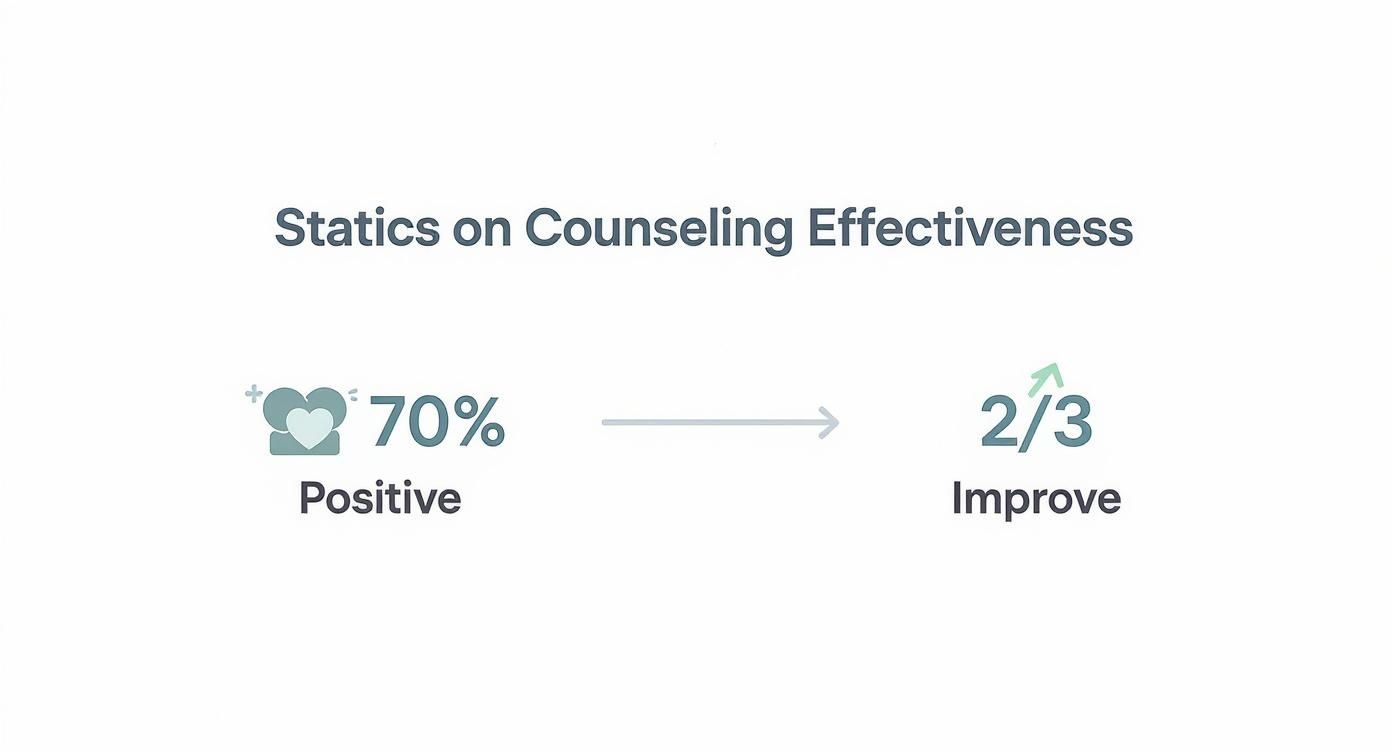
Here's a quick summary of what you can generally expect.
Couple Counselling At a Glance
Aspect | Typical Outcome or Statistic |
|---|---|
Overall Effectiveness | Approximately 70% of couples report a significant improvement in their relationship satisfaction. |
Communication Skills | The vast majority learn new, healthier ways to communicate and resolve conflict. |
Client Improvement | Roughly two-thirds of clients feel their condition has improved after completing therapy. |
Long-Term Impact | Many couples find the benefits and skills learned continue long after their sessions have ended. |
The goal isn't just to stop the arguments. It’s about fundamentally strengthening the foundations of your relationship by learning practical skills and gaining a much deeper insight into each other’s worlds. This journey is what sets you up for a more resilient and connected partnership for years to come. You can read more about effective therapy for relationship issues in the UK to see how this works in practice.
Understanding the Science Behind a Stronger Relationship

It’s one thing to hear that couples counselling works, but it’s another to understand how we know. It's not just about gut feelings or a few success stories; the effectiveness of good therapy is backed by solid research that measures real, tangible changes in both the individuals and the partnership itself.
Think of it this way. When you see a doctor, they don’t just ask if you ‘feel’ better. They take your blood pressure or look at test results to get objective proof of what’s going on. Relationship science works in a similar way, using properly validated tools to track progress and turn subjective experiences into concrete data.
Measuring What Really Matters
So, how do you measure something as complex as a relationship? Researchers use specialised assessment tools designed to gauge both psychological well-being and the quality of the partnership.
In UK-based studies, two of the key instruments you’ll see are:
CORE-OM (Clinical Outcomes in Routine Evaluation): This is all about the individual. It measures levels of psychological distress, looking at things like anxiety, depression, and how well you're functioning day-to-day.
GRIMS (Golombok Rust Inventory of Marital State): This tool zooms in on the relationship itself. It evaluates satisfaction levels, the quality of communication, and that feeling of connection between partners.
By using these tools before therapy starts and again after it finishes, we can scientifically see the impact of counselling. The aim is simple: to see individual distress go down (a lower CORE-OM score) and relationship satisfaction go up (a higher GRIMS score). This dual focus is vital because you can't have a healthy relationship without healthy individuals.
What the UK Research Shows
And the evidence is compelling. A major UK study of 877 clients showed that couples counselling delivered significant improvements on both fronts. The research found a big reduction in personal distress for both men and women, alongside a real, meaningful improvement in how they felt about their relationship. If you're interested in the details, you can explore the full findings of the study here.
This really gets to the heart of good couples therapy: it works on the individual and the partnership at the same time. You aren't just there to fix a "relationship problem"; you're there to help two people grow, which in turn strengthens the bond they share.
This approach ensures the changes you make are built to last. Alongside therapy, looking into practical tips for building lasting love can help reinforce the new skills you're learning. Ultimately, the science confirms what many of us know from experience: committing to the process is a powerful step towards building a more resilient and happier future together.
Finding the Right Approach for Your Relationship
Just as no two relationships are identical, there’s no single type of therapy that fits every couple. Finding an approach that really resonates with your specific challenges is one of the biggest factors in whether counselling actually works for you. Different methods zoom in on different parts of a relationship, so getting a basic feel for them can help you find the right path forward.
Think of it like choosing how to get fit. Some people need the clear structure of a weight-lifting programme, while others thrive on the flexibility of something like yoga. Both can make you stronger, but you’ll only get results from the one you stick with because it feels right. Therapy is much the same.
Emotionally Focused Therapy (EFT)
One of the most respected and effective approaches out there is Emotionally Focused Therapy, or EFT for short. The research speaks for itself: studies show that over 70-75% of couples who go through EFT see a significant recovery in their relationship, with around 90% reporting marked improvements.
At its heart, EFT is all about the emotional bond between you and your partner. It helps you both get underneath the surface of your arguments to understand the deeper feelings and fears that keep you stuck in negative cycles. Rather than just teaching you conflict-resolution tricks, it aims to rebuild that sense of emotional safety and strengthen your core connection.
This therapy helps you answer the question that so often lies beneath the conflict: "Are you there for me?" By fostering a secure connection, EFT helps partners turn towards each other for comfort, not away.
This approach is particularly powerful for couples who feel emotionally distant, or who are trying to heal from a breach of trust like an affair.
The Gottman Method
Developed by Drs. John and Julie Gottman after decades of observing real couples, the Gottman Method is a very practical, skills-based approach. It’s less about deep emotional exploration and more about giving you a concrete toolkit to improve your friendship, manage conflict better, and support each other’s hopes for the future.
The core of this method is the "Sound Relationship House," a brilliant analogy for the nine building blocks of a healthy partnership. Each level builds on the last, from really knowing your partner’s inner world to creating a shared sense of meaning together. It provides a clear blueprint for what a strong relationship looks like and how to build one, step-by-step.
This method is an excellent fit for couples who:
Feel stuck in the same, gridlocked arguments over and over.
Need practical tools for better communication.
Want to rediscover their friendship and intimacy.
Feel like they are living more like flatmates than partners.
Understanding the different models available is a key first step. To explore this a bit more, you can read our comprehensive guide to types of counselling in the UK. The right approach can make all the difference, turning therapy from a daunting chore into a genuinely rewarding journey.
Who Goes to Counselling and Why

It’s surprisingly easy to feel like you’re the only ones struggling in your relationship, that your problems are somehow too unique or maybe not even "bad enough" to warrant therapy.
The truth is, couples from every imaginable background find their way to counselling for a massive range of issues. Getting a sense of who goes to therapy, and why, can help take the weight off your shoulders and show you that you’re far from alone.
There’s no such thing as a "typical" couple in the therapy room. I've worked with newlyweds hitting their first major roadblock and long-term partners who feel more like flatmates than lovers. The challenges are as varied as the people themselves.
Common Reasons Couples Seek Support
While every relationship has its own story, many couples end up grappling with similar hurdles. Data from UK relationship support services gives us a real glimpse behind closed doors. Some of the most common reasons people decide to get help include:
Communication Breakdown: This is a big one. It's that feeling of being constantly misunderstood, unheard, or stuck in a loop of arguing over the same small things.
Breach of Trust: Trying to find a way forward after the gut-punch of infidelity or some other form of betrayal.
Life Transitions: Struggling to adapt to massive changes like having kids, one person changing careers, or dealing with a bereavement.
External Pressures: The classic stuff – money worries, conflicts with the in-laws, or the constant juggle of work-life balance.
Mental Health Impact: When one or both partners are managing something like anxiety or depression, it naturally impacts the relationship dynamic.
One of the biggest myths is that you have to be at a breaking point to benefit from counselling. That's just not true. Many couples use it proactively, as a way to strengthen what they have and build the skills to handle whatever life throws at them next.
The complexity of modern relationships is reflected in the data. For instance, UK research shows that younger adults under 35 often present with numerous interconnected issues, averaging 11.6 issues per client.
A Deeper Look at the Data
If you look at the statistics from major UK providers like Relate, you get a clear picture of what’s really going on. For example, mental health is a factor for nearly 44% of clients, but it's the main reason for coming to therapy in only about a quarter of those cases. This just shows how deeply our individual wellbeing is tied to the health of our relationships.
What’s really interesting is that couples rarely come in with just one single problem. It's usually a tangle of overlapping issues. This is precisely why the question does couple counselling work is so vital for so many people; the whole process is designed to help you unravel that complexity. You can read more about these demographic trends.pdf) if you want to better understand the challenges modern couples are up against.
Choosing a Therapist Who Truly Connects with You
The success of your counselling journey often boils down to one thing: the person guiding you. While qualifications are an important starting point, the real magic happens when you find a therapist you both genuinely connect with. This relationship, what we call the therapeutic alliance, is the bedrock on which all trust and progress are built.
Think of it like hiring a guide for a difficult expedition. You need to know they can read a map (their qualifications), but you also need to trust that they understand the unique landscape of your relationship and can speak a language you both understand.
When you're looking, the first thing to check is that they are registered with a recognised UK body, like the BACP (British Association for Counselling and Psychotherapy) or the UKCP (UK Council for Psychotherapy). This is your assurance that they meet strict professional and ethical standards.
Finding the Right Fit and Format
Beyond the bit of paper, the personal fit is everything. Most therapists offer a free initial chat, which is a fantastic opportunity to see if their style clicks with you both. Does the conversation feel natural? Do you both feel heard? Trust your gut on this one. For a bit more on this, our post on how to choose a therapist is your guide to finding the right fit can help.
It’s also worth thinking about how different formats and even the therapist's own background might make a difference to your experience.
Considering a Male Counsellor: It's not a hard-and-fast rule, but sometimes a male partner might find it easier to open up with another man. For some, that shared perspective can help lower the initial barriers to feeling vulnerable.
Exploring 'Walk and Talk' Therapy: If sitting face-to-face in a quiet room feels a bit too intense, ‘walk and talk’ therapy is a brilliant alternative. There's something about walking side-by-side in nature that just diffuses tension, making it far easier to tackle tough conversations in a more relaxed way.
The question does couple counselling work often hinges on finding this right combination of professional expertise, personal connection, and a therapeutic format that puts you both at ease. Taking the time to find the right person is one of the most significant investments you can make in the process.
Ultimately, you're not just looking for someone who is qualified on paper. You're looking for a genuine ally for your relationship—someone who makes you feel empowered to do the deep, meaningful work needed to build a stronger future together.
Turning Your Counselling Sessions into Lasting Change

It’s a common misconception that just showing up for therapy is enough. I wish it were that simple, but the truth is, the real, lasting change happens when you both roll up your sleeves and take what you uncover in the therapy room back out into your day-to-day life.
Think of your counselling sessions as a strategy meeting for your relationship. Your therapist is the facilitator, a guide, but you and your partner are the ones who have to execute the game plan. This is the moment the question “does couple counselling work?” gets its answer. It’s not just a possibility; it’s something you actively build.
The goal isn't just about having interesting conversations for an hour a week. It’s about forging new habits from those lightbulb moments. It’s about finding the courage to communicate differently when things get heated, or choosing to be vulnerable when your gut tells you to put up a wall.
Making Every Session Count
To really squeeze the value out of your time with a counsellor, it pays to be prepared and all-in. This isn't about being the perfect client, but about showing up with a real intention to do the work, both during the session and in the days that follow.
Here are a few practical things I've seen make a huge difference:
Prepare Your Thoughts: Before you head to a session, take a few minutes to think about the week. What were the high points? The low points? Was there a specific argument or moment you’d like to untangle?
Embrace Total Honesty: The therapy room should feel like a safe container. Be as open and honest as you possibly can, even when it’s uncomfortable. A therapist can only help with what they know.
Practise Vulnerability: This is a big one. Real connection is forged in vulnerability. That means sharing the deeper fears and feelings, not just the surface-level frustrations that are easy to point out.
The real shift happens when you move from a place of blame towards one of shared responsibility. It’s about stopping the finger-pointing and learning to stand side-by-side to look at the problem together. That collaborative spirit is what truly transforms a relationship.
From Insights to Action
Believe it or not, the most important work actually happens between your sessions. This is your training ground. It’s where you put those new communication skills, emotional regulation tools, and your deeper understanding of each other into practice.
It's about catching yourself before you slip into that old, damaging pattern and consciously choosing a new, healthier response.
As you start to weave the lessons from counselling into your daily life, don't forget that strengthening your bond also means making dedicated time for fun, connection, and romance. Sometimes, a dedicated break, like a stay at one of the many Couples Resorts, can provide the perfect space to practice what you've learned. By actively applying these new tools, therapy stops being just an appointment and becomes a powerful catalyst for building a genuinely stronger, more fulfilling partnership.
A Few Common Questions About Couple Counselling
It’s completely normal to have questions before starting a journey like this. Understanding the practicalities can help take the mystery out of the process, making that first step feel a lot less daunting. Here are a few things couples often ask.
How Long Does Couple Counselling Usually Take to Work?
There really is no magic number for how long therapy takes; it all depends on your unique situation and what you’re hoping to achieve. For couples working on specific communication goals, a shorter, more solution-focused approach might only take between 6 and 12 sessions.
But for deeper-seated issues, like rebuilding trust after an affair or untangling years of built-up resentment, the process will naturally take longer. A good therapist will be open about a potential timeline after your first few sessions and will check in regularly with you both about the progress you feel you’re making.
Can Counselling Help If One Partner Is Unsure About the Relationship?
Yes, absolutely. In fact, this is one of the most common reasons couples come to see me. When one person is feeling ambivalent, counselling provides a safe, neutral space to explore those feelings without pressure or judgement.
This type of therapy is sometimes called 'discernment counselling', and it isn't about forcing a decision. It’s about helping both of you gain clarity. The real goal is to understand the root of the uncertainty so you can consciously decide whether to recommit to the relationship or to separate in a more constructive, thoughtful way.
What If My Partner Is Reluctant to Attend?
This is a frequent and understandable hurdle. The best way to approach this is with empathy, focusing on how you feel rather than what you think they are doing wrong.
Try framing the conversation using 'I' statements. Something like, "I’ve been feeling a bit disconnected from you lately, and I’d love for us to find new ways to support each other." This presents counselling as a team project for 'us', rather than an attempt to 'fix' them. Suggesting a single, no-commitment introductory session can also make the idea feel much less intimidating.
And if they still refuse? Attending on your own can still be incredibly valuable. Working on your side of the dynamic often creates positive shifts within the relationship anyway.
If you're ready to explore how counselling can strengthen your relationship, Therapy-with-Ben offers a supportive and non-judgemental space in Cheltenham to begin. Find out more about face-to-face, online, or walk-and-talk sessions by visiting https://www.therapy-with-ben.co.uk.


Comments