


How to Get Over Getting Cheated On and Start Healing
Updated: Dec 11, 2025
Author: Therapy-with-Ben
When you first find out you’ve been cheated on, the ground beneath you simply vanishes. Survival comes first; healing comes later. The immediate priority is to carve out a safe space to even begin to process the shock.
This means putting your own physical and emotional safety at the top of the list, drawing some hard lines in the sand, and fighting that overwhelming urge to dig for every single painful detail. Demanding all the answers at once can be incredibly re-traumatising, and right now, your only job is to protect yourself.
Your First Steps After Discovering Infidelity

The moment of discovery is its own special kind of trauma. It shatters your reality, leaving you feeling completely lost in a tidal wave of shock, rage, and a sadness so deep it feels like it might swallow you whole.
In these first raw hours and days, you don't need to be making life-altering decisions. You just need to get through the initial emotional tsunami. Think of this as your emotional first-aid kit—the goal is to create a safe container, physically and mentally, so you can start to breathe again without the pressure of finding instant solutions.
Create Immediate Emotional and Physical Space
Right now, your nervous system is completely overloaded. The most important thing you can do is give yourself a safe space to land. This isn't about avoiding the problem; it's about giving yourself the room to absorb the initial impact without making the crisis worse.
This might look like asking your partner to stay with a friend for a few nights, or maybe you're the one who needs to go somewhere else. A calm, neutral environment can make all the difference.
It’s also perfectly okay to say, "I can't talk about this right now. I need time." Trying to hash out all the details while emotions are this high is rarely productive and almost always leads to more hurt. If you’re being bombarded with calls or messages, give yourself permission to turn your phone off. Your peace is the priority.
If you feel completely overwhelmed by it all, simple grounding techniques can pull you back into the present moment. Try to really feel your feet on the floor, or hold a cold glass of water in your hands. These small physical anchors can be surprisingly steadying when everything else feels like it’s spinning out of control.
Resist the Urge for All the Details
There’s an almost primal instinct after a betrayal to know everything. Who, what, where, when, how many times? While you might need some of that information later, demanding a blow-by-blow account right now can inflict deep, unnecessary trauma.
Your mind is desperately trying to make sense of something senseless, and it tricks you into believing that more information will bring clarity. In reality, it often just provides more graphic images to haunt you. For now, protect yourself by pausing the investigation.
These painful details can easily become intrusive thoughts, making it so much harder to heal down the line. You can decide later what you truly need to know to make a clear decision about the relationship. For now, self-preservation is your only task.
Focus on Your Basic Needs
When your emotional world implodes, it’s all too easy to forget about your physical self. But your body and mind are completely connected. Tending to your most basic needs is a quiet but powerful act of self-care, a way to reclaim a little bit of control when everything feels chaotic.
Just focus on the simple things:
Drink a glass of water. It sounds almost ridiculously simple, but your body is under immense stress, and stress is incredibly dehydrating.
Try to eat something. Even if you have no appetite, a piece of toast or a banana can help. Your body needs fuel to cope with this level of emotional strain.
Just breathe. Try taking a few slow, deep breaths. Inhale for a count of four, hold it for four, and then exhale slowly for a count of six. This simple exercise can work wonders to calm a panicked nervous system.
When you're reeling from betrayal, it's easy to feel utterly alone, but it's important to remember you aren't. While it doesn't lessen the sting, various UK studies show that infidelity is a distressingly common experience. Around 20% of adults admit to having cheated on a partner at some point. You can learn more about the prevalence of infidelity in the UK if you feel it might help. Knowing this can't take away the pain, but it can chip away at that isolating feeling that you're the only one this has ever happened to.
In the first 24-48 hours, your brain will be in overdrive. A simple checklist can help you focus on what truly matters: keeping yourself safe and grounded.
Immediate Self-Care Checklist After Betrayal
Action | Why It Helps | Practical Example |
|---|---|---|
Secure a Safe Space | Removes you from the immediate source of trauma, allowing your nervous system to calm down. | Ask your partner to leave for 24 hours, or go and stay with a trusted friend or family member. |
Limit Communication | Prevents further emotional injury from panicked, accusatory, or defensive conversations. | Send a text: "I need space and cannot talk right now. I will let you know when I am ready." |
Hydrate and Eat Simply | Provides your body with the basic fuel it needs to manage extreme stress and emotional shock. | Keep a water bottle with you. Eat a piece of fruit or some toast, even if you don't feel hungry. |
Contact ONE Trusted Friend | Reduces feelings of isolation and provides an immediate emotional outlet with someone who has your back. | Call the one person you know will listen without judgement and simply offer support. |
Avoid Major Decisions | Your mind is in a state of shock and not capable of making rational, long-term choices right now. | Promise yourself you won't decide anything about the relationship's future for at least a week. |
Do a Grounding Exercise | Brings you back into your body and the present moment, interrupting the cycle of panicked thoughts. | Hold an ice cube in your hand, focusing only on the cold sensation until it melts. |
This checklist isn't about "fixing" anything. It's about getting through the next hour, and then the one after that. It's about treating yourself with the same care and compassion you'd offer a friend in crisis.
Navigating the Stages of Grief After Betrayal

The aftermath of discovering infidelity feels a lot like grief because, in many ways, that's exactly what it is. You aren't just mourning an action; you’re mourning the entire reality of the relationship you thought you had.
The sense of loss can be immense—for the trust that's been shattered, for shared memories now tainted, and for the future you had so carefully planned together.
Recognising your experience as a form of grief is a crucial first step. It helps you make sense of the chaotic, painful, and often contradictory emotions you’re feeling. These feelings aren’t a sign that you're "going crazy"; they are the well-known stages of healing from a profound loss.
It's vital to remember that these stages aren't linear. You won’t neatly progress from one to the next like ticking off a checklist. Instead, you might find yourself jumping between them, or even feeling several at once on a particularly tough day. This is completely normal. The key is to be patient with yourself and allow space for each feeling as it comes up.
Denial: Shielding Yourself from the Pain
In the very beginning, your mind might simply refuse to accept what has happened. Denial is a powerful psychological defence mechanism, a way for your psyche to shield itself from a truth so painful it feels completely unbearable.
This can show up as telling yourself, "This can't be happening," or minimising the betrayal by thinking, "It must have just been a one-time mistake." You might find yourself drifting through your day in a numb haze, almost as if nothing has changed, because the alternative is just too overwhelming to face.
This stage isn't about being weak; it's about survival. It's your brain giving you a moment to catch your breath before the full weight of the situation settles in.
Anger: The Inevitable Eruption
Once the initial shock begins to wear off, anger often rushes in to fill the void. This anger can be white-hot and all-consuming. You might direct it squarely at your partner for their betrayal, at the other person involved, or even at yourself for "not seeing the signs."
This rage is a completely valid response to having your trust so deeply violated. Infidelity is a leading cause of relationship breakdown for a reason; its impact is destructive. In fact, one recent report found that in the UK, cheating is cited as the top reason for divorce, accounting for the breakdown of approximately one-third of marriages. You can explore more insights from the 2025 divorce report to understand its full impact.
Finding a healthy outlet for this anger is critical. Trying to suppress it will only cause it to fester and grow. Channel it into something physical, like a brisk walk or a run, or get it all out by writing everything down in a journal you never intend to share.
Bargaining: Trying to Regain Control
Bargaining is the stage where you might find yourself replaying events over and over, completely consumed by "what if" scenarios. You might think, "If only I had been more attentive," or "If I had just done things differently, this wouldn't have happened."
This is your mind's attempt to find some sense of control in a situation where you feel completely powerless. It's a desperate search for a reason, a way to make sense of something that feels utterly senseless.
You might make promises to yourself or your partner: "I'll do anything to fix this," or "If we can just go back to how things were before..."
You might try to negotiate with a higher power: "I promise I'll be a better person if you just make this pain stop."
This stage is often riddled with self-blame, but it’s so important to remember that your partner's choice to be unfaithful was theirs and theirs alone.
Depression: When the Reality Sets In
As the anger subsides and the reality of the loss truly sinks in, a profound sadness or depression can take hold. This is often the quietest but heaviest stage of the entire grieving process.
The raw energy of anger is gone, replaced by a feeling of emptiness and despair. You might feel a deep, penetrating loneliness, question your self-worth, and struggle to find any joy in things you once loved. Just getting out of bed can feel like an impossible task.
This is the point where the full emotional weight of the betrayal lands. It is a period of deep mourning for the relationship you've lost. Allow yourself to feel this sadness without judgement. It's okay to cry, to retreat, and to simply be with the pain for a while.
Acceptance: Finding a Path Forward
Acceptance doesn't mean you condone what happened or that the pain has magically vanished. It simply means you are no longer fighting against the reality of the situation. It’s about acknowledging the betrayal, understanding that it happened, and feeling ready to start building a future again.
This stage is about integration, not erasure. The scar will likely always be there, but it no longer dictates your every thought and feeling. You start to see a path forward, whether that is with your partner through a long and difficult process of rebuilding, or on your own, towards a new beginning.
Acceptance is where true healing begins. It’s a quiet recognition that you have survived something incredibly painful and that you absolutely have the strength to create a new life for yourself—one where peace is possible again.
Practical Steps to Reclaim Your Life
Working through the grief that comes with betrayal is a huge part of healing, but it can’t stop there. True healing demands action. It’s about taking small, deliberate steps to rebuild your life and find some solid ground again when everything feels like chaos.
These actions aren’t a shortcut to “getting over it”. Think of them more as a way to create structure, stability, and moments of peace that remind you who you are outside of this relationship. This is your chance to reconnect with the person you were before all this happened, and to start nurturing the person you want to become.
Lean on Your Support Network
When you’re hurting, the urge to retreat into yourself can be overwhelming. But connection is a powerful antidote to the shame and loneliness that infidelity leaves in its wake. Reaching out to trusted friends and family is one of the most important things you can do right now.
Find those people in your life who can just listen, without jumping in to offer advice or solutions. Often, what you need most is simply a safe space to be heard. Let them know what would actually help – whether that’s a distraction, a shoulder to cry on, or even just someone to sit in comfortable silence with you.
Remember, leaning on others is a sign of strength, not a weakness. Letting people who care about you share the load can make an unbearable burden feel that little bit lighter.
Rediscover Who You Are
It’s completely normal for our identities to get a bit tangled up in our relationships. Hobbies, interests, and even friend groups can start to merge. After a betrayal, it’s absolutely vital to rediscover the things that are solely yours.
Think back to what you loved doing before this relationship. What brought you joy? What made you feel energised and alive?
Reconnect with old hobbies: Did you used to paint, play an instrument, or love hiking? Give it another go, even if it feels a bit strange at first.
Explore new interests: This is the perfect time to finally try something you've always been curious about, like a pottery class, a book club, or a new sport.
Spend time with your own friends: Reinvesting in friendships that exist outside of your coupledom helps reinforce your own, individual support system.
These activities aren't just distractions; they are powerful acts of self-reclamation. They remind you that your identity is whole and complete on its own, and they help rebuild the self-esteem that’s taken a knock by showing you that you are capable and interesting, independent of your partner.
Prioritise Meaningful Self-Care
Self-care after a trauma like this isn’t about bubble baths and grand gestures. It's about small, consistent actions that provide stability and help soothe your nervous system. When everything feels out of control, a simple routine can be an incredible anchor.
Try to focus on the fundamentals that make a real difference:
Establish a Simple Daily Routine: Try to get up and go to bed at roughly the same time each day. Eat your meals on a regular schedule. This kind of predictability can be incredibly calming for a mind in turmoil.
Focus on Nourishment: Stress can do a number on your appetite, but your body needs fuel to cope. Aim for simple, nourishing foods. Honestly, even managing a smoothie or a bowl of soup is a victory.
Embrace Gentle Movement: You don't need to suddenly start training for a marathon. A simple daily walk is one of the most effective ways to manage stress hormones like cortisol and adrenaline. The rhythm of walking, especially if you can get outdoors, can do wonders for clearing your head and lifting your mood.
These tangible actions provide a framework for your day, giving you back a small but significant sense of control and purpose. Each small act of self-care sends a powerful message to yourself: that you are worthy of kindness and attention, especially now.
Should I Stay or Should I Go? Making a Clear Decision
Once the initial shockwave subsides, you’re left at a crossroads, facing a question with no easy answer: should I stay or should I go? This is arguably the toughest part of the entire process, and it’s a decision only you can make, free from pressure or judgement.
The goal here isn't a quick fix, but genuine clarity. It's a process that calls for a careful and honest look at your relationship, your partner's actions, and what you truly need to feel safe and whole again.
Looking at the Relationship Before the Betrayal
Before you can decide on the future, you have to look honestly at the past. Was the relationship a source of happiness and support before the infidelity, or were there already significant cracks in the foundation?
Take some real time to think about these questions:
Were your needs being met? Before this, did you feel heard, respected, and valued by your partner?
How was your communication? Could you both talk about difficult topics and sort out conflicts in a healthy way?
Was this part of a pattern? Was this infidelity a shocking one-off, or was it part of a bigger picture of secrets or broken trust?
Answering these honestly helps you figure out if you're fighting to save a genuinely good relationship that's been deeply wounded, or trying to piece together something that was already unhealthy.
Evaluating Your Partner’s Response
How your partner behaves after you find out speaks volumes. Their response is a massive clue as to whether genuine repair is even on the table. True accountability is so much more than a tearful apology; it's a fundamental shift in their behaviour.
You need to look for signs of genuine remorse, not just regret at being caught.
A partner showing true remorse will focus on your pain ("I am so sorry for the hurt I’ve caused you") rather than their own self-pity ("My life is ruined"). They'll take full ownership without making excuses, blaming you, or downplaying what they did.
This is where you'll need to have some incredibly tough conversations. Learning how to handle difficult conversations with confidence can give you a framework to express what you need and really gauge if your partner is listening.
If you’re even considering reconciliation, your partner has to be willing to do whatever it takes to rebuild trust. That means being transparent, answering hard questions, and often, getting into individual or couples therapy to understand why they did it.
Making the Decision That Is Right for You
There’s no right or wrong answer here, only the answer that is right for you. As you weigh everything up, it might help to know how common this is, which can dial down the feelings of shame or isolation. Pre-COVID UK surveys found that 54% of women and 57% of men admitted to having cheated in a committed relationship. The emotional fallout is profound, regardless of the stats.
When your thoughts are all jumbled and overwhelming, something like a simple decision tree can help you see a path forward.
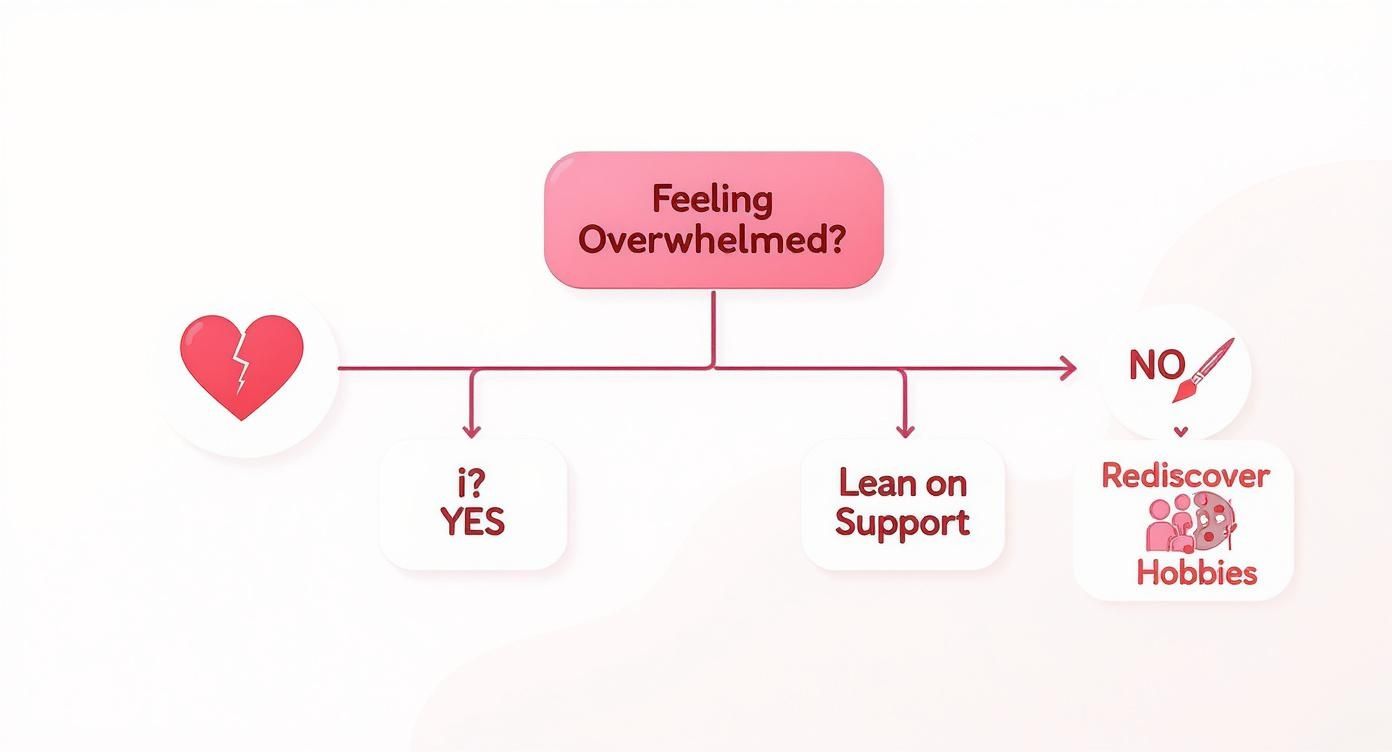
The key takeaway is that every path to recovery involves taking an active step, whether that’s reaching out for support or reconnecting with yourself.
If you decide to leave, the path ahead involves both emotional and practical steps. Understanding the legal implications of adultery in divorce can be a crucial piece of the puzzle. This knowledge empowers you, helping you plan your next steps from a position of strength and clarity.
Ultimately, trust your gut. Your intuition is a powerful guide. Give yourself the time and space you need to listen to what it’s telling you, away from the noise of apologies or the opinions of others. This decision will shape your future, and you owe it to yourself to make it with as much clarity and self-compassion as possible.
Rebuilding Yourself After the Betrayal

Whether you choose to stay or go, the most critical journey you’ll take now is the one back to yourself. The betrayal doesn’t just break trust with a partner; it often fractures the trust you have in your own judgement. It can leave you questioning everything—your worth, your perception, and your ability to see people for who they really are.
This part of the recovery process is all about you. It's about rediscovering your inner strength, reconnecting with your confidence, and writing a new story for your life. A story where this painful chapter is just that—a chapter, not the whole book. You can come out of this not just healed, but stronger and more self-aware than ever before.
Confronting Negative Self-Talk
It’s incredibly common for a harsh inner critic to take over after you’ve been cheated on. That voice can whisper some truly awful things: "I'm not good enough," "I should have seen the signs," or "There must be something wrong with me." This kind of self-blame is a cruel trick your mind plays to try and make sense of a senseless situation.
The first step is to see this narrative for what it is: a coping mechanism, not the truth. When you find yourself spiralling into that negative self-talk, just pause. Gently challenge it. Ask yourself, "Is this thought actually true, or is it just the hurt talking?"
Your partner's decision to cheat was about them—their choices, their issues, and their inability to cope. It was not, and never will be, a measure of your value. Reminding yourself of this, even when it feels impossible to believe, is a radical act of self-compassion.
Learning to Trust Your Intuition Again
One of the most damaging side effects of infidelity is how it can silence your gut feelings. You might find yourself second-guessing every little decision, feeling totally unable to trust your own judgement in relationships and beyond. Rebuilding that trust is a slow, deliberate process.
Start small. I mean really small, low-stakes situations. Practise listening to that quiet inner voice about everyday things, like what you feel like eating for dinner or which friend you genuinely want to call. By proving to yourself that your intuition can be trusted in these small ways, you gradually rebuild the confidence to rely on it for the bigger things. This is a core part of the journey when we explore how to find yourself again after a major life event, as it reconnects you with your own inner compass.
Practical Exercises for Rebuilding Self-Worth
Healing isn't just a mental exercise; it requires action. Bringing small, consistent practices into your daily life can powerfully reinforce your sense of worth and capability.
Here are a few practical ideas you can start with:
Start a 'Done' List: Forget the to-do list for a while; it can feel overwhelming. Instead, at the end of each day, write down everything you actually accomplished. It could be as simple as "made the bed," "walked around the block," or "replied to that one email." This creates tangible proof of your resilience.
Set a Small, Achievable Goal: Choose something you want to learn or do that has absolutely nothing to do with your relationship. Maybe it’s learning three chords on a guitar, trying a new recipe each week, or training for a 5k run. Achieving something that's just for you is a powerful reminder of your own agency.
Write a New Story: Take some quiet time to write about the person you want to be moving forward. What are your core values? What do you truly want in a healthy relationship? How do you want to feel each day? This exercise helps shift your focus from the painful past to a future you are actively creating.
Part of this process might also involve understanding how to build emotional intimacy, which lays the groundwork for healthier connections in the future, whether that's with a new partner or a renewed one.
Ultimately, the goal is to shift your focus back to what you can control. You cannot control what someone else did, but you have complete control over your own healing. This painful experience can become the catalyst for profound personal growth, leading you to a future built on a stronger, more authentic foundation.
When to Seek Professional Support
Leaning on your friends and family is invaluable, but sometimes the trauma of betrayal cuts too deep for even the most well-meaning support network to handle. There's absolutely no shame in needing that bit of extra help; in fact, recognising that you’re stuck is a sign of immense strength.
Professional support, like counselling, offers something different. It’s a completely confidential, non-judgemental space with a trained professional whose only focus is your wellbeing. It gives you a place to explore the full, messy extent of your pain and anger without having to worry about burdening or alarming a loved one.
Signs You Might Need More Support
So, how do you know when it’s actually time to reach out? Everyone’s healing journey is unique, of course, but there are some common signs that you might be struggling to process the trauma on your own. It's often less about one big, dramatic event and more about a persistent, nagging pattern of feeling stuck.
Does any of this feel familiar?
Intrusive Thoughts: You find yourself constantly replaying the painful details. These thoughts just pop into your mind, unwanted, disrupting your work and stealing your peace.
Inability to Function: Simple, everyday tasks like getting out of bed, eating properly, or concentrating at work feel completely impossible.
Persistent Feelings of Worthlessness: The betrayal has dug in deep, triggering an unshakable belief that you are somehow flawed, unlovable, or even to blame for what happened.
Extreme Emotional Swings: Your emotions feel completely out of control, swinging wildly from intense rage to deep despair in a way that feels both exhausting and frightening.
Social Withdrawal: You've started avoiding friends, family, and things you once enjoyed because you feel too ashamed, sad, or anxious to face the world.
If these experiences hang around for weeks with no signs of easing up, it might be time to think about professional help. A therapist can provide the tools and guidance to help you navigate this incredibly difficult period.
What Therapy for Infidelity Looks Like
The thought of therapy can be a bit daunting, I know, but its purpose is simple: to create a safe container for your pain. In sessions, you'll be able to unpack your feelings without judgement, understand the psychological impact of what’s happened, and develop healthy, effective ways to cope. It’s not about being told what to do; it’s about being guided back to your own strength.
The goal of therapy isn't to erase what happened. It's to help you integrate the experience in a way that it no longer controls your life, allowing you to move forward with a renewed sense of self and purpose.
There are various approaches, and a good therapist will work with you to find what feels right. This could be traditional talking therapy in an office, online sessions from the comfort of your own home, or even walk-and-talk therapy. Getting outdoors and moving while you process difficult emotions can be incredibly effective, often helping to reduce the intensity of the feelings and prevent you from feeling stuck.
Choosing the right person is a crucial first step, and it's so important to find someone you feel comfortable and safe with. Our guide on how to choose a therapist and find the right fit can walk you through the process, helping you feel more confident as you take this vital step for your own wellbeing. A therapist can help you rebuild your life, but on a solid, healthy foundation.
A Few Common Questions After Being Cheated On
When your world gets turned upside down by infidelity, it’s completely normal for your mind to be racing with questions. Let's tackle some of the big ones that often come up in the therapy room.
Is It My Fault My Partner Cheated?
Let’s get this one out of the way immediately: No. Absolutely not.
The choice to cheat belongs 100% to the person who did it. End of story.
Yes, relationships are complicated, and maybe things weren't perfect. But cheating is a coping mechanism—a destructive one. Your partner had a whole menu of healthier options. They could have talked to you about what was wrong, suggested you see a therapist together, or even ended the relationship respectfully.
They chose not to. That was their decision, not a reflection of your worth. It's so easy to get lost in self-blame, but please know that's just the trauma talking. The first step to getting your power back is to place the responsibility exactly where it belongs: with them.
Will I Ever Be Able to Trust Anyone Again?
Right now, the very idea of trust probably feels impossible. Betrayal on this level shatters your foundations and can make you doubt your own judgement about people. It's a horrible feeling, and it's a perfectly normal reaction.
The key isn't to force yourself to trust other people right away. Instead, the journey begins with learning to trust yourself again.
It's a gradual process. As you heal, you'll start to reconnect with your intuition. You'll become better at spotting those little red flags you might have missed before. Therapy is brilliant for this, as it helps you sort out what's a genuine warning sign and what's just the lingering echo of past trauma.
Trust is possible again, but it won't be the same naive trust you had before. It will be a wiser, more discerning trust, built on a solid foundation of knowing and respecting yourself. You’ll learn to bet on you.
How Long Does It Take to Get Over This?
There’s no magic number or neat timeline for healing. Honestly, it's different for everyone. It depends on so many things—the specifics of the betrayal, what your support system looks like, and your own personal history.
Some people might start to feel the fog lift after a few months, while for others, it could take a year or more. Try not to get caught up in watching the calendar.
Instead, focus on small signs of progress.
Are you having a few more good days than bad ones this week?
Have you found yourself enjoying a hobby again, even for just a little while?
Are those painful, intrusive thoughts popping up a little less often?
These are your victories. Celebrate them. Be kind to yourself and give yourself the grace to heal at whatever pace feels right. Every step forward, no matter how small, is a testament to your own strength and resilience.
At Therapy-with-Ben, I offer a safe, non-judgemental space to work through the pain of betrayal and start rebuilding. If you feel stuck and think some professional support could help, please get in touch to learn about face-to-face, online, or walk-and-talk therapy sessions. You really don't have to go through this alone.
Find out more at https://www.therapy-with-ben.co.uk.


Comments