


How to Find Yourself Again: A Practical Guide
By Therapy-with-Ben
The whole journey of finding yourself again kicks off with a single, simple step: pausing to admit you feel lost. It is not about finding a final destination. Instead, rediscovering your identity is a gentle process of looking inward, reconnecting with what truly matters to you, and figuring out which parts of yourself have been pushed aside or forgotten along the way.
Understanding Why You Feel Lost
Feeling disconnected from yourself is not a personal failing; it is a profoundly human experience. It is often a quiet drift that happens over time, usually kicked off by big life changes, long periods of stress, or even just subtle shifts in our day-to-day lives. You might catch your reflection one day and wonder who is looking back, feeling like a stranger in your own skin.
This sense of being lost can show up in a few common ways:
A constant feeling of numbness, like you are just going through the motions.
Struggling to make decisions, big or small, because you are not sure what you really want.
A nagging sense that your life is being lived for someone else—your partner, your kids, your boss.
Losing interest in the hobbies and passions that used to light you up.
The infographic below really brings home how common this is, highlighting the triggers and feelings many of us share.
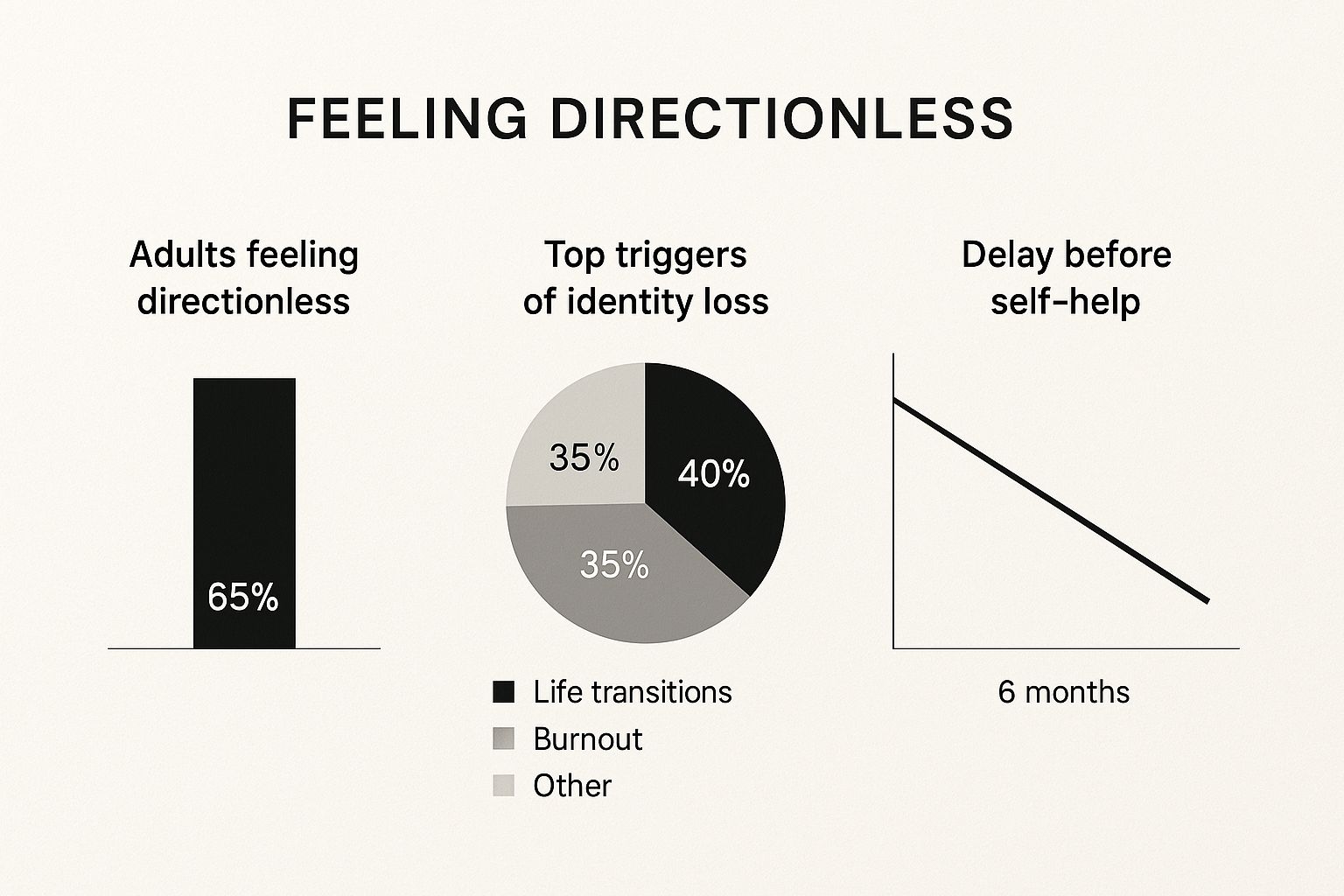
As you can see, major life events and burnout are huge factors. It also shows that many people wait for months before they even start looking for ways to feel like themselves again.
The Link Between Mental Wellbeing and Self-Identity
It is so important to recognise the deep connection between feeling lost and your overall mental wellbeing. Sometimes, that fog of disconnection is made thicker by underlying mental health challenges that can make the idea of self-reflection feel completely overwhelming. The path back to yourself often starts with tending to these foundational parts of your health first.
In England, this link is becoming impossible to ignore. Recent data shows a clear rise in common mental health conditions, which can seriously cloud a person's sense of who they are. The Adult Psychiatric Morbidity Survey revealed that by 2023/24, roughly 1 in 5 adults was living with a common mental health issue. This is especially stark among young adults aged 16-24, where the numbers have climbed significantly. These figures really highlight why mental health support can be such a vital first step. You can read more about the rise in common mental health conditions in England and their impact on Rethink.org.
Feeling lost is not a sign that you are broken; it is a signal that you have evolved. Your old map no longer fits your new territory, and it is time to draw a new one.
This journey does not begin with some grand, dramatic gesture. It starts with the quiet courage to simply ask, "Who am I now?" Acknowledging your starting point—that feeling of being adrift—is the most powerful step you can take. It is from this honest place that you can begin to navigate your way back to a more authentic and fulfilling connection with yourself.
Reconnect With Yourself Through Mindful Reflection

The very first step on any journey inwards is simply to listen. To find yourself again, you need to carve out quiet moments to hear your own thoughts, free from the constant noise of daily life and other people’s expectations. This is not about making grand, life-altering gestures; it is about building small, consistent habits of self-reflection that you can actually stick with.
Mindful reflection is your chance to check in with yourself. It creates a space to understand what you are feeling and reconnect with what truly matters to you, without any judgement.
Starting With Simple Journaling Prompts
Journaling is a brilliant tool, but I know that a blank page can feel incredibly daunting. So, instead of trying to write an epic, start with just a single, focused question. The aim here is to sidestep your overthinking, analytical brain and tap directly into your honest feelings.
Give these prompts a try. Do not censor yourself or strive for the "right" answer—just jot down whatever comes to mind first.
When did you last feel completely lost in an activity, where time just seemed to disappear?
What values did your younger self hold dear that you might have let go of?
If you had a totally free afternoon with zero obligations, what would you really do?
What is one thing you miss about the person you were five years ago?
These questions are designed to gently unearth forgotten passions and parts of your identity that have been buried under the weight of everyday life. Think of them as breadcrumbs leading you back to a more authentic you.
Introducing Mindfulness Into Your Day
Mindfulness is so much more than sitting cross-legged and meditating. It is about bringing a sense of awareness to the present moment, whatever you are doing. You do not need a special cushion or a silent room. You can practise it anywhere, at any time, to ground yourself and connect with your inner state.
A powerful, yet incredibly simple, technique is the five-minute 'body scan'. Wherever you are—at your desk, on the bus, or waiting in a queue—just close your eyes for a moment and bring your attention to your body. Notice the physical sensations without trying to change them. This practice helps you tune into your feelings, which are so often stored physically.
Building this habit of checking in creates a stronger mind-body connection. Over time, this self-awareness becomes a reliable internal compass, guiding you toward choices that feel genuinely right for you. If you are interested in the nuts and bolts of how this works in a therapeutic setting, you can learn more about [what mindfulness is in therapy](https://www.therapy-with-ben.co.uk/post/what-is-mindfulness-in-therapy-and-how-does-it-work) in our detailed guide. It is a foundational skill for anyone looking to find themselves again.
A few simple mindfulness exercises to try:
Mindful Listening: Just pause and identify three distinct sounds you can hear right now.
Mindful Breathing: Focus on the sensation of five full breaths, feeling the air come in and go out.
Mindful Walking: As you walk, pay attention to the feeling of your feet making contact with the ground.
These small acts of reflection, when practised consistently, build a bridge back to yourself. They remind you that even when you feel lost, your inner voice is still there, just waiting to be heard. The key is to start small and be patient.
Explore Your Identity Beyond Your Roles
We all wear different hats: parent, professional, partner, friend. These roles give our lives structure and meaning, but over time, they can start to feel less like a choice and more like a uniform, hiding the person underneath. It is easy to fall into the trap of defining ourselves by what we do rather than who we truly are.
Finding yourself again often means gently peeling back these layers. It is about questioning the expectations—both from others and ourselves—that have quietly shaped our sense of self. Your identity is far richer and more complex than a simple list of responsibilities.
Step Away from the Everyday
Rediscovering who you are requires a conscious choice to explore things just for you, not for productivity or anyone else’s approval. It is about remembering what genuinely excites you when nobody is watching. Think of it as carving out little pockets of your life that belong entirely to you.
What might this look like in practice?
Take a solo day trip: Visit a town you have never seen before, wander through a gallery, or just sit in a cafe and watch the world go by. No agenda needed.
Reconnect with old friends: Get in touch with people who knew you before your current roles took over. They often hold a mirror up to a version of you that you might have forgotten.
Try something new, just for fun: Creative hobbies can be a fantastic way to tap into different parts of your personality. You could [discover new creative outlets like cross stitch](https://cross-stitched.com/blogs/what-is-cross-stitch/cross-stitch-ideas) or join a local pottery class, simply for the joy of creating.
For instance, a new parent might feel their identity has been completely swallowed by parenthood. Rediscovery could be as simple as putting aside one evening a week to listen to the music they loved before having children. This is not about neglecting your roles; it is about nurturing your whole self so you can bring more to them.
Your roles are a part of your story, but they are not the entire book. True self-discovery happens when you give yourself permission to explore the unwritten chapters.
The Impact of Societal Pressures on Identity
It is important to remember that our sense of self is deeply tied to our mental wellbeing and the world around us. For many, feeling lost is tangled up with mental health challenges, which are often shaped by wider social factors. In the UK, the statistics show a clear link between identity and mental health, especially for certain groups.
For example, while around 1 in 4 adults in England experiences a mental health problem each year, women are disproportionately affected, with young women aged 16 to 24 being the highest-risk group. This shows that finding yourself is not just a personal journey; it is often connected to overcoming stigma and navigating a system with deep-rooted disparities.
By acknowledging these external pressures, you can approach your own journey with more self-compassion. Stepping beyond your defined roles is an act of real courage and a vital part of [learning how to be yourself authentically](https://www.therapy-with-ben.co.uk/post/how-to-be-yourself-a-guide-to-authentic-living). It is about building a stronger, more resilient identity that can stand firm, whatever life throws at it.
Heal Through Movement and Nature

Sometimes, the clearest thoughts do not arrive when we are sitting still, trying to force them out. They often emerge when we are in motion, connecting our minds with our bodies and the world around us. Shifting your physical state can be one of the most powerful ways to shift your mental state, especially when you feel completely stuck or lost.
This link between movement and mental clarity is a strong one. When you reconnect with your body through gentle activity, it helps to ground you in the present moment, pulling you away from the circular thoughts that often keep you feeling disconnected. It does not have to be an intense workout, either; something as simple as a walk can create the mental space you need for real reflection.
Why Walk and Talk Therapy Works
In my own practice, I often use 'walk and talk' therapy sessions. Taking the conversation outdoors completely changes the dynamic. Many clients find that walking side-by-side feels much less intense and confrontational than sitting face-to-face in an office. The steady rhythm of walking and the shared focus on the path ahead can make difficult conversations feel more approachable.
This side-by-side approach often encourages a more natural and open dialogue. Without the pressure of direct eye contact, people sometimes feel more able to explore vulnerable feelings and share thoughts they might otherwise hold back. It breaks down the formal barrier that can exist in a traditional therapy setting, fostering a real sense of partnership in the journey of self-discovery.
Reconnecting with your physical self and the natural world is a direct pathway to reconnecting with your inner self. When you move your body, you move your mind.
This principle is not just for therapy sessions; you can easily apply it yourself. When you are wrestling with a difficult emotion or a complex problem, try taking it for a walk. You might be surprised by the clarity that comes from simply changing your environment and engaging your body. To support your physical and mental wellbeing, you can also explore the advantages of natural practices, like understanding the chai tea health benefits.
Practical Ways to Use Nature for Clarity
You do not need a therapist with you to experience the healing power of the outdoors. Integrating nature into your routine is a simple yet profound way to start finding yourself again.
Here are a few actionable ideas to get you started:
Mindful Park Walks: Instead of listening to music on your next walk, pay full attention to your surroundings. Notice the sound of the leaves, the feel of the breeze on your skin, and the different colours you can see.
The Five-Minute Reset: Feeling overwhelmed at work or home? Just step outside for five minutes. Focus on your breathing and the sensory details of the outdoors. This small break can completely reset your perspective.
Choose the Scenic Route: Whenever you can, choose a walking or driving route that takes you past green spaces. Even brief exposure to nature can have a noticeable calming effect.
Being in nature is proven to reduce stress, lower cortisol levels, and create a peaceful space for processing your thoughts. If you would like to dive deeper into this, our guide on the [mental health benefits of nature](https://www.therapy-with-ben.co.uk/post/mental-health-benefits-of-nature) offers more insights. The natural world provides a quiet, non-judgmental space to just be—an essential element in the journey back to yourself.
Dealing with Setbacks and Knowing When to Ask for Help
The path to finding yourself again is rarely a straight line. It is more of a winding road, full of unexpected detours. You will have days where old habits sneak back in or that old, familiar feeling of being lost starts to creep up on you. This is completely normal and definitely not a sign that you have failed.
When these moments hit, the most important thing you can do is practise self-compassion. Instead of beating yourself up for what feels like a step backward, try to acknowledge that healing and growth are not linear. They happen in cycles. Recognise the feeling for what it is, offer yourself a bit of kindness, and gently bring your focus back to the small, positive actions you have been taking.
When to Consider Getting Professional Help
While your own strategies are incredibly powerful, sometimes we all need a guide to help us through the trickier parts of the journey. Reaching out for professional support is not a last resort; it is a proactive and courageous step towards building a more resilient sense of who you are. It is a sign of strength.
It might be time to talk to a therapist if you notice that:
You feel persistently stuck, no matter what you try.
Your feelings of being lost are seriously impacting your daily life, work, or relationships.
You are finding it hard to manage overwhelming emotions or past experiences on your own.
You simply want a dedicated, non-judgmental space to explore what is going on in your head.
Therapy is a Normal Tool for Self-Discovery
Thankfully, seeking therapy is becoming a much more recognised and accepted part of personal growth here in the UK. The demand for mental health services has shot up, which shows a real shift in how we view mental wellbeing as a key part of rediscovering ourselves. From 2007 to 2023/4, the prevalence of common mental disorders among adults aged 16-64 climbed from 17.6% to 22.6%. This growing engagement with mental healthcare shows just how many people are actively using therapy to find their way back to themselves. You can explore the data on mental health trends in England to see this shift for yourself.
Therapy offers a unique chance to explore your inner world with a trained professional who can offer new perspectives and tools you might not find on your own. It is an investment in understanding who you are now and who you want to become.
It is common to worry about being judged or not knowing what to say, and these fears can be real barriers. A good therapist gets this and will create a safe, confidential space where you can feel at ease. The goal is to build a supportive toolkit for your journey, combining your own strategies with professional guidance when you need it most. This dual approach gives you a really strong foundation for lasting change and a deeper connection with your true self.
Your Questions Answered
Taking the first steps to reconnect with yourself is a huge deal, and it is completely natural to have a few questions buzzing around. Here are some of the things people often ask when they start this journey.
How Long Does It Take to Find Yourself Again?
This is probably the question I hear the most, and the honest answer is, there is no finish line. For some people, a real sense of clarity starts to click into place after a few months of putting in the work. For others, it is a much slower burn—a lifelong process of getting to know themselves again and again.
The real goal is not to reach some final destination where you are suddenly “found.” It is about building a stronger, more honest relationship with yourself, day by day. It is far more helpful to focus on the small, consistent steps you are taking rather than fixating on how long it will take.
True progress is not about big, flashy breakthroughs. It is found in the small, quiet moments of connection you feel with yourself. Celebrate those—they are the real wins.
When you shift your mindset from a race to a journey, the pressure just melts away. It gives you the space to grow at a pace that actually feels right for you.
What If I Try These Things and Still Feel Lost?
Feeling this way is not just normal; it is incredibly common. If you have been journaling, trying new things, and really making an effort but still feel completely adrift, it might be a sign that something deeper needs a bit of gentle attention.
Often, this persistent feeling of being lost points to unresolved experiences from your past or underlying mental health challenges that are getting in the way. This is the perfect time to think about getting some professional support.
Reaching out to a therapist is not a sign of weakness or failure. It is a smart, supportive next step on your path. A therapist can offer a safe, confidential space and specialised tools to help you explore these deeper barriers in a way that is almost impossible to do on your own. It is a proactive choice to take your self-discovery to the next level.
Is It Selfish to Focus on Myself?
This is a big one, especially for anyone who is a parent, partner, or caregiver. The short answer? Absolutely not. In fact, looking after your own wellbeing is one of the most generous things you can do for the people you love.
When you are more in tune with yourself—your needs, your values, your passions—you can show up in your relationships as your whole, authentic self. You just cannot pour from an empty cup.
Think about the oxygen mask rule on an aeroplane: you have to put your own on first before you can help anyone else. Investing time and energy in yourself means you can give to others from a place of strength and resilience, not from a place of burnout and resentment. It benefits everyone.
Feeling ready to take the next step on your journey? At Therapy with Ben, I offer a supportive and non-judgemental space to explore who you are and navigate life's challenges. Learn more about my approach, including walk-and-talk therapy in Cheltenham, by visiting my website. Find out more at https://www.therapy-with-ben.co.uk.


Comments