


CBT and Social Phobia A Practical Guide to Reclaim Your Confidence
- Jan 18
- 16 min read
By Therapy-with-Ben
When you’re grappling with social phobia – or social anxiety disorder, as it’s also known – Cognitive Behavioural Therapy (CBT) is one of the most reliable and effective paths forward. It’s not about just "thinking positive"; it’s a practical, structured approach that gives you the tools to identify, question, and ultimately change the very thought patterns and behaviours that keep social fear alive.
Think of it as a toolkit designed specifically to help you rewire your brain's response to social situations.
Understanding the Cycle of Social Anxiety
Facing an upcoming social event can feel like you’re staring over the edge of a cliff. That sinking feeling of dread, the heart-pounding physical sensations, the overwhelming urge to just back away – these are all hallmarks of social phobia. It’s crucial to know this isn’t a personal failing or a sign of weakness; it's a common and highly treatable pattern of thinking and feeling.
This kind of anxiety can really get in the way of everyday life. Maybe you sidestep a presentation at work, dread making a simple phone call, or just avoid parties and gatherings altogether. The tricky part is that each time you avoid something, you get a moment of relief, which accidentally reinforces the belief that the situation was genuinely dangerous. This creates a powerful feedback loop. You can read more about how to start breaking the anxiety and avoidance cycle in our guide.
The Role of Anticipatory Dread
A huge part of this cycle is the intense worry that kicks in before an event has even started. This feeling of impending doom can be just as crippling as the anxiety you might feel in the moment itself.
As you get to grips with how social anxiety works, it's really important to understand one of its main drivers: the role of anticipatory anxiety. It’s basically the mental rehearsal of everything that could possibly go wrong, creating a mountain of fear before you’ve even left the house.
This guide is here to offer a sense of hope and empowerment. We're going to explore how Cognitive Behavioural Therapy (CBT) provides a practical road map for rebuilding your confidence.
Throughout this article, we’ll cover:
How CBT actually works to interrupt the social anxiety cycle.
The core techniques you’ll learn, like cognitive restructuring and graded exposure.
What a typical journey with CBT looks like, from the first session to the last.
Simple, practical self-help exercises you can start using today.
How CBT Interrupts Social Phobia
To really get how Cognitive Behavioural Therapy works for social phobia, it helps to think of social anxiety as a faulty alarm system. Picture a smoke detector that’s so sensitive it doesn’t just go off for a fire—it screams the house down for a piece of slightly overdone toast. In the same way, your brain can mistake a perfectly normal social situation, like a casual chat with a neighbour, for a genuine threat to your survival.
This false alarm sets off a powerful chain reaction. Your body gets a jolt of adrenaline (hello, racing heart and sweaty palms), your mind spirals into worst-case scenarios ("I'm going to say something stupid," "They'll think I'm boring"), and every instinct screams "get out of here!" This vicious loop of thoughts, feelings, and actions is the very engine that keeps social phobia running.
CBT essentially gives you the user manual to recalibrate this alarm. It doesn't just tell you to ignore it; it teaches you how to check for actual smoke, question the system’s faulty logic, and prove to yourself that most of the time, it's just a bit of toast.
The Thought-Feeling-Behaviour Cycle
At the very heart of CBT is a simple but profound idea: it’s not the situation itself that dictates how we feel, but our interpretation of that situation.
For someone struggling with social phobia, this cycle can easily become a self-fulfilling prophecy.
The Situation: You get an invitation to a work party.
The Thought: "I won't have anyone to talk to. Everyone will see how awkward I am and judge me."
The Feeling: A wave of intense anxiety, dread, and a crushing sense of inadequacy.
The Behaviour: You make an excuse and decide not to go.
Dodging the event brings a moment of relief, but it also hammers home the underlying belief that you can't handle social events. This makes the next invitation feel even more terrifying. CBT works by helping you step in and challenge the thoughts and change the behaviours to finally break that cycle.
The diagram below shows this self-perpetuating loop in action and, crucially, where CBT can step in to make a difference.
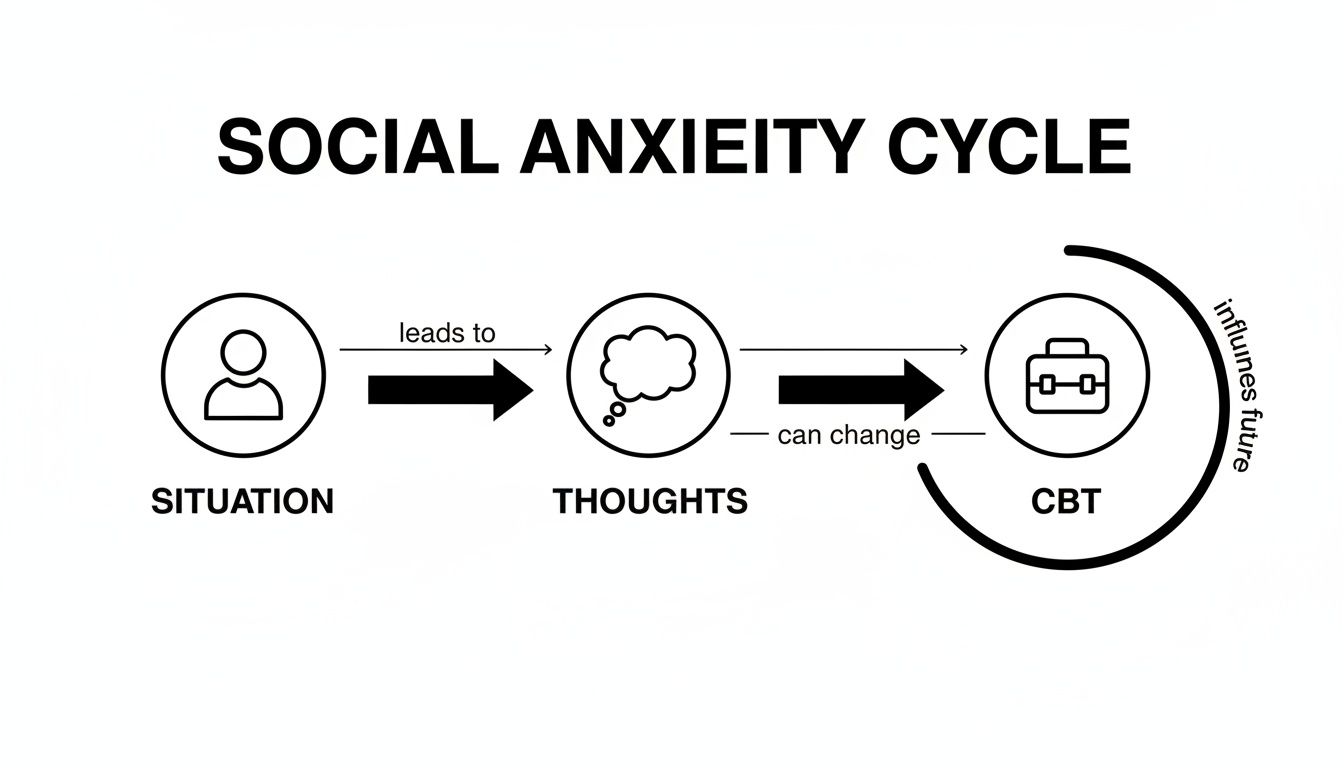
As you can see, CBT provides the tools to interrupt this pattern before it has a chance to escalate, giving you back control.
Why This Approach Is So Effective
There’s a reason CBT is considered a gold-standard treatment: it gets to the root of the problem rather than just trying to manage the symptoms. It’s an active, skills-based therapy that empowers you to become your own therapist over time, with a structured approach that’s been backed by decades of solid evidence. The skills learned can even extend to other areas; for example, you might find interesting parallels in articles that explore Cognitive Behavioral Therapy techniques for restful nights.
The need for effective treatments is huge. Social anxiety disorder affects up to 12% of the UK population at some point in their lives—a figure that’s significantly higher than for generalised anxiety or panic disorder. These are not just numbers; NICE statistics show how social phobia can quietly sabotage relationships, education, and careers for millions.
The good news is that CBT is recommended as a cornerstone treatment, and UK data confirms it works. Studies show that between 47.8% and 73.5% of patients achieve reliable positive change, with these results holding up even at a 12-month follow-up. For residents here in Cheltenham facing these challenges, Therapy with Ben offers supportive CBT to help you reclaim that social confidence.
CBT isn't about getting rid of anxiety entirely—that wouldn’t be human. It's about turning down the volume and changing your relationship with it. It teaches you that you can feel anxious and still do the things that truly matter to you.
This shift in perspective is incredibly freeing. By learning to challenge anxious thoughts and gradually change your avoidance habits, you begin to systematically dismantle the very structure of social phobia. Modern therapy is always building on these foundations, which you can learn more about in our article on what is third wave CBT and how can it help you.
Your Practical CBT Toolkit for Social Anxiety
Okay, so we've looked at the 'why' behind social anxiety. Now, let's get our hands dirty with the 'how'—the practical tools you'll use to start making real changes. This is where we move from theory to action.
Think of these CBT techniques as skills you build over time, not just academic exercises. They’re designed to be flexible, helping you tackle everything from speaking up in a team meeting to simply walking into a party. Together, they work to dismantle the unhelpful thoughts and safety behaviours that have been keeping you stuck. You're about to learn how to build a new relationship with social situations, one grounded in confidence and real-world evidence rather than old fears.
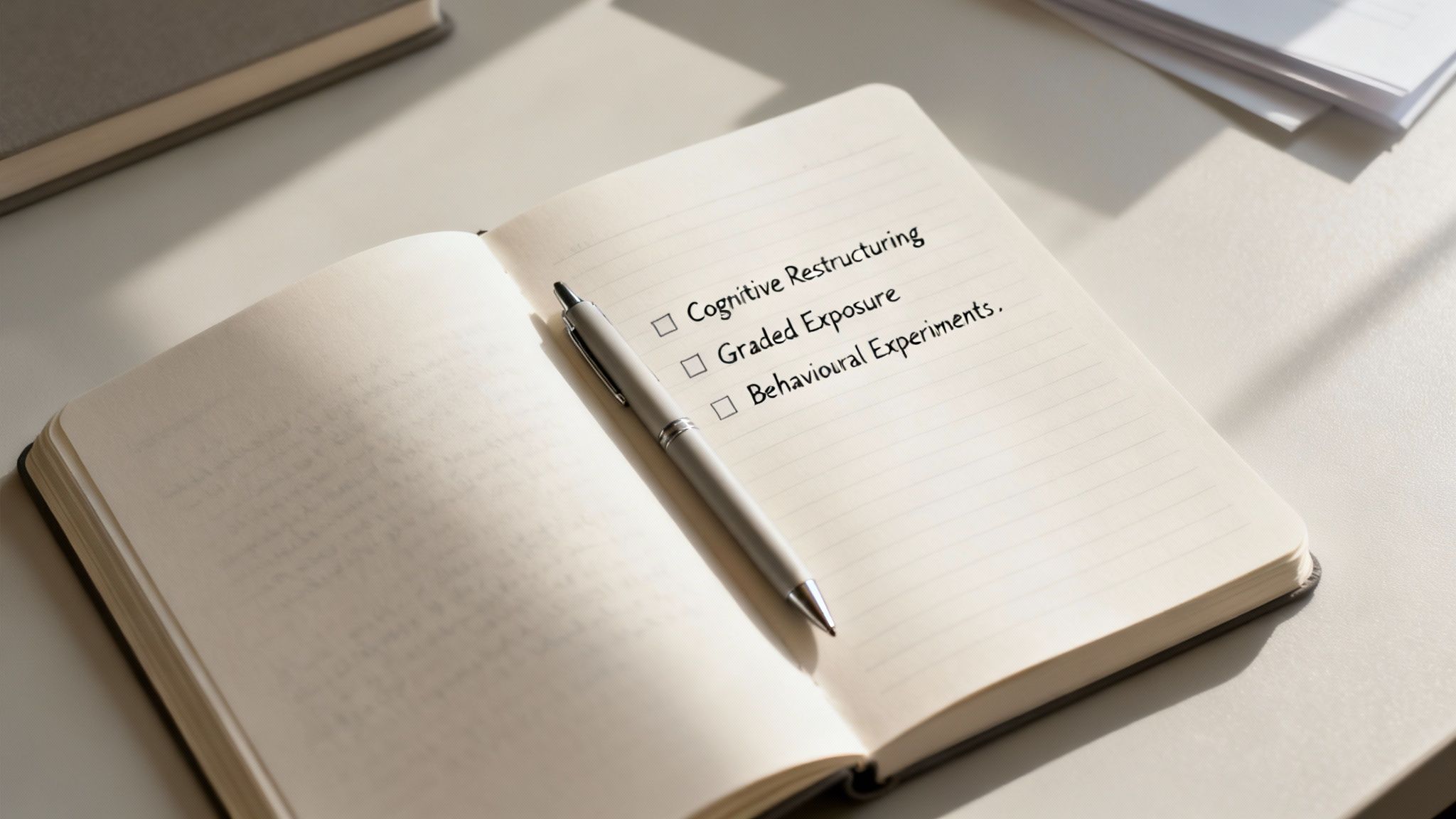
Cognitive Restructuring: Putting Your Thoughts on Trial
The first tool we need to get to grips with is cognitive restructuring. At its heart, this is about learning to be a detective for your own mind. We all have Negative Automatic Thoughts (NATs) that pop into our heads and feel like undeniable facts, especially when we're anxious.
Say you’re about to walk into a pub to meet friends. A NAT might whisper, "Everyone will think I'm boring and awkward." This thought probably feels completely true in that moment. Cognitive restructuring gives you a framework to catch that thought, put it on the stand, and properly examine the evidence.
You learn to ask some really important questions:
Where's the proof? What evidence do I have that everyone will find me boring? Has anyone actually ever said that?
Is there another way of seeing this? Could it be that people are mostly wrapped up in their own worlds? Maybe they'll just see me as a bit quiet at first?
What's the worst that could happen? And if it did, how would I actually cope? Would it really be as bad as my anxiety is telling me?
What would I tell a friend if they were thinking this?
The goal isn't to force yourself into "positive thinking." It’s about finding a more balanced and realistic viewpoint. It’s a powerful way to quieten that nagging inner critic, and you can dive deeper into this with our guide on how to stop negative self-talk.
Graded Exposure: Building Your Challenge Ladder
While we work on the thoughts, graded exposure helps us tackle the behaviours—specifically, the habit of avoidance. Avoiding things gives you a brief sigh of relief, but in the long run, it just makes the fear bigger. Graded exposure gently unwinds this by helping you face feared situations one small, manageable step at a time.
Imagine your biggest social fear is going to a big party. If you tried to jump straight into that, it would feel completely overwhelming. So instead, we create a 'challenge ladder'.
The idea behind graded exposure is simple: start small and build momentum. You take a terrifying goal and break it down into a series of achievable steps. Each one builds your confidence for the next, putting you back in the driver's seat.
Your ladder might look something like this:
Step 1: Go to a coffee shop alone and just sit for 10 minutes without hiding behind your phone.
Step 2: Ask a shop assistant for help finding something.
Step 3: Make a quick phone call to book a haircut or an appointment.
Step 4: Go to a small get-together with a trusted friend by your side.
Step 5: Attend a larger party, but only for 30 minutes with a pre-planned exit.
Each step is designed to be a little bit challenging, but not so much that you feel swamped. Every time you complete one, you gather solid proof that you can cope, which directly challenges what your anxiety has been telling you.
Behavioural Experiments: Testing Your Beliefs
The final core technique brings the other two together. With behavioural experiments, you become a bit of a scientist, actively designing experiments to test your anxious beliefs out in the real world.
Let's revisit that thought: "If I speak up in a meeting, I'll say something stupid and everyone will judge me." A behavioural experiment is about testing that prediction directly.
You'd set it up like this:
Prediction: If I ask a question in the team meeting, my colleagues will think I'm incompetent and roll their eyes.
The Experiment: I'll prepare one relevant question and make sure I ask it during the next meeting.
What to Look For: I'll pay close attention to how people actually react. Do they look annoyed? Do they ignore me? Or do they answer the question and move on?
The Outcome: Almost always, the result is far less dramatic than we predict. People might nod, your boss might thank you for the input, or it might just lead to a normal conversation.
This is the most powerful kind of learning because it's based on your own direct experience. It proves to you, in a very real way, that your anxious mind isn't a very good fortune-teller.
To make this a bit clearer, here’s a quick summary of how these core tools fit together.
Your CBT Toolkit for Social Phobia at a Glance
Technique | What It Does | Simple Example |
|---|---|---|
Cognitive Restructuring | Helps you challenge and reframe the negative automatic thoughts that fuel anxiety. | Catching the thought "I have nothing to say" and asking, "Is that 100% true? What would I talk about with a close friend?" |
Graded Exposure | Systematically reduces avoidance by facing feared situations in manageable steps. | Creating a 'ladder' of challenges, starting with asking for directions and building up to making small talk. |
Behavioural Experiments | Actively tests your anxious predictions to see if they hold up in reality. | Predicting "If I blush, everyone will stare," then deliberately doing something to feel warm and observing the actual (usually minimal) reaction. |
By combining these three approaches—challenging your thoughts, facing your fears step-by-step, and testing your predictions—you create a really robust toolkit for taking back control from social phobia.
What Your CBT Journey Will Look Like
Taking that first step into therapy can feel like jumping into the deep end, and that’s especially true when you’re already navigating social phobia. So, let’s pull back the curtain and demystify the whole process. Think of this as a roadmap for your journey with Cognitive Behavioural Therapy, helping you know what to expect and easing any of that initial anxiety.
It’s a collaborative effort from the get-go. Imagine you’re working with a personal trainer, but for your mind. You and your therapist are a team, working together to get you where you want to be. A typical course of CBT for social phobia runs for about 12 to 20 weekly sessions, with each one building on the last.
The Initial Assessment Phase
Your journey starts not with a test, but with a conversation. This first session, the assessment, is all about your therapist getting to know you and understanding your world.
We'll talk through what situations you find toughest, how social anxiety is really impacting your day-to-day life, and what you’d genuinely like to achieve. From there, we set some meaningful, realistic goals together that will act as our guide. This makes sure the therapy is built around you.
Active Therapy and Skill Building
With our goals set, we move into the active part of therapy. This is where the real work begins, and you’ll start learning and trying out the CBT techniques we’ve discussed, like challenging those negative thought patterns and gradually facing feared situations.
To keep things on track and make sure we’re making the most of our time, each session has a bit of a structure. It usually looks something like this:
Agenda Setting: We’ll decide together what we want to focus on for that session.
Weekly Review: We’ll chat about your week—what went well, what was challenging, and how you got on with any practice tasks.
Learning a New Skill: The main chunk of our time will be spent on a specific CBT technique, either learning something new or refining a skill.
Planning Next Steps: We’ll wrap up by creating a clear plan for what you can practise before we meet again.
This approach gives our work a clear focus, but it’s always flexible enough to deal with whatever comes up for you.
Ensuring Your Progress Lasts
The final phase is all about relapse prevention. My goal isn’t to keep you in therapy forever; it’s to give you the tools to become your own therapist. Here, we’ll make sure your new skills are locked in and create a personal plan for you to handle future bumps in the road. It’s all about making sure the confidence you’ve built is here to stay.
It's worth remembering that therapy is always evolving. A fascinating UK study on phobias found that a single, intensive session of CBT could be just as effective as a longer course for young people. It just goes to show how powerful and adaptable these techniques are. You can read more about these findings on the NIHR website.
For families here in Cheltenham, Therapy with Ben offers that same flexibility. Whether it's face-to-face, online, or even walk-and-talk therapy, we can find an approach that fits into your life and helps you move forward.
Right, so you understand the theory behind CBT. But how do you actually use it? The move from theory to practice can feel like a big leap, so this section is all about giving you some simple, actionable exercises you can try yourself.
These are designed to give you a real flavour of how CBT works on the ground. We're going to look at how to catch those anxious thoughts in the moment and start gently nudging yourself towards the situations you’d normally run a mile from. It's about getting a tangible feel for the process.
Your First Thought Record
A Thought Record is a classic CBT tool. I often describe it to clients as putting your anxious thoughts on trial. It forces you to slow down, look at the stories your mind is spinning, and find a more balanced, realistic perspective. It’s basically a structured way to have a conversation with your own anxiety.
Grab a notebook or open a document and draw up five columns. Let's walk through it.
Situation: What was happening right before you felt anxious? (e.g., "Got a text inviting me to a friend's birthday drinks.")
Automatic Thought: What was the very first thing that popped into your head? What’s the worst-case scenario you're imagining? (e.g., "I won't know anyone. I'll just stand in the corner by myself looking like an idiot.")
Feeling: What emotion did that thought spark, and how strong was it from 0-100%? (e.g., "Dread, 90%. Anxiety, 85%.")
Evidence Challenge: Now, play detective. What facts support this thought? Crucially, what facts go against it? (e.g., "Evidence against: I know my friend, the one whose birthday it is. I’ve been to things like this before and usually manage to have a chat with at least one person.")
Balanced Thought: Looking at all the evidence, what's a more reasonable, helpful way of seeing things? (e.g., "It might feel a bit awkward when I first get there, but I do know my friend. Maybe I can just aim to stay for an hour and try to have one conversation.")
This isn't about "positive thinking" or forcing yourself to be happy. It's about finding what's accurate. By looking at the actual facts, you offer your brain a credible, less frightening alternative to the anxious story. When you do that, the emotional intensity naturally starts to drop.
Creating a Mini Exposure Ladder
The second exercise is about tackling that urge to avoid things. An Exposure Ladder (some call it a fear hierarchy) is all about facing a feared situation in small, manageable chunks. You build up your confidence one step at a time.
Let's use a common one: making a simple, but dreaded, phone call.
First, rate your fear of making that call from 0 to 100. Let's say it's an 80. That's pretty high. So, instead of trying to jump straight to the top, we break it down into smaller, less scary steps.
Step 1 (10% fear): Just look up the phone number you need to call.
Step 2 (25% fear): Scribble down a couple of sentences covering what you need to say.
Step 3 (40% fear): Pick up the phone and dial the number, but hang up before it even rings.
Step 4 (60% fear): Call at a time you know you’ll get voicemail, and just leave a quick message.
Step 5 (80% fear): Make the actual call.
By starting small, you prove to yourself at each stage, "Okay, I can handle this." It’s a process that genuinely begins to rewire your brain's fear response, making that final step feel far less overwhelming than it did at the start.
How Therapy with Ben Can Guide Your Progress
Understanding the ideas behind CBT is one thing; putting them into practice with the right support is something else entirely. While the self-help exercises are a brilliant start, working with a therapist gives you a dedicated, safe space to explore your social phobia without any fear of judgement. It’s about having a guide who gets it, someone who can help you navigate the tricky parts.
My role at Therapy with Ben is to create that supportive environment. As a male counsellor, I offer a perspective that some clients find particularly helpful, but the main thing is building a trusting, collaborative relationship where you feel properly heard and understood. This is the foundation for all the practical CBT work we'll do together.

Finding an Approach That Fits You
Social anxiety doesn’t look the same for everyone, so your therapy shouldn’t be a one-size-fits-all affair. Because of this, I offer a few different ways we can work together, making sure you can choose an option that feels comfortable and right for you.
Face-to-Face Sessions: For those in or near Cheltenham, we can meet in person in a calm, private setting. This is the traditional format and allows for really direct, focused therapeutic work.
Flexible Online Counselling: If getting to a clinic feels like a barrier in itself, or if you live further afield, online sessions provide the same high-quality support from the comfort of your own home.
Walk-and-Talk Therapy: This unique approach takes our sessions outdoors into the natural spaces around Cheltenham. For many people with social anxiety, the gentle movement and open environment can really lower the pressure, making it much easier to open up and get stuck into the CBT process.
The idea behind walk-and-talk therapy is simple but powerful. Moving side-by-side can feel less intense than a direct, face-to-face chat in a quiet room. It brings a gentle, physical element to the session that can help ground you and ease that anxious energy.
Taking the Next Step
Tackling social phobia takes real courage, but you don’t have to do it alone. The goal of therapy isn't just to reduce anxiety, but to help you get back to the parts of your life that social phobia might have pushed aside—friendships, career opportunities, or just simple, everyday joys.
If you’re ready to see how a personalised course of CBT for social phobia could help, I invite you to take that next step. You can book a free consultation to talk through your situation and see if working together feels like a good fit. It’s just a no-pressure chat to answer your questions and help you decide on the best path forward.
Your Questions About CBT and Social Phobia Answered
Starting any kind of therapy is a big step, and it’s totally normal to have a head full of questions. This final section is all about tackling some of the most common queries I hear about using CBT for social phobia. My goal here is to give you clear, straight answers so you feel more informed and confident about what comes next.
Let's think of this as a quick chat to clear up any last-minute doubts. From the nuts and bolts of how therapy works to worries about how effective it might be, let's get those questions sorted.
How Long Does It Take for CBT to Work?
This is usually the first thing people want to know, and the honest answer is, it’s different for everyone. That said, many people start to notice a real shift in how they feel within just a few weeks of getting started. A typical course of CBT for social phobia tends to land somewhere between 12 and 20 weekly sessions.
The exact timeframe really depends on a few things, like how severe the phobia is and how much you're able to practise the new skills between our sessions. CBT isn't something that just happens to you; it’s a team effort. The work you put in outside the therapy room is just as important as the work we do together. The whole point is to give you a toolkit you can use for life.
Will I Have to Do Things That Make Me Really Anxious?
This is a massive, and completely understandable, fear. The very idea of facing what scares you can feel overwhelming. The short answer is yes, CBT does involve gradually facing situations you fear, but—and this is the crucial part—it is always done at a pace that you are comfortable with.
You are always in the driver's seat. We'll work together to build what’s called a 'challenge ladder', starting with things that only trigger a little bit of anxiety. You will never be thrown in at the deep end or pushed into something you're not ready for. The process is designed to build your confidence one small step at a time.
Each little success is proof that you can handle it, which starts to strip the fear of its power. It’s about gently stretching your comfort zone, not breaking it.
Can I Do CBT for Social Phobia Online?
Absolutely. Online CBT has proven to be just as effective as face-to-face therapy for social anxiety. In fact, for many people struggling with social phobia, starting online is a brilliant way in. It gets rid of that first hurdle of having to travel to a new place and sit in an unfamiliar room.
Online sessions give you incredible flexibility and mean you can do the work from a space where you already feel safe. Services like Therapy with Ben offer professional online counselling, making sure you can get high-quality support no matter where you are.
Is Medication Necessary Alongside CBT?
That's a very personal decision, and one that should always be made with your GP or a psychiatrist. The official NICE guidelines actually recommend CBT as the first thing to try for social phobia, and for many, it’s more than enough on its own.
For some, however—especially if symptoms are very severe or there's also depression involved—a combination of medication (like an SSRI) and CBT can work really well. The medication can take the edge off the anxiety, which can make it easier to dive into the practical side of CBT. While it’s something we can talk about, only a medical doctor can prescribe medication.
If you feel ready to see how a personalised approach to CBT and social phobia could work for you, Therapy with Ben is here to help. To take the next step, you can book a free, no-obligation consultation today.
Comments