


How Do I Stop Worrying About Everything? A Therapist's Guide
Updated: Feb 5
If you're trying to stop worrying about everything, the first thing to understand is the self-fuelling 'worry cycle'. It’s a vicious loop where an anxious thought triggers a physical feeling, which then convinces your brain there's a real danger, creating even more worry.
The key isn't to just "stop thinking" about it — that's impossible. Instead, we need to interrupt that pattern. This guide will show you exactly how to apply specific, evidence-based techniques to break the cycle for good.
Author: Therapy-with-Ben
Why You Worry and How You Can Start to Stop

Feeling stuck on a constant treadmill of 'what-ifs'? You are far from alone. From my perspective as a therapist, I don’t see worry as a personal failing. It’s a protective instinct that has simply gone into overdrive. Your brain is trying to keep you safe by scanning for potential threats, but it’s become oversensitive, flagging everything from a minor work email to a strange noise downstairs as a top-priority danger.
This creates that classic loop. An anxious thought pops into your head: "What if I make a mistake in that presentation?" Your body immediately responds—maybe your heart races or your shoulders tense up. Your brain then interprets these physical signals as concrete proof that the danger is real, which only supercharges the initial worry.
Simply understanding this cycle is the first, most empowering step toward dismantling it.
You Are Not Alone in Feeling This Way
This feeling of pervasive worry has become incredibly common. Recent data shows a significant rise in anxiety levels right across the UK, particularly since the pandemic.
In 2023, a staggering 23% of working-age UK adults reported experiencing 'poor anxiety'—a sharp increase from pre-2019 levels. That's over 7 million people feeling highly anxious every single day, putting immense pressure on our public health services. Young people have been hit particularly hard, with a notable rise in anxiety, depression, and stress. You can read the full research on mental health trends in the UK to see the scale of the issue.
By recognising that your experience is part of a wider national trend, you can start to let go of self-blame. It's not just you; it's a shared challenge, and there are proven ways to navigate it.
To help you move forward, I’ve structured this guide as a clear roadmap. We're going to explore practical, evidence-based techniques that empower you to regain control over your thoughts and, crucially, calm your nervous system.
Here's a quick overview of the powerful strategies we'll be covering, giving you a clear path from the outset.
Your Roadmap to a Quieter Mind
This table gives you a snapshot of the practical, hands-on tools you'll learn to use in the sections ahead. Each one is a vital part of the toolkit for managing and reducing worry effectively.
Technique | What It Achieves |
|---|---|
Mind-Body Grounding | Instantly calms physical anxiety symptoms in overwhelming moments. |
Cognitive Reframing (CBT) | Challenges and changes the negative thought patterns that fuel worry. |
Worry Containment | Gives you control over when and how you engage with anxious thoughts. |
Behavioural Action | Breaks the cycle of avoidance and proves your worries are manageable. |
These aren't just theories; they are actionable skills. By learning to apply them, you can start to actively reshape your relationship with worry, moving from feeling controlled by it to being in control of it.
Grounding Techniques for Immediate Relief

When worry spins out of control and you feel that familiar storm brewing—racing heart, chaotic thoughts—you need an anchor. Right now. This is precisely what grounding techniques are for: to pull you out of the frantic 'what-ifs' of the future and plant you firmly back in the relative safety of the present moment.
The trick is, you're not trying to wrestle your thoughts into submission. That's a battle you’ll rarely win. Instead, you're going to deliberately shift your focus to your body and your immediate environment. This simple act sends a powerful message to your nervous system that you are safe right now, which is often enough to start calming the physical symptoms and quietening the mental noise.
The 5-4-3-2-1 Sensory Method
One of the best grounding tools out there is the 5-4-3-2-1 method. It's so effective because it forces you to engage with all your senses, making it very difficult for your brain to keep worrying at the same time. It’s wonderfully simple, completely discreet, and you can do it anywhere – from a tense meeting at work to lying in bed at 3 a.m.
Here’s all you have to do:
Look for 5 things you can see: Glance around and name five distinct objects. Don't just tick them off a list; really look at them. Notice the colour, the shape, the way the light hits the corner of your desk or the pattern on the rug.
Acknowledge 4 things you can feel: Tune into your sense of touch. It could be the solid feeling of your feet on the floor, the texture of your jumper against your skin, or the coolness of a glass of water in your hand.
Listen for 3 things you can hear: Pay close attention to the sounds around you. Can you hear the distant hum of traffic? The ticking of a clock? Even just the sound of your own breathing counts.
Identify 2 things you can smell: What scents are in the air? Maybe it’s the faint smell of coffee from this morning, or the fresh air coming through an open window.
Notice 1 thing you can taste: Focus on the taste in your mouth. You could take a sip of water, notice the lingering flavour of your lunch, or just become aware of what your mouth tastes like right now.
By the time you get to the end, you've successfully hijacked your brain's focus. You've steered it away from abstract worry and onto concrete, present-moment sensory input. That's the whole point of grounding.
For some people, physical sensations can provide an even stronger anchor. If that sounds like you, understanding deep pressure therapy for anxiety might offer some useful strategies that complement this sensory approach.
Master Square Breathing
Another brilliant tool is 'square breathing', sometimes called 'box breathing'. This technique gets to work directly on your autonomic nervous system, helping to counteract the short, shallow breaths that so often go hand-in-hand with anxiety.
The idea is to imagine drawing a square with your breath.
Breathe in slowly through your nose for a count of four.
Gently hold that breath for a count of four.
Breathe out slowly through your mouth for a count of four.
Hold the breath out for a final count of four.
Just repeat this cycle four or five times. The steady, rhythmic nature of this exercise is incredibly calming. It gives your mind something simple and singular to focus on, providing an immediate, practical way to stop worrying when you’re in the thick of it.
Rewire Anxious Thoughts with Practical CBT
Grounding techniques are brilliant for getting through that immediate, physical rush of anxiety. But for real, lasting change—to actually stop worrying about everything—we need to get to the source: the anxious thoughts themselves. This is where Cognitive Behavioural Therapy (CBT) comes in. Think of it as becoming a detective of your own mind.
Chronic worry isn't just random noise. It follows surprisingly predictable, unhelpful patterns that therapists call cognitive distortions, or 'thinking traps'. These are like putting on a pair of skewed glasses; they warp reality and pour fuel on the fire of anxiety. The moment you learn to spot them, you can start to take away their power.
Spotting Common Thinking Traps
Do any of these sound familiar? Just recognising these patterns is a massive first step.
Catastrophising: This is the classic 'what if?' spiral. You take a small, uncertain event—like a text message that hasn't been returned—and your mind leaps to the absolute worst conclusion imaginable: "They must be furious with me, and now the friendship is completely ruined."
All-or-Nothing Thinking: Sometimes called black-and-white thinking, this trap leaves zero room for grey areas. If you aren't a runaway success, you must be a total failure. A single mistake on a project at work translates to "I'm just terrible at my job."
Mind Reading: You're convinced you know what other people are thinking, and it's almost always negative. There’s no real evidence, but the feeling is overwhelming. "I could just tell in that meeting everyone thought my idea was stupid."
Once you can put a name to these traps, you can begin to question them. CBT isn't about slapping on a layer of forced positivity. It’s about finding a more balanced and realistic perspective. It's about seeing things as they actually are.
The goal isn’t to stop negative thoughts from ever happening—that's impossible. The goal is to build a more flexible, evidence-based relationship with them, so they no longer run the show.
A Framework for Challenging Worries
The next time a worry really takes hold, you can use a simple but incredibly powerful CBT framework to pick it apart and reframe it.
Identify the Worry: First, get it out of the fuzzy mess in your head and state it clearly. For example: "I'm going to be made redundant in the next round of job cuts."
Gather the Evidence: Now, play detective. What actual facts support this thought? (e.g., "The company has announced it's making some cuts.") Next, what facts contradict it? (e.g., "My last performance review was excellent," or "My manager just assigned me a key new project.")
Forge a Balanced View: Looking at all the evidence, what’s a more realistic, less extreme thought? "The company is going through a tough time, which is unsettling. However, my performance has been strong, so while I can't be 100% certain, the evidence suggests my role is valued."
This methodical process short-circuits the emotional chaos of a worry by getting your rational brain involved. If you want to explore this kind of work for other specific issues, you can find more information in our other guides for tackling common mental health challenges.
CBT in Action: A Real-World Example
I once worked with a client, let's call him Alex, who was totally consumed by worry about his performance at work. He would scrutinise every email he sent and replay every conversation in his head. Using this framework, we helped Alex pinpoint his core fear: "I'm not good enough, and I'll be found out."
Together, we gathered the evidence. In the 'for' column: he'd made one minor error on a report two weeks ago. In the 'against' column: he'd recently received positive feedback, had met all his targets for the quarter, and his colleagues often came to him for help.
Seeing this clear imbalance on paper allowed him to form a new, more balanced thought: "I am a competent person who, like everyone else, occasionally makes small mistakes." This might sound simple, but practising this shift consistently made a dramatic difference to his daily anxiety levels.
How to Contain and Manage Your Worries
If your worry feels like a tap you can't turn off, constantly dripping into every corner of your mind, containment strategies are what give you back control. Instead of letting worry run your day, you start deciding when—and for how long—you’ll actually listen to it.
This isn't about pretending problems don't exist. Far from it. It’s about setting firm boundaries so that anxiety isn't the one in the driver's seat anymore.
When you create a bit of structure around your worries, you begin to change your entire relationship with them. You prove to yourself, little by little, that you are the one in control. This is a massive step towards breaking that exhausting habit of constant, low-level anxiety.
Schedule Dedicated 'Worry Time'
A technique I often suggest, which can sound a bit strange at first, is to schedule 'Worry Time'. By giving your worries a specific, non-negotiable appointment in your diary, you’re training your brain that it doesn't need to be on high alert 24/7.
Here’s the basic idea:
Pick a Time and Place: Set aside the same 15-20 minute slot each day. Just make sure it’s not right before you try to sleep.
Park Your Worries: When a worry pops into your head during the day, notice it, acknowledge it, and then consciously "park" it until your scheduled time. You can say to yourself, "Okay, that's a thought. I'll give it my full attention at 5 p.m."
Use Your Session Wisely: When your worry appointment arrives, actually sit down and engage with the thoughts you’ve parked. Get them out of your head by writing them down. Think them through. If any are practical problems, you can even start brainstorming a few small steps.
This simple act of postponing is incredibly powerful. You’ll probably find that by the time your scheduled slot rolls around, many of the day's worries have either fizzled out on their own or just don't feel as big and scary anymore.
By containing worry to a specific window, you reclaim huge amounts of mental energy. You are no longer allowing anxiety to interrupt your focus, steal your joy, or disrupt your sleep. You are in charge.
Use the Worry Tree to Sort Your Thoughts
Another brilliant tool for this is the 'Worry Tree'. Think of it as a simple flowchart for your mind. It helps you quickly figure out whether you're dealing with a hypothetical 'what if' worry you can't control, or a practical problem you can actually do something about.
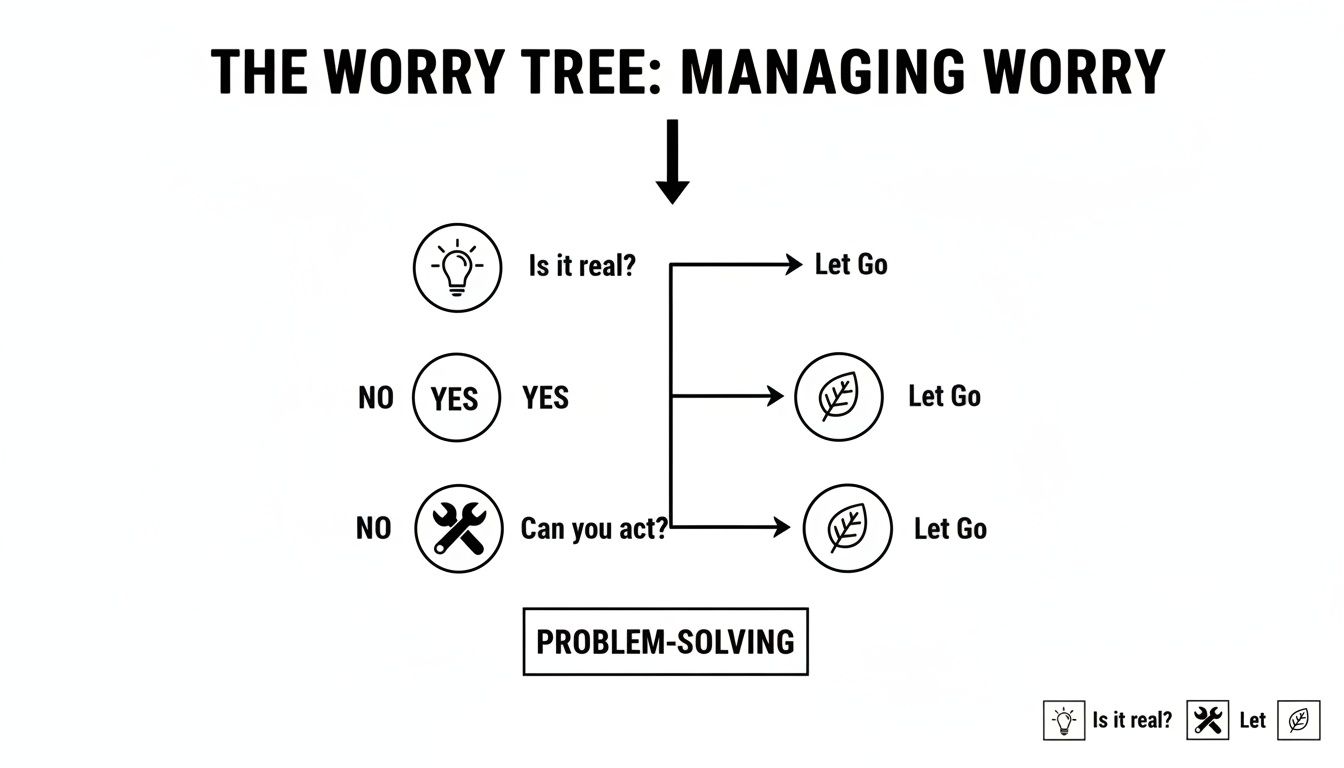
The process forces a moment of clarity. Is this worry about something happening right now, or is it a 'what if' scenario playing out in your head? If it’s something you can influence, the tree guides you to make a plan. If not, the instruction is just as clear: let it go and bring your attention back to the present moment.
This process elegantly sorts your anxieties into two piles—those that need a plan, and those that need to be released.
And these aren't just neat ideas; structured approaches like this are shown to be really effective. In England, while the prevalence of common mental disorders has unfortunately risen, tools from Cognitive Behavioural Therapy (CBT) like Worry Time have a recovery rate of 45-60% in NHS Talking Therapies. It's solid proof that proactive management can make a real difference. You can discover more insights about these mental health statistics if you’re interested.
Building a Worry-Resistant Lifestyle

While the techniques we've discussed are fantastic for those intense, in-the-moment battles with worry, the real long game is about building a life that's naturally more resistant to it. Think of it as preventative maintenance for your mind. It’s the small, consistent habits that create a solid foundation, making it much harder for chronic worry to find a foothold.
These core pillars of wellbeing have a direct line to your nervous system's baseline state. When you get them right, you're simply less prone to the biochemical spikes that throw fuel on the fire of anxiety. It gives you a much calmer, more stable platform to handle whatever life decides to throw at you.
Prioritise Restorative Sleep
Poor sleep and anxiety are a nightmare duo, locked in a vicious cycle. Worry keeps you staring at the ceiling, and the resulting sleep deprivation makes your brain see threats everywhere the next day. A tired brain has a hyperactive amygdala—your emotional alarm system—and a sluggish prefrontal cortex, which is meant to be the voice of reason. It's the perfect storm for a worry spiral.
Getting a handle on your sleep hygiene is genuinely one of the most powerful things you can do to get a grip on worry. And it's about more than just getting to bed on time.
Create a Buffer Zone: Carve out the last 30-60 minutes before bed for something screen-free and calming. Read an actual book, listen to some gentle music—anything that signals to your brain that it’s time to power down.
Mind Your Environment: A cool, dark, and quiet bedroom is your best friend. This simple setup helps your body produce melatonin, the hormone that tells you it's time to sleep.
Be Consistent: Try to wake up and go to bed at roughly the same time every day. Yes, even on weekends! This helps to stabilise your internal body clock, or circadian rhythm, which thrives on routine.
For a bit of extra support, a magnesium glycinate supplement for anxiety can be really helpful. It’s well-known for its ability to calm the nervous system and encourage deeper, more restorative rest.
Fuel Your Mind and Move Your Body
It’s no secret that what you eat and how you move directly affects your mood and anxiety. The blood sugar rollercoaster caused by processed foods and sugary snacks can actually mimic or even trigger feelings of panic. By focusing on whole foods—things like lean proteins, complex carbs, and healthy fats—you give your body a steady stream of energy, avoiding those dramatic slumps and spikes.
In the same way, regular physical activity is a potent, natural antidote to worry. You don't need to sign up for a marathon; even a brisk 20-minute walk can work wonders.
Exercise helps burn off excess cortisol (the stress hormone), releases feel-good endorphins, and gives your mind a much-needed break from looping thoughts. It's something I see all the time in my walk-and-talk therapy sessions; combining movement with talking things through can be an incredibly powerful way to untangle worry.
When to Seek Professional Help with Anxiety
Self-help strategies can be incredibly powerful, but sometimes the sheer weight of constant worry calls for a guide. Knowing when to reach out is a sign of strength, not a weakness. So, how do you know when it’s time to stop going it alone and seek some professional support?
The clearest sign is when worry starts to really get in the way of your day-to-day life. If you find anxiety is consistently interfering with your work, putting a strain on your relationships, or just stealing the joy from your hobbies, it's a strong indicator you could benefit from therapy. You don't have to wait until you hit a crisis point.
What Does Therapy Actually Involve?
Seeing a therapist gives you a confidential, non-judgemental space to explore the roots of your anxiety in a way that’s almost impossible to do on your own. Think of it as a proactive and empowering step towards lasting change. It offers structured support to start untangling the thought patterns that keep you feeling stuck.
If you're feeling apprehensive, it might help to know you're far from alone. Around 1 in 7 UK adults are diagnosed with anxiety, meaning millions of people are actively taking steps to manage their mental health. And the data shows that getting professional help really works; structured therapies like CBT can slash symptoms by over 50% in just a few weeks. You can read more about these mental health statistics if you're interested in the positive trends.
How I Can Help You Stop Worrying
At Therapy with Ben, I offer a couple of different ways we can work together, depending on what feels most comfortable and effective for you.
Online Therapy: This gives you complete flexibility. You can access support from the comfort and privacy of your own home, making it much easier to fit sessions into your life.
Walk-and-Talk Therapy: We can meet in a local park, combining the therapeutic benefits of conversation with the natural calming effects of gentle movement and being outdoors.
Therapy isn't a last resort; it's a forward-thinking investment in your own wellbeing. It’s about equipping yourself with the tools and insights needed to build a calmer, more resilient future.
If you feel that persistent worry is holding you back, exploring anxiety counselling in Cheltenham could be your next best step. Please feel free to get in touch to see how I can help.
A Few Common Questions About Worry
As you start putting these ideas into practice, a few questions often come up. It's completely normal to wonder about the process, so let's tackle some of the most common ones.
How Quickly Will These Techniques Actually Work?
This is probably the number one question I get asked, and it's an important one. While there's no magic wand, some techniques offer relief almost immediately. Grounding skills, for example, can pull you out of a spiral of anxiety in just a few minutes. They're your first line of defence.
For the deeper, more lasting change that comes from methods like CBT, consistency is what really counts. Think of it like building muscle. Most people start to feel a real, noticeable difference in how often and how intensely they worry within a few weeks of consistent practice. The goal isn't overnight perfection; it's about making steady, sustainable progress.
What If My Worries Are About Real, Actual Problems?
A fantastic and crucial question. It’s easy to dismiss worry-management techniques if you feel your concerns are completely valid. And often, they are!
This is exactly where tools like the 'Worry Tree' exercise really shine. They are specifically designed to help you separate the hypothetical "what if?" fears from the genuine, here-and-now problems that need a plan. When a worry is about a real-world issue, we stop trying to eliminate the thought and instead channel that anxious energy into productive problem-solving. It's about shifting from spinning your wheels to taking practical, forward-moving steps.
Is Online Therapy As Good As Seeing Someone Face-to-Face for Anxiety?
Absolutely. It’s a common concern, but a huge amount of research has shown that for anxiety, online therapy is just as effective as traditional in-person sessions. You get the same evidence-based support from a qualified, experienced therapist, but with the added flexibility of fitting it around your life, from a space where you feel most comfortable.
For more tools and articles to help you on your way, you can find a whole range of helpful posts in my mental health resources section.
If you feel that getting some professional, confidential support could be the right next step to break free from the cycle of worry, Therapy with Ben is here for you. You can find out more about my approach or book a session directly on my site.


Comments