


What Is Third Wave CBT and How Can It Help You?
- Jan 7
- 14 min read
If you’ve ever felt like you’re at war with your own mind, you’re in good company. Third wave CBT is a newer family of therapies designed for that exact struggle. The whole point is to change your relationship with difficult thoughts and feelings, rather than trying to bully them into submission. It’s less about fighting your mind and more about learning to work with it.
Understanding Third Wave CBT and Its Core Idea
Think of your mind as a stormy sea. For a long time, many therapies tried to calm the waves – a noble goal, but often exhausting and, let's be honest, pretty much impossible. Third wave CBT sees things differently. It doesn’t try to stop the storm. Instead, it teaches you how to become a skilled sailor, navigating the rough seas of your own thoughts and emotions with more grace and less struggle.
This whole approach is built on the foundations of acceptance and mindfulness. Instead of getting tangled up in a battle with anxiety, self-criticism, or a low mood, you learn to just… observe them. Without judgement. The aim is to create a bit of breathing room between you and your thoughts, which frees you up to live a life that actually means something to you, guided by your values, even when things are tough.
Building a New Relationship with Your Mind
The core idea is to stop struggling and start living. Simple as that. This means picking up some key skills that help you stay grounded in the here and now, rather than getting swept away by the storm in your head. These aren't about achieving some mythical state of perfect calm, but about building awareness and being a bit kinder to yourself.
Two of the big players here are:
Mindfulness: This is basically the practice of paying attention to the present moment, on purpose. By focusing on something simple like your breath or the sounds around you, you learn to drop an anchor when your mind feels like it’s about to capsize. You can learn more about what mindfulness in therapy is and how it all works.
Acceptance: This is all about making room for the difficult stuff – the uncomfortable thoughts, the painful feelings – instead of constantly trying to push them away. It’s about recognising that pain is a normal part of being human, but the suffering we add on top by fighting it is often optional.
And this isn't just fluffy talk; this approach really works. In the UK, third wave cognitive and behavioural therapies are seen as a major step forward in psychological treatment. Data from the Improving Access to Psychological Therapies (IAPT) programme shows that around 50% of people recover completely, and up to two-thirds see a significant improvement in their symptoms. If you're into the research, you can read the full study about these findings on PMC.
How Third Wave CBT Differs from Classic CBT
To really get a feel for what makes third wave CBT different, it’s helpful to look at where it came from. Therapy has evolved in stages, or ‘waves’. The first wave was behaviourism, focusing purely on what we do—our observable actions. The second wave gave us classic Cognitive Behavioural Therapy (CBT), which brought our thoughts into the picture.
Classic CBT is a bit like being a detective. It helps you identify unhelpful or negative thoughts, put them on trial, and challenge them to see if they hold up to the facts. The main goal here is to change the content of your thinking. By correcting these cognitive distortions, the idea is that you’ll feel better. For many, this is an incredibly effective and logical way to manage their mental health.
But sometimes, trying to argue with your own mind can feel like a draining, unwinnable war. This is where the third wave comes in, offering a completely different perspective.
A Shift from Changing Thoughts to Observing Them
Instead of acting as a detective who argues with thoughts, third wave CBT invites you to become more of a curious observer. The focus shifts away from whether a thought is ‘true’ or ‘false’ and moves towards simply noticing it as a mental event – a fleeting product of your mind. You learn to change your relationship with your thoughts, not necessarily the thoughts themselves.
Think of it like this: your thoughts are clouds passing in the sky. Classic CBT might ask you to examine each dark cloud, analyse its shape, and argue that it’s probably not going to rain. A third wave approach, on the other hand, teaches you to simply notice the cloud, acknowledge it’s there without getting carried away by it, and let it drift by on its own.
To put it simply, here’s a quick comparison of the two approaches.
Classic CBT vs Third Wave CBT: A Quick Comparison
Aspect | Classic CBT (Second Wave) | Third Wave CBT |
|---|---|---|
Primary Goal | Change the content of negative thoughts. | Change your relationship with your thoughts and feelings. |
Core Technique | Challenging and disputing unhelpful thoughts. | Observing thoughts non-judgementally (mindfulness). |
Stance on Thoughts | Thoughts are evaluated as rational or irrational. | Thoughts are seen as mental events, not necessarily facts. |
Role of Emotion | Aims to reduce distressing emotions by changing thoughts. | Aims to accept all emotions, even difficult ones. |
Focus | Symptom reduction. | Living a rich, meaningful life guided by your values. |
This table shows the fundamental shift in philosophy. It’s less about fighting and more about accepting.
The core difference is one of acceptance versus alteration. Third wave therapy isn't about winning a war against your thoughts; it’s about learning to coexist with them peacefully, freeing up your energy to focus on what truly matters in your life.
This journey—from being swamped by our thoughts to navigating them with gentle acceptance—is right at the heart of the third wave philosophy.
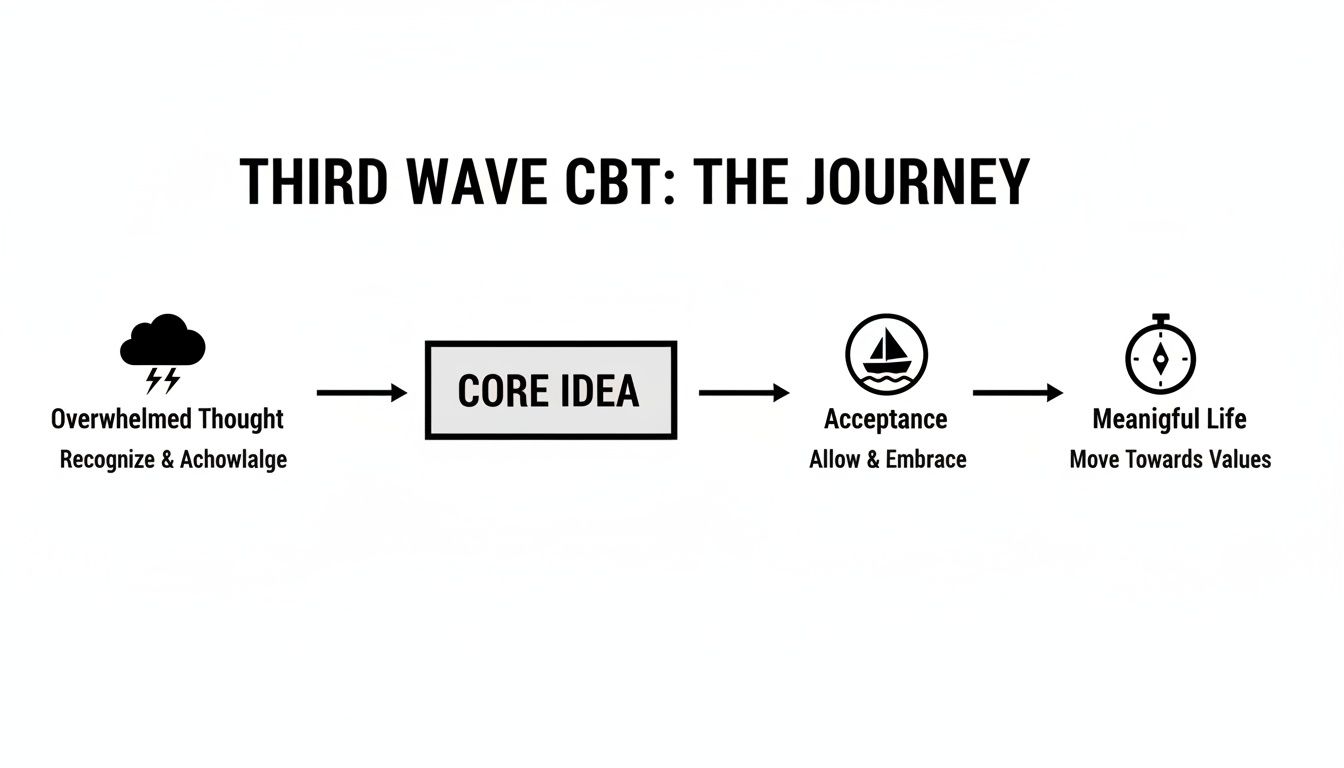
This process shows how learning to accept our internal storms allows us to use our values as a compass, guiding us toward a more meaningful and fulfilling life.
The Three Pillars of Third Wave Therapies

While the big ideas behind third-wave CBT are powerful, their real magic lies in how they translate into practical, life-changing skills. These therapies are built on three core pillars that work in harmony, helping you build resilience and forge a more meaningful life.
These aren't just abstract theories we'll talk about; they're active practices that will form the very foundation of our work together. By learning to cultivate mindfulness, embrace acceptance, and live by your values, you’re essentially creating a robust internal toolkit for navigating whatever challenges life throws your way.
Pillar 1: Mindfulness
At its heart, mindfulness is the simple (but not always easy) practice of paying attention to the present moment, on purpose, without getting tangled up in judgement. It’s about dropping an anchor into the here and now, rather than being swept away by worries about the future or regrets about the past.
Imagine you're caught in a mental whirlwind of anxious thoughts. Mindfulness is like that anchor. It doesn't magically stop the storm, but it holds you steady, letting you observe the chaos without being capsized by it. This creates a vital pocket of calm, a space where you can choose how to respond, instead of just being pulled under by automatic reactions.
Pillar 2: Acceptance
This is often the most misunderstood piece of the puzzle. In the context of therapy, acceptance doesn't mean you have to like a difficult situation or just resign yourself to it. It’s more about making room for uncomfortable thoughts and feelings, acknowledging they're there without launching into an exhausting battle to get rid of them.
Trying to fight off anxiety or sadness is a bit like trying to hold a beach ball underwater—it’s tiring, and eventually, it just pops back up with even more force. Acceptance is about letting the ball float on the surface next to you. You see it, you acknowledge it, but you don't let it stop you from swimming. This idea is central to developing better skills for emotional regulation.
Acceptance is not about giving up; it's about giving up the struggle. It frees up enormous amounts of mental energy that can be redirected from fighting your feelings to building a life you value.
This shift from fighting to allowing has a huge impact. In fact, research within the UK's own mental health system has shown that third-wave approaches can be significantly more effective than standard care. A major Cochrane review found these therapies were roughly twice as effective, with patients just as willing to engage with them as with traditional treatments. You can discover more about these findings on third-wave CBT effectiveness and see the data for yourself.
Pillar 3: Values-Driven Living
So, mindfulness anchors you in the present and acceptance helps you handle the internal storms. But what gives you direction? That’s where your values come in.
This pillar is all about getting crystal clear on what truly matters to you, deep down. What kind of person do you want to be? What do you want to stand for in this life? Your values are your personal compass.
Think of them as the destination you set on a map for a long journey. You know you'll encounter rough terrain, bad weather, and unexpected detours (we all do). But your values keep you oriented, ensuring you're always moving in a direction that feels meaningful to you. This makes your actions purposeful, even when you have to do things that feel difficult or uncomfortable.
Exploring the Main Types of Third Wave CBT
When we talk about ‘third wave CBT’, it’s not one single, rigid therapy. It's much better to think of it as a family of related approaches. Each one has its own specialised toolkit, designed to help with specific challenges, but they all share the same DNA of mindfulness, acceptance, and values.
Getting a feel for these different therapies helps you see just how broad the support can be. They all offer a unique path towards a more meaningful life, and each is suited to different needs and ways of seeing the world. Let’s get to know some of the most established members of this therapeutic family.
Acceptance and Commitment Therapy (ACT)
Acceptance and Commitment Therapy, or ACT as it’s usually called, is probably one of the most well-known of the third wave therapies. The main goal here is to build psychological flexibility – basically, the ability to sit with difficult feelings without getting swept away by them, while still taking action on what truly matters to you.
Instead of fighting to get rid of painful thoughts, ACT teaches you skills to ‘unhook’ from them. You learn to see them for what they are – just words and pictures in your head, not commands you have to obey. We’ve got a more in-depth article if you’d like to read our detailed guide on Acceptance and Commitment Therapy.
Dialectical Behaviour Therapy (DBT)
Dialectical Behaviour Therapy (DBT) was first created to help people struggling with really intense, overwhelming emotions, and it’s since been shown to be incredibly effective for a whole range of issues. DBT is a very practical, hands-on therapy, focused on building concrete skills in four key areas:
Mindfulness: Learning to stay grounded and aware in the here and now.
Distress Tolerance: Finding ways to get through painful moments without making things worse.
Emotion Regulation: Gaining a better understanding of your emotions and how to manage them.
Interpersonal Effectiveness: Building healthier relationships by learning to communicate your needs clearly and respectfully.
This skills-based approach makes DBT a really powerful option, especially if you often feel overwhelmed by your emotions or find relationships a struggle.
Mindfulness-Based Cognitive Therapy (MBCT)
Mindfulness-Based Cognitive Therapy (MBCT) was specifically put together to help people who experience repeated bouts of depression. It cleverly blends the practical tools of classic cognitive therapy with the grounding practices of mindfulness.
The goal isn't to stop negative thoughts from ever appearing – that’s an impossible task! Instead, MBCT is all about changing your relationship to those thoughts. By learning to spot the early warning signs of a depressive spiral and just observe your thoughts without getting tangled up in them, you can break the cycle before it gathers momentum.
A key takeaway is that you don't need to choose between third wave or older therapies. Research shows that these modern approaches are just as effective as traditional CBT and other established psychological treatments, offering a robust and evidence-backed alternative for your mental health journey.
This isn’t just an opinion; it's backed by a huge amount of research. A major Cochrane review, for instance, found no real difference in effectiveness between third wave CBT and other psychological therapies. This just confirms that these approaches are a solid, effective choice for anyone looking for support.
Who Can This Approach Help?
One of the real strengths of third-wave CBT is just how many people it can help. Because its focus isn't so much on diagnosing a ‘problem’ but more on building the skills for a fuller, richer life, it’s a good fit for all sorts of people facing different kinds of struggles. This approach isn't about trying to 'fix' you; it’s about giving you the tools to handle life’s inevitable ups and downs with a bit more grace and self-kindness.
This makes it a really practical option for many of the common difficulties that bring people to therapy. If you're wrestling with anxiety, depression, chronic stress, or feel like you're stuck on a hamster wheel with the same unhelpful relationship patterns, these therapies have something tangible to offer. They help you get out of that constant battle with your own thoughts and feelings, and reconnect with what actually matters to you.
A Powerful Approach for Neurodiversity
Third-wave CBT is also proving to be a particularly powerful approach for neurodivergent people. If you have ADHD or are autistic, you’ll know the world can often feel like a very overwhelming place. Dealing with constant sensory input and big emotions is just part of the daily routine, and some traditional therapies that zero in on changing thoughts can sometimes miss the mark.
The core ideas of acceptance and mindfulness offer a different, and frankly, more validating path.
For ADHD: Mindfulness can be a game-changer. It helps train the brain to stay in the present moment, strengthening focus and helping to quieten that pull of a million different distractions.
For Autism: Acceptance-based strategies are invaluable for managing the intensity of sensory overload and big emotions. They encourage self-compassion, not self-criticism.
The goal isn't to change who you fundamentally are, but to find skills that help you thrive. It’s about learning to work with your unique brain wiring, not against it. When we're looking at who can benefit, it's also worth remembering the broader CBT therapy options for ADHD and Autism which provide a wider context for the kind of support available.
At its heart, this kind of therapy is for anyone who feels stuck in a fight with their own mind. It starts by saying your experience is valid, and then gives you a toolkit to build a meaningful life, not by getting rid of all the challenges, but by learning to live well alongside them.
Whether you're navigating life’s general pressures or are specifically looking for support as a man wanting to work with a male counsellor, this inclusive, skills-first approach can offer a clear way forward.
What to Expect in a Third Wave Therapy Session

Starting therapy can feel a bit like stepping into the unknown, so it’s completely natural to wonder what actually happens behind the door. When we work together using third wave CBT, you’ll find a compassionate, non-judgemental, and genuinely collaborative space. We’re a team. This is a long way from the old-fashioned image of therapy where you just talk and I silently take notes.
Instead, our sessions are an active blend of supportive conversation and practical, hands-on exercises. We don't just talk about concepts like mindfulness; we'll actually practise them, right there in the moment. It’s this learn-by-doing approach that helps the skills feel real and genuinely useful in your day-to-day life.
An Active and Grounded Experience
A typical session involves us looking at whatever you're struggling with, but through a new lens. We might start with a simple guided mindfulness practice to help you feel more grounded, or use a powerful metaphor to explore your relationship with difficult thoughts. The real aim is to build your psychological tool kit in real time.
This could look like:
Guided Mindfulness: Simple exercises to connect you with the present moment. We might focus on your breath or the sounds around you, just to create a small anchor of calm in the storm.
Values Clarification: Engaging activities designed to help you tap into what truly matters to you deep down. Think of it as creating a personal compass to guide your decisions.
Defusion Techniques: Learning creative ways to ‘unhook’ from those sticky, unhelpful thoughts so they have less of a hold over you and your choices.
A third wave therapy session is less about analysing the past and much more about building practical skills for the present and future. It’s an active, engaging process designed to empower you with tools you can carry with you long after our work together is done.
Taking Therapy Outdoors with Walk and Talk Sessions
Here in Cheltenham, I also offer ‘walk and talk therapy’. I’ve found this approach naturally complements the principles of third wave CBT. There’s something about being in nature, moving your body, and engaging your senses that makes the practice of being mindful and present feel so much more grounded and accessible.
This approach helps to demystify therapy, taking it out of the traditional four walls and into the real world. It creates a more relaxed, informal atmosphere that many people find helps them to open up, making the whole process feel more like a supportive conversation than a clinical appointment.
Of course. Here is the rewritten section, crafted to sound completely human-written and natural, following the style of your provided examples.
Common Questions About Third Wave CBT
Deciding to start therapy is a big step, and it’s completely normal to have a few practical questions rattling around your head before you even think about reaching out. This final section is all about giving you clear, straightforward answers to the queries I hear most often about third wave CBT, helping you feel a bit more confident and informed as you consider what to do next.
The whole idea is to pull back the curtain on the process, so you have a good idea of what to expect.
How Many Sessions Will I Need?
This is probably the most common question I get asked, and the honest answer is: it really depends. Therapy is all about you, so it’s tailored to your specific situation and what you want to achieve. Some people find they get the tools and perspective they need in a relatively short time, maybe 8-12 sessions. For others, longer-term work is more helpful for exploring deeper, more ingrained patterns.
We’ll talk about this in our first meeting and check in regularly on how you feel things are going. The aim is always to empower you with skills for life, not to keep you in therapy forever.
Is This Suitable If Classic CBT Didn't Work for Me?
Absolutely. In fact, many people who feel that classic CBT wasn't quite the right fit for them find that a third wave approach really clicks. If you found the idea of constantly challenging your thoughts a bit of a struggle, or felt like you were somehow ‘failing’ at it, the focus here on acceptance can feel like a breath of fresh air.
It simply offers a different path. It's less about wrestling with your mind and more about learning how to live well alongside it. It’s not about which is 'better,' but about finding the approach that genuinely resonates with you and your experience.
Do I Have to Be Good at Meditation for This to Work?
Not at all! This is a very common worry, so you’re not alone in thinking it. Mindfulness in therapy isn't about emptying your mind or floating away into a perfect state of zen-like calm. It's much simpler than that: it’s just the practice of paying attention to what’s happening right now—your breath, sounds, the feeling of your feet on the floor—with a bit of curiosity and without judging yourself.
Your mind will wander; that’s what minds do. The practice is simply about gently noticing when it has wandered off and kindly bringing your attention back, again and again. It’s a skill we build together, and there's absolutely no pressure to be an expert from day one.
How Do I Know If This Is the Right Therapy for Me?
Honestly, the best way to find out is just to have a chat. A good relationship with your therapist is the foundation for any meaningful progress. I offer a consultation where you can ask me anything you like, get a feel for how I work, and see if you feel comfortable.
We can talk about what you're struggling with and explore whether a third wave CBT approach sounds like it could be a good fit for you. Please feel free to get in touch to book a no-obligation chat.
If you're ready to explore how third wave CBT could help you, Therapy with Ben is here to support you. Visit the website to learn more or to book an initial consultation.
Comments