


How to Overcome Fear of Rejection A Practical Guide
Posted by: Therapy-with-Ben
Tackling the fear of rejection means getting to grips with where it comes from, challenging the negative stories it tells you, and slowly, carefully, putting yourself in situations you’d normally run a mile from. It’s a process of reframing rejection – seeing it not as a final judgement on your worth, but just as a normal, if uncomfortable, part of life. This is how you build resilience and a bit of self-compassion along the way.
Understanding Where Your Fear of Rejection Comes From

That sting of potential rejection is a deeply human thing. Evolutionarily speaking, our ancestors’ survival literally depended on being part of the tribe. Getting cast out was a death sentence. That ancient wiring is still in us, which is why social rejection can feel so threatening – it actually lights up the same parts of the brain that physical pain does.
This primal fear often gets amplified by our own personal histories. Our early experiences, especially with parents or caregivers, really do set the stage. Those first relationships create a blueprint for how we expect to be treated and whether we feel, deep down, that we’re worthy of connection. For a deeper dive, you can learn more about how attachment theory shapes you and your relationships in our dedicated article.
The Echoes of Past Experiences
Painful memories can get stuck on a loop, reinforcing the idea that rejection says something awful about us. A critical teacher, a friendship that just vanished, a messy break-up – these can all feed a story that says, "I'm not good enough."
This internalised story can put you on high alert, constantly scanning for any sign that someone disapproves. Over time, it becomes a self-fulfilling prophecy. You avoid opportunities to connect to protect yourself, but that just reinforces the loneliness and feeling of inadequacy. This avoidance is a big deal, especially for younger people. A 2023 survey by the UK mental health charity stem4 found that a massive eight in ten young people (80%) deliberately avoid situations to dodge anxiety, with fear of social judgement being a huge factor.
The fear of rejection isn't about what might happen to you, but about what you will make it mean about you. The real work is in separating the event from your identity.
Distinguishing Fear from Fact
It’s crucial to know the difference between healthy caution and a debilitating fear that runs your life. Feeling a bit nervous before a first date or a job interview is normal. It’s a problem when that fear stops you from dating or applying for jobs at all.
This isn’t about trying to get rid of fear completely – that’s impossible and wouldn’t even be helpful. It’s about learning to manage it, to turn the volume down. The goal is to get to a point where you can feel the fear and still do the things that matter to you, guided by your values, not by a desperate need to avoid discomfort.
If you’re interested in exploring where these internal barriers come from, you might find some real insights in these lessons on limiting beliefs from adventure. It’s a path of compassion, learning to live more freely alongside your fears, not constantly fighting against them.
Practical CBT Exercises to Reframe Rejection Anxiety
Knowing where your fear of rejection comes from is one thing, but what do you do in the heat of the moment? This is where Cognitive Behavioural Therapy (CBT) comes in, offering a really practical set of tools to help you get unstuck.
The basic idea behind CBT is simple: our thoughts, feelings, and actions are all linked. If we can learn to spot and question the unhelpful thoughts that rejection anxiety feeds us, we can start to change how we feel and what we do. These aren't just abstract theories; they're concrete exercises you can start using right away to break those old mental habits.
Catch and Challenge Your Automatic Negative Thoughts
The second you think you’ve been rejected—a message left on ‘read’, a friend cancelling last minute—your mind probably leaps to a worst-case scenario. This is what we call an Automatic Negative Thought, or an ANT. It’s that instant, gut-reaction thought that feels like a cold, hard fact. The very first skill is to just notice it happening.
Think of yourself as a detective, calmly investigating your own mind. When that familiar spike of anxiety hits, just pause and ask: “What was the thought that just flashed through my head?”
Once you've 'caught' it, you can start to challenge it. Anxious thoughts are terrible lawyers; they ignore all the evidence that doesn't fit their gloomy narrative.
Look for the evidence: What are the actual facts here? Does the evidence really, truly support your negative conclusion, or could there be other ways of looking at it?
Spot the distortion: ANTs often follow predictable, unhelpful patterns. Are you catastrophising (imagining the absolute worst outcome) or mind-reading (assuming you know exactly what someone else is thinking)?
Brainstorm alternatives: Try to come up with other possible explanations. This isn't about slapping on a fake-positive spin; it's about making room for uncertainty and seeing other perspectives.
So, if your ANT is, “They didn’t text back, they must hate me,” an alternative could be, “They’re probably just swamped at work, like I often am.” It's a small shift, but it chips away at the certainty of your fear. Modern approaches like third-wave CBT offer even more tools for this kind of flexible thinking, and you can learn more by exploring what third-wave CBT is and how it can help you.
Your Rejection Reframing Toolkit
A thought record is a brilliant way to put this detective work into practice. It’s a structured table that helps you slow down and look at your thoughts more objectively, breaking the cycle of automatic panic. You can do this in a notebook or even a notes app on your phone.
Automatic Negative Thought | Cognitive Distortion | A More Balanced Perspective |
|---|---|---|
"I shared an idea in a meeting and no one responded. They all think it's stupid." | Mind-reading & Catastrophising | "The meeting was running over. People might still be processing it. A lack of immediate praise isn't the same as universal criticism." |
"They cancelled our plans again. They obviously don't want to be my friend anymore." | Jumping to Conclusions & Personalisation | "They've had a really stressful week. Their reason for cancelling was about them and their energy, not about me. I can check in later." |
"I got turned down for that date. I'm just unlovable and I'll be alone forever." | Overgeneralisation & All-or-Nothing Thinking | "This one person wasn't a match. That's all it means. It hurts, but it doesn't say anything about my worth or my entire future." |
Doing this consistently helps you see the direct link between what you think and how you feel, proving that you have more influence over your emotional state than you might believe.
Try Decatastrophising Your Worst Fears
Often, the fear of rejection is wrapped up in a terrifying "what if?" story. Decatastrophising is a technique where you intentionally follow that fear all the way to its so-called catastrophic conclusion. More often than not, you’ll find it’s survivable.
The core of rejection anxiety isn't just the fear of a 'no'; it's the fear of what that 'no' will mean about your fundamental worth. CBT helps you break that connection.
Next time a catastrophic thought pops up, walk it through these questions:
What am I most afraid will happen here? (e.g., "If I ask for a promotion and get turned down, my boss will lose all respect for me and I'll be sidelined.")
Realistically, how likely is that to happen? (e.g., "It's pretty unlikely they'd lose all respect just for me showing ambition. They might just think I'm not quite ready yet.")
And if the worst did happen, how would I cope? (e.g., "It would sting, for sure. But I could ask for specific feedback on what to work on. I could look at other roles. My career wouldn't be over; it would just be a setback.")
By playing out the scenario, you drag the imagined disaster out of the shadows and into the light of practical problem-solving. You prove to your brain that you can handle it, which takes a huge amount of power away from the initial fear.
Building Your Resilience Through Gradual Exposure
While sorting out your internal monologue is a huge step, the best way to really quiet that fear is to face it. This doesn't mean you have to jump into the deep end and ask your boss for a massive pay rise tomorrow. Instead, we can use a structured, therapeutic approach called gradual exposure. It’s all about confronting your fear of rejection in small, deliberate, and totally manageable steps.
The idea is pretty simple: your brain learns from experience. Right now, it might be convinced that any kind of rejection is a catastrophe to be avoided at all costs. Gradual exposure is about systematically teaching it a new lesson—that you can not only survive rejection, but that it’s rarely as bad as you build it up to be.
Introducing the Exposure Ladder
An exposure ladder (sometimes called a fear hierarchy) is your personalised roadmap for this journey. It’s basically a list of situations that trigger your fear of rejection, which you organise from the least scary to the most intimidating. The goal is to start at the bottom and only move up a rung when you feel comfortable and less anxious at your current level.
This isn't about seeking out pain; it's about building psychological muscle. Every small success builds your confidence and gives your brain solid proof that you can handle these situations.
Here’s a sample to give you an idea. The trick is to make it completely your own, based on your specific fears.
Fear Level (0-10) | Exposure Task | Potential 'Rejection' Outcome |
|---|---|---|
2/10 | Ask a stranger for the time, even if you already know it. | They might ignore you or seem a bit annoyed. |
4/10 | Give a genuine compliment to a colleague on their work. | They could dismiss it or just not seem to care. |
6/10 | Share a different opinion on a low-stakes topic (like a film) with a friend. | They might disagree or think your take is a bit odd. |
8/10 | Pitch a small idea during a team meeting. | The idea might get shut down or ignored by the group. |
10/10 | Ask someone you're interested in out for a coffee. | They could simply say no. |
The key is to start with a task that feels only mildly uncomfortable (a 2 or 3 out of 10) and keep doing it until it feels almost boring. That's your cue that you're ready for the next step.
Navigating Each Step Effectively
Just going through the motions isn’t enough. The real learning happens in how you approach the task and what you take from it afterwards. You can get the most out of each exercise by following a simple process before, during, and after.
This process boils down to three core stages: catching your anxious thoughts, challenging whether they're actually true, and then changing your perspective based on what really happened. This little diagram breaks it down.
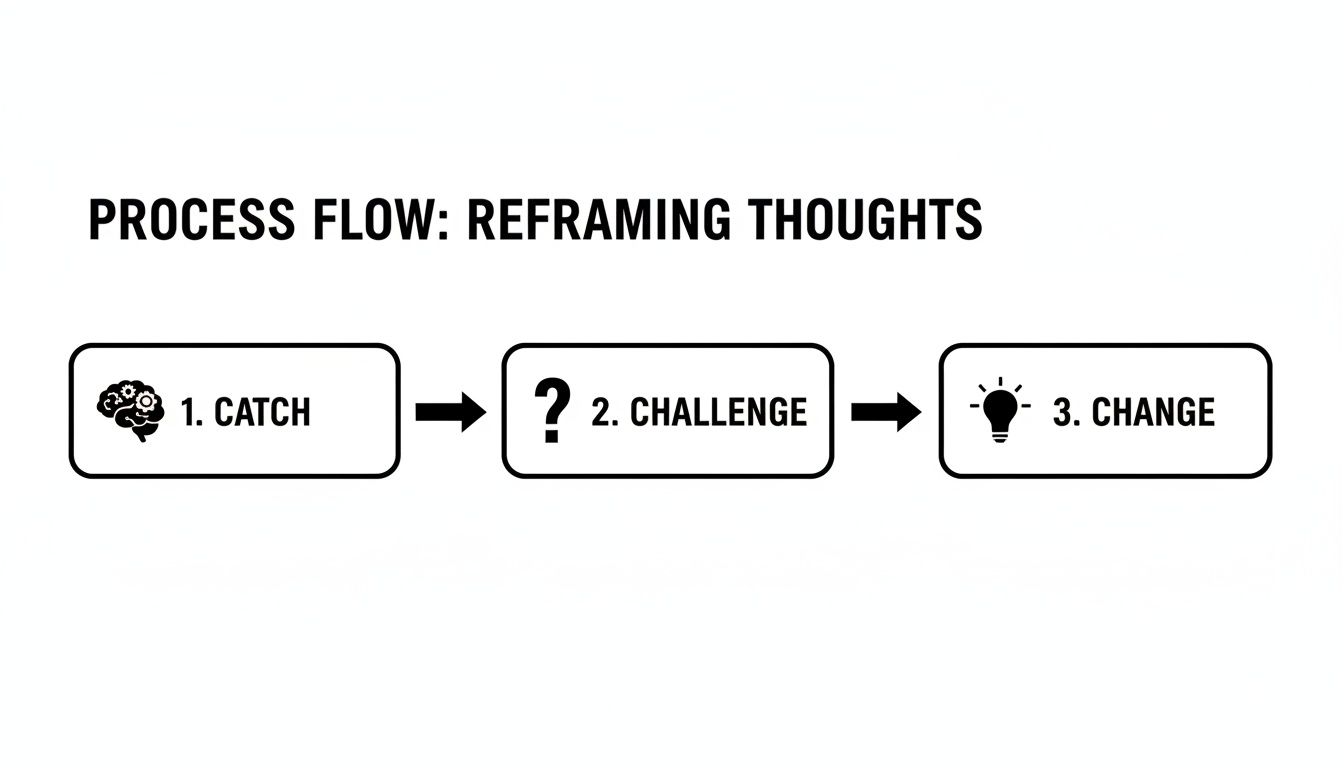
This simple flow—Catch, Challenge, Change—is your mental toolkit for turning a scary experience into a powerful learning opportunity.
After you’ve done a task from your ladder, take a minute to reflect:
What was I most afraid would happen? (e.g., "I thought the person would laugh at me for asking for the time.")
What actually happened? (e.g., "They just told me the time and we both moved on.")
What did I learn? (e.g., "I learned my worst-case scenario was just a story in my head. I handled the awkward moment and nothing bad happened.")
This reflection is crucial. It cements the new, more realistic evidence in your mind, which directly argues against those old, fearful beliefs. For people whose fear pops up a lot at work, learning specific strategies to handle job rejection and move forward can be a really practical way to build this kind of resilience.
The point of exposure isn't to get a 'yes'. The point is to learn, deep in your bones, that you can fully handle a 'no'. Success is defined by your willingness to try, not by the outcome.
By methodically working your way up your ladder, you aren't just managing your fear—you're actively rewriting your relationship with it. You're proving to yourself, through direct experience, that rejection is not a verdict on your worth. It’s just an outcome, one of many possibilities in a full and engaged life. This gradual process builds a solid, lasting self-confidence that’s grounded in reality, not just wishful thinking.
The Power of Self-Compassion in Healing Rejection Fears

While challenging your thoughts and facing your fears are crucial, they become much harder to sustain if you're battling a harsh inner critic at the same time. Often, the voice that hurts us most after a rejection isn't someone else's – it’s our own.
This is where self-compassion comes in. It’s an essential part of your toolkit for building resilience.
It's not about self-pity or making excuses. Self-compassion is about responding to your own pain with the same kindness you'd offer a good friend. It’s that warm, supportive voice that says, "This is really tough, and it's okay to feel this way," rather than the critical one that whispers, "I knew you'd mess this up."
The Three Pillars of Self-Compassion
Developing this skill really comes down to nurturing three core ideas. When you bring them together, they create a powerful antidote to the shame and self-blame that so often go hand-in-hand with the fear of rejection.
Self-Kindness vs. Self-Judgement: This is about actively choosing warmth over criticism when you’re having a hard time. Instead of tearing yourself down for a mistake, you offer yourself comfort.
Common Humanity vs. Isolation: This means recognising that struggle is part of the shared human experience. Everyone feels rejected sometimes; everyone makes mistakes. You are not alone in this.
Mindfulness vs. Over-Identification: This is the practice of observing your negative thoughts and emotions without getting totally swept away by them. You acknowledge the pain without letting it define your entire reality.
This internal shift is especially important when dealing with isolation. Government-backed research from 2023 uncovered a significant loneliness crisis among UK students. Despite nearly all reporting feelings of loneliness, 43% of 18-34-year-olds feared being judged by their peers if they admitted it, directly linking loneliness to a fear of rejection.
Learning to be kinder to yourself can be the first step in dismantling these internal barriers. To explore these concepts in more detail, have a read of our quick guide to kinder thinking with self-compassion.
Putting Self-Compassion into Practice
Understanding the theory is one thing, but how do you actually do it? Like any new skill, it takes practice. The goal is to create new mental habits that become your go-to response when things get tough.
One of the most effective ways to start is with a 'self-compassion break'. The next time you feel the sting of rejection or notice your inner critic piping up, just pause and go through these three steps, either in your head or by writing them down.
Acknowledge the Pain (Mindfulness): Simply say to yourself, "This is a moment of suffering," or "This really hurts." This simple acknowledgement validates what you're feeling without adding any extra drama.
Connect with Others (Common Humanity): Gently remind yourself, "Suffering is a part of life," or "Other people feel this way, too." This helps counter that isolating feeling that you're the only one who struggles.
Offer Yourself Kindness (Self-Kindness): You could try placing a hand over your heart to provide a comforting physical sensation and say something like, "May I be kind to myself," or "May I give myself the compassion I need right now."
Self-compassion is the act of turning toward your own emotional pain with the intention of caring for yourself. It’s the voice that allows you to be an imperfect human being.
This simple practice helps retrain your brain to respond to distress with care instead of criticism. Over time, this builds a deep-seated resilience, allowing you to navigate life’s inevitable rejections with a much greater sense of inner safety and stability.
When to Seek Professional Support for Fear of Rejection
While self-help tools like cognitive reframing and building exposure hierarchies are incredibly powerful, sometimes they just don't feel like enough. The journey to overcome a deep-seated fear of rejection is a very personal one, and often, the bravest thing you can do is ask for a guide to walk alongside you.
Realising you could do with some support isn't a sign of weakness; it's a mark of real strength. It shows you're ready to properly invest in your own well-being and get to the root of the problem in a more structured, supported way.
Signs It Might Be Time to Talk to Someone
It’s not always easy to know when it’s time to make that call. But if you’re dealing with constant distress or feel like this fear is making your world smaller and smaller, professional support can be a game-changer.
Think about reaching out if any of these patterns feel familiar:
Your relationships are suffering. You find yourself consistently sidestepping intimacy, turning down social events, or just can't bring yourself to be authentic with loved ones because you’re terrified of being judged or left.
Your career has hit a wall. You hold back your best ideas in meetings, shy away from promotions you know you deserve, or avoid networking opportunities. The fear of hearing ‘no’ is stopping you from chasing your professional goals.
You feel cut off and isolated. The sheer effort of avoiding any chance of rejection has left you feeling profoundly lonely and disconnected from the world around you.
Your mental health is taking a hit. The fear is fuelling persistent anxiety, a persistently low mood, or feelings of worthlessness that are bleeding into your everyday life.
This is especially common at work. A revealing 2023 study from the University of Law found that a staggering 84% of UK workers are afraid of being judged by their colleagues on how they communicate. That number leaps to 97% for people aged 25-34. When that kind of anxiety is stifling your growth, getting professional support can give you the tools you need to break free. Read the full research about workplace communication fears.
How Therapy Can Help You Overcome Rejection Fears
Working with a counsellor gives you a safe, completely confidential space to explore these fears without any judgement whatsoever. It's a dedicated environment where we can unpack where your specific fear of rejection comes from and start building personalised strategies for managing it.
Therapy isn’t about finding someone who has all the answers. It’s about partnering with someone who can help you find your own. It provides a secure base from which you can start to take those brave steps back into the world.
A therapist can guide you in:
Identifying the root causes: We can uncover the past experiences and deep-seated core beliefs that are fuelling your fear today.
Building a tailored toolkit: We move beyond generic advice to find the specific CBT, self-compassion, or mindfulness techniques that actually resonate and work for you.
Practising in a safe space: The therapeutic relationship itself is a place to practise vulnerability and communication before you have to try it out in the real world.
Providing accountability and support: Having a consistent, supportive professional in your corner helps keep you motivated, especially when you hit the inevitable bumps in the road.
Finding the Right Support for You
Here at Therapy with Ben, I get that the traditional therapy office doesn't feel right for everyone. That’s why I offer a few different ways for us to connect, making sure you feel as comfortable as possible while we work on how to overcome the fear of rejection together.
My services are designed to meet you where you are, offering a flexible and modern approach to counselling in and around Cheltenham.
Face-to-Face Sessions: For those who prefer a classic, in-person connection in a calm and private setting.
Online Counselling: Giving you the flexibility to have our sessions from the comfort of your own home, no matter where you are.
Walk and Talk Therapy: A really unique approach where we hold our sessions outdoors. The simple act of walking can help lower anxiety and makes conversations flow more naturally, which is brilliant for tackling tough topics like rejection.
If you recognise yourself in any of this and feel ready to see how therapy could help, I invite you to get in touch. You can learn more about the services I offer and take that first step towards a life less limited by fear.
Got Questions About Facing Rejection?
Taking on a fear that’s been with you for a while is a real journey, and it’s only natural to have a few questions pop up. Here are some of the most common ones I hear in my practice, answered to give you a bit more clarity and confidence as you move forward.
Is This Fear of Rejection Just Social Anxiety?
It's a great question, and the honest answer is: it's complicated. While a strong fear of rejection is definitely a big part of social anxiety, having that fear doesn’t automatically mean you have the disorder.
Think of it more like a spectrum. For many people, the fear crops up in specific situations – like asking someone on a date or giving a presentation at work – but it doesn’t take over their whole life. It crosses the line into a clinical issue when the fear becomes so persistent and intense that you start avoiding social situations altogether, and that avoidance really starts to shrink your world and affect your quality of life.
A good therapist can help you figure out where you sit on that spectrum and what that means for you.
How Can Walk and Talk Therapy Actually Help with This?
Walk and talk therapy can be a fantastic way to tackle these kinds of fears, for a couple of key reasons. First off, just the simple act of moving your body – gentle walking – helps to calm down the physical side of anxiety. It can lower stress hormones like cortisol and release endorphins, which puts you in a much better headspace to talk about tricky subjects without feeling completely overwhelmed.
The setting itself makes a huge difference, too. Being out in nature, walking side-by-side, just feels less intense and formal than sitting face-to-face in a therapy room. I find that conversation flows more naturally, and it gives us a chance to literally 'walk through' your fears in a supportive way, building up your confidence for when you face them in the real world.
The goal isn't to get rid of this feeling entirely – it’s a normal human emotion, after all. It’s about shrinking its power over you. Success is feeling the fear, but still being able to do the thing that matters to you, knowing that a 'no' doesn't change who you are.
Can I Ever Stop Fearing Rejection Completely?
It's more useful to aim for resilience rather than complete immunity. Let’s be honest, rejection stings. It stings for everyone. We're social creatures, wired for connection, so it's bound to hurt when we feel pushed away.
So, success here isn't about never feeling that sting again. It's about getting to a place where that fear no longer calls the shots. It's about proving to yourself, time and again, that you can handle rejection. You learn that it doesn't break you, it doesn't lessen your worth, and that the possibility of connection, of achieving your goals, is worth the risk.
How Can I Support a Friend or Partner Who’s Struggling with This?
This is a tough one, and it takes a lot of patience and empathy. The best thing you can do is listen and validate their feelings without accidentally making the fear bigger.
For instance, instead of saying, "Don't worry, they'll definitely say yes!" (which just raises the stakes), try something like, "I get why you're nervous about asking. Whatever happens, I know you can handle it, and I'm here for you."
A few more practical tips:
Encourage tiny steps. Don't push, just gently encourage.
Celebrate the effort, not the outcome. The bravery was in the trying.
Ditch dismissive phrases like "Just get over it" or "It's no big deal."
Offer to be there. Sometimes, just having a supportive friend nearby can make all the difference.
Your job isn't to fix it for them, but to be a supportive ally. When you show them that you believe in their ability to cope, you're helping them build that belief in themselves.
If any of this resonates and you feel that one-to-one professional support could help you find a way forward, Therapy with Ben is here. Take a look at the different types of therapy I offer, including Walk and Talk sessions in Cheltenham, and take that first step towards a life that isn’t defined by fear.


Comments