


How much does counselling cost: Your UK guide to affordable therapy
- Jan 17
- 13 min read
Updated: Jan 19
Navigating the cost of counselling can feel like a big step, but figuring out the typical figures is probably easier than you think. In the UK, a private therapy session generally costs between £50 and £80. Of course, this can climb to £150 or more in big cities like London, often reflecting the therapist's experience and the specific kind of support you're after.
Understanding the Average Cost of Counselling in the UK
When you start your search for a counsellor, one of the first practical questions that pops up is, "So, how much is this going to cost?" While there isn't a single, fixed price across the board, there are definite patterns that can help you budget for this important investment in yourself. The price is shaped by a few key factors, and knowing what they are puts you in a much better position to find the right fit.
Think of it like this: the fee is influenced by the therapist's level of expertise, where their practice is based, and how the session is delivered. It’s a bit like how a specialist consultant in a major city hospital might have different fees from a local GP. A highly experienced therapist in the centre of London will likely charge more than a practitioner in a smaller town.
A National and Local Perspective
Looking across the UK, counselling fees paint a varied picture. You’ll typically see prices ranging from £50 to £150 per 50-minute session, which is heavily swayed by the therapist's experience, location, and the type of therapy offered.
Here's a quick look at how counselling costs can vary.
UK Counselling Costs at a Glance
This table gives a snapshot of typical session costs you might encounter.
Therapy Type | Average Cost Per Session (50 mins) |
|---|---|
Private Face-to-Face (UK Average) | £50 - £80 |
Private Face-to-Face (London) | £75 - £150+ |
Online/Remote Therapy | £40 - £70 |
Cheltenham & South West | £50 - £65 |
As you can see, costs differ quite a bit depending on where you are and how you choose to have your therapy.
In urban hubs like London, you’re often looking at £75+ per session. Here in the South West, including Cheltenham, the rate hovers around £60 an hour. The national average sits at about £60, but this can dip to around £45 in more rural areas.
This chart helps to visualise the typical cost differences you might come across.
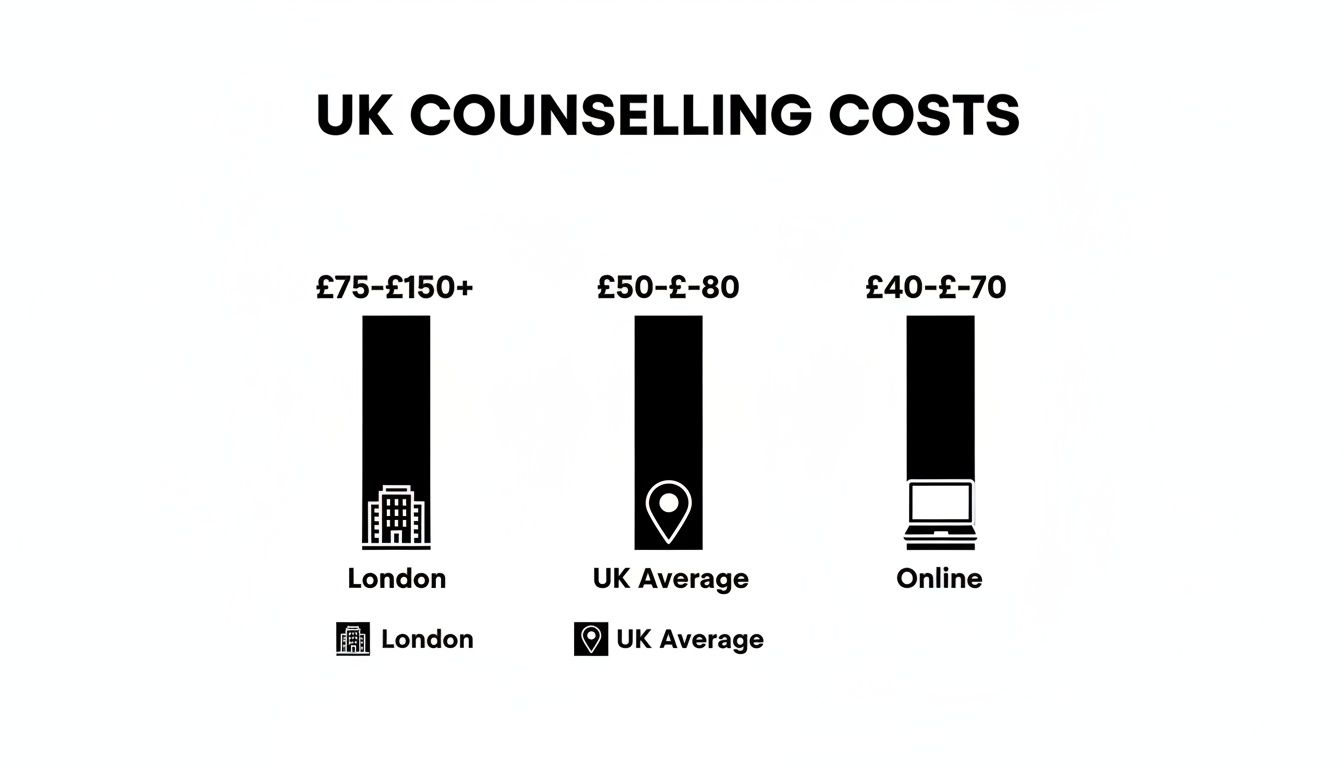
As the data shows, online therapy often comes in as a more affordable option, which makes sense when you consider the lower overheads for the therapist.
Key Variables That Shape the Price
To really understand the cost, you have to look beyond the numbers. It's about recognising the value and expertise that comes with that fee. The main things that influence the price are:
Therapist’s Experience and Specialisation: A counsellor with years of training in a specific field, like trauma or couples therapy, will naturally have higher fees.
Session Type: Individual sessions, couples counselling, or group therapy all come with different price tags.
Session Format: Whether you meet face-to-face, online, or for walk-and-talk therapy can also affect the cost.
It's completely normal for cost to be a genuine concern, and acknowledging that is the first step. This guide is here to walk you through all the options, from private therapy to low-cost alternatives, so you have all the information you need. To help you feel more prepared, it can also be useful to read up on what to expect from counselling in a typical session.
What Really Influences the Price of Therapy?
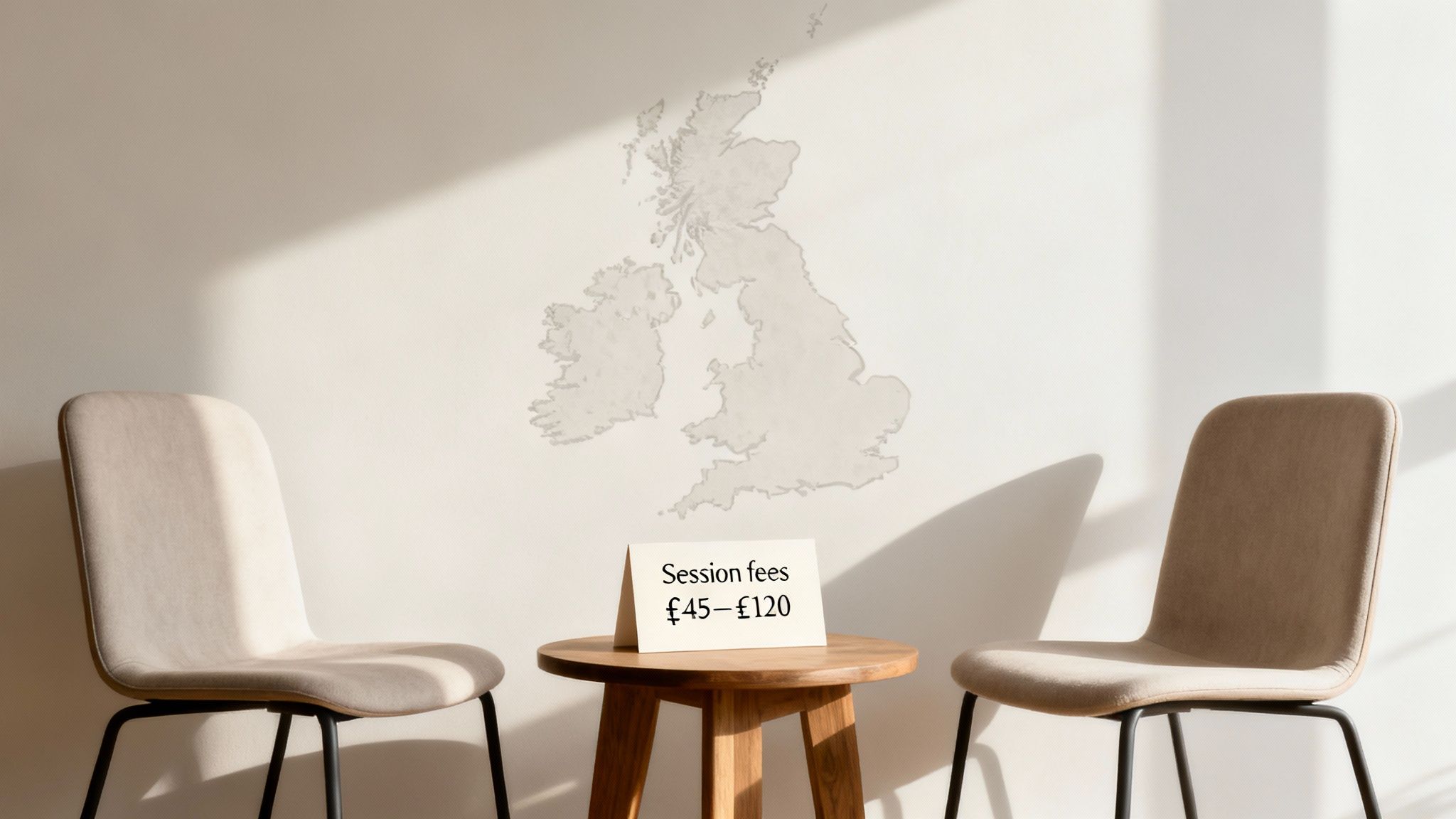
It can be a bit confusing seeing such a wide range of prices for counselling, but once you pull back the curtain, it all starts to make sense. Several key things feed into the final price you see, and getting to grips with them helps you understand the real value behind the cost. It’s about making an informed choice for your own mental health.
One of the biggest factors is the counsellor themselves—their background, how long they've been practising, and what specific areas they've trained in. A therapist with twenty years of experience and advanced qualifications in something complex like trauma or relationship therapy will naturally charge more than someone who has just recently qualified.
Experience and Specialisation
A counsellor's training and specialisms, including things like online mental health certification programs, have a direct impact on their rates. If a therapist offers highly specialised approaches like EMDR (Eye Movement Desensitisation and Reprocessing) or psychodynamic therapy, they’ve likely invested a huge amount of time and money into that training. That investment is reflected in their session fees because it allows them to provide incredibly effective, targeted support for specific, often complex, issues.
Think of it like hiring any other professional. You’d expect to pay a premium for a seasoned architect with a string of award-winning projects under their belt compared to a recent graduate. It’s the same principle in therapy; you’re paying for a depth of knowledge and proven expertise.
Location: The Postcode Lottery
Where a therapist is based makes a massive difference to their fees. This ‘postcode lottery’ is a real thing, driven by how much it costs to live and run a business (like renting a therapy room) in different parts of the country. A session in central London, where overheads are sky-high, is going to be priced very differently to one in Cheltenham or a more rural area.
You can see a stark divide across the UK. London sessions often start at £75 and go up, whereas in the South West—including Cheltenham—the average is closer to £60. This isn't just a North-South divide; it's a pattern seen all over, with prices mirroring the local economy.
What does this mean in real terms? A course of 12 sessions in London could set you back £1,920, while the very same support up north might be nearer to £1,284.
Session Format and Type
The way your therapy is delivered also plays a big part in the price. The structure of the sessions can vary quite a bit:
Individual Counselling: This is the classic one-on-one format where the session is focused entirely on you. You can learn more about my approach to this on my counselling services page.
Couples Counselling: These sessions involve two people and a therapist who often needs specialist training in relationship dynamics, which usually means a higher fee.
Group Therapy: A more affordable option for many, as you share the therapist's time and cost with several other people.
Each format offers its own unique benefits, and the price reflects the different skills and demands placed on the therapist. By understanding what goes into setting these fees, you can get a clearer picture of how much counselling costs and find an option that feels right for both your needs and your budget.
Exploring Different Therapy Formats and Their Costs
Therapy isn't a one-size-fits-all deal, and the way it’s delivered can make a huge difference not just to the cost, but to how you feel in the session. It’s a really personal choice, and each option has its own unique vibe and price tag. Getting to grips with these differences is the first step in finding something that works for your budget and, more importantly, for you.
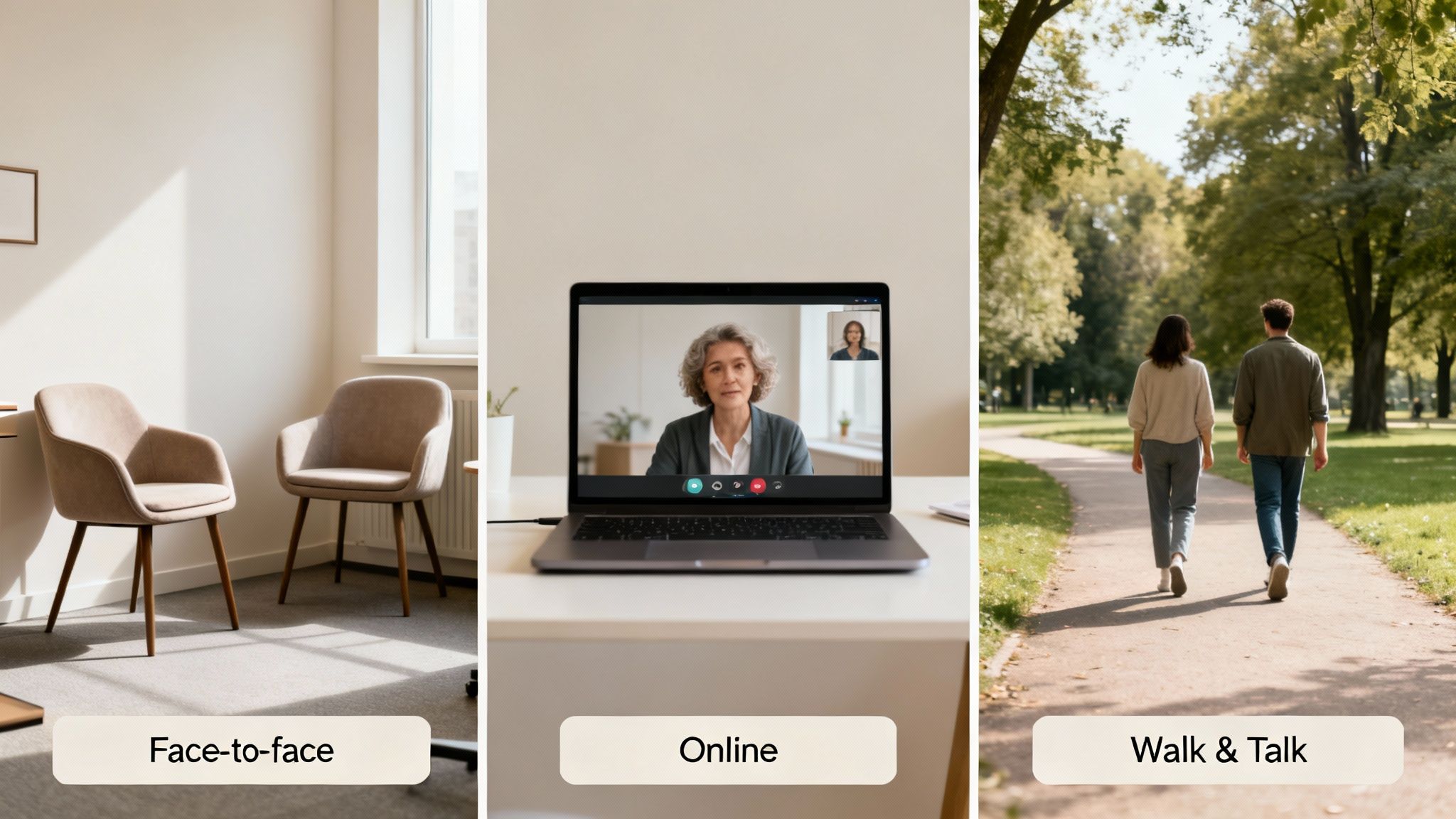
The classic format is face-to-face therapy, where you meet your counsellor in a dedicated therapy room. There's a real, tangible connection that comes from being in the same space as someone. You pick up on all the non-verbal cues, which for many people is crucial for building that initial trust. Naturally, the cost for these sessions often has to cover the therapist's overheads, like hiring the room.
Online Counselling: A Convenient Alternative
Over the last few years, online counselling has really taken off, and for good reason. It offers a ton of flexibility, letting you connect with a therapist from your own home. This can be a lifesaver if you've got a hectic schedule, find it hard to travel, or live somewhere a bit more remote.
Because therapists working online don't have to worry about renting a room, they often have fewer overheads. Those savings can be passed on to you, which is why online sessions are frequently a little more affordable than their in-person equivalent. It also throws the doors wide open, giving you access to specialists you’d never be able to see otherwise.
The heart of the work is exactly the same whether you meet on a screen or in a room. It’s all about building a strong, supportive relationship where you feel safe enough to explore what’s on your mind. The format is just the vehicle for that journey.
Walk and Talk Therapy: A Fresh Approach
Another format that’s getting more and more recognition is ‘Walk and Talk’ therapy. It’s exactly what it sounds like: a counselling session combined with a simple walk outdoors, usually in a park or another natural spot. For some people, this is a complete game-changer.
Walking side-by-side with your therapist can feel less intense and more like a shared journey compared to a face-to-face chat. The gentle rhythm of walking can also help with processing tricky emotions, making it easier to open up. It’s especially brilliant for anyone who feels ‘stuck’ or finds the idea of a formal therapy room a bit intimidating. The cost is generally on par with face-to-face sessions, but the boost to your mental and physical wellbeing can be massive.
Ultimately, the best format is whichever one feels right for you. It can be really helpful to weigh up your options and maybe learn a bit more about the distinct value of face-to-face therapy in the UK against the pure convenience of online sessions or the refreshing dynamic of walking therapy.
How to Find Affordable Counselling That Works for You
Let's be honest, money worries shouldn't stop you from getting the support you need. While private therapy offers a lot of choice and flexibility, the cost can be a real sticking point for many. The good news is, there are several ways to find good, affordable counselling, whatever your budget looks like.
One of the first places people think of is the NHS. You can chat with your GP, who can refer you to mental health services, often through a programme called IAPT (Improving Access to Psychological Therapies). This is where you can access proven treatments like Cognitive Behavioural Therapy (CBT) for common struggles like anxiety and depression.
It's worth being realistic, though. While these services are free, the waiting lists can be pretty long. Recent figures suggest the average NHS wait for CBT has stretched to over 26 weeks. When you're in the thick of it, that can feel like an eternity. Knowing this upfront helps you weigh up all your options and decide what’s best for you right now. For a deeper dive into this, you might find our article on how to get therapy in the UK helpful.
Exploring Low-Cost and Subsidised Options
Beyond the NHS, a number of charities and community organisations do incredible work offering low-cost mental health support. Big names like Mind have local branches all over the country that often provide free or heavily subsidised counselling sessions. They're an amazing resource for so many people.
Another fantastic option is to seek out private therapists who offer a ‘sliding scale’. This simply means the fee you pay is based on your income, making it a much more manageable choice if you're on a lower wage. Never feel awkward asking a potential therapist if they offer this – many of us do because we believe therapy should be accessible to everyone. You can always get in touch to discuss your specific circumstances.
A recent report highlighted that the average cost to see a private psychologist has risen to £129.90 per session. This significant increase makes exploring affordable alternatives more important than ever for those feeling the pinch.
Other Avenues for Affordable Support
If you're a student, your university or college almost certainly has its own free counselling service. These are staffed by qualified professionals and are a brilliant first port of call.
You can also look into training colleges for counsellors. They often have clinics where you can have sessions with trainee therapists at a much lower rate. These trainees are in the final stages of their qualifications and work under the close eye of experienced supervisors, so you can be sure you're in good hands. By exploring these different avenues, you can build a toolkit of real, practical options to find the support that fits your circumstances.
Does a Higher Price Mean Better Therapy?
It’s a natural assumption to make, isn't it? The more a counselling session costs, the better the therapy must be. But when it comes to mental health, the price tag isn't always the best measure of quality. While a highly specialised therapist in a major city will justifiably charge more, that doesn't automatically guarantee they're the right person for you.
The truth is, the single most important factor in whether therapy works is the therapeutic relationship. It all comes down to the sense of trust, safety, and genuine connection you feel with your counsellor. This unique bond is what creates the space for you to open up, explore difficult feelings, and ultimately, make meaningful changes.
Finding the Right Fit Is Crucial
Think of it like finding a personal trainer. You could hire the most expensive, highly-acclaimed trainer in the country, but if their communication style doesn't motivate you and you just don't click, you’re unlikely to see the results you want. Therapy works in exactly the same way. The 'right fit' is far more important than the fee.
So, instead of just focusing on how much counselling costs, what should you be looking for?
Professional Accreditation: First things first, check that the counsellor is registered with a professional body like the BACP (British Association for Counselling and Psychotherapy). This is your assurance that they meet strict ethical and training standards.
A Therapeutic Style That Resonates: Therapists use different approaches. It’s worth doing a little reading to see what feels right for you—whether it's CBT, psychodynamic, or a person-centred approach.
That Feeling of Connection: This one is more gut feeling. Do you feel heard and understood? Do you feel safe and not judged? This is the absolute foundation of good therapy.
The real goal is to find a qualified professional you can build a strong, trusting alliance with. This relationship is the vehicle for change, and without it, even the most expensive therapy is unlikely to get you very far.
Use Initial Consultations to Your Advantage
Most therapists, myself included, offer a free initial consultation call. This is your chance to gauge that all-important connection before you commit any money. Think of it as a no-obligation chat. Use this time to ask questions, get a feel for their personality, and see if you feel comfortable talking to them.
By focusing on the quality of the connection rather than the cost, you’re making an investment in real value, not just a higher fee. It’s about finding the right person to support you on your journey.
Ready to Begin Your Journey?
Figuring out how much counselling costs is, understandably, a huge part of finding the right support. Hopefully, this guide has given you a clearer picture of the typical prices, what influences them, and the more affordable options out there. The next part is all about taking that first step with confidence.
Here at Therapy with Ben, whether you’re in Cheltenham or prefer to connect online, my focus is always on providing supportive, empathetic counselling that’s right for you. Deciding to start therapy is a powerful investment in your own long-term wellbeing and growth. It’s about taking the courageous step to ask for help and finding the strength to begin a new chapter.
My Approach and Pricing
To make sure you find a way of working that feels comfortable and effective, I offer a few different formats. Each one provides a dedicated, confidential space just for you.
My pricing is kept simple and clear:
Face-to-Face Counselling (Cheltenham): £60 per 50-minute session
Online Video Counselling: £60 per 50-minute session
Walk and Talk Therapy (Cheltenham): £60 per 50-minute session
This fee isn’t just for 50 minutes of time; it reflects a dedicated, professional service where your growth is the absolute priority. Think of it as an investment in building your resilience, finding clarity, and moving towards a more fulfilled life.
If you feel ready to get started, I invite you to learn more about my counselling services or simply get in touch to book an initial chat.
Your Questions About Counselling Costs, Answered
Thinking about the financial side of therapy is completely normal, and getting clear answers can make the whole process feel much more manageable. When you're wondering how much counselling might cost in the long run, it helps to have the key facts upfront.
Here are a few of the most common questions people ask.
How Many Counselling Sessions Will I Need?
There’s really no one-size-fits-all answer here. The number of sessions you'll need depends entirely on you, your personal goals, and what you’re hoping to work through.
For a specific, focused issue, you might find that short-term counselling of 6-12 sessions is enough. But if you’re looking to explore deeper, more long-standing patterns of behaviour or feelings, it will naturally take a bit longer.
Your counsellor will always chat with you about a potential plan at the beginning and check in with you regularly to see how you’re getting on. It’s best to see it as a focused investment in yourself for a particular chapter of your life, rather than a lifelong commitment.
Can I Use My Private Health Insurance?
Some UK private health insurance plans do cover therapy, but it's crucial to check the fine print of your specific policy. The simplest way to find out is to give your provider a call and ask them exactly what’s included.
They often have their own rules. For example, they might have a list of approved therapists you have to choose from, or they might need a GP referral before they’ll agree to fund your sessions. Getting this sorted out before you begin can save you a lot of hassle later.
What Does the Session Fee Actually Cover?
It’s easy to think the fee is just for the 50 minutes you spend in the room, but it covers a lot more. A significant amount of essential work goes on behind the scenes to ensure you get the best possible support.
This includes:
Time spent preparing for your session and keeping detailed notes.
Mandatory clinical supervision, where the therapist discusses their work with a senior practitioner to ensure ethical and effective practice.
Professional indemnity insurance and membership fees for governing bodies like the BACP.
Continuous training and professional development to keep skills sharp and up-to-date.
All these things are vital for maintaining high professional standards and making sure you’re in safe hands. If you needed something extra, like a formal written report, that would typically be a separate cost.
What’s a Typical Cancellation Policy?
Most private counsellors ask for at least 24 to 48 hours' notice if you need to cancel or move an appointment. If you cancel within that window or don’t show up, you’ll likely be asked to pay the full fee for the session.
This isn’t a penalty; it’s because that time slot was reserved just for you, and it’s almost impossible for the therapist to offer it to someone else at such short notice. It’s always a good idea to clarify your counsellor’s specific policy right at the start so you know where you stand.
If you feel ready to take the next step on your journey, Therapy-with-Ben is here to help. You can explore the services I offer or book an initial, no-obligation chat to see if we're the right fit for you.


Comments