


How to Adapt to Change and Build Lasting Resilience
- Feb 3
- 10 min read
Updated: Feb 5
Learning how to adapt to change is really about three things: letting yourself feel what you're feeling, looking at the situation from a different angle, and then building some practical ways to cope. It's a conscious shift from digging your heels in to simply accepting what's happening. Yes, change is often uncomfortable, but it’s also where real growth happens.
Why Navigating Change Can Feel So Difficult

Change is one of life's few constants, yet it so often leaves us feeling anxious and completely ungrounded. If you struggle with it, you're not alone. This is a perfectly normal human response, and it's deeply rooted in how our brains are wired. We are creatures of habit who find a lot of comfort in things staying predictable and routine.
When a big life event hits—a career shift, the end of a relationship, or even just massive societal changes—our brain can register it as a direct threat to our stability. This can kick off an intense stress response, flooding us with uncertainty and a fear of the unknown.
The Brain's Preference for Predictability
Our minds are wired to create mental shortcuts and patterns to conserve energy. It’s an efficiency thing. But when an unexpected change comes along and smashes those familiar patterns, it forces our brain to work overtime to create new ones. Honestly, it can feel exhausting and completely overwhelming.
This resistance isn't some personal failing; it’s a biological drive designed to keep us safe. Just acknowledging that can be a huge first step toward being a bit kinder to yourself through the process.
External pressures can really magnify these feelings, making it even harder to cope. Think about someone waiting for medical help, only to feel their mental health crumbling under the sheer weight of the delay. That’s the unfortunate reality for many Britons stuck on long NHS waiting lists.
With over 8.2 million people queued up for consultant-led elective care in England alone, these extended waits are fuelling a proper mental health crisis. You can read more about how NHS waiting lists are impacting mental wellbeing, but the main takeaway is that proactive support is absolutely essential.
Understanding why change feels so difficult is crucial. It’s not about trying to avoid the discomfort, but about realising that your reaction is valid. That insight allows you to stop fighting your natural response and start working with it instead.
By accepting this struggle for what it is, we can begin to see change not just as something to be endured, but as a genuine chance to grow, learn, and build real resilience.
Giving Yourself Space to Process Your Feelings
When big life changes hit, our first instinct is often to either push our feelings down or leap straight into problem-solving mode. But if you want to know how to adapt to change effectively, the first, most crucial step is actually just to pause. You have to give yourself a moment to simply acknowledge how you're feeling about it all. Trying to ignore or suppress feelings like fear, anger, or sadness doesn't make them go away; it just makes the struggle last longer.
Giving yourself permission to feel these emotions without judging them isn’t a sign of weakness—it’s the very foundation of resilience. It doesn't matter if you're dealing with a sudden redundancy or the slow, painful end of a relationship; your feelings are a valid, normal part of being human. Think of them as signals, your mind and body’s way of trying to make sense of a new reality.
Acknowledging Your Emotional State
Instead of fighting against what you’re feeling, try observing it with a bit of curiosity. This creates a small but powerful distance, allowing you to see your emotions without being completely swept away by them.
This practice is at the heart of healthy emotional regulation, a skill that helps you manage what you’re feeling in a much more constructive way. Acknowledging your feelings is the necessary first step before you can begin to manage them.
One of the most powerful ways to get a handle on what you're feeling is to get it out of your head and onto paper. Journaling doesn't have to be poetic or perfectly structured. Just scribbling down your raw, unfiltered thoughts can do wonders for untangling the chaos in your mind.
Treat your emotions not as obstacles to be overcome, but as information to be understood. This shift in perspective allows you to respond with compassion rather than resistance, setting the stage for genuine healing and adaptation.
Another fantastic technique is mindfulness. At its simplest, this just means focusing on your breath and bringing your attention to the present moment. It helps you notice your feelings as they come and go—like clouds passing in the sky—without getting pulled into the storm. This simple act of observation makes the whole emotional journey feel more normal and gives you the power to move forward.
How to Reframe Your Perspective on Change
When you’re facing the unexpected, your mindset is probably the most powerful asset you have. A huge part of learning how to adapt to change is all about what therapists call cognitive reframing—that is, consciously shifting how you see a situation. It's about catching those automatic negative thoughts and challenging them, rather than letting them keep you feeling stuck.
Instead of dwelling on what you’ve lost, you can actually train yourself to look for what might be gained. This isn't about pretending something isn't difficult; it's about choosing where you put your energy. When you concentrate on the aspects you can control, even the small ones, you start to reclaim a sense of purpose.
This simple, three-step process can help you work through difficult feelings as they come up.
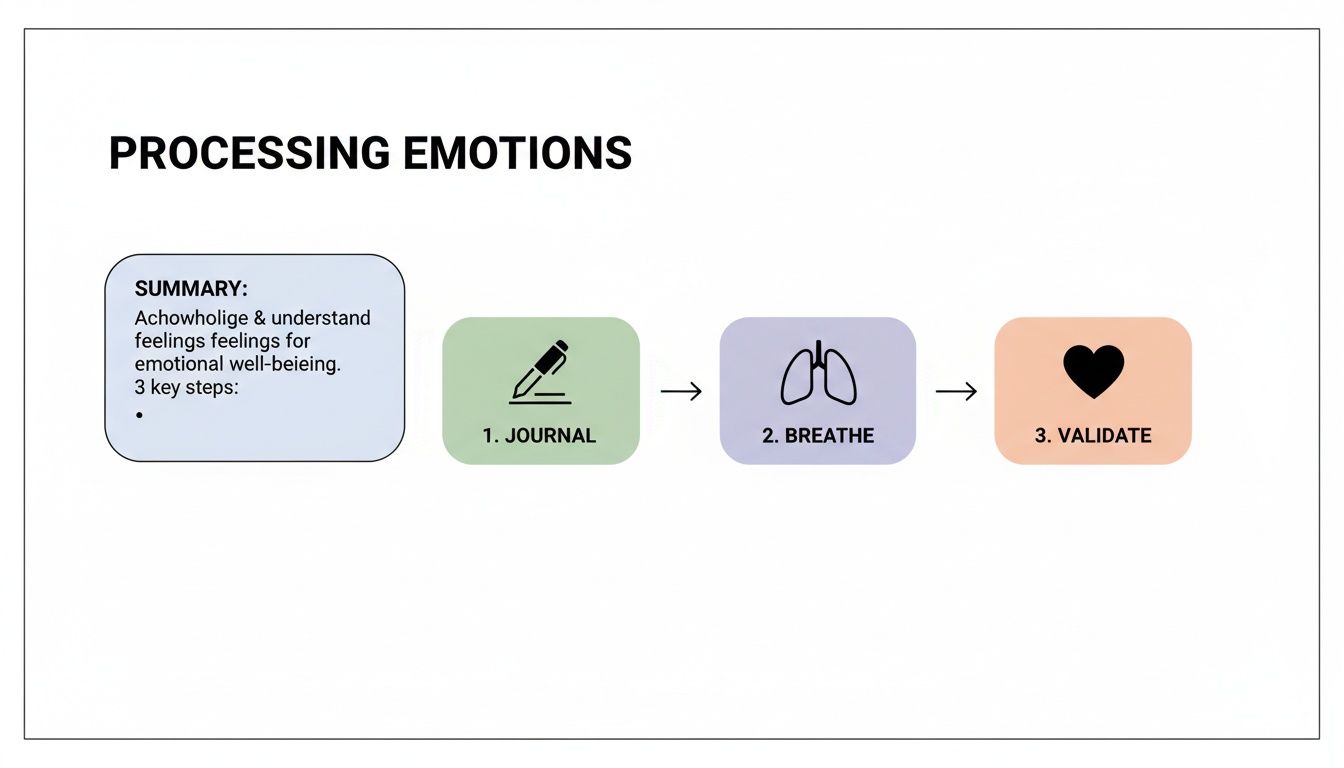
Giving yourself the space to journal, breathe, and validate your own feelings is what creates the mental breathing room you need to begin reframing your perspective.
Adopt a Growth Mindset
Adopting a 'growth mindset' is absolutely fundamental to this process. It’s the core belief that your abilities aren't fixed but can be developed through dedication and hard work. When you start seeing a challenge as a learning experience rather than a final verdict on your capabilities, everything changes. As you get better at reframing challenges, it's also key to learn how to build emotional resilience.
The way we talk to ourselves during times of change often reveals whether we're stuck in a fixed mindset or leaning into growth. Here’s a look at how those reactions can differ and how to reframe them.
Shifting Your Thoughts From a Fixed to Growth Mindset
Situation of Change | Fixed Mindset Reaction | Growth Mindset Reframe |
|---|---|---|
Facing a new, difficult task | "I've never done this before, so I'll probably fail." | "This is a new challenge for me. What can I learn from it?" |
Receiving unexpected negative feedback | "This just proves I'm not good enough at my job." | "This feedback is tough, but it's an opportunity to improve." |
A relationship ending | "I'll never find someone else. Something is wrong with me." | "This hurts, but what did I learn about myself and what I need?" |
Losing a job or project | "This is a disaster. My career is over." | "This door has closed. What other doors might open now?" |
Recognising these fixed mindset thoughts is the first step. The next is to consciously choose the growth-oriented reframe. It takes practice, but it's a skill you can build over time.
Another powerful technique is practising gratitude, especially for the stable parts of your life. When everything feels up in the air, reminding yourself of what remains constant—be it supportive friends, your health, or even a comfortable home—can be incredibly grounding. This helps counteract our brain's natural tendency to zoom in on the negatives.
This approach of accepting what is, while committing to positive action, is a central idea in therapies like Acceptance and Commitment Therapy.
Building Your Practical Coping Toolkit
When you're dealing with change, it helps to have a reliable toolkit of strategies you can turn to when things get tough. The key is not to wait until you're completely overwhelmed, but to proactively build a set of practices that bring a bit of stability and control back into your life. It's less about finding a single magic solution and more about experimenting to see what genuinely works for you.

When the world outside feels chaotic, simple, consistent routines can be incredibly grounding. This could be as basic as making your bed every morning or sticking to a regular sleep schedule. These small acts create pockets of predictability when everything else feels uncertain.
Break It Down into Manageable Pieces
A huge life change can feel like an unclimbable mountain, and it's no surprise this can trigger a lot of anxiety. In England, 1 in 4 adults will face a mental health problem each year, and big life upheavals are often at the root of it.
Instead of staring up at the whole mountain, just focus on the first few steps. If you’ve been made redundant, the first step isn’t “find a new career”; it’s “update my CV.” This approach makes the situation feel less overwhelming and helps you get back a sense of control.
If you’re thinking about a major shift, like a new profession, it can be useful to look at practical guides on topics like how to change careers at 30.
Setting small, realistic goals is another great way to rebuild that feeling of accomplishment. Remember to celebrate the small wins along the way.
Your coping toolkit is personal. It should contain strategies that genuinely resonate with you, whether that's a grounding exercise to calm anxiety, a walk in nature to clear your head, or setting a single, achievable goal for the day.
Physical activity is also a brilliant way to process stress. Something I often explore with clients is ‘walk and talk therapy’, which combines the benefits of movement and being in nature with professional support.
By actively building these tools, you aren’t just surviving change. You're learning how to build the emotional resilience needed to truly thrive. You can learn more about this in our guide on how to build emotional resilience and thrive.
Finding Strength in Your Support System

Learning how to adapt to change is rarely something we have to do completely on our own. In fact, one of the most powerful things you can do is to simply lean on the people you have around you. Your support system—close friends, family, even colleagues you trust—can offer a sense of stability when your own world feels like it's been shaken up.
I know reaching out can be tough. It's easy to worry about being a burden. But genuine support isn't about asking someone to solve your problems for you; it's often just about having someone who will listen without passing judgement.
You could try being quite direct: "I'm having a really tough time with this change at work, and I could just do with talking it through with someone for a bit."
If you’re feeling a bit isolated, it can be really helpful to look for communities built around shared experiences. This might be an online forum for people navigating a similar career change or a local group. Connecting with others who genuinely get what you're going through can be incredibly validating and helps to chip away at those feelings of loneliness.
Seeking Professional Support
Sometimes, though, the support we need is a bit more than what our friends and family can offer. This is where a professional counsellor can be invaluable. A therapist provides a confidential, safe space for you to explore what you're feeling and develop practical strategies for coping with the change you're facing.
Therapy isn't about 'fixing' something that's broken. It's about giving you a dedicated space and professional guidance to build the tools you need to navigate life’s challenges more effectively.
There are a few different ways to access this kind of support, so you can find what feels right for you:
Face-to-face sessions: The traditional therapy setup in a private, comfortable setting.
Online counselling: This offers a lot of flexibility and means you can have sessions from your own home.
Walk and talk therapy: A great option that combines the benefits of counselling with a bit of gentle exercise out in nature.
Making the choice to seek professional help is a powerful, proactive step towards taking control of your own wellbeing.
Still Have Questions About Adapting to Change?
Even when you feel prepared, adapting to something new will always bring up questions. It's completely natural. This last section covers some of the most common queries I hear from clients, giving you a quick point of reference to help you feel a bit more grounded on your journey.
How Long Does Adapting to Change Actually Take?
This is a big one, and the honest answer is there's no universal timeline. Everyone’s experience is completely unique, shaped by the change itself and our own personal ways of coping. It’s far more helpful to think of it as a gradual process rather than a finish line you have to cross.
The best thing you can do is focus on small, consistent steps. This could be as simple as maintaining a daily routine or just giving yourself five minutes to sit with and acknowledge your feelings. The key is to be patient and compassionate with yourself, and try to avoid any pressure to just ‘get over it’ by a certain date.
What if My Family Resists a Change I Need to Make?
When the people closest to us push back, it can be incredibly challenging. This resistance often comes from their own place of fear or concern for you, even if it doesn't feel that way.
The best starting point is always open, non-confrontational communication. Try to really listen and understand their perspective while clearly explaining your own reasons for the change and why it’s so important for you.
If you find yourselves at an impasse, bringing in a couples or family counsellor can provide a neutral, safe space. A professional can help mediate the conversation, supporting you all in finding a constructive way forward together.
When a sudden change hits, the priority isn't to create a ten-year plan; it's to ground yourself in the present moment. Focus on getting through the next 24 hours with stability and self-compassion.
What's the Best First Step When Change Comes Out of Nowhere?
When change is completely unexpected, the immediate priority is simply to ground yourself. It's easy to fall into the trap of thinking you need a grand, long-term plan right away. You don't. Instead, just focus on the next 24 hours.
Take a few deep breaths. Reach out to one trusted person for support. Make sure your basic needs like food, water, and a bit of rest are being met. Giving yourself a moment to simply process the shock before making any big decisions is a powerful and necessary first step.
Navigating change is a journey, and you don’t have to do it alone. If you're looking for professional support to build resilience and find your footing, Therapy-with-Ben offers a safe, non-judgemental space to explore your feelings and develop practical coping strategies. Get in touch today to see how counselling can help.
If you're curious about how counselling could support you, why not explore my range of services? Whether you're considering in-person sessions in Cheltenham, online therapy, or something more flexible, you'll find full details on what I offer. Ready to take the next step? Contact me for a no-obligation chat.
Comments