


How to Let Go of the Past: A Therapist's Guide
By Therapy-with-Ben
Letting go isn't about forgetting what happened. It’s about accepting it, really feeling the emotions that come with it without judging yourself, and then making a conscious choice to put your energy into today. It's a process of reframing your own story—not as one of pain, but one of resilience. This is how we move forward without being dragged down by the weight of yesterday.
Why Letting Go of the Past Feels So Hard
Before we can even talk about how to let go, it’s really important to understand why holding on can feel so automatic. This isn’t a sign of weakness; it’s often a protective mechanism that’s been wired into us for a long time. Our minds cling to painful memories for reasons that probably made sense once, and just acknowledging that is the first step toward healing.
Often, we stay stuck because the emotions tied to an event are still raw and unresolved. That anger, grief, or regret can play on a loop in our minds, demanding to be heard. For others, the past—no matter how painful—is familiar territory. The future, by contrast, is completely unknown. Stepping into that uncertainty can feel a lot scarier than staying with a hurt you already know.
The Identity We Build from Pain
Sometimes, our past experiences get so tangled up with our sense of self that we can't imagine who we'd be without them. If you’ve always seen yourself as a ‘survivor’ of a difficult relationship, for instance, letting go of that pain might feel like you're losing a core piece of your identity.
The way we connect with others can also keep us stuck. Our earliest experiences often shape our relational patterns, or attachment styles, making it incredibly difficult to break free from old habits. I explore this more in my guide on attachment styles and their interaction with self-worth.
The infographic below really highlights just how much of our precious time and emotional energy can get consumed by past events.
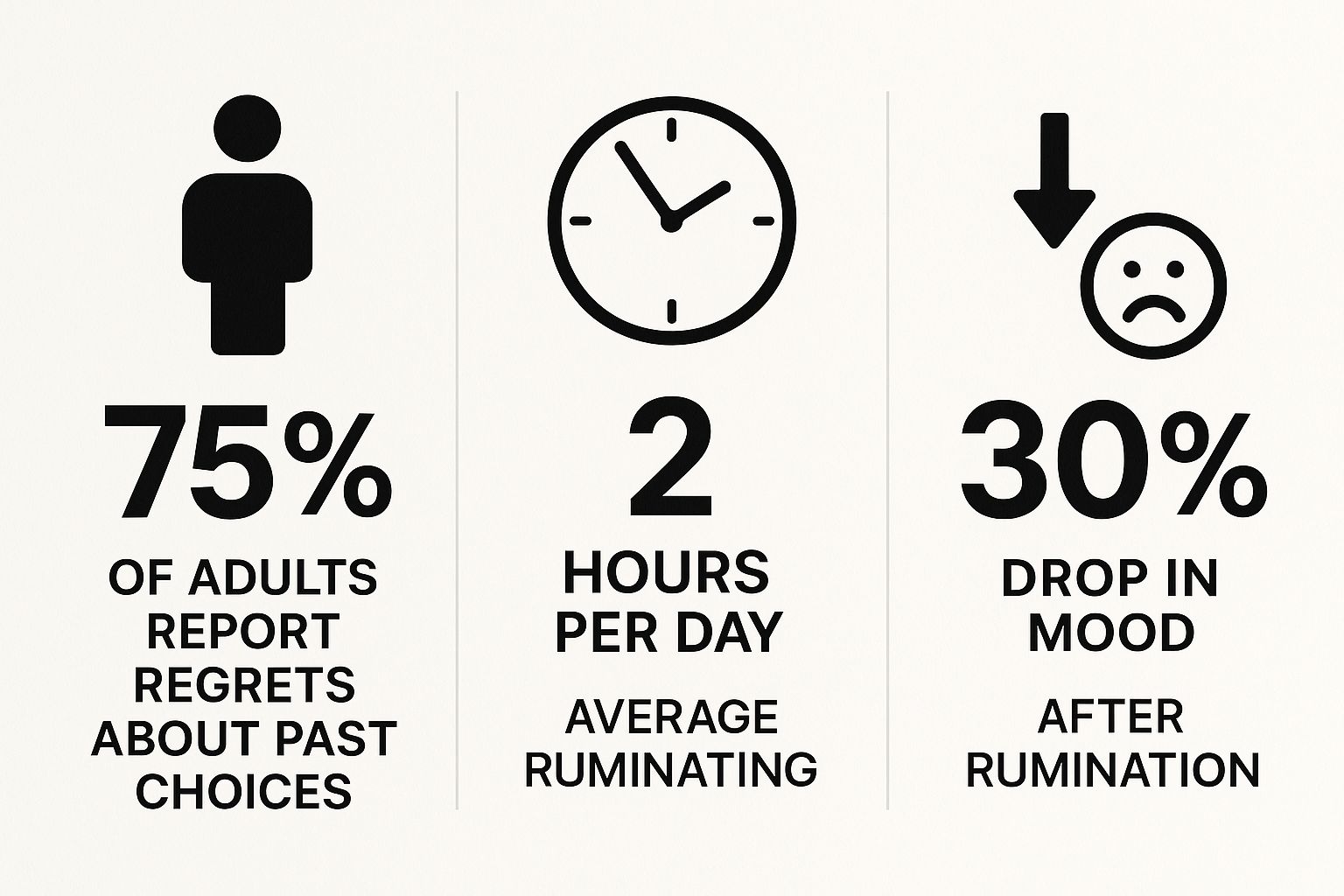
As you can see, dwelling on regrets isn't just common—it has a real, measurable impact on how we feel day-to-day.
This is a widespread struggle. In the UK, it’s estimated that about 1 in 10 people will experience Post-Traumatic Stress Disorder (PTSD) at some point in their lives, a condition that makes releasing trauma exceptionally difficult. This really underlines the scale of the challenge. The figures also show that young women have the highest likelihood of screening positive for PTSD, which points to a profound need for effective, compassionate support to help people move beyond their psychological wounds.
It can be hard to let go because our brains are wired to protect us, even when those protective instincts are no longer helpful. The table below summarises some common psychological reasons we cling to what's happened.
| Common Reasons We Cling to the Past | | :--- | :--- | | Barrier | Psychological Function | | Unresolved Emotions | Grief, anger, or guilt demand attention until they are processed. | | Familiarity and Safety | The known pain of the past can feel safer than an uncertain future. | | Identity Formation | Past trauma can become a central part of how we see ourselves. | | A Sense of Justice | Holding on can feel like a way of ensuring the wrong isn't forgotten. | | Fear of Forgetting | We worry that letting go means condoning what happened or forgetting a lesson. |
Understanding these barriers isn't about making excuses; it's about building self-compassion. When you know why you're holding on, you can start to loosen your grip gently.
The goal isn't to erase your past but to stop it from controlling your present. By understanding why you hold on, you can begin to gently loosen your grip with kindness and self-awareness.
By Therapy-with-Ben
How to Acknowledge and Process Your Emotions

The first proper step in learning how to let go of the past isn't about waging a war on your feelings or trying to force yourself to forget. It’s actually the opposite. It’s about making space for them. This all starts with a practice called radical acceptance—which is really just about observing and allowing your emotions to be there, without slapping a 'good' or 'bad' label on them.
Most of us have been taught from a young age to bottle up difficult feelings, but that only gives them more power over us. Think of it like trying to hold a beach ball underwater; it takes a huge amount of effort, and sooner or later, it’s going to shoot to the surface with surprising force. Emotions work in much the same way. When we finally give ourselves permission to simply feel, we take away their explosive power.
This is a massive challenge for many people. The struggle to process past events is a growing issue across the UK, where problems like anxiety and PTSD are on the rise. In fact, only about one-third of adults with common mental health problems actually receive treatment, making it incredibly hard to move on from painful memories. The charity Mind has some eye-opening statistics on this if you want to understand the scale of the problem.
Naming Your Feelings to Tame Them
A powerful strategy we use in therapy is what’s known as 'Name It to Tame It'. It sounds simple, and it is: you just label what you're feeling as it comes up. Instead of sitting with a vague, heavy sense of unease, you might identify the feeling as "disappointment," "loneliness," or "anger."
This simple act of labelling gets the prefrontal cortex—the more logical, thinking part of your brain—online, which in turn helps to soothe the more reactive, emotional centres. It creates a tiny but vital bit of space between you and the emotion, reminding you that you are not your feelings; you are simply experiencing them. Getting the hang of this is a cornerstone of building emotional resilience, and I touch on similar techniques in my guide on what emotional regulation is and how to master it.
Your emotions are not enemies to be defeated. They are messengers carrying important information about your needs and experiences. Your task is to learn how to listen to them without letting them take control.
Let’s say you’re walking down the street and a song comes on that triggers an instant wave of grief for someone you’ve lost. The natural instinct for many is to shut it down immediately, change the music, and find a distraction.
Instead, try this:
Pause and acknowledge it. Just say to yourself, silently, "I am feeling grief right now."
Find it in your body. Ask yourself, "Where do I feel this?" Is it a tightness in your chest? A hollow feeling in your stomach?
Breathe into it. Take a few slow, deep breaths. Imagine you’re directing your breath right to that physical sensation. You're not trying to push it away; you're just sitting with it for a moment.
Journalling with Purpose
Journalling is another brilliant tool for getting these feelings out, but aimless writing can sometimes turn into rumination, where you just go over and over the same negative thoughts. To stop this from happening, it helps to use specific, investigative prompts to guide you. This gives your writing a structure and helps you explore your feelings with curiosity instead of judgement.
Try these prompts to get you started:
What am I *really* feeling right now, underneath everything else? (For example, underneath the anger, is there hurt or maybe fear?)
What story is this feeling trying to tell me about what happened?
If this emotion could speak, what would it say it needs from me right now?
This kind of practice helps you to see your emotions not as chaotic, overwhelming forces, but as signals that just need to be understood. By giving them a voice, you can start to process them constructively, which is a fundamental part of learning how to let go of the past and get back to your present.
By Therapy-with-Ben
Reframing Your Narrative to Find New Meaning

The story of your past has already been written, but it's vital to remember that you are the narrator. A huge part of letting go involves grabbing the pen and shifting the story from one defined by pain to one centred on your own resilience and growth.
This isn't about slapping a coat of paint over the cracks or forcing some kind of toxic positivity. It's about looking the pain square in the eye while actively searching for the lessons and strengths that came out of the fire. It’s about consciously changing your perspective from being a passive victim of your history to becoming an active survivor who has learned, grown, and endured.
Challenging Unhelpful Thought Patterns
Our minds can get stuck in some pretty unhelpful ruts, especially after we’ve been through something tough. These automatic thoughts can keep us trapped in a cycle of pain. The first step is to simply notice them, and the next is to gently, but firmly, challenge them.
This process is what we call cognitive reframing. It involves spotting a limiting belief you hold about yourself or your past and then consciously swapping it for one that's more balanced and empowering.
Think about these common thought patterns and how a simple shift in perspective can change everything:
The old story: "I'll always be broken because of what happened."
The new narrative: "That experience was incredibly painful, and it showed me how strong I truly am."
The old story: "I can't trust anyone ever again."
The new narrative: "That person hurt me, but I can learn to trust my own judgement in choosing who to let into my life now."
Personal stories can be a powerful source of inspiration for finding new meaning. For instance, reading about how someone channelled their grief into a new hobby, like in Kerrys Crochet Journey From Loss To Hope, reminds us that growth is always within reach.
The goal isn't to rewrite history, but to reinterpret your role within it. You can't change what happened, but you have complete control over the meaning you assign to it today.
This process is absolutely fundamental to reclaiming your sense of self. For a deeper dive into this journey, our practical guide on how to find yourself again after a tough time might be helpful.
A Letter From Your Future Self
One of the most powerful exercises I use with clients for reframing their story is to write a letter from their future, healed self. It might feel a bit strange at first, but it’s an incredible way to tap into your own inner wisdom and cultivate a real sense of hope.
Find a quiet space where you won’t be disturbed and give this a try:
Visualise your future self. Picture yourself five or even ten years from now. You're at peace, you're happy, and you've successfully moved through the pain you feel today. What are you like? What have you learned along the way?
Start writing. As this future version of you, write a letter to the person you are right now. Offer the words of comfort, encouragement, and perspective you desperately need to hear.
Share your wisdom. What do you want your present self to know? Reassure them that they will get through this. Remind them of their own strength and resilience.
This exercise does something brilliant—it helps you see that your current pain is temporary. It connects you to a future where healing isn't just a vague possibility, but your actual reality. By stepping into the shoes of your healed self, you start to build the path that gets you there.
By Therapy-with-Ben
Practical Rituals for Releasing the Past
While sorting through your emotions and looking at your story from a new angle are massive internal steps, sometimes the idea of 'letting go' feels a bit… abstract. It can really help to give that mental process a physical anchor. Creating real, symbolic rituals can turn the act of release into something tangible and empowering, giving your mind a clear sense of closure to grab onto.
These rituals don't need to be some grand, complicated ceremony. Their power is all in the intention you bring to them. Think of them as a clear signal to your subconscious that you're making a conscious choice to close a chapter and move forward.
Create a Symbolic Release
One of the most powerful things I’ve seen clients do is to externalise the pain. A ‘release letter’ is a brilliant tool for this. This isn't a letter you'll ever post; its only job is to be a safe container for all the unspoken words and bottled-up feelings you've been carrying.
Write it all down. Everything you need to say to a person, a situation, or even an old version of yourself. Don't filter it. Don't worry about being polite. Just let the anger, hurt, and disappointment pour out onto the page. When you’re done, the simple act of safely burning the letter and watching the smoke drift away can create a surprisingly profound feeling of release.
Another really meaningful ritual is creating a ‘memory box’.
Gather physical reminders: Collect objects, photos, or old letters that tie you to the past you're ready to move on from.
Acknowledge each item: Take a moment with each one. Hold it, and consciously thank it for the lesson it taught you or the part it played in your story.
Store it away: Place everything in a box and put it somewhere out of sight—the attic, the back of a wardrobe, a storage unit.
This isn't about trying to pretend the memories don't exist. It’s a deliberate, physical act of choosing not to let them take up prime real estate in your emotional world today.
Ground Yourself in the Present Moment
When your mind inevitably gets snagged on the past, grounding techniques are your anchor to the here and now. They’re designed to pull your focus away from those looping, distressing thoughts and bring you back into your physical senses, which helps to calm your nervous system right down.
The past has no power over the present moment. Grounding techniques are a practical way to reclaim your focus and remind yourself that you are safe right now.
The 5-4-3-2-1 method is a beautifully simple yet effective way to do this, and you can do it anywhere. Just take a slow breath and gently identify:
5 things you can see around you.
4 things you can physically feel (the chair beneath you, the fabric of your clothes).
3 things you can hear.
2 things you can smell.
1 thing you can taste.
By engaging all your senses like this, you interrupt that rumination cycle and drag your awareness, sometimes kicking and screaming, back to your immediate surroundings.
These practical rituals aren't magic fixes, of course. But they are potent tools that honour your journey. They provide the physical punctuation mark you need to end one sentence and finally start writing the next.
By Therapy-with-Ben
Cultivating Self-Compassion to Move Forward

Often, the toughest barrier we face when trying to let go of the past isn't the event itself, but our own relentless inner critic. Self-compassion is perhaps the most vital tool for healing, yet it's so often misunderstood. It’s not about making excuses or wallowing in self-pity; it’s the simple, profound act of treating yourself with the same kindness you’d offer a dear friend who was hurting.
When we’re caught in the loop of a painful memory, that internal monologue can be incredibly cruel, endlessly rehashing our mistakes and piling on the blame. Self-compassion is what interrupts that destructive cycle. It’s about acknowledging your pain without judgement and offering yourself comfort instead of criticism. This shift in perspective is absolutely crucial for creating the emotional safety you need to finally move on.
The weight of unresolved trauma is especially heavy for young people. A sobering study revealed that nearly one in three young people in the UK (31.1%) are exposed to trauma by the age of 18, with a quarter of them going on to develop PTSD. This really highlights the immense burden these experiences create and underlines the desperate need for compassionate ways to heal, particularly as so many don't access professional help. You can read the full research on trauma in UK youth to get a sense of the scale of the problem.
Actionable Self-Compassion Exercises
Putting this into practice can feel a bit awkward at first, I get it. But like any skill, it becomes more natural over time. The key is to begin with small, intentional actions that start to build a new habit of self-kindness.
A simple but surprisingly powerful tool is guided meditation. As you work on moving forward with more compassion for yourself, bringing in practices that encourage a sense of inner peace can make a real difference, like exploring the health benefits of meditation.
Give this short self-compassion script a go:
Find a quiet spot where you won't be disturbed and gently close your eyes.
Place a hand over your heart, just feeling the warmth and light pressure there.
Acknowledge what you're going through by saying to yourself, "This is a moment of suffering."
Remind yourself you're not alone in this: "Suffering is a part of being human. Others have felt this way."
Offer yourself some kindness: "May I be kind to myself in this moment. May I give myself the compassion that I need."
Protecting Your Energy with Boundaries
A huge part of self-compassion is learning to protect your emotional energy by setting healthy boundaries. This means getting comfortable with saying "no" to people or situations that drain you or rip open old wounds.
Boundaries aren't about shutting people out. They are an act of self-preservation, a loving gesture to yourself that prevents new hurts from piling up while you're trying to heal from old ones.
Learning how to let go of the past requires you to become your own staunchest ally. Self-compassion is the language of that alliance, and boundaries are the fences that protect your healing space.
Journalling can also be a gentle way to check in with yourself. Instead of dwelling on the pain, try using prompts that encourage nurturing actions. Ask yourself: "What's one kind thing I can do for myself today to honour my struggle?" It might be something as small as making a proper cup of tea, going for a short walk, or simply allowing yourself to rest without feeling guilty about it.
By Therapy-with-Ben
Common Questions About Letting Go
As you start working on letting go of the past, it’s completely normal for questions and roadblocks to pop up. This part of the healing journey is often messy and non-linear, so let's tackle some of the most common concerns I hear from clients. Hopefully, this offers a bit of reassurance and practical advice to help you navigate it all.
Does Letting Go Mean I Have to Forgive?
This is a huge one, and the short answer is no. Letting go and forgiveness are two entirely separate things. You absolutely do not need to forgive someone to release the hold their actions have on you.
Think of letting go as an internal act of self-preservation. It’s about you choosing to free yourself from the heavy emotional weight of anger, resentment, and pain—for your own wellbeing.
Forgiveness, if it comes at all, might be part of that journey for some, but it is never a requirement. You can move forward without ever condoning what happened or reconciling with the person who hurt you.
The goal of letting go is to reclaim your own peace and emotional energy. It's about you, not them. Forgiveness is a separate choice that you may or may not decide to make later.
How Long Does It Take to Let Go?
Honestly, there is no universal timeline for healing. Anyone who tells you otherwise is mistaken. The process is deeply personal and depends on so many factors—the nature of the hurt, your support system, and your own unique way of coping.
It’s so important to be patient with yourself. There will be good days where the past feels distant, and then there will be setbacks where it feels as raw as ever. This isn’t a sign of failure; it’s just a normal part of how healing works.
The real goal isn't to erase the memory but to lessen its emotional power so it no longer dictates your present life. Just focus on gentle progress, not perfection.
What If I Try These Things and Still Feel Stuck?
If you've genuinely tried these techniques but still feel like you're spinning your wheels, it could be a sign that you need more specialised support. Sometimes, the roots of our pain, especially from complex trauma, are so deep that self-help strategies alone aren't enough to untangle them.
Reaching out to a qualified therapist is not a sign of weakness. In fact, it's a courageous and powerful step towards genuine, lasting healing.
A professional can offer a safe, structured environment and specialised therapeutic approaches to help you process what you’ve been through. Remember, you don’t have to do this alone.
If you're in Cheltenham or anywhere in the UK and feel that professional support could help you on your journey, Therapy with Ben offers a compassionate space to explore these challenges. To learn more or to book a session, please visit https://www.therapy-with-ben.co.uk.


Comments