


How to Overcome Trust Issues and Rebuild Your Connections
Before you can begin to overcome trust issues, you have to get to grips with where they came from. This isn't about blaming anyone or getting stuck in the past. It’s about connecting the dots between what happened back then and how you feel right now, so you can start to heal and move forward. Think of it as laying the proper groundwork.
Understanding Where Your Trust Issues Come From

We have to look under the bonnet here. Mistrust rarely just appears out of nowhere; it’s a defence mechanism we learn, and often for very good reasons. It’s like an emotional alarm system that’s become far too sensitive because of past events, and now it goes off at the slightest thing.
This journey isn't about dwelling on what’s happened. It’s about making sense of the present. Why does your stomach clench when a partner is five minutes late? Why do you catch yourself needing constant reassurance from friends? These feelings are usually echoes from a time when you learned the world could be unreliable.
Connecting Past Events to Present Feelings
The roots of mistrust can go back a long way, sometimes right back to our very first relationships. When the people looking after us are inconsistent – warm one minute, distant the next – a child learns a powerful lesson: people are unpredictable, and you can’t fully rely on them.
This pattern can be set by all sorts of experiences:
Childhood Instability: Growing up with chaotic routines or patchy emotional support can wire a belief deep inside you that nothing is ever really secure.
Significant Betrayals: A partner cheating or a close friend letting you down badly creates a deep wound. These moments leave behind "triggers" – situations or even simple phrases that throw you right back into the pain of that original hurt, even in a completely new relationship.
Repeated Disappointments: A string of broken promises from people you cared about can slowly chip away at your ability to believe in what people say.
If any of this rings a bell, you're far from alone. A major survey from the University of Oxford found that 25% of adults in the UK have significant mistrust towards others. It just goes to show how common it is for our past to shape our present.
Acknowledging where your trust issues come from is the first real step in taking back control. It changes a vague, nagging anxiety into an understandable reaction to something that happened. And that is something you can start to work with.
Recognising Your Patterns of Mistrust
Once you know the 'why', it’s much easier to see the 'how'. How does this mistrust actually play out in your day-to-day life? It usually shows up as specific thoughts, feelings, and actions. Have a read through these common patterns and see if any of them feel familiar.
Do you ever find yourself:
Expecting the worst in relationships, just waiting for the other shoe to drop?
Needing constant reassurance from a partner or friend to feel like the connection is solid?
Feeling a spike of anxiety when someone’s actions don’t quite match their words, like them being a few minutes late?
Avoiding vulnerability by keeping everyone at arm's length so you can’t get hurt?
It's important to realise these aren't character flaws; they're coping strategies you've learned along the way. Many of these behaviours are linked to our early bonding experiences, which is something explored in great detail by attachment theory. Pinpointing your specific patterns is a game-changer because it takes the problem from a big, scary feeling into a set of real-world behaviours you can actually start to change.
Common Triggers and Their Potential Origins
Sometimes, the connection between a present-day trigger and a past event isn't immediately obvious. The table below links some common modern reactions to their potential roots, which might help you connect your own dots.
Common Trigger | Potential Root Cause | Internal Monologue Example |
|---|---|---|
A partner not answering their phone | Childhood experiences of a caregiver being emotionally unavailable or physically absent, creating a fear of abandonment. | "They're ignoring me. They don't care. I knew they'd disappear." |
Vague answers to direct questions | Past betrayal by someone who was deceitful (e.g., an unfaithful partner or dishonest friend), leading to hyper-vigilance for signs of lies. | "They're hiding something. What aren't they telling me?" |
A friend cancelling plans last minute | A history of being let down or feeling unimportant to others, reinforcing a core belief that you are not a priority. | "Of course, they cancelled. I'm never anyone's first choice." |
Feeling excluded from an inside joke or chat | Early experiences of being bullied or left out by peers, making social exclusion feel deeply threatening. | "They're all laughing at me. I don't belong here." |
A manager giving constructive feedback | Growing up with a highly critical parent where praise was rare, making any critique feel like a personal attack on your worth. | "I've messed it up again. I'm just not good enough." |
Seeing these patterns laid out can be a real lightbulb moment. It helps to normalise your reactions and shows that they are often logical, learned responses to past hurts, rather than random overreactions.
Learning to Trust Yourself First

The road back from broken trust doesn’t start with others. It can’t. The real starting line is much closer to home—it’s about learning to trust yourself again.
When someone lets you down, it’s all too easy to turn the blame inward. You start questioning your own judgement, asking, "How could I have been so blind?" or "Why did I ignore the signs?" This kind of self-doubt chips away at the most fundamental relationship you have: the one with yourself.
Before you can even think about extending trust to someone else, you need to rebuild that inner foundation. It’s about knowing you can count on your own instincts and decisions. This isn’t about grand, sweeping gestures. It's built on small, consistent, and provable actions.
Make and Keep Small Promises to Yourself
Trust, at its core, is built on reliability. We trust people who do what they say they’ll do, time and time again. You can apply that exact same principle to yourself by starting with tiny, almost laughably small promises.
The idea here is to create a track record of your own dependability. It's about retraining your brain to see yourself as someone who follows through, no matter how small the task.
Think about low-stakes commitments like these:
Movement: "I will go for a 10-minute walk on my lunch break."
A Simple Task: "I will clear that pile of letters off the kitchen counter before bed."
Quiet Time: "I will put my phone in another room and read for 15 minutes."
Every time you follow through, you give yourself a piece of concrete evidence that you are, in fact, trustworthy. It's not about just ticking a box; it’s about taking a moment to acknowledge, "I did it. I showed up for myself." This is a powerful antidote to the self-doubt that creeps in when trust is broken.
Building self-trust is like building a muscle. It starts with small, manageable weights and, through consistency, grows stronger over time. Each kept promise is another repetition, strengthening your belief in your own reliability.
Learn to Listen to Your Gut Feelings
After a betrayal, it’s common to mute your intuition. You start second-guessing that knot in your stomach or that quiet inner voice that whispers something feels off. A huge part of overcoming trust issues is learning to tune back into those signals.
Mindfulness is a surprisingly effective tool for this. It’s simply the practice of paying attention to the present moment without judging it. You don’t need to meditate for an hour on a cushion—a few minutes is all it takes.
When a situation makes you feel uneasy, just try this:
Pause. Don’t react immediately.
Breathe. Take a few slow, deep breaths. This helps calm the nervous system right down.
Notice. Where in your body are you feeling this? A tightness in the chest? A churning in your stomach?
Acknowledge. Name the feeling without judgement. "Okay, I'm feeling anxious," or "This doesn't feel right."
The point isn't to decide if your gut is 'right' or 'wrong'. It’s about getting back into the habit of listening. With practice, you’ll start to get a better sense of the difference between anxiety leftover from the past and genuine intuition about the present.
Create a Record of Your Sound Judgement
Our brains have a nasty habit of remembering our mistakes far more vividly than our successes. To fight this, you can create a tangible record of all the times you made a good call. Think of it as building a case file to prove you can trust your own judgement.
Start a simple journal, but with a specific focus. At the end of each day or week, jot down a couple of decisions you made and how they turned out.
It could be as simple as:
The Decision: "I decided to speak up in that meeting, even though I was nervous."
The Outcome: "My boss actually liked the idea. Felt good to contribute."
The Decision: "I had a weird feeling about that 'amazing' offer, so I said no."
The Outcome: "Found out later it was a total scam. So glad I listened to my gut."
Looking back over these entries gives you undeniable proof of your own competence. It’s a practical way to rebuild your confidence and is a vital step on this journey. For more on building this inner strength, have a look at our proven strategies to boost confidence. By proving to yourself, with evidence, that you are reliable, you lay the solid groundwork needed to safely trust others again.
A Practical Guide to Rebuilding Trust with Others

So, you’ve started the work on strengthening the relationship with yourself. That’s a massive step. It also means you’re in a much better place to start mending connections with the people around you.
The trick is to shift away from blind faith and towards an approach that’s more measured and based on actual evidence. This isn't about throwing your heart open to just anyone. It’s about cautiously, methodically testing the waters.
This is where the idea of 'trust experiments' comes into play. Think of yourself as a scientist gathering data. Each experiment is a small, controlled act of vulnerability, designed to see if someone is a safe place for your trust. The aim here is to collect real-world proof of trustworthiness, which empowers you to make decisions based on facts, not fear.
Starting with Low-Stakes Scenarios
The first rule of trust experiments? Start small. You want the potential fallout to be minimal. That way, if someone lets you down, it's a minor disappointment, not a major catastrophe that sends you spiralling. It’s all about protecting your emotional wellbeing while you’re building up that resilience.
You're on the lookout for situations where the risk is low but the potential to learn something about a person is high. Why not try one of these low-stakes experiments:
Ask a colleague for a bit of help. Something really simple, like asking them to glance over a short email for typos. Do they do it cheerfully, or do they seem put out? Their reaction tells you something about their willingness to be supportive.
Request a small favour from a neighbour. Can they take in a parcel for you? Their response and whether they remember to give it to you is a useful piece of data.
Share a non-critical opinion. Test the waters by sharing a view on something light, like a film or a book, with a new acquaintance. Do they listen respectfully, even if they disagree?
These tiny interactions are your building blocks. Every positive outcome is another small piece of evidence that this person might just be reliable, and that slowly starts to counteract the old story that people will always let you down.
Letting Others Earn Your Trust
This is a crucial shift in mindset: moving from freely giving trust to allowing people to earn it. Trust isn't a gift you hand out right at the start of a relationship. It's something that is built over time, through consistent and dependable actions.
It means you have to pay close attention to what people do, not just what they say. Someone can say all the right things, but do their actions line up? Consistency is the language of trust. For anyone working on how to overcome trust issues, this principle is non-negotiable.
Think of trust like a bank account. Every time someone follows through on a promise, they make a deposit. Every time they let you down, they make a withdrawal. You wouldn't give your life savings to someone with a history of bad transactions, and the same logic applies to your emotional safety.
As you start rebuilding trust with others, it can be really helpful to get your head around mastering behavioral intervention strategies. This approach helps you focus on observing and responding to tangible actions, rather than getting lost in fearful assumptions.
Gradually Increasing Vulnerability
Once you've run a few successful low-stakes experiments and someone has shown themselves to be reliable, you can gradually raise the stakes. The process is incremental, like climbing a ladder one rung at a time. You only move to the next level of vulnerability when the person has proven themselves at the current one.
Here’s how that progression might look with a friend:
Level 1: You mention you've had a stressful week. Do they listen and show a bit of empathy, or do they immediately change the subject back to themselves?
Level 2: If they responded well, you might later share a specific, but not deeply personal, challenge you're facing at work. Do they offer support, or maybe even follow up later to see how things are going?
Level 3: If their behaviour stays consistent and supportive, you might eventually feel safe enough to share something a bit more personal.
This slow, evidence-based approach puts you firmly in the driver's seat. You're choosing to trust based on demonstrated behaviour, which massively reduces the fear of being let down out of the blue.
Structuring things this way is incredibly effective. In fact, for romantic relationships, data from the charity Relate shows that counselling, which often uses these kinds of structured exercises, successfully rebuilds trust in 70% of cases.
If you're looking to apply these ideas in your own life, our guide on how to build trust in relationships provides proven tips that complement this experimental approach perfectly. It's all about taking deliberate, thoughtful steps to create connections that feel secure and are built to last.
Mastering Communication and Setting Healthy Boundaries
By Therapy-with-Ben
When you're rebuilding trust, it's not just about watching what other people do; it’s about actively teaching them how you need to be treated. To do this, your best tools are clear, honest communication and good, healthy personal boundaries. These skills are absolutely vital for working through trust issues because they help create an environment of mutual respect where you can actually feel safe.
After being hurt, the natural instinct is often to pull back and sidestep those tricky conversations. The problem is, silence gives misunderstanding and resentment a place to fester and grow. Learning how to put your feelings and needs into words, calmly and clearly, is a complete game-changer. It stops you from falling into the trap of expecting people to be mind-readers and puts you firmly back in the driver's seat of your own relationships.
The Power of 'I' Statements
One of the most powerful communication techniques I work with is the 'I' statement. The whole point is to talk about your own feelings and what you need, rather than pointing fingers and making accusations that instantly put the other person on the defensive. It completely shifts the dynamic from blame ("You always...") to a more open vulnerability ("I feel...").
Just look at the difference:
Accusation: "You never tell me when you're going to be late. It's so inconsiderate."
'I' Statement: "I feel anxious when plans change at the last minute because it makes me worry something is wrong."
The second one invites a conversation and a solution. The first one? It’s pretty much guaranteed to start a fight. 'I' statements aren't about being soft; they’re about being incredibly clear about what's going on for you emotionally, which makes it much easier for someone to understand where you're coming from.
Using 'I' statements is about taking ownership of your feelings while clearly showing someone how their actions affect you. It's a foundational skill for building any relationship that feels secure.
Simple Scripts for Difficult Conversations
Often, just finding the right words is the hardest part. Here are a few simple scripts you can adapt, all using that basic formula: "I feel [your emotion] when [the specific behaviour], and what I need is [a clear, actionable request]."
For unreliability: "I feel unimportant when plans we've made are cancelled last minute. I need a bit more notice if things might change."
For lack of communication: "I feel out of the loop and a bit worried when I don't hear from you for a while. I would really appreciate a quick text to let me know you're okay."
For feeling unheard: "I feel frustrated when I'm interrupted while I'm talking. I need to be able to finish my thought so you can understand the whole picture."
Try saying these out loud to yourself. It might feel a bit strange at first, but practising helps them feel more natural when you actually need to use them.
Boundaries: The Fences That Protect Your Wellbeing
People often get the wrong idea about boundaries. They aren’t massive walls you build to shut everyone out. A better way to think of them is as protective fences that define where you end and another person begins. They’re simply guidelines you set for yourself about what behaviour you will and won't accept from other people.
Having healthy boundaries is a sign of self-respect. It sends a message to the world that you value your own emotional, mental, and physical wellbeing. For anyone learning how to work through trust issues, they are completely non-negotiable. They create the safety net that trust needs to grow.
Setting a solid boundary really comes down to two things:
Saying 'No' Without Guilt: This is tough, no doubt, especially if you’re used to being a people-pleaser. The trick is to start small. Say 'no' to a low-stakes request and just notice that the world doesn't end. Your 'no' doesn't need a huge justification either—a simple, "I'm sorry, I can't manage that right now" is perfectly fine.
Responding to Oversteps: People will test or cross your boundaries; it’s inevitable, and sometimes they don't even realise they're doing it. The key is how you respond: calmly and consistently. For instance, if someone keeps making critical jokes after you've asked them to stop, you might say, "I've mentioned that I don't find those jokes funny. If it continues, I'm going to have to end our conversation."
When you consistently uphold your boundaries, you teach people how to treat you. More importantly, you reinforce your trust in yourself. It's you, proving to you, that you are capable of keeping yourself safe—and that's a massive step in the healing process.
When Professional Support Can Help
By Therapy-with-Ben
Working through your past and rebuilding trust on your own is a powerful, worthwhile journey. There’s no doubt about that. But sometimes, the roots of mistrust run so deep, or the anxiety they stir up is so overwhelming, that self-help strategies just don't cut it.
Recognising you might need that extra bit of support isn't a sign of failure. Far from it. It's a sign of real strength.
Making the decision to speak with a professional is a huge step. It’s often the right one when trust issues are consistently chipping away at your quality of life. If you feel like you're stuck in a loop, sabotaging relationships before they even get off the ground, or if the constant anxiety is messing with your work, your sleep, or just your ability to get through the day, it’s probably time to talk to someone.
Signs It Might Be Time to Talk to a Counsellor
It can be tough to know when to make that call. It's all too easy to tell yourself to just 'get over it' or that 'it's not that bad'. But certain patterns are clear signals that professional guidance could make a genuine difference.
Think about reaching out if you’re experiencing:
Pervasive Anxiety: A constant feeling of dread or suspicion hangs over most of your relationships, and it just won’t shift.
Relationship Sabotage: You find yourself consistently pushing people away, ending things prematurely, or even picking fights just to confirm your belief that you'll be let down.
Complete Avoidance: The fear of being hurt has become so intense that you avoid getting close to anyone at all, leading to deep loneliness and isolation.
Physical Symptoms: The anxiety is showing up physically – think panic attacks, sleepless nights, or stomach problems whenever you're in a situation that triggers your mistrust.
These signs often suggest the trust issues are deeply embedded and could benefit from a structured therapeutic approach to help untangle them.
Different Therapeutic Approaches for Trust Issues
Therapy isn't a one-size-fits-all solution. There are various methods out there, and finding the one that clicks with you is absolutely key.
Perhaps one of the most common and effective approaches, often available through the NHS, is Cognitive Behavioural Therapy (CBT). It’s a very practical therapy that focuses on helping you identify and challenge the negative thought patterns and behaviours that are fuelling your mistrust.
In my own practice here in Cheltenham, I've seen firsthand how the setting itself can play a massive role. For some people, sitting face-to-face in a quiet room feels far too intense. This is where something like walk-and-talk therapy can be incredibly helpful. Simply walking side-by-side in nature often makes it easier for people to open up, making those difficult conversations feel less confrontational.
It's also worth noting that some people find it particularly helpful to work with a male counsellor. This might be because they need to work through issues related to male figures from their past, or they might just feel a different dynamic could help them see things from a fresh perspective.
The goal of any therapy is to create a safe, non-judgemental space where you can explore these deep-seated fears. The right therapist for you is someone you feel you can build a trusting therapeutic relationship with.
The infographic below touches on one of the core principles we often work on in therapy: establishing healthy boundaries. They're an essential part of rebuilding trust with anyone.
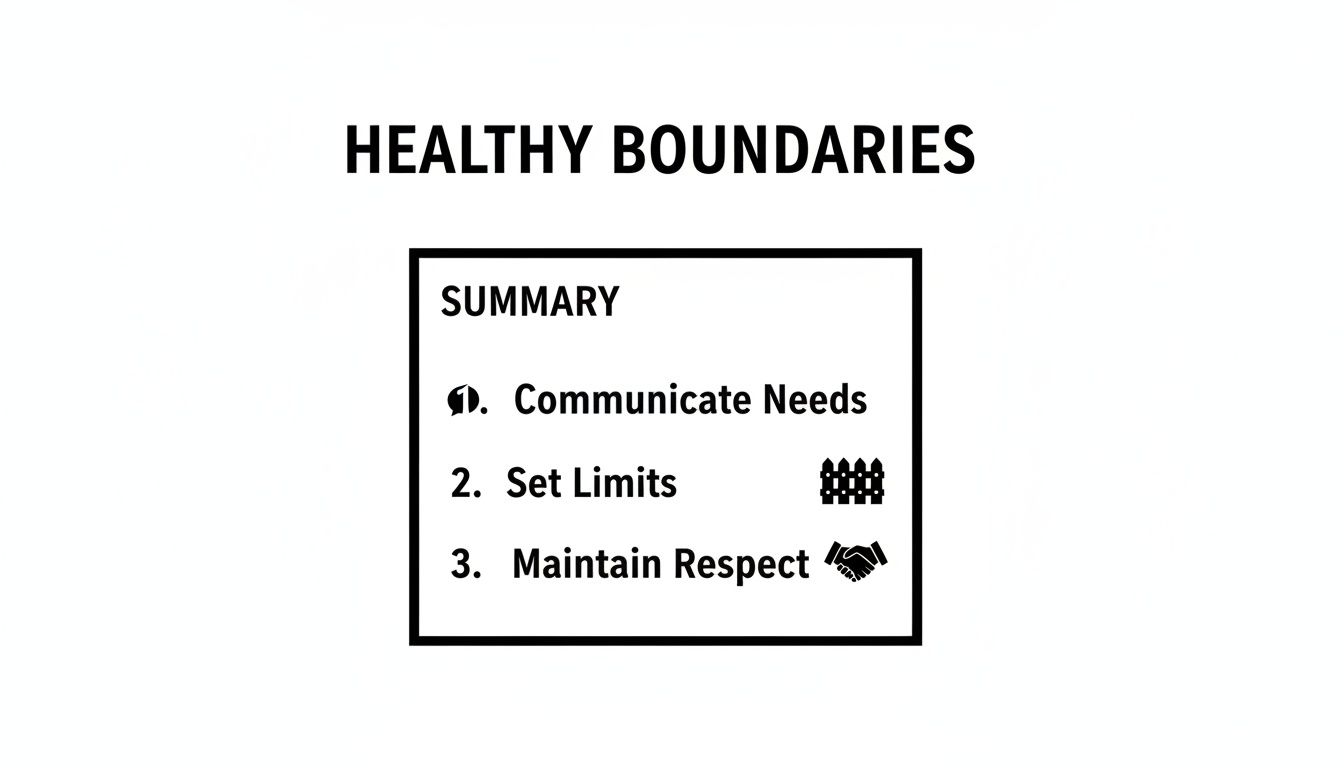
This breaks down the building blocks of any trusting relationship: clearly communicating what you need, setting your limits, and maintaining mutual respect.
Choosing the Right Therapeutic Approach
Navigating the world of therapy can feel a bit daunting at first. There are several different types available in the UK, each with its own focus. This table gives a quick overview to help you see what might be the best fit for you.
Therapy Type | What It Involves | Best Suited For | How to Access (UK) |
|---|---|---|---|
CBT | Structured sessions focusing on changing negative thought patterns and behaviours. | Practical, goal-oriented individuals who want to tackle specific thought cycles. | NHS referral (via GP), private therapists, online services. |
Psychodynamic | Exploring how past experiences, often from childhood, influence current feelings and behaviours. | Individuals wanting to understand the deep roots of their trust issues. | Primarily through private practice; some NHS availability. |
Person-Centred | A non-directive approach where the therapist provides empathy and support for self-exploration. | People who want a supportive space to find their own answers and build self-worth. | Widely available privately and through charities. |
Walk-and-Talk | Therapy sessions conducted outdoors while walking. | Those who find formal office settings intimidating or benefit from movement. | Offered by specific private counsellors (like me in Cheltenham). |
Finding the right approach is a personal decision. It's about what feels right for you and where you are in your journey.
Taking the First Step and What to Expect
The link between our overall mental wellbeing and our ability to trust is undeniable. ONS data paints a stark picture: only 44% of UK adults with moderate-to-severe depression report high trust in others. Compare that to 80% for those aged 70+. This really highlights how managing your mental health is a foundational piece of the puzzle. It’s a reality backed by NHS Talking Therapies, which sees a 50% recovery rate for related anxiety and depression. You can explore more about these population trends and wellbeing on the ONS website.
When dealing with the severe emotional distress that can come with deep-seated trust issues, some people find it helpful to explore options like natural alternatives to antidepressants as part of a wider healing strategy.
Finding a therapist often starts with a simple online search for counsellors in your area, like 'counselling in Cheltenham', or by using directories like the BACP (British Association for Counselling and Psychotherapy) website.
Most therapists offer a free initial chat. This isn't the first session; think of it as a no-pressure opportunity to see if you 'click' and to ask any questions you have.
In your first proper session, you won’t be expected to dive straight into your deepest traumas. It's usually about getting to know each other, talking about what brought you to therapy, and setting some gentle goals together. It’s all about building a foundation of safety and trust—with the very person who is there to help you learn how to do just that.
Frequently Asked Questions About Trust
By Therapy-with-Ben
Working through trust issues brings up a lot of questions. It’s a complex and often messy process, so it's perfectly normal to feel a bit lost at times. Here are some straightforward answers to the things people most often ask when they begin this important work.
How Long Does It Take to Overcome Trust Issues?
There's no magic timeline for this; it’s a deeply personal journey that looks different for everyone. How long it takes really depends on where the mistrust comes from. For some, a few months of conscious effort and trying out new ways of thinking can make a massive difference.
But if the issues are tangled up with deep-seated trauma or patterns from childhood, it could take a year or more, often with the steady support of a counsellor. The most important thing is to focus on consistent progress, not a deadline. Celebrating the small wins, like trusting a friend with something minor, is a vital part of healing.
Can a Relationship Survive After Trust Is Broken?
Yes, a relationship can absolutely survive a major breach of trust. In fact, it can sometimes become stronger, but it demands a genuine, unwavering commitment from both people. This isn't a quick fix.
The person who broke the trust has to show sincere remorse, take full responsibility for what they did—no excuses—and consistently prove they can be trusted over a long period. Words aren't enough; their actions have to do the talking. The person who was hurt needs to be willing, when they're ready, to open up to the healing process.
Couples counselling can be invaluable here. It offers a structured, safe space to have the tough conversations needed to heal and learn healthier ways of communicating with each other.
What if I Feel I Cannot Trust Anyone at All?
This is an incredibly isolating feeling, sometimes called pistanthrophobia, and it often points to a significant past trauma or a string of painful betrayals. If your default setting is to distrust everyone, it means your internal alarm system is stuck on high alert, trying to protect you from more pain.
If this sounds like you, getting professional support from a counsellor is really the best next step. It gives you a safe place to unpack the experiences behind this feeling. In the meantime, you can take the smallest possible step by rebuilding trust in the one person you're always with: yourself.
Start by keeping one tiny, achievable promise to yourself each day. It could be as simple as drinking a glass of water when you wake up. The act of following through starts to rebuild that core foundation of reliability from within.
Is It Normal to Distrust New People After a Bad Experience?
Yes, it’s completely normal. In many ways, it's a healthy protective response. After being hurt, your brain naturally becomes more vigilant to stop it from happening again. That’s just a survival instinct kicking in.
The real challenge is not letting that defence mechanism wall you off from potentially wonderful, healthy new connections. A good way forward is to adopt an attitude of 'cautious optimism'. You don't have to give your trust away to every new person you meet. Instead, be open to letting people earn your trust through their consistent, reliable actions over time. It’s all about finding that balance between being wisely guarded and being emotionally available.
If you're in Cheltenham and feel that professional support could help you on your journey, Therapy with Ben offers a safe, non-judgemental space to explore these issues. Whether through face-to-face, online, or walk-and-talk therapy, we can work together to help you rebuild trust and form stronger, healthier connections. Learn more and get in touch today.


Comments