


How to stop feeling guilty: Practical Steps to Self-Compassion
- Jan 25
- 16 min read
Before we can get into how to stop feeling guilty, we first need to get a handle on what guilt actually is. I often tell my clients that guilt is a totally normal, human emotion. It's supposed to be there, acting as a kind of internal compass to guide our actions. The real trick is learning to tell the difference between helpful, adaptive guilt – the kind that helps you grow – and the unhealthy, chronic guilt that just keeps you trapped in a loop of self-blame and shame.
This guide is all about giving you some therapy-informed tools to manage that heavy feeling.
Understanding Why You Feel So Guilty

Guilt is a powerful, self-conscious feeling that pops up when we believe we've crossed one of our own moral lines or let someone down. It often feels like a heavy weight, a nagging voice in your head, or just a constant sense of unease that can cast a shadow over everything.
When it's working properly, guilt is our social and moral compass. It’s that internal nudge that says, “Hang on, that didn’t align with my values,” which then prompts you to think, say sorry, or put things right. This kind of guilt is constructive. It helps us repair relationships and become better people.
The problem is, many of us get stuck with a much more persistent and damaging form of guilt. This is the type that hangs around long after you’ve made amends, or even when you haven't actually done anything wrong at all. It's like carrying a heavy backpack of guilt every single day, making each step feel that much harder.
This burden is incredibly common, especially now, with mental health challenges in the UK at record levels. The Big Mental Health Report 2025 found that one in five adults in England – a huge 20.2% – are living with a common mental health issue. Guilt often sits right at the heart of these struggles with anxiety and depression.
The report also shows that women are affected more significantly at 24.2%, compared to 15.4% for men, which might explain why so many are reaching out for support. You can dive deeper into the data on the Centre for Mental Health website.
Healthy Guilt vs Unhealthy Guilt
Learning to separate these two is your first, and most important, step. Healthy guilt fits the crime, so to speak. It leads to positive action and then it fades away. Unhealthy guilt, on the other hand, is often completely out of proportion, irrational, and keeps you stuck punishing yourself.
Here’s a simple way to think about it:
Healthy Guilt: You snap at a colleague during a stressful meeting. Later, you feel a pang of guilt, which pushes you to go and apologise and maybe think about better ways to handle your stress.
Unhealthy Guilt: You take a much-needed sick day from work. You then spend the entire day consumed with guilt, convinced you've let the whole team down and replaying imaginary scenes of their disappointment.
Guilt becomes a problem not when you feel it, but when it starts to control your thoughts, feelings, and actions long after the event has passed. The goal isn't to never feel guilty, but to learn how to process it effectively so it doesn't define your state of mind.
Understanding this difference is everything. It shifts your focus away from a hopeless goal like "how do I stop feeling guilty forever?" to a much more useful question: "Is this guilt helpful, and what is it trying to tell me?".
This is a core part of the work we do in therapy, including during my walk-and-talk sessions around Cheltenham, where we unpack these feelings in a supportive space. By learning to put your guilt under the microscope, you can finally start to loosen its grip.
How to Manage Guilt in the Moment

When a wave of guilt hits, it can feel like a physical force. It knocks the air out of your lungs and sends your thoughts into a spiral. In these moments, trying to logically pick apart the situation is often impossible because your nervous system is in overdrive.
The first and most important job is simply to ground yourself.
These immediate, sensory-based techniques aren't about solving the underlying issue right then and there. They're about creating enough mental space to breathe so you can address it later, without being completely overwhelmed. Think of them as emotional first aid.
Engage Your Senses with the 5-4-3-2-1 Method
When guilt pulls you into a whirlwind of past actions or future worries, grounding techniques yank you right back into the present moment. The 5-4-3-2-1 method is brilliant because it forces your brain to focus on your immediate environment, interrupting that looping track of guilty thoughts.
It's beautifully simple, and you can do it anywhere. Just pause and identify:
5 things you can see: Look around and really notice five distinct objects. Don't just list them. See the grain on a wooden table, the specific shade of blue on a book spine, or the way light reflects off a window.
4 things you can feel: Bring your attention to physical sensations. It could be the texture of your jumper against your skin, the solidness of the chair beneath you, the cool surface of a glass, or your feet firm on the floor.
3 things you can hear: Tune in to three sounds you might have been filtering out. Perhaps it's the gentle hum of a computer, birdsong outside, or the distant rumble of traffic.
2 things you can smell: What can you smell right now? It might be your cup of tea, the scent of hand lotion, or the faint smell of rain coming through an open window.
1 thing you can taste: Focus on a single taste. You could take a sip of water and notice its flavour, or simply become aware of the existing taste in your mouth.
This exercise short-circuits the emotional part of your brain and activates the observational, thinking part. To get a handle on guilt as it arises, learning how to actively stay mindful during difficult times can be an invaluable skill.
Calm Your Nervous System with Mindful Breathing
Guilt often triggers a physiological stress response—a racing heart, shallow breathing, tense muscles. One of the quickest ways to counteract this is through conscious breathing. It sends a direct signal to your nervous system that it's safe to calm down.
You don't need any complex meditation skills. Just focus on a simple box breathing exercise. If you can, find a quiet spot and try this:
Breathe in slowly through your nose for a count of four.
Hold your breath for a count of four.
Exhale slowly through your mouth for a count of four.
Pause for a count of four.
Repeat this cycle four or five times. The rhythmic, controlled nature of this breathing pattern helps to regulate your heart rate and ease physical tension, creating a much-needed sense of calm.
A client I worked with, Sarah, found this incredibly helpful. After snapping at her children, she'd feel a huge surge of guilt. Her go-to action was to walk to the kitchen, hold a cold glass of water, and practise box breathing for just one minute. This small act gave her the pause she needed to stop the guilt from spiralling out of control.
Create a Personal Soothing Kit
A soothing kit is just a collection of items that engage your senses and offer immediate comfort. Having these things ready means you don't have to think when you're feeling overwhelmed; you can just reach for your kit.
What goes in is completely personal to you, but here are a few ideas:
A soft blanket or a favourite cosy jumper
A soothing scent, like a lavender oil rollerball
A smooth stone or a stress ball to hold
A playlist of calming music on your phone
A favourite tea or a small piece of good-quality dark chocolate
Keep these items together in a box or a small bag. When guilt strikes, using them can become a comforting ritual that helps you regulate your emotions right there in the moment.
Challenging Your Guilty Thoughts
Guilt doesn’t just bubble up from nowhere. It’s almost always tangled up in a story you’re telling yourself—a harsh internal narrative that can feel incredibly powerful and, frankly, very real. But here’s the thing: a thought is not a fact. Learning to challenge these stories is the first real step towards breaking free from that constant, nagging sense of guilt.
We can actually borrow a brilliant tool from Cognitive Behavioural Therapy (CBT) for this. The idea is to become a bit of a detective for your own mind, consciously examining those automatic guilty thoughts and looking for cold, hard evidence—both for and against them. It’s about shifting from an immediate, emotional reaction to a more logical and balanced look at what’s really going on.
This might sound a bit clinical, but in practice, it’s a game-changer. Take an automatic thought like, "I'm a terrible friend for missing that call." That’s an emotional conclusion, not a fact. By challenging it, you might land on a more balanced perspective: "I was overwhelmed at that moment, and good friends understand that life gets in the way sometimes. I can call them back, explain, and reconnect."
This isn't about letting yourself off the hook. It's about holding yourself accountable to reality, not to an overly critical inner voice that's got the standards dialled up to impossible. Over time, this practice starts to loosen the grip of unhealthy guilt and helps you build a more compassionate and realistic internal dialogue. When you learn to question your thoughts, you start to take back the power.
Becoming a Thought Detective
The first job is to simply notice the automatic thought that flashes through your mind when you feel that pang of guilt. These thoughts are often so quick and ingrained that we just accept them as the truth without a second thought. To challenge them, you have to slow down and catch them in the act.
Let's break it down. Imagine you had to cancel plans with a family member because you were completely exhausted after a long week. The guilt hits hard. Your automatic thought might be something like: "I'm so selfish and unreliable. They must be really disappointed in me."
Instead of letting that thought spiral, you can pause and start investigating with a few key questions:
Is this thought 100% true? Is it always true that prioritising your well-being is selfish?
What evidence contradicts this thought? Think about all the times you have been reliable and supportive.
What is a more compassionate way of looking at this? Perhaps resting was exactly what you needed to be a better family member in the long run.
What might you say to a friend in the same situation? You’d likely offer kindness and understanding, not judgement.
This kind of questioning helps you see that your initial guilty thought is just one possible interpretation—and often, it’s a pretty distorted one. To get more practice with tackling these kinds of thoughts, you might find it helpful to read our guide on how to stop negative self-talk and quieten your inner critic.
Using a Thought Record to Find Balance
To make this process even more concrete, you can use a simplified Thought Record. It’s a simple but structured way to put this detective work into practice, guiding you from that initial guilty feeling to a much more balanced conclusion.
Use this framework to challenge guilty thoughts and find a more balanced perspective.
Your Practical Guilt Thought Record
Situation (What happened?) | Guilty Thought ('I am...') | Evidence That Supports This | Evidence That Contradicts This | A More Balanced Thought |
|---|---|---|---|---|
I cancelled weekend plans with my sister because I was exhausted. | "I'm selfish and unreliable. She'll be so disappointed." | "She was looking forward to it, and I did change the plan at the last minute." | "I'm usually very reliable. I was genuinely burnt out and needed to rest. I called her to explain honestly." | "I made a difficult decision to prioritise my health. It's okay to need rest, and I can make new plans with my sister soon. Taking care of myself doesn't make me selfish." |
Working through a structure like this helps you get the thoughts out of your head and see them more objectively. It stops the internal spiral and replaces it with a deliberate, logical process.
The goal of a thought record isn't to prove your guilt wrong, but to find a middle ground. It's about acknowledging the nuances of a situation instead of defaulting to black-and-white, self-critical thinking.
Guilt can feel like a relentless shadow, but remember that professional therapy offers a clear path forward, particularly for those battling anxiety, where guilt often festers. UK statistics show that 1 in 4 adults in England experience a mental health issue each year, with Generalised Anxiety Disorder affecting 6 in 100 people weekly. Guilt fuels this cycle, but therapy can change lives. You don't have to carry this weight alone.
Turning Insight into Actionable Change
Understanding the stories your mind is telling you is a massive step forward. But the real freedom from guilt comes when you turn that insight into tangible action. This is where we shift from just thinking differently to actively doing things differently.
We're going to explore three practical, behavioural strategies that I've seen empower clients to break the cycle of guilt for good.
These aren't about avoiding or suppressing guilt. Far from it. They're about engaging with it constructively, transforming it from a source of pain into a catalyst for positive change in your life and your relationships.
Making Meaningful Amends When Necessary
Sometimes, that pang of guilt is there for a very good reason: you’ve messed up and hurt someone. In these moments, simply challenging your thoughts isn't going to cut it. The most powerful way forward is to make meaningful amends.
This isn’t about grovelling or endless self-punishment. It's about taking genuine responsibility and focusing on repairing the connection you have with the other person.
A real apology centres on their feelings, not your own discomfort. It usually has three key parts:
Acknowledge the specific action: State clearly what you did wrong without tacking on excuses. For instance, "I am really sorry for speaking to you so sharply yesterday."
Validate their feelings: Show them you get it. "I can see that my words were hurtful, and you have every right to feel upset with me."
State what you will do differently: Explain how you plan to avoid repeating the mistake. "I'm going to work on managing my stress better so I don't take it out on you in the future."
Making proper amends closes the loop. It honours the guilt's purpose by leading to repair, and once you've done what you can to put things right, it allows you to finally let it go.
This simple infographic below shows the process of intercepting a guilty thought and actively reframing it before it has a chance to spiral.
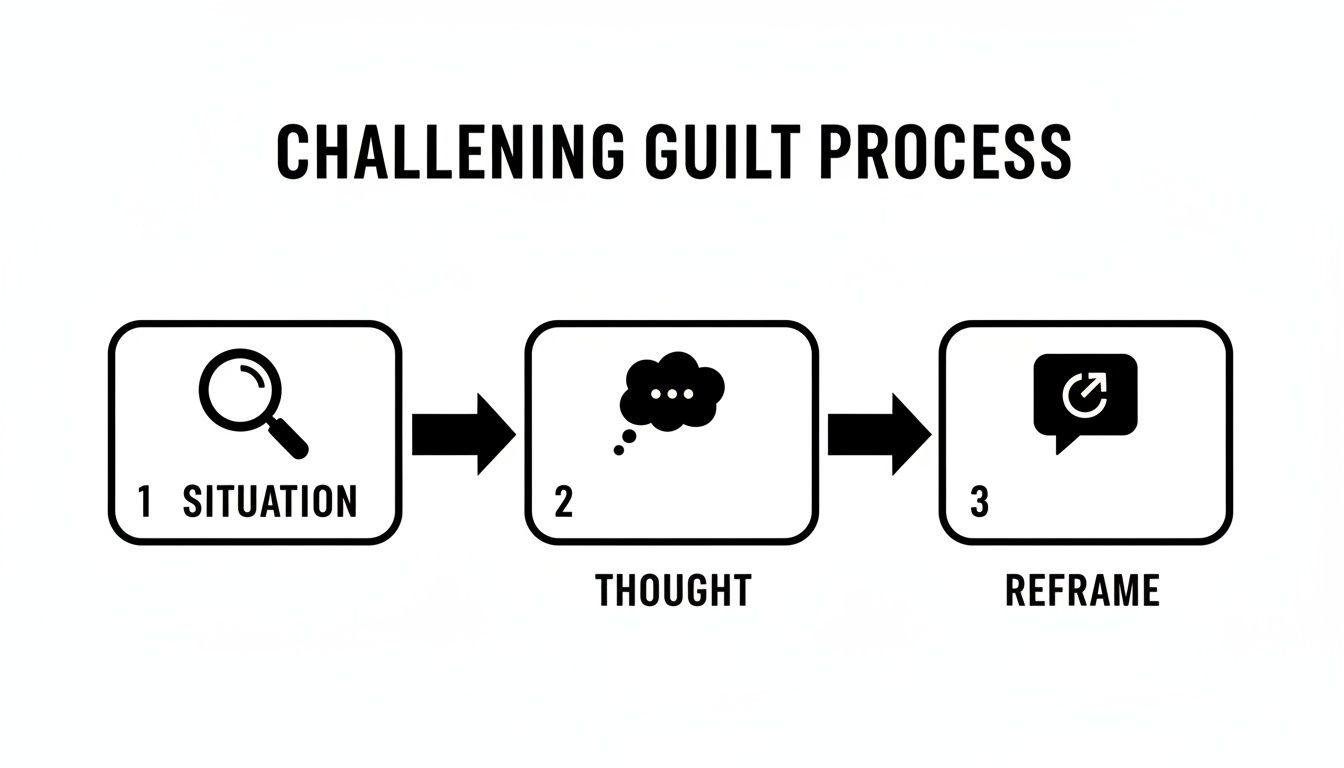
It’s a great visual for how you can move from a trigger and an automatic thought to a more deliberate, balanced reframe. This is the foundation for taking effective action.
Setting Boundaries to Prevent Future Guilt
A huge amount of the unhealthy, lingering guilt I see in my practice comes from a lack of strong personal boundaries. You find yourself saying 'yes' when you desperately want to say 'no', overcommitting to please others, and then feeling swamped by guilt when you inevitably feel resentful or fail to meet those unrealistic expectations.
Setting healthy boundaries is a proactive strategy. It’s about stopping that guilt before it even starts by clearly and respectfully communicating your limits. This can feel incredibly difficult at first, particularly if you're a natural people-pleaser.
One of the kindest things you can do for yourself and others is to be clear about what you can and cannot offer. Vague expectations are a breeding ground for guilt and resentment.
Imagine a friend who constantly asks for last-minute favours that throw your own plans into chaos. Instead of reluctantly agreeing and seething with resentment later, you could try setting a gentle but firm boundary:
"I really value our friendship, but I'm not able to change my plans at such short notice. If you can give me a couple of days' notice, I'd be happy to help if I can."
This isn't selfish; it's self-respect. It teaches people how to treat you and prevents that slow build-up of guilt that comes from consistently putting your own needs last.
Testing Your Beliefs with Behavioural Experiments
The final strategy is one of the most powerful tools in therapy: the behavioural experiment. It’s all about treating your guilty belief as a hypothesis—an educated guess—and then running a small, safe experiment to see if it holds up in the real world.
This approach is perfect for tackling guilt that stems from those anxious 'what if' scenarios. For example, a client I worked with felt intensely guilty for not replying to work emails instantly. His core belief was, "If I don't reply within ten minutes, my boss will think I'm lazy and unproductive."
Our experiment was simple. For one afternoon, he was to wait a full hour before replying to any non-urgent email. And the result? Absolutely nothing happened. His boss didn't say a word, no projects fell apart, and the world kept spinning. This dose of real-world evidence was far more powerful than any amount of thought challenging we could have done. It dismantled the belief from the ground up.
Here’s how you can design your own little experiment:
Identify the guilty belief: What are you actually afraid will happen? (e.g., "If I say no to going out, my friends will be angry with me.")
Create a small, low-stakes test: What’s one small thing you can do? (e.g., "I will politely decline one invitation this week, explaining I just need a quiet night in.")
Observe the outcome: What really happened? (e.g., "My friend just said, 'No problem, hope you get some rest! See you next time.'")
Confronting guilt isn't about ignoring it. Data shows that tackling it head-on, often with therapeutic support, is crucial, especially amid the UK's rising mental health crisis. Our Future Health's recent analysis found that 1 in 6 UK adults self-report a lifetime depression diagnosis, and 1 in 7 report anxiety. Guilt is strongly linked to these conditions, making proactive strategies like these essential for well-being. You can explore more about these UK mental health statistics and their findings.
Practising Self-Compassion to Heal from Guilt

After we’ve challenged our guilty thoughts and started to take meaningful action, there’s one final piece to the puzzle: changing the way we relate to ourselves. Self-compassion is the ultimate antidote to that harsh inner critic that fuels so much chronic guilt.
This isn’t about letting yourself off the hook. Far from it. It's about learning to treat yourself with the same warmth and understanding you’d automatically offer a good friend who was struggling.
I know this can feel incredibly unnatural at first, especially if your default setting is self-criticism. But stick with it. It’s a powerful way to build a healthier internal relationship, shifting from a place of self-punishment to one of genuine self-support.
The Three Pillars of Self-Compassion
Dr. Kristin Neff, a leading researcher in this field, gives us a really helpful way to understand self-compassion by breaking it down into three core parts. Thinking about them can make this abstract idea feel much more concrete.
Self-Kindness vs Self-Judgement: This is about making an active choice. When you mess up, do you meet yourself with criticism, or with gentleness and understanding?
Common Humanity vs Isolation: This is the crucial reminder that you are not alone in your imperfection. Your mistakes don’t make you uniquely flawed; they connect you to the shared, messy human experience. Everyone gets it wrong sometimes.
Mindfulness vs Over-Identification: This is about being able to observe your painful feelings without getting completely swallowed by them. It's the difference between saying, "I am feeling a wave of guilt," and believing, "I am a guilty person."
When you start to weave these three elements together, you create a powerful buffer against the destructive cycle of guilt and shame. For those looking for more guidance, exploring a range of self-help resources can also provide valuable perspectives.
Try the Compassionate Friend Technique
One of the most practical ways I introduce this to clients is with the 'compassionate friend' exercise. It's simple but surprisingly effective.
When you catch yourself spiralling in guilty self-talk, just pause. Ask yourself one simple question:
What would I say to a dear friend who came to me with this exact same problem?
Think about it. You’d likely offer them warmth, perspective, and kindness. You wouldn't launch into a tirade, listing all their past failings. This exercise is all about learning how to turn that compassionate voice inward.
Try actually writing down what you would say to that friend. Then, read the words back to yourself, maybe even out loud. Hearing that kind, reasonable perspective can be enough to interrupt the harsh voice of your inner critic. Learning what is self-compassion in more depth is a really important part of this journey, and you can explore this topic further in our guide.
Write a Compassionate Letter to Yourself
To take this a step further, try writing a compassionate letter to yourself. This can be an incredibly healing exercise that helps you process a specific situation that's causing you guilt.
Acknowledge the Pain: Start by simply acknowledging how tough the situation is and the pain your guilt is causing. You could start with something like, "I know you're feeling really guilty and upset about what happened..."
Offer Understanding: Gently remind yourself of that idea of common humanity. Write about how everyone makes mistakes and that being imperfect is just part of being human.
Use Kind Language: Write to yourself using the same warm, supportive, and non-judgemental language you’d use for someone you care about deeply. No 'shoulds' or 'musts'.
Suggest Constructive Steps: If it feels right, you might suggest some gentle, forward-looking actions, but frame them with kindness and encouragement, not as a demand.
Keep the letter somewhere safe. Read it again whenever those feelings of guilt resurface. It can act as a tangible, powerful reminder to treat yourself with the care you absolutely deserve. This isn't about wallowing in self-pity; it’s about building the resilience to move forward.
When to Get Professional Support for Guilt
All the strategies we've explored are powerful tools you can use to manage feelings of guilt. From grounding yourself in the moment to reframing your thoughts and practising self-compassion, you really can make significant progress on your own.
But it’s also important to recognise when you might need a bit more support.
Sometimes, guilt is so deeply embedded or persistent that self-help techniques alone just aren't enough to shift it. Reaching out to a professional isn't a sign of failure; it's a courageous and proactive step toward reclaiming your peace of mind and learning how to stop feeling guilty for good.
Signs It Might Be Time to Talk to a Therapist
If you're on the fence about whether your feelings warrant professional support, see if any of these situations sound familiar. It’s particularly important to think about seeking help if your guilt:
Disrupts Daily Life: Your feelings are consistently getting in the way of your work, your sleep, your relationships, or just your ability to enjoy life.
Is Linked to Trauma: The guilt is tied to a past traumatic event and continues to cause you significant distress.
Feels Overwhelming and Constant: Despite your best efforts, the guilt is relentless. You feel stuck in a cycle of self-blame that you just can’t seem to escape on your own.
Accompanies Other Mental Health Challenges: Your guilt feels tangled up with symptoms of severe anxiety, depression, or obsessive-compulsive patterns.
A therapist provides a safe, non-judgemental space to explore the roots of your guilt. Together, you can untangle complex feelings and develop personalised strategies that go deeper than self-help alone.
Different therapeutic approaches can be incredibly effective. For instance, you might want to learn more about what Acceptance and Commitment Therapy is and how it helps you move forward without being controlled by difficult emotions.
At Therapy-with-Ben, I offer several ways for us to connect, making sure you can find a style that feels right for you. This includes traditional face-to-face sessions here in Cheltenham, flexible online counselling, and even unique walk-and-talk therapy sessions that combine the benefits of nature with our therapeutic work.
Whatever you're going through, you don’t have to face it alone.
At Therapy-with-Ben, I'm here to support you on your journey towards a more compassionate and fulfilling life. If you're ready to take the next step, please visit my website to learn more or to book an initial consultation.https://www.therapy-with-ben.co.uk
Comments