


Top 5 Best Therapy for Depression in 2025
Feeling overwhelmed by depression can be an incredibly isolating experience. The path forward often seems unclear, but one of the most powerful steps you can take is seeking professional support. The good news is that there isn't just one single best therapy for depression; there are many evidence-based approaches, each with unique strengths and methods. The true key to recovery is finding the one that aligns with your specific needs, personality, and life circumstances.
This guide is designed to demystify the process and provide a clear, actionable overview of your options. We will explore ten of the most effective and well-regarded therapeutic models, breaking down exactly how they work, who they are best suited for, and what you can realistically expect from the sessions. Understanding the differences between these therapies is a crucial first step, empowering you to engage more effectively with potential counsellors and make a more informed choice about your care.
From structured, goal-oriented methods like Cognitive Behavioural Therapy (CBT) that focus on changing thought patterns, to insight-driven approaches like Psychodynamic Therapy which delves into your past, our aim is to equip you with the knowledge to navigate your journey toward improved mental well-being. Whether you are in Cheltenham or elsewhere in the UK, a man seeking a male therapist, or simply someone wanting to feel more like yourself again, this curated list provides the clarity needed to move forward with confidence.
1. Cognitive Behavioural Therapy (CBT)
Cognitive Behavioural Therapy (CBT) is a highly structured, evidence-based psychotherapy that stands as one of the most researched and effective treatments for depression. It is founded on the core principle that our thoughts, feelings, and behaviours are interconnected. CBT helps you identify and challenge the negative thought patterns and unhelpful behaviours that fuel depressive cycles, replacing them with more balanced and constructive ones.
How It Works
A therapist guides you in recognising "automatic negative thoughts" (ANTs), which are often distorted and contribute to feelings of sadness and hopelessness. For example, if a friend doesn't reply to your text, an ANT might be, "They are angry with me." CBT teaches you to question this thought, examine the evidence (they could be busy), and reframe it more realistically: "I don't have enough information to know why they haven't replied yet."
This cognitive work is paired with behavioural changes. The approach is collaborative, short-term, and goal-oriented, focusing on present-day challenges rather than past events. Major health organisations, such as the NHS in the UK, frequently recommend CBT and have even developed computerised CBT (cCBT) programmes to improve access.
The following infographic provides a quick reference to the key characteristics of this therapeutic approach.
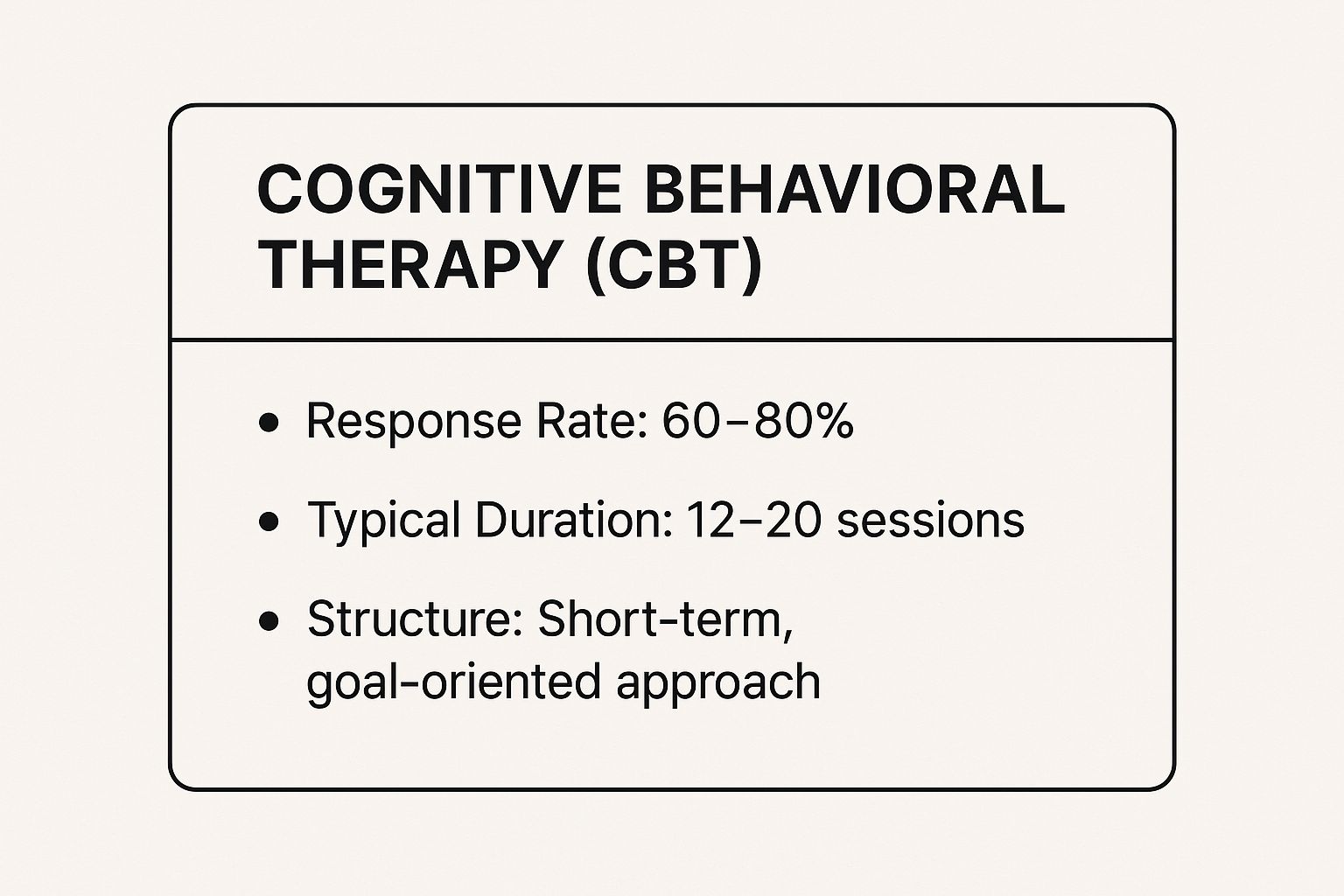
The data highlights that CBT is a time-limited and highly effective option, with a significant majority of individuals experiencing positive outcomes within a defined number of sessions.
Actionable Tips for Success
To maximise the benefits of CBT, active participation is crucial. Here are some practical steps you can take:
Keep a thought diary: Regularly note down situations, the thoughts they trigger, and your resulting feelings. This builds awareness of your unique patterns.
Practise behavioural activation: Depression often leads to withdrawal. Intentionally schedule one small, pleasant activity each day, like a short walk or listening to music, to counteract this.
Complete "homework" assignments: Therapists often assign tasks between sessions. Consistently completing these, such as thought-challenging worksheets, is vital for progress.
2. Interpersonal Therapy (IPT)
Interpersonal Therapy (IPT) is a structured, time-limited psychotherapy that directly links mood to interpersonal events. It is founded on the principle that our relationships and social roles profoundly impact our mental health, and that depression often occurs within an interpersonal context. IPT helps you identify and resolve specific problems in your relationships, thereby alleviating depressive symptoms.
How It Works
Developed by Gerald Klerman and Myrna Weissman, IPT focuses on improving relationship patterns and communication. Instead of exploring deep-seated personality issues, a therapist helps you pinpoint a primary interpersonal problem area to work on. These areas typically fall into one of four categories: unresolved grief, interpersonal role disputes (e.g., conflicts with a partner or colleague), role transitions (e.g., becoming a new parent or retiring), or interpersonal deficits (e.g., social isolation).
The therapy is highly focused and usually completed within 12-16 weeks. A session might involve role-playing a difficult conversation or analysing a recent social interaction to understand its impact on your mood. By strengthening your support network and improving how you relate to others, IPT provides practical tools to manage the triggers of depression. It is often recommended in treatment programmes for postpartum depression and is a key approach in many community mental health centres.
Actionable Tips for Success
To get the most out of Interpersonal Therapy, active engagement with your relationships both inside and outside of sessions is key.
Identify specific interpersonal triggers: Pay close attention to which interactions or relationship dynamics consistently precede a dip in your mood. Note them down to discuss in therapy.
Focus on one primary problem area: Trying to fix every relationship at once can be overwhelming. Work with your therapist to select the most impactful area, such as a dispute with a family member, and concentrate your efforts there first.
Practise communication skills: Use the time between sessions to actively practise the assertiveness and communication techniques you learn. This could be as simple as using "I" statements to express your feelings.
Use the therapeutic relationship as a model: The safe, trusting relationship you build with your therapist can serve as a template for fostering healthier connections with others in your life.
3. Dialectical Behavior Therapy (DBT)
Dialectical Behavior Therapy (DBT) is a comprehensive cognitive-behavioural treatment that enhances standard CBT techniques with powerful strategies for mindfulness, distress tolerance, and emotional regulation. Originally developed by Marsha Linehan to treat borderline personality disorder, its application has broadened significantly. DBT is now recognised as one of the best therapy for depression options, particularly for individuals experiencing intense emotional dysregulation, self-harm behaviours, or chronic suicidal thoughts alongside their depressive symptoms.

How It Works
The core of DBT is the concept of "dialectics," or the integration of opposites, specifically balancing acceptance and change. A therapist helps you accept yourself and your current situation while simultaneously working to change unhelpful behaviours and emotional responses. This is achieved through four key skill modules: Mindfulness, Distress Tolerance, Emotion Regulation, and Interpersonal Effectiveness.
Treatment is often multifaceted, involving individual therapy, group skills training, and sometimes phone coaching for in-the-moment crises. This intensive structure provides a robust support system for learning and applying new coping mechanisms. You can find DBT-informed care in various settings, from intensive outpatient programmes to skills groups at university counselling centres.
The video below offers a deeper look into the principles and application of DBT.
Actionable Tips for Success
Engaging fully with DBT skills outside of therapy sessions is essential for building emotional resilience. Here are some effective practices:
Practise daily mindfulness: Dedicate even just five minutes a day to a mindfulness exercise, such as focusing on your breath. This builds the foundational skill of non-judgmental awareness.
Use the TIPP skill for crises: When overwhelmed, use the TIPP technique: change your Temperature (splash cold water on your face), engage in Intense exercise, practise Paced breathing, and use Paired muscle relaxation.
Try "opposite action": When an emotion doesn't fit the facts of a situation (e.g., intense fear when you are safe), act opposite to the emotion's urge. If depression makes you want to isolate, reach out to a friend.
4. Acceptance and Commitment Therapy (ACT)
Acceptance and Commitment Therapy (ACT) is a modern, evidence-based psychotherapy that takes a different approach to mental distress. Instead of directly challenging or eliminating difficult thoughts and feelings, ACT teaches you to accept them as a natural part of the human experience. It uses mindfulness and behavioural strategies to build psychological flexibility, helping you live a rich and meaningful life even with the presence of pain.
How It Works
ACT operates on the principle that struggling against negative thoughts and emotions often makes them stronger. A therapist helps you learn to "defuse" from these thoughts, seeing them as just words or mental events rather than absolute truths. For instance, instead of getting caught in the thought "I am worthless," you learn to observe it from a distance, perhaps by saying, "I'm having the thought that I am worthless."
This acceptance is paired with a strong focus on your core personal values. The therapy guides you in identifying what truly matters to you and then committing to actions that align with those values. This behavioural shift helps you build a life of purpose, which is a powerful antidote to the hopelessness of depression. ACT is increasingly used in various settings, from chronic pain programmes in medical centres to workplace mental health initiatives.
Actionable Tips for Success
To get the most out of ACT, it’s important to engage with its core concepts both in and out of sessions. Here are some practical ways to apply its principles:
Identify your core values: Spend time reflecting on what is most important to you in different areas of life, such as relationships, career, or personal growth. Use these values as a compass to guide your daily actions.
Practise the 'leaves on a stream' exercise: Visualise your thoughts as leaves floating down a stream. This mindfulness technique helps you practise observing thoughts without getting attached to them or judging them.
Focus on what's 'workable': Instead of labelling behaviours as 'right' or 'wrong', ask yourself if a particular action is 'workable' in moving you closer to the life you want. This pragmatic approach fosters more effective choices.
5. Psychodynamic Therapy
Psychodynamic therapy is a depth-oriented approach that explores how unconscious thoughts and past experiences, particularly those from early life, shape your current feelings, behaviours, and relationships. It is founded on the principle that depression often stems from unresolved past conflicts and ingrained emotional patterns that operate outside of our conscious awareness. This method aims to bring these underlying issues to the surface, fostering deep self-awareness and lasting emotional change.
How It Works
In this form of therapy, the therapeutic relationship itself is a key tool for insight. A therapist helps you explore recurring themes in your thoughts and feelings, including those that arise within the therapy sessions. For instance, you might notice a pattern of avoiding conflict in all your relationships, which could be linked to early experiences. By examining these connections in a safe environment, you can understand their origins and develop healthier ways of relating to yourself and others.
The focus is less on structured exercises and more on free-flowing conversation, exploring dreams, memories, and emotions. Unlike short-term therapies, psychodynamic work often involves a longer-term commitment, allowing for a thorough exploration of complex issues. This approach is considered one of the best therapy for depression options for those seeking to understand the "why" behind their feelings, not just manage the symptoms. You can delve deeper into understanding the benefits of counselling for depression to see how this insight helps.
Actionable Tips for Success
To get the most out of psychodynamic therapy, a curious and open mindset is essential. Here are some practical ways to engage with the process:
Be open to exploring the past: Be prepared to discuss childhood memories and significant past relationships, as these are seen as foundational to your current emotional state.
Pay attention to recurring themes: Notice patterns that show up in your life, whether in your career, friendships, or romantic relationships. Discussing these with your therapist can unlock key insights.
Keep a journal: Document your thoughts, dreams, and feelings between sessions. This can provide rich material for exploration and help you track emotional shifts over time.
6. Mindfulness-Based Cognitive Therapy (MBCT)
Mindfulness-Based Cognitive Therapy (MBCT) is a powerful, evidence-based approach that merges the tools of Cognitive Behavioural Therapy with the practice of mindfulness meditation. It was specifically developed to help people who have experienced recurrent episodes of depression. Rather than focusing on changing the content of negative thoughts, MBCT teaches you to change your relationship to them, observing them as passing mental events without getting caught up in them.

How It Works
MBCT helps you develop an awareness of the early warning signs of a depressive relapse, such as subtle shifts in mood or recurring negative thought patterns. Instead of automatically reacting with old, unhelpful habits of mind, you learn to respond with mindful awareness. This involves acknowledging the thought or feeling without judgement and gently redirecting your attention. An MBCT course typically runs for eight weeks, combining guided meditations, group discussion, and gentle mindful movement.
This approach is highly regarded for relapse prevention and is offered by numerous NHS trusts across the UK as a treatment option. Developed by Zindel Segal, Mark Williams, and John Teasdale, it builds on Jon Kabat-Zinn's foundational mindfulness work. The core goal is to cultivate a new way of being that fosters resilience against the downward spiral of depressive thinking, making it a key contender for the best therapy for depression for those with a history of the illness.
Actionable Tips for Success
To get the most out of MBCT, consistent practice is essential. Integrating these skills into your daily life can make a profound difference:
Start with short meditations: Begin with a 5-10 minute guided meditation practice each day to build your "attentional muscle" and create a routine.
Use the '3-minute breathing space': When you feel overwhelmed, take three minutes to consciously check in with your thoughts, feelings, and body sensations before broadening your awareness.
Recognise thoughts are not facts: Practise labelling your thoughts as just "thoughts" rather than absolute truths. This creates a crucial space between you and the depressive pattern.
Mindfully notice pleasant events: Depression can make it hard to notice the good. Make a point of mindfully engaging with small, pleasant moments, like the taste of a cup of tea or the feeling of sunshine.
7. Behavioural Activation (BA)
Behavioural Activation (BA) is a straightforward, effective psychotherapy that targets the patterns of avoidance and withdrawal often seen in depression. Its core principle is simple: our actions significantly influence our mood. BA operates on the understanding that as depression takes hold, people stop engaging in rewarding, meaningful, or enjoyable activities, which in turn deepens their low mood and creates a vicious cycle. This therapy systematically helps individuals re-engage with their lives in positive ways.
How It Works
A BA therapist works collaboratively with you to identify specific activities that align with your personal values and goals. Instead of focusing heavily on challenging thoughts, the emphasis is on changing behaviour first, with the belief that improved mood will follow. For instance, if you value social connection but have been isolating yourself, a therapist might help you schedule a short, manageable activity like sending a text to a friend or going for a brief coffee.
The approach is highly structured and focuses on scheduling and monitoring activities to break the inertia of depression. This practical, action-oriented method is considered one of the best therapy for depression options due to its clear focus and strong evidence base. It has been successfully implemented in diverse settings, from brief interventions in primary care settings to structured programmes within NHS and Veterans Administration healthcare systems.
Actionable Tips for Success
To get the most from Behavioural Activation, a proactive and consistent approach is key. Here are some practical steps you can take:
Start small to build momentum: Don't aim to overhaul your life overnight. Begin with small, easily achievable activities, like a ten-minute walk or listening to a favourite song.
Schedule activities like appointments: Vague intentions like "I'll do something fun tomorrow" are easy to put off. Instead, schedule a specific activity at a specific time, such as "Walk in the park at 10 a.m. on Tuesday."
Track your mood: Note how you feel before and after an activity. This helps you build a personal evidence base of which actions have the most positive impact on your mood.
Mix up your activities: Include a balance of necessary tasks (like tidying a room), routine activities (like showering), and pleasurable pursuits. Re-engaging with creativity can be a powerful way to find pleasure; you can learn more about how creativity and mental health are linked.
8. Eye Movement Desensitization and Reprocessing (EMDR)
Eye Movement Desensitization and Reprocessing (EMDR) is a structured psychotherapy initially developed to alleviate distress associated with traumatic memories. Its effectiveness has since been recognised in treating depression, particularly when past adverse experiences contribute to current symptoms. The core principle of EMDR is that depression can be fuelled by unprocessed memories, which are improperly stored in the brain and can be triggered by present-day events.
How It Works
EMDR therapy facilitates the brain's natural healing process through a technique called bilateral stimulation. While recalling a distressing memory, a client will follow the therapist's hand movements with their eyes, or may receive other stimuli like alternating sounds or taps. This process is thought to help the brain access and process the traumatic memory, reducing its vividness and emotional charge.
Unlike other talk therapies, EMDR does not require you to describe the distressing event in extensive detail. Instead, it focuses on changing the emotions, thoughts, and behaviours that result from the memory. It is used effectively in settings such as trauma centres for complex PTSD and co-occurring depression, and in military programmes to treat combat-related mood disorders.
Actionable Tips for Success
To get the most from EMDR, a strong therapeutic relationship and personal commitment are key. Consider these practical steps:
Ensure proper preparation: Your therapist will spend time helping you build coping skills and resources before addressing any traumatic memories. This stabilisation phase is vital.
Practise grounding techniques: Learn and use self-soothing strategies, such as deep breathing or mindfulness, between sessions to manage any emotional arousal that may arise.
Communicate openly: Be honest with your therapist about your comfort levels during processing. The pace of the therapy can and should be adjusted to what you can handle.
Maintain regular attendance: Consistent sessions are crucial for successfully moving through the phases of EMDR and integrating the processed memories in an adaptive way.
9. Group Therapy
Group Therapy offers a powerful and unique setting for treating depression, bringing together several individuals who share similar challenges to work with one or more trained therapists. It is built on the principle of shared experience, providing a supportive community where members can gain insight, develop coping strategies, and realise they are not alone in their struggles. This collective approach helps to reduce the isolation and stigma often associated with depression.
How It Works
In a typical group session, members share their personal experiences and progress, offering and receiving feedback under the guidance of a therapist. The focus is on fostering a sense of belonging and mutual support. For example, hearing another person describe their struggle with low motivation can validate your own feelings, while seeing them successfully implement a new habit can provide inspiration and practical ideas.
The therapist facilitates the conversation, ensuring the environment remains safe, respectful, and focused on therapeutic goals. This format allows you to practise social skills and build healthier relationship patterns in real-time. Leading organisations like the National Alliance on Mental Illness (NAMI) champion support groups, highlighting their role in long-term recovery. Many community mental health centres and outpatient departments also offer structured group programmes, often based on modalities like CBT.
Actionable Tips for Success
To get the most out of group therapy, your engagement is key. Here are some effective strategies to apply:
Commit to regular attendance: Consistency is crucial for building trust and rapport with the group, creating a stable foundation for personal growth.
Share openly but respect boundaries: Be willing to be vulnerable and share your experiences, but also be mindful of your own and others' comfort levels.
Listen actively to others: Pay close attention when others are speaking. Their stories often hold valuable lessons and perspectives that can help your own journey.
Practise skills outside sessions: Apply the communication techniques, coping mechanisms, and insights you learn in the group to your daily life to reinforce progress.
10. Solution-Focused Brief Therapy (SFBT)
Solution-Focused Brief Therapy (SFBT) is a forward-looking, goal-oriented approach that concentrates on what individuals want to achieve rather than dwelling on the problems that led them to seek help. Founded on the principle that clients possess the internal resources to create change, SFBT is an excellent therapy for depression as it shifts the focus from pathology and past failures to strengths, solutions, and future possibilities. It is collaborative and empowering, aiming for positive change in a short timeframe.
How It Works
Instead of analysing the root causes of depression, an SFBT therapist helps you construct a detailed vision of a preferred future where the problem is no longer present. A key technique is the "miracle question," which asks you to imagine waking up one day with your depression gone and describe what would be different. This helps clarify your goals and identify the small, practical steps needed to move towards them.
The therapy is typically very brief, often lasting only a few sessions. It is highly valued in settings like Employee Assistance Programmes (EAPs) and primary care behavioural health, where rapid, effective interventions are crucial. The work, co-founded by Steve de Shazer and Insoo Kim Berg, emphasises that significant change can stem from small, well-placed actions.
Actionable Tips for Success
To get the most from SFBT, a proactive and future-oriented mindset is key. Here are some effective strategies:
Identify exceptions: Note any times when your depression symptoms felt less severe or were absent. Analyse what was different during those moments and how you can replicate those conditions.
Use scaling questions: On a scale of 1 to 10 (where 10 is your preferred future), rate where you are now. Then, identify what a small step up to the next number would look like. This makes progress feel manageable.
Focus on small, achievable changes: Concentrate on making minor adjustments in your daily routine rather than attempting a major life overhaul. Small wins build momentum and confidence.
Celebrate existing strengths: Acknowledge and build upon your current coping strategies and past successes, no matter how minor they seem. This reinforces your capacity for change.
Top 10 Depression Therapies Comparison
Therapy Type | Implementation Complexity 🔄 | Resource Requirements ⚡ | Expected Outcomes 📊 | Ideal Use Cases 💡 | Key Advantages ⭐ |
|---|---|---|---|---|---|
Cognitive Behavioral Therapy (CBT) | Moderate - structured short-term (12-20 sessions) | Moderate - therapist + homework needed | 60-80% response rate, practical coping skills | Depression needing structured, evidence-based treatment | Most researched, practical tools, relapse prevention |
Interpersonal Therapy (IPT) | Moderate - 12-16 structured sessions | Moderate - therapist involvement | 50-60% response rate, improved social functioning | Depression related to interpersonal issues, grief | Addresses social factors, time-limited, effective for transitions |
Dialectical Behavior Therapy (DBT) | High - intensive year-long program | High - individual + group + 24/7 support | Reduces suicidal behavior, improves emotion regulation | Depression with emotional dysregulation, self-harm | Comprehensive skills, crisis support, effective for complex cases |
Acceptance and Commitment Therapy (ACT) | Moderate - flexible duration (8-20 sessions) | Moderate - mindfulness & experiential exercises | Moderate to large effect sizes, builds resilience | Treatment-resistant depression, anxiety comorbidity | Focus on acceptance, values-driven, psychological flexibility |
Psychodynamic Therapy | High - long duration (months to years) | High - extensive therapist time | Comparable effectiveness, lasting emotional insight | Depression needing deep insight and personality work | Addresses root causes, promotes personal growth |
Mindfulness-Based Cognitive Therapy (MBCT) | Moderate - 8-week structured program | Moderate - group format + daily practice | 40-50% relapse reduction | Relapse prevention, individuals with recurrent depression | Prevents relapse, cost-effective group delivery |
Behavioral Activation (BA) | Low to moderate - 12-24 sessions | Low - therapist guided activity scheduling | Comparable to CBT, immediate behavior change | Severe depression with behavioral withdrawal | Straightforward, cost-effective, suitable for severe depression |
Eye Movement Desensitization and Reprocessing (EMDR) | Moderate - 6-20 variable sessions | High - specialized training required | High effectiveness for trauma-related depression | Trauma-related depression | Rapid trauma processing, addresses somatic symptoms |
Group Therapy | Moderate - 12-20 weekly sessions | Low to moderate - one or more facilitators | Comparable to individual therapy, social support | Depression needing peer support and social skills | Cost-effective, reduces isolation, peer learning |
Solution-Focused Brief Therapy (SFBT) | Low - brief 5-8 sessions | Low - goal-oriented therapist involvement | Effective for mild to moderate depression | Clients preferring practical, solution-focused approach | Time-efficient, strength-based, hopeful orientation |
Making Your Choice: Taking the Next Step Towards Healing
Navigating the landscape of mental health support can feel overwhelming, but understanding the options is a powerful first step. As we've explored, the search for the "best therapy for depression" isn't about finding a single, universally perfect solution. Instead, it's about discovering the approach that best aligns with your personality, your specific challenges, and your goals for a more fulfilling life.
We've delved into ten distinct therapeutic modalities, each offering a unique pathway towards healing. From the structured, thought-challenging framework of Cognitive Behavioural Therapy (CBT) to the deep, past-focused exploration of Psychodynamic Therapy, the variety is a testament to the complex nature of depression itself. Your journey might be best supported by the practical, goal-oriented strategies of Solution-Focused Brief Therapy (SFBT) or the emotional regulation skills taught in Dialectical Behaviour Therapy (DBT).
Key Takeaways: Finding Your Therapeutic Fit
Reflecting on these different approaches, it becomes clear that the effectiveness of therapy is deeply personal. What resonates powerfully with one individual might not connect with another. To help you synthesise this information and move forward, consider these core takeaways:
Structure vs. Exploration: Do you feel you would benefit more from a highly structured, homework-driven approach like CBT or Behavioural Activation (BA)? Or does the idea of a more open-ended, exploratory conversation, as found in Psychodynamic therapy, feel more appropriate for your needs?
Present vs. Past Focus: Are your current struggles primarily linked to immediate life circumstances, relationships, or thought patterns? Approaches like Interpersonal Therapy (IPT) and Acceptance and Commitment Therapy (ACT) are excellent for present-focused work. If you suspect that past experiences or unresolved conflicts are shaping your depression, EMDR or Psychodynamic therapy may offer the deeper insight you need.
Skills vs. Insight: Some therapies, such as DBT and MBCT, are heavily focused on teaching you tangible skills to manage emotions, thoughts, and distress. Others prioritise developing self-awareness and understanding the "why" behind your feelings. Neither is superior; the best choice depends on what you feel is missing from your personal toolkit right now.
The Cornerstone of Success: The Therapeutic Relationship
While understanding the models is crucial, research and experience consistently point to one factor as the most significant predictor of a positive outcome: the therapeutic relationship. This is the connection you build with your counsellor. It’s the feeling of being seen, heard, and understood without judgement.
The most sophisticated therapeutic technique in the world will be ineffective if you do not feel safe and connected with the person delivering it. Trust is the foundation upon which all healing is built.
Finding a therapist you can be truly authentic with, especially for men who may find it difficult to open up, is paramount. This connection allows you to be vulnerable, to explore difficult emotions, and to challenge yourself in a supportive environment. It’s this collaborative alliance that transforms therapeutic theory into real, lasting change.
Your Actionable Next Steps
Empowered with this knowledge, you are ready to take meaningful action. The journey doesn't end with reading an article; it begins with your next decision.
Reflect and Shortlist: Review the therapies discussed. Which one or two sparked your interest the most? What aspects of them felt like they were speaking directly to your experience?
Research Local Therapists: Begin looking for counsellors in your area, like Cheltenham, who specialise in the approaches you’ve shortlisted. Many therapists, including those offering innovative methods like walk and talk therapy, will list their specialisms on their websites.
Schedule a Consultation: Most therapists offer a brief initial consultation, often for free. This is not a commitment to therapy; it's an interview. Use this time to ask questions about their approach and, most importantly, to gauge how you feel talking to them. Do you feel comfortable? Do they seem empathetic and knowledgeable?
Choosing to seek therapy is a profound act of self-care and courage. It’s an investment in your well-being and a declaration that you are ready for change. The path ahead is one of self-discovery and empowerment, and you have already taken the most important step by seeking out information and preparing for the journey.
If you're in Cheltenham or the surrounding areas and are looking for a supportive, non-judgemental space to explore these options, Therapy with Ben is here to help. I offer a range of therapeutic approaches, including walk and talk therapy, tailored to help individuals, particularly men, navigate depression, anxiety, and life changes. Visit Therapy with Ben to learn more and book an initial consultation.


Comments