


Understanding ADHD Obsessive Thoughts and How to Regain Control
Updated: Feb 16
If you have ADHD, you might know the feeling all too well: your brain gets stuck on an unwanted thought and just won't let it go. It's like a scratched record playing the same frustrating line over and over. This experience with ADHD obsessive thoughts can feel incredibly isolating, but it's a surprisingly common part of the picture, all stemming from the unique way the ADHD brain wires up focus and information. Wondering if you might have ADHD?
Before you dive in, you can try a set of standardised ADHD screening questions. This quick, confidential self-test uses widely recognised criteria to help you spot some of the common signs and patterns associated with ADHD.
If you’re considering a formal diagnosis but worried about the cost, check out my practical guide: Navigating ADHD Assessments – A Personal Perspective. It’s packed with tips for finding a more affordable private ADHD assessment in the UK, based on my own experience and research.
Feel free to explore these resources as you read—my aim is to make the ADHD journey a bit less confusing and a lot more accessible.
Unravelling the Connection Between ADHD and Obsessive Thoughts

It can seem like a real contradiction, can't it? One minute your brain struggles to focus on anything, and the next, it refuses to let go of one specific thing. But this isn't a contradiction at all; it's two sides of the same coin. Think of the ADHD brain as a high-performance car with incredibly sensitive steering—it can either drift all over the road or lock into a single direction, making it nearly impossible to turn away.
This mental "stickiness" has its roots in our executive functions, which you can think of as the brain's management system for organising, planning, and shifting attention. For most people, thoughts flow smoothly from one to the next. For those with ADHD, a worry, an idea, or even a snippet of a song can get stuck in a repetitive loop.
Why Your Brain Gets Stuck
There are a few core features of ADHD that feed into these obsessive thought patterns. Getting to grips with them is the first step towards finding a bit more control and, just as importantly, a bit more self-compassion.
Hyperfocus: We often talk about hyperfocus as an ADHD "superpower," but it has a flip side. When that intense, unwavering concentration turns inward and latches onto a negative thought or worry, it becomes incredibly difficult to disengage.
Emotional Dysregulation: People with ADHD often feel their emotions more intensely. What might be a minor frustration or a fleeting moment of anxiety for someone else can quickly escalate, providing powerful fuel for a thought loop that replays the event or feeling endlessly.
Working Memory Challenges: Difficulties with working memory can create a deep-seated fear of forgetting something important. This can lead to obsessively re-checking whether you've locked the door or replaying conversations in your head to make sure you didn't miss a crucial detail.
"Recognising that ADHD obsessive thoughts are a brain-based challenge, not a personal failing, is fundamental. It shifts the perspective from self-criticism to self-awareness, opening the door to effective, compassionate strategies." - Therapy-with-Ben
The scale of ADHD in the UK really brings home how significant this is. It's estimated that there are 2.5 million people in England with ADHD, but the diagnostic gap is staggering. Recent figures suggest only about one in nine of those people has actually been diagnosed. This highlights just how hard it can be to get support, which is a massive issue for people in Cheltenham and beyond who are struggling with symptoms like obsessive thoughts. To get a broader overview of the condition, you can read my guide to understanding adult ADHD.
In the rest of this guide, we’ll explore why this happens, look at the crucial differences between ADHD rumination and OCD, and walk through some practical strategies to manage these thought cycles. With the right support and understanding, you really can learn to work with your brain, not against it.
Of course. Here is the rewritten section, designed to sound completely human-written and natural, following your specific instructions and examples.
Distinguishing ADHD Rumination from OCD Obsessions
Getting a handle on where your thoughts are coming from is the first, and arguably most powerful, step toward managing them.
At first glance, the repetitive, sticky thoughts that come with both ADHD and Obsessive-Compulsive Disorder (OCD) can look strikingly similar. They both loop, they both cause distress, and they both feel impossible to switch off. But peel back that first layer, and you’ll find their roots are in completely different ground.
Telling them apart is more than just an academic exercise. It's crucial. The strategies that work for one can be unhelpful, or even make things worse, for the other. Getting this clarity is what points you toward the right kind of support for what you're genuinely going through.
The Nature of the Thought
The heart of the difference often comes down to the thought's relationship with you.
ADHD-related thoughts, which we often call rumination, usually feel like an extension of your own personality, worries, or interests. They’re you, just turned up to volume 11 and stuck on a loop. It might be unproductive and exhausting, but the thought itself generally aligns with who you are.
For example, a brain with ADHD might latch onto a small mistake made at work and replay it for hours. While painful, it’s an understandable worry, often fuelled by hyperfocus locking onto a real event or a surge of emotional dysregulation.
OCD obsessions, on the other hand, are what we call ego-dystonic. This is a clinical way of saying they feel foreign, intrusive, and totally at odds with your values and character. Someone with OCD might have a horrifying, unwanted thought about harming a loved one—something that causes profound distress precisely because it’s the absolute opposite of what they’d ever want.
These intrusive thoughts in OCD are not a reflection of your character or desires. They are a symptom of a neurological glitch that sets off distressing, false alarms in the brain. The intense anxiety they cause is a direct result of how alien they feel to you.
This is such a vital distinction. ADHD rumination is like your own inner voice stuck on repeat, whereas an OCD obsession often feels like a hostile intruder shouting things you don't believe.
The Driving Force Behind the Thought
The next question to ask is why the thought is looping. What’s keeping it spinning?
ADHD Rumination: This is usually a byproduct of other core ADHD traits. A thought might get stuck because of hyperfocus, an emotional overwhelm (like Rejection Sensitive Dysphoria), or even a practical fear of forgetting something important due to working memory issues. The thought loop isn't really trying to "solve" anything; it's more like a mental engine that has stalled and is just spinning its wheels.
OCD Obsessions: This is where things are fundamentally different. OCD obsessions are inextricably linked to compulsions. The obsession fires off intense anxiety, and the compulsion is a ritual—either physical or mental—that you perform to try and neutralise that anxiety. A thought about contamination (the obsession) leads to washing your hands over and over (the compulsion).
This obsession-compulsion cycle is the defining feature of OCD. The thought creates a terrifying "what if?" scenario, and the compulsion offers a temporary, false sense of safety. For a deeper dive into managing these kinds of thoughts, you might find our practical guide on dealing with intrusive thoughts helpful.
With ADHD, that direct link between an obsessive thought and a neutralising ritual just isn't there.
To make it even clearer, let’s put them side-by-side.
Comparing ADHD Obsessive Thoughts and OCD Obsessions
This table breaks down the key differences in how these thoughts show up, what drives them, and how they make you feel.
Feature | ADHD Obsessive Thoughts (Rumination) | OCD Obsessions |
|---|---|---|
Nature of Thought | Ego-syntonic: The thoughts, while distressing, often feel like an extension of your own worries or personality. | Ego-dystonic: The thoughts feel intrusive, alien, and contrary to your true values and character. |
Primary Driver | Driven by hyperfocus, emotional dysregulation, or fear of forgetting. The thought is often a reaction to a real-life event. | Driven by intense, irrational anxiety. The thought is the source of the anxiety itself. |
Connection to Actions | Not directly linked to compulsive behaviours designed to neutralise the thought. | Directly linked to compulsions (rituals) performed to reduce the anxiety caused by the obsession. |
Emotional Response | Often leads to feelings of frustration, anxiety, sadness, or being overwhelmed by the inability to "switch off." | Sparks intense fear, disgust, or dread because the thought feels so unacceptable or dangerous. |
Seeing it laid out like this can really help highlight that while the experience of being "stuck" in a thought is shared, the underlying mechanics are worlds apart. This understanding is the foundation for finding the right path forward.
Why the ADHD Brain Gets Stuck on Repeat
To really get why your brain can feel like a broken record, we need to peek under the bonnet at its unique wiring. This isn't a case of lacking willpower; it’s all about the specific, neurobiological traits that come with having ADHD. We can break down the complex science into something that actually makes sense and explains why these thought loops happen.
At the heart of it are your executive functions – think of these as the brain's air traffic control system, in charge of organising, planning, and, crucially, shifting your focus. A key player here is cognitive flexibility, which is just the brain's ability to smoothly switch gears from one thought or task to the next.
For someone with ADHD, that gear-shifting mechanism can be a bit sticky. It’s like trying to change the channel on the TV with a dodgy remote. You keep pressing the button for a new programme, but the screen is stubbornly fixed on the same one, playing it over and over. That's pretty much what it feels like when your brain latches onto a thought and just won't let go.
The Role of Emotional Intensity
It’s not just about the brain's mechanics, though. Emotions play a huge part in supergluing these thoughts in place. Emotional dysregulation, a common feature of ADHD, means feelings are often felt much more intensely. A minor worry that someone else might brush off can feel like a five-alarm fire in the ADHD brain.
This emotional boost acts like rocket fuel for the thought loop. It gives the thought a sense of urgency and importance that makes it incredibly difficult to ignore. This is especially true when it comes to social situations.
Realising that ADHD obsessive thoughts are a brain-based challenge, not a personal failing, is the most important first step you can take. It allows you to approach this with a bit of self-compassion, which is the foundation for learning to work with your brain instead of constantly fighting against it.
Rejection Sensitive Dysphoria as a Trigger
One of the most powerful emotional triggers for this kind of rumination is Rejection Sensitive Dysphoria (RSD). While it’s not a formal diagnosis, it perfectly describes an extreme emotional sensitivity and pain sparked by the perception of being rejected, criticised, or falling short.
Because of RSD, something as small as an ambiguous text message, a slightly critical tone from your manager, or feeling left out of a conversation can set off an intense and painful emotional reaction. The brain then kicks into overdrive, replaying the event endlessly to try and figure out what went wrong or to brace for future rejection. This turns a fleeting moment of social anxiety into a long, distressing rumination loop that can stick around for hours, or even days.
This diagram gives a visual comparison of the thought patterns you see in ADHD and OCD, which helps to clarify how different they are.
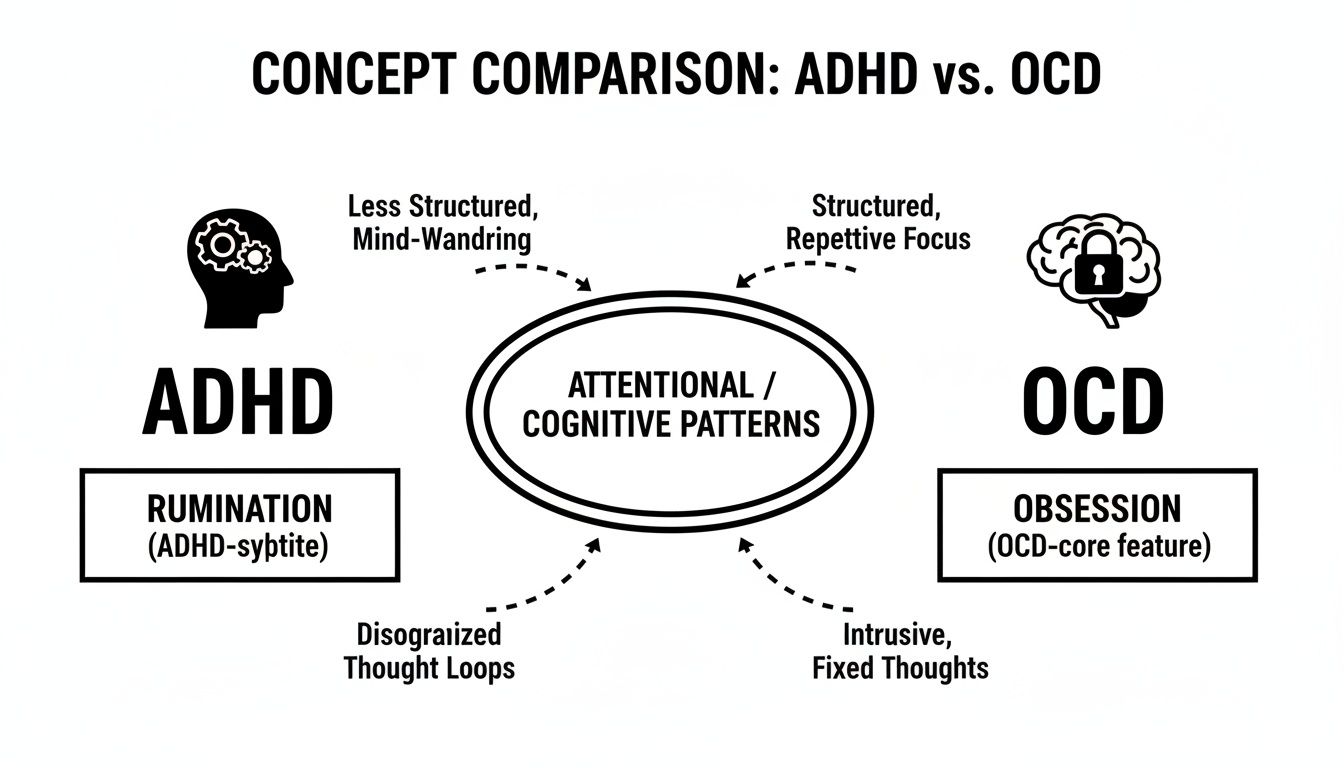
The main takeaway here is that while both conditions involve repetitive thoughts, the 'why' behind them—rumination driven by hyperfocus versus obsessions tied to anxiety relief—is fundamentally different.
Ultimately, the combination of sticky cognitive shifting and intense emotional responses creates the perfect storm for getting stuck. Your brain’s "remote control" gets jammed on a particularly loud and emotionally charged channel, with the volume turned all the way up. Understanding these neurological roots is the key to finding strategies that actually help you change the channel.
Getting to Know Your Personal Thought Loop Triggers
The first step to breaking out of a thought loop is simply awareness. Before you can hope to escape one, you have to understand what pushes you into it in the first place. Think of it like becoming a detective of your own mind, learning to spot the clues that tell you a rumination cycle is just around the corner.
These triggers aren’t random. They are very specific situations, feelings, or even physical states that make your ADHD brain more likely to get stuck. Once you can identify them, you can shift from being reactive—scrambling to get out of a spiral that’s already started—to being proactive, and simply stepping aside before it gets going.
The Triggers From Within
Often, the spark for ADHD obsessive thoughts comes from inside our own heads. Certain internal states can lower our mental defences, making it incredibly easy for a sticky thought to grab hold and refuse to budge.
Stress and Overwhelm: When you’re stressed out, your executive functions are already stretched thin. This makes it much harder to manage your attention and emotions, creating the perfect storm for your brain to fixate on a single worry in a misguided attempt to regain some control.
Fatigue: A tired brain is a rigid brain. When you're mentally or physically exhausted, you just don't have the energy for the cognitive gear-shifting required to move on from a thought. It's easier to just stay put.
Low Self-Esteem: If you’re already feeling down on yourself, your brain is primed to hunt for evidence that confirms those negative beliefs. This can quickly turn a tiny mistake into "proof" that you're a failure, a thought that then gets stuck on a brutal, repeating loop.
You can think of your mental energy like a phone battery. When it’s drained by stress, tiredness, or self-criticism, your brain defaults to its most well-worn paths—and for an ADHD brain, that path often leads straight to rumination.
Learning to recognise these internal states as high-risk periods is a game-changer. It’s about knowing when you’re more susceptible, so you can be extra vigilant about where your thoughts are heading.
The Triggers From Outside
While our internal world is a huge factor, external events are often the catalyst that sets the whole thought loop in motion. These situations frequently tap right into core ADHD-related sensitivities.
Consider this all-too-familiar scenario: you get a short, slightly ambiguous email from your boss that just says, "Can we have a quick chat this afternoon?" For an ADHD brain prone to Rejection Sensitive Dysphoria, this isn't just a message; it feels like a potential threat.
The thought process can quickly spiral: "A chat? What about? It must be that report I sent in. Did I mess something up? They probably think it’s awful. I’m going to get told off. Maybe I can't even do this job." What started as a simple email has now mushroomed into hours of unproductive worry, completely derailing your focus for the rest of the day.
This example brings a few common external triggers into sharp focus:
Receiving Criticism or Vague Feedback: This can set off an intense emotional reaction and a desperate need to replay the interaction over and over, trying to figure out what went wrong.
Facing an Overwhelming Task: When a project just feels too big or complicated, the brain can get stuck in a loop of anxiety about where to even begin, instead of actually starting.
Unstructured Time: Too much downtime without a plan can be a breeding ground for rumination. An under-stimulated ADHD brain will often create its own stimulation, and sometimes that comes in the form of latching onto a nagging worry.
By learning to spot your specific triggers—whether it’s the bone-deep exhaustion after a long week or a vague text from a friend—you can start to anticipate when your brain is most vulnerable. This awareness is the first and most vital step towards using proactive strategies to stop a thought loop before it gathers steam and takes over your day.
Practical Strategies to Break the Thought Cycle

Knowing what triggers these thought loops is the first step, but having a toolkit of practical, in-the-moment strategies is what really makes a difference. When you feel that familiar pull of a thought loop starting, the goal isn't to fight it head-on—that often just gives it more power. Instead, you need ways to interrupt the pattern and gently guide your attention back to right now.
These aren't complicated, long-winded exercises. They're designed to be simple, effective, and ready to use the second you notice your brain getting stuck. It's about building a personalised response plan by finding a few that resonate with you and practising them until they become second nature.
Create Distance with Cognitive Defusion
The real problem with ADHD obsessive thoughts is that we tend to fuse with them. We start believing they're absolute truths rather than just mental noise. Cognitive defusion is a collection of techniques designed to create a bit of space between you and your thoughts, so you can observe them without getting tangled up.
One of the most effective methods is simply naming the thought. When the loop kicks in, just label it, either out loud or in your head. For example, you might say, "Ah, there's the 'I messed up that email' story again," or "Hello, 'worrying about the future' thought."
This simple act does two powerful things: it externalises the thought, reminding you that it is separate from you, and it frames it as a recurring story rather than an urgent reality. You strip away its power by treating it as a familiar, and frankly, slightly predictable, visitor.
Use Physical Pattern Interrupts
The ADHD brain is deeply connected to the body. Sometimes, the quickest way to shift your mental state is to change your physical one. A pattern interrupt is a small, deliberate action that jolts your brain out of its current loop and forces it to reorient to the here and now.
Think of it as hitting a reset button. The action doesn't have to be dramatic; it just needs to be different from what you're doing right now.
Change Your Environment: If you're sitting, stand up and walk to another room. The simple act of changing your physical space can break mental inertia.
Engage Your Senses: Splash cold water on your face. The shock of the temperature is a powerful anchor to the present moment. You could also hold an ice cube or even bite into a lemon.
Move Your Body: Do ten quick star jumps or stretch your arms above your head for thirty seconds. It gets the blood flowing and pulls your focus away from the racing thoughts.
The goal of a physical interrupt isn't to solve the problem the thought is presenting. Its sole purpose is to break the hypnotic rhythm of the rumination cycle, giving you a precious moment of clarity to choose a different mental path.
Ground Yourself with Mindfulness
Mindfulness isn't about emptying your mind; it's about anchoring your attention to the present. When your thoughts are spiralling, grounding techniques that engage your senses are incredibly powerful for bringing you back to solid ground. A classic technique for this is the 5-4-3-2-1 Method.
Wherever you are, just pause and gently guide your attention to notice:
FIVE things you can see: Look around and name five objects. Notice their colour, shape, and texture.
FOUR things you can feel: Bring your awareness to physical sensations—your feet on the floor, the texture of your clothing, the chair supporting you.
THREE things you can hear: Listen for three distinct sounds. It might be the hum of a computer, birds outside, or distant traffic.
TWO things you can smell: Try to identify two scents in the air, whether they're pleasant or just neutral.
ONE thing you can taste: Focus on one taste. You could take a sip of water or simply notice the taste already in your mouth.
This exercise pulls your brain out of the abstract world of worry and plants it firmly back in the reality of your current sensory experience. For anyone looking to explore this further, our practical guide to mindfulness for ADHD offers more techniques to help tame a busy mind.
Beyond these in-the-moment techniques, it's also worth exploring some of the best time management apps specifically designed for the ADHD brain. These can provide the structural support that reduces the overwhelm that often triggers these thought loops in the first place.
Right, let’s talk about how counselling can help you get a handle on those obsessive thoughts.
While the self-help strategies we've touched on are fantastic, sometimes you need a guide to help you navigate your own mind. Trying to tackle ADHD obsessive thoughts alone can feel a bit like trying to find your way out of a maze while you're still stuck in the middle of it. A therapist offers that outside perspective, helping you see the whole map more clearly.
Counselling gives you a dedicated, non-judgemental space to properly explore these thought patterns. It’s a chance to connect the dots between your own life experiences and the things that trigger those spiralling thoughts. It's a team effort, really, aimed at building skills that last, not just finding a temporary plaster.
Developing Your Personal Toolkit
A good therapist works with you to understand the specific flavour of your obsessive thoughts. We go beyond the generic advice you find online and figure out coping strategies that actually fit your personality and day-to-day life.
Often, this means digging a bit deeper to find what's fuelling the fire. Things like lingering anxiety, low self-worth, or past experiences can all play a part. By getting to the root of these issues, we can build a much stronger foundation for managing your thoughts. Therapy isn't about trying to erase your ADHD; it's about learning to work with your brain's unique wiring, not against it.
Therapy offers a path to not just cope, but to thrive. It’s about moving from a place of reacting to your thoughts to a place of actively choosing where you direct your focus and energy.
Finding the Right Therapeutic Approach for You
There’s no "one size fits all" approach to therapy, especially for the ADHD mind. That’s why I offer a few different ways of working, so we can find a method that feels right and is genuinely effective for you.
Face-to-Face Sessions in Cheltenham: For those who prefer a traditional, in-person connection, my Cheltenham practice is a calm, supportive environment to do this important work.
Flexible Online Therapy: If you're based elsewhere in the UK or just find it easier from home, online sessions provide the same level of professional support with a lot more flexibility.
Unique Walk and Talk Therapy: This can be a game-changer for the active ADHD brain. The gentle rhythm of walking often helps to calm the nervous system, making it easier to process difficult thoughts and untangle those mental knots. It’s a great way to use physical movement to help an active mind find its clarity.
Each of these is about creating a supportive partnership. My role is to empower you with the insight and tools you need to feel back in control.
If you feel you’re ready to see how counselling could help, you can learn more about how I work on my Therapy with Ben service page. The goal is always to find a path that helps you move forward with confidence and a bit more peace of mind.
Your Questions Answered
Here are some straightforward answers to the questions I hear most often from people grappling with ADHD and obsessive thoughts.
Can ADHD Obsessive Thoughts Go Away Completely?
While completely silencing a busy ADHD brain isn't the goal—or even really possible—you can absolutely learn to manage these thoughts. Through our work together and practising different strategies, we can dramatically dial down their volume and intensity.
Think of it less like hitting a mute button and more like turning a disruptive shout into a background whisper. It’s still there, but you can easily tune it out and get back in control of your focus.
Is Medication the Only Answer for ADHD Rumination?
Medication can be an incredibly helpful part of the plan, but it’s very rarely the whole picture. Therapeutic approaches like Cognitive Behavioural Therapy (CBT), mindfulness, and developing your own personalised coping mechanisms are powerful tools for creating lasting change.
These strategies can work brilliantly alongside medication, or they can be the primary way we build the skills you need to manage the thought cycles that come with ADHD obsessive thoughts.
How Do I Know if My Thoughts Are from ADHD or OCD?
This guide can give you a good sense of the differences, but sorting it out for sure really needs a proper assessment from a qualified healthcare professional. They're the ones who can look at your specific symptoms, history, and experiences to give you a clear and accurate picture.
Getting that professional clarity is the most important step you can take. It ensures you get the right support for what you're actually dealing with.
Does Walk and Talk Therapy Really Help Obsessive Thoughts?
For many people with ADHD, it’s a game-changer. The simple, rhythmic act of walking can have a wonderfully calming effect on the nervous system, which helps a 'stuck' brain become more flexible and open to new ideas.
It creates a much less formal, more natural space than sitting opposite someone in a clinical room. This often makes it far easier to open up and process those difficult thoughts and feelings. It’s a powerful approach that combines the benefits of gentle exercise, being in nature, and a skilled therapeutic conversation.
Posted by: Therapy-with-Ben
If you recognise these patterns in yourself and feel ready to find a better way of managing your thoughts, Therapy-with-Ben is here to help. To see how counselling can support you, have a look around the site at https://www.therapy-with-ben.co.uk and take that first step towards a calmer mind.


Comments