


Mindfulness for ADHD: A Practical Guide to Taming a Busy Mind
Updated: Feb 16
Author: Therapy-with-Ben
Yes, mindfulness can work for an ADHD brain, but probably not in the way you've been told. It's less about achieving a state of perfect Zen-like calm and more about learning to notice the chaos without getting swept up in it. The key is using short, active practices that actually work for an energetic mind.
Before we dive in, I want to say that I'm not just writing about ADHD from a counsellor's perspective; I live with it myself, you can try a set of standardised ADHD screening questions. This quick, confidential self-test uses widely recognised criteria to help you spot some of the common signs and patterns associated with ADHD. Although I haven't had a formal assessment, I know firsthand what it's like to have a brain that's always on the move. That means everything I share here isn't just theory; it's grounded in real, daily experience. If you're feeling frustrated, overwhelmed, or just tired of advice that doesn't fit, you're in good company. I get it, and I've tried and tested many of these strategies myself with differing degrees of success.
If you’re considering a formal diagnosis but worried about the cost, check out my practical guide: Navigating ADHD Assessments – A Personal Perspective. It’s packed with tips for finding a more affordable private ADHD assessment in the UK, based on my own experience and research.
Although I haven't had a formal assessment, I know firsthand what it's like to have a brain that's always on the move. That means everything I share here isn't just theory; it's grounded in real, daily experience. If you're feeling frustrated, overwhelmed, or just tired of advice that doesn't fit, you're in good company. I get it, and I've tried and tested many of these strategies myself with differing degrees of success.
Can Mindfulness Really Work for an ADHD Brain?

Let’s be honest for a moment. The whole idea of mindfulness for ADHD often sounds like a bad joke. If your mind already feels like a pinball machine, being told to “just sit still and quiet your thoughts” is a recipe for pure frustration. If you’ve downloaded a meditation app and given up after 30 seconds, you are definitely not alone.
That scepticism is completely justified. Most traditional mindfulness practices, with their long, silent periods of stillness, simply weren’t designed with a neurodivergent brain in mind. Trying to stick to them can feel like aiming for an impossible standard, leaving you with a sense of failure rather than peace.
A Different Approach for a Different Brain
The good news is that there’s a much better way. Adapted mindfulness isn’t about trying to force your brain to be something it’s not. It’s about working with your ADHD wiring, not fighting against it.
Think of it less like trying to stop a hurricane and more like learning to be a calm, curious observer watching it from a safe distance.
This means we shift the goalposts. Forget long, daunting sessions. Instead, the focus is on short, manageable, and often active practices. These techniques are designed to be engaging enough to hold your attention and compassionate enough to accommodate a mind that loves to wander. They offer a genuinely practical way to handle the daily challenges of inattention, impulsivity, and emotional overwhelm. You can dig deeper into this by exploring our guide to understanding adult ADHD.
Mindfulness for ADHD isn't about emptying your mind. It's about giving your busy mind a single, interesting thing to focus on for a brief moment, again and again.
This kind of approach is vital, especially when you look at the numbers here in the UK. Recent estimates suggest that around 2.5 million people in England may have ADHD, and that includes a huge number of adults who are still undiagnosed. You can read more about these ADHD statistics and what they mean for public health. My goal here is to show you that there are effective techniques that can actually fit into your life, no matter how busy it feels.
How Mindfulness Rewires Your Brain for Focus
To get our heads around how mindfulness actually works for an ADHD brain, it helps to use a little analogy. Imagine the part of your brain in charge of attention – the prefrontal cortex – is like a busy but brilliant CEO. In an ADHD brain, this CEO is constantly getting sidetracked by a flood of new emails, urgent phone calls, and spontaneous ideas, which makes it incredibly tough to see one important project through to the end.
This is where short, consistent mindfulness practice comes in. It’s not about forcing the CEO to sit in a silent, empty office for hours on end. Far from it. Instead, think of it as giving them a series of brief, structured workouts that strengthen their ability to consciously choose where to place their attention and to better manage those distracting impulses.
Quieting the Background Static
One of the most powerful things mindfulness does is turn down the volume on your brain's "background static." This constant mental chatter comes from a network of brain regions known as the Default Mode Network (DMN). The DMN is what’s active when your mind is just wandering – daydreaming, stewing over something that happened yesterday, or worrying about tomorrow.
For those of us with ADHD, the DMN is often stuck in overdrive. This makes it much harder to switch off that internal noise and just focus on what's happening right now. Mindfulness exercises gently train your brain to notice when the DMN has taken over and to intentionally guide your attention back to an anchor, like your breath or the feeling of your feet on the floor.
With time, this simple, repeated action starts to loosen the DMN's grip and strengthens your capacity for focused attention. If you want to dive a bit deeper into the mechanics, you can learn more about what mindfulness in therapy is and how it works.
Think of it like this: Each time you notice your mind has wandered and you gently bring it back, you're doing a single 'rep' of a mental push-up. This small act builds real neurological muscle.
Building Stronger Neural Pathways
And that isn't just a metaphor; it's what's happening biologically. Regular mindfulness practice physically changes your brain by strengthening the neural pathways linked to our executive functions. Research has shown it can lead to increased density in parts of the prefrontal cortex responsible for:
Emotional Regulation: Helping you respond more thoughtfully to frustration or stress, rather than reacting on impulse.
Attention Control: Sharpening your ability to stay focused on a task and tune out distractions.
Self-Awareness: Building a clearer understanding of your own thoughts and feelings, without getting caught up in judging them.
This whole process is called neuroplasticity, and it proves that mindfulness is a practical brain-training tool, not some mystical quick fix. For anyone interested in the science behind it, you can find more on how to retrain and reprogramme your brain for improved focus. By doing these adapted exercises, you're actively rewiring your brain to work more effectively for you.
Adapting Mindfulness for the ADHD Experience
If you’ve ever tried a standard mindfulness app and felt like a complete failure five minutes in, you're in the right place. There's a good reason it felt impossible. Most traditional mindfulness methods are a terrible fit for the ADHD brain, often clashing directly with core traits like restlessness, a hair-trigger boredom response, and that loud inner critic that loves to pipe up the second your mind wanders.
This creates a really frustrating cycle. The very tool that’s supposed to help ends up being just another thing to feel bad about. But here’s the thing: the problem isn't you. It’s the one-size-fits-all approach. To make mindfulness work for ADHD, we need a different set of rules entirely.
Making Mindfulness Work For You
The whole idea is to adapt the practice to fit your brain, not force your brain into a mould it was never designed for. This means swapping out those long, silent, sit-still-and-don't-move meditations for something shorter, more engaging, and often, something that involves a bit of movement.
Instead of chasing a perfectly silent, empty mind (which, let's be honest, is a myth for most people, let alone someone with ADHD), the goal is to catch brief, compassionate moments of awareness.
Think of it like training a muscle. You wouldn't start by trying to lift the heaviest weight in the gym. You start small and build up. These small, consistent training sessions are what help rewire the brain's "CEO"—the prefrontal cortex—for better focus.
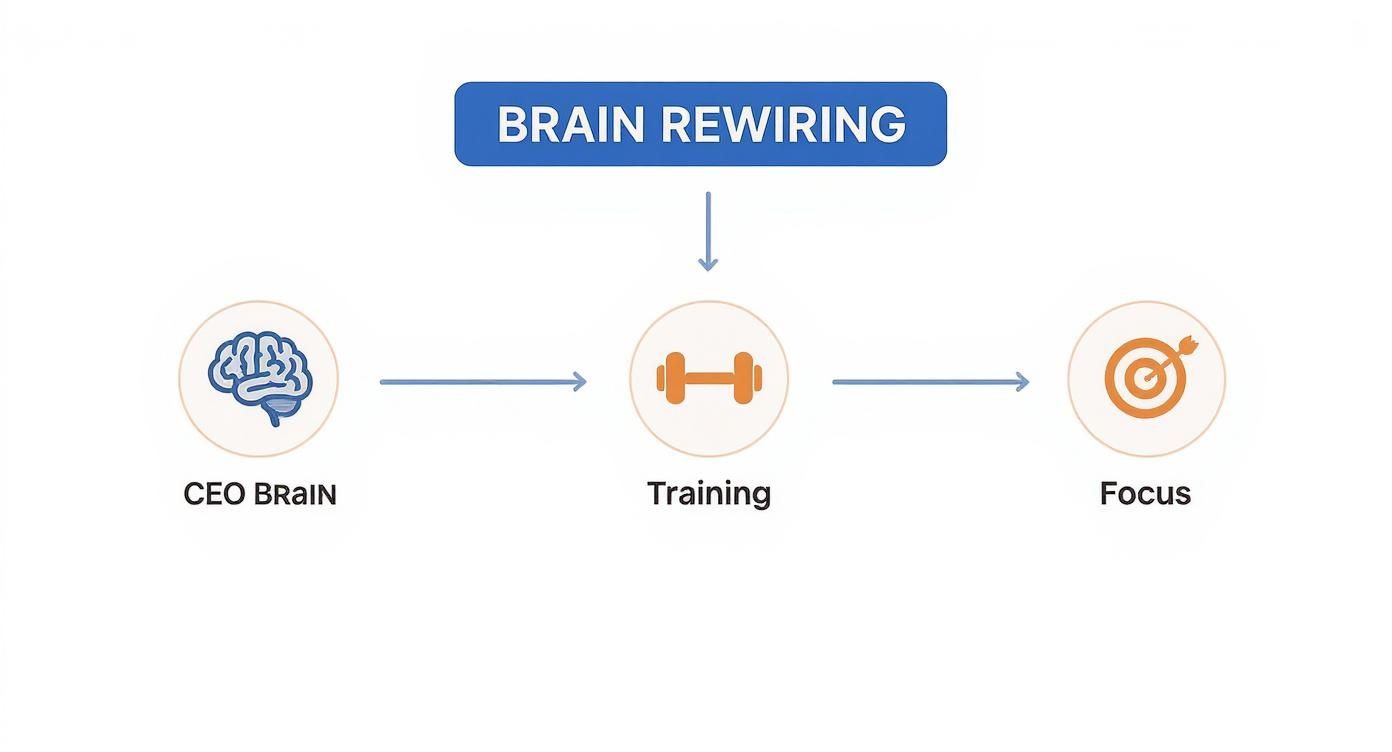
This process shows the journey from a scattered, reactive state to one where you can actually sustain your attention, all through practices that are built for your brain, not against it.
Adapting Mindfulness Practices for the ADHD Brain
To make this really practical, it helps to see the difference between the 'standard' instructions you've probably heard and the ADHD-friendly tweaks that make success feel genuinely achievable. The table below breaks down some common examples.
Mindfulness Practice | Traditional Approach (Often Difficult for ADHD) | ADHD-Friendly Adaptation |
|---|---|---|
Duration | Sit for a 20-30 minute guided meditation. | Start with 1-3 minutes. Seriously. Aim for consistency over duration—a little bit every day works wonders. |
Breathing Meditation | Sit perfectly still, focusing only on the sensation of breath. | Place a hand on your chest to feel the breath, count breaths in short cycles of 1-4, and absolutely allow yourself to fidget. |
Body Scan | Lie still for 30+ minutes, slowly scanning each body part. | Do a 'quick scan' for 3-5 minutes, focusing only on major contact points (feet on the floor, back on the chair). Try it standing or walking. |
Mind Wandering | Gently note the thought and return your focus to the breath. | Acknowledge the 'brain buzz' with curiosity, not judgement. Use an external anchor (a ticking clock, a fan) to come back to. |
As you can see, the adaptations aren’t about 'dumbing it down'; they’re about making it smarter and more effective for how your brain is wired.
Key Principles for an ADHD-Friendly Practice
Beyond the specific techniques, a few key shifts in your mindset can make all the difference between feeling frustrated and actually making progress.
Start Small. No, Smaller: I mean it. A one-minute practice you do every day is infinitely more powerful than a 30-minute session you only manage once a month. It’s the consistency that builds those new neural pathways.
Embrace Movement: Fidgeting is not a failure. In fact, it can be a feature. Pacing, walking, stretching, or using a fidget tool during a mindfulness exercise can give your brain the sensory input it’s craving, which ironically helps you focus better.
Use External Anchors: The breath can sometimes feel a bit too subtle or, frankly, boring. Anchor your attention to something more concrete instead. This could be the sound of traffic outside, the feeling of your feet on the ground, or the warmth of a cup of tea in your hands.
Practise Self-Compassion: Your mind will wander. That is what minds do, especially ADHD minds. The real practice isn't about stopping your thoughts from wandering off. It's about the gentle, non-judgemental act of noticing it’s happened and kindly guiding your attention back.
The real "work" of mindfulness for ADHD happens in that tiny moment you realise your mind has drifted and you choose to guide it back, kindly. Each time you do that, it's a win.
By making these small but significant adjustments, you can transform mindfulness from an intimidating chore into an accessible, supportive tool. It becomes a way of working with your brain's natural tendencies, empowering you to build focus and calm in a way that feels authentic, sustainable, and genuinely helpful.
Four Mindfulness Exercises You Can Start Today

All the theory is great, but the best way to really get mindfulness for ADHD is to just give it a go. These exercises are short, simple, and designed with the ADHD brain in mind.
Just remember, this isn't about achieving a state of perfect Zen-like calm. It's about the gentle, repeated practice of noticing your mind has wandered and kindly guiding it back, even if it’s just for a moment.
Each one of these can be done in under five minutes, so they’re easy to slip into a busy day. Think of them as tools in your pocket, ready for whenever you feel overwhelmed, distracted, or just need to hit the reset button. The key is to be kind to yourself—whether your mind feels like a calm pond or a chaotic storm.
1 The 3-Breath Reset
This is the ultimate micro-practice. It’s perfect for hitting the pause button when stress is high or you feel your thoughts starting to spiral out of control. It’s also quick and discreet enough to do anywhere.
First Breath: Take a slow, deep breath in. As you breathe out, consciously let your shoulders drop and release any tension you’re holding.
Second Breath: On the next deep breath, bring all your focus to the physical feeling of the air moving. Notice it entering your lungs and then leaving your body. Is it cool on the way in, warm on the way out?
Third Breath: For this last one, just be aware of your whole body, right here, right now. Feel your feet on the floor, your hands in your lap, the chair supporting you.
That's it. In less than a minute, you’ve broken the spell of autopilot and created a small island of awareness in your day.
2 Mindful Walking
For many people with ADHD, the idea of sitting still is a nightmare. Mindful walking is brilliant because it uses that restless energy as the very focus of your attention, making it much more accessible when you’re feeling fidgety.
The next time you’re walking—even if it’s just to the kitchen or from the car to the office—give this a try:
Feel Your Feet: Turn your attention to the soles of your feet. What does it feel like when each foot makes contact with the ground? Notice the heel, then the ball of the foot, then the toes.
Notice the Movement: Pay attention to the simple rhythm of your steps and the subtle way your weight shifts from one leg to the other.
Expand Your Awareness: Once you’ve got a sense of your feet, you can gently expand your awareness outwards. What does the air feel like on your skin? What sounds can you hear?
You don’t need to go on a long hike. Even just ten intentional, mindful steps can be a powerful way to anchor yourself in the present.
The aim isn't to stop thinking. It's to give your busy mind a simple, sensory task to focus on, allowing thoughts to come and go in the background without taking centre stage.
3 The Anchor Practice
Let’s be honest, for an ADHD brain, the breath can sometimes feel a bit too subtle—or even boring—to focus on. An anchor practice is about choosing a more distinct sensation, either inside or outside your body, to return your attention to when you notice your mind has drifted.
Here are a few anchor ideas to play with:
Sound: Pick a steady sound in your environment, like the hum of the fridge, birdsong outside your window, or even the distant rumble of traffic. Let that be the thing you gently return your focus to.
Touch: Zero in on a physical sensation. This could be the feeling of your hands resting on your thighs, the texture of the fabric on your chair, or the warmth of a mug of tea in your hands.
Sight: Softly gaze at a single object in front of you—a plant, a picture on the wall, a pen on your desk. Without analysing it, just notice its colour, shape, and form.
These anchors give your attention something more solid to hold onto, which can be a game-changer when focusing on the breath feels impossible. For those whose racing thoughts get in the way of sleep, finding the right anchor is key. This practical guide to sleep meditation offers more ways to reclaim restful nights.
4 The 5-4-3-2-1 Grounding Technique
When you feel completely overwhelmed and lost in a storm of thoughts, this technique can pull you out of your head and back into your body with surprising speed. It works by engaging all five of your senses to root you firmly in the here and now.
Wherever you are, just pause and quietly notice:
5 things you can see around you. (Really look at them—the colour, the shape, the light).
4 things you can feel with your body. (Your feet in your shoes, your back against the chair, the fabric of your clothes).
3 things you can hear in your environment. (Listen for sounds near and far).
2 things you can smell. (If there's nothing obvious, what does the air itself smell of?).
1 thing you can taste. (The lingering taste of coffee, or just the natural taste of your own mouth).
This simple exercise acts as a powerful circuit breaker. It forces your brain to switch from abstract worrying to concrete, sensory information, offering immediate relief when your mind feels like it's spinning out of control.
Weaving Mindfulness into Your Daily Routine
While doing formal mindfulness exercises is a fantastic start, the real magic happens when it stops feeling like another chore on your to-do list. The goal with mindfulness for ADHD isn’t to add more pressure, but to weave tiny moments of awareness into the day you’re already living.
This is especially important when you look at the bigger picture here in the UK. It’s thought that ADHD affects around 3–4% of the adult population, but actually getting a diagnosis can be a real struggle. This means millions of people are likely coping on their own. You can read more about the state of UK adult ADHD services to get a sense of the challenges. Finding strategies that are accessible and that you can manage yourself has never been more vital.
The trick is to make it so seamless it feels like you’re not even trying.
Using Habit Stacking to Build Consistency
One of the best ways to do this is with a simple technique called ‘habit stacking’. The idea is dead simple: you just link a tiny new mindfulness practice to something you already do every single day, completely on autopilot.
Rather than trying to find a new 10-minute slot in your packed schedule, you just piggyback the new habit onto an old one. This takes away the mental effort of remembering to do it and helps your brain wire in the new habit much more quickly.
The real power of mindfulness isn’t found in one long 30-minute meditation, but in the dozens of 10-second moments of awareness you can sprinkle throughout your day.
This simple shift turns mundane, everyday moments into real opportunities for practice.
Simple Habit Stacks for an ADHD Brain
So, what does this look like in real life? Here are a few practical examples of how you can attach a micro-mindfulness moment to things you’re already doing. The key is to make it so small that it feels impossible to fail.
While the kettle boils: As you’re waiting for your morning brew, try the 3-Breath Reset. Don’t worry about trying to clear your mind. Just bring your attention to the feeling of your feet on the floor for the time it takes to take three slow breaths.
Waiting at a traffic light: Instead of instinctively reaching for your phone, just do a quick sensory check-in. Notice one thing you can see, one thing you can hear, and the feeling of your hands on the steering wheel. That’s it.
Walking from your car to the front door: This little walk is the perfect chance for a couple of minutes of mindful walking. Just focus on the sensation of your feet hitting the ground with each step. It creates a small but powerful buffer between the stress of your journey and whatever is waiting for you inside.
These tiny habits are especially useful for managing difficult transitions – those moments like leaving the house or switching tasks that are often a real pain point with ADHD. They act like little anchors, helping to ground you, reduce that feeling of being overwhelmed, and let you move through your day with a bit more calm and control.
When to Seek Professional Support with ADHD
Mindfulness is a fantastic tool to have in your back pocket, but it’s important we’re honest about its limits. While it can absolutely make a difference to your focus and help you get a handle on your emotions, it isn’t a magic wand for ADHD. Sometimes, you just need more structured, one-to-one support to untangle the knots that ADHD can create.
Realising that self-help isn't quite cutting it is a sign of strength, not weakness. If you've given mindfulness a real go but still feel like you’re constantly swimming against the tide, it might be time to bring in a professional. The aim is to build a complete toolkit, and therapy can offer some of the most crucial tools that mindfulness alone can't provide.
Signs It Might Be Time for Therapy
There are a few clear signs that suggest some extra support could be a game-changer. It’s worth paying attention if you’re consistently running into:
Significant emotional dysregulation: We're talking about intense mood swings, feeling overwhelmed by frustration, or emotional reactions that are causing real problems in your life.
Ongoing relationship difficulties: Perhaps impulsivity or inattention is creating constant friction with your partner, family, or even your colleagues.
Struggles at work or university: You're trying the tools, but you’re still finding it incredibly hard to hit deadlines, stay on top of your organisation, or manage your workload.
Co-occurring challenges: ADHD often brings along friends like anxiety and depression. If you’re dealing with these as well, professional support is definitely the way to go.
How Therapy Can Help
A therapist offers a safe, non-judgemental space to build on the skills you’ve started developing with mindfulness. They can help you dig a bit deeper into what’s going on, create coping strategies that are genuinely designed for your brain, and provide that gentle accountability to keep you moving forward.
For many people, therapeutic models like Acceptance and Commitment Therapy (ACT) are particularly powerful. ACT isn’t about getting rid of difficult thoughts and feelings; it’s about learning to accept them while still committing to the actions that matter to you.
Therapy isn't a sign of failure; it's a strategic move to get the expert support and structure you need to truly thrive with ADHD.
The need for this kind of structured care is being recognised more and more. In fact, NHS England recently acknowledged that almost 2.5 million people in England may have ADHD and launched a plan to improve services. This really highlights the scale of the issue and just how vital good support systems are. You can discover more about this new ADHD data plan and what it aims to do.
At Therapy with Ben, I also offer something a bit different, an approach that’s often a great fit for the ADHD brain: Walk and Talk Therapy. By taking our sessions outdoors, we tap into the benefits of movement, which can be a massive help for anyone who finds sitting still a real challenge. It's a practical, engaging way to work through things in a setting that naturally supports focus and calms restlessness.
Of course. Here is the rewritten section, crafted to sound like an experienced human expert, following the specific style and tone of the provided examples.
Your Questions About Mindfulness and ADHD
Starting out with something new like mindfulness is bound to bring up a few questions. It’s completely normal to wonder how it all works in practice. So, let’s get straight to it and tackle some of the most common queries I hear about using mindfulness for ADHD.
How Long Does It Take to See Results?
This is the big question, isn't it? The honest answer is there’s no magic timeline, because everyone's brain and journey is unique. That said, a lot of people tell me they notice a subtle shift—maybe a little more calm or a flicker of awareness—within a week or two of consistent daily practice. And I'm talking just 2-3 minutes a day.
The real key here is consistency over intensity. Bigger changes, like better focus and not being so reactive to your emotions, tend to build up over several months. Think of it less like a quick fix and more like training a muscle at the gym; it’s the steady, repeated effort that builds strength over time.
Can I Do Mindfulness if I'm on ADHD Medication?
Absolutely. In fact, they often work brilliantly together. Think of them as a team tackling different aspects of ADHD.
Medication often creates a better baseline of focus. It can clear some of the mental fog, which makes it far less frustrating to even try a mindfulness exercise.
Mindfulness then comes in to help with everything else—the emotional ups and downs and the in-the-moment focus wobbles that medication might not fully cover.
They really can be a powerful duo. Still, it’s always a good idea to have a chat with your GP or psychiatrist about any new self-management strategies you're trying out.
The goal isn't to achieve a perfectly still mind. That’s a myth. The real win is every single time you notice your mind has wandered off and you gently, without judgement, guide it back. That is the practice.
What if I Get Bored or Nod Off During Practice?
Welcome to the club! This happens to almost everyone, especially with an ADHD brain that’s wired for novelty and stimulation. It’s not a sign you’re failing; it’s just your brain giving you feedback.
If boredom strikes, switch it up. Try a more active practice like mindful walking, or find a more engaging anchor, like the sound of a ticking clock. If you find yourself getting sleepy, try sitting upright on a chair instead of lying down, or pick a time of day when you're naturally more alert. The important thing is not to judge yourself for it. Just notice what’s happening and gently adjust.
At Therapy-with-Ben, I can help you build these skills in a way that works for you. We can explore this in a supportive, structured environment, including through Walk and Talk Therapy that honours your brain’s need for movement. Find out more about how therapy can support you.
If you’ve read this far, you’re already taking a decisive step toward understanding and supporting your ADHD brain. Remember, there’s no single “right” way to practise mindfulness; what matters is finding what genuinely works for you and being kind to yourself in the process. Suppose you’re curious about getting a formal ADHD assessment but put off by the long NHS wait times or the high cost of private clinics. In that case, you might find my recent blog on ADHDcertify and affordable assessment options really helpful. Not only could it save you time and money, but it’s also a way to access support sooner—and yes, if you go through my referral link, it helps support my work too.
Whether you’re looking for practical self-help, considering therapy, or just want to understand your mind a bit better, you’re not alone. If you’d like more tailored support, you can always reach out to me here at Therapy-with-Ben—whether for Walk and Talk sessions, online counselling, or just a conversation about your next steps. You deserve support that fits you. Ready to take the next step?
You don’t have to figure this out on your own. Support is out there—and so are practical, affordable options.


Comments