


What is trauma informed care? Learn the core principles
Updated: Aug 29
By Therapy-with-Ben
When we talk about trauma informed care, we’re talking about a fundamental shift in perspective. It’s about moving away from asking, “What’s wrong with you?” and instead, gently and curiously exploring, “What happened to you?”. This isn’t a specific technique or a rigid set of rules; it’s a compassionate way of working that recognises just how widespread the impact of trauma really is. The goal is to build an environment of safety, trust, and genuine collaboration from the very first moment we meet.
Shifting From What Is Wrong to What Happened
Think of a gardener looking after a plant that's struggling to thrive. Instead of just criticising its wilting leaves, a good gardener gets their hands dirty. They check the soil, look at the roots, and consider the amount of sunlight and water it's getting. They understand the plant's distress is a response to its environment.
That’s the essence of trauma informed care. We're looking to understand the root causes of distress, not just patch up the symptoms.
This approach is built on the simple but profound understanding that our life experiences—especially the difficult ones—shape our behaviours, our relationships, and our sense of wellbeing. It reframes emotional and psychological struggles not as character flaws, but as completely understandable adaptations to overwhelming events. The whole point is to create a therapeutic space where your story is heard and validated, not judged or pathologised.
A Foundation of Compassionate Understanding
At its heart, trauma informed care is my commitment to you to build a relationship based on safety and respect. It operates on the knowledge that past events, particularly those that happened in our earliest relationships, can leave a lasting imprint. This connection to others is fundamental to feeling secure in the world, a concept you can explore more deeply by understanding [what attachment theory is and how it shapes you].
By leading with curiosity and empathy, we avoid the risk of re-traumatising and instead, create a space where you can reclaim your sense of control and empowerment.
A trauma informed approach is built on the belief that people are incredibly resilient. It trusts that we can all heal when we're given a supportive, understanding environment that honours our unique history and our inherent strengths.
This shift is so important because it completely changes the dynamic of therapy. I'm not here to see you as a collection of symptoms that need fixing. I'm here to see you as a whole person with a story that matters. It’s a promise that you’ll be met with compassion, creating the right conditions for real, meaningful healing to begin.
To make this shift clearer, let’s look at a quick comparison. It really highlights the difference in the questions we ask and the assumptions we make.
Traditional Care vs Trauma Informed Care at a Glance
Aspect | Traditional Approach Asks | Trauma Informed Approach Asks |
|---|---|---|
Focus of Inquiry | "What's wrong with you?" | "What happened to you?" |
View of Symptoms | Symptoms are a problem to be fixed or managed. | Symptoms are adaptations or survival strategies. |
Client Role | Often seen as a passive recipient of treatment. | An active collaborator in their own healing. |
Therapist's Goal | To diagnose and treat a disorder. | To build safety, trust, and empower the individual. |
Core Assumption | There is something inherently wrong with the person. | The person has strengths and has done their best to survive. |
This table shows how trauma informed care isn't just a minor tweak—it's a complete reframing of how we see and respond to human suffering. It’s about creating a partnership for healing.
The Six Guiding Principles of Safe Therapy
Putting the idea of trauma-informed care into practice isn't just about good intentions; it's a structured, compassionate approach guided by six core principles. These aren't just tick-box exercises. They all work together to create an environment where you feel seen, heard, and respected at every single turn, transforming the therapy room into a genuine partnership for healing.
This infographic shows the simple but profound shift from traditional ways of thinking to a more empathetic, trauma-informed perspective.
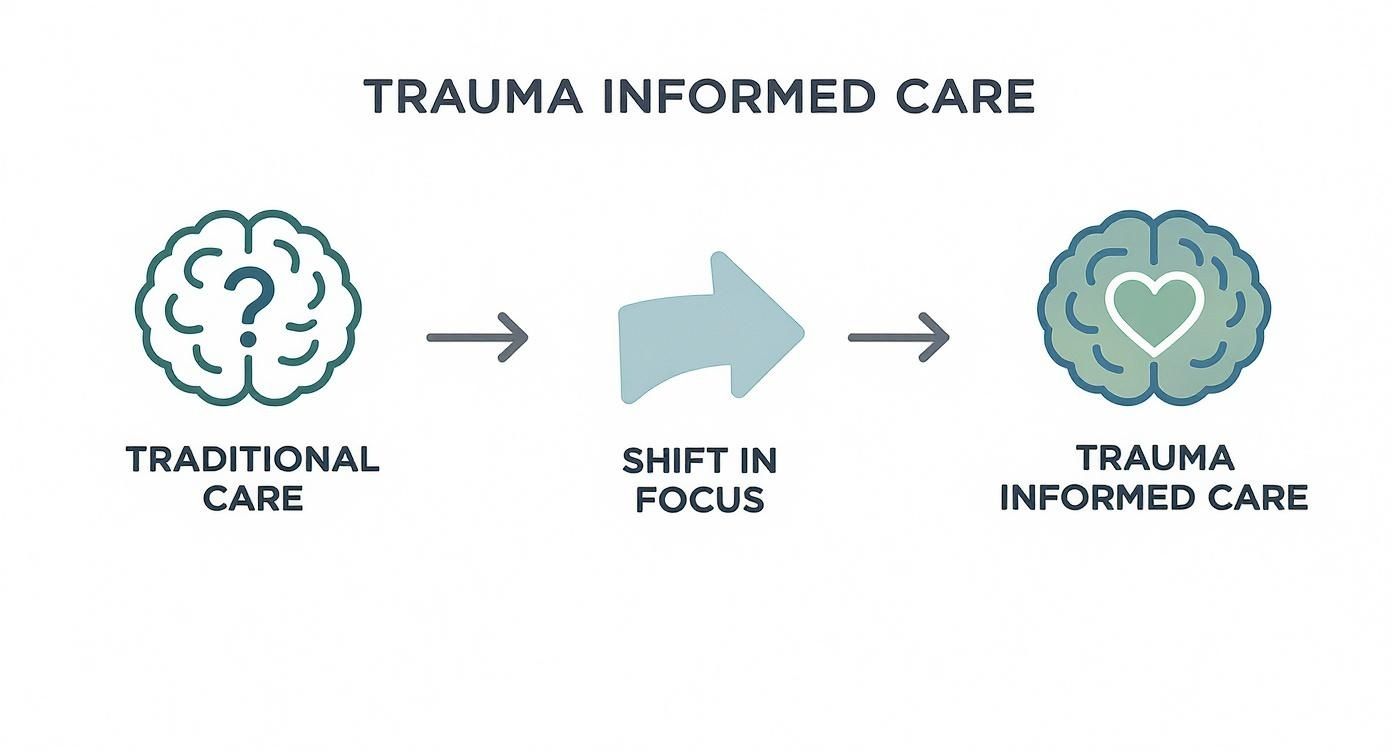
As the image shows, it’s all about moving from the confusion of "What's wrong with you?" to the connection of "What happened to you?". This simple question is the very foundation of these guiding principles.
1. Safety First and Foremost
The absolute bedrock of our work is creating a sense of safety, both physically and psychologically. Without this foundation, meaningful therapy is pretty much impossible. This means our sessions are a predictable, calm space, completely free from judgement.
It also means you are always in the driving seat when it comes to the pace. I will never push you to explore something you’re not ready for. Safety is the soil from which trust can grow.
2. Trustworthiness and Transparency
Trust isn't something I can assume; it has to be earned. Right from our very first conversation, I’m committed to being open and honest about how therapy works. This means clear communication about what to expect, how we'll work together, and the boundaries of our professional relationship.
There are no hidden agendas or surprises here. Building this kind of open dialogue is essential, and you can read a bit more about how this works in our guide to [what makes a therapeutic relationship successful](https://www.therapy-with-ben.co.uk/post/what-is-therapeutic-relationship-key-to-therapy-success). This transparency is all about making sure you feel secure and respected throughout your journey.
3. Peer Support and Shared Understanding
This principle is about recognising the immense value of shared human experience. While my role is as a professional counsellor, the idea of peer support helps to highlight that you are absolutely not alone in your feelings or experiences.
It values the wisdom that comes from lived experience, creating a real sense of connection rather than isolation. Just hearing that others have walked similar paths can be incredibly validating and helps to normalise your responses to difficult events.
4. Collaboration and Mutuality
Therapy is not something that is done to you; it’s a process we undertake together. Collaboration means we are partners on your healing journey. Your insights, opinions, and feelings are every bit as important as my professional expertise.
This mutuality levels the playing field, moving away from a traditional top-down dynamic. We work as a team to figure out your goals and find the best ways to move towards them, ensuring you are an active participant in your own growth.
5. Empowerment, Voice, and Choice
A central goal of working in a trauma-informed way is to help restore your sense of personal power. Trauma can so often leave people feeling helpless or voiceless, so our work is specifically designed to counteract that.
You have a choice in every aspect of our sessions:
You choose what to share: It’s up to you which topics we discuss and when.
You set the pace: We move as quickly or as slowly as feels right for you.
Your voice is central: Your feedback and preferences are what guide our approach.
This focus on empowerment helps you build confidence and begin to recognise your own incredible strengths and resilience.
6. Cultural, Historical, and Gender Issues
Finally, a truly trauma-informed approach has to recognise and respect the individual in their full context. This means being sensitive to your cultural background, personal history, gender identity, and any experiences of systemic bias or prejudice you may have faced.
These things can be significant sources of stress and trauma in their own right, and they deserve to be acknowledged with respect and genuine understanding.
Why This Approach Is So Important in the UK
Understanding what trauma-informed care is becomes incredibly urgent when you look at the reality for so many people across the UK. It’s not just some abstract idea; it's a vital way of working that’s grounded in the real experiences happening in our communities every single day.
Why is it so essential? Because it directly speaks to the sheer number of people who have gone through difficult, often damaging, experiences.
For example, trauma from domestic abuse is a huge public health issue. When you learn that up to 29% of women and 13% of men in the UK have experienced it, you start to see just how necessary it is for therapy to understand its deep, lasting impact. The financial cost is staggering, estimated at around £14 billion a year, but the personal cost to individuals is completely immeasurable.
Preventing Re-traumatisation in Therapy
One of the most critical reasons for working this way is to prevent something called re-traumatisation. This is what happens when someone who is trying to get help ends up in a situation that accidentally causes them more harm because the professional they’re with doesn’t understand the effects of trauma.
A therapist who pushes for details too quickly, or who dismisses someone’s coping mechanisms as just ‘bad behaviour’, can actually make the healing process much, much harder.
A trauma-informed counsellor, on the other hand, makes it their first priority to create a safe space where you are the one in control. This careful, respectful way of working is crucial for anyone who has had their sense of safety completely shattered by what’s happened to them in the past.
The core promise of a trauma-informed approach is that the therapy room will be a sanctuary, not another place where you have to defend yourself or re-live your pain without support. It's a commitment to 'do no harm'.
The UK Landscape and Your Choice
While awareness of trauma-informed care is thankfully growing across the UK, how it’s actually put into practice can be a bit of a mixed bag. Some places, like Scotland and Wales, have more joined-up national strategies, whereas in England it can be a bit more piecemeal.
This means it's really important for you, as someone seeking support, to find practitioners who are explicitly trained in and committed to these principles. When looking for a therapist, it can be helpful to know about specific, evidence-based methods like Trauma-Focused Cognitive Behavioural Therapy (TF-CBT).
Making that choice ensures you’re partnering with someone who gets not just what you’ve been through, but how it has shaped you. That understanding is what creates the right conditions for genuine recovery to begin.
Recognising Trauma Responses in Daily Life
Ever find yourself struggling with something and not quite knowing why? Maybe it's a persistent anxiety in social situations, or a nagging difficulty in trusting the people you love. We often blame ourselves, thinking there’s something wrong with us. But a trauma informed approach invites us to look at things differently—seeing these reactions not as personal flaws, but as clever survival strategies your mind developed long ago.

These responses are your mind and body’s logical attempt to protect you from repeating a painful past. What might look like an overreaction on the surface is often a deeply ingrained protective mechanism that was once absolutely essential for your safety.
From Survival Mode to Self-Compassion
Trauma responses aren't always the dramatic flashbacks you see in films. More often, they’re subtle, persistent patterns that quietly disrupt your daily life. Learning to spot these is the first real step towards self-compassion and healing.
You might recognise some of these common, yet often overlooked, responses in yourself:
Hypervigilance: This is that feeling of being constantly "on alert," even when you’re perfectly safe. You might startle easily, find it impossible to truly relax, or find yourself scanning a room for threats without even realising it.
Emotional Dysregulation: Do you experience intense mood swings that feel completely out of your control? A tiny trigger might spark a massive emotional reaction—a sudden burst of anger, a wave of overwhelming sadness, or a complete shutdown into numbness.
Avoidance: This is when you actively steer clear of people, places, or even thoughts that remind you of a difficult past. It brings short-term relief, for sure, but over time it can lead to a very small, restricted, and isolated life.
Difficulty with Relationships: If you struggle to trust others, feel disconnected from loved ones, or keep finding yourself in the same unhealthy relationship patterns, it could be linked to past trauma. These are often protective strategies designed to stop you from getting hurt again.
Recognising these behaviours as survival adaptations, rather than signs you’re broken, is at the very heart of trauma informed care. It’s about finally connecting the dots between your past and your present.
A New Lens for Your Experiences
Think of it like this: if you touched a hot stove as a child, your body would instinctively learn to pull away from hot surfaces in the future. It’s a brilliant survival response. In the same way, if a past relationship caused you deep pain, your mind might develop a pattern of keeping people at a distance to avoid getting "burned" again.
This approach hands you a new, compassionate lens. Instead of asking, "Why can't I just relax?" you can start to understand, "My nervous system is working really hard to keep me safe based on what it's learned."
This shift in perspective is incredibly powerful. It opens the door to self-kindness and helps you see your own resilience in a new light. Building awareness of what’s going on inside you, perhaps through simple mindfulness exercises for beginners, can be a fantastic tool for recognising and processing these responses without judgement.
It’s about understanding your story and honouring the ways you’ve learned to survive.
How I Practise Trauma Informed Care
It’s one thing to talk about the principles of trauma informed care, but quite another to see how they actually show up in a real therapy session. My approach isn’t just a set of theories I follow; it’s a living commitment woven into every conversation, making sure you feel genuinely safe and in control from the moment we begin. Here’s a look at how I put those ideas into practice.

From our very first conversation, the focus is on building a safe and collaborative therapeutic relationship. We start by creating a shared understanding of what you hope to achieve and how we can best work together as a team. This isn't about me telling you what to do; it’s about us figuring it out, side by side.
Your Comfort Sets the Pace
One of the most important things you need to know about working with me is that your comfort guides the pace of our sessions. Your psychological safety is always the number one priority. That means I will never push you to talk about anything you’re not ready to explore. We move at a speed that feels right for you.
If overwhelming feelings bubble up during a session, we don’t just power through. We pause. I might introduce simple grounding techniques—like focusing on your breath or noticing the feeling of your feet on the floor—to help you feel more present and anchored. This ensures the therapy room remains a place of safety, not a source of more distress.
My role is to hold a safe space for you, not to direct your journey. You are always in the driver's seat, and my job is to offer a map and navigate alongside you when you feel ready.
Building Trust Through Transparency
Trust is earned, and it’s built on a foundation of consistency and honesty. I’m always completely transparent about the therapeutic process, explaining the ‘why’ behind any techniques or suggestions I make. This openness helps demystify therapy and reinforces our partnership, making sure you always feel respected and in the loop.
This commitment to creating a secure foundation is especially vital when exploring difficult pasts. Many of the strategies we use are designed to support individuals looking for a path forward, which I explore more in my practical guide on [how to heal from childhood trauma](https://www.therapy-with-ben.co.uk/post/how-to-heal-from-childhood-trauma-a-practical-guide). These principles aren't just abstract ideals; they are the active, living core of my practice, designed to answer that crucial question: 'What would therapy with you actually feel like?'
Right, let's clear the air about trauma therapy. A lot of understandable fears and myths can bubble up when people think about getting support, and that can be a real barrier to healing. It's so important to tackle these worries head-on and replace them with a clearer, more compassionate picture of how this approach actually works.
One of the biggest worries I hear is that therapy will mean being forced to relive the worst moments of your life, over and over again. This is a huge misconception and, frankly, the opposite of what we do.
Trauma-informed care isn’t about dragging you through every painful detail of the past. It’s about understanding the impact those experiences are having on you today. We focus on helping you build the skills to manage overwhelming feelings and find your feet again, so you can regain a sense of safety and control.
You are always in the driving seat. The goal here is to build resilience, not to re-traumatise.
Who Is This Approach For?
Another common idea is that this kind of therapy is only for people with a formal diagnosis like Post-Traumatic Stress Disorder (PTSD). In reality, a trauma-informed lens is helpful for a much wider range of people. It’s an approach that recognises many of life’s painful experiences—from a difficult childhood to a major loss—can leave a lasting mark on our wellbeing, whether there’s a specific diagnosis or not.
Finally, some people worry that looking at behaviour through a trauma lens is just a way to 'excuse' difficult actions. This couldn't be further from the truth. It isn't about letting behaviour off the hook; it's about understanding where it comes from. By seeing certain actions as survival strategies that are no longer needed, we can find kinder, more effective ways to heal the root cause. That’s what leads to real, lasting change.
While awareness is getting better, putting trauma-informed care into practice across the UK health system still has its hurdles. Professionals often say there's a lack of joined-up thinking nationally, which can lead to patchy support. It highlights the real need for agreed standards to make sure everyone gets the safe, effective help they deserve. You can read a bit more on these challenges in this detailed UK healthcare system analysis. All of this just reinforces how important it is to find a therapist who is truly and explicitly committed to these principles.
Common Questions About Trauma Informed Care
It’s completely normal to have questions when you’re thinking about starting therapy, especially when you come across a term like ‘trauma informed care’. Getting some clear, straightforward answers can make all the difference in feeling confident about taking that next step.
Here are a few of the questions that come up most often in my conversations with people who are curious about this gentler, more effective way of working.
Do I Need a PTSD Diagnosis to Benefit from This?
Not in the slightest. Trauma informed care isn't just for people with a specific diagnosis. It's really a way of understanding that difficult experiences, big or small, can ripple through our lives and affect our wellbeing.
The whole point is to create a therapeutic space that feels safe and empowering for everyone, whatever their history. It's for anyone who wants to explore their experiences in a more compassionate way, without needing a label.
Will I Be Forced to Talk About My Trauma?
Absolutely not. You will never be pushed to talk about anything you’re not ready to share.
A core belief in this approach is putting 'choice and control' back in your hands. My first priority is always to help you build a sense of safety and develop coping skills for the here and now. You are in the driver's seat – you decide what to share, when, and how fast we go. This ensures the process is healing, not re-traumatising.
A trauma informed therapist’s role is to create a safe harbour for you to explore your experiences at your own pace. The focus is on your present-day safety and future wellbeing, not on forcing a painful retelling of the past.
How Is This Different from Other Types of Therapy?
That's a great question. While lots of therapies are helpful, trauma informed care is less of a specific technique and more of a foundational philosophy. It changes the entire relationship between therapist and client right from the start.
Instead of looking at a set of symptoms and asking, 'What's wrong with you?', this approach shifts the perspective entirely. We start by seeking to understand your story with the question, 'What happened to you?'. This compassionate lens is woven into every single part of our work together.
What's the First Step to Getting Started?
Taking the first step is usually just having a chat. I offer an initial, no-obligation consultation so you can ask your own questions, get a feel for how I work, and see if you feel comfortable.
The most important thing is that you feel safe and in control from the very beginning. You can get in touch with me to set up a brief introductory call to see how we might work together.
Thinking about therapy can feel like a big step, but you don’t have to figure it all out on your own. At Therapy with Ben, I’m committed to creating a safe, understanding, and empowering space for your healing journey.
If you're ready to explore a path guided by compassion and respect, I invite you to learn more.


Comments